Topic :Play therapy
Play therapy refers to a method
of psychotherapy with children in
which a therapist uses a child's
fantasies and the symbolic meanings of
his or her play as a medium for
understanding and communication with
the child.
To resolve psychological difficulties
and achieve optimal growth and
development. (Association for Play
Therapy Board, March 1997)
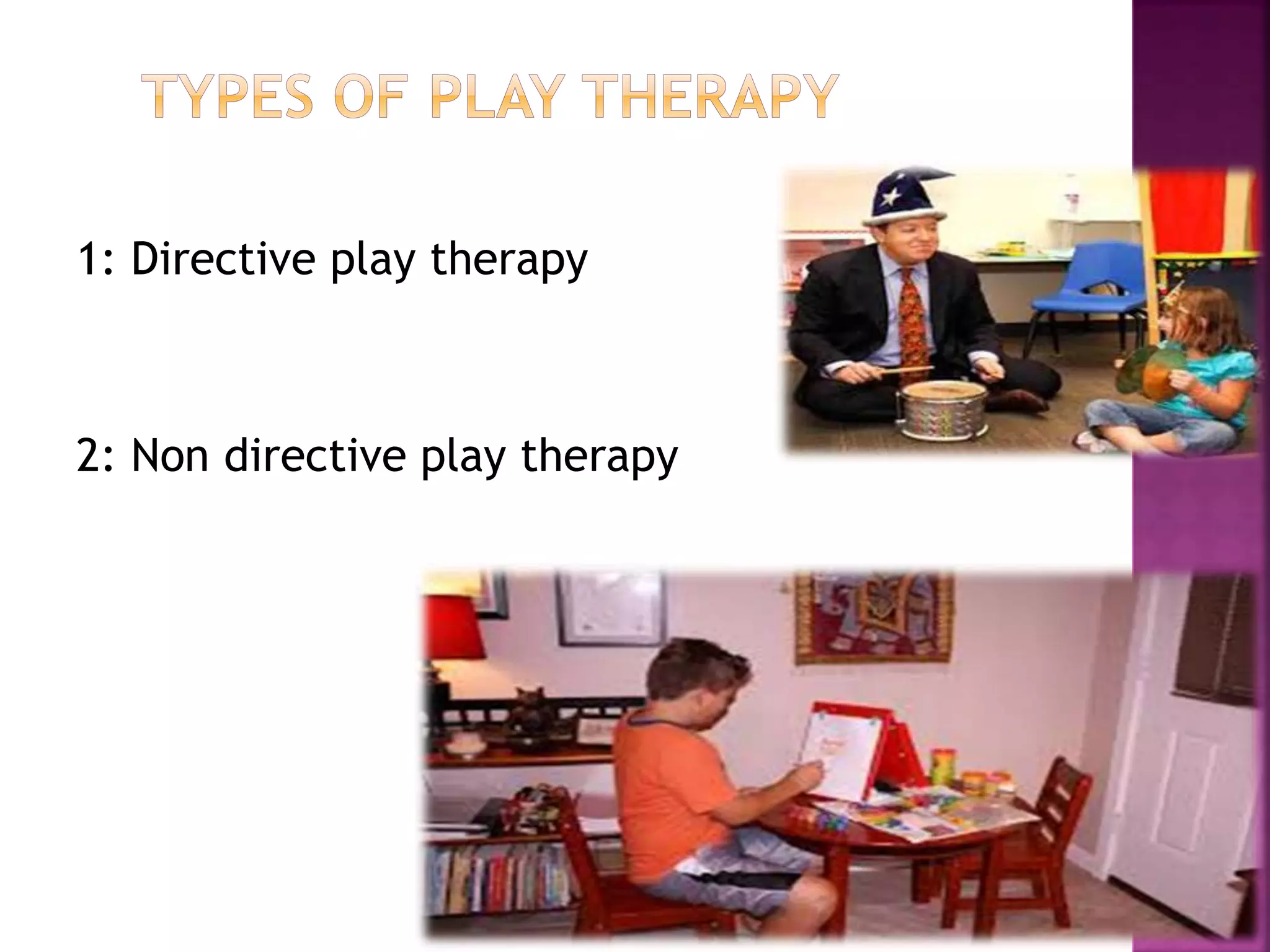
 It is a form of counseling or psychotherapy
that uses play to communicate with and help
people, especially children, to prevent or
resolve psychosocial challenges.
 Play therapy is generally employed with
children aged 3 through 11.
 It provides a way for them to express their
experiences and feelings through a natural,
self-guided, self-healing process.
 Enhance child’s self control, self-concept,
and self-efficacy.
 Help child become aware of his or her
feelings.
 Learn and practice self-control and
alternative behaviors.
 Develop capacity to trust adults.
 Develop capacity to relate to an adult in an
open, positive and caring manner.
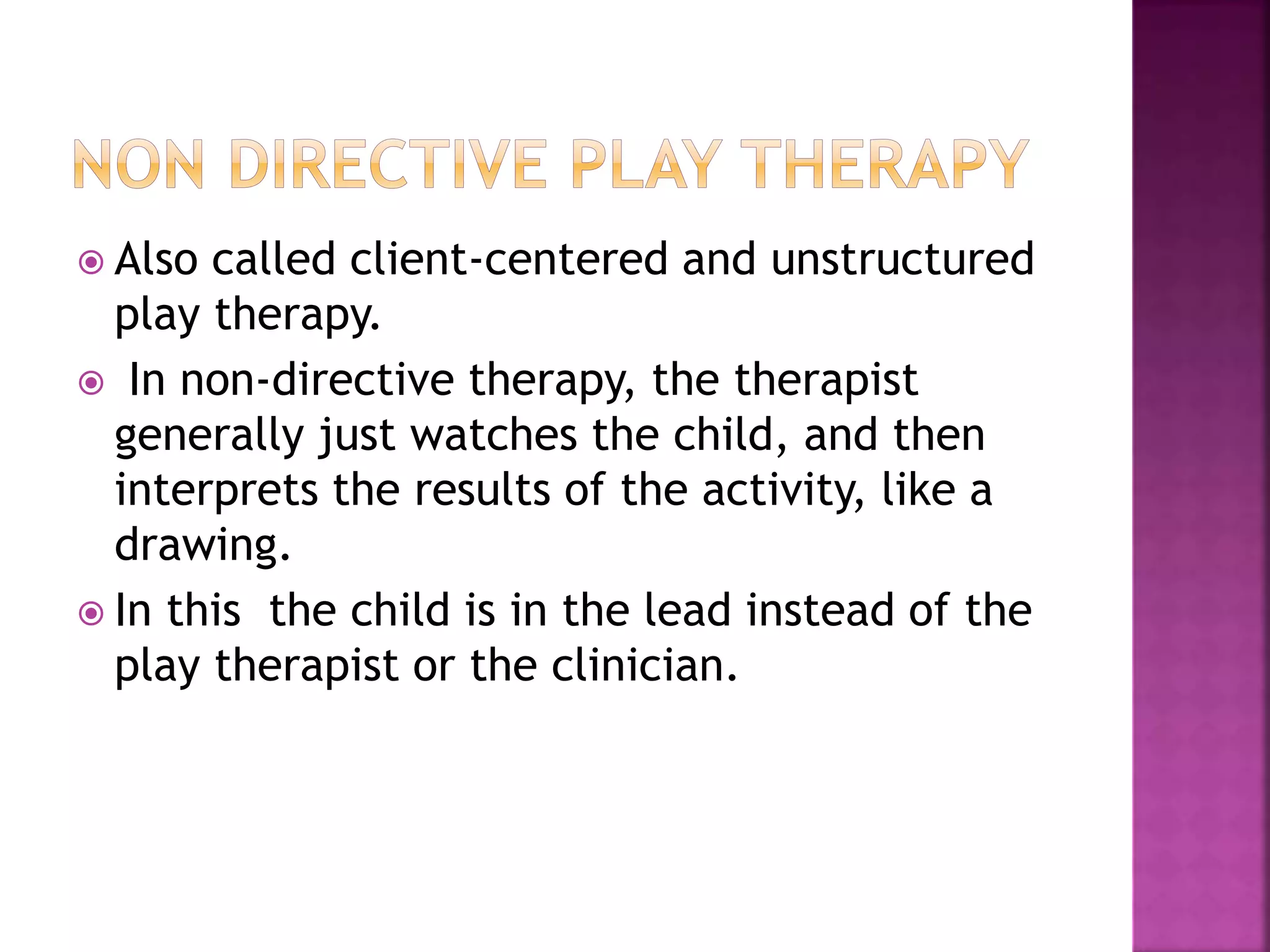
1: Directive play therapy
2: Non directive play therapy
 In directive play therapy, the therapist often
asks the child questions throughout the
session
 encourages him to talk more about certain
topics
 participates in activities with the child.
 Directive therapy is seen as a Cognitive
Behavioral Therapy (CBT), focusing on
behavior and conscious actions.
 Directive therapy is often use
with trauma victims.
 Directed sand tray therapy is more commonly
used with trauma victims.
 Therapists may ask clients questions about their
sand tray
 suggest them to change the sand tray,
 ask them to elaborate on why they chose
particular objects to put in the tray, and on rare
occasions, change the sand tray themselves.
 Roger Phillips, in the early 1980s, was one of
the first to suggest that combining aspects of
cognitive behavioral therapy with play
interventions.
 Cognitive behavioral play therapy was then
developed to be used with very young
children between two and six years of age.
 because children may not have the
developed cognitive abilities necessary for
participation in straight cognitive therapy.
 specific toys such as dolls and stuffed
animals may be used to model particular
cognitive strategies, such as effective coping
mechanisms and problem-solving skills
 Also called client-centered and unstructured
play therapy.
 In non-directive therapy, the therapist
generally just watches the child, and then
interprets the results of the activity, like a
drawing.
 In this the child is in the lead instead of the
play therapist or the clinician.
 given the chance to speak and play freely
under optimal therapeutic conditions.
 troubled children and young people will be
able to resolve their own problems and work
toward their own solutions.
 Using toys in non-directive play therapy with
children is another common method
therapists employ
 children will be better able to express their
feelings toward themselves and their
environment through play with toys than
through verbalization of their feelings.
 Through these actions child may experience
catharsis
 Non-directive therapy is often categorized as
psychodynamic theory.
 It focuses on unconscious actions and
beliefs.
 non-directive therapy may be used to help
with behavioral problems.
 One of the first parent/child play therapy
approaches developed was Filial Therapy
 in which parents are trained to facilitate
nondirective play therapy sessions with their
own children.
 One method is to provide parents/carers
with basic play therapy skills to use at home.
 Sand Tray
 Imaginative Play
 Puppet Play
 Art/Crafts
 Scary toys
Client’s can use these to deal with fears
Plastic monsters, snakes, bugs, bears, lions
 Nurturing Toys
Client’s can use these to play out family
relationships and events
Doll house, dolls, puppets, baby dolls, baby doll
supplies, kitchen set
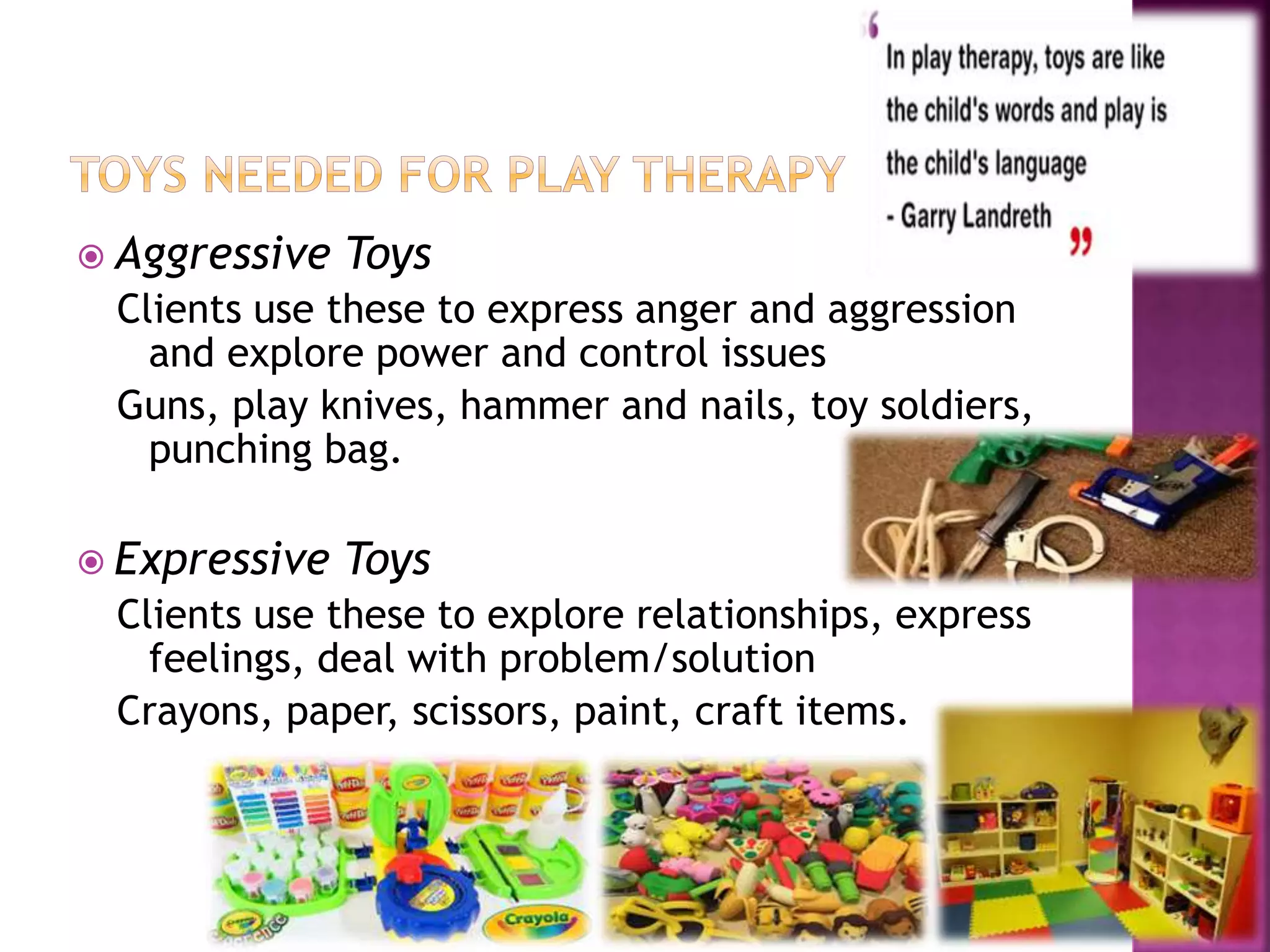
 Aggressive Toys
Clients use these to express anger and aggression
and explore power and control issues
Guns, play knives, hammer and nails, toy soldiers,
punching bag.
 Expressive Toys
Clients use these to explore relationships, express
feelings, deal with problem/solution
Crayons, paper, scissors, paint, craft items.
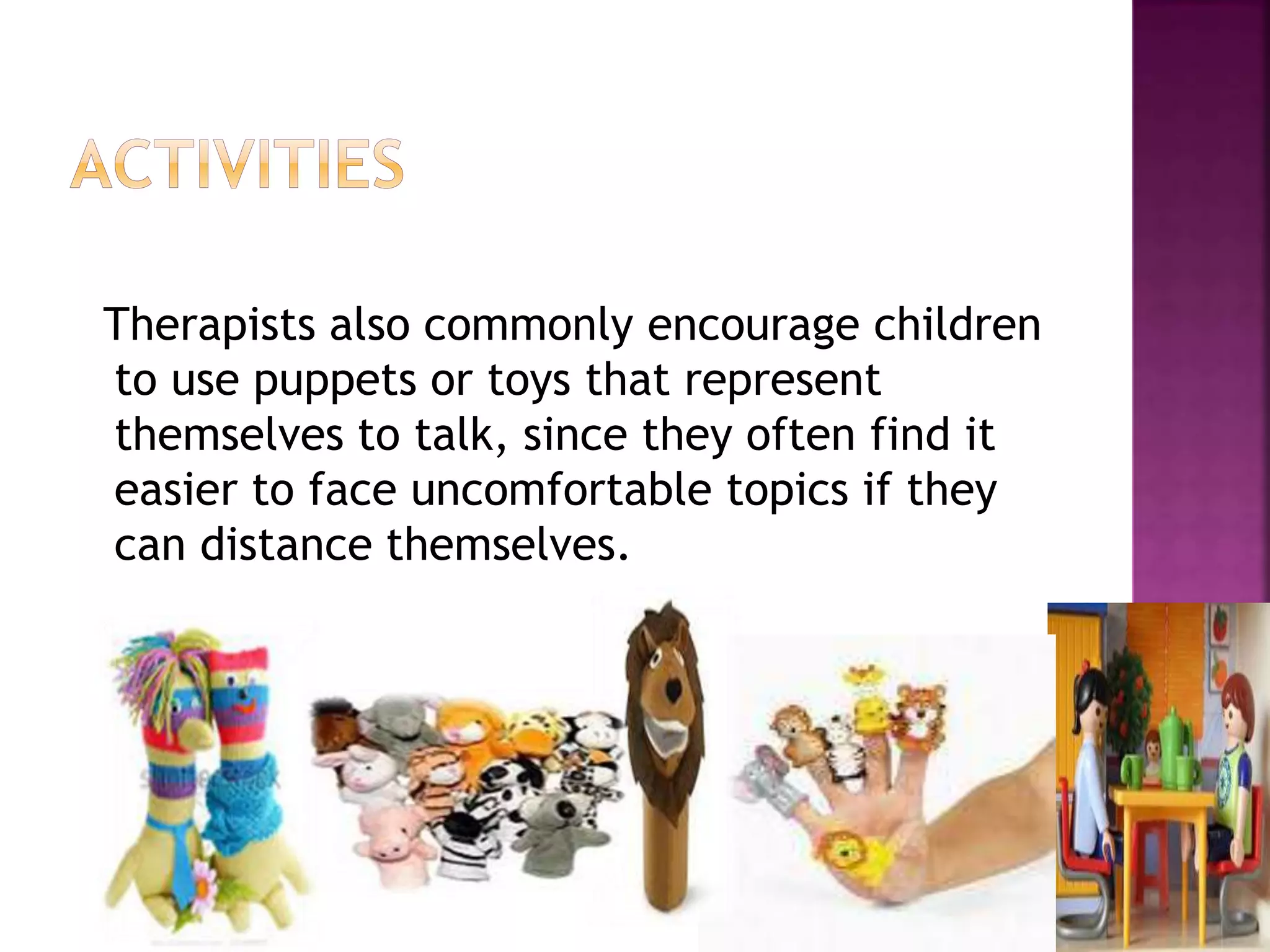
Therapists also commonly encourage children
to use puppets or toys that represent
themselves to talk, since they often find it
easier to face uncomfortable topics if they
can distance themselves.
 In this activity, the therapist and the child
blow bubbles together, and the child learns
to take deep, slow breaths
 just as if he were blowing a big bubble when
he feels anxious.
 Used when child is anxious.
 Therapist become the child friend.
 Therapist creates a safe environment in
which the child can get in touch with who he
is, what he is feeling, thinking, wishing and
dreaming.
 To give the special time.
 To understand their issues and to explore
their abilities.
Play therapy

Play therapy

  • 1.
  • 2.
    Play therapy refersto a method of psychotherapy with children in which a therapist uses a child's fantasies and the symbolic meanings of his or her play as a medium for understanding and communication with the child. To resolve psychological difficulties and achieve optimal growth and development. (Association for Play Therapy Board, March 1997)
  • 3.
     It isa form of counseling or psychotherapy that uses play to communicate with and help people, especially children, to prevent or resolve psychosocial challenges.  Play therapy is generally employed with children aged 3 through 11.  It provides a way for them to express their experiences and feelings through a natural, self-guided, self-healing process.
  • 4.
     Enhance child’sself control, self-concept, and self-efficacy.  Help child become aware of his or her feelings.  Learn and practice self-control and alternative behaviors.  Develop capacity to trust adults.  Develop capacity to relate to an adult in an open, positive and caring manner.
  • 5.
    1: Directive playtherapy 2: Non directive play therapy
  • 6.
     In directiveplay therapy, the therapist often asks the child questions throughout the session  encourages him to talk more about certain topics  participates in activities with the child.  Directive therapy is seen as a Cognitive Behavioral Therapy (CBT), focusing on behavior and conscious actions.
  • 7.
     Directive therapyis often use with trauma victims.  Directed sand tray therapy is more commonly used with trauma victims.  Therapists may ask clients questions about their sand tray  suggest them to change the sand tray,  ask them to elaborate on why they chose particular objects to put in the tray, and on rare occasions, change the sand tray themselves.
  • 8.
     Roger Phillips,in the early 1980s, was one of the first to suggest that combining aspects of cognitive behavioral therapy with play interventions.  Cognitive behavioral play therapy was then developed to be used with very young children between two and six years of age.  because children may not have the developed cognitive abilities necessary for participation in straight cognitive therapy.
  • 9.
     specific toyssuch as dolls and stuffed animals may be used to model particular cognitive strategies, such as effective coping mechanisms and problem-solving skills
  • 10.
     Also calledclient-centered and unstructured play therapy.  In non-directive therapy, the therapist generally just watches the child, and then interprets the results of the activity, like a drawing.  In this the child is in the lead instead of the play therapist or the clinician.
  • 11.
     given thechance to speak and play freely under optimal therapeutic conditions.  troubled children and young people will be able to resolve their own problems and work toward their own solutions.  Using toys in non-directive play therapy with children is another common method therapists employ
  • 12.
     children willbe better able to express their feelings toward themselves and their environment through play with toys than through verbalization of their feelings.  Through these actions child may experience catharsis  Non-directive therapy is often categorized as psychodynamic theory.  It focuses on unconscious actions and beliefs.  non-directive therapy may be used to help with behavioral problems.
  • 13.
     One ofthe first parent/child play therapy approaches developed was Filial Therapy  in which parents are trained to facilitate nondirective play therapy sessions with their own children.  One method is to provide parents/carers with basic play therapy skills to use at home.
  • 14.
     Sand Tray Imaginative Play  Puppet Play  Art/Crafts
  • 15.
     Scary toys Client’scan use these to deal with fears Plastic monsters, snakes, bugs, bears, lions  Nurturing Toys Client’s can use these to play out family relationships and events Doll house, dolls, puppets, baby dolls, baby doll supplies, kitchen set
  • 16.
     Aggressive Toys Clientsuse these to express anger and aggression and explore power and control issues Guns, play knives, hammer and nails, toy soldiers, punching bag.  Expressive Toys Clients use these to explore relationships, express feelings, deal with problem/solution Crayons, paper, scissors, paint, craft items.
  • 17.
    Therapists also commonlyencourage children to use puppets or toys that represent themselves to talk, since they often find it easier to face uncomfortable topics if they can distance themselves.
  • 18.
     In thisactivity, the therapist and the child blow bubbles together, and the child learns to take deep, slow breaths  just as if he were blowing a big bubble when he feels anxious.  Used when child is anxious.
  • 19.
     Therapist becomethe child friend.  Therapist creates a safe environment in which the child can get in touch with who he is, what he is feeling, thinking, wishing and dreaming.  To give the special time.  To understand their issues and to explore their abilities.