ETHNOGRAPHIC RESEARCHIts uses
What is Ethnographic Research?Ethnographic research is an attempt to obtain a holistic picture as possible of a particular society, group, institution, setting or situation.There are a variety of approaches used in this type of research.  The key tools are all ethnographic studies are in-depth interviewing and on-going participant observation of a situation.  The emphasis is on documenting and portraying the individual experiences of individuals by observing them or by interview in order to get the “whole picture.”
Ethnographic ConceptsThese are needed to guide the researcher in making his work and reaching conclusions which are:Culture – according to behaviorists it is the sum of the social group’s observable pattern of behavior, customs and way of life.  It is also the logical cohesive pattern in the myriad often ritualistic behavior and ideas of a groupThe interpretation of culture is considered by many a primary contribution of ethnographic research
Holistic perspectiveIn conducting research, one must consider the important background of the subject such as social structure, beliefs, politics, symbols, rituals and the environmentDeveloping a holistic example demands that the researcher spends a great time out in the field gathering all kinds of data.
ContextualizationThis is a process in which the data should fit the background of the findings.For example a school administrator recommended the termination of an after school tutoring project because of low attendance at 50% it was found out that 50% was a good figure since the students who attended were those who failed in the lessons.
“Emic” perspectiveThis is called the “insider’s” perspective.Behaviors can be easily understood by researchers if they are in the “inside” of the research area.There are what is called “multiple realities” which are allowed to be seen by the subject.
Thick DescriptionWhen researchers prepare their reports they engage in thick description which involves describing things that hey have seen and heard in the field. In thick description thick detail is mentioned
Number checkingA major objective of ethnographic research is to represent as accurately as possible an emic perspective of reality.This is done by number checking in which the participants review what the researchers have written to check for accuracy and completeness
Non-judgmental orientationHere the researchers do their best to refrain from making value judgment about the unfamiliar practices.  Though none of us can be completely neutral, we must guard against the most obvious biases.
Do Ethnographic Researchers Use Concepts?
Topics that can use ethnographic researchThose by their very nature defy quantification i.e.  Interaction of students and teachers in classroom discussionThose that can be best understood in their natural rather than artificial stateThose involving study of formal organization in their totality i.e. Schools, school districts, etc.Those that involve study of activity i.e. Classes, athletic teams, administrative units, etc.Those that involve study of individuals or groups over time. i.e. Changes of student attitudes, reading programs, school programs, etc.Those that study behaviors and roles. i.e. Attitude of school newly-hired teachers, new students, etc.
Data Collection in Ethnographic ResearchSamplingNo researcher however can sample everything and can only observe a segment of the populationHe has to make a representative of the population.
Data Analysis in Ethnographic ResearchSome researchers propose hypotheses to predict results in advance.But rather they should address it with an open-ended problem.  i.e. What is the attitude of first-year students in this schoolDescriptions should be better described as portrayals and data collected should include dedtailed prose descriptions.The researchers aim to paint of a portrait of a school or classroom as thoroughly as possible
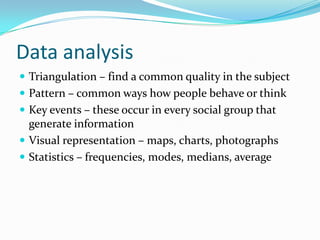
Data analysis Triangulation – find a common quality in the subjectPattern – common ways how people behave or thinkKey events – these occur in every social group that generate informationVisual representation – maps, charts, photographsStatistics – frequencies, modes, medians, average
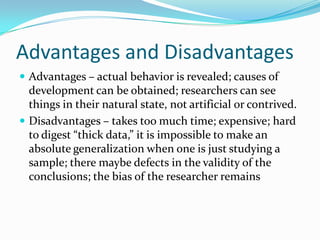
Advantages and DisadvantagesAdvantages – actual behavior is revealed; causes of development can be obtained; researchers can see things in their natural state, not artificial or contrived.Disadvantages – takes too much time; expensive; hard to digest “thick data,” it is impossible to make an absolute generalization when one is just studying a sample; there maybe defects in the validity of the conclusions; the bias of the researcher remains
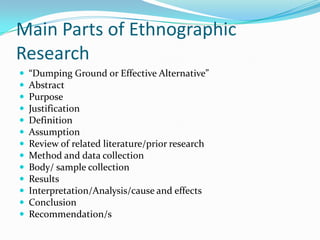
Main Parts of Ethnographic Research“Dumping Ground or Effective Alternative”AbstractPurposeJustificationDefinitionAssumptionReview of related literature/prior researchMethod and data collectionBody/ sample collectionResultsInterpretation/Analysis/cause and effectsConclusionRecommendation/s

Ethnographic research

  • 1.
  • 2.
    What is EthnographicResearch?Ethnographic research is an attempt to obtain a holistic picture as possible of a particular society, group, institution, setting or situation.There are a variety of approaches used in this type of research. The key tools are all ethnographic studies are in-depth interviewing and on-going participant observation of a situation. The emphasis is on documenting and portraying the individual experiences of individuals by observing them or by interview in order to get the “whole picture.”
  • 3.
    Ethnographic ConceptsThese areneeded to guide the researcher in making his work and reaching conclusions which are:Culture – according to behaviorists it is the sum of the social group’s observable pattern of behavior, customs and way of life. It is also the logical cohesive pattern in the myriad often ritualistic behavior and ideas of a groupThe interpretation of culture is considered by many a primary contribution of ethnographic research
  • 4.
    Holistic perspectiveIn conductingresearch, one must consider the important background of the subject such as social structure, beliefs, politics, symbols, rituals and the environmentDeveloping a holistic example demands that the researcher spends a great time out in the field gathering all kinds of data.
  • 5.
    ContextualizationThis is aprocess in which the data should fit the background of the findings.For example a school administrator recommended the termination of an after school tutoring project because of low attendance at 50% it was found out that 50% was a good figure since the students who attended were those who failed in the lessons.
  • 6.
    “Emic” perspectiveThis iscalled the “insider’s” perspective.Behaviors can be easily understood by researchers if they are in the “inside” of the research area.There are what is called “multiple realities” which are allowed to be seen by the subject.
  • 7.
    Thick DescriptionWhen researchersprepare their reports they engage in thick description which involves describing things that hey have seen and heard in the field. In thick description thick detail is mentioned
  • 8.
    Number checkingA majorobjective of ethnographic research is to represent as accurately as possible an emic perspective of reality.This is done by number checking in which the participants review what the researchers have written to check for accuracy and completeness
  • 9.
    Non-judgmental orientationHere theresearchers do their best to refrain from making value judgment about the unfamiliar practices. Though none of us can be completely neutral, we must guard against the most obvious biases.
  • 10.
  • 11.
    Topics that canuse ethnographic researchThose by their very nature defy quantification i.e. Interaction of students and teachers in classroom discussionThose that can be best understood in their natural rather than artificial stateThose involving study of formal organization in their totality i.e. Schools, school districts, etc.Those that involve study of activity i.e. Classes, athletic teams, administrative units, etc.Those that involve study of individuals or groups over time. i.e. Changes of student attitudes, reading programs, school programs, etc.Those that study behaviors and roles. i.e. Attitude of school newly-hired teachers, new students, etc.
  • 12.
    Data Collection inEthnographic ResearchSamplingNo researcher however can sample everything and can only observe a segment of the populationHe has to make a representative of the population.
  • 13.
    Data Analysis inEthnographic ResearchSome researchers propose hypotheses to predict results in advance.But rather they should address it with an open-ended problem. i.e. What is the attitude of first-year students in this schoolDescriptions should be better described as portrayals and data collected should include dedtailed prose descriptions.The researchers aim to paint of a portrait of a school or classroom as thoroughly as possible
  • 14.
    Data analysis Triangulation– find a common quality in the subjectPattern – common ways how people behave or thinkKey events – these occur in every social group that generate informationVisual representation – maps, charts, photographsStatistics – frequencies, modes, medians, average
  • 15.
    Advantages and DisadvantagesAdvantages– actual behavior is revealed; causes of development can be obtained; researchers can see things in their natural state, not artificial or contrived.Disadvantages – takes too much time; expensive; hard to digest “thick data,” it is impossible to make an absolute generalization when one is just studying a sample; there maybe defects in the validity of the conclusions; the bias of the researcher remains
  • 16.
    Main Parts ofEthnographic Research“Dumping Ground or Effective Alternative”AbstractPurposeJustificationDefinitionAssumptionReview of related literature/prior researchMethod and data collectionBody/ sample collectionResultsInterpretation/Analysis/cause and effectsConclusionRecommendation/s