Semi-structured interview
Things to keep in mind
while conducting an
interview…
Ernesto Correa. Colegio Seminario. Skills.
Information taken from Massey University research materials.
www.massey.ac.nz
Remember?
• A key feature of the semi-structured interview is
in the partial pre-planning of the questions.
• Semi-structured interviews still allow for
replication of the interview with others, but are
be less controlled.
• Semi-structured interviews may be conducted in
various modes: face-to-face, by telephone,
videophone... but face-to face is probably best.
• A great deal of qualitative research uses semi-
structured interview material.
Benefits of the semi-structured interview
• The primary advantage of in-depth interviews is
that they provide much more detailed
information than what is available through
other data collection methods, such as surveys.
• They also may provide a more relaxed
atmosphere in which to collect information—
people may feel more comfortable having a
conversation with you as opposed to filling out a
survey.
◦ What else can you imagine?
Limitations of in-depth interviews
• The use of an occasional spontaneous question
makes the answers difficult to quantify and
analyse.
• Can be time consuming.
• The interviewer must be cap able of performing
reliable interviews.
• Not suitable for generalizations.
• Prone to possible bias
Do NOT forget that…
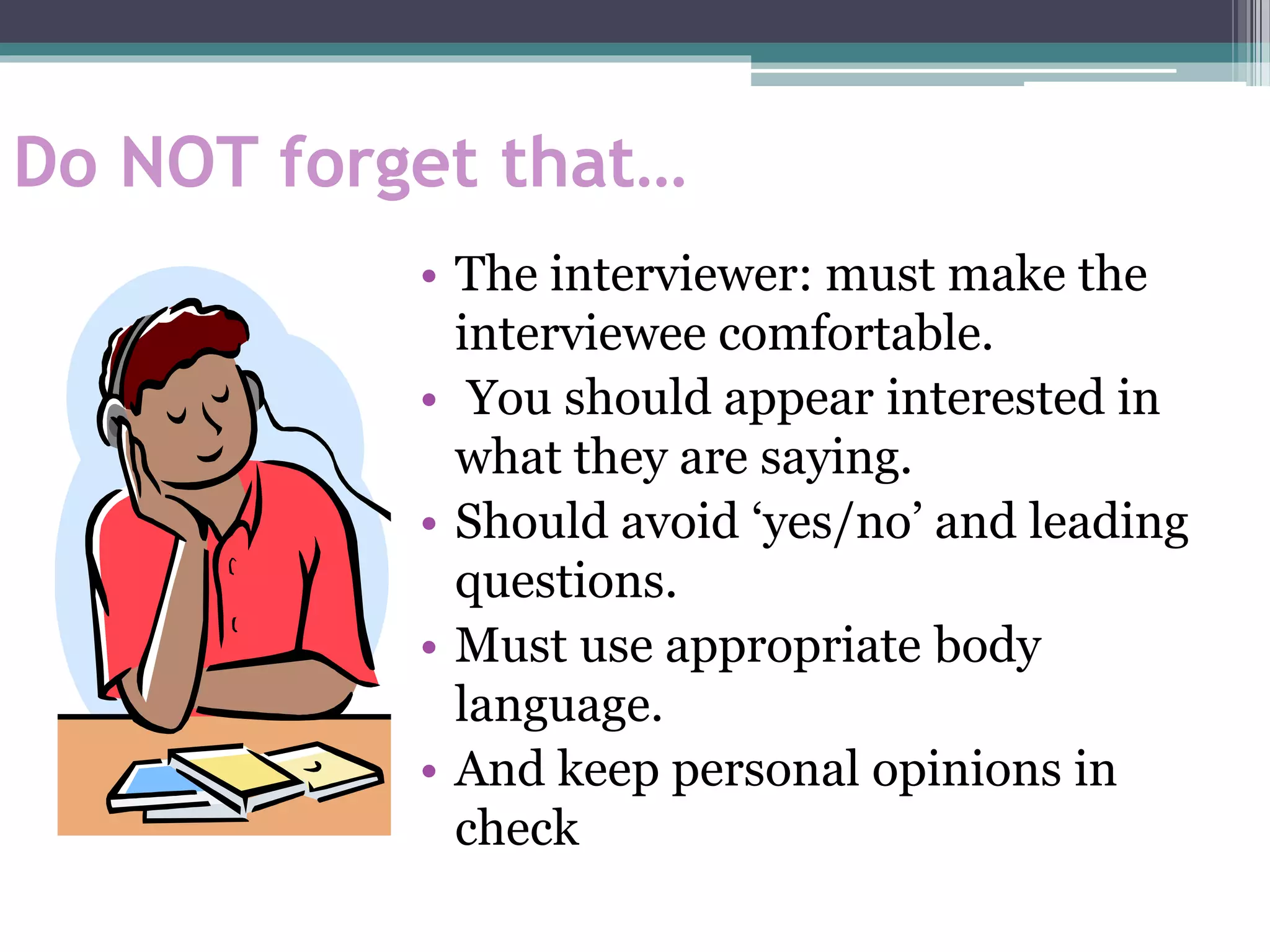
• The interviewer: must make the
interviewee comfortable.
• You should appear interested in
what they are saying.
• Should avoid ‘yes/no’ and leading
questions.
• Must use appropriate body
language.
• And keep personal opinions in
check
Always think about…
• Seek understanding and
interpretation...
• Try to interpret what you are hearing,
as well as seek clarity and a deeper
understanding from the respondent
throughout the interview.
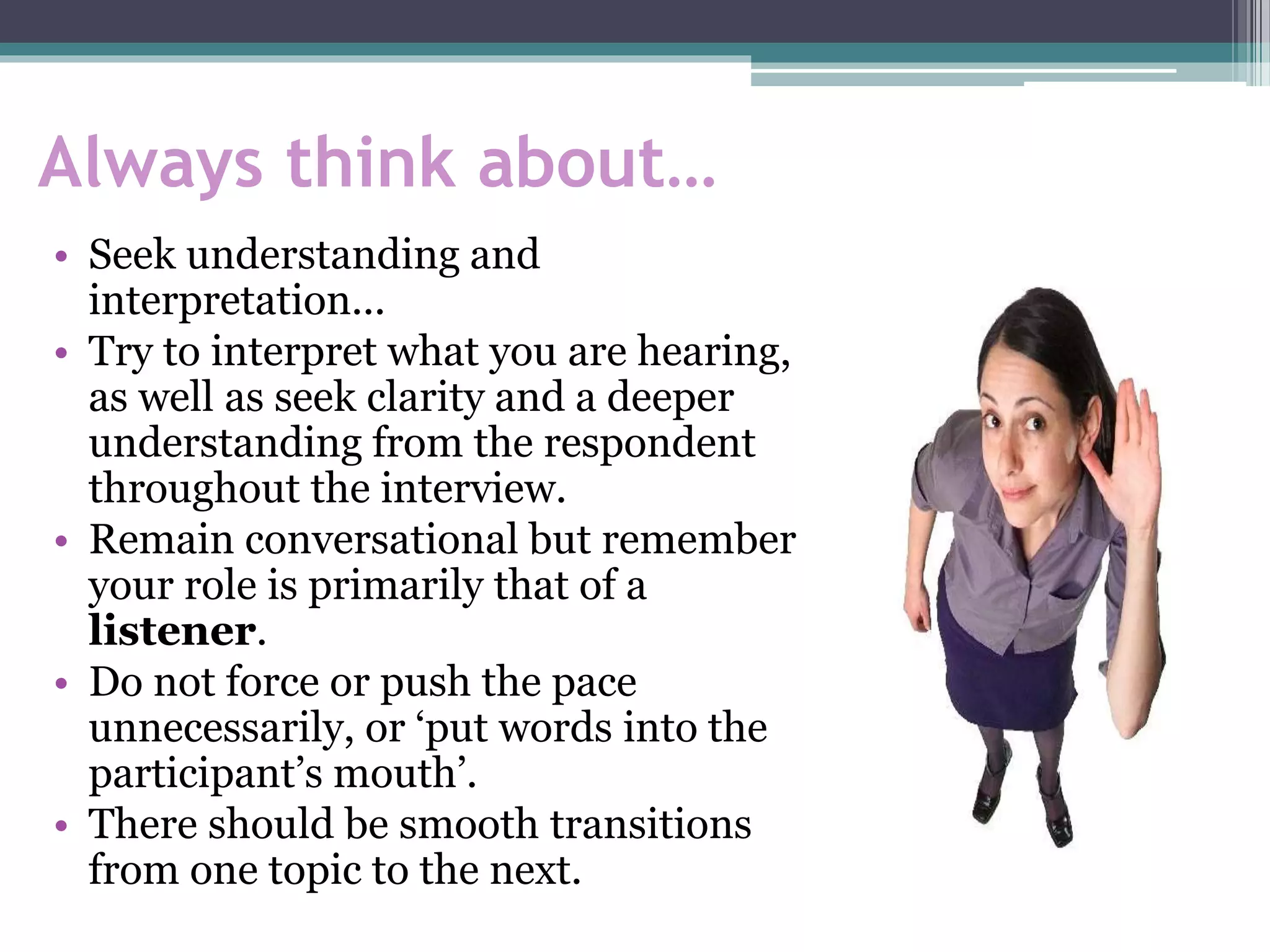
• Remain conversational but remember
your role is primarily that of a
listener.
• Do not force or push the pace
unnecessarily, or ‘put words into the
participant’s mouth’.
• There should be smooth transitions
from one topic to the next.
Keep in mind that…
1. Background noises can really affect the quality of
any recording.
2. Faulty recording equipment can be disastrous.
3. People often say some very interesting things after
the recording device has been turned off.
4. Not every session will last the full amount of time.
5. What is not said may sometimes be of considerable
interest in an interview.
6. Participant body and facial gestures, pauses,
silence, laughter can be of interest.
7. Transcribing is a lot of hard work.
8. Good transcribers are worth their weight in gold.

Semi structured interview

  • 1.
    Semi-structured interview Things tokeep in mind while conducting an interview… Ernesto Correa. Colegio Seminario. Skills. Information taken from Massey University research materials. www.massey.ac.nz
  • 2.
    Remember? • A keyfeature of the semi-structured interview is in the partial pre-planning of the questions. • Semi-structured interviews still allow for replication of the interview with others, but are be less controlled. • Semi-structured interviews may be conducted in various modes: face-to-face, by telephone, videophone... but face-to face is probably best. • A great deal of qualitative research uses semi- structured interview material.
  • 3.
    Benefits of thesemi-structured interview • The primary advantage of in-depth interviews is that they provide much more detailed information than what is available through other data collection methods, such as surveys. • They also may provide a more relaxed atmosphere in which to collect information— people may feel more comfortable having a conversation with you as opposed to filling out a survey. ◦ What else can you imagine?
  • 4.
    Limitations of in-depthinterviews • The use of an occasional spontaneous question makes the answers difficult to quantify and analyse. • Can be time consuming. • The interviewer must be cap able of performing reliable interviews. • Not suitable for generalizations. • Prone to possible bias
  • 5.
    Do NOT forgetthat… • The interviewer: must make the interviewee comfortable. • You should appear interested in what they are saying. • Should avoid ‘yes/no’ and leading questions. • Must use appropriate body language. • And keep personal opinions in check
  • 6.
    Always think about… •Seek understanding and interpretation... • Try to interpret what you are hearing, as well as seek clarity and a deeper understanding from the respondent throughout the interview. • Remain conversational but remember your role is primarily that of a listener. • Do not force or push the pace unnecessarily, or ‘put words into the participant’s mouth’. • There should be smooth transitions from one topic to the next.
  • 7.
    Keep in mindthat… 1. Background noises can really affect the quality of any recording. 2. Faulty recording equipment can be disastrous. 3. People often say some very interesting things after the recording device has been turned off. 4. Not every session will last the full amount of time. 5. What is not said may sometimes be of considerable interest in an interview. 6. Participant body and facial gestures, pauses, silence, laughter can be of interest. 7. Transcribing is a lot of hard work. 8. Good transcribers are worth their weight in gold.