s
Data Collection and
Analysis Procedures
Qualitative data is descriptive rather than
numerical, and it looks for context — it’s about
people’s perceptions. You gather it to understand
the reasons and motivations that drive certain
behavior.
For example, qualitative data can reveal people’s
feelings and opinions about your organization,
and you can use it to determine why customers
buy your products (or don’t).
Based on the research paradigm and the chosen
research design, there are a series of data
generation methods that can be be used. Here
are few:
A. Interviews
B. Questionnaires
C. Observations
D. Document Collection
A. Interviews
 It is a data collection strategy in which
participants are asked to talk about the area
under consideration.
 Interviews can be used to investigate sensitive
issues.
A. Interviews
 Interviews can explore emotions, experiences
or feelings that cannot be easily observed or
described through pre-defined questionnaire
responses.
 Interviews are widely used in
phenomenologies, case studies
and ethnographies.
Kinds of of Interviews
a. Unstructured/ in-depth the researcher asks
the respondent a general queston regarding
the area of interest and asks them to tell their
own story; aims to discuss a limited number of
topics in great depth.
Kinds of of Interviews
b. Semi-structured- the interviewer has a slightly
more focused. Questions are phrased to allow
the particpants to tell, the story in their own
way and an interview guide is used to ensure
information is gathered on areas
of interest to the researcher.
Kinds of of Interviews
c. Structured- an interiew in which the questions
are pre-determined and asked to all subjects.
Closed questions are used with limited
response
choises.
Kinds of of Interviews
d. Focus groups- interviews of groups of people
with something in common. Focus groups are
used to encit the views ot a group (usually
around
6 to 10 individuals) who have
common experiences or interests.
B. Questionnaires
 A questionnaire is a predefined set of
questions, assembled in a pre-determined
order. Questionnaires are frequently
associated with surveys,
but they are used in interviews
as well.
B. Questionnaires
 Questionnaires are handy when the researcher
is trying to collect information from large
numbers of people.
Who Answers the Questionnaires?
 Questionnaires can be:
1. Self-administered
2. Researcher administered
The question content and wording,
together with the order of the
questions, are extremely important.
Adapting or getting inspiration from
- existing questionnaires mignt
prove very useful.
Characteristics of the Question
 According to (Peterson, 2000), each question
should be:
1. Brief
2. Relevant
3. Unambiguous
4. Specific
5. Objective
There are basically 2 question types:
1. Open questions (a blank space is left for
respondents to fill)
2. Closed questions (a pre-defined range of
answers is provided)
What is the Format of Questions and
Responses?
1. Yes/ No answers
2. Quantity questions
3. Agree/ Disagree with a statement
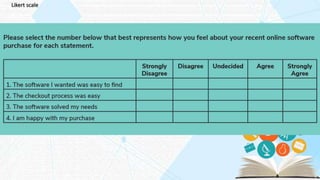
4. Degree ot agreement/ Disagreement- Likert
scale
What is the Format of Questions and
Responses?
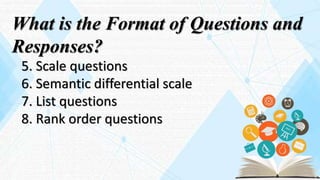
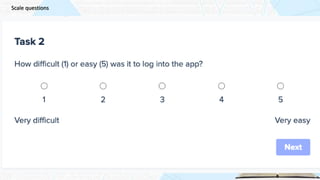
5. Scale questions
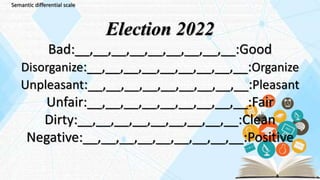
6. Semantic differential scale
7. List questions
8. Rank order questions
Likert scale
Scale questions
Election 2022
Bad:__,__,__,__,__,__,__,__,__:Good
Disorganize:__,__,__,__,__,__,__,__,__:Organize
Unpleasant:__,__,__,__,__,__,__,__,__:Pleasant
Unfair:__,__,__,__,__,__,__,__,__:Fair
Dirty:__,__,__,__,__,__,__,__,__:Clean
Negative:__,__,__,__,__,__,__,__,__:Positive
Semantic differential scale
C. Observation
 Observation can be used within any research
strategy. Observation can take various shapes
and use difterent senses and/or equipment.
C. Observation
 Observation can be used within any research
strategy. Observation can take various shapes
and use difterent senses and/or equipment.
1. Participant Observation
 The researcher takes part in the situation
under study, in order to experience life from
the perspective ot participants.
1. Participant Observation
 It requires that the researcher becomes a
participant in the culture or context being
observed.
1. Participant Observation
 Participant observation often requires months
or years of intensive work because the
researcher needs to become accepted as a
natural
part of the culture in order to
assure that the observations
are of the natural phenomenon.
2. Systematic or Direct Observation
1. The type of events to be observed, the
frequency and duration are decided in
advance;
2. Systematic observation usually involves
counting or timing,
so it leads to the generation
of quantitative data;
2. Systematic or Direct Observation
3. Using an observation schedule from the
literature might prove useful;
4. Multiple observers can work on the study,
if they are properly trained and use a
common observation schedule
D. Document Collection
 Document collection is used in historical
research and in other research designs in
combination with other ways or data
collection.
D. Document Collection
 Found Documents: Produced by
Organizations
1. Formal records: personnel, sales records,
shareholder reports, minutes of the
meeting
2. Intormal communications:
notes, memos, email
D. Document Collection
 Found Documents: Produced by
Organizations
1. Public records: electoral registers, registers
ot births, marriages,
and deaths
D. Document Collection
 Found Documents: Produced by Individuals
1. Personal papers: diaries, logs, letters, phone
texts, emails
2. Documents from everyday
lives: shopping lists, bus,
and train tickets.
D. Document Collection
 Found Documents:
- Publications
- Secondary Data
- Multimedia
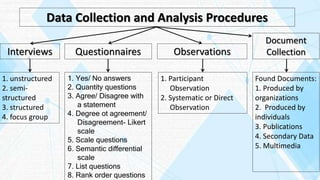
Data Collection and Analysis Procedures
Interviews Questionnaires
Document
Collection
Observations
1. unstructured
2. semi-
structured
3. structured
4. focus group
1. Yes/ No answers
2. Quantity questions
3. Agree/ Disagree with
a statement
4. Degree ot agreement/
Disagreement- Likert
scale
5. Scale questions
6. Semantic differential
scale
7. List questions
8. Rank order questions
1. Participant
Observation
2. Systematic or Direct
Observation
Found Documents:
1. Produced by
organizations
2. Produced by
individuals
3. Publications
4. Secondary Data
5. Multimedia
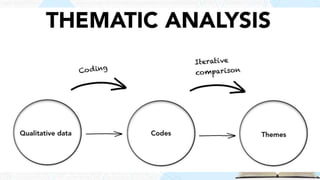
Systems for Analysis of Qualitative
Data Involving Language
1. Content analysis is a research tool used to
determine the presence of certain words,
themes, or concepts
within some given qualitative
data (i.e. text).
2. In grounded analysis, you do not start from a
defined point. Instead, you allow the data to
‘speak for itself’, with themes emerging from
the discussions and conversations. This may
be
much harder to achieve.
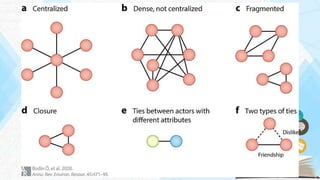
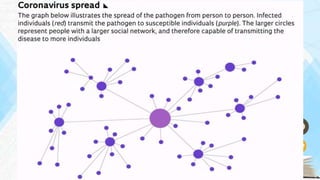
3. Social Network Analysis. This form of analysis
examines the links between individuals as a
way of understanding what motivates
behaviour. It’s often helpful to use a visual
approach to kind of analysis to generate a
diagram showing the relation
between members of a network.
4. Discourse Analysis. This approach not only
analyses conversation, but also takes into
account the social context in which the
conversation occurs, including previous
conversations, power relationships and the
concept of individual identity.

5. Narrative Analysis. This looks at the way in
which stories are told within an organisation
or society to try to understand more about
the way in which people think and are
organised within groups.
6. Conversation Analysis. It assumes that
conversations are all governed by rules and
patterns which remain the same whoever is
talking. It also assumes that what is said can
only be understood by looking at what went
before and after.
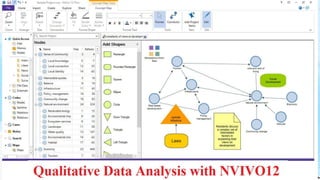
7. Computer-Aided Analysis. There are many
computer packages designed to support and assist
with the analysis of qualitative (language-based)
data, these include NVivo, Atlas.ti and the like. They
are widely used to analyse large quantities of data,
reducing the pressure on a
researcher to read and code
everything him- or herself.
Characteristics of Good Data-Collection Instrument
 concise but able to elicit the needed data
 seeks information that cannot be obtained
from other sources
 questions are arranged in
sequence (simple to complex)
 questions are arranged according to SOP
(statement of the problem) should pass the
validity and reliability easily tabulated and
interpreted
Guidelines in Writing
Research Methodology
Methodology in research is defined as the
systematic method to resolve a research problem
through data gathering using various techniques,
providing an interpretation of data gathered and
drawing conclusions about the
research data.
Writing Your Research Paper Methodology
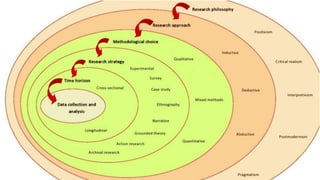
Saunders et al. (2007) proposed the concept of the
research onion model to help researchers develop a
methodology and construct a research design within
the field of future studies.
Writing Your Research Paper Methodology
This research onion model has six main layers,
which serve as a step-by-step guide for
researchers to create and organize their
research methodology.
g
Writing Effective Methodology Section
 Introduce your methods.
 Establish methodological connection.
 Introduce your instruments.
 Discuss your analysis.
 Provide background information.
 Discuss sampling process.
 Address research limitations.
Ethical Considerations
 The rights to privacy of the individuals
involved.
 The nature of participation in the research
must be voluntary and the individuals
involved must have the right to withdraw
partially or completely from the process.
Ethical Considerations
 All participants must provide their consent
first.
 Maintenance of the confidentiality of data
provided by individuals as well as identifiable
participants’ anonymity.
Ethical Considerations
 How participants react to the researchers’
methods in seeking to collect data.
 How the participants will be affected by the
way in which data is
analyzed and reported.
 The behavior and objectivity
of the researcher.

1Data Collection and Analysis Procedures .pptx

  • 5.
  • 6.
  • 7.
    Qualitative data isdescriptive rather than numerical, and it looks for context — it’s about people’s perceptions. You gather it to understand the reasons and motivations that drive certain behavior.
  • 8.
    For example, qualitativedata can reveal people’s feelings and opinions about your organization, and you can use it to determine why customers buy your products (or don’t).
  • 9.
    Based on theresearch paradigm and the chosen research design, there are a series of data generation methods that can be be used. Here are few: A. Interviews B. Questionnaires C. Observations D. Document Collection
  • 10.
    A. Interviews  Itis a data collection strategy in which participants are asked to talk about the area under consideration.  Interviews can be used to investigate sensitive issues.
  • 11.
    A. Interviews  Interviewscan explore emotions, experiences or feelings that cannot be easily observed or described through pre-defined questionnaire responses.  Interviews are widely used in phenomenologies, case studies and ethnographies.
  • 12.
    Kinds of ofInterviews a. Unstructured/ in-depth the researcher asks the respondent a general queston regarding the area of interest and asks them to tell their own story; aims to discuss a limited number of topics in great depth.
  • 13.
    Kinds of ofInterviews b. Semi-structured- the interviewer has a slightly more focused. Questions are phrased to allow the particpants to tell, the story in their own way and an interview guide is used to ensure information is gathered on areas of interest to the researcher.
  • 14.
    Kinds of ofInterviews c. Structured- an interiew in which the questions are pre-determined and asked to all subjects. Closed questions are used with limited response choises.
  • 15.
    Kinds of ofInterviews d. Focus groups- interviews of groups of people with something in common. Focus groups are used to encit the views ot a group (usually around 6 to 10 individuals) who have common experiences or interests.
  • 16.
    B. Questionnaires  Aquestionnaire is a predefined set of questions, assembled in a pre-determined order. Questionnaires are frequently associated with surveys, but they are used in interviews as well.
  • 17.
    B. Questionnaires  Questionnairesare handy when the researcher is trying to collect information from large numbers of people.
  • 18.
    Who Answers theQuestionnaires?  Questionnaires can be: 1. Self-administered 2. Researcher administered
  • 19.
    The question contentand wording, together with the order of the questions, are extremely important. Adapting or getting inspiration from - existing questionnaires mignt prove very useful.
  • 20.
    Characteristics of theQuestion  According to (Peterson, 2000), each question should be: 1. Brief 2. Relevant 3. Unambiguous 4. Specific 5. Objective
  • 21.
    There are basically2 question types: 1. Open questions (a blank space is left for respondents to fill) 2. Closed questions (a pre-defined range of answers is provided)
  • 22.
    What is theFormat of Questions and Responses? 1. Yes/ No answers 2. Quantity questions 3. Agree/ Disagree with a statement 4. Degree ot agreement/ Disagreement- Likert scale
  • 23.
    What is theFormat of Questions and Responses? 5. Scale questions 6. Semantic differential scale 7. List questions 8. Rank order questions
  • 24.
  • 25.
  • 26.
  • 27.
    C. Observation  Observationcan be used within any research strategy. Observation can take various shapes and use difterent senses and/or equipment.

  • 28.
    C. Observation  Observationcan be used within any research strategy. Observation can take various shapes and use difterent senses and/or equipment.
  • 29.
    1. Participant Observation The researcher takes part in the situation under study, in order to experience life from the perspective ot participants.
  • 30.
    1. Participant Observation It requires that the researcher becomes a participant in the culture or context being observed.
  • 31.
    1. Participant Observation Participant observation often requires months or years of intensive work because the researcher needs to become accepted as a natural part of the culture in order to assure that the observations are of the natural phenomenon.
  • 32.
    2. Systematic orDirect Observation 1. The type of events to be observed, the frequency and duration are decided in advance; 2. Systematic observation usually involves counting or timing, so it leads to the generation of quantitative data;
  • 33.
    2. Systematic orDirect Observation 3. Using an observation schedule from the literature might prove useful; 4. Multiple observers can work on the study, if they are properly trained and use a common observation schedule
  • 34.
    D. Document Collection Document collection is used in historical research and in other research designs in combination with other ways or data collection.
  • 35.
    D. Document Collection Found Documents: Produced by Organizations 1. Formal records: personnel, sales records, shareholder reports, minutes of the meeting 2. Intormal communications: notes, memos, email
  • 36.
    D. Document Collection Found Documents: Produced by Organizations 1. Public records: electoral registers, registers ot births, marriages, and deaths
  • 37.
    D. Document Collection Found Documents: Produced by Individuals 1. Personal papers: diaries, logs, letters, phone texts, emails 2. Documents from everyday lives: shopping lists, bus, and train tickets.
  • 38.
    D. Document Collection Found Documents: - Publications - Secondary Data - Multimedia
  • 40.
    Data Collection andAnalysis Procedures Interviews Questionnaires Document Collection Observations 1. unstructured 2. semi- structured 3. structured 4. focus group 1. Yes/ No answers 2. Quantity questions 3. Agree/ Disagree with a statement 4. Degree ot agreement/ Disagreement- Likert scale 5. Scale questions 6. Semantic differential scale 7. List questions 8. Rank order questions 1. Participant Observation 2. Systematic or Direct Observation Found Documents: 1. Produced by organizations 2. Produced by individuals 3. Publications 4. Secondary Data 5. Multimedia
  • 41.
    Systems for Analysisof Qualitative Data Involving Language 1. Content analysis is a research tool used to determine the presence of certain words, themes, or concepts within some given qualitative data (i.e. text).
  • 42.
    2. In groundedanalysis, you do not start from a defined point. Instead, you allow the data to ‘speak for itself’, with themes emerging from the discussions and conversations. This may be much harder to achieve.
  • 43.
    3. Social NetworkAnalysis. This form of analysis examines the links between individuals as a way of understanding what motivates behaviour. It’s often helpful to use a visual approach to kind of analysis to generate a diagram showing the relation between members of a network.
  • 46.
    4. Discourse Analysis.This approach not only analyses conversation, but also takes into account the social context in which the conversation occurs, including previous conversations, power relationships and the concept of individual identity.
  • 47.
    5. Narrative Analysis.This looks at the way in which stories are told within an organisation or society to try to understand more about the way in which people think and are organised within groups.
  • 48.
    6. Conversation Analysis.It assumes that conversations are all governed by rules and patterns which remain the same whoever is talking. It also assumes that what is said can only be understood by looking at what went before and after.
  • 54.
    7. Computer-Aided Analysis.There are many computer packages designed to support and assist with the analysis of qualitative (language-based) data, these include NVivo, Atlas.ti and the like. They are widely used to analyse large quantities of data, reducing the pressure on a researcher to read and code everything him- or herself.
  • 57.
    Characteristics of GoodData-Collection Instrument  concise but able to elicit the needed data  seeks information that cannot be obtained from other sources  questions are arranged in sequence (simple to complex)
  • 58.
     questions arearranged according to SOP (statement of the problem) should pass the validity and reliability easily tabulated and interpreted
  • 60.
  • 61.
    Methodology in researchis defined as the systematic method to resolve a research problem through data gathering using various techniques, providing an interpretation of data gathered and drawing conclusions about the research data.
  • 62.
    Writing Your ResearchPaper Methodology Saunders et al. (2007) proposed the concept of the research onion model to help researchers develop a methodology and construct a research design within the field of future studies.
  • 63.
    Writing Your ResearchPaper Methodology This research onion model has six main layers, which serve as a step-by-step guide for researchers to create and organize their research methodology.
  • 65.
  • 66.
    Writing Effective MethodologySection  Introduce your methods.  Establish methodological connection.  Introduce your instruments.  Discuss your analysis.  Provide background information.  Discuss sampling process.  Address research limitations.
  • 67.
    Ethical Considerations  Therights to privacy of the individuals involved.  The nature of participation in the research must be voluntary and the individuals involved must have the right to withdraw partially or completely from the process.
  • 68.
    Ethical Considerations  Allparticipants must provide their consent first.  Maintenance of the confidentiality of data provided by individuals as well as identifiable participants’ anonymity.
  • 69.
    Ethical Considerations  Howparticipants react to the researchers’ methods in seeking to collect data.  How the participants will be affected by the way in which data is analyzed and reported.  The behavior and objectivity of the researcher.

Editor's Notes

  • #24 https://www.scribbr.com/dissertation/methodology/ https://www.indeed.com/career-advice/career-development/how-to-write-a-methodology
  • #43 because it requires you to put aside what you have read and simply concentrate on the data.
  • #47  because it requires you to put aside what you have read and simply concentrate on the data.
  • #49 This is largely used in ethnographic research.
  • #50 This is largely used in ethnographic research.
  • #51 This is largely used in ethnographic research.
  • #52 This is largely used in ethnographic research.
  • #53 This is largely used in ethnographic research.
  • #54 This is largely used in ethnographic research.
  • #57 Essentially, a research methodology is the blueprint of a research or study.
  • #62 Essentially, a research methodology is the blueprint of a research or study.
  • #63 Essentially, a research methodology is the blueprint of a research or study.
  • #64 Essentially, a research methodology is the blueprint of a research or study.
  • #66 Essentially, a research methodology is the blueprint of a research or study.
  • #67 Essentially, a research methodology is the blueprint of a research or study.
  • #68 Essentially, a research methodology is the blueprint of a research or study.
  • #69 Essentially, a research methodology is the blueprint of a research or study.
  • #70 https://research.com/research/how-to-write-research-methodology