Chapter 7
Qualitative Research Tools
What is Qualitative Business Research?
Research that address business objectives through
techniques that allow the researcher to provide
elaborate interpretations of phenomena without
depending on numerical measurement; its focus
is on discovering true inner meanings and new
insights.
– Qualitative research is less structured than most
quantitative approaches.
– It does not rely on self-response questionnaires
containing structured response formats.
– It is more researcher-dependent
• Research in which the researcher must extract meaning
from unstructured responses such as text from a recorded
interview or a collage representing the meaning of some
experience i.e. skateboarding.
Quantitative Research
Business research that addresses research objectives
through empirical assessment that involve numerical
measurement and analysis.
Uses of Qualitative Research
• The application of qualitative tools can help clear up
ambiguity and provide innovative ideas.
– When it is difficult to develop specific and actionable
problem statements or research objectives. Qualitative
research is often useful to gain further insight and
crystallize the research problem.
– When the emphasis is on a deeper understanding of
phenomena or developing novel concepts, qualitative research is
very appropriate.
– When the objective is to learn how a phenomenon occurs
in a natural setting
– When some behavior the researcher is studying is
particularly context dependent
– When a fresh approach is needed to study some problem.
Qualitative vs Quantitative Research
• Exploratory
• Broad range of questioning
• Small sample size
• Subjective interpretation
– Results are researcher
dependent, meaning
different researchers may
reach different conclusions
based on the same interview.
• Interpretive procedures
that require subjective
judgments
• Descriptive and conclusive
• Structured questions
• Large sample size
• Objective approach i.e.
statistical analysis
– Numeric values are used in
statistical computations and
hypothesis testing. the
number will be the same no
matter what researcher is
involved in the analysis.
• Definitive conclusions from
experiments
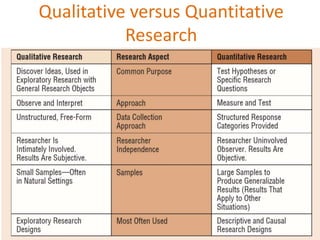
Qualitative versus Quantitative
Research
Exploratory Research
• Initial research conducted to clarify and define
the nature of a problem which does not
provide conclusive evidence
• Subsequent research expected
– When researchers have limited experience or
knowledge about a research issue, exploratory
research is a useful step.
– Exploratory research, which often involves
qualitative methods, can be an essential first step
to a more conclusive, confirmatory study by
reducing the chance of beginning with an
inadequate, incorrect, or misleading set of
research objectives.
Exploratory research
• Secondary data
• Experience survey
• Pilot studies
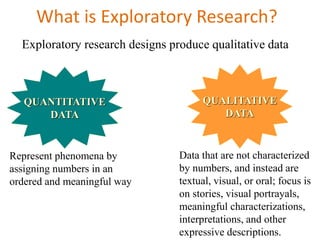
What is Exploratory Research?
QUANTITATIVE
DATA
QUALITATIVE
DATA
Data that are not characterized
by numbers, and instead are
textual, visual, or oral; focus is
on stories, visual portrayals,
meaningful characterizations,
interpretations, and other
expressive descriptions.
Represent phenomena by
assigning numbers in an
ordered and meaningful way
Exploratory research designs produce qualitative data
1. Diagnose a situation
2. Screening of alternatives
3. Discover new ideas
Why Conduct Exploratory
Research?
Orientations to Qualitative Research
• Phenomenology
• Ethnography
• Grounded Theory
• Case Studies
• Phenomenology
– A philosophical approach that focuses on how a
person’s behavior is shaped by the relationship he
or she has with the physical environment, objects,
people, and situations.
• Phenomenological inquiry seeks to describe, reflect
upon, and interpret experiences.
• Researchers with a phenomenological orientation rely
largely on conversational interview tools.
Orientations to Qualitative Research
• Ethnography
– Ethnography represents ways of studying cultures
through methods that involve becoming highly
active within that culture.
• Participant-observation typifies an ethnographic
research approach.
• Observation means the researcher becomes immersed
within the culture that he or she is studying and draws
data from his or her observations.
Orientations to Qualitative Research
• Grounded theory
– Grounded theory represents an inductive
investigation in which the researcher poses
questions about information provided by
respondents or taken from historical records.
• The researcher asks the questions to him or herself and
repeatedly questions the responses to derive deeper
explanations
• Two key questions asked by the grounded theory
researcher are “What is happening here?” and “How is
it different?
Orientations to Qualitative Research
• Case Study Method
– Case studies refer to the documented history of a
particular person, group, organization or event.
– A primary advantage of the case study is that an
entire organization or entity can be investigated in
depth with meticulous attention to detail.
• Intensely investigates one or a few situations similar to
the problem
• Investigate in depth
• Careful study
• May require cooperation
Orientations to Qualitative Research
Common Techniques Used in
Qualitative Research
• Focus group
• Depth Interviews
• Conversation
• Semi-structured Interview
• Word association / Sentence completion
• Observation
• Projective Techniques
• Thematic Apperception Test (T.A.T)
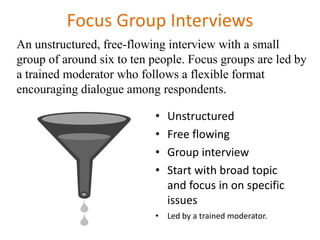
Focus Group Interviews
• Unstructured
• Free flowing
• Group interview
• Start with broad topic
and focus in on specific
issues
• Led by a trained moderator.
An unstructured, free-flowing interview with a small
group of around six to ten people. Focus groups are led by
a trained moderator who follows a flexible format
encouraging dialogue among respondents.
Advantages of Focus Groups
• Relatively fast
– three or four group sessions can be conducted, analyzed, and reported in
a week or so
• Easy to execute
• Allow respondents to piggyback off each other’s ideas
– A procedure where a comment by one individual often triggers a chain
of responses from the other participants
– As this process continues, increasingly creative insights are possible.
• Provide multiple perspectives
– The social nature of the focus group also helps bring out multiple views
as each person shares a particular perspective
• Flexibility to allow more detailed descriptions
– Less structured and doesn’t follow a rigid format therefore, numerous
topics can be discussed and many insights can be gained
• High degree of scrutiny
– the session can be observed by several people including researchers &
decision makers
– focus group sessions are generally recorded on audio or videotape for
later examination
Focus Group Illustration
• Focus groups often are used for concept
screening and concept refinement. The
concept may be continually modified, refined,
and retested until management believes it is
acceptable
Focus Group
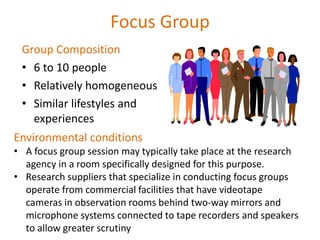
Group Composition
• 6 to 10 people
• Relatively homogeneous
• Similar lifestyles and
experiences
Environmental conditions
• A focus group session may typically take place at the research
agency in a room specifically designed for this purpose.
• Research suppliers that specialize in conducting focus groups
operate from commercial facilities that have videotape
cameras in observation rooms behind two-way mirrors and
microphone systems connected to tape recorders and speakers
to allow greater scrutiny
The Moderator
• Develops rapport - helps
people relax
• Interacts
• Listens to what people have to
say
• Must not interject his or her
own opinions.
• Maintains loose control and
focuses discussion
• Stimulates spontaneous
responses
A person who leads a focus group interview and ensures
that everyone gets a chance to speak and contribute to
the discussion.
Outline for a Focus Group
Discussion guide
– A focus group outline that includes written
introductory comments informing the group
about the focus group purpose and rules and
then outlines topics or questions to be
addressed in the group session.
• Establish a rapport
• Begin with broad topic
• Focus in on specific topic
• Generate discussion and interaction
Disadvantages of
Focus Groups
• Focus groups require objective, sensitive, and
effective moderators. It is very difficult for a
moderator to remain completely objective about
most topics
• Some sampling problems might arise with focus
groups
• Focus groups may not be useful for discussing
sensitive topics if respondents are not familiar
with each other
• Focus groups can be costly
Depth interviews
• A one-one-one interview between a
professional researcher and a respondent
conducted about some relevant business or
social topic.
– Probing questions are critical
Conversations
• An informal data gathering approach in
which the researcher engages a respondent
in a discussion of the relevant subject
matter.
• This approach is almost completely
unstructured
• The goal is to have the respondent produce a
dialogue about his or her experiences.
• Meaning will be extracted from the resulting
dialogue.
Semi-structured Interview
• Semi-structured interviews usually come in
written form and ask respondents for short essay
responses to specific open-ended questions.
– Respondents are free to write as much or as little as
they want
• For example:
– The semi-structured interview began with a free-
association task:
• List the first five things that come into your mind when you
think of a “car salesman.”
– This was followed up with a probing question:
• Describe the way a typical “car salesman” looks.
Word Association/ Free-association
• Subject is presented with a list of words
• Asked to respond with first word that comes to mind
• Or, respondents view an ambiguous figure and are
asked to say the first thing that comes to their mind.
• For example:
– People who smoke are
_______________________________
– A man who smokes a lot is
_______________________________
– Imported cigarette is most liked by
______________________________.
– The woman smoking in the commercial
_______________________________
Observation
• Observation can be a very important
qualitative tool.
• It is keenly advantageous for gaining insight
into things that respondents can not or will
not verbalize.
– Meaning is extracted from field notes.
– Field notes are the researchers’ descriptions of
what actually happens in the field. These notes
then become the text from which meaning is
extracted.
Projective Techniques
• A projective technique is an indirect means of
questioning enabling respondents to project
beliefs and feelings onto a third party, an
inanimate object, or a task situation.
– Word association tests
– Sentence completion method
– Third-person technique
– Role playing
– T.A.T. (Thematic Apperception Test)
Misuse of Qualitative Research
• Lacks objectivity
– Qualitative tools are best applied in exploratory
design, they are likewise limited in the ability to
draw conclusive inferences—test hypotheses.
– One of the biggest drawbacks is the subjectivity
that comes along with “interpretation.”
• Lacks Replication
– The same results and conclusions will be drawn if
the study is repeated by different researchers with
different respondents following the same
methods.

BRM Chapter 7.ppt

  • 1.
  • 2.
    What is QualitativeBusiness Research? Research that address business objectives through techniques that allow the researcher to provide elaborate interpretations of phenomena without depending on numerical measurement; its focus is on discovering true inner meanings and new insights. – Qualitative research is less structured than most quantitative approaches. – It does not rely on self-response questionnaires containing structured response formats. – It is more researcher-dependent • Research in which the researcher must extract meaning from unstructured responses such as text from a recorded interview or a collage representing the meaning of some experience i.e. skateboarding.
  • 3.
    Quantitative Research Business researchthat addresses research objectives through empirical assessment that involve numerical measurement and analysis.
  • 4.
    Uses of QualitativeResearch • The application of qualitative tools can help clear up ambiguity and provide innovative ideas. – When it is difficult to develop specific and actionable problem statements or research objectives. Qualitative research is often useful to gain further insight and crystallize the research problem. – When the emphasis is on a deeper understanding of phenomena or developing novel concepts, qualitative research is very appropriate. – When the objective is to learn how a phenomenon occurs in a natural setting – When some behavior the researcher is studying is particularly context dependent – When a fresh approach is needed to study some problem.
  • 5.
    Qualitative vs QuantitativeResearch • Exploratory • Broad range of questioning • Small sample size • Subjective interpretation – Results are researcher dependent, meaning different researchers may reach different conclusions based on the same interview. • Interpretive procedures that require subjective judgments • Descriptive and conclusive • Structured questions • Large sample size • Objective approach i.e. statistical analysis – Numeric values are used in statistical computations and hypothesis testing. the number will be the same no matter what researcher is involved in the analysis. • Definitive conclusions from experiments
  • 6.
  • 7.
    Exploratory Research • Initialresearch conducted to clarify and define the nature of a problem which does not provide conclusive evidence • Subsequent research expected – When researchers have limited experience or knowledge about a research issue, exploratory research is a useful step. – Exploratory research, which often involves qualitative methods, can be an essential first step to a more conclusive, confirmatory study by reducing the chance of beginning with an inadequate, incorrect, or misleading set of research objectives.
  • 8.
    Exploratory research • Secondarydata • Experience survey • Pilot studies
  • 9.
    What is ExploratoryResearch? QUANTITATIVE DATA QUALITATIVE DATA Data that are not characterized by numbers, and instead are textual, visual, or oral; focus is on stories, visual portrayals, meaningful characterizations, interpretations, and other expressive descriptions. Represent phenomena by assigning numbers in an ordered and meaningful way Exploratory research designs produce qualitative data
  • 10.
    1. Diagnose asituation 2. Screening of alternatives 3. Discover new ideas Why Conduct Exploratory Research?
  • 11.
    Orientations to QualitativeResearch • Phenomenology • Ethnography • Grounded Theory • Case Studies
  • 12.
    • Phenomenology – Aphilosophical approach that focuses on how a person’s behavior is shaped by the relationship he or she has with the physical environment, objects, people, and situations. • Phenomenological inquiry seeks to describe, reflect upon, and interpret experiences. • Researchers with a phenomenological orientation rely largely on conversational interview tools. Orientations to Qualitative Research
  • 13.
    • Ethnography – Ethnographyrepresents ways of studying cultures through methods that involve becoming highly active within that culture. • Participant-observation typifies an ethnographic research approach. • Observation means the researcher becomes immersed within the culture that he or she is studying and draws data from his or her observations. Orientations to Qualitative Research
  • 14.
    • Grounded theory –Grounded theory represents an inductive investigation in which the researcher poses questions about information provided by respondents or taken from historical records. • The researcher asks the questions to him or herself and repeatedly questions the responses to derive deeper explanations • Two key questions asked by the grounded theory researcher are “What is happening here?” and “How is it different? Orientations to Qualitative Research
  • 15.
    • Case StudyMethod – Case studies refer to the documented history of a particular person, group, organization or event. – A primary advantage of the case study is that an entire organization or entity can be investigated in depth with meticulous attention to detail. • Intensely investigates one or a few situations similar to the problem • Investigate in depth • Careful study • May require cooperation Orientations to Qualitative Research
  • 16.
    Common Techniques Usedin Qualitative Research • Focus group • Depth Interviews • Conversation • Semi-structured Interview • Word association / Sentence completion • Observation • Projective Techniques • Thematic Apperception Test (T.A.T)
  • 17.
    Focus Group Interviews •Unstructured • Free flowing • Group interview • Start with broad topic and focus in on specific issues • Led by a trained moderator. An unstructured, free-flowing interview with a small group of around six to ten people. Focus groups are led by a trained moderator who follows a flexible format encouraging dialogue among respondents.
  • 18.
    Advantages of FocusGroups • Relatively fast – three or four group sessions can be conducted, analyzed, and reported in a week or so • Easy to execute • Allow respondents to piggyback off each other’s ideas – A procedure where a comment by one individual often triggers a chain of responses from the other participants – As this process continues, increasingly creative insights are possible. • Provide multiple perspectives – The social nature of the focus group also helps bring out multiple views as each person shares a particular perspective • Flexibility to allow more detailed descriptions – Less structured and doesn’t follow a rigid format therefore, numerous topics can be discussed and many insights can be gained • High degree of scrutiny – the session can be observed by several people including researchers & decision makers – focus group sessions are generally recorded on audio or videotape for later examination
  • 19.
    Focus Group Illustration •Focus groups often are used for concept screening and concept refinement. The concept may be continually modified, refined, and retested until management believes it is acceptable
  • 20.
    Focus Group Group Composition •6 to 10 people • Relatively homogeneous • Similar lifestyles and experiences Environmental conditions • A focus group session may typically take place at the research agency in a room specifically designed for this purpose. • Research suppliers that specialize in conducting focus groups operate from commercial facilities that have videotape cameras in observation rooms behind two-way mirrors and microphone systems connected to tape recorders and speakers to allow greater scrutiny
  • 21.
    The Moderator • Developsrapport - helps people relax • Interacts • Listens to what people have to say • Must not interject his or her own opinions. • Maintains loose control and focuses discussion • Stimulates spontaneous responses A person who leads a focus group interview and ensures that everyone gets a chance to speak and contribute to the discussion.
  • 22.
    Outline for aFocus Group Discussion guide – A focus group outline that includes written introductory comments informing the group about the focus group purpose and rules and then outlines topics or questions to be addressed in the group session. • Establish a rapport • Begin with broad topic • Focus in on specific topic • Generate discussion and interaction
  • 23.
    Disadvantages of Focus Groups •Focus groups require objective, sensitive, and effective moderators. It is very difficult for a moderator to remain completely objective about most topics • Some sampling problems might arise with focus groups • Focus groups may not be useful for discussing sensitive topics if respondents are not familiar with each other • Focus groups can be costly
  • 24.
    Depth interviews • Aone-one-one interview between a professional researcher and a respondent conducted about some relevant business or social topic. – Probing questions are critical
  • 25.
    Conversations • An informaldata gathering approach in which the researcher engages a respondent in a discussion of the relevant subject matter. • This approach is almost completely unstructured • The goal is to have the respondent produce a dialogue about his or her experiences. • Meaning will be extracted from the resulting dialogue.
  • 26.
    Semi-structured Interview • Semi-structuredinterviews usually come in written form and ask respondents for short essay responses to specific open-ended questions. – Respondents are free to write as much or as little as they want • For example: – The semi-structured interview began with a free- association task: • List the first five things that come into your mind when you think of a “car salesman.” – This was followed up with a probing question: • Describe the way a typical “car salesman” looks.
  • 27.
    Word Association/ Free-association •Subject is presented with a list of words • Asked to respond with first word that comes to mind • Or, respondents view an ambiguous figure and are asked to say the first thing that comes to their mind. • For example: – People who smoke are _______________________________ – A man who smokes a lot is _______________________________ – Imported cigarette is most liked by ______________________________. – The woman smoking in the commercial _______________________________
  • 28.
    Observation • Observation canbe a very important qualitative tool. • It is keenly advantageous for gaining insight into things that respondents can not or will not verbalize. – Meaning is extracted from field notes. – Field notes are the researchers’ descriptions of what actually happens in the field. These notes then become the text from which meaning is extracted.
  • 29.
    Projective Techniques • Aprojective technique is an indirect means of questioning enabling respondents to project beliefs and feelings onto a third party, an inanimate object, or a task situation. – Word association tests – Sentence completion method – Third-person technique – Role playing – T.A.T. (Thematic Apperception Test)
  • 30.
    Misuse of QualitativeResearch • Lacks objectivity – Qualitative tools are best applied in exploratory design, they are likewise limited in the ability to draw conclusive inferences—test hypotheses. – One of the biggest drawbacks is the subjectivity that comes along with “interpretation.” • Lacks Replication – The same results and conclusions will be drawn if the study is repeated by different researchers with different respondents following the same methods.