Introduction to
EMBEDDED SYSTEM
(2nd Edition)
SHIBU K V
Dr Moe Moe Myint
Department of Computer Engineering & Information Technology
Mandalay Technological University
www.slideshare.net/MoeMoeMyint
moemoemyint@moemyanmar.ml
moe2myint.mdy@gmail.com
drmoemoemyint.blogspot.com
Agenda
2.1 Core of the Embedded System 17
2.2 Memory 28
2.3 Sensors and Actuators 35
2.4 Communication Interface 45
2.5 Embedded Firmware 59
2.6 Other System Components 60
2.7 PCB and Passive Components 64
2
Mandalay Technological University
Department of Computer Engineering and Information Technology
Learning Objectives
 Learn the building blocks of a typical Embedded System
 Learn about General Purpose Processors (GPPs), Application
Specific Instruction Set Processors (ASIPs), Microprocessors,
Microcontrollers, Digital Signal Processors, RISC & CISC
processors, Harvad and Von-Neumann Processor Architecture, Big-
endian v/s Little endian processors, Load Store operation and
Instruction pipelining
 Learn about different PLDs like Complex Programmable Logic
Devices (CPLDs), Field Programmable Gate Arrays (FPGAs), etc.
3
Mandalay Technological University
Department of Computer Engineering and Information Technology
Cont’d
 Learn about the different memory technologies and memory types used in
embedded system development
 Learn about Masked ROM (MROM), PROM, OTP, EPROM, EEPROM, and
FLASH memory for embedded firmware storage
 Learn about Serial Access Memory (SAM), Static Random Access Memory
(SRAM), Dynamic Random Access Memory (DRAM) and Nonvolatile
SRAM (NVRAM)
 Understand the different factors to be considered in the selection of memory
for embedded systems
 Understand the role of sensors, actuators and their interfacing with the I/O
subsystems of an embedded system
4
Mandalay Technological University
Department of Computer Engineering and Information Technology
Cont’d
 Learn about the interfacing of LEDs, 7-segment LED Displays, Piezo Buzzer,
Stepper Motor, Relays, Optocouplers, Matrix keyboard, Push button switches,
Programmable Peripheral Interface Device (e.g. 8255 PPI), etc. with the I/O
subsystem of the embedded system
 Learn about the different communication interfaces of an embedded system
 Understand the various chip level communication interfaces like I2C, SPI,
UART, 1-wire, parallel bus, etc
 Understand the different wired and wireless external communication interfaces
like RS-232C, RS-485, Parallel Port, USB, IEEE1394, Infrared (IrDA),
Bluetooth, Wifi, ZigBee, GPRS, etc.
 Know what embedded firmware is and its role in embedded systems
5
Mandalay Technological University
Department of Computer Engineering and Information Technology
Cont’d
 Understand the different system components like Reset Circuit,
Brown-out protection circuit, Oscillator Unit, Real-Time Clock
(RTC) and Watchdog Timer unit
 Understand the role of PCB in embedded systems
6
Mandalay Technological University
Department of Computer Engineering and Information Technology
Typical Embedded System
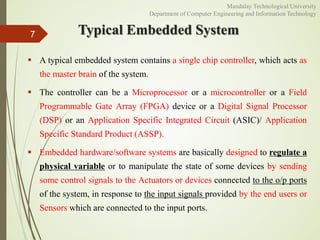
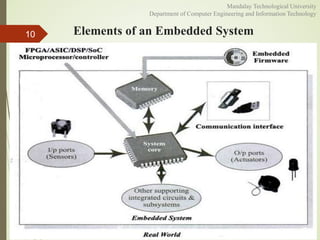
 A typical embedded system contains a single chip controller, which acts as
the master brain of the system.
 The controller can be a Microprocessor or a microcontroller or a Field
Programmable Gate Array (FPGA) device or a Digital Signal Processor
(DSP) or an Application Specific Integrated Circuit (ASIC)/ Application
Specific Standard Product (ASSP).
 Embedded hardware/software systems are basically designed to regulate a
physical variable or to manipulate the state of some devices by sending
some control signals to the Actuators or devices connected to the o/p ports
of the system, in response to the input signals provided by the end users or
Sensors which are connected to the input ports.
7
Mandalay Technological University
Department of Computer Engineering and Information Technology
8
Mandalay Technological University
Department of Computer Engineering and Information Technology
Cont’d
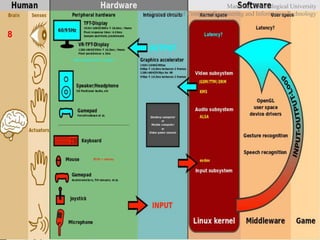
 Keyboards, push button switches, etc. are examples for common
user interface input devices whereas LEDs, liquid crystal displays,
piezoelectric buzzers, etc. are examples for common user interface
output devices for a typical embedded system.
 For example, if the embedded system is designed for any handheld
application, such as a mobile handset application, then the system
should contain user interfaces like a keyboard for performing input
operations and display unit for providing users the status of various
activities in progress.
9
Mandalay Technological University
Department of Computer Engineering and Information Technology
Elements of an Embedded System10
Mandalay Technological University
Department of Computer Engineering and Information Technology
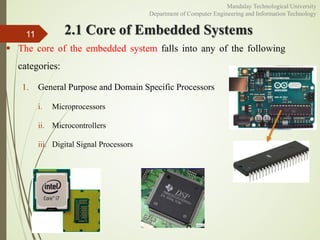
2.1 Core of Embedded Systems
 The core of the embedded system falls into any of the following
categories:
1. General Purpose and Domain Specific Processors
i. Microprocessors
ii. Microcontrollers
iii. Digital Signal Processors
11
Mandalay Technological University
Department of Computer Engineering and Information Technology
Cont’d
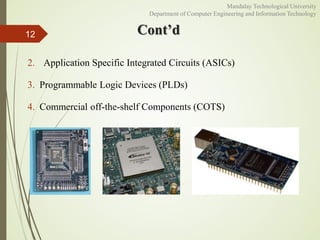
2. Application Specific Integrated Circuits (ASICs)
3. Programmable Logic Devices (PLDs)
4. Commercial off-the-shelf Components (COTS)
12
Mandalay Technological University
Department of Computer Engineering and Information Technology
13
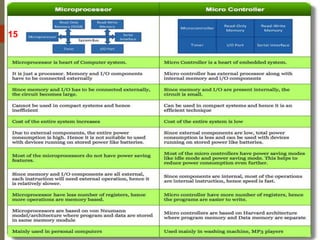
 Microcontrollers are designed to perform specific tasks. However,
Microprocessors are designed to perform unspecific tasks like developing
software, games, website, photo editing, creating documents, etc.
 Depending on the input, some processing for microcontroller needs to be done
and output is defined. However, the relationship between input and output for
microprocessor is not defined.
 Since the applications of microcontroller are very specific, they need small
resources like RAM, ROM, I/O ports etc. and hence can be embedded on a
single chip. Microprocessors need high amount of resources like RAM,
ROM, I/O ports etc.
 The clock speed of Microprocessor is quite high as compared to the
microcontroller. Whereas the microcontrollers operate from a few MHz (from
30 to 50 MHz), today’s microprocessor operate above 1 GHz as they perform
complex tasks.
Merits, Drawbacks and Application Areas of
Microcontrollers and Microprocessors
Mandalay Technological University
Department of Computer Engineering and Information Technology
14
 Microprocessor cannot be used stand alone. They need other peripherals
like RAM, ROM, buffer, I/O ports etc and hence a system designed around a
microprocessor is quite costly.
 Application areas of microcontroller: Mobile phones, CD/DVD players,
Washing machines, Cameras, Security alarms, microwave oven, etc.
 Application areas of microprocessor: Calculators, Accounting Systems,
Games Machine, Complex Industrial Controllers, Data Acquisition Systems,
Military applications, Communication systems, etc.
Cont’d
Mandalay Technological University
Department of Computer Engineering and Information Technology
15
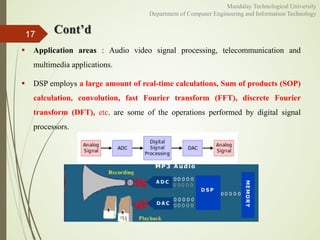
Digital Signal Processors
 DSPs are powerful special purpose 8/16/32 bit microprocessors designed specifically
to meet the computational demands and power constraints of today’s embedded audio,
video, and communications applications.
 Digital signal processors are 2 to 3 times faster than the general purpose
microprocessors in signal processing applications.
 A typical digital signal processor incorporates the following key units:
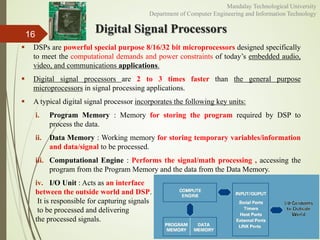
i. Program Memory : Memory for storing the program required by DSP to
process the data.
ii. Data Memory : Working memory for storing temporary variables/information
and data/signal to be processed.
iii. Computational Engine : Performs the signal/math processing , accessing the
program from the Program Memory and the data from the Data Memory.
iv. I/O Unit : Acts as an interface
between the outside world and DSP.
It is responsible for capturing signals
to be processed and delivering
the processed signals.
16
Mandalay Technological University
Department of Computer Engineering and Information Technology
Cont’d
 Application areas : Audio video signal processing, telecommunication and
multimedia applications.
 DSP employs a large amount of real-time calculations, Sum of products (SOP)
calculation, convolution, fast Fourier transform (FFT), discrete Fourier
transform (DFT), etc. are some of the operations performed by digital signal
processors.
17
Mandalay Technological University
Department of Computer Engineering and Information Technology
RISC vs CISC Processors/Controllers
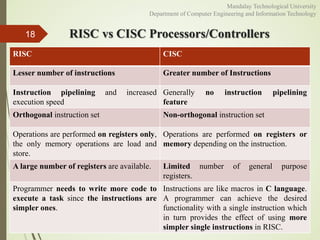
RISC CISC
Lesser number of instructions Greater number of Instructions
Instruction pipelining and increased
execution speed
Generally no instruction pipelining
feature
Orthogonal instruction set Non-orthogonal instruction set
Operations are performed on registers only,
the only memory operations are load and
store.
Operations are performed on registers or
memory depending on the instruction.
A large number of registers are available. Limited number of general purpose
registers.
Programmer needs to write more code to
execute a task since the instructions are
simpler ones.
Instructions are like macros in C language.
A programmer can achieve the desired
functionality with a single instruction which
in turn provides the effect of using more
simpler single instructions in RISC.
18
Mandalay Technological University
Department of Computer Engineering and Information Technology
Cont’d19
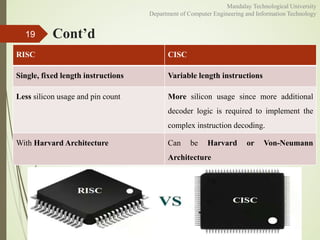
RISC CISC
Single, fixed length instructions Variable length instructions
Less silicon usage and pin count More silicon usage since more additional
decoder logic is required to implement the
complex instruction decoding.
With Harvard Architecture Can be Harvard or Von-Neumann
Architecture
Mandalay Technological University
Department of Computer Engineering and Information Technology
Big-Endian vs. Little-Endian Processors/Controllers
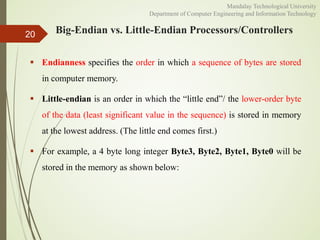
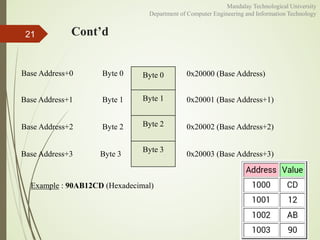
 Endianness specifies the order in which a sequence of bytes are stored
in computer memory.
 Little-endian is an order in which the “little end”/ the lower-order byte
of the data (least significant value in the sequence) is stored in memory
at the lowest address. (The little end comes first.)
 For example, a 4 byte long integer Byte3, Byte2, Byte1, Byte0 will be
stored in the memory as shown below:
20
Mandalay Technological University
Department of Computer Engineering and Information Technology
Cont’d21
Byte 0
Byte 1
Byte 2
Byte 3
Base Address+0
Base Address+1
Base Address+3
Base Address+2
Byte 0
Byte 1
Byte 2
Byte 3
0x20000 (Base Address)
0x20001 (Base Address+1)
0x20002 (Base Address+2)
0x20003 (Base Address+3)
Mandalay Technological University
Department of Computer Engineering and Information Technology
Example : 90AB12CD (Hexadecimal)
Cont’d
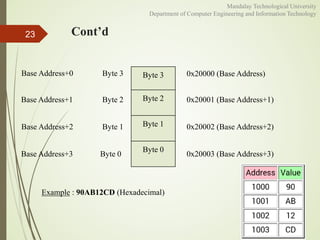
 Big-endian is an order in which the “big end” / the higher-order byte of
the data (most significant value in sequence) is stored in memory at the
lowest address. (The big end comes first.)
 For example, a 4 byte long integer Byte3, Byte2, Byte1, Byte0 will be
stored in the memory as shown below:
22
Mandalay Technological University
Department of Computer Engineering and Information Technology
Cont’d23
Byte 3
Byte 2
Byte 1
Byte 0
Base Address+0
Base Address+1
Base Address+3
Base Address+2
Byte 3
Byte 2
Byte 1
Byte 0
0x20000 (Base Address)
0x20001 (Base Address+1)
0x20002 (Base Address+2)
0x20003 (Base Address+3)
Mandalay Technological University
Department of Computer Engineering and Information Technology
Example : 90AB12CD (Hexadecimal)
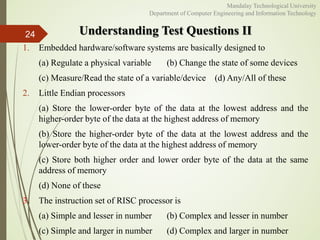
Understanding Test Questions II
1. Embedded hardware/software systems are basically designed to
(a) Regulate a physical variable (b) Change the state of some devices
(c) Measure/Read the state of a variable/device (d) Any/All of these
2. Little Endian processors
(a) Store the lower-order byte of the data at the lowest address and the
higher-order byte of the data at the highest address of memory
(b) Store the higher-order byte of the data at the lowest address and the
lower-order byte of the data at the highest address of memory
(c) Store both higher order and lower order byte of the data at the same
address of memory
(d) None of these
3. The instruction set of RISC processor is
(a) Simple and lesser in number (b) Complex and lesser in number
(c) Simple and larger in number (d) Complex and larger in number
24
Mandalay Technological University
Department of Computer Engineering and Information Technology
Cont’d
4. Which of the following is true about CISC processors?
(a) The instruction set is non-orthogonal
(b) The number of general purpose registers is limited.
(c) Instructions are like macros in C language
(d) Variable length instructions
(e) All of these (f) None of these
5. Which of the following processor architecture supports easier instruction
pipelining?
(a) Harvard (b) Von Neumann (c ) Both of them (d) None of these
6. An integer variable with value 255 is stored in memory location at 0x8000.
The processor word length is 8 bits and the processor is a big endian processor.
The size of integer is considered as 4 bytes in the system. What is the value
held by the memory location 0x8000?
(a) 0 x FF (b) 0 x 00 (c ) 0 x 01 (d) None of these
25
Mandalay Technological University
Department of Computer Engineering and Information Technology
Reviewed Questions II
1. Explain the components of a typical embedded system in detail.
2. Which are the components used as the core of an embedded system?
Explain the merits, drawbacks, if any, and the applications/domains
where they are commonly used.
3. What is the difference between microprocessor and microcontroller?
Explain the role of microprocessors and controllers in embedded
system design?
4. What is Digital Signal Processor (DSP)? Explain the role of DSP in
embedded system design?
5. What is the difference between RISC and CISC processors? Give an
example for each.
6. What is the difference between big-endian and little-endian processors?
Give an example of each.
26
Mandalay Technological University
Department of Computer Engineering and Information Technology
Assignment II
What are the components used as the core of an embedded
system? Among them, explain the merits, drawbacks, if
any, and the applications/ domains of Application Specific
Integrated Circuits (ASICs), Programmable Logic Devices
and Commercial Off-the-Shelf Components (COTS) where
they are commonly used.
Remark: for all groups
Deadline : 26.12.17 (Coming Tuesday)
27
Mandalay Technological University
Department of Computer Engineering and Information Technology
 Only Original Owner has full rights reserved for copied images.
 This PPT is only for fair academic use.
 Coming soon for chapter 2 (2nd portion)
28
Mandalay Technological University
Department of Computer Engineering and Information Technology
29

Introduction to Embedded Systems I: Chapter 2 (1st portion)

  • 1.
    Introduction to EMBEDDED SYSTEM (2ndEdition) SHIBU K V Dr Moe Moe Myint Department of Computer Engineering & Information Technology Mandalay Technological University www.slideshare.net/MoeMoeMyint moemoemyint@moemyanmar.ml moe2myint.mdy@gmail.com drmoemoemyint.blogspot.com
  • 2.
    Agenda 2.1 Core ofthe Embedded System 17 2.2 Memory 28 2.3 Sensors and Actuators 35 2.4 Communication Interface 45 2.5 Embedded Firmware 59 2.6 Other System Components 60 2.7 PCB and Passive Components 64 2 Mandalay Technological University Department of Computer Engineering and Information Technology
  • 3.
    Learning Objectives  Learnthe building blocks of a typical Embedded System  Learn about General Purpose Processors (GPPs), Application Specific Instruction Set Processors (ASIPs), Microprocessors, Microcontrollers, Digital Signal Processors, RISC & CISC processors, Harvad and Von-Neumann Processor Architecture, Big- endian v/s Little endian processors, Load Store operation and Instruction pipelining  Learn about different PLDs like Complex Programmable Logic Devices (CPLDs), Field Programmable Gate Arrays (FPGAs), etc. 3 Mandalay Technological University Department of Computer Engineering and Information Technology
  • 4.
    Cont’d  Learn aboutthe different memory technologies and memory types used in embedded system development  Learn about Masked ROM (MROM), PROM, OTP, EPROM, EEPROM, and FLASH memory for embedded firmware storage  Learn about Serial Access Memory (SAM), Static Random Access Memory (SRAM), Dynamic Random Access Memory (DRAM) and Nonvolatile SRAM (NVRAM)  Understand the different factors to be considered in the selection of memory for embedded systems  Understand the role of sensors, actuators and their interfacing with the I/O subsystems of an embedded system 4 Mandalay Technological University Department of Computer Engineering and Information Technology
  • 5.
    Cont’d  Learn aboutthe interfacing of LEDs, 7-segment LED Displays, Piezo Buzzer, Stepper Motor, Relays, Optocouplers, Matrix keyboard, Push button switches, Programmable Peripheral Interface Device (e.g. 8255 PPI), etc. with the I/O subsystem of the embedded system  Learn about the different communication interfaces of an embedded system  Understand the various chip level communication interfaces like I2C, SPI, UART, 1-wire, parallel bus, etc  Understand the different wired and wireless external communication interfaces like RS-232C, RS-485, Parallel Port, USB, IEEE1394, Infrared (IrDA), Bluetooth, Wifi, ZigBee, GPRS, etc.  Know what embedded firmware is and its role in embedded systems 5 Mandalay Technological University Department of Computer Engineering and Information Technology
  • 6.
    Cont’d  Understand thedifferent system components like Reset Circuit, Brown-out protection circuit, Oscillator Unit, Real-Time Clock (RTC) and Watchdog Timer unit  Understand the role of PCB in embedded systems 6 Mandalay Technological University Department of Computer Engineering and Information Technology
  • 7.
    Typical Embedded System A typical embedded system contains a single chip controller, which acts as the master brain of the system.  The controller can be a Microprocessor or a microcontroller or a Field Programmable Gate Array (FPGA) device or a Digital Signal Processor (DSP) or an Application Specific Integrated Circuit (ASIC)/ Application Specific Standard Product (ASSP).  Embedded hardware/software systems are basically designed to regulate a physical variable or to manipulate the state of some devices by sending some control signals to the Actuators or devices connected to the o/p ports of the system, in response to the input signals provided by the end users or Sensors which are connected to the input ports. 7 Mandalay Technological University Department of Computer Engineering and Information Technology
  • 8.
    8 Mandalay Technological University Departmentof Computer Engineering and Information Technology
  • 9.
    Cont’d  Keyboards, pushbutton switches, etc. are examples for common user interface input devices whereas LEDs, liquid crystal displays, piezoelectric buzzers, etc. are examples for common user interface output devices for a typical embedded system.  For example, if the embedded system is designed for any handheld application, such as a mobile handset application, then the system should contain user interfaces like a keyboard for performing input operations and display unit for providing users the status of various activities in progress. 9 Mandalay Technological University Department of Computer Engineering and Information Technology
  • 10.
    Elements of anEmbedded System10 Mandalay Technological University Department of Computer Engineering and Information Technology
  • 11.
    2.1 Core ofEmbedded Systems  The core of the embedded system falls into any of the following categories: 1. General Purpose and Domain Specific Processors i. Microprocessors ii. Microcontrollers iii. Digital Signal Processors 11 Mandalay Technological University Department of Computer Engineering and Information Technology
  • 12.
    Cont’d 2. Application SpecificIntegrated Circuits (ASICs) 3. Programmable Logic Devices (PLDs) 4. Commercial off-the-shelf Components (COTS) 12 Mandalay Technological University Department of Computer Engineering and Information Technology
  • 13.
    13  Microcontrollers aredesigned to perform specific tasks. However, Microprocessors are designed to perform unspecific tasks like developing software, games, website, photo editing, creating documents, etc.  Depending on the input, some processing for microcontroller needs to be done and output is defined. However, the relationship between input and output for microprocessor is not defined.  Since the applications of microcontroller are very specific, they need small resources like RAM, ROM, I/O ports etc. and hence can be embedded on a single chip. Microprocessors need high amount of resources like RAM, ROM, I/O ports etc.  The clock speed of Microprocessor is quite high as compared to the microcontroller. Whereas the microcontrollers operate from a few MHz (from 30 to 50 MHz), today’s microprocessor operate above 1 GHz as they perform complex tasks. Merits, Drawbacks and Application Areas of Microcontrollers and Microprocessors Mandalay Technological University Department of Computer Engineering and Information Technology
  • 14.
    14  Microprocessor cannotbe used stand alone. They need other peripherals like RAM, ROM, buffer, I/O ports etc and hence a system designed around a microprocessor is quite costly.  Application areas of microcontroller: Mobile phones, CD/DVD players, Washing machines, Cameras, Security alarms, microwave oven, etc.  Application areas of microprocessor: Calculators, Accounting Systems, Games Machine, Complex Industrial Controllers, Data Acquisition Systems, Military applications, Communication systems, etc. Cont’d Mandalay Technological University Department of Computer Engineering and Information Technology
  • 15.
  • 16.
    Digital Signal Processors DSPs are powerful special purpose 8/16/32 bit microprocessors designed specifically to meet the computational demands and power constraints of today’s embedded audio, video, and communications applications.  Digital signal processors are 2 to 3 times faster than the general purpose microprocessors in signal processing applications.  A typical digital signal processor incorporates the following key units: i. Program Memory : Memory for storing the program required by DSP to process the data. ii. Data Memory : Working memory for storing temporary variables/information and data/signal to be processed. iii. Computational Engine : Performs the signal/math processing , accessing the program from the Program Memory and the data from the Data Memory. iv. I/O Unit : Acts as an interface between the outside world and DSP. It is responsible for capturing signals to be processed and delivering the processed signals. 16 Mandalay Technological University Department of Computer Engineering and Information Technology
  • 17.
    Cont’d  Application areas: Audio video signal processing, telecommunication and multimedia applications.  DSP employs a large amount of real-time calculations, Sum of products (SOP) calculation, convolution, fast Fourier transform (FFT), discrete Fourier transform (DFT), etc. are some of the operations performed by digital signal processors. 17 Mandalay Technological University Department of Computer Engineering and Information Technology
  • 18.
    RISC vs CISCProcessors/Controllers RISC CISC Lesser number of instructions Greater number of Instructions Instruction pipelining and increased execution speed Generally no instruction pipelining feature Orthogonal instruction set Non-orthogonal instruction set Operations are performed on registers only, the only memory operations are load and store. Operations are performed on registers or memory depending on the instruction. A large number of registers are available. Limited number of general purpose registers. Programmer needs to write more code to execute a task since the instructions are simpler ones. Instructions are like macros in C language. A programmer can achieve the desired functionality with a single instruction which in turn provides the effect of using more simpler single instructions in RISC. 18 Mandalay Technological University Department of Computer Engineering and Information Technology
  • 19.
    Cont’d19 RISC CISC Single, fixedlength instructions Variable length instructions Less silicon usage and pin count More silicon usage since more additional decoder logic is required to implement the complex instruction decoding. With Harvard Architecture Can be Harvard or Von-Neumann Architecture Mandalay Technological University Department of Computer Engineering and Information Technology
  • 20.
    Big-Endian vs. Little-EndianProcessors/Controllers  Endianness specifies the order in which a sequence of bytes are stored in computer memory.  Little-endian is an order in which the “little end”/ the lower-order byte of the data (least significant value in the sequence) is stored in memory at the lowest address. (The little end comes first.)  For example, a 4 byte long integer Byte3, Byte2, Byte1, Byte0 will be stored in the memory as shown below: 20 Mandalay Technological University Department of Computer Engineering and Information Technology
  • 21.
    Cont’d21 Byte 0 Byte 1 Byte2 Byte 3 Base Address+0 Base Address+1 Base Address+3 Base Address+2 Byte 0 Byte 1 Byte 2 Byte 3 0x20000 (Base Address) 0x20001 (Base Address+1) 0x20002 (Base Address+2) 0x20003 (Base Address+3) Mandalay Technological University Department of Computer Engineering and Information Technology Example : 90AB12CD (Hexadecimal)
  • 22.
    Cont’d  Big-endian isan order in which the “big end” / the higher-order byte of the data (most significant value in sequence) is stored in memory at the lowest address. (The big end comes first.)  For example, a 4 byte long integer Byte3, Byte2, Byte1, Byte0 will be stored in the memory as shown below: 22 Mandalay Technological University Department of Computer Engineering and Information Technology
  • 23.
    Cont’d23 Byte 3 Byte 2 Byte1 Byte 0 Base Address+0 Base Address+1 Base Address+3 Base Address+2 Byte 3 Byte 2 Byte 1 Byte 0 0x20000 (Base Address) 0x20001 (Base Address+1) 0x20002 (Base Address+2) 0x20003 (Base Address+3) Mandalay Technological University Department of Computer Engineering and Information Technology Example : 90AB12CD (Hexadecimal)
  • 24.
    Understanding Test QuestionsII 1. Embedded hardware/software systems are basically designed to (a) Regulate a physical variable (b) Change the state of some devices (c) Measure/Read the state of a variable/device (d) Any/All of these 2. Little Endian processors (a) Store the lower-order byte of the data at the lowest address and the higher-order byte of the data at the highest address of memory (b) Store the higher-order byte of the data at the lowest address and the lower-order byte of the data at the highest address of memory (c) Store both higher order and lower order byte of the data at the same address of memory (d) None of these 3. The instruction set of RISC processor is (a) Simple and lesser in number (b) Complex and lesser in number (c) Simple and larger in number (d) Complex and larger in number 24 Mandalay Technological University Department of Computer Engineering and Information Technology
  • 25.
    Cont’d 4. Which ofthe following is true about CISC processors? (a) The instruction set is non-orthogonal (b) The number of general purpose registers is limited. (c) Instructions are like macros in C language (d) Variable length instructions (e) All of these (f) None of these 5. Which of the following processor architecture supports easier instruction pipelining? (a) Harvard (b) Von Neumann (c ) Both of them (d) None of these 6. An integer variable with value 255 is stored in memory location at 0x8000. The processor word length is 8 bits and the processor is a big endian processor. The size of integer is considered as 4 bytes in the system. What is the value held by the memory location 0x8000? (a) 0 x FF (b) 0 x 00 (c ) 0 x 01 (d) None of these 25 Mandalay Technological University Department of Computer Engineering and Information Technology
  • 26.
    Reviewed Questions II 1.Explain the components of a typical embedded system in detail. 2. Which are the components used as the core of an embedded system? Explain the merits, drawbacks, if any, and the applications/domains where they are commonly used. 3. What is the difference between microprocessor and microcontroller? Explain the role of microprocessors and controllers in embedded system design? 4. What is Digital Signal Processor (DSP)? Explain the role of DSP in embedded system design? 5. What is the difference between RISC and CISC processors? Give an example for each. 6. What is the difference between big-endian and little-endian processors? Give an example of each. 26 Mandalay Technological University Department of Computer Engineering and Information Technology
  • 27.
    Assignment II What arethe components used as the core of an embedded system? Among them, explain the merits, drawbacks, if any, and the applications/ domains of Application Specific Integrated Circuits (ASICs), Programmable Logic Devices and Commercial Off-the-Shelf Components (COTS) where they are commonly used. Remark: for all groups Deadline : 26.12.17 (Coming Tuesday) 27 Mandalay Technological University Department of Computer Engineering and Information Technology
  • 28.
     Only OriginalOwner has full rights reserved for copied images.  This PPT is only for fair academic use.  Coming soon for chapter 2 (2nd portion) 28 Mandalay Technological University Department of Computer Engineering and Information Technology
  • 29.

Editor's Notes

  • #4 Understand the different types of core i.e. processor Understand the difference between microprocessor & microcontroller Understand the classification of processors based on Bus Architecture, Instruction set Architecture, and Endiannes. Have an overview of processors from most simple and cheap to most expensive and complex, powerful Understand what are sensors and actuators, communication interfaces
  • #8 * Microprocessor (e.g Intel 8085) * Microcontroller (e.g Atmega328) * Field Programmable Gate Array (FPGA) device (e.g. Xilinx Spartan) * Digital Signal Processor (DSP) (e.g. Blackfin Processors from Analog Devices) *Application Specific Integrated Circuit (ASIC)/ Application Specific Standard Product (ASSP) (e.g ADE7760 Single Phase Energy Metreing IC from) Analog Devices for energy metering applications)
  • #9 To know sensors and actuators ………
  • #10 No. 1 Explain the components of a typical embedded system in detail.
  • #11 SoC (a System on Chip) Memory ! I/p ports - (System Core ) --- o/p ports ! Other devices
  • #12 Which are the components used as the core of an embedded system? Explain the merits, drawbacks, if any, and the applications/domains where they are commonly used.
  • #14 Specific means applications where the relationship of input and output is defined. Almost 80% of the embedded systems are processor/ controller based.
  • #15 Specific means applications where the relationship of input and output is defined.
  • #16 Microprocessor is a silicon chip representing a central processing unit (CPU), which is capable of performing arithmetic as well as Logical operations according to a pre-defined set of instructions. A microcontroller is a highly integrated chip that contains a CPU, scratchpad RAM, special and general purpose register arrays, on chip ROM/ FLASH memory for program storage, timer and interrupt control units and dedicated I/O ports. 2. Microprocessor >>Limited power saving options compared to microcontrollers Microcontroller >> Includes lot of power saving features. _ Harvard vs. Von-Neumann refers to the processor architecture design
  • #17 (What’s inside a DSP?) The goal of DSPs is usually to measure, filter or compress continuous real-world analog signals. Most general-purpose microprocessors can also execute digital signal processing algorithms successfully, but dedicated DSPs usually have better power efficiency thus they are more suitable in portable devices such as mobile phones because of power consumption constraints. DSPs often use special memory architectures that are able to fetch multiple data or instructions at the same time. What is Digital Signal Processor (DSP)? Explain the role of DSP in embedded system design?
  • #18 - DSP take real-world signals like voice, audio, video, temperature, pressure, or position that have been digitized and then mathematically manipulate them.
  • #19 What is CISC? A complex instruction set computer (CISC) is a computer where single instructions can execute several low-level operations (such as a load from memory, an arithmetic operation, and a memory store) or are capable of multi-step operations or addressing modes within single instructions, as its name suggest “COMPLEX INSTUCTION SET”. What is RISC? A reduced instruction set computer (RISC) is a computer which only use simple instructions that can be divide into multiple instructions which perform low-level operation within single clock cycle, as its name suggest “REDUCED INSTRUCTION SET”. Orthogonal (statistically independent) RISC (Reduced Instruction Set Computing) CISC (Complex Instruction Set Computing) AVR is a family of microcontrollers developed by Atmel beginning in 1996. These are modified Harvard architecture 8-bit RISC single-chip microcontrollers. AVR was one of the first microcontroller families to use on0chip flash memory for program storage, as opposed to one-time programmable ROM, EPROM, or EEPROM used by other microcontrollers at the time. No. 3 Orthogonal ( Allows each instruction to operate on any register and use any addressing mode) Non-orthogonal (All instructions are not allowed to operate on any register and use any addressing mode. It is instruction-specific)
  • #20 What is the difference between RISC and CISC processors ? Give an example for each.
  • #21 Big endian and little endian are terms that describe the order in which a sequences of bytes are stored in computer memory. Big endian is an order in which the “big-end” (most significant value in the sequence) is stored first (at the lowest storage address). Little endian is an order in which the “little end” (least significant value in the sequence ) is stored first. For example, in a big endian computer, the two bytes required for the hexadecimal number 4F52 would be stored as 4F52 in storage (if 4F is stored at storage address 1000, for example, 52 will be at address 1001). In a little endian system, it would be stored as 524F (52 at address 1000, 4F at 1001).
  • #22 90AB12CD (Hexadecimal) In little endian, you store the least significant byte in the smallest address. It would be stored as CD12AB90 (CD at address 1000, 12 at 1001)
  • #24 90AB12CD (Hexadecimal) In big endian, you store the most significant byte in the smallest address.