Downloaded 418 times

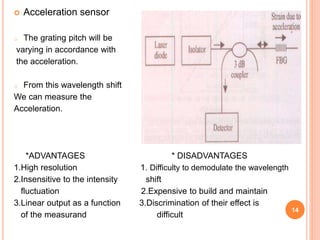
![FBG AS SENSOR
FBG As strain sensor
The shift in wavelength
ΔλB=(1-Pe) λB ε 7.3
Pe = (n2 /2 )[P12-μ(P11+P12)]
were, μ is the poission ratio
of the optical fiber.
ε is the applied strain.
Pe is the photo elastic
coefficient term.
FBG as temperature sensor
It dependence on the Bragg wavelength on temperature
It occurs due to two effect
1:Temperature dependence of the refractive index of the glass
2:Thermal expansion of the glass
13](https://image.slidesharecdn.com/fbgppt-170428063944/85/Fbg-ppt-13-320.jpg)


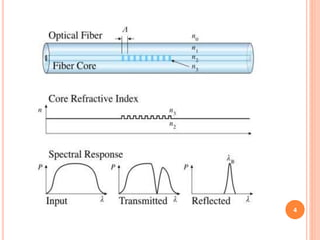
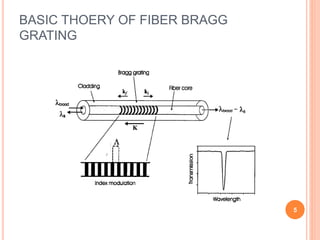
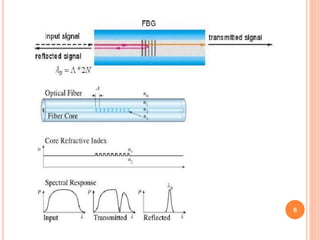
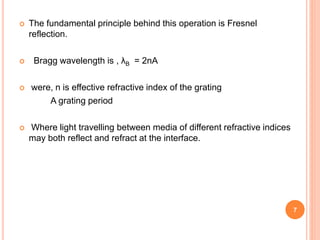
This document discusses fiber Bragg gratings (FBG), which are periodic variations in the refractive index of an optical fiber that reflect specific wavelengths of light. It provides an introduction to FBG, the basic theory behind how they work, common fabrication methods, applications as optical filters and sensors, and their advantages and disadvantages. Key points covered include how the Bragg wavelength is determined by the refractive index and grating period, common types of grating structures, and how FBG can be used as sensors for strain, temperature, and acceleration.


