GPRS
Presented by
Hrudya
Need for GPRS
 Speed
 Immediacy

 New

and better applications
 User friendly billing
History


In 1994, a Special Mobile Group started to think
about a High Speed Data upgrade for GSM.



The first step was HSCSD (High Speed Circuit
Switched Data).




HSCSD is a circuit-switched extension to GSM.

The next step was GPRS.


GPRS is a packet-switched extension to GSM.
What is HSCSD?



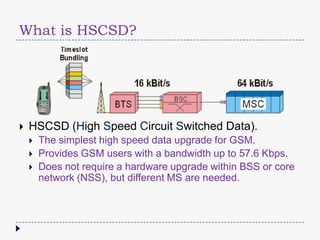
HSCSD (High Speed Circuit Switched Data).




The simplest high speed data upgrade for GSM.
Provides GSM users with a bandwidth up to 57.6 Kbps.
Does not require a hardware upgrade within BSS or core
network (NSS), but different MS are needed.
What is GPRS?




GPRS is a packet oriented data service for IP and
X.25 over GSM networks.
GPRS is a step towards 3G and is often referred to
as 2.5G.
The GPRS network acts in parallel with the GSM
network, providing packet switched connections to
the external networks.
Functions


Traditional mobile communication network +
Traditional packet switched computer network.








Capability to separate circuit switched and packet
switched traffic from mobile station (MS)
Interfaces to Internet, intranets, Public Data Networks
(PDN)
Routing of packets to appropriate destination
Allocation of static or dynamic address for packets
originating from MS
Protection of the GPRS network from security threats

Translation between logical names and IP addresses
using Domain Name System (DNS)
The GPRS network and it’s new
elements.
GPRS Architecture
From GSM to GPRS....



Figure shows the architecture of a GPRS network. The GPRS system
brings some new network elements to an existing GSM network. These
elements are:












Packet Control Unit (PCU)
Serving GPRS Support Node (SGSN): the MSC of the GPRS
network
Gateway GPRS Support Node (GGSN): gateway to external
networks
Border Gateway (BG): a gateway to other PLMN (Public Land
Mobile Network)
Intra-PLMN backbone: an IP based network inter-connecting all
the
GPRS elements
Charging Gateway (CG)
Legal Interception Gateway (LIG)
Domain Name System (DNS)
Firewalls: used wherever a connection to an external network is
required.

Not all of the network elements are compulsory for every GPRS network.
SGSN (Service GPRS Support Node )








The SGSN is the most important element of the GPRS
network.
The SGSN of the GPRS network is equivalent to the MSC of
the GSM network. There must at least one SGSN in a GPRS
network.
There is a coverage area associated with a SGSN. As the
network expands and the number of subscribers increases,
there may be more than one SGSN in a network.
Handles:
 PDP contexts for Mobile Stations.
 Determines Quality of Service assigned to user.
 Routes packets to Mobile Stations.
 “Pages” Mobile Stations when data is to be sent.
 Handover/cell Change


Stores:





Security:





Subscriber data for all Mobile Stations in the location area.
Store not-acknowledged packets in case of a cell change during
an ongoing packet data transfer
Authentication, by means of identity or equipment check.
Data compression is used to minimise the size of transmitted data
units

Charging


The SGSN collects CDR's (Call Data Records) for the use of the
own network resources.
GGSN (Gateway GPRS Support Node)








The GGSN is the gateway to external networks.
Every connection to a fixed external data network
has to go through a GGSN.
The GGSN acts as the anchor point in a GPRS data
connection even when the subscriber moves to
another SGSN during roaming.
There are usually two or more GGSNs in a network
for redundancy purposes, and they back up each
other up in case of failure.
The functions of a GGSN are given below:


Handles:







Stores:




Interconnects a PLMN to the external world (Internet).
Routes IP packets to the appropriate SGSN.
Routing packets originating from a mobile to the correct external
network
Activation and Deactivation of PDP-Contexts / Session
Management.
Subscriber data for active Mobile Stations.

Security:


Interfaces to external IP networks and deals with security issues





Firewall.
Screening.

Charging



The GGSN will, in addition to the SGSN, collect CDRs and forward
them to the charging gateway (CG).
GGSN will collect call data records based on the usage of external
network resources .
Charging Gateway


GPRS users have to be charged for the use of the
network.






In a GSM network, charging is based on the destination,
duration, and time of call.
However, GPRS offers connectionless service to users, so it
not possible to charge subscribers on the connection
duration.
Charging has to be based on the volume, destination, QoS,
and other parameters of a connectionless data transfer.
These GPRS charging data are generated by all the SGSNs
and GGSNs in the network. This data is referred to as
Charging Data Records or CDRs.







One data session may generate a number of CDRs, so
these need to collected and processed.
The Charging Gateway (CG) collects all of these
records, sorts them, processes it, and passes it on to
the Billing System.
The GPRS subscriber is billed for the data transaction.
All CDRs contain unique subscriber and connection
identifiers to distinguish it.
A protocol called GTP„ (pronounced GTP prime) is
used for the transfer of data records between GSNs
and the Charging Gateway.
Border Gateway








The Border Gateway (BG) is a router that can provide a
direct GPRS tunnel between different operators' GPRS
networks. This is referred to as an inter- PLMN data
network.
It is more secure to transfer data between two operators„
PLMN networks through a direct connection rather than
via the public Internet.
The Border Gateway will commence operation once the
GPRS roaming agreements between various operators
have been signed.
It will essentially allow a roaming subscriber to connect to
company intranet through the Home GGSN via the
visiting PLMN network.
Domain Name Servers


These devices convert IP names into IP addresses
for example, server.nokia.com to 133.44.15.5.
Lawful Intercept Gateway



This is for monitoring traffic for law-enforcement
agencies that require court order.
When data packets traverse the GPRS network , it
may be intercepted and forwarded to the agencies.
Packet Control Unit







GPRS cell phone will trasmit data in Packet switched
mode and voice in circuit switched mode .
So there needs to be a network to differenciate the
different kinds of calls and send them to respective core
networks – voice call to MSC and data calls to SGSN.
PCU does this . PCU is placed at the Base station
subsystem (BSS) .
The functions of PCU are





Packet segmentation and reassembly
Access control
Scheduling for all active transmissions including radio channel
management
Controlling transmission for checking, buffering and
retransmission
Classes Of GPRS Equipments




As GPRS users need to handle both voice and data
services, the following classifications are made in the
perspective of GPRS equipment.
Class A.




Class B.




Equipments that handle voice calls and transfer data at
the same time
Equipments that can handle voice or data traffic
separately, and can put a packet transfer on hold to
receive a phone call

Class C.


Equipments that handle voice calls and transfer data , but
has to be disconnected from one mode explicitly inorder
to enable the other
GPRS Interfaces


Gb:






Gr:







Between a SGSN and a BSS.
The Gb interface carries the GPRS traffic and signalling
between the GSM radio network (BSS) and the GPRS network.
Frame Relay based network services is used for this interface.
Between an SGSN and the HLR.
The Gr gives the SGSN access to subscriber information in the
HLR.
The HLR can be located in a different PLMN than the SGSN
(MAP).

Gs:



Between a SGSN and a MSC.
The SGSN can send location data to the MSC or receive
paging requests from the MSC via this optional interface.






Gf:
 Between an SGSN and the EIR.
 The Gf gives the SGSN access to GPRS user equipment
information.
 The EIR maintains three different lists of mobile equipment:
black list for stolen mobiles, grey list for mobiles under
observation and white list for other mobiles .
Gc
 Between the GGSN and the HLR.
 The GGSN may request the location of an MS via this optional
interface.
 The interface can be used if the GGSN needs to forward
packets to an MS that is not active.

Gn


Between two GSNs (GPRS support node) within the same
PLMN. (GP interface is used if they are in different PLMN)
It consist of a protocol stack that includes IP and GPRS
Tunnelling Protocol (GTP)
 GTP has two parts , the GTP-U which is used to carry user
data and GTP-C to carry control data.
Gd:
 Interface connects the SGSN to an SMS gateway , thus
enabling the SGSN to support SMS services.
Gi:
 Is a references rather than an interface.
 It refers to the connection between the GGSN and some
external network
 IPV4, IPV6, and PPP are supported by GGSN
Um:
 Modified air interface between mobile device and the GPRS
network.







GPRS Logical channel


Logical channels in the GPRS network , are divided
into two categories







Traffic channels
Signalling/Control Channels

Logical channels are defined to perform multiple
functions like broadcast , paging , signalling and
payload transport.
They are listed in table
Group

Channel

Function

Direction

Packet Broadcast Control Channel

PBCCH

Broadcast
Control

BSS  MS

Packet Data Traffic Channel

PDTCH

Data traffic
flow

MS BSS

Packet Dedicated Control Channel

PACCH

Associated
Control

MS BSS

PTCCH

Timing Cntrl

PRACH

Random
Access

MS BSS

PAGCH

Access
Grant

MS BSS

PPCH

Paging

MS BSS

PNCH

Notification

MS BSS

Packet Common Control Channel

MS BSS


PDTCH:






PBCCH:





Packet Data Traffic Channel
Is employed for the transfer of user data, assigned to one
mobile station (MS) during data transfer.
Each MS can use several PDTCHs simultaneously
Packet Broadcast Control Channel.
Is a uni-directional point to multi point signalling channel
from base station sub system (BSS) to mobile stations.

PTCCH:



Packet Timing Advance Control Channel .
used for adaptive frame synchronisation.


PCCCH:





Packet Common Control Channel.
bi-directional point to multi point channel
Transport signalling information for network access
management
It consist of for sub channels as shown in table
GPRS Service Types



A PLMN provider is responsible for the data transfer
between the GPRS Service Access Points
Two kinds of services are presents



PTP (Point to Point):










Used for single packet transfer between two subscribers.
Operated in connection oriented (CONS) and connection
less mode (CLNS)
CONS for X.25
CLNS for IP

PTM (Point to Multipoint):


Supports transmission of data packets between a service
user and a specified group inside a certain geographical
region.


It is again divided into









PTM- Multicast (PTM-M).
PTM- Group (PTM-G)

In PTM-M Data packets are broadcast over a certain
geographical area.
A group identifier indicates whether the packets are intended
for all users or a group of users
PTM- Group (PTM-G) is meant for only certain group of users
The messages are addressed explicitly to a specified group
and are sent to all geographical region where the group
members are located .
GPRS States

Idle
GPRS Attach

GPRS Detach

Ready
Ready Timer
expired

Data transfer or
reception

Standby


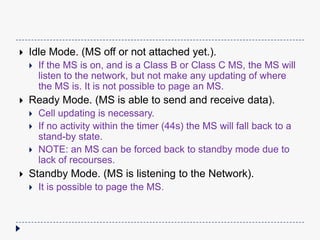
Idle Mode. (MS off or not attached yet.).




Ready Mode. (MS is able to send and receive data).






If the MS is on, and is a Class B or Class C MS, the MS will
listen to the network, but not make any updating of where
the MS is. It is not possible to page an MS.
Cell updating is necessary.
If no activity within the timer (44s) the MS will fall back to a
stand-by state.
NOTE: an MS can be forced back to standby mode due to
lack of recourses.

Standby Mode. (MS is listening to the Network).


It is possible to page the MS.

GPRS

  • 1.
  • 2.
    Need for GPRS Speed  Immediacy  New and better applications  User friendly billing
  • 3.
    History  In 1994, aSpecial Mobile Group started to think about a High Speed Data upgrade for GSM.  The first step was HSCSD (High Speed Circuit Switched Data).   HSCSD is a circuit-switched extension to GSM. The next step was GPRS.  GPRS is a packet-switched extension to GSM.
  • 4.
    What is HSCSD?  HSCSD(High Speed Circuit Switched Data).    The simplest high speed data upgrade for GSM. Provides GSM users with a bandwidth up to 57.6 Kbps. Does not require a hardware upgrade within BSS or core network (NSS), but different MS are needed.
  • 5.
    What is GPRS?    GPRSis a packet oriented data service for IP and X.25 over GSM networks. GPRS is a step towards 3G and is often referred to as 2.5G. The GPRS network acts in parallel with the GSM network, providing packet switched connections to the external networks.
  • 6.
    Functions  Traditional mobile communicationnetwork + Traditional packet switched computer network.       Capability to separate circuit switched and packet switched traffic from mobile station (MS) Interfaces to Internet, intranets, Public Data Networks (PDN) Routing of packets to appropriate destination Allocation of static or dynamic address for packets originating from MS Protection of the GPRS network from security threats Translation between logical names and IP addresses using Domain Name System (DNS)
  • 7.
    The GPRS networkand it’s new elements.
  • 8.
  • 9.
    From GSM toGPRS.... 
  • 10.
     Figure shows thearchitecture of a GPRS network. The GPRS system brings some new network elements to an existing GSM network. These elements are:           Packet Control Unit (PCU) Serving GPRS Support Node (SGSN): the MSC of the GPRS network Gateway GPRS Support Node (GGSN): gateway to external networks Border Gateway (BG): a gateway to other PLMN (Public Land Mobile Network) Intra-PLMN backbone: an IP based network inter-connecting all the GPRS elements Charging Gateway (CG) Legal Interception Gateway (LIG) Domain Name System (DNS) Firewalls: used wherever a connection to an external network is required. Not all of the network elements are compulsory for every GPRS network.
  • 11.
    SGSN (Service GPRSSupport Node )     The SGSN is the most important element of the GPRS network. The SGSN of the GPRS network is equivalent to the MSC of the GSM network. There must at least one SGSN in a GPRS network. There is a coverage area associated with a SGSN. As the network expands and the number of subscribers increases, there may be more than one SGSN in a network. Handles:  PDP contexts for Mobile Stations.  Determines Quality of Service assigned to user.  Routes packets to Mobile Stations.  “Pages” Mobile Stations when data is to be sent.  Handover/cell Change
  • 12.
     Stores:    Security:    Subscriber data forall Mobile Stations in the location area. Store not-acknowledged packets in case of a cell change during an ongoing packet data transfer Authentication, by means of identity or equipment check. Data compression is used to minimise the size of transmitted data units Charging  The SGSN collects CDR's (Call Data Records) for the use of the own network resources.
  • 13.
    GGSN (Gateway GPRSSupport Node)      The GGSN is the gateway to external networks. Every connection to a fixed external data network has to go through a GGSN. The GGSN acts as the anchor point in a GPRS data connection even when the subscriber moves to another SGSN during roaming. There are usually two or more GGSNs in a network for redundancy purposes, and they back up each other up in case of failure. The functions of a GGSN are given below:
  • 14.
     Handles:      Stores:   Interconnects a PLMNto the external world (Internet). Routes IP packets to the appropriate SGSN. Routing packets originating from a mobile to the correct external network Activation and Deactivation of PDP-Contexts / Session Management. Subscriber data for active Mobile Stations. Security:  Interfaces to external IP networks and deals with security issues    Firewall. Screening. Charging   The GGSN will, in addition to the SGSN, collect CDRs and forward them to the charging gateway (CG). GGSN will collect call data records based on the usage of external network resources .
  • 15.
    Charging Gateway  GPRS usershave to be charged for the use of the network.     In a GSM network, charging is based on the destination, duration, and time of call. However, GPRS offers connectionless service to users, so it not possible to charge subscribers on the connection duration. Charging has to be based on the volume, destination, QoS, and other parameters of a connectionless data transfer. These GPRS charging data are generated by all the SGSNs and GGSNs in the network. This data is referred to as Charging Data Records or CDRs.
  • 16.
         One data sessionmay generate a number of CDRs, so these need to collected and processed. The Charging Gateway (CG) collects all of these records, sorts them, processes it, and passes it on to the Billing System. The GPRS subscriber is billed for the data transaction. All CDRs contain unique subscriber and connection identifiers to distinguish it. A protocol called GTP„ (pronounced GTP prime) is used for the transfer of data records between GSNs and the Charging Gateway.
  • 17.
    Border Gateway     The BorderGateway (BG) is a router that can provide a direct GPRS tunnel between different operators' GPRS networks. This is referred to as an inter- PLMN data network. It is more secure to transfer data between two operators„ PLMN networks through a direct connection rather than via the public Internet. The Border Gateway will commence operation once the GPRS roaming agreements between various operators have been signed. It will essentially allow a roaming subscriber to connect to company intranet through the Home GGSN via the visiting PLMN network.
  • 18.
    Domain Name Servers  Thesedevices convert IP names into IP addresses for example, server.nokia.com to 133.44.15.5.
  • 19.
    Lawful Intercept Gateway   Thisis for monitoring traffic for law-enforcement agencies that require court order. When data packets traverse the GPRS network , it may be intercepted and forwarded to the agencies.
  • 20.
    Packet Control Unit     GPRScell phone will trasmit data in Packet switched mode and voice in circuit switched mode . So there needs to be a network to differenciate the different kinds of calls and send them to respective core networks – voice call to MSC and data calls to SGSN. PCU does this . PCU is placed at the Base station subsystem (BSS) . The functions of PCU are     Packet segmentation and reassembly Access control Scheduling for all active transmissions including radio channel management Controlling transmission for checking, buffering and retransmission
  • 21.
    Classes Of GPRSEquipments   As GPRS users need to handle both voice and data services, the following classifications are made in the perspective of GPRS equipment. Class A.   Class B.   Equipments that handle voice calls and transfer data at the same time Equipments that can handle voice or data traffic separately, and can put a packet transfer on hold to receive a phone call Class C.  Equipments that handle voice calls and transfer data , but has to be disconnected from one mode explicitly inorder to enable the other
  • 22.
  • 23.
     Gb:     Gr:     Between a SGSNand a BSS. The Gb interface carries the GPRS traffic and signalling between the GSM radio network (BSS) and the GPRS network. Frame Relay based network services is used for this interface. Between an SGSN and the HLR. The Gr gives the SGSN access to subscriber information in the HLR. The HLR can be located in a different PLMN than the SGSN (MAP). Gs:   Between a SGSN and a MSC. The SGSN can send location data to the MSC or receive paging requests from the MSC via this optional interface.
  • 24.
       Gf:  Between anSGSN and the EIR.  The Gf gives the SGSN access to GPRS user equipment information.  The EIR maintains three different lists of mobile equipment: black list for stolen mobiles, grey list for mobiles under observation and white list for other mobiles . Gc  Between the GGSN and the HLR.  The GGSN may request the location of an MS via this optional interface.  The interface can be used if the GGSN needs to forward packets to an MS that is not active. Gn  Between two GSNs (GPRS support node) within the same PLMN. (GP interface is used if they are in different PLMN)
  • 25.
    It consist ofa protocol stack that includes IP and GPRS Tunnelling Protocol (GTP)  GTP has two parts , the GTP-U which is used to carry user data and GTP-C to carry control data. Gd:  Interface connects the SGSN to an SMS gateway , thus enabling the SGSN to support SMS services. Gi:  Is a references rather than an interface.  It refers to the connection between the GGSN and some external network  IPV4, IPV6, and PPP are supported by GGSN Um:  Modified air interface between mobile device and the GPRS network.    
  • 26.
    GPRS Logical channel  Logicalchannels in the GPRS network , are divided into two categories     Traffic channels Signalling/Control Channels Logical channels are defined to perform multiple functions like broadcast , paging , signalling and payload transport. They are listed in table
  • 27.
    Group Channel Function Direction Packet Broadcast ControlChannel PBCCH Broadcast Control BSS  MS Packet Data Traffic Channel PDTCH Data traffic flow MS BSS Packet Dedicated Control Channel PACCH Associated Control MS BSS PTCCH Timing Cntrl PRACH Random Access MS BSS PAGCH Access Grant MS BSS PPCH Paging MS BSS PNCH Notification MS BSS Packet Common Control Channel MS BSS
  • 28.
     PDTCH:     PBCCH:    Packet Data TrafficChannel Is employed for the transfer of user data, assigned to one mobile station (MS) during data transfer. Each MS can use several PDTCHs simultaneously Packet Broadcast Control Channel. Is a uni-directional point to multi point signalling channel from base station sub system (BSS) to mobile stations. PTCCH:   Packet Timing Advance Control Channel . used for adaptive frame synchronisation.
  • 29.
     PCCCH:     Packet Common ControlChannel. bi-directional point to multi point channel Transport signalling information for network access management It consist of for sub channels as shown in table
  • 30.
    GPRS Service Types  APLMN provider is responsible for the data transfer between the GPRS Service Access Points Two kinds of services are presents  PTP (Point to Point):       Used for single packet transfer between two subscribers. Operated in connection oriented (CONS) and connection less mode (CLNS) CONS for X.25 CLNS for IP PTM (Point to Multipoint):  Supports transmission of data packets between a service user and a specified group inside a certain geographical region.
  • 31.
     It is againdivided into       PTM- Multicast (PTM-M). PTM- Group (PTM-G) In PTM-M Data packets are broadcast over a certain geographical area. A group identifier indicates whether the packets are intended for all users or a group of users PTM- Group (PTM-G) is meant for only certain group of users The messages are addressed explicitly to a specified group and are sent to all geographical region where the group members are located .
  • 32.
    GPRS States Idle GPRS Attach GPRSDetach Ready Ready Timer expired Data transfer or reception Standby
  • 33.
     Idle Mode. (MSoff or not attached yet.).   Ready Mode. (MS is able to send and receive data).     If the MS is on, and is a Class B or Class C MS, the MS will listen to the network, but not make any updating of where the MS is. It is not possible to page an MS. Cell updating is necessary. If no activity within the timer (44s) the MS will fall back to a stand-by state. NOTE: an MS can be forced back to standby mode due to lack of recourses. Standby Mode. (MS is listening to the Network).  It is possible to page the MS.