SEMINAR PRESENTATION ON
UNDER WATER
ACOUSTIC
COMMUNICATION
SUBMITTED BY
JAISICA
05311503010
ICE 7th
SEMESTER
INDEX
Introduction
Deficiencies of current U.W. Communications
History
About
Basic Model
Acoustic Modem
Applications
DART
Robotic Crawler
INTRODUCTION
Technique of sending and receiving message below water.
Most commonly employed using hydrophones.
Difficult due to factors like multi-path propagation, time
variations of the channel, small available bandwidth and
strong signal attenuation.
Underwater communication uses acoustic waves instead
of electromagnetic waves.
DEFICIENCY IN
CURRENT
COMMUNICATION
Future ocean environment will be increasingly
complicated.
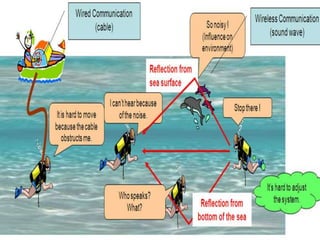
Radio waves propagate under water at extremely low
frequencies (30Hz-300Hz) & require large antennae and
high transmission power.
Optical waves do not suffer much attenuation but are
affected by scattering.
Acoustic waves are the single best solution for
communicating Under water.
HISTORY
The science of underwater acoustics began in
1490, when Leonardo Da Vinci, stated
"If you cause your ship to stop and place the head of a long tube
in the water and place the outer extremity to your ear, you will
hear ships at a great distance from you.“
In 1687 Isaac Newton wrote his Mathematical Principles of
Natural Philosophy which included the first mathematical
treatment of sound.
In 1912 sinking of TITANIC and start of World War I, systems for
detecting icebergs and U-boats were developed.
ABOUT
Underwater Acoustics is the study of propagation of sound
in water & interaction of mechanical waves that constitute
with water & its boundaries.
Typical frequencies associated with Underwater Acoustics
are 10Hz to 1MHz
The propagation of sound in the ocean at frequencies lower
than 10 Hz is not possible.
Frequencies above 1 MHz are rarely used because they are
absorbed very quickly.
Underwater Acoustics is also known as
HYDROACOUSTICS.
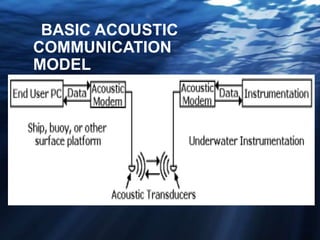
BASIC ACOUSTIC
COMMUNICATION
MODEL
ACOUSTIC MODEM
Is used to transmit data underwater, much as telephone
modems are used to transmit data over phone lines.
Converts digital data into special underwater sound
signals.
These signals are then received by a second acoustic
modem and converted back into digital data.
Can be used for underwater telemetry, ROV and AUV
command and control, diver
communications, underwater monitoring .
Underwater acoustic modems are relatively slow
compared to telephone or cable modems on land.
 this technology is important because it provides an
accurate and efficient means to send and receive data
underwater.
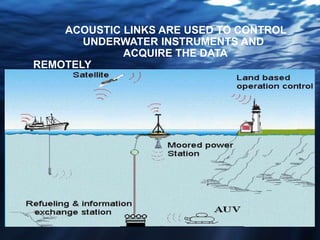
Oceanographers use acoustics to control underwater
instruments and acquire the data that they collect
remotely.
This technology can also be used to control
small, unmanned submarines, called Autonomous
Undersea Vehicles (AUV's), and get data back from them
in real-time.
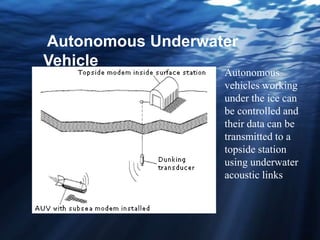
Autonomous
vehicles working
under the ice can
be controlled and
their data can be
transmitted to a
topside station
using underwater
acoustic links
Autonomous Underwater
Vehicle
ACOUSTIC LINKS ARE USED TO CONTROL
UNDERWATER INSTRUMENTS AND
ACQUIRE THE DATA
REMOTELY
APPLICATIONS
• Underwater data links can be combined with satellite data links to
provide data in real-time from instruments on the seafloor to
scientists ashore.
• Can be used to provide early warnings of tsunamis generated by
undersea earthquakes.
• Pressure sensors that are deployed on the seafloor can detect
tsunamis.
• U.S. National Oceanic and Atmospheric Administration (NOAA)
Deep-ocean Assessment and Reporting of Tsunamis (DART)
program has installed bottom pressure sensors near regions with a
history of tsunami generation, to measure waves as they spread.
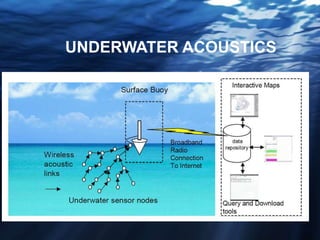
UNDERWATER ACOUSTICS
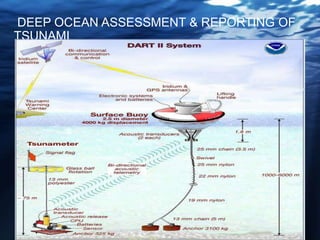
DEEP OCEAN ASSESSMENT & REPORTING OF
TSUNAMI
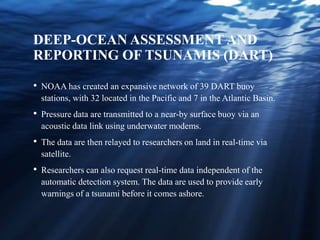
DEEP-OCEAN ASSESSMENT AND
REPORTING OF TSUNAMIS (DART)
• NOAA has created an expansive network of 39 DART buoy
stations, with 32 located in the Pacific and 7 in the Atlantic Basin.
• Pressure data are transmitted to a near-by surface buoy via an
acoustic data link using underwater modems.
• The data are then relayed to researchers on land in real-time via
satellite.
• Researchers can also request real-time data independent of the
automatic detection system. The data are used to provide early
warnings of a tsunami before it comes ashore.
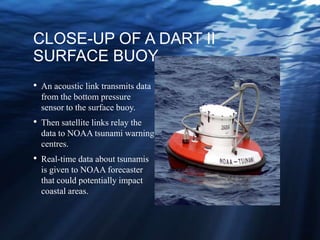
CLOSE-UP OF A DART II
SURFACE BUOY
• An acoustic link transmits data
from the bottom pressure
sensor to the surface buoy.
• Then satellite links relay the
data to NOAA tsunami warning
centres.
• Real-time data about tsunamis
is given to NOAA forecaster
that could potentially impact
coastal areas.
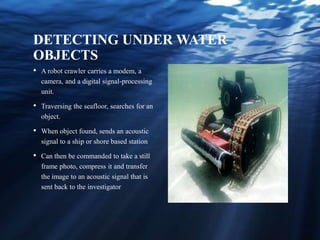
DETECTING UNDER WATER
OBJECTS
• A robot crawler carries a modem, a
camera, and a digital signal-processing
unit.
• Traversing the seafloor, searches for an
object.
• When object found, sends an acoustic
signal to a ship or shore based station
• Can then be commanded to take a still
frame photo, compress it and transfer
the image to an acoustic signal that is
sent back to the investigator
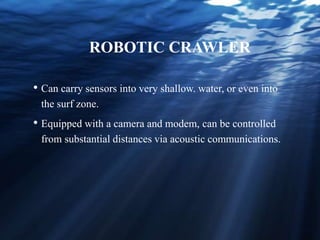
ROBOTIC CRAWLER
• Can carry sensors into very shallow. water, or even into
the surf zone.
• Equipped with a camera and modem, can be controlled
from substantial distances via acoustic communications.
UNDER WATER ACOUSTIC COMMUNICATION

UNDER WATER ACOUSTIC COMMUNICATION

  • 1.
    SEMINAR PRESENTATION ON UNDERWATER ACOUSTIC COMMUNICATION SUBMITTED BY JAISICA 05311503010 ICE 7th SEMESTER
  • 2.
    INDEX Introduction Deficiencies of currentU.W. Communications History About Basic Model Acoustic Modem Applications DART Robotic Crawler
  • 3.
    INTRODUCTION Technique of sendingand receiving message below water. Most commonly employed using hydrophones. Difficult due to factors like multi-path propagation, time variations of the channel, small available bandwidth and strong signal attenuation. Underwater communication uses acoustic waves instead of electromagnetic waves.
  • 4.
    DEFICIENCY IN CURRENT COMMUNICATION Future oceanenvironment will be increasingly complicated. Radio waves propagate under water at extremely low frequencies (30Hz-300Hz) & require large antennae and high transmission power. Optical waves do not suffer much attenuation but are affected by scattering. Acoustic waves are the single best solution for communicating Under water.
  • 6.
    HISTORY The science ofunderwater acoustics began in 1490, when Leonardo Da Vinci, stated "If you cause your ship to stop and place the head of a long tube in the water and place the outer extremity to your ear, you will hear ships at a great distance from you.“ In 1687 Isaac Newton wrote his Mathematical Principles of Natural Philosophy which included the first mathematical treatment of sound. In 1912 sinking of TITANIC and start of World War I, systems for detecting icebergs and U-boats were developed.
  • 7.
    ABOUT Underwater Acoustics isthe study of propagation of sound in water & interaction of mechanical waves that constitute with water & its boundaries. Typical frequencies associated with Underwater Acoustics are 10Hz to 1MHz The propagation of sound in the ocean at frequencies lower than 10 Hz is not possible. Frequencies above 1 MHz are rarely used because they are absorbed very quickly. Underwater Acoustics is also known as HYDROACOUSTICS.
  • 8.
  • 9.
    ACOUSTIC MODEM Is usedto transmit data underwater, much as telephone modems are used to transmit data over phone lines. Converts digital data into special underwater sound signals. These signals are then received by a second acoustic modem and converted back into digital data. Can be used for underwater telemetry, ROV and AUV command and control, diver communications, underwater monitoring .
  • 10.
    Underwater acoustic modemsare relatively slow compared to telephone or cable modems on land.  this technology is important because it provides an accurate and efficient means to send and receive data underwater. Oceanographers use acoustics to control underwater instruments and acquire the data that they collect remotely. This technology can also be used to control small, unmanned submarines, called Autonomous Undersea Vehicles (AUV's), and get data back from them in real-time.
  • 11.
    Autonomous vehicles working under theice can be controlled and their data can be transmitted to a topside station using underwater acoustic links Autonomous Underwater Vehicle
  • 12.
    ACOUSTIC LINKS AREUSED TO CONTROL UNDERWATER INSTRUMENTS AND ACQUIRE THE DATA REMOTELY
  • 13.
    APPLICATIONS • Underwater datalinks can be combined with satellite data links to provide data in real-time from instruments on the seafloor to scientists ashore. • Can be used to provide early warnings of tsunamis generated by undersea earthquakes. • Pressure sensors that are deployed on the seafloor can detect tsunamis. • U.S. National Oceanic and Atmospheric Administration (NOAA) Deep-ocean Assessment and Reporting of Tsunamis (DART) program has installed bottom pressure sensors near regions with a history of tsunami generation, to measure waves as they spread.
  • 14.
  • 15.
    DEEP OCEAN ASSESSMENT& REPORTING OF TSUNAMI
  • 16.
    DEEP-OCEAN ASSESSMENT AND REPORTINGOF TSUNAMIS (DART) • NOAA has created an expansive network of 39 DART buoy stations, with 32 located in the Pacific and 7 in the Atlantic Basin. • Pressure data are transmitted to a near-by surface buoy via an acoustic data link using underwater modems. • The data are then relayed to researchers on land in real-time via satellite. • Researchers can also request real-time data independent of the automatic detection system. The data are used to provide early warnings of a tsunami before it comes ashore.
  • 17.
    CLOSE-UP OF ADART II SURFACE BUOY • An acoustic link transmits data from the bottom pressure sensor to the surface buoy. • Then satellite links relay the data to NOAA tsunami warning centres. • Real-time data about tsunamis is given to NOAA forecaster that could potentially impact coastal areas.
  • 18.
    DETECTING UNDER WATER OBJECTS •A robot crawler carries a modem, a camera, and a digital signal-processing unit. • Traversing the seafloor, searches for an object. • When object found, sends an acoustic signal to a ship or shore based station • Can then be commanded to take a still frame photo, compress it and transfer the image to an acoustic signal that is sent back to the investigator
  • 19.
    ROBOTIC CRAWLER • Cancarry sensors into very shallow. water, or even into the surf zone. • Equipped with a camera and modem, can be controlled from substantial distances via acoustic communications.