FAUVISM
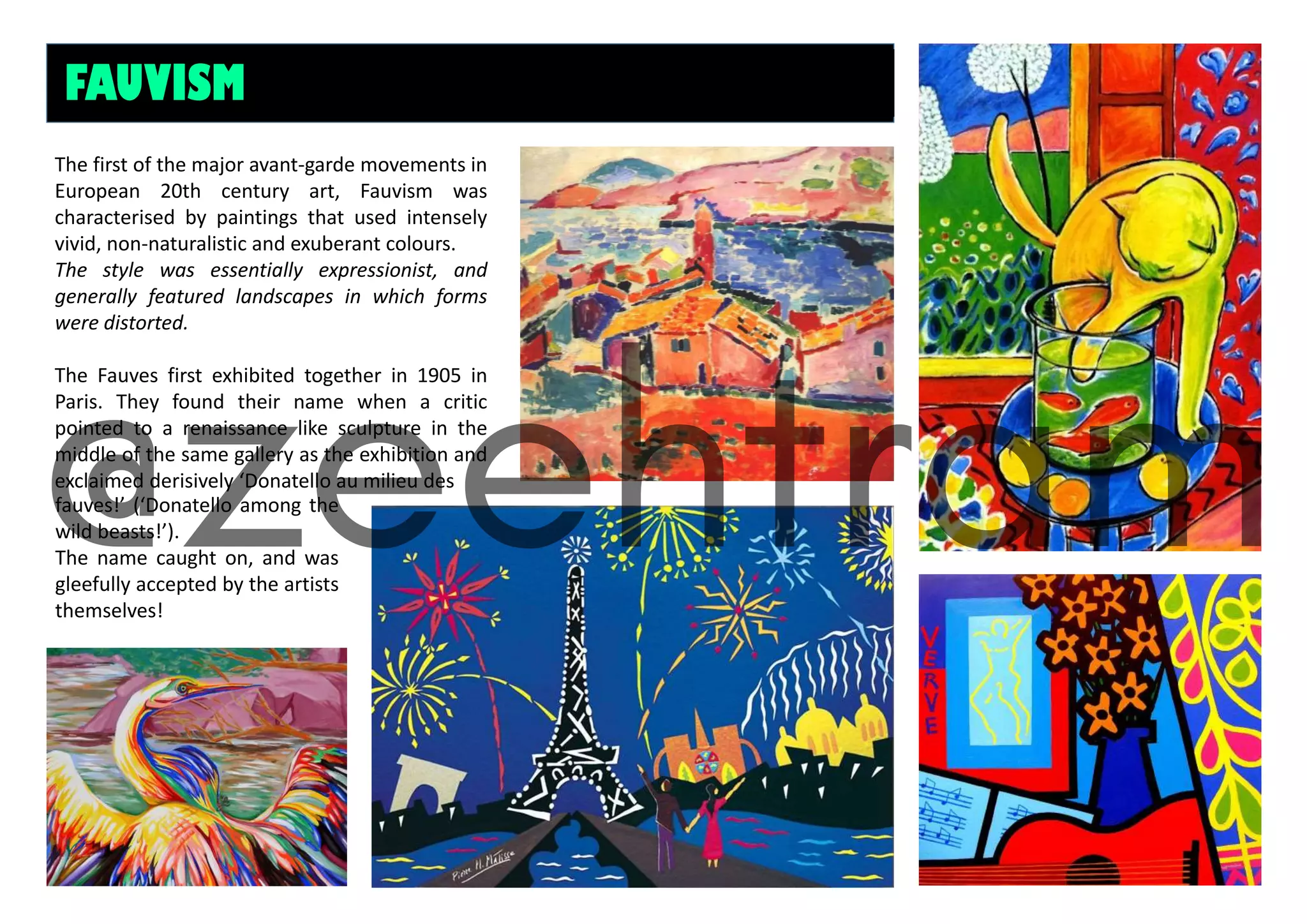
The first of the major avant-garde movements in
European 20th century art, Fauvism was
characterised by paintings that used intensely
vivid, non-naturalistic and exuberant colours.
The style was essentially expressionist, and
generally featured landscapes in which forms
were distorted.
The Fauves first exhibited together in 1905 in
Paris. They found their name when a critic
pointed to a renaissance like sculpture in the
middle of the same gallery as the exhibition and
exclaimed derisively ‘Donatello au milieu des
fauves!’ (‘Donatello among the
wild beasts!’).
The name caught on, and was
gleefully accepted by the artists
themselves!
Fauvism was initially inspired by the examples of Vincent van Gogh, Paul Gauguin, Georges Seurat, and Paul Cézanne. The Fauves
("wild beasts") were a loosely allied group of French painters with shared interests. Several of them, including Henri Matisse, Albert
Marquet, and Georges Rouault, had been pupils of the Symbolist artist Gustave Moreau and admired the older artist's emphasis on
personal expression. Matisse emerged as the leader of the group, whose members shared the use of intense colour as a vehicle for
describing light and space, and who redefined pure colour and form as means of communicating the artist's emotional state.
In these regards, Fauvism proved to be an important precursor to Cubism and Expressionism as well as a touchstone for future modes
of abstraction.
Key Ideas
*One of Fauvism's major contributions to modern art was its
radical goal of separating colour from its descriptive,
representational purpose and allowing it to exist on the canvas as
an independent element. Colour could project a mood and
establish a structure within the work of art without having to be
true to the natural world.
*Another of Fauvism's central artistic concerns was the overall
balance of the composition. The Fauves' simplified forms and
saturated colours drew attention to the inherent flatness of the
canvas or paper; within that pictorial space, each element played
a specific role. The immediate visual impression of the work is to
be strong and unified.
*Above all, Fauvism valued individual
expression. The artist's direct experience
of his subjects, his emotional response to
nature, and his intuition were all more
important than academic theory or
elevated subject matter. All elements of
painting were employed in service of this
goal.
Henri Rousseau, The Hungry Lion Throws Itself on the Antelope, 1905
Jean Metzinger, 1907, Paysage coloré aux oiseaux
aquatiques, Musée d’Art Moderne de la Ville de Paris.
Henri Matisse, Le bonheur de vivre, 1905-6, Barnes
Foundation, Philadelphia, PA.
While Fauvism as a style began around 1900 and continued beyond 1910, the movement as such lasted only a few years, 1904–1908, and
had three exhibitions. The leaders of the movement were Henri Matisse and André Derain.
HENRI MATISSE
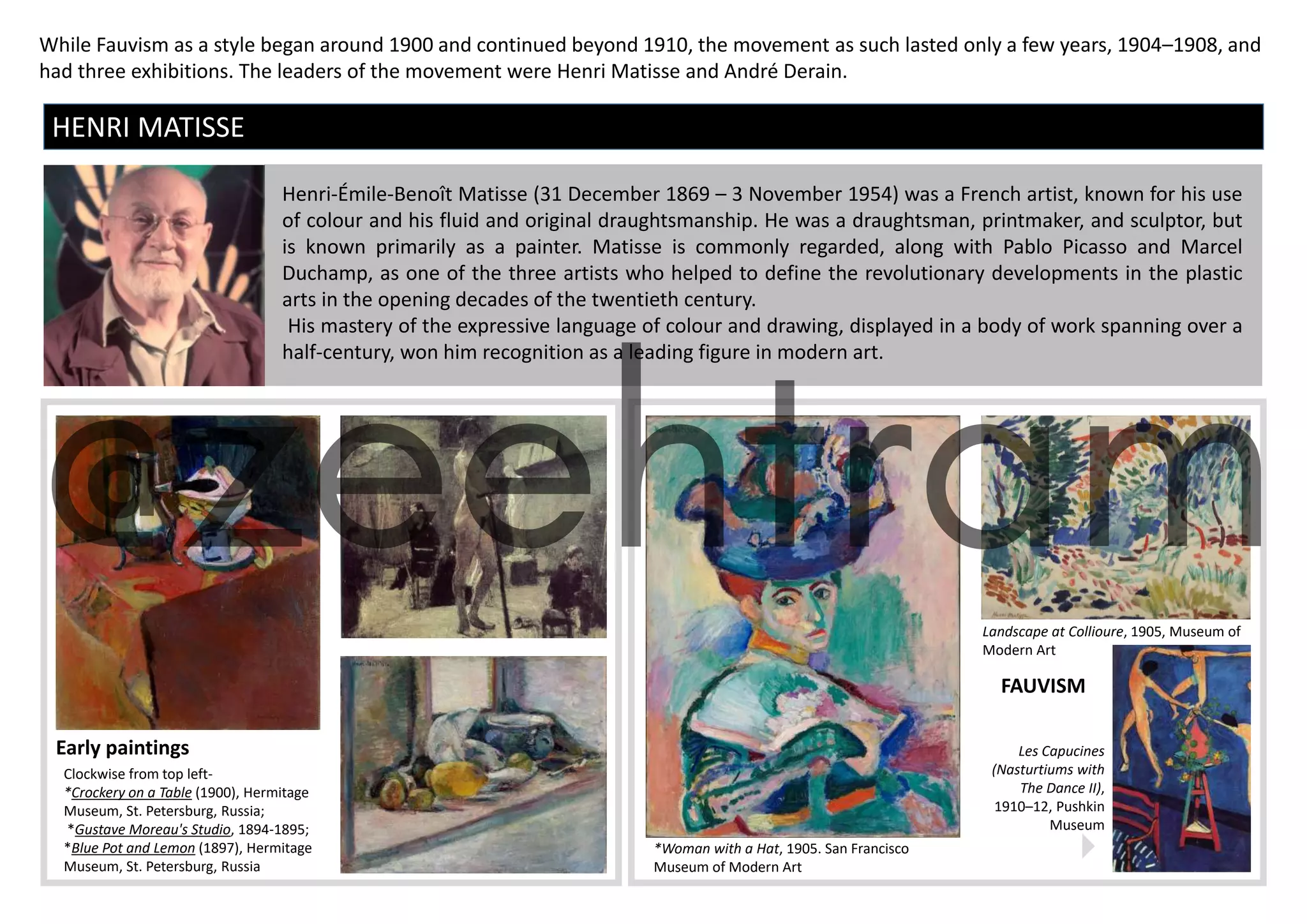
Henri-Émile-Benoît Matisse (31 December 1869 – 3 November 1954) was a French artist, known for his use
of colour and his fluid and original draughtsmanship. He was a draughtsman, printmaker, and sculptor, but
is known primarily as a painter. Matisse is commonly regarded, along with Pablo Picasso and Marcel
Duchamp, as one of the three artists who helped to define the revolutionary developments in the plastic
arts in the opening decades of the twentieth century.
His mastery of the expressive language of colour and drawing, displayed in a body of work spanning over a
half-century, won him recognition as a leading figure in modern art.
Early paintings
Clockwise from top left-
*Crockery on a Table (1900), Hermitage
Museum, St. Petersburg, Russia;
*Gustave Moreau's Studio, 1894-1895;
*Blue Pot and Lemon (1897), Hermitage
Museum, St. Petersburg, Russia
FAUVISM
*Woman with a Hat, 1905. San Francisco
Museum of Modern Art
Landscape at Collioure, 1905, Museum of
Modern Art
Les Capucines
(Nasturtiums with
The Dance II),
1910–12, Pushkin
Museum
Thanks!
Found this useful?
Follow @zeehtram on Instagram for more
Art, Architecture and Design related stuff.

Understanding the Fauvism Art Movement

  • 1.
    FAUVISM The first ofthe major avant-garde movements in European 20th century art, Fauvism was characterised by paintings that used intensely vivid, non-naturalistic and exuberant colours. The style was essentially expressionist, and generally featured landscapes in which forms were distorted. The Fauves first exhibited together in 1905 in Paris. They found their name when a critic pointed to a renaissance like sculpture in the middle of the same gallery as the exhibition and exclaimed derisively ‘Donatello au milieu des fauves!’ (‘Donatello among the wild beasts!’). The name caught on, and was gleefully accepted by the artists themselves!
  • 2.
    Fauvism was initiallyinspired by the examples of Vincent van Gogh, Paul Gauguin, Georges Seurat, and Paul Cézanne. The Fauves ("wild beasts") were a loosely allied group of French painters with shared interests. Several of them, including Henri Matisse, Albert Marquet, and Georges Rouault, had been pupils of the Symbolist artist Gustave Moreau and admired the older artist's emphasis on personal expression. Matisse emerged as the leader of the group, whose members shared the use of intense colour as a vehicle for describing light and space, and who redefined pure colour and form as means of communicating the artist's emotional state. In these regards, Fauvism proved to be an important precursor to Cubism and Expressionism as well as a touchstone for future modes of abstraction. Key Ideas *One of Fauvism's major contributions to modern art was its radical goal of separating colour from its descriptive, representational purpose and allowing it to exist on the canvas as an independent element. Colour could project a mood and establish a structure within the work of art without having to be true to the natural world. *Another of Fauvism's central artistic concerns was the overall balance of the composition. The Fauves' simplified forms and saturated colours drew attention to the inherent flatness of the canvas or paper; within that pictorial space, each element played a specific role. The immediate visual impression of the work is to be strong and unified. *Above all, Fauvism valued individual expression. The artist's direct experience of his subjects, his emotional response to nature, and his intuition were all more important than academic theory or elevated subject matter. All elements of painting were employed in service of this goal. Henri Rousseau, The Hungry Lion Throws Itself on the Antelope, 1905 Jean Metzinger, 1907, Paysage coloré aux oiseaux aquatiques, Musée d’Art Moderne de la Ville de Paris. Henri Matisse, Le bonheur de vivre, 1905-6, Barnes Foundation, Philadelphia, PA.
  • 3.
    While Fauvism asa style began around 1900 and continued beyond 1910, the movement as such lasted only a few years, 1904–1908, and had three exhibitions. The leaders of the movement were Henri Matisse and André Derain. HENRI MATISSE Henri-Émile-Benoît Matisse (31 December 1869 – 3 November 1954) was a French artist, known for his use of colour and his fluid and original draughtsmanship. He was a draughtsman, printmaker, and sculptor, but is known primarily as a painter. Matisse is commonly regarded, along with Pablo Picasso and Marcel Duchamp, as one of the three artists who helped to define the revolutionary developments in the plastic arts in the opening decades of the twentieth century. His mastery of the expressive language of colour and drawing, displayed in a body of work spanning over a half-century, won him recognition as a leading figure in modern art. Early paintings Clockwise from top left- *Crockery on a Table (1900), Hermitage Museum, St. Petersburg, Russia; *Gustave Moreau's Studio, 1894-1895; *Blue Pot and Lemon (1897), Hermitage Museum, St. Petersburg, Russia FAUVISM *Woman with a Hat, 1905. San Francisco Museum of Modern Art Landscape at Collioure, 1905, Museum of Modern Art Les Capucines (Nasturtiums with The Dance II), 1910–12, Pushkin Museum
  • 4.
    Thanks! Found this useful? Follow@zeehtram on Instagram for more Art, Architecture and Design related stuff.