Les Fauves: The “Wild Beasts”
                      of Paris
         by Eleanor Pence & Ruby Rehman
Explosive Beginnings
   1905 Salon d’Automne in Paris
       All grouped in one room (Salle VII)
   Generally, negative critical response at first.
       “Primitive, brutal and violent”
       “Raving madness, or perhaps, a bad joke”
       “A child playing with its paintbox”
   Name given by critic Louis Vauxcelles
       “Donatello au milieu des fauves”.
Why so scandalous?
   In many ways, a major departure from previous
    movements
       Bright, “unnatural colors” straight from tube.
       Extremely visible brush strokes
       Colors and lack of shading work against perspective.
       Abstraction - a painting is not meant to show what’s
        happening
   A preview of the characteristics of many
    movements to come.
Influences
   Neo-Impressionist colorists
       Nabis
       Seurat’s Pointillism - share an interest in the use of
        color in lending visual intensity
   Van Gogh - Pure colors, strong, visible
    brushstrokes
   Later, Cezanne and Gaugin
       Cezanne: Playing with perspective through color
       Gaugin: strong colors, rich contrasts, flat color areas
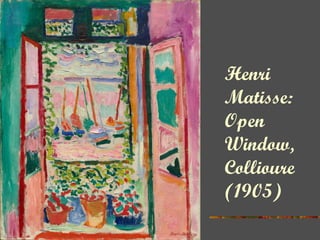
Henri
Matisse:
Open
Window,
Collioure
(1905)
Matisse:
Woman
with a
Hat
(1905)
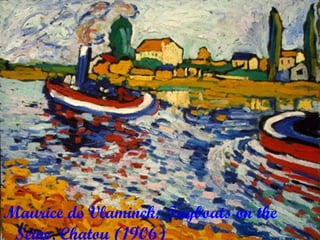
Maurice de Vlaminck: Tugboats on the
 Seine, Chatou (1906)
André Derain
   Unlike the other Fauves, Derain didn’t
    start out in Impressionism
       Aim of the painter was to ‘substitute his inner
        vision for his perception of the world around him’
   Served in the French military from 1901-1904
   Painted over the course of several visits to
    judge light and seasonal changes
André Derain: Turning Road at
L’Estaque (1906)
André Derain: The Bridge of
Waterloo (1907)
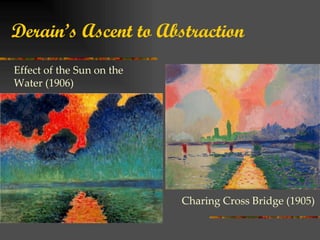
Derain’s Ascent to Abstraction
Effect of the Sun on the
Water (1906)


                           Charing Cross Bridge (1905)
What Happened to Fauvism?
   Fauvism’s brief history begs the question: Why
    was it so brief?
       Barely unified - mostly a group of painters whose
        styles and ideologies coincided for a short time.
       Rejected wild colors and blatant emotions for more
        classical techniques…all except Matisse
       Emotional use of color absorbed into German
        impressionism
       Its freeing of color for emotions and its refusal to
        portray the world as it was had a powerful influence
        on later, even more avante-garde movements.

Fauvism finale

  • 1.
    Les Fauves: The“Wild Beasts” of Paris by Eleanor Pence & Ruby Rehman
  • 2.
    Explosive Beginnings  1905 Salon d’Automne in Paris  All grouped in one room (Salle VII)  Generally, negative critical response at first.  “Primitive, brutal and violent”  “Raving madness, or perhaps, a bad joke”  “A child playing with its paintbox”  Name given by critic Louis Vauxcelles  “Donatello au milieu des fauves”.
  • 3.
    Why so scandalous?  In many ways, a major departure from previous movements  Bright, “unnatural colors” straight from tube.  Extremely visible brush strokes  Colors and lack of shading work against perspective.  Abstraction - a painting is not meant to show what’s happening  A preview of the characteristics of many movements to come.
  • 4.
    Influences  Neo-Impressionist colorists  Nabis  Seurat’s Pointillism - share an interest in the use of color in lending visual intensity  Van Gogh - Pure colors, strong, visible brushstrokes  Later, Cezanne and Gaugin  Cezanne: Playing with perspective through color  Gaugin: strong colors, rich contrasts, flat color areas
  • 5.
  • 6.
  • 7.
    Maurice de Vlaminck:Tugboats on the Seine, Chatou (1906)
  • 8.
    André Derain  Unlike the other Fauves, Derain didn’t start out in Impressionism  Aim of the painter was to ‘substitute his inner vision for his perception of the world around him’  Served in the French military from 1901-1904  Painted over the course of several visits to judge light and seasonal changes
  • 9.
    André Derain: TurningRoad at L’Estaque (1906)
  • 10.
    André Derain: TheBridge of Waterloo (1907)
  • 11.
    Derain’s Ascent toAbstraction Effect of the Sun on the Water (1906) Charing Cross Bridge (1905)
  • 12.
    What Happened toFauvism?  Fauvism’s brief history begs the question: Why was it so brief?  Barely unified - mostly a group of painters whose styles and ideologies coincided for a short time.  Rejected wild colors and blatant emotions for more classical techniques…all except Matisse  Emotional use of color absorbed into German impressionism  Its freeing of color for emotions and its refusal to portray the world as it was had a powerful influence on later, even more avante-garde movements.