Fauvism
0Between 1901 and 1906, several
comprehensive exhibitions were held in Paris,
making the work of Vincent van Gogh, Paul
Gauguin, and Paul Cézanne widely accessible
for the first time. For the painters who saw the
achievements of these great artists, the effect
was one of liberation and they began to
experiment with radical new styles. Fauvism
was the first movement of this modern period,
in which color ruled supreme.
Fauvism
0Fauvism, French Fauvisme, style of painting
that flourished in France from 1898 to 1908;
it used pure, brilliant color, applied
straight from the paint tubes in an
aggressive, direct manner to create a sense
of an explosion on the canvas. The Fauves
painted directly from nature as the
Impressionists had before them, but their
works were invested with a strong expressive
reaction to the subjects they painted.
Fauvism
0First formally exhibited in Paris in 1905,
Fauvist paintings shocked visitors to the
annual Salon d'Automne; one of these
visitors was the critic Louis Vauxcelles,
who, because of the violence of their
works, dubbed the painters "Les Fauves"
(Wild Beasts).
Fauvism
0 The advent of Modernism if often dated by the
appearance of the Fauves in Paris at the Salon
d'Automne in 1905. Their style of painting, using
non-naturalistic colors, was one of the first
avant-garde developments in European art. They
greatly admired van Gogh, who said of his own work:
``Instead of trying to render what I see before me, I
use color in a completely arbitrary way to express
myself powerfully''.
Fauvism
0The Fauvists carried this idea further,
translating their feelings into color with a
rough, almost clumsy style. Matisse was a
dominant figure in the movement; other
Fauvists included Vlaminck, Derain, Marquet,
and Rouault. However, they did not form a
cohesive group and by 1908 a number of
painters had seceded to Cubism.
Fauvism
0Fauvism was a short-lived movement, lasting
only as long as its originator, Henri Matisse
(1869-1954), fought to find the artistic
freedom he needed. Matisse had to make color
serve his art, rather as Gauguin needed to
paint the sand pink to express an emotion.
The Fauvists believed absolutely in color as an
emotional force. Color lost its descriptive
qualities and became luminous, creating light
rather than imitating it.
Fauvism
0They astonished viewers at the 1905 Salon
d'Automne: the art critic Louis Vauxcelles saw
their bold paintings surrounding a conventional
sculpture of a young boy, and remarked that it
was like a Donatello ``parmi les fauves'' (among
the wild beasts). The painterly freedom of the
Fauves and their expressive use of color gave
splendid proof of their intelligent study of van
Gogh's art. But their art seemed brasher than
anything seen before.
Fauvism
0 The leader of the group was Henri Matisse, who had
arrived at the Fauve style after careful, critical study of
the masters of Postimpressionism Paul Gauguin,
Vincent van Gogh, and Georges Seurat. Matisse's
methodical studies led him to reject traditional
renderings of three-dimensional space and to seek
instead a new picture space defined by movement of
color. Matisse exhibited his famous "Woman with the
Hat" (SFMOMA) at the 1905 exhibition; brisk strokes
of color--blues, greens, and reds--form an energetic,
expressive view of the woman. As always in Matisse's
Fauve style, his painting is ruled by his intuitive sense
of formal order.
Fauvism
0Other members of the group included
two painters from Chatou, France, André
Derain and Maurice de Vlaminck, who,
together with Matisse, formed the
nucleus of the Fauves. Derain's Fauve
paintings translate every tone of a
landscape into pure colour, applied with
short, forceful brushstrokes.
Fauvism
0 The Fauves represented the first break with the
artistic traditions of the past. The movement's
emphasis on formal values and expressive use of
color, line, and brushwork helped liberate painting
from the representational expectations that had
dominated Western art since the Renaissance.
Fauvism was the first explosive 20th-century art
movement.
Fauvism
0Fauvism was for most of these artists a
transitional, learning stage. By 1908 a revived
interest in Paul Cézanne's vision of the order
and structure of nature had led them to reject
the turbulent emotionalism of Fauvism in
favour of the logic of Cubism. Matisse alone
pursued the course he had pioneered,
achieving a sophisticated balance between his
own emotions and the world he painted.
Henri Matisse
Self Portrait with
Striped T Shirt
1906
Henri Matisse
0An artist often regarded as the most
important French painter of the
20th century. The leader of the
Fauvist movement around 1900,
Matisse pursued the expressiveness
of color throughout his career.
Henri Matisse
0 While studying to become a lawyer, Henri Matisse felt
the urge to paint—a feeling that completely changed
his life. In the exhibition of 1905, Matisse exhibited
shocking works with the “Wild Beasts.” He used
intense colors and simplified complex subjects. This
ability moved him to the forefront of Fauvism and he
became spokesperson for the group. He wanted to
express himself with simple color and shape rather
than shading and perspective.
Henri Matisse
Master of Color
0Matisse's artistic career was long and varied,
covering many different styles of painting from
Impressionism to near Abstraction. Early on in his
career Matisse was viewed as a Fauvist, and his
celebration of bright colors reached its peak in
1917 when he began to spend time on the French
Riviera at Nice and Venice. Here he concentrated
on reflecting the sensual color of his surroundings
and completed some of his most exciting
paintings.
Abstraction
0 Abstraction:
Imagery which departs from representational accuracy,
to a variable range of possible degrees, for some reason
other than appear to be true or real. Abstract artists
select and then exaggerate or simplify the forms
suggested by the world around them.
Henri Matisse
0In 1941 Matisse was diagnosed as
having duodenal cancer and was
permanently confined to a
wheelchair. It was in this condition
that he completed the magnificent
Chapel of the Rosary in Vence.
Woman with a Hat
1905
Woman with a Hat 1905
0 It is believed that the woman in the painting was
Matisse's wife, Amelie.
0 It was exhibited with the work of other artists, now
known as "Fauves" at the 1905 Salon d'Automne.
0 The pictures gained considerable condemnation, such
as "A pot of paint has been flung in the face of the
public" from the critic Camille Mauclair, but also some
favorable attention. The painting that was singled out
for attacks was Matisse's Woman with a Hat, which
was bought by Gertrude and Leo Stein: this had a very
positive effect on Matisse, who was suffering
demoralization from the bad reception of his work.
Salon d’Automne, ( French: Autumn Salon) exhibition of the
works of young artists held every fall in Paris since 1903.
The Salon d’Automne was established as an alternative
to the conservative official Salon. It was also an
alternative to the Salon des Indépendants, which was
liberal but had a juryless policy that often led to
mediocrity. The founders decided to form their own
organization with the aims of welcoming any artist who
wished to join, selecting a jury for exhibitions by
drawing straws from the new group’s membership, and
giving the decorative arts the same respect accorded
the fine arts.
Open Window 1905
Luxury, Calm
and Pleasure
1904
0 Green Stripe (Madame Matisse)
0 1905
0 In his green stripe portrait of
his wife, he has used color
alone to describe the image.
Her oval face is bisected with
a slash of green and her
coiffure, purpled and top-
knotted, juts against a frame
of three jostling colors. Her
right side repeats the
vividness of the intrusive
green; on her left, the mauve
and orange echo the colors of
her dress. This is Matisse's
version of the dress, his
creative essay in harmony.
Green Stripe—Madame
Matisse
0Matisse painted this unusual portrait of his
wife in 1905. The green stripe down the
center of Amélie Matisse's face acts as an
artificial shadow line and divides the face in
the conventional portraiture style, with a light
and a dark side, Matisse divides the face
chromatically, with a cool and warm side. The
natural light is translated directly into colors
and the highly visible brush strokes add to the
sense of artistic drama.
The Conversation 1909
0Matisse's Fauvist years were superseded by an
experimental period, as he abandoned three-
dimensional effects in favor of dramatically
simplified areas of pure color, flat shape, and
strong pattern. The intellectual splendor of
this dazzlingly beautiful art appealed to the
Russian mentality, and many great Matisses
are now in Russia. One is The Conversation
(1909; 177 x 217 cm (5 ft 9 3/4 in x 7 ft 1 1/2
in)) in which husband and wife converse. But
the conversation is voiceless.
The Conversation 1909
The Dance 1910
The Dance 1910
0 It was one of two monumental panel pictures created
by the artist in 1910 for his principal patron, the
Russian businessman Sergei Schukhin, who originally
hung them on the staircase of his mansion in Moscow.
Together with its companion piece, Music, the work
can now be seen in the State Hermitage Museum in
Leningrad.
The Dance
0 “I like dance very much,” Matisse said, explaining the
genesis of this stark and brightly coloured depiction
of naked, convulsively cavorting figures. “Dance is an
extraordinary thing: life and rhythm. It is easy for me
to live with dance. When I had to compose a dance for
Moscow , I had just gone to the Moulin de la Galette on
a Sunday afternoon.
The Dance
0And I watched the dancing. I especially watched
the farandole (a dance accompanied by pipe and
tabor_ … This farandole was very gay. The dancers
hold each other by the hands, they run across the
room, and they wind around the people who are
standing around … Back at home, I composed my
dance on a canvas of four meters, singing the
same tune that I had heard at the Moulin de la
Galette, so that the entire composition and all the
dancers are in harmony and dance to a single
rhythm.”
The Red Studio 1911
0Matisse gets his place in the timeline of
painting because of his use of color. He
did things with color no-one had before,
and influenced many artists who
followed. Matisse's Red Studio is
important for its use of color and its
flattened perspective, his altering of
reality and our perception of space.
The Red Studio
0 Matisse didn't get the perspective "wrong", he painted it
the way he wanted it. He flattened the perspective in the
room, and altered it from how we perceive perspective
with our eyes.
0 The question of getting perspective "right" applies only if
you're trying to paint in a realist style, that is to create an
illusion of reality and depth in a painting. If that's not your
aim, then you can't get the perspective "wrong". And it's
not that Matisse didn't know how to get it "right" neither;
he just chose not to do it that way.
Chapel of the Rosary
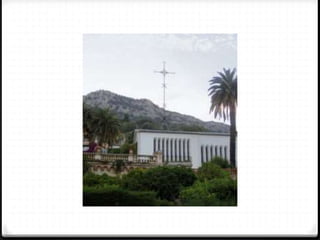
0 The Chapelle du Rosaire de Vence (Chapel of the
Rosary), often referred to as the Matisse Chapel or the
Vence Chapel, is a small chapel built for Dominican
nuns in the town of Vence on the French Riviera. It
was built and decorated between 1949 and 1951
under a plan devised by Henri Matisse. It houses a
number of Matisse originals and was regarded by
Matisse himself as his "masterpiece." While the simple
white exterior has drawn mixed reviews from casual
observers, many regard it as one of the great religious
structures of the 20th century.
Three Great Murals
0 For the walls, Matisse designed three great murals to
be made by painting on white tiles with black paint
and then firing the large sections of tile. Each tile
measures 12 in.2. Matisse was so crippled with
ailments by this time that he could only work from a
wheelchair, and he had a long stick with a brush
strapped to his arm and pieces of construction paper
placed on the wall. He then drew the images, which
were transferred to tiles by skilled craftsmen.
The Fall of Icarus 1943
Anfitrite 1947
Le Gerbe 1953
Matisse’s Paper Cuts
0 During the last fifteen years of his life, Henri Matisse
developed his final artistic triumph by "cutting into
color." The drama, scale, and innovation of Matisse's
rare and fragile papiers coupes (paper cutouts)
remain without precedent or parallel. His technique
involved the freehand cutting of colored papers into
beautiful shapes, which he then pinned loosely to the
white studio walls, later adjusting, recutting,
combining, and recombining them to his satisfaction.
Matisse’s Paper Cuts
0The result created an environment that
transcended the boundaries of conventional
painting, drawing, and sculpture. Later, the
shapes were glued to large white paper
backgrounds for shipping or display. This
group of cutouts represents one of the largest
concentrations of these important works
worldwide.
FAUVISM.ppt

FAUVISM.ppt

  • 2.
    Fauvism 0Between 1901 and1906, several comprehensive exhibitions were held in Paris, making the work of Vincent van Gogh, Paul Gauguin, and Paul Cézanne widely accessible for the first time. For the painters who saw the achievements of these great artists, the effect was one of liberation and they began to experiment with radical new styles. Fauvism was the first movement of this modern period, in which color ruled supreme.
  • 3.
    Fauvism 0Fauvism, French Fauvisme,style of painting that flourished in France from 1898 to 1908; it used pure, brilliant color, applied straight from the paint tubes in an aggressive, direct manner to create a sense of an explosion on the canvas. The Fauves painted directly from nature as the Impressionists had before them, but their works were invested with a strong expressive reaction to the subjects they painted.
  • 4.
    Fauvism 0First formally exhibitedin Paris in 1905, Fauvist paintings shocked visitors to the annual Salon d'Automne; one of these visitors was the critic Louis Vauxcelles, who, because of the violence of their works, dubbed the painters "Les Fauves" (Wild Beasts).
  • 5.
    Fauvism 0 The adventof Modernism if often dated by the appearance of the Fauves in Paris at the Salon d'Automne in 1905. Their style of painting, using non-naturalistic colors, was one of the first avant-garde developments in European art. They greatly admired van Gogh, who said of his own work: ``Instead of trying to render what I see before me, I use color in a completely arbitrary way to express myself powerfully''.
  • 6.
    Fauvism 0The Fauvists carriedthis idea further, translating their feelings into color with a rough, almost clumsy style. Matisse was a dominant figure in the movement; other Fauvists included Vlaminck, Derain, Marquet, and Rouault. However, they did not form a cohesive group and by 1908 a number of painters had seceded to Cubism.
  • 7.
    Fauvism 0Fauvism was ashort-lived movement, lasting only as long as its originator, Henri Matisse (1869-1954), fought to find the artistic freedom he needed. Matisse had to make color serve his art, rather as Gauguin needed to paint the sand pink to express an emotion. The Fauvists believed absolutely in color as an emotional force. Color lost its descriptive qualities and became luminous, creating light rather than imitating it.
  • 8.
    Fauvism 0They astonished viewersat the 1905 Salon d'Automne: the art critic Louis Vauxcelles saw their bold paintings surrounding a conventional sculpture of a young boy, and remarked that it was like a Donatello ``parmi les fauves'' (among the wild beasts). The painterly freedom of the Fauves and their expressive use of color gave splendid proof of their intelligent study of van Gogh's art. But their art seemed brasher than anything seen before.
  • 9.
    Fauvism 0 The leaderof the group was Henri Matisse, who had arrived at the Fauve style after careful, critical study of the masters of Postimpressionism Paul Gauguin, Vincent van Gogh, and Georges Seurat. Matisse's methodical studies led him to reject traditional renderings of three-dimensional space and to seek instead a new picture space defined by movement of color. Matisse exhibited his famous "Woman with the Hat" (SFMOMA) at the 1905 exhibition; brisk strokes of color--blues, greens, and reds--form an energetic, expressive view of the woman. As always in Matisse's Fauve style, his painting is ruled by his intuitive sense of formal order.
  • 10.
    Fauvism 0Other members ofthe group included two painters from Chatou, France, André Derain and Maurice de Vlaminck, who, together with Matisse, formed the nucleus of the Fauves. Derain's Fauve paintings translate every tone of a landscape into pure colour, applied with short, forceful brushstrokes.
  • 11.
    Fauvism 0 The Fauvesrepresented the first break with the artistic traditions of the past. The movement's emphasis on formal values and expressive use of color, line, and brushwork helped liberate painting from the representational expectations that had dominated Western art since the Renaissance. Fauvism was the first explosive 20th-century art movement.
  • 12.
    Fauvism 0Fauvism was formost of these artists a transitional, learning stage. By 1908 a revived interest in Paul Cézanne's vision of the order and structure of nature had led them to reject the turbulent emotionalism of Fauvism in favour of the logic of Cubism. Matisse alone pursued the course he had pioneered, achieving a sophisticated balance between his own emotions and the world he painted.
  • 13.
  • 14.
  • 15.
    Henri Matisse 0An artistoften regarded as the most important French painter of the 20th century. The leader of the Fauvist movement around 1900, Matisse pursued the expressiveness of color throughout his career.
  • 16.
    Henri Matisse 0 Whilestudying to become a lawyer, Henri Matisse felt the urge to paint—a feeling that completely changed his life. In the exhibition of 1905, Matisse exhibited shocking works with the “Wild Beasts.” He used intense colors and simplified complex subjects. This ability moved him to the forefront of Fauvism and he became spokesperson for the group. He wanted to express himself with simple color and shape rather than shading and perspective.
  • 17.
    Henri Matisse Master ofColor 0Matisse's artistic career was long and varied, covering many different styles of painting from Impressionism to near Abstraction. Early on in his career Matisse was viewed as a Fauvist, and his celebration of bright colors reached its peak in 1917 when he began to spend time on the French Riviera at Nice and Venice. Here he concentrated on reflecting the sensual color of his surroundings and completed some of his most exciting paintings.
  • 18.
    Abstraction 0 Abstraction: Imagery whichdeparts from representational accuracy, to a variable range of possible degrees, for some reason other than appear to be true or real. Abstract artists select and then exaggerate or simplify the forms suggested by the world around them.
  • 22.
    Henri Matisse 0In 1941Matisse was diagnosed as having duodenal cancer and was permanently confined to a wheelchair. It was in this condition that he completed the magnificent Chapel of the Rosary in Vence.
  • 23.
    Woman with aHat 1905
  • 24.
    Woman with aHat 1905 0 It is believed that the woman in the painting was Matisse's wife, Amelie. 0 It was exhibited with the work of other artists, now known as "Fauves" at the 1905 Salon d'Automne. 0 The pictures gained considerable condemnation, such as "A pot of paint has been flung in the face of the public" from the critic Camille Mauclair, but also some favorable attention. The painting that was singled out for attacks was Matisse's Woman with a Hat, which was bought by Gertrude and Leo Stein: this had a very positive effect on Matisse, who was suffering demoralization from the bad reception of his work.
  • 25.
    Salon d’Automne, (French: Autumn Salon) exhibition of the works of young artists held every fall in Paris since 1903. The Salon d’Automne was established as an alternative to the conservative official Salon. It was also an alternative to the Salon des Indépendants, which was liberal but had a juryless policy that often led to mediocrity. The founders decided to form their own organization with the aims of welcoming any artist who wished to join, selecting a jury for exhibitions by drawing straws from the new group’s membership, and giving the decorative arts the same respect accorded the fine arts.
  • 26.
  • 27.
  • 28.
    0 Green Stripe(Madame Matisse) 0 1905 0 In his green stripe portrait of his wife, he has used color alone to describe the image. Her oval face is bisected with a slash of green and her coiffure, purpled and top- knotted, juts against a frame of three jostling colors. Her right side repeats the vividness of the intrusive green; on her left, the mauve and orange echo the colors of her dress. This is Matisse's version of the dress, his creative essay in harmony.
  • 29.
    Green Stripe—Madame Matisse 0Matisse paintedthis unusual portrait of his wife in 1905. The green stripe down the center of Amélie Matisse's face acts as an artificial shadow line and divides the face in the conventional portraiture style, with a light and a dark side, Matisse divides the face chromatically, with a cool and warm side. The natural light is translated directly into colors and the highly visible brush strokes add to the sense of artistic drama.
  • 30.
    The Conversation 1909 0Matisse'sFauvist years were superseded by an experimental period, as he abandoned three- dimensional effects in favor of dramatically simplified areas of pure color, flat shape, and strong pattern. The intellectual splendor of this dazzlingly beautiful art appealed to the Russian mentality, and many great Matisses are now in Russia. One is The Conversation (1909; 177 x 217 cm (5 ft 9 3/4 in x 7 ft 1 1/2 in)) in which husband and wife converse. But the conversation is voiceless.
  • 31.
  • 32.
  • 33.
    The Dance 1910 0It was one of two monumental panel pictures created by the artist in 1910 for his principal patron, the Russian businessman Sergei Schukhin, who originally hung them on the staircase of his mansion in Moscow. Together with its companion piece, Music, the work can now be seen in the State Hermitage Museum in Leningrad.
  • 34.
    The Dance 0 “Ilike dance very much,” Matisse said, explaining the genesis of this stark and brightly coloured depiction of naked, convulsively cavorting figures. “Dance is an extraordinary thing: life and rhythm. It is easy for me to live with dance. When I had to compose a dance for Moscow , I had just gone to the Moulin de la Galette on a Sunday afternoon.
  • 35.
    The Dance 0And Iwatched the dancing. I especially watched the farandole (a dance accompanied by pipe and tabor_ … This farandole was very gay. The dancers hold each other by the hands, they run across the room, and they wind around the people who are standing around … Back at home, I composed my dance on a canvas of four meters, singing the same tune that I had heard at the Moulin de la Galette, so that the entire composition and all the dancers are in harmony and dance to a single rhythm.”
  • 37.
    The Red Studio1911 0Matisse gets his place in the timeline of painting because of his use of color. He did things with color no-one had before, and influenced many artists who followed. Matisse's Red Studio is important for its use of color and its flattened perspective, his altering of reality and our perception of space.
  • 38.
    The Red Studio 0Matisse didn't get the perspective "wrong", he painted it the way he wanted it. He flattened the perspective in the room, and altered it from how we perceive perspective with our eyes. 0 The question of getting perspective "right" applies only if you're trying to paint in a realist style, that is to create an illusion of reality and depth in a painting. If that's not your aim, then you can't get the perspective "wrong". And it's not that Matisse didn't know how to get it "right" neither; he just chose not to do it that way.
  • 39.
    Chapel of theRosary 0 The Chapelle du Rosaire de Vence (Chapel of the Rosary), often referred to as the Matisse Chapel or the Vence Chapel, is a small chapel built for Dominican nuns in the town of Vence on the French Riviera. It was built and decorated between 1949 and 1951 under a plan devised by Henri Matisse. It houses a number of Matisse originals and was regarded by Matisse himself as his "masterpiece." While the simple white exterior has drawn mixed reviews from casual observers, many regard it as one of the great religious structures of the 20th century.
  • 41.
    Three Great Murals 0For the walls, Matisse designed three great murals to be made by painting on white tiles with black paint and then firing the large sections of tile. Each tile measures 12 in.2. Matisse was so crippled with ailments by this time that he could only work from a wheelchair, and he had a long stick with a brush strapped to his arm and pieces of construction paper placed on the wall. He then drew the images, which were transferred to tiles by skilled craftsmen.
  • 44.
    The Fall ofIcarus 1943
  • 45.
  • 46.
  • 47.
    Matisse’s Paper Cuts 0During the last fifteen years of his life, Henri Matisse developed his final artistic triumph by "cutting into color." The drama, scale, and innovation of Matisse's rare and fragile papiers coupes (paper cutouts) remain without precedent or parallel. His technique involved the freehand cutting of colored papers into beautiful shapes, which he then pinned loosely to the white studio walls, later adjusting, recutting, combining, and recombining them to his satisfaction.
  • 48.
    Matisse’s Paper Cuts 0Theresult created an environment that transcended the boundaries of conventional painting, drawing, and sculpture. Later, the shapes were glued to large white paper backgrounds for shipping or display. This group of cutouts represents one of the largest concentrations of these important works worldwide.