

FATS AND
LIPIDS
by Marvin B. Gonzaga
Lipids • a large and diverse group of
naturally occurring organic
compounds that are related by their
solubility in nonpolar organic
solvents (e.g. ether, chloroform,
acetone & benzene) and general
insolubility in water.
• many lipids incorporate fatty acids,
small organic compounds consisting
of a long carbon chain with an acidic
carboxyl group at one end.
• Major lipid groups include fats,
phospholipids, steroids, and waxes.
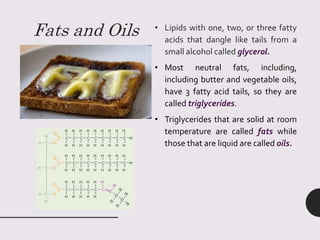
Fats and Oils • Lipids with one, two, or three fatty
acids that dangle like tails from a
small alcohol called glycerol.
• Most neutral fats, including,
including butter and vegetable oils,
have 3 fatty acid tails, so they are
called triglycerides.
• Triglycerides that are solid at room
temperature are called fats while
those that are liquid are called oils.
Saturated,
Mono-
unsaturated, and
Poly-unsaturated
Fats
• The terms saturated, mono-
unsaturated, and poly-unsaturated
refer to the number of hydrogens
attached to the hydrocarbon tails of the
fatty acids as compared to the number
of double bonds between carbon atoms
in the tail.
• the fatty acids in saturated fats contain
the maximum possible amount of
hydrogens. The hydrocarbon chains in
these fatty acids are, thus, fairly straight
and can pack closely together, making
these fats solid at room temperature.
Unsaturate
d Fats
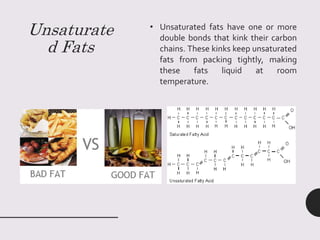
• Unsaturated fats have one or more
double bonds that kink their carbon
chains. These kinks keep unsaturated
fats from packing tightly, making
these fats liquid at room
temperature.
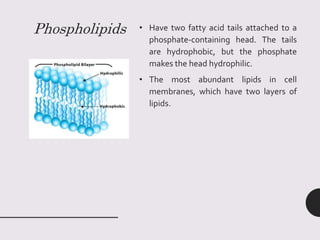
Phospholipids • Have two fatty acid tails attached to a
phosphate-containing head. The tails
are hydrophobic, but the phosphate
makes the head hydrophilic.
• The most abundant lipids in cell
membranes, which have two layers of
lipids.
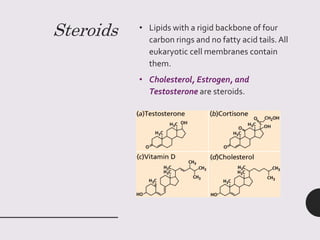
Steroids • Lipids with a rigid backbone of four
carbon rings and no fatty acid tails.All
eukaryotic cell membranes contain
them.
• Cholesterol, Estrogen, and
Testosterone are steroids.
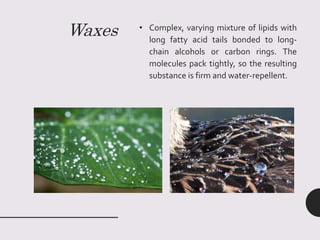
Waxes • Complex, varying mixture of lipids with
long fatty acid tails bonded to long-
chain alcohols or carbon rings. The
molecules pack tightly, so the resulting
substance is firm and water-repellent.
NUCLEIC
ACIDS
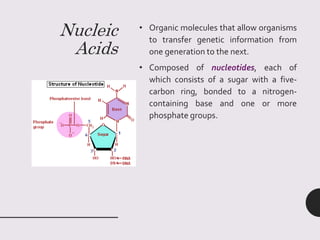
Nucleic
Acids
• Organic molecules that allow organisms
to transfer genetic information from
one generation to the next.
• Composed of nucleotides, each of
which consists of a sugar with a five-
carbon ring, bonded to a nitrogen-
containing base and one or more
phosphate groups.
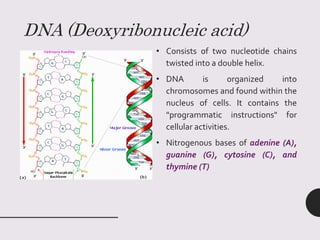
DNA (Deoxyribonucleic acid)
• Consists of two nucleotide chains
twisted into a double helix.
• DNA is organized into
chromosomes and found within the
nucleus of cells. It contains the
"programmatic instructions" for
cellular activities.
• Nitrogenous bases of adenine (A),
guanine (G), cytosine (C), and
thymine (T)
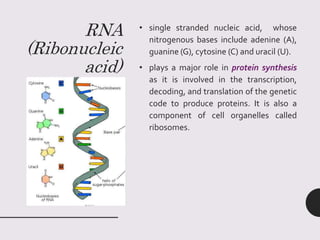
RNA
(Ribonucleic
acid)
• single stranded nucleic acid, whose
nitrogenous bases include adenine (A),
guanine (G), cytosine (C) and uracil (U).
• plays a major role in protein synthesis
as it is involved in the transcription,
decoding, and translation of the genetic
code to produce proteins. It is also a
component of cell organelles called
ribosomes.
THANK
YOU!

lipids and nucleic acids

  • 1.
  • 2.
    Lipids • alarge and diverse group of naturally occurring organic compounds that are related by their solubility in nonpolar organic solvents (e.g. ether, chloroform, acetone & benzene) and general insolubility in water. • many lipids incorporate fatty acids, small organic compounds consisting of a long carbon chain with an acidic carboxyl group at one end. • Major lipid groups include fats, phospholipids, steroids, and waxes.
  • 3.
    Fats and Oils• Lipids with one, two, or three fatty acids that dangle like tails from a small alcohol called glycerol. • Most neutral fats, including, including butter and vegetable oils, have 3 fatty acid tails, so they are called triglycerides. • Triglycerides that are solid at room temperature are called fats while those that are liquid are called oils.
  • 4.
    Saturated, Mono- unsaturated, and Poly-unsaturated Fats • Theterms saturated, mono- unsaturated, and poly-unsaturated refer to the number of hydrogens attached to the hydrocarbon tails of the fatty acids as compared to the number of double bonds between carbon atoms in the tail. • the fatty acids in saturated fats contain the maximum possible amount of hydrogens. The hydrocarbon chains in these fatty acids are, thus, fairly straight and can pack closely together, making these fats solid at room temperature.
  • 5.
    Unsaturate d Fats • Unsaturatedfats have one or more double bonds that kink their carbon chains. These kinks keep unsaturated fats from packing tightly, making these fats liquid at room temperature.
  • 6.
    Phospholipids • Havetwo fatty acid tails attached to a phosphate-containing head. The tails are hydrophobic, but the phosphate makes the head hydrophilic. • The most abundant lipids in cell membranes, which have two layers of lipids.
  • 7.
    Steroids • Lipidswith a rigid backbone of four carbon rings and no fatty acid tails.All eukaryotic cell membranes contain them. • Cholesterol, Estrogen, and Testosterone are steroids.
  • 8.
    Waxes • Complex,varying mixture of lipids with long fatty acid tails bonded to long- chain alcohols or carbon rings. The molecules pack tightly, so the resulting substance is firm and water-repellent.
  • 9.
  • 10.
    Nucleic Acids • Organic moleculesthat allow organisms to transfer genetic information from one generation to the next. • Composed of nucleotides, each of which consists of a sugar with a five- carbon ring, bonded to a nitrogen- containing base and one or more phosphate groups.
  • 11.
    DNA (Deoxyribonucleic acid) •Consists of two nucleotide chains twisted into a double helix. • DNA is organized into chromosomes and found within the nucleus of cells. It contains the "programmatic instructions" for cellular activities. • Nitrogenous bases of adenine (A), guanine (G), cytosine (C), and thymine (T)
  • 12.
    RNA (Ribonucleic acid) • single strandednucleic acid, whose nitrogenous bases include adenine (A), guanine (G), cytosine (C) and uracil (U). • plays a major role in protein synthesis as it is involved in the transcription, decoding, and translation of the genetic code to produce proteins. It is also a component of cell organelles called ribosomes.
  • 13.