Lipids Fats and Oils  Steroids Phospholipids 03/09/10
Lipids Nonpolar - mostly C, H – like hydrocarbons Hydrophobic – don’t dissolve in water Feel slippery/oily Some fatty acids are  ESSENTIAL 1 03/09/10
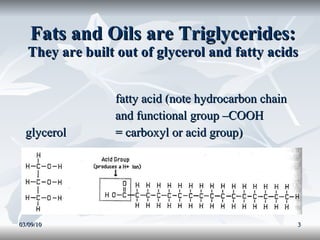
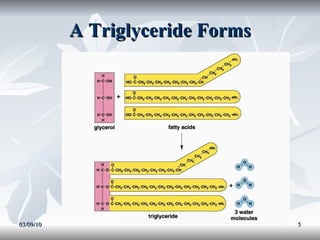
Fats and Oils are Triglycerides: They are built out of glycerol and fatty acids   glycerol fatty acid (note hydrocarbon chain  and functional group –COOH  = carboxyl or acid group) 03/09/10
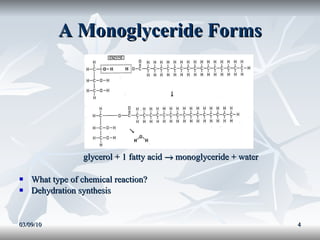
A Monoglyceride Forms glycerol + 1 fatty acid    monoglyceride + water What type of chemical reaction? Dehydration synthesis 03/09/10
A Triglyceride Forms 03/09/10
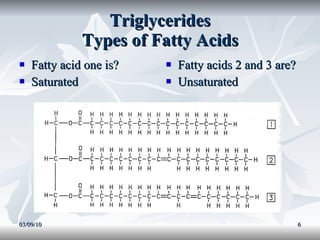
Triglycerides Types of Fatty Acids Fatty acid one is? Saturated Fatty acids 2 and 3 are? Unsaturated 03/09/10
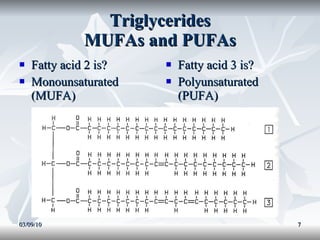
Triglycerides MUFAs and PUFAs Fatty acid 2 is? Monounsaturated (MUFA) Fatty acid 3 is?  Polyunsaturated (PUFA) 03/09/10
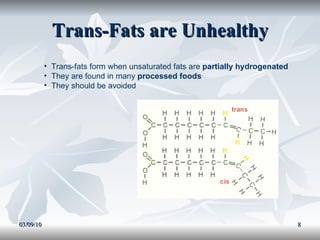
Trans-Fats are Unhealthy 03/09/10 Trans-fats form when unsaturated fats are  partially hydrogenated They are found in many  processed foods They should be avoided
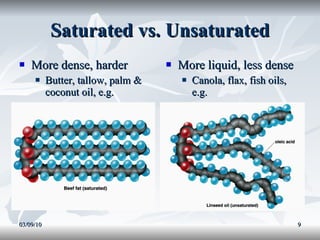
Saturated vs. Unsaturated More dense, harder Butter, tallow, palm & coconut oil, e.g. More liquid, less dense Canola, flax, fish oils, e.g. 03/09/10
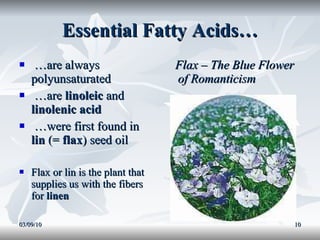
Essential Fatty Acids… … are always polyunsaturated … are  linoleic  and  linolenic acid … were first found in  lin  (=  flax ) seed oil Flax or lin is the plant that supplies us with the fibers for  linen Flax – The Blue Flower of Romanticism 03/09/10
Essential Fatty Acids polyunsaturated found in: plant oils  (especially flax seed (lin),  canola, soy fish oils 03/09/10
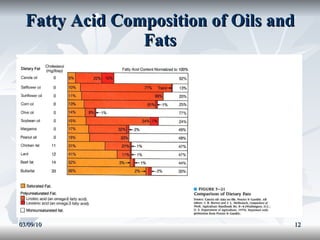
Fatty Acid Composition of Oils and Fats 03/09/10
Lipids Function In Living Things 03/09/10
Function of Lipids Energy storage, insulation, shock absorption fats, oils Protection  oils, waxes Component of cell membranes  phospholipids, cholesterol Hormones  sex hormones other steroid hormones Carriers for fat-soluble vitamins Provide Flavor  to foods 03/09/10
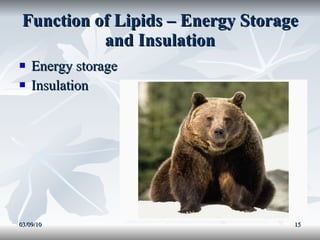
Function of Lipids – Energy Storage and Insulation Energy storage  Insulation 03/09/10
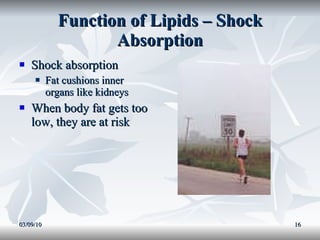
Function of Lipids – Shock Absorption Shock absorption Fat cushions inner organs like kidneys When body fat gets too low, they are at risk 03/09/10
Waxes For Building and Coating Bee hive They also coat (shiny) leaves, to prevent evaporation 03/09/10
Cell Membranes Fatty acids are used to make: Phospholipids and Cholesterol 03/09/10
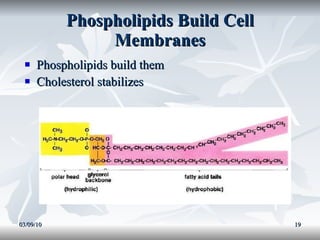
Phospholipids Build Cell Membranes Phospholipids build them Cholesterol stabilizes 03/09/10
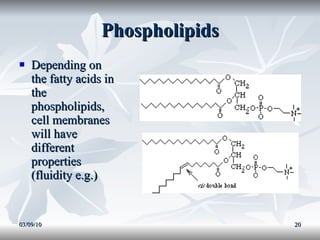
Phospholipids Depending on the fatty acids in the phospholipids, cell membranes will have different properties (fluidity e.g.) 03/09/10
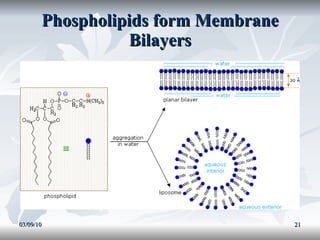
Phospholipids form Membrane Bilayers 03/09/10
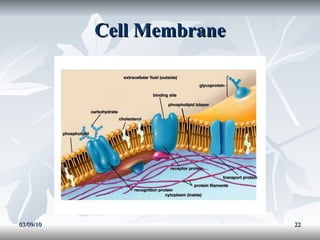
Cell Membrane 03/09/10
All cell membranes   in all cells  and around  all cell organelles  are made from  phospholipids 03/09/10
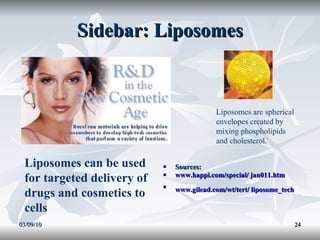
Sidebar: Liposomes Sources: www.happi.com/special/ jan011.htm   www.gilead.com/wt/tert/ liposome_tech   03/09/10 Liposomes are spherical envelopes created by  mixing phospholipids and cholesterol. Liposomes can be used for targeted delivery of drugs and cosmetics to cells
Carriers for Fat-Soluble Vitamins Fat-soluble vitamins (A, D, E, K) can only be absorbed when consumed with fats/oils. These vitamins from salads are significantly better absorbed when the dressing contains oil. Salad dressings can contain the fats we need, in their best form: raw Conclusion: Fat-free dressings are a stupid invention If you are getting too many calories it is better to cut calories elsewhere. 03/09/10
Which is the fattiest organ of your body? Your brain! 03/09/10
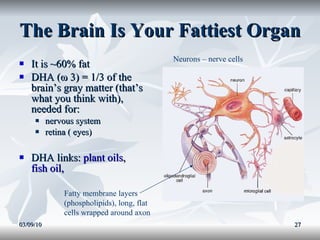
The Brain Is Your Fattiest Organ It is ~60% fat DHA (ω 3) = 1/3 of the brain’s gray matter (that’s what you think with), needed for: nervous system  retina ( eyes) DHA links:  plant oils ,  fish oil,    03/09/10 Fatty membrane layers (phospholipids), long, flat cells wrapped around axon Neurons – nerve cells
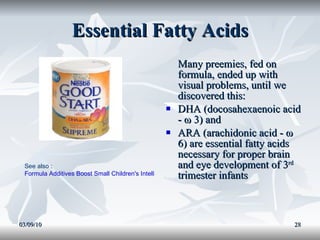
Essential Fatty Acids Many preemies, fed on formula, ended up with  visual problems, until we discovered this: DHA (docosahexaenoic acid - ω 3) and ARA (arachidonic acid - ω 6) are essential fatty acids necessary for proper brain and eye development of 3 rd  trimester infants 03/09/10 See also :  Formula Additives Boost Small Children's Intelligence In Study
Lipid Hormones  Sex and other hormones 03/09/10
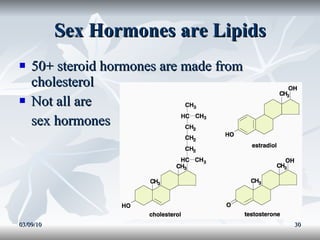
Sex Hormones are Lipids 50+ steroid hormones are made from cholesterol Not all are sex hormones 03/09/10
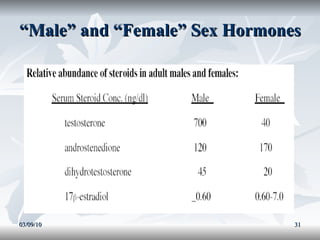
“ Male” and “Female” Sex Hormones 03/09/10
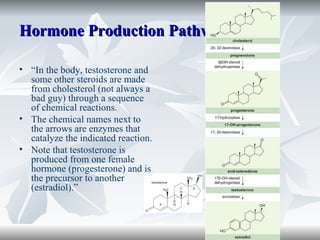
Hormone Production Pathways  “ In the body, testosterone and some other steroids are made from cholesterol (not always a bad guy) through a sequence of chemical reactions.  The chemical names next to the arrows are enzymes that catalyze the indicated reaction.  Note that testosterone is produced from one female hormone (progesterone) and is the precursor to another (estradiol).”
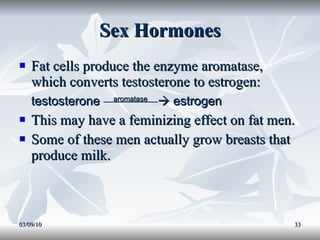
Sex Hormones Fat cells produce the enzyme aromatase, which converts testosterone to estrogen: testosterone  aromatase    estrogen This may have a feminizing effect on fat men. Some of these men actually grow breasts that produce milk. 03/09/10
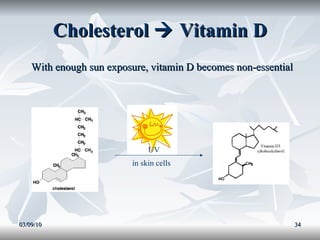
Cholesterol    Vitamin D With enough sun exposure, vitamin D becomes non-essential 03/09/10 in skin cells UV
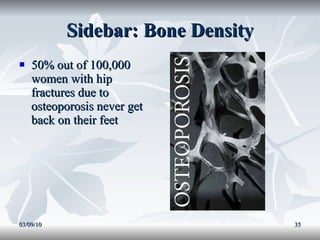
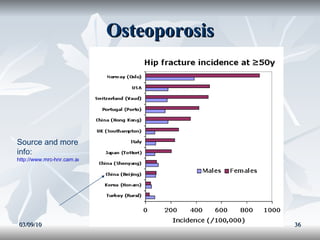
Sidebar: Bone Density 50% out of 100,000 women with hip fractures due to osteoporosis never get back on their feet 03/09/10
Osteoporosis 03/09/10 Source and more info: http://www.mrc-hnr.cam.ac.uk/research/bone_health/bone_health.html
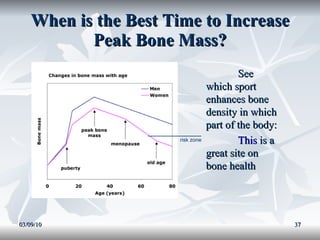
When is the Best Time to Increase Peak Bone Mass? 03/09/10 ____________ risk zone See which sport enhances bone density in which part of the body: This  is a great site on bone health
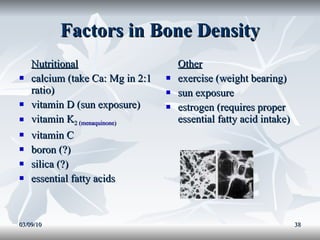
Factors in Bone Density Nutritional calcium (take Ca: Mg in 2:1 ratio) vitamin D (sun exposure) vitamin K 2 ( menaquinone ) vitamin C  boron (?) silica (?) essential fatty acids Other exercise (weight bearing) sun exposure estrogen (requires proper essential fatty acid intake) 03/09/10
Bone Health See which sport enhances bone density in which part of the body This  is a great site on bone health 03/09/10
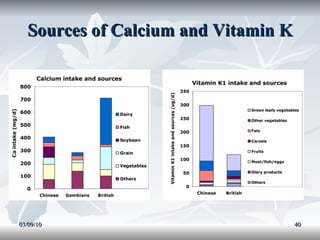
Sources of Calcium and Vitamin K 03/09/10
Lipid Requirements Which lipids do we need? Essential, unsaturated fatty acids How much should we get? 20 -35 % of total calories consumed should be from fats Max. 1/3 of total fat calories (=1/10 of total calories) from saturated FAs 2/3 from unsaturated fats (MUFA and PUFA) 5 MUFA : 1 PUFA 4  ω   ( omega) 6 : 1  ω 3 03/09/10
Fish Oils and Health For a meat-eating man, replacing 1 meat meal a week with a fish meal reduces his chance of stroke by 20% 03/09/10
Should You Eat Fish Caught in the Waters Around New York City? See next page or click  here  for Dept. of Health Info 03/09/10
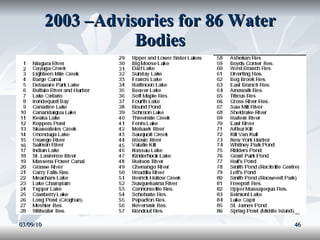
Wave of Fish Advisories  New figures released by the U.S. EPA show that  35% of lake  acreage in the United States and  24% of river  miles  contain enough pollution to warrant consumption advisories for fish  caught in those waters.  The advisories cover some  40 different substances ; 98% of them involve  PCBs, chlordane, dioxins, DDT, or mercury .  Though the number of advisories rose from 2,814 in 2002 to 3,094 in 2003, EPA administrator Mike Leavitt attributed that increase to more monitoring rather than an increase in pollution. .. 1 03/09/10
03/09/10
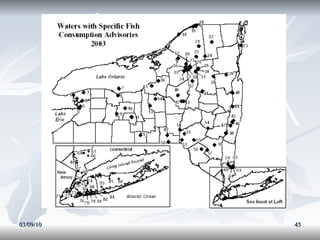
2003 –Advisories for 86 Water Bodies 03/09/10
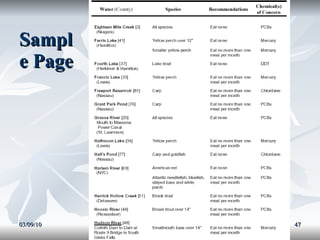
Sample Page 03/09/10
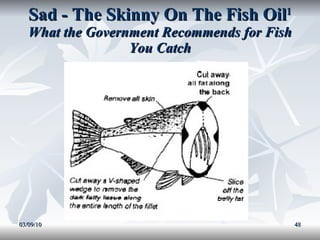
Sad - The Skinny On The Fish Oil 1 What the Government Recommends for Fish You Catch 03/09/10
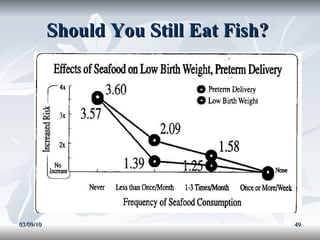
Should You Still Eat Fish?  03/09/10
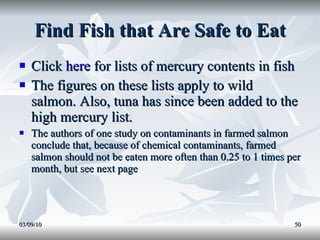
Find Fish that Are Safe to Eat Click  here  for lists of mercury contents in fish The figures on these lists apply to wild salmon. Also, tuna has since been added to the high mercury list. The authors of one study on contaminants in farmed salmon conclude that, because of chemical contaminants, farmed salmon should not be eaten more often than 0.25 to 1 times per month, but see next page 03/09/10
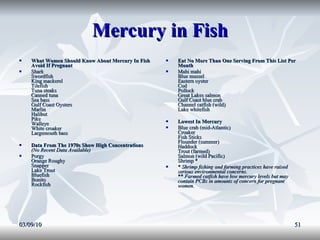
Mercury in Fish What Women Should Know About Mercury In Fish Avoid If Pregnant   Shark Swordfish King mackerel Tilefish Tuna steaks Canned tuna Sea bass Gulf Coast Oysters Marlin Halibut Pike Walleye White croaker Largemouth bass  Data From The 1970s Show High Concentrations   (No Recent Data Available)   Porgy Orange Roughy Snapper Lake Trout Bluefish Bonito Rockfish  Eat No More Than One Serving From This List Per Month   Mahi mahi Blue mussel Eastern oyster Cod Pollock Great Lakes salmon Gulf Coast blue crab Channel catfish (wild) Lake whitefish  Lowest In Mercury   Blue crab (mid-Atlantic) Croaker Fish Sticks Flounder (summer) Haddock Trout (farmed) Salmon (wild Pacific) Shrimp *  *  Shrimp fishing and farming practices have raised serious environmental concerns. **  Farmed catfish have low mercury levels but may contain PCBs in amounts of concern for pregnant women.   03/09/10
The Environmental Working Group’s Tuna Calculator Click  here  to find out how much tuna a week you can safely eat 03/09/10
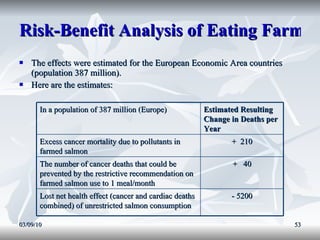
Risk-Benefit Analysis of Eating Farmed Salmon The effects were estimated for the European Economic Area countries (population 387 million).  Here are the estimates: 03/09/10 In a population of 387 million (Europe)  Estimated Resulting Change in Deaths per Year  Excess cancer mortality due to pollutants in farmed salmon +  210 The number of cancer deaths that could be prevented by the restrictive recommendation on farmed salmon use to 1 meal/month +  40 Lost net health effect (cancer and cardiac deaths combined) of unrestricted salmon consumption - 5200
Yes !!! But … The EPA’s advisories for pregnant and breastfeeding women This site has lots of info regarding breast-feeding, go to the reference articles on the bottom 03/09/10
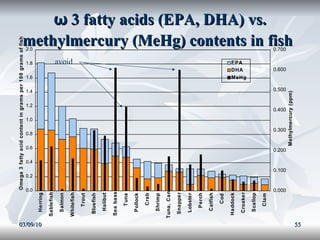
ω  3 fatty acids (EPA, DHA) vs. methylmercury (MeHg) contents in fish   03/09/10 avoid
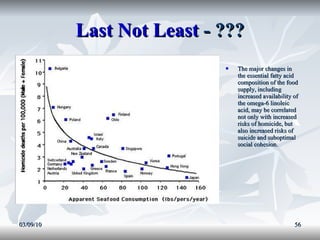
Last Not Least  - ??? The major changes in the essential fatty acid composition of the food supply, including increased availability of the omega-6 linoleic acid, may be correlated not only with increased risks of homicide, but also increased risks of suicide and suboptimal social cohesion. 03/09/10
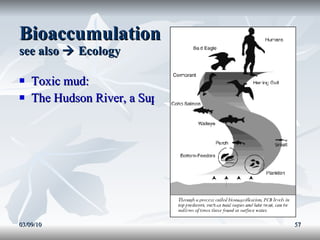
Bioaccumulation see also    Ecology Toxic mud: The Hudson River, a Superfund Site 03/09/10
The End Next => Proteins 03/09/10

Lipids

  • 1.
    Lipids Fats andOils Steroids Phospholipids 03/09/10
  • 2.
    Lipids Nonpolar -mostly C, H – like hydrocarbons Hydrophobic – don’t dissolve in water Feel slippery/oily Some fatty acids are ESSENTIAL 1 03/09/10
  • 3.
    Fats and Oilsare Triglycerides: They are built out of glycerol and fatty acids glycerol fatty acid (note hydrocarbon chain and functional group –COOH = carboxyl or acid group) 03/09/10
  • 4.
    A Monoglyceride Formsglycerol + 1 fatty acid  monoglyceride + water What type of chemical reaction? Dehydration synthesis 03/09/10
  • 5.
  • 6.
    Triglycerides Types ofFatty Acids Fatty acid one is? Saturated Fatty acids 2 and 3 are? Unsaturated 03/09/10
  • 7.
    Triglycerides MUFAs andPUFAs Fatty acid 2 is? Monounsaturated (MUFA) Fatty acid 3 is? Polyunsaturated (PUFA) 03/09/10
  • 8.
    Trans-Fats are Unhealthy03/09/10 Trans-fats form when unsaturated fats are partially hydrogenated They are found in many processed foods They should be avoided
  • 9.
    Saturated vs. UnsaturatedMore dense, harder Butter, tallow, palm & coconut oil, e.g. More liquid, less dense Canola, flax, fish oils, e.g. 03/09/10
  • 10.
    Essential Fatty Acids…… are always polyunsaturated … are linoleic and linolenic acid … were first found in lin (= flax ) seed oil Flax or lin is the plant that supplies us with the fibers for linen Flax – The Blue Flower of Romanticism 03/09/10
  • 11.
    Essential Fatty Acidspolyunsaturated found in: plant oils (especially flax seed (lin), canola, soy fish oils 03/09/10
  • 12.
    Fatty Acid Compositionof Oils and Fats 03/09/10
  • 13.
    Lipids Function InLiving Things 03/09/10
  • 14.
    Function of LipidsEnergy storage, insulation, shock absorption fats, oils Protection oils, waxes Component of cell membranes phospholipids, cholesterol Hormones sex hormones other steroid hormones Carriers for fat-soluble vitamins Provide Flavor to foods 03/09/10
  • 15.
    Function of Lipids– Energy Storage and Insulation Energy storage Insulation 03/09/10
  • 16.
    Function of Lipids– Shock Absorption Shock absorption Fat cushions inner organs like kidneys When body fat gets too low, they are at risk 03/09/10
  • 17.
    Waxes For Buildingand Coating Bee hive They also coat (shiny) leaves, to prevent evaporation 03/09/10
  • 18.
    Cell Membranes Fattyacids are used to make: Phospholipids and Cholesterol 03/09/10
  • 19.
    Phospholipids Build CellMembranes Phospholipids build them Cholesterol stabilizes 03/09/10
  • 20.
    Phospholipids Depending onthe fatty acids in the phospholipids, cell membranes will have different properties (fluidity e.g.) 03/09/10
  • 21.
    Phospholipids form MembraneBilayers 03/09/10
  • 22.
  • 23.
    All cell membranes in all cells and around all cell organelles are made from phospholipids 03/09/10
  • 24.
    Sidebar: Liposomes Sources:www.happi.com/special/ jan011.htm www.gilead.com/wt/tert/ liposome_tech 03/09/10 Liposomes are spherical envelopes created by mixing phospholipids and cholesterol. Liposomes can be used for targeted delivery of drugs and cosmetics to cells
  • 25.
    Carriers for Fat-SolubleVitamins Fat-soluble vitamins (A, D, E, K) can only be absorbed when consumed with fats/oils. These vitamins from salads are significantly better absorbed when the dressing contains oil. Salad dressings can contain the fats we need, in their best form: raw Conclusion: Fat-free dressings are a stupid invention If you are getting too many calories it is better to cut calories elsewhere. 03/09/10
  • 26.
    Which is thefattiest organ of your body? Your brain! 03/09/10
  • 27.
    The Brain IsYour Fattiest Organ It is ~60% fat DHA (ω 3) = 1/3 of the brain’s gray matter (that’s what you think with), needed for: nervous system retina ( eyes) DHA links: plant oils , fish oil, 03/09/10 Fatty membrane layers (phospholipids), long, flat cells wrapped around axon Neurons – nerve cells
  • 28.
    Essential Fatty AcidsMany preemies, fed on formula, ended up with visual problems, until we discovered this: DHA (docosahexaenoic acid - ω 3) and ARA (arachidonic acid - ω 6) are essential fatty acids necessary for proper brain and eye development of 3 rd trimester infants 03/09/10 See also : Formula Additives Boost Small Children's Intelligence In Study
  • 29.
    Lipid Hormones Sex and other hormones 03/09/10
  • 30.
    Sex Hormones areLipids 50+ steroid hormones are made from cholesterol Not all are sex hormones 03/09/10
  • 31.
    “ Male” and“Female” Sex Hormones 03/09/10
  • 32.
    Hormone Production Pathways “ In the body, testosterone and some other steroids are made from cholesterol (not always a bad guy) through a sequence of chemical reactions. The chemical names next to the arrows are enzymes that catalyze the indicated reaction. Note that testosterone is produced from one female hormone (progesterone) and is the precursor to another (estradiol).”
  • 33.
    Sex Hormones Fatcells produce the enzyme aromatase, which converts testosterone to estrogen: testosterone aromatase  estrogen This may have a feminizing effect on fat men. Some of these men actually grow breasts that produce milk. 03/09/10
  • 34.
    Cholesterol  Vitamin D With enough sun exposure, vitamin D becomes non-essential 03/09/10 in skin cells UV
  • 35.
    Sidebar: Bone Density50% out of 100,000 women with hip fractures due to osteoporosis never get back on their feet 03/09/10
  • 36.
    Osteoporosis 03/09/10 Sourceand more info: http://www.mrc-hnr.cam.ac.uk/research/bone_health/bone_health.html
  • 37.
    When is theBest Time to Increase Peak Bone Mass? 03/09/10 ____________ risk zone See which sport enhances bone density in which part of the body: This is a great site on bone health
  • 38.
    Factors in BoneDensity Nutritional calcium (take Ca: Mg in 2:1 ratio) vitamin D (sun exposure) vitamin K 2 ( menaquinone ) vitamin C boron (?) silica (?) essential fatty acids Other exercise (weight bearing) sun exposure estrogen (requires proper essential fatty acid intake) 03/09/10
  • 39.
    Bone Health Seewhich sport enhances bone density in which part of the body This is a great site on bone health 03/09/10
  • 40.
    Sources of Calciumand Vitamin K 03/09/10
  • 41.
    Lipid Requirements Whichlipids do we need? Essential, unsaturated fatty acids How much should we get? 20 -35 % of total calories consumed should be from fats Max. 1/3 of total fat calories (=1/10 of total calories) from saturated FAs 2/3 from unsaturated fats (MUFA and PUFA) 5 MUFA : 1 PUFA 4 ω ( omega) 6 : 1 ω 3 03/09/10
  • 42.
    Fish Oils andHealth For a meat-eating man, replacing 1 meat meal a week with a fish meal reduces his chance of stroke by 20% 03/09/10
  • 43.
    Should You EatFish Caught in the Waters Around New York City? See next page or click here for Dept. of Health Info 03/09/10
  • 44.
    Wave of FishAdvisories New figures released by the U.S. EPA show that 35% of lake acreage in the United States and 24% of river miles contain enough pollution to warrant consumption advisories for fish caught in those waters. The advisories cover some 40 different substances ; 98% of them involve PCBs, chlordane, dioxins, DDT, or mercury . Though the number of advisories rose from 2,814 in 2002 to 3,094 in 2003, EPA administrator Mike Leavitt attributed that increase to more monitoring rather than an increase in pollution. .. 1 03/09/10
  • 45.
  • 46.
    2003 –Advisories for86 Water Bodies 03/09/10
  • 47.
  • 48.
    Sad - TheSkinny On The Fish Oil 1 What the Government Recommends for Fish You Catch 03/09/10
  • 49.
    Should You StillEat Fish? 03/09/10
  • 50.
    Find Fish thatAre Safe to Eat Click here for lists of mercury contents in fish The figures on these lists apply to wild salmon. Also, tuna has since been added to the high mercury list. The authors of one study on contaminants in farmed salmon conclude that, because of chemical contaminants, farmed salmon should not be eaten more often than 0.25 to 1 times per month, but see next page 03/09/10
  • 51.
    Mercury in FishWhat Women Should Know About Mercury In Fish Avoid If Pregnant Shark Swordfish King mackerel Tilefish Tuna steaks Canned tuna Sea bass Gulf Coast Oysters Marlin Halibut Pike Walleye White croaker Largemouth bass Data From The 1970s Show High Concentrations (No Recent Data Available) Porgy Orange Roughy Snapper Lake Trout Bluefish Bonito Rockfish Eat No More Than One Serving From This List Per Month Mahi mahi Blue mussel Eastern oyster Cod Pollock Great Lakes salmon Gulf Coast blue crab Channel catfish (wild) Lake whitefish Lowest In Mercury Blue crab (mid-Atlantic) Croaker Fish Sticks Flounder (summer) Haddock Trout (farmed) Salmon (wild Pacific) Shrimp * * Shrimp fishing and farming practices have raised serious environmental concerns. ** Farmed catfish have low mercury levels but may contain PCBs in amounts of concern for pregnant women. 03/09/10
  • 52.
    The Environmental WorkingGroup’s Tuna Calculator Click here to find out how much tuna a week you can safely eat 03/09/10
  • 53.
    Risk-Benefit Analysis ofEating Farmed Salmon The effects were estimated for the European Economic Area countries (population 387 million). Here are the estimates: 03/09/10 In a population of 387 million (Europe) Estimated Resulting Change in Deaths per Year Excess cancer mortality due to pollutants in farmed salmon + 210 The number of cancer deaths that could be prevented by the restrictive recommendation on farmed salmon use to 1 meal/month + 40 Lost net health effect (cancer and cardiac deaths combined) of unrestricted salmon consumption - 5200
  • 54.
    Yes !!! But… The EPA’s advisories for pregnant and breastfeeding women This site has lots of info regarding breast-feeding, go to the reference articles on the bottom 03/09/10
  • 55.
    ω 3fatty acids (EPA, DHA) vs. methylmercury (MeHg) contents in fish 03/09/10 avoid
  • 56.
    Last Not Least - ??? The major changes in the essential fatty acid composition of the food supply, including increased availability of the omega-6 linoleic acid, may be correlated not only with increased risks of homicide, but also increased risks of suicide and suboptimal social cohesion. 03/09/10
  • 57.
    Bioaccumulation see also  Ecology Toxic mud: The Hudson River, a Superfund Site 03/09/10
  • 58.
    The End Next=> Proteins 03/09/10

Editor's Notes

  • #3 Lipids-The second of four major classes of biochemical compounds. Essential nutrients: We cannot make (sufficient amounts of) them, but we need them, so we have to eat them. Two classes of lipids: Triglycerides: Oils & waxes. Nonfatty-acid types: steroids.
  • #5 Glycerin is another word for glycerol
  • #6 Figure 03.UN04 Title: Triglyceride formation Caption: Triglyceride formation glycerol and three fatty acids
  • #7 Saturated - No C=C double bonds Unsaturated - One or more C=C double bonds
  • #8 monounsaturated - 1 C=C double bond polyunsaturated – more than 1 C=C double bond
  • #10 Figure 03.UN05a Title: "Beef fat, a saturated triglyceride" Caption: Beef fat, a saturated triglyceride.
  • #16 Figure 03.05a Title: Lipids store energy Caption: A European brown bear ready to hibernate. Fat is an efficient way to store energy. If this bear stored the same amount of energy in carbohydrates instead of fat, she probably would be unable to walk!
  • #18 Figure 03.05b Title: Wax in a honeycomb Poison ivy, flowering Caption: Wax is a highly saturated lipid that remains very firm at normal outdoor temperatures. Its rigidity allows it to be used to form the strong but thin-walled hexagons of this honeycomb.
  • #20 Figure 03.6 Title: Phospholipids Caption: Phospholipids are similar to fats and oils, except that only two fatty acid tails are attached to the glycerol backbone. The third position on the glycerol is occupied by a polar head composed of a phosphate group (–PO 4 – ) to which a second, typically nitrogen-containing, functional group is attached. The phosphate group is negatively charged, and the nitrogen-containing group is positively charged.
  • #23 The basic building blocks of cell membranes are phospholipids, stabilized by cholesterol. Embedded are proteins and glycoproteins, depending on membrane function.
  • #28 Prematurely born babies used to not be given DHA in their formula. They ended up with vision problems (early need for glasses) because their bodies could not build the eyes (and their brains?) properly. It is very important during the 3 rd trimester of pregnancy.
  • #31 Figure 03.7 Title: Steroids Caption: Steroids are synthesized from cholesterol. All steroids have almost the same molecular structure (colored rings). Great differences in steroid function can be a result of even minor differences in functional groups attached to the rings. Notice the similarity in structure between the male sex hormone testosterone and the female sex hormone estradiol (a type of estrogen). Many steroid hormones are not sex hormones. INSUFFICIENT FAT INTAKE LEADS TO LACK OF SEX and other STEROID HORMONES
  • #33 The link in the header leads to an article that discusses doping with male hormones (Barry Bonds – baseball, Marion Jones – runner, Steve Landis – cyclist, Tour de France)
  • #45 Environmental advocates say these latest findings point up the need to more strictly regulate coal-fired power plants, one of the primary sources of mercury.
  • #49 Fish Consumption Advisories Infants, children under fifteen and women of childbearing age should not eat any fish from the Hudson River (including the Upper Bay of New York Harbor, Arthur Kill and Kill Van Kull), East River and Harlem River. They should not eat any striped bass from the Lower Bay of NY Harbor, should not eat more than ½ pound (1 meal) per week (combined) of American eels and bluefish from Jamaica Bay, the Rockaways and the Lower Bay, and should eat no more than 1 meal per week of striped bass from Jamaica Bay and the Rockaways. Women beyond childbearing age and men should not eat any American Eels caught in the East River & Harlem River, should not eat more than 1 meal per month (combined) of bluefish, striped bass, white perch and Atlantic needlefish and should not eat more than 1 meal per week (combined) of all other fish from these waters. They should not eat more than 1 meal per month (combined) of American eel, Atlantic needlefish, bluefish, carp, goldfish, largemouth bass, smallmouth bass, rainbow smelt, striped bass, walleye, white catfish, and white perch from the Hudson River (any part of the river in the NYC area, including the Upper Bay of New York Harbor, Arthur Kill and Kill Van Kull), and should not eat more than 1 meal per week of all other fish from these waters. They should not eat more than 1 meal per week (combined) of bluefish, American eels and striped bass from Jamaica Bay and the Lower Bay, no more than 1 meal per month of striped bass, and no more than 1 meal per week of American eel and bluefish from the Lower Bay. Source: NY State Dept. of Health Advisories for Fish and Game The entire Advisory is online at: http://www.health.state.ny.us/nysdoh/environ/fish.htm See also: http:// www.epa.gov/waterscience/fish
  • #52 Source: www.ewg.org
  • #57 Nutr Health. 2007;19(1-2):9-19.Links From homicide to happiness--a commentary on omega-3 fatty acids in human society. Cleave Award Lecture. Hibbeln JR .