Rasheed Perry, MPhil student

 Introduction to lipids.
 Functions of lipids.
 Triglycerides in foods.
 Trans fats.
 Digestion, absorption, and metabolism.
 Lipids and health.
 Dietary Athletic recommendations.
Content

WHAT ARE
LIPIDS?

 Each nutrient plays a specific and important role in
keeping the body healthy.
 Fat is one of 3 nutrients that provide energy. The
other two are carbohydrates and proteins.
 Lipid = a compound that is insoluble in water, but
soluble in an organic solvent (e.g., ether, benzene,
acetone, chloroform)
 “lipid” is synonymous with “fat”
LIPIDS

 Include
 fats, oils, and cholesterol, a rich source of energy and
found in the structure of fat cells
 Fat
 Solid at room tempreture
 Oils
 liquid at room tempreture
LIPIDS

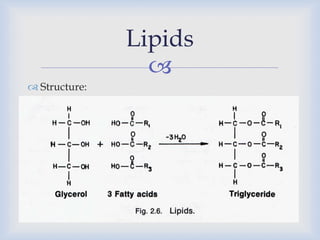
 Structure:
Lipids
Types of Lipids

 Saturated Fats
a lipid have no double bonds between carbons in chain
 Monounsaturated
a lipid has two double bonds between carbons in chain
 Polyunsaturated
a lipid has more than double bonds between carbons in
chain
Types of Lipids

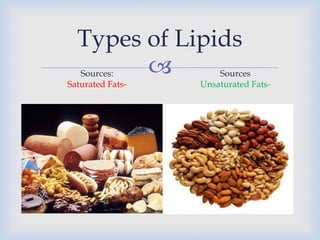
Types of Lipids
Sources:
Saturated Fats-
Sources
Unsaturated Fats-

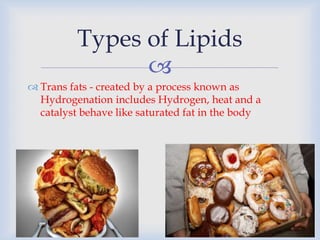
 Trans fats - created by a process known as
Hydrogenation includes Hydrogen, heat and a
catalyst behave like saturated fat in the body
Types of Lipids

 Cholesterol
 Is found in every cell in the body
 Needed to make
 bile acids
 hormones
 vitamin D
Types of Lipids

WHAT Functions do lipids
have in food

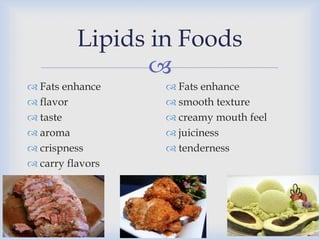
Lipids in Foods
 Fats enhance
 flavor
 taste
 aroma
 crispness
 carry flavors
 Fats enhance
 smooth texture
 creamy mouth feel
 juiciness
 tenderness

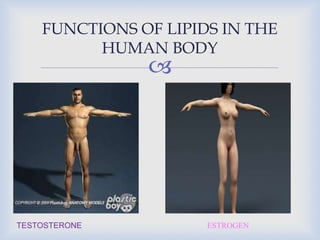
FUNCTIONS OF LIPIDS IN THE
HUMAN BODY
TESTOSTERONE ESTROGEN

 Lipids are concentrated sources of energy (9 kcal/g)
 Provide means whereby fat-soluble nutrients (e.g.,
sterols, vitamins) can be absorbed by the body
 Structural element of cell, subcellular components
 Components of hormones and precursors for
prostaglandin synthesis
FUNCTIONS OF LIPIDS IN THE
HUMAN BODY
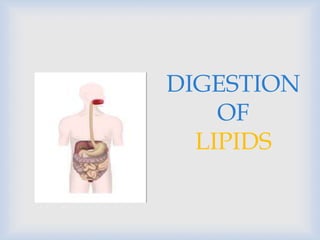
DIGESTION
OF
LIPIDS
• The first step to digestion is the
mastication or chewing of the
food item
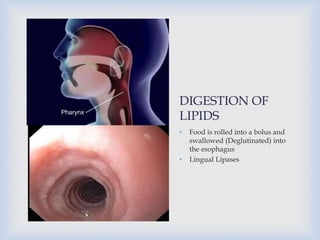
DIGESTION OF
LIPIDS
• Food is rolled into a bolus and
swallowed (Deglutinated) into
the esophagus
• Lingual Lipases
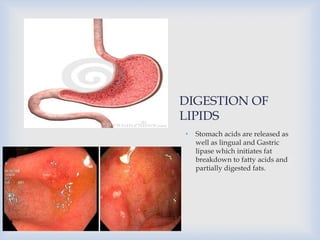
DIGESTION OF
LIPIDS
• Stomach acids are released as
well as lingual and Gastric
lipase which initiates fat
breakdown to fatty acids and
partially digested fats.
DIGESTION OF
LIPIDS
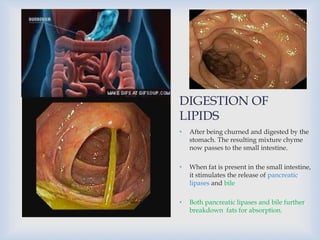
• After being churned and digested by the
stomach. The resulting mixture chyme
now passes to the small intestine.
• When fat is present in the small intestine,
it stimulates the release of pancreatic
lipases and bile
• Both pancreatic lipases and bile further
breakdown fats for absorption.
LIPIDS IN HEALTH

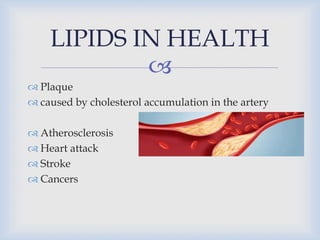
 Plaque
 caused by cholesterol accumulation in the artery
 Atherosclerosis
 Heart attack
 Stroke
 Cancers
LIPIDS IN HEALTH

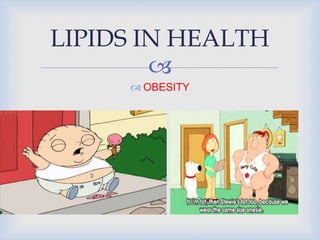
 OBESITY
LIPIDS IN HEALTH

 Dietary Recomendaions for Fat are that fat should
compose 10- 35% of the total amount of energy from
the individuals diet.
 Saturated Fat (M- less than 30mg/ F – less than 20mg)
 Cholesterol- less than 300mg
Dietary Recomendaions

FAT INTAKE OF ACTIVE AND
INACTIVE INDIVIDUALS
Generally:
 Active individuals have lower stores of body fat than
inactive individuals.
 Women have higher body fat stores than men.

FACTORS THAT CAN ENHANCE OR
INHIBIT FAT OXIDATION DURING
EXERCISE
IMPORTANCE OF DIETARY FATS
 Fat meets energy needs:
Need 10 - 30% of total daily kcal as fat
 Dietary fat:
Essential to human metabolism
 Provides essential fatty acids:
a. Linoleic acid
b. Alpha-linolenic acid
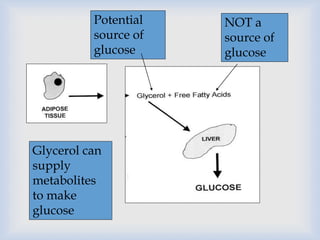
NOT a
source of
glucose
Potential
source of
glucose
Glycerol can
supply
metabolites
to make
glucose

FACTORS THAT CAN ENHANCE OR
INHIBIT FAT OXIDATION DURING
EXERCISE
Two major sources for ATP production during
exercise:
carbohydrate
fats
(mixture of both fuels used)

FACTORS THAT CAN ENHANCE OR
INHIBIT FAT OXIDATION DURING
EXERCISE
Sources of fat during exercise:
 Stored fat:
 Muscle fat
 Adipose tissue
 Lipoproteins in the blood

FACTORS THAT CAN ENHANCE OR
INHIBIT FAT OXIDATION DURING
EXERCISE
Factors that determine the amount and source of
Fat used during exercise:
 Fitness level
 Type of exercise
 Intensity and duration of exercise
 Available fat reserves in the muscle
 Composition of pre-exercise meal
 Availability of stored carbohydrate or amount of
carbohydrate eaten during exercise

FACTORS THAT CAN ENHANCE OR
INHIBIT FAT OXIDATION DURING
EXERCISE
Trained athletes use more fat than untrained
athletes during a standardized exercise task:
 Increased blood flow and capillarization to
muscle, delivering more free fatty acids
 Increased number and size of mitochondria and associated
oxidative enzymes for processing of
activated free fatty acids
 Increased activation of free fatty acids and transport across
mitochondrial membrane

FACTORS THAT CAN ENHANCE OR
INHIBIT FAT OXIDATION DURING
EXERCISE
Moderate exercise, 60-75 % VO2
Max of long duration:
Fat is the primary energy source

Fats: Ergogenic aspects
Examples of research studies:
 Venkatraman (1998) noted short term high fat diets may
improve endurance exercise performance at 60-80% VO2
max
 Keins (2000) noted that varying periods of fat adaptation
followed by high carbohydrate diet, despite increased fat
oxidation and decreased carbohydrates oxidation during
submaximal exercise resulted in no ergogenic benefits
High fat diets not advised for long-term basis

FACTORS THAT CAN ENHANCE OR
INHIBIT FAT OXIDATION DURING
EXERCISE
Moderate exercise, 60-75 % VO2
Max of long duration:
Fat is the primary energy source

FACTORS THAT CAN ENHANCE OR
INHIBIT FAT OXIDATION DURING
EXERCISE
Exercise at 65% VO2 max
Fats , carbohydrates contribute almost equally
Exercise at > 85% VO2 max
a. Energy contribution from fats diminishes to <
25%
b. Muscle glycogen becomes preferred energy
source

FACTORS THAT CAN ENHANCE OR
INHIBIT FAT OXIDATION DURING
EXERCISE
Within 90 to 120 minutes of high-intensity
aerobic exercise:
 Glycogen stores significantly drop
 The body shifts to an increased usage of free fatty acids ,
leading to a decrease in exercise intensity

Fats: Ergogenic aspects
Fat loading:
Appears to be no benefit of consuming high-fat
meal several hours prior to performance
Consuming a high-fat diet for 1-2 days may impair
performance in high-intensity exercise
Chronic low- carbohydrates and high-fat diets:
 Do not benefit performance in untrained individuals
 Additional research is needed with highly-trained endurance
athletes
 Research studies report conflicting results

Fats: Ergogenic aspects
Examples of research studies:
 Venkatraman (1998) noted short term high fat diets may
improve endurance exercise performance at 60-80% VO2
max
 Keins (2000) noted that varying periods of fat adaptation
followed by high carbohydrate diet, despite increased fat
oxidation and decreased carbohydrates oxidation during
submaximal exercise resulted in no ergogenic benefits
High fat diets not advised for long-term basis

Determining Percentage
Fat by weight
 Determine the total weight of fat within the product.
 Divide the total weight of Fat by the net weight and
multiply the value obtained by 100 to determine
percentage fat by weight.

Determining Calories
from Fat
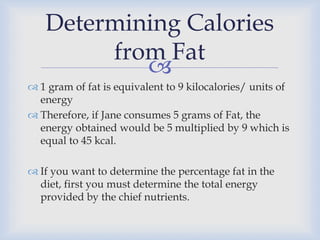
 1 gram of fat is equivalent to 9 kilocalories/ units of
energy
 Therefore, if Jane consumes 5 grams of Fat, the
energy obtained would be 5 multiplied by 9 which is
equal to 45 kcal.
 If you want to determine the percentage fat in the
diet, first you must determine the total energy
provided by the chief nutrients.

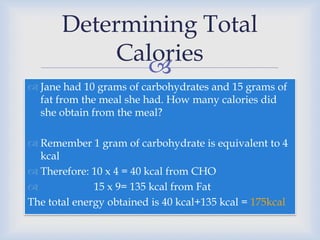
 Jane had 10 grams of carbohydrates and 15 grams of
fat from the meal she had. How many calories did
she obtain from the meal?
 Remember 1 gram of carbohydrate is equivalent to 4
kcal
 Therefore: 10 x 4 = 40 kcal from CHO
 15 x 9= 135 kcal from Fat
The total energy obtained is 40 kcal+135 kcal = 175kcal
Determining Total
Calories

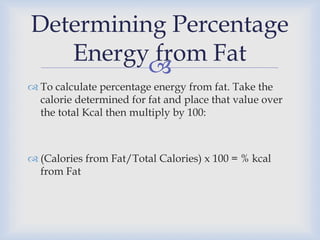
 To calculate percentage energy from fat. Take the
calorie determined for fat and place that value over
the total Kcal then multiply by 100:
 (Calories from Fat/Total Calories) x 100 = % kcal
from Fat
Determining Percentage
Energy from Fat

Determining Percentage
Energy from Fat
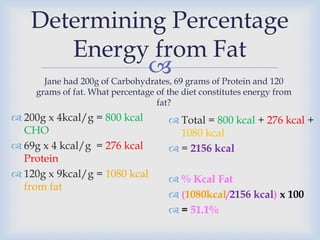
 200g x 4kcal/g = 800 kcal
CHO
 69g x 4 kcal/g = 276 kcal
Protein
 120g x 9kcal/g = 1080 kcal
from fat
Jane had 200g of Carbohydrates, 69 grams of Protein and 120
grams of fat. What percentage of the diet constitutes energy from
fat?
 Total = 800 kcal + 276 kcal +
1080 kcal
 = 2156 kcal
 % Kcal Fat
 (1080kcal/2156 kcal) x 100
 = 51.1%
Lipids: Fats and Oils

Lipids: Fats and Oils

  • 1.
  • 2.
      Introduction tolipids.  Functions of lipids.  Triglycerides in foods.  Trans fats.  Digestion, absorption, and metabolism.  Lipids and health.  Dietary Athletic recommendations. Content
  • 3.
  • 4.
      Each nutrientplays a specific and important role in keeping the body healthy.  Fat is one of 3 nutrients that provide energy. The other two are carbohydrates and proteins.  Lipid = a compound that is insoluble in water, but soluble in an organic solvent (e.g., ether, benzene, acetone, chloroform)  “lipid” is synonymous with “fat” LIPIDS
  • 5.
      Include  fats,oils, and cholesterol, a rich source of energy and found in the structure of fat cells  Fat  Solid at room tempreture  Oils  liquid at room tempreture LIPIDS
  • 6.
  • 7.
  • 8.
      Saturated Fats alipid have no double bonds between carbons in chain  Monounsaturated a lipid has two double bonds between carbons in chain  Polyunsaturated a lipid has more than double bonds between carbons in chain Types of Lipids
  • 9.
     Types of Lipids Sources: SaturatedFats- Sources Unsaturated Fats-
  • 10.
      Trans fats- created by a process known as Hydrogenation includes Hydrogen, heat and a catalyst behave like saturated fat in the body Types of Lipids
  • 11.
      Cholesterol  Isfound in every cell in the body  Needed to make  bile acids  hormones  vitamin D Types of Lipids
  • 12.
     WHAT Functions dolipids have in food
  • 13.
     Lipids in Foods Fats enhance  flavor  taste  aroma  crispness  carry flavors  Fats enhance  smooth texture  creamy mouth feel  juiciness  tenderness
  • 14.
     FUNCTIONS OF LIPIDSIN THE HUMAN BODY TESTOSTERONE ESTROGEN
  • 15.
      Lipids areconcentrated sources of energy (9 kcal/g)  Provide means whereby fat-soluble nutrients (e.g., sterols, vitamins) can be absorbed by the body  Structural element of cell, subcellular components  Components of hormones and precursors for prostaglandin synthesis FUNCTIONS OF LIPIDS IN THE HUMAN BODY
  • 16.
  • 17.
    • The firststep to digestion is the mastication or chewing of the food item
  • 18.
    DIGESTION OF LIPIDS • Foodis rolled into a bolus and swallowed (Deglutinated) into the esophagus • Lingual Lipases
  • 19.
    DIGESTION OF LIPIDS • Stomachacids are released as well as lingual and Gastric lipase which initiates fat breakdown to fatty acids and partially digested fats.
  • 20.
    DIGESTION OF LIPIDS • Afterbeing churned and digested by the stomach. The resulting mixture chyme now passes to the small intestine. • When fat is present in the small intestine, it stimulates the release of pancreatic lipases and bile • Both pancreatic lipases and bile further breakdown fats for absorption.
  • 21.
  • 22.
      Plaque  causedby cholesterol accumulation in the artery  Atherosclerosis  Heart attack  Stroke  Cancers LIPIDS IN HEALTH
  • 23.
  • 24.
      Dietary Recomendaionsfor Fat are that fat should compose 10- 35% of the total amount of energy from the individuals diet.  Saturated Fat (M- less than 30mg/ F – less than 20mg)  Cholesterol- less than 300mg Dietary Recomendaions
  • 25.
     FAT INTAKE OFACTIVE AND INACTIVE INDIVIDUALS Generally:  Active individuals have lower stores of body fat than inactive individuals.  Women have higher body fat stores than men.
  • 26.
     FACTORS THAT CANENHANCE OR INHIBIT FAT OXIDATION DURING EXERCISE IMPORTANCE OF DIETARY FATS  Fat meets energy needs: Need 10 - 30% of total daily kcal as fat  Dietary fat: Essential to human metabolism  Provides essential fatty acids: a. Linoleic acid b. Alpha-linolenic acid
  • 27.
    NOT a source of glucose Potential sourceof glucose Glycerol can supply metabolites to make glucose
  • 28.
     FACTORS THAT CANENHANCE OR INHIBIT FAT OXIDATION DURING EXERCISE Two major sources for ATP production during exercise: carbohydrate fats (mixture of both fuels used)
  • 29.
     FACTORS THAT CANENHANCE OR INHIBIT FAT OXIDATION DURING EXERCISE Sources of fat during exercise:  Stored fat:  Muscle fat  Adipose tissue  Lipoproteins in the blood
  • 30.
     FACTORS THAT CANENHANCE OR INHIBIT FAT OXIDATION DURING EXERCISE Factors that determine the amount and source of Fat used during exercise:  Fitness level  Type of exercise  Intensity and duration of exercise  Available fat reserves in the muscle  Composition of pre-exercise meal  Availability of stored carbohydrate or amount of carbohydrate eaten during exercise
  • 31.
     FACTORS THAT CANENHANCE OR INHIBIT FAT OXIDATION DURING EXERCISE Trained athletes use more fat than untrained athletes during a standardized exercise task:  Increased blood flow and capillarization to muscle, delivering more free fatty acids  Increased number and size of mitochondria and associated oxidative enzymes for processing of activated free fatty acids  Increased activation of free fatty acids and transport across mitochondrial membrane
  • 32.
     FACTORS THAT CANENHANCE OR INHIBIT FAT OXIDATION DURING EXERCISE Moderate exercise, 60-75 % VO2 Max of long duration: Fat is the primary energy source
  • 33.
     Fats: Ergogenic aspects Examplesof research studies:  Venkatraman (1998) noted short term high fat diets may improve endurance exercise performance at 60-80% VO2 max  Keins (2000) noted that varying periods of fat adaptation followed by high carbohydrate diet, despite increased fat oxidation and decreased carbohydrates oxidation during submaximal exercise resulted in no ergogenic benefits High fat diets not advised for long-term basis
  • 34.
     FACTORS THAT CANENHANCE OR INHIBIT FAT OXIDATION DURING EXERCISE Moderate exercise, 60-75 % VO2 Max of long duration: Fat is the primary energy source
  • 35.
     FACTORS THAT CANENHANCE OR INHIBIT FAT OXIDATION DURING EXERCISE Exercise at 65% VO2 max Fats , carbohydrates contribute almost equally Exercise at > 85% VO2 max a. Energy contribution from fats diminishes to < 25% b. Muscle glycogen becomes preferred energy source
  • 36.
     FACTORS THAT CANENHANCE OR INHIBIT FAT OXIDATION DURING EXERCISE Within 90 to 120 minutes of high-intensity aerobic exercise:  Glycogen stores significantly drop  The body shifts to an increased usage of free fatty acids , leading to a decrease in exercise intensity
  • 37.
     Fats: Ergogenic aspects Fatloading: Appears to be no benefit of consuming high-fat meal several hours prior to performance Consuming a high-fat diet for 1-2 days may impair performance in high-intensity exercise Chronic low- carbohydrates and high-fat diets:  Do not benefit performance in untrained individuals  Additional research is needed with highly-trained endurance athletes  Research studies report conflicting results
  • 38.
     Fats: Ergogenic aspects Examplesof research studies:  Venkatraman (1998) noted short term high fat diets may improve endurance exercise performance at 60-80% VO2 max  Keins (2000) noted that varying periods of fat adaptation followed by high carbohydrate diet, despite increased fat oxidation and decreased carbohydrates oxidation during submaximal exercise resulted in no ergogenic benefits High fat diets not advised for long-term basis
  • 39.
     Determining Percentage Fat byweight  Determine the total weight of fat within the product.  Divide the total weight of Fat by the net weight and multiply the value obtained by 100 to determine percentage fat by weight.
  • 40.
     Determining Calories from Fat 1 gram of fat is equivalent to 9 kilocalories/ units of energy  Therefore, if Jane consumes 5 grams of Fat, the energy obtained would be 5 multiplied by 9 which is equal to 45 kcal.  If you want to determine the percentage fat in the diet, first you must determine the total energy provided by the chief nutrients.
  • 41.
      Jane had10 grams of carbohydrates and 15 grams of fat from the meal she had. How many calories did she obtain from the meal?  Remember 1 gram of carbohydrate is equivalent to 4 kcal  Therefore: 10 x 4 = 40 kcal from CHO  15 x 9= 135 kcal from Fat The total energy obtained is 40 kcal+135 kcal = 175kcal Determining Total Calories
  • 42.
      To calculatepercentage energy from fat. Take the calorie determined for fat and place that value over the total Kcal then multiply by 100:  (Calories from Fat/Total Calories) x 100 = % kcal from Fat Determining Percentage Energy from Fat
  • 43.
     Determining Percentage Energy fromFat  200g x 4kcal/g = 800 kcal CHO  69g x 4 kcal/g = 276 kcal Protein  120g x 9kcal/g = 1080 kcal from fat Jane had 200g of Carbohydrates, 69 grams of Protein and 120 grams of fat. What percentage of the diet constitutes energy from fat?  Total = 800 kcal + 276 kcal + 1080 kcal  = 2156 kcal  % Kcal Fat  (1080kcal/2156 kcal) x 100  = 51.1%

Editor's Notes

  • #30 At the present time there appears to be no advantage to feeding a high-fat diet to athletes. Not recommended for health. Causes GI distress.
  • #31 During exercise or starvation, when the need for fat as an energy source is high, insulin is low and lipolysis is high. The decrease of insulin during exercise occurs primarily because epinephrine and norepinephrine inhibit pancreatic insulin release. [high insulin inhibits fat lipolysis and oxidation – think fed state].