LET’S GET TO KNOW….
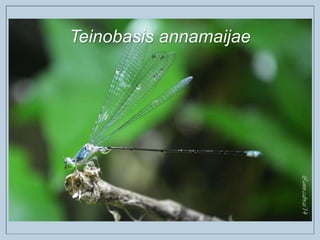
Teinobasis
annamaijae
BY: MARVIN B. GONZAGA
Teinobasis annamaijae
Etymology
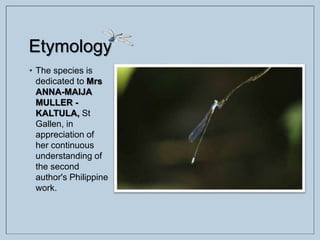
• The species is
dedicated to Mrs
ANNA-MAIJA
MULLER -
KALTULA, St
Gallen, in
appreciation of
her continuous
understanding of
the second
author's Philippine
work.
Description
MALE:
• H e a d . - Labium pale yellowish. Face grayish blue, with postclypeus
and the basal margin of labrum shining black; the black area in labrum
extending axially from the base to the middle of labrum. Rest of head
mat black with a broad bronze-green belt on occipital area. Rear of
head pale.
• T h o r a x . — Dorsum of pro- and pterothorax black with metallic
greenish tinge; lateral and ventral sides pale bluish, pruinose in older
specimens. Posterior lobe of prothorax very short, evenly rounded; its
apical border somewhat raised as seen in lateral view.
• L e g s . — Legs brownish yellow. Coxae pruinose, extensor surface of
femora dark brown. Spines black.
W i n g s. - R4+5 and IR3 well separated at origin. R4+s rising slightly
distal to the subnodus, IR3 further distad. R3 arises at Px7.9 in fore
wing and at Px6.7 in hind wing; IR2 atPxn.12 in fore and at Px9.u in
hind wing. Postnodals number 14-17 in fore and 12-15 in hind wing. Ac
situated much nearer to Ax2 than Axj, arculus distal to Ax2. Three
postquadrangular antenodal cells. IA and Cu2 long, IA reaching the hind
wing margin at Px7.10. Pterostigma with the anal side slightly longer
than the costal side, more markedly so in hind wing; grayishbrown,
yellow in circumference.
Abdomen. — Long and slender, basal and terminal segments slightly
expanded. Segments 1-7 black or dark brown on dorsum and bluish
green on sides. In the apex of segments 3-7 the dorsal black extends
ventrad forming a complete ring. The dorsal carina very narrowly yellow
in segments 3-6. Segment 8 black with large blue ventrolateral mark in
the basal half. Segment 9 with similar blue mark covering the basal
3/4th of the otherwise black segment; the blue area encircling a black
dot in the middle. Segment 10 black on dorsum and sides, blue
ventrally. Its apical portion slightly raised dorsally. Configuration of the
10th tergite as in Figure 2; the posterior border hollowed out in the
middle, the cavity being encircled by two acute teeth directed towards
each other.
Measurements (in mm). — Hind wing 26-27.5, abdomen 43 44.
FEMALE unknown.
IUCN STATUS
• This taxon has not yet been assessed for the IUCN Red List
• This species prefers more shady sites compared to its congeners. The
local population is not very abundant unlike that in some other areas in
Mindanao.
References
• Odonata fauna of Diomabok Lake and its surroundings, Davao
• Oriental, Mindanao Island, Philippines
• Reagan Joseph T. Villanueva
• D3C Gahol Apartment, Lopez Jaena St., Davao City, 8000 Philippines
• DESCRIPTION OF TEINOBASIS ANNAMAIJAE SPEC. NOV.
• FROM THE PHILIPPINES
• (ODONATA: COENAGRIONIDAE) *
• M. HAMALAINEN l and R.A. MULLER

Bs 2 report T. annamaijae

  • 1.
    LET’S GET TOKNOW…. Teinobasis annamaijae BY: MARVIN B. GONZAGA
  • 2.
  • 3.
    Etymology • The speciesis dedicated to Mrs ANNA-MAIJA MULLER - KALTULA, St Gallen, in appreciation of her continuous understanding of the second author's Philippine work.
  • 4.
    Description MALE: • H ea d . - Labium pale yellowish. Face grayish blue, with postclypeus and the basal margin of labrum shining black; the black area in labrum extending axially from the base to the middle of labrum. Rest of head mat black with a broad bronze-green belt on occipital area. Rear of head pale. • T h o r a x . — Dorsum of pro- and pterothorax black with metallic greenish tinge; lateral and ventral sides pale bluish, pruinose in older specimens. Posterior lobe of prothorax very short, evenly rounded; its apical border somewhat raised as seen in lateral view. • L e g s . — Legs brownish yellow. Coxae pruinose, extensor surface of femora dark brown. Spines black.
  • 5.
    W i ng s. - R4+5 and IR3 well separated at origin. R4+s rising slightly distal to the subnodus, IR3 further distad. R3 arises at Px7.9 in fore wing and at Px6.7 in hind wing; IR2 atPxn.12 in fore and at Px9.u in hind wing. Postnodals number 14-17 in fore and 12-15 in hind wing. Ac situated much nearer to Ax2 than Axj, arculus distal to Ax2. Three postquadrangular antenodal cells. IA and Cu2 long, IA reaching the hind wing margin at Px7.10. Pterostigma with the anal side slightly longer than the costal side, more markedly so in hind wing; grayishbrown, yellow in circumference.
  • 6.
    Abdomen. — Longand slender, basal and terminal segments slightly expanded. Segments 1-7 black or dark brown on dorsum and bluish green on sides. In the apex of segments 3-7 the dorsal black extends ventrad forming a complete ring. The dorsal carina very narrowly yellow in segments 3-6. Segment 8 black with large blue ventrolateral mark in the basal half. Segment 9 with similar blue mark covering the basal 3/4th of the otherwise black segment; the blue area encircling a black dot in the middle. Segment 10 black on dorsum and sides, blue ventrally. Its apical portion slightly raised dorsally. Configuration of the 10th tergite as in Figure 2; the posterior border hollowed out in the middle, the cavity being encircled by two acute teeth directed towards each other. Measurements (in mm). — Hind wing 26-27.5, abdomen 43 44. FEMALE unknown.
  • 7.
    IUCN STATUS • Thistaxon has not yet been assessed for the IUCN Red List
  • 8.
    • This speciesprefers more shady sites compared to its congeners. The local population is not very abundant unlike that in some other areas in Mindanao.
  • 9.
    References • Odonata faunaof Diomabok Lake and its surroundings, Davao • Oriental, Mindanao Island, Philippines • Reagan Joseph T. Villanueva • D3C Gahol Apartment, Lopez Jaena St., Davao City, 8000 Philippines • DESCRIPTION OF TEINOBASIS ANNAMAIJAE SPEC. NOV. • FROM THE PHILIPPINES • (ODONATA: COENAGRIONIDAE) * • M. HAMALAINEN l and R.A. MULLER