Lipid
The naturally occurring organic compound of the animals and plants
which are soluble in the organic
Solvents and non soluble in the water called lipid .e.g oils fats waxes and
steroid.
Classification of lipid
There are three classes of lipid.
1:simple lipid
2:compound lipid
3:derived lipid
1 Simple lipid
The lipid which contain fatty acid and glycerol are called simple lipid .e.g fats
and oil
2 Compound lipids
The lipids which contain fatty acid ,glycerol.phosphorous and nitrogen
compound are called Compound lipid E.g phospholipid
,shingolipid.lipoprotiens
3 derived lipid
The lipids which are obtain by hydrolysis of simple or compound lipids are
called derived lipid
E.g vitamins d ,terpense, sterols.
Fats and oil
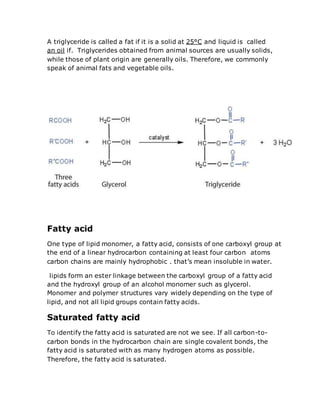
Fats and oils are called triglycerides (or triacylcylgerols) because they are
esters composed of three fatty acid units joined to glycerol.when it join it
release three water molecules.
A triglyceride is called a fat if it is a solid at 25°C and liquid is called
an oil if. Triglycerides obtained from animal sources are usually solids,
while those of plant origin are generally oils. Therefore, we commonly
speak of animal fats and vegetable oils.
Fatty acid
One type of lipid monomer, a fatty acid, consists of one carboxyl group at
the end of a linear hydrocarbon containing at least four carbon atoms
carbon chains are mainly hydrophobic . that’s mean insoluble in water.
lipids form an ester linkage between the carboxyl group of a fatty acid
and the hydroxyl group of an alcohol monomer such as glycerol.
Monomer and polymer structures vary widely depending on the type of
lipid, and not all lipid groups contain fatty acids.
Saturated fatty acid
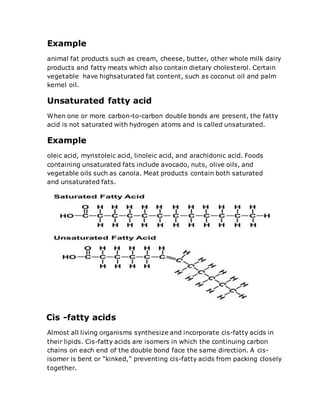
To identify the fatty acid is saturated are not we see. If all carbon-to-
carbon bonds in the hydrocarbon chain are single covalent bonds, the
fatty acid is saturated with as many hydrogen atoms as possible.
Therefore, the fatty acid is saturated.
Example
animal fat products such as cream, cheese, butter, other whole milk dairy
products and fatty meats which also contain dietary cholesterol. Certain
vegetable have highsaturated fat content, such as coconut oil and palm
kernel oil.
Unsaturated fatty acid
When one or more carbon-to-carbon double bonds are present, the fatty
acid is not saturated with hydrogen atoms and is called unsaturated.
Example
oleic acid, myristoleic acid, linoleic acid, and arachidonic acid. Foods
containing unsaturated fats include avocado, nuts, olive oils, and
vegetable oils such as canola. Meat products contain both saturated
and unsaturated fats.
Cis -fatty acids
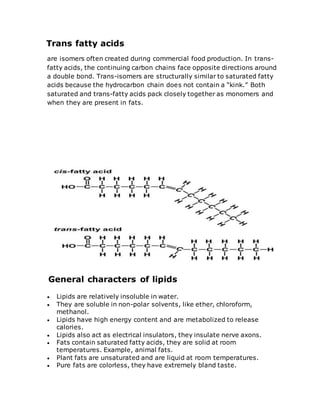
Almost all living organisms synthesize and incorporate cis-fatty acids in
their lipids. Cis-fatty acids are isomers in which the continuing carbon
chains on each end of the double bond face the same direction. A cis-
isomer is bent or “kinked,” preventing cis-fatty acids from packing closely
together.
Trans fatty acids
are isomers often created during commercial food production. In trans-
fatty acids, the continuing carbon chains face opposite directions around
a double bond. Trans-isomers are structurally similar to saturated fatty
acids because the hydrocarbon chain does not contain a “kink.” Both
saturated and trans-fatty acids pack closely together as monomers and
when they are present in fats.
General characters of lipids
 Lipids are relatively insoluble in water.
 They are soluble in non-polar solvents, like ether, chloroform,
methanol.
 Lipids have high energy content and are metabolized to release
calories.
 Lipids also act as electrical insulators, they insulate nerve axons.
 Fats contain saturated fatty acids, they are solid at room
temperatures. Example, animal fats.
 Plant fats are unsaturated and are liquid at room temperatures.
 Pure fats are colorless, they have extremely bland taste.
Function of lipids.
Lipids are storage compounds, triglycerides serve as reserve energy of
the body.
 Lipids are important component of cell membranes structure in
eukaryotic cells.
 Lipids regulate membrane permeability.
 They serve as source for fat soluble vitamins like A, D, E, K.
 They act electrical insulators to the nerve fibres, where the myelin
sheath contains lipids.
 Lipids are components of some enzyme systems.
 Some lipids like prostaglandins and steroid hormones act as cellular
metabolic regulators.
 Cholesterol is found in cell membranes, blood, and bile of many
organisms.
 As lipids are small molecules and are insoluble in water, they act as
signalling molecules.
 Layers of fat in the subcutaneous layer, provides insulation and
protection from cold. Body temperature maintenance is done by brown
fat.
 Polyunsaturated phospholipids are important constituents of
phospholipids, they provide fluidity and flexibility to the cell
membranes.
 Lipoproteins that are complexes of lipids and proteins, occur in blood
as plasma lipoprotein, they enable transport of lipids in aqueous
environment, and their transport throughout the body.
 Cholesterol maintains fluidity of membranes by interacting with
lipid complexes.
 Cholesterol is the precursor of bile acids, Vitamin D and steroids.
Lipid  presentation

Lipid presentation

  • 1.
    Lipid The naturally occurringorganic compound of the animals and plants which are soluble in the organic Solvents and non soluble in the water called lipid .e.g oils fats waxes and steroid. Classification of lipid There are three classes of lipid. 1:simple lipid 2:compound lipid 3:derived lipid 1 Simple lipid The lipid which contain fatty acid and glycerol are called simple lipid .e.g fats and oil 2 Compound lipids The lipids which contain fatty acid ,glycerol.phosphorous and nitrogen compound are called Compound lipid E.g phospholipid ,shingolipid.lipoprotiens 3 derived lipid The lipids which are obtain by hydrolysis of simple or compound lipids are called derived lipid E.g vitamins d ,terpense, sterols. Fats and oil Fats and oils are called triglycerides (or triacylcylgerols) because they are esters composed of three fatty acid units joined to glycerol.when it join it release three water molecules.
  • 2.
    A triglyceride iscalled a fat if it is a solid at 25°C and liquid is called an oil if. Triglycerides obtained from animal sources are usually solids, while those of plant origin are generally oils. Therefore, we commonly speak of animal fats and vegetable oils. Fatty acid One type of lipid monomer, a fatty acid, consists of one carboxyl group at the end of a linear hydrocarbon containing at least four carbon atoms carbon chains are mainly hydrophobic . that’s mean insoluble in water. lipids form an ester linkage between the carboxyl group of a fatty acid and the hydroxyl group of an alcohol monomer such as glycerol. Monomer and polymer structures vary widely depending on the type of lipid, and not all lipid groups contain fatty acids. Saturated fatty acid To identify the fatty acid is saturated are not we see. If all carbon-to- carbon bonds in the hydrocarbon chain are single covalent bonds, the fatty acid is saturated with as many hydrogen atoms as possible. Therefore, the fatty acid is saturated.
  • 3.
    Example animal fat productssuch as cream, cheese, butter, other whole milk dairy products and fatty meats which also contain dietary cholesterol. Certain vegetable have highsaturated fat content, such as coconut oil and palm kernel oil. Unsaturated fatty acid When one or more carbon-to-carbon double bonds are present, the fatty acid is not saturated with hydrogen atoms and is called unsaturated. Example oleic acid, myristoleic acid, linoleic acid, and arachidonic acid. Foods containing unsaturated fats include avocado, nuts, olive oils, and vegetable oils such as canola. Meat products contain both saturated and unsaturated fats. Cis -fatty acids Almost all living organisms synthesize and incorporate cis-fatty acids in their lipids. Cis-fatty acids are isomers in which the continuing carbon chains on each end of the double bond face the same direction. A cis- isomer is bent or “kinked,” preventing cis-fatty acids from packing closely together.
  • 4.
    Trans fatty acids areisomers often created during commercial food production. In trans- fatty acids, the continuing carbon chains face opposite directions around a double bond. Trans-isomers are structurally similar to saturated fatty acids because the hydrocarbon chain does not contain a “kink.” Both saturated and trans-fatty acids pack closely together as monomers and when they are present in fats. General characters of lipids  Lipids are relatively insoluble in water.  They are soluble in non-polar solvents, like ether, chloroform, methanol.  Lipids have high energy content and are metabolized to release calories.  Lipids also act as electrical insulators, they insulate nerve axons.  Fats contain saturated fatty acids, they are solid at room temperatures. Example, animal fats.  Plant fats are unsaturated and are liquid at room temperatures.  Pure fats are colorless, they have extremely bland taste.
  • 5.
    Function of lipids. Lipidsare storage compounds, triglycerides serve as reserve energy of the body.  Lipids are important component of cell membranes structure in eukaryotic cells.  Lipids regulate membrane permeability.  They serve as source for fat soluble vitamins like A, D, E, K.  They act electrical insulators to the nerve fibres, where the myelin sheath contains lipids.  Lipids are components of some enzyme systems.  Some lipids like prostaglandins and steroid hormones act as cellular metabolic regulators.  Cholesterol is found in cell membranes, blood, and bile of many organisms.  As lipids are small molecules and are insoluble in water, they act as signalling molecules.  Layers of fat in the subcutaneous layer, provides insulation and protection from cold. Body temperature maintenance is done by brown fat.  Polyunsaturated phospholipids are important constituents of phospholipids, they provide fluidity and flexibility to the cell membranes.  Lipoproteins that are complexes of lipids and proteins, occur in blood as plasma lipoprotein, they enable transport of lipids in aqueous environment, and their transport throughout the body.  Cholesterol maintains fluidity of membranes by interacting with lipid complexes.  Cholesterol is the precursor of bile acids, Vitamin D and steroids.