LIPIDS
MUKARRAM SHARIF
MICROBIOLOGY AND MOLECULAR GENETICS
Introduction
 Lipids are a diverse group of nonpolar biological
molecules whose common properties are their
ability to dissolve in organic solvents, such as
chloroform or benzene, and their inability to
dissolve in water—a property that explains many
of their varied biological functions.
 Lipids of importance in cellular function include
fats, steroids, and phospholipids.
Fats
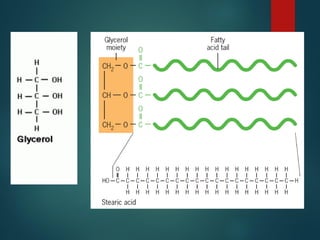
 Fats consist of a glycerol molecule linked by ester bonds to three
fatty acids; the composite molecule is termed a triacylglycerol.
 Fatty acids are long, unbranched hydrocarbon chains with a
single carboxyl group at one end
 Because the two ends of a fatty acid molecule have a very
different structure, they also have different properties.
 The hydrocarbon chain is hydrophobic, whereas the carboxyl
group (—COOH), which bears a negative charge, is hydrophilic.
 Molecules having both hydrophobic and hydrophilic regions are
said to be amphipathic.
Types of fatty acids based
on length
 Short-chain fatty acids (SCFA) are fatty acids with aliphatic
tails of five or fewer carbons e.g. butyric acid (4 carbon
atoms).
 Medium-chain fatty acids (MCFA) are fatty acids with
aliphatic tails of 6 to 12 carbons, which can form medium-
chain triglycerides.
 Long-chain fatty acids (LCFA) are fatty acids with aliphatic
tails of 13 to 21 carbons.
 Very long chain fatty acids (VLCFA) are fatty acids with
aliphatic tails of 22 or more carbons
 Fatty acids differ from one another in the length of their
hydrocarbon chain and the presence or absence of double
bonds.
 Fatty acids present in cells typically vary in length from 14 to 20
carbons.
 Naturally occurring fatty acids have double bonds in the cis
configuration.
 A molecule of fat can contain three identical fatty acids, or it
can be a mixed fat, containing more than one fatty acid
species. Most natural fats, such as olive oil or butterfat, are
mixtures of molecules having different fatty acid species.
C:D
 C = Number of carbon atoms
 D = Number of double bonds
 Stearic acid 18:0
 Oleic acid 18:1
 Palmitic acid 16:0
 Linoliec acid 18:2
 Saturated fats: Fatty acids that lack double bonds, such as stearic
acid (mostly solid at room temperature) (Animal fats)
 Unsaturated fats: Fatty acids that possess double bonds (mostly
liquid at room temperature) (Plant fats)
 Double bonds produce bends in fatty acid chains
 The more double bonds that fatty acid chains possess, the less
effectively these long chains can be packed together. This lowers
the temperature at which a fatty acid-containing lipid melts.
 The abundance of double bonds in vegetable fats accounts for
their liquid state — and for their being labeled as
“polyunsaturated.”
 Fats that are liquid at room temperature are described as oils.
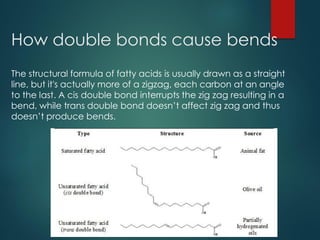
How double bonds cause bends
The structural formula of fatty acids is usually drawn as a straight
line, but it's actually more of a zigzag, each carbon at an angle
to the last. A cis double bond interrupts the zig zag resulting in a
bend, while trans double bond doesn’t affect zig zag and thus
doesn’t produce bends.
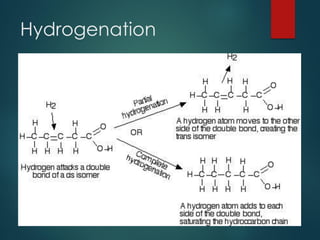
Hydrogenation and trans fats
 Chemically reducing the double bonds in unsaturated
vegetable oils with hydrogen atoms is called hydrogenation.
 Complete hydrogenation: converts all double bonds into
single bonds
 Partial hydrogenation: converts some double bonds into single
bonds. Some of the unsaturated fatty acids, which are
normally found as the cis isomer about the double bonds, are
changed to a trans double bond and remain unsaturated.
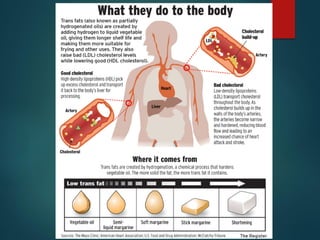
 Trans fats are difficult for the body to metabolize, and can
neither be incorporated into cell structures nor excreted in the
normal fashion. Thus, hydrogenated or "trans-" fats tend to
remain "stuck" in blood circulation, contributing significantly to
an increased risk for heart diseases and stroke.
Hydrogenation
Fats, energy and storage
 Fats are very rich in chemical energy; a gram of fat contains
over twice the energy content of a gram of carbohydrate.
 Carbohydrates function primarily as a short-term, rapidly
available energy source, whereas fat reserves store energy on
a long-term basis.
 Because they lack polar groups, fats are extremely insoluble in
water and are stored in cells in the form of lipid droplets.
 Since lipid droplets do not contain water as do glycogen
granules, they represent an extremely concentrated storage
fuel.
 In many animals, fats are stored in special cells called
adipocytes whose cytoplasm is filled with one or a few large
lipid droplets.
 Adipocytes exhibit a remarkable ability to change their
volume to accommodate varying quantities of fat.
Steroids
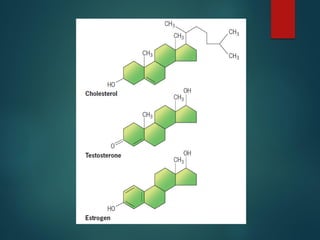
 Steroids are built around a characteristic four
ringed hydrocarbon skeleton.
 One of the most important steroids is cholesterol,
a component of animal cell membranes and a
precursor for the synthesis of a number of steroid
hormones, such as testosterone, progesterone,
and estrogen.
 Cholesterol is largely absent from plant cells,
which is why vegetable oils are considered
“cholesterol-free”
Phospholipids
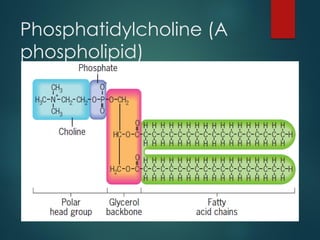
 The molecule resembles a fat (triacylglycerol), but has only two
fatty acid chains rather than three; it is a diacylglycerol.
 The third hydroxyl of the glycerol backbone is covalently bonded
to a phosphate group, which in turn is covalently bonded to a
small polar group, such as choline.
 Phospholipids contain two ends that have very different
properties: the end containing the phosphate group has a
distinctly hydrophilic character; the other end composed of the
two fatty acid tails has a distinctly hydrophobic character.
 Phospholipids function primarily in cell membranes, and properties
of cell membranes depend on their phospholipid components.
Phosphatidylcholine (A
phospholipid)

Lipids.pdf

  • 1.
  • 2.
    Introduction  Lipids area diverse group of nonpolar biological molecules whose common properties are their ability to dissolve in organic solvents, such as chloroform or benzene, and their inability to dissolve in water—a property that explains many of their varied biological functions.  Lipids of importance in cellular function include fats, steroids, and phospholipids.
  • 3.
    Fats  Fats consistof a glycerol molecule linked by ester bonds to three fatty acids; the composite molecule is termed a triacylglycerol.  Fatty acids are long, unbranched hydrocarbon chains with a single carboxyl group at one end  Because the two ends of a fatty acid molecule have a very different structure, they also have different properties.  The hydrocarbon chain is hydrophobic, whereas the carboxyl group (—COOH), which bears a negative charge, is hydrophilic.  Molecules having both hydrophobic and hydrophilic regions are said to be amphipathic.
  • 5.
    Types of fattyacids based on length  Short-chain fatty acids (SCFA) are fatty acids with aliphatic tails of five or fewer carbons e.g. butyric acid (4 carbon atoms).  Medium-chain fatty acids (MCFA) are fatty acids with aliphatic tails of 6 to 12 carbons, which can form medium- chain triglycerides.  Long-chain fatty acids (LCFA) are fatty acids with aliphatic tails of 13 to 21 carbons.  Very long chain fatty acids (VLCFA) are fatty acids with aliphatic tails of 22 or more carbons
  • 6.
     Fatty acidsdiffer from one another in the length of their hydrocarbon chain and the presence or absence of double bonds.  Fatty acids present in cells typically vary in length from 14 to 20 carbons.  Naturally occurring fatty acids have double bonds in the cis configuration.  A molecule of fat can contain three identical fatty acids, or it can be a mixed fat, containing more than one fatty acid species. Most natural fats, such as olive oil or butterfat, are mixtures of molecules having different fatty acid species.
  • 7.
    C:D  C =Number of carbon atoms  D = Number of double bonds  Stearic acid 18:0  Oleic acid 18:1  Palmitic acid 16:0  Linoliec acid 18:2
  • 8.
     Saturated fats:Fatty acids that lack double bonds, such as stearic acid (mostly solid at room temperature) (Animal fats)  Unsaturated fats: Fatty acids that possess double bonds (mostly liquid at room temperature) (Plant fats)  Double bonds produce bends in fatty acid chains  The more double bonds that fatty acid chains possess, the less effectively these long chains can be packed together. This lowers the temperature at which a fatty acid-containing lipid melts.  The abundance of double bonds in vegetable fats accounts for their liquid state — and for their being labeled as “polyunsaturated.”  Fats that are liquid at room temperature are described as oils.
  • 9.
    How double bondscause bends The structural formula of fatty acids is usually drawn as a straight line, but it's actually more of a zigzag, each carbon at an angle to the last. A cis double bond interrupts the zig zag resulting in a bend, while trans double bond doesn’t affect zig zag and thus doesn’t produce bends.
  • 10.
    Hydrogenation and transfats  Chemically reducing the double bonds in unsaturated vegetable oils with hydrogen atoms is called hydrogenation.  Complete hydrogenation: converts all double bonds into single bonds  Partial hydrogenation: converts some double bonds into single bonds. Some of the unsaturated fatty acids, which are normally found as the cis isomer about the double bonds, are changed to a trans double bond and remain unsaturated.  Trans fats are difficult for the body to metabolize, and can neither be incorporated into cell structures nor excreted in the normal fashion. Thus, hydrogenated or "trans-" fats tend to remain "stuck" in blood circulation, contributing significantly to an increased risk for heart diseases and stroke.
  • 11.
  • 13.
    Fats, energy andstorage  Fats are very rich in chemical energy; a gram of fat contains over twice the energy content of a gram of carbohydrate.  Carbohydrates function primarily as a short-term, rapidly available energy source, whereas fat reserves store energy on a long-term basis.  Because they lack polar groups, fats are extremely insoluble in water and are stored in cells in the form of lipid droplets.  Since lipid droplets do not contain water as do glycogen granules, they represent an extremely concentrated storage fuel.  In many animals, fats are stored in special cells called adipocytes whose cytoplasm is filled with one or a few large lipid droplets.  Adipocytes exhibit a remarkable ability to change their volume to accommodate varying quantities of fat.
  • 14.
    Steroids  Steroids arebuilt around a characteristic four ringed hydrocarbon skeleton.  One of the most important steroids is cholesterol, a component of animal cell membranes and a precursor for the synthesis of a number of steroid hormones, such as testosterone, progesterone, and estrogen.  Cholesterol is largely absent from plant cells, which is why vegetable oils are considered “cholesterol-free”
  • 16.
    Phospholipids  The moleculeresembles a fat (triacylglycerol), but has only two fatty acid chains rather than three; it is a diacylglycerol.  The third hydroxyl of the glycerol backbone is covalently bonded to a phosphate group, which in turn is covalently bonded to a small polar group, such as choline.  Phospholipids contain two ends that have very different properties: the end containing the phosphate group has a distinctly hydrophilic character; the other end composed of the two fatty acid tails has a distinctly hydrophobic character.  Phospholipids function primarily in cell membranes, and properties of cell membranes depend on their phospholipid components.
  • 17.