MACHINE DESIGN: STATIC
FAILURE THEORIES
Dr. Himanshu Chaudhary
Associate Professor
Dept. of Mech. Eng.
MNIT Jaipur
Static failure theories
• Why do parts fail?
• You may say “Parts fail because their stresses exceed
their strength”
• Then what kind of stresses cause the failure: Tensile?
Compressive? Shear?
• Answer may be: It depends.
• It depends on the material and its relative strength in
compressive, tension, and shear.
• It also depends on the type loading (Static, Fatigue,
Impact) and
• presence of the cracks in the material
Static failure theories
• The failure may be elastic or fracture
• Elastic failure results in excessive
deformation, which makes the machine
component unfit to perform its function
satisfactorily
• Fracture results in breaking the component
into two parts
Static failure theories
• Question: How do one compare stresses
induced to the material properties?
– Generally machine parts are subjected to combined
loading and to find material properties under real
loading condition is practically not economical
– Thus, material properties are obtained from simple
tension/torsion test
– These data like Syt, Sut etc are available in form of
table (Design Data Book)
Static failure theories
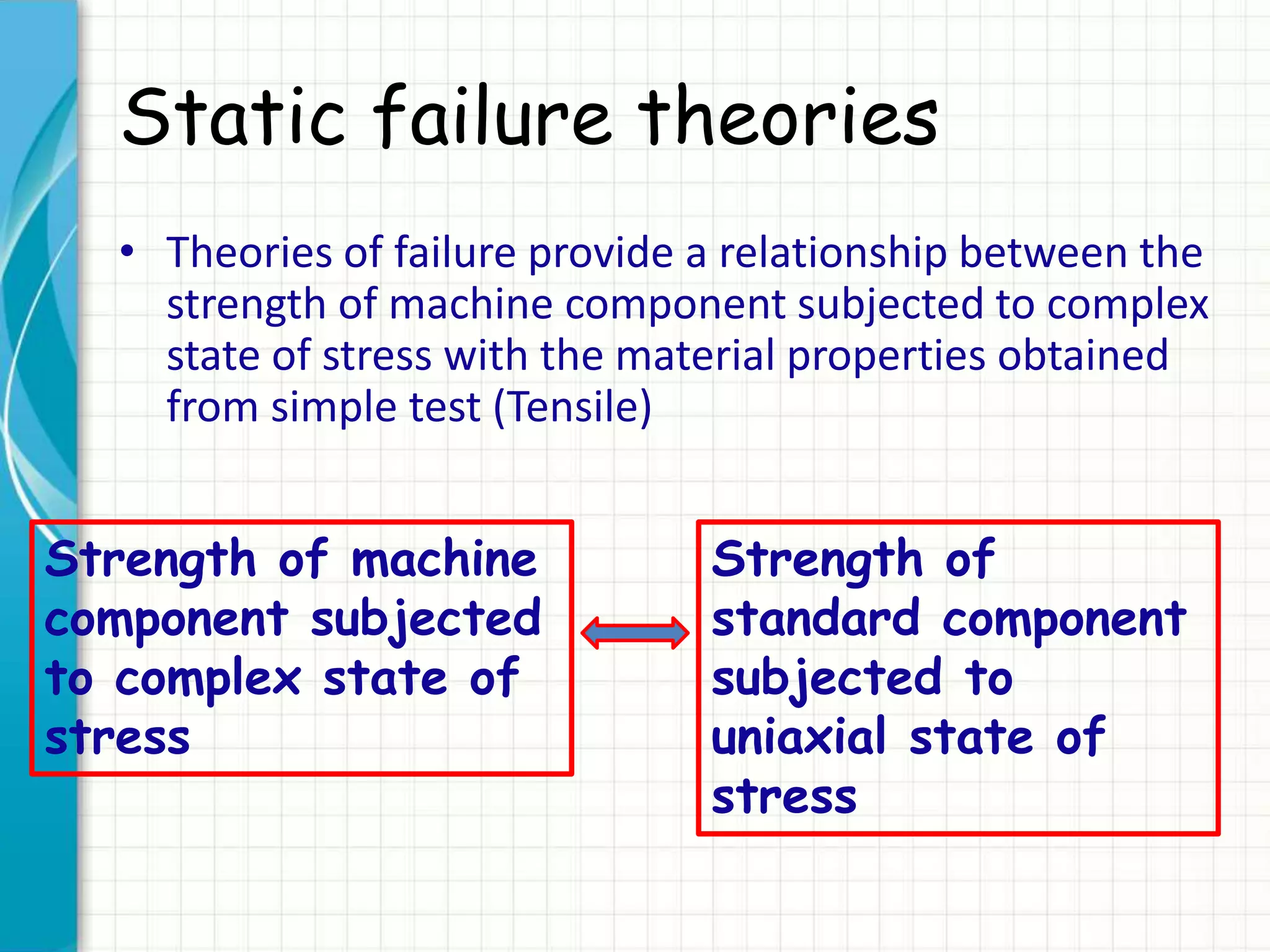
• Theories of failure provide a relationship between the
strength of machine component subjected to complex
state of stress with the material properties obtained
from simple test (Tensile)
Strength of machine
component subjected
to complex state of
stress
Strength of
standard component
subjected to
uniaxial state of
stress
Static failure theories
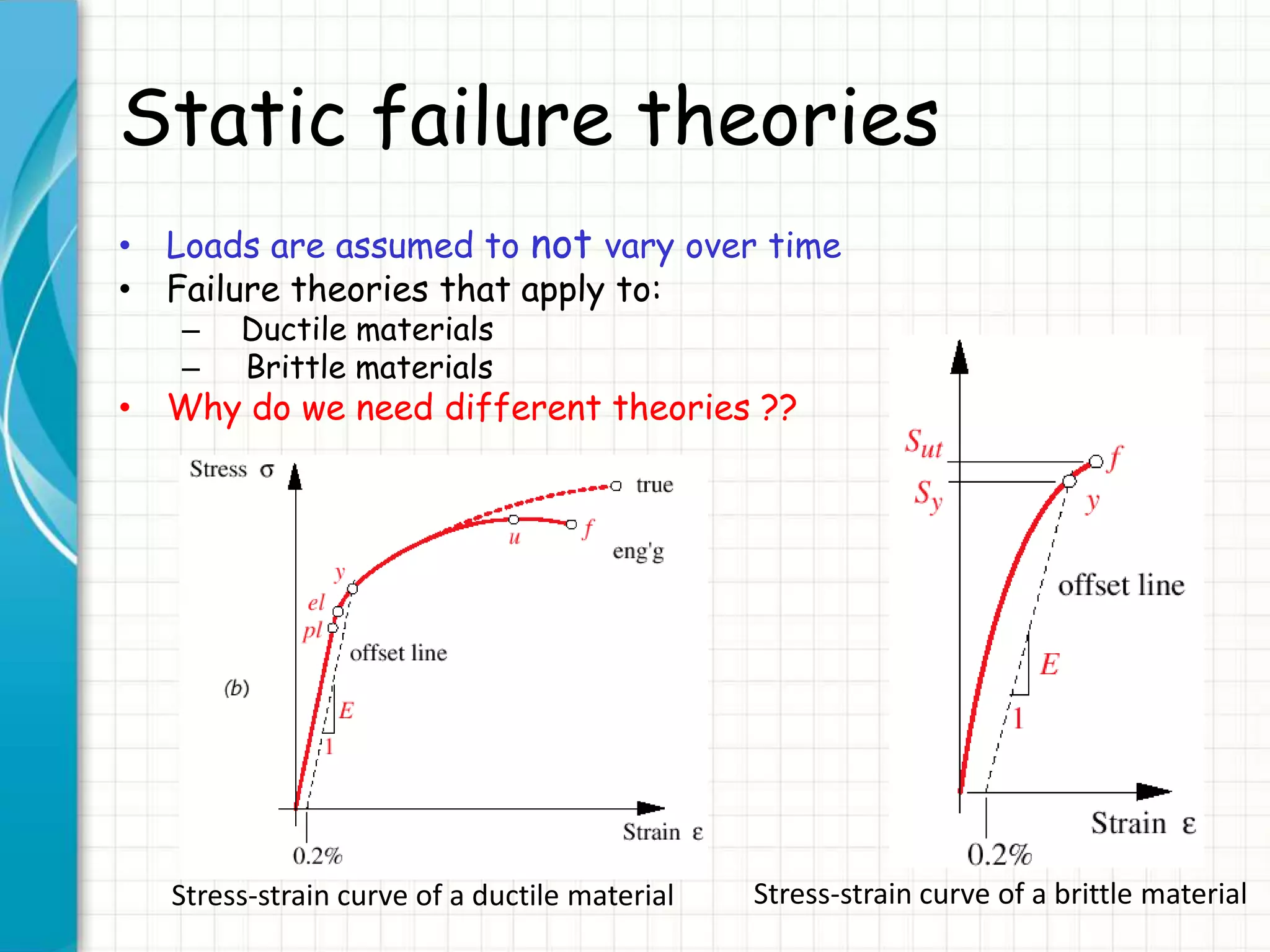
• Loads are assumed to not vary over time
• Failure theories that apply to:
– Ductile materials
– Brittle materials
• Why do we need different theories ??
Stress-strain curve of a ductile material Stress-strain curve of a brittle material
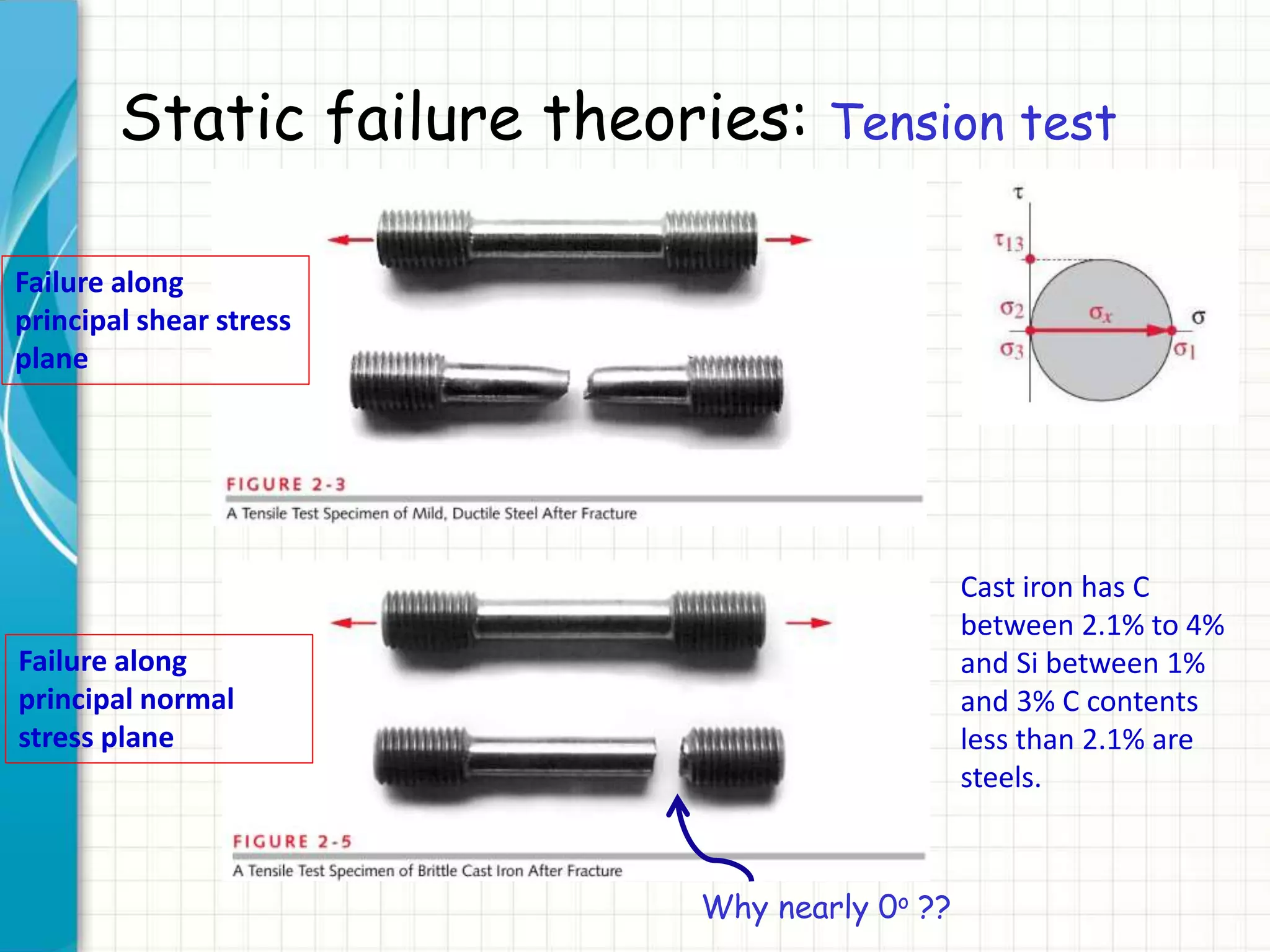
Static failure theories: Tension test
Why nearly 0o ??
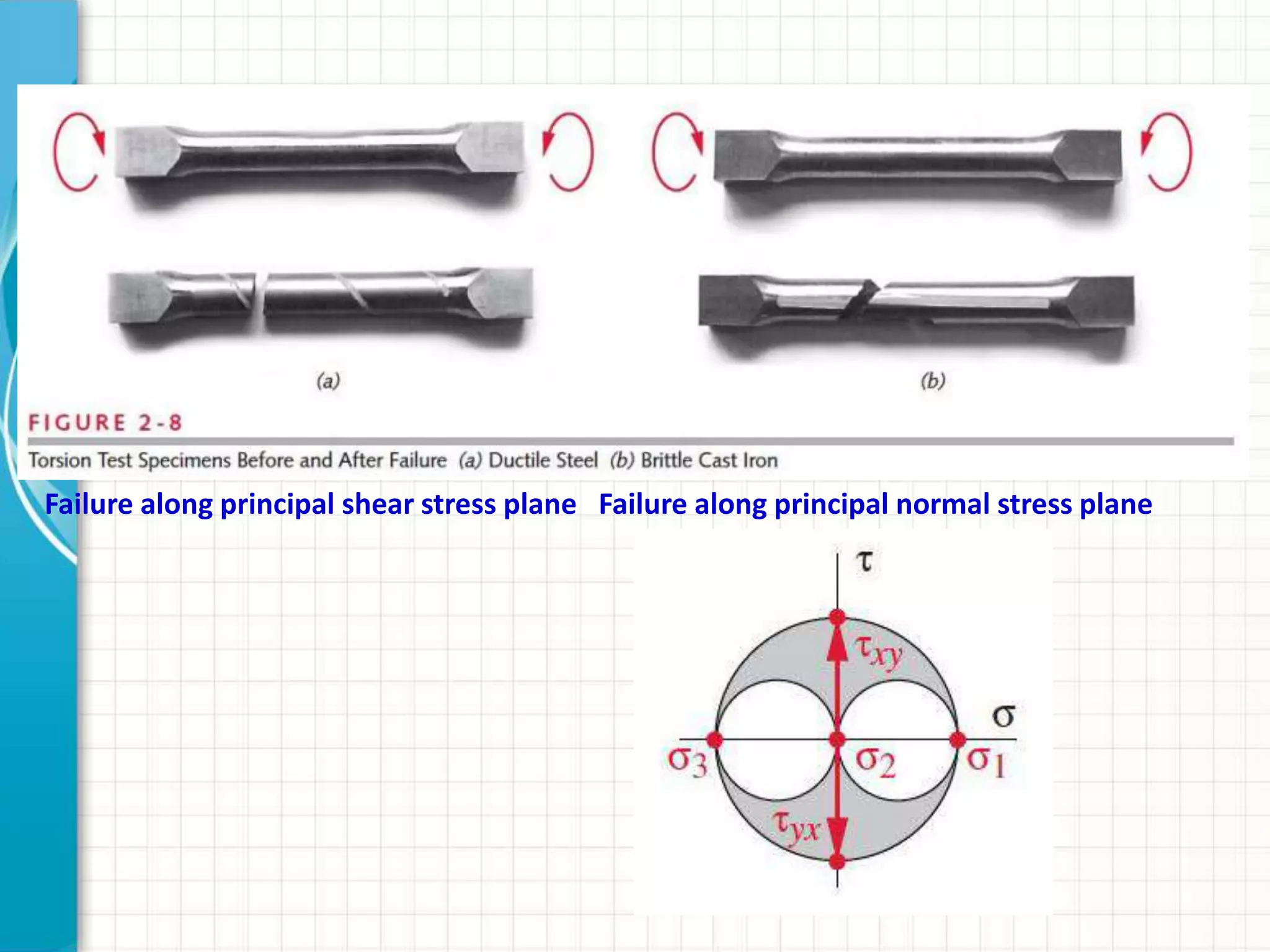
Failure along
principal shear stress
plane
Failure along
principal normal
stress plane
Cast iron has C
between 2.1% to 4%
and Si between 1%
and 3% C contents
less than 2.1% are
steels.
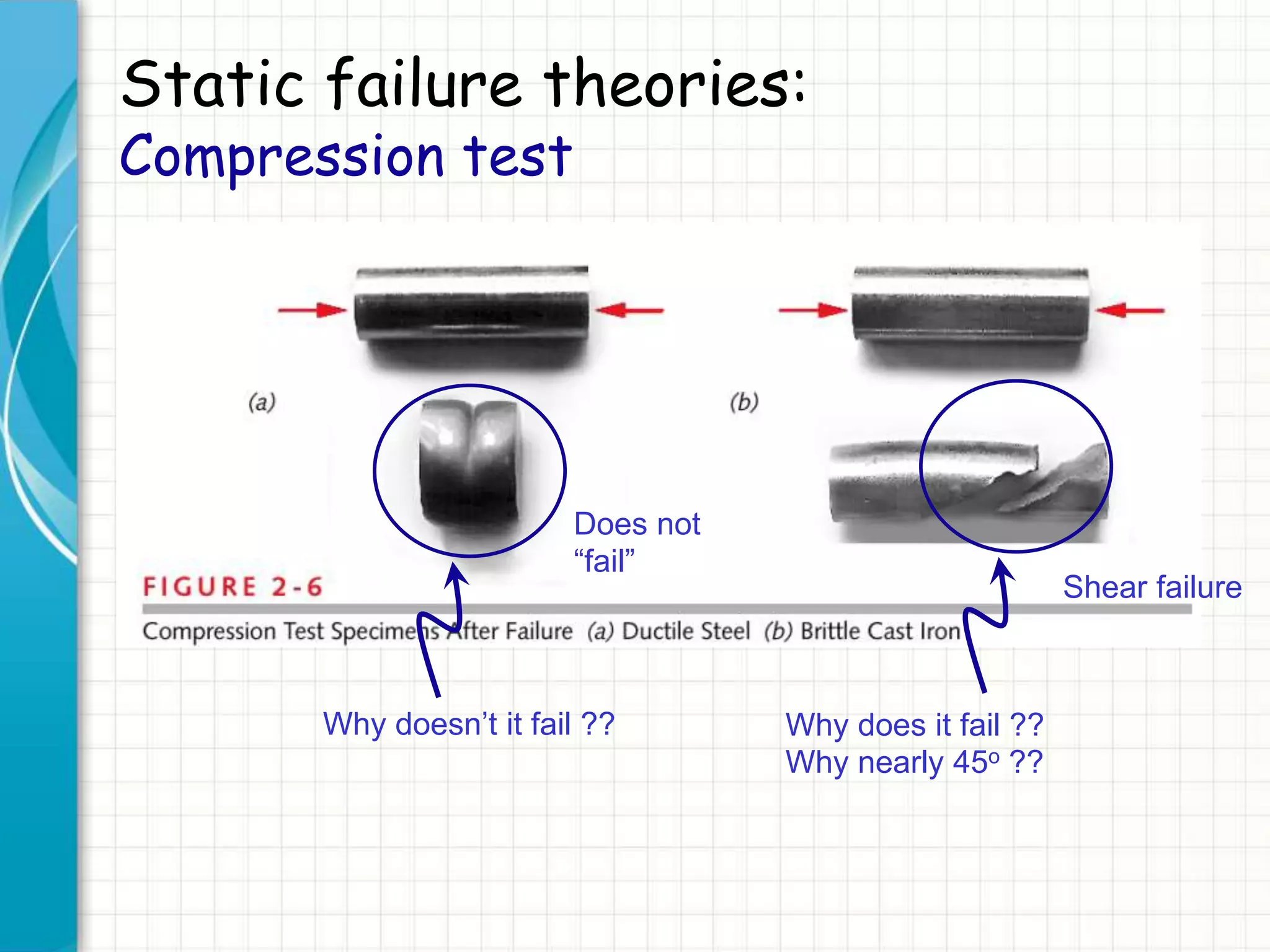
Static failure theories:
Compression test
Why doesn’t it fail ?? Why does it fail ??
Why nearly 45o ??
Does not
“fail”
Shear failure
Failure along principal shear stress plane Failure along principal normal stress plane
Static failure theories
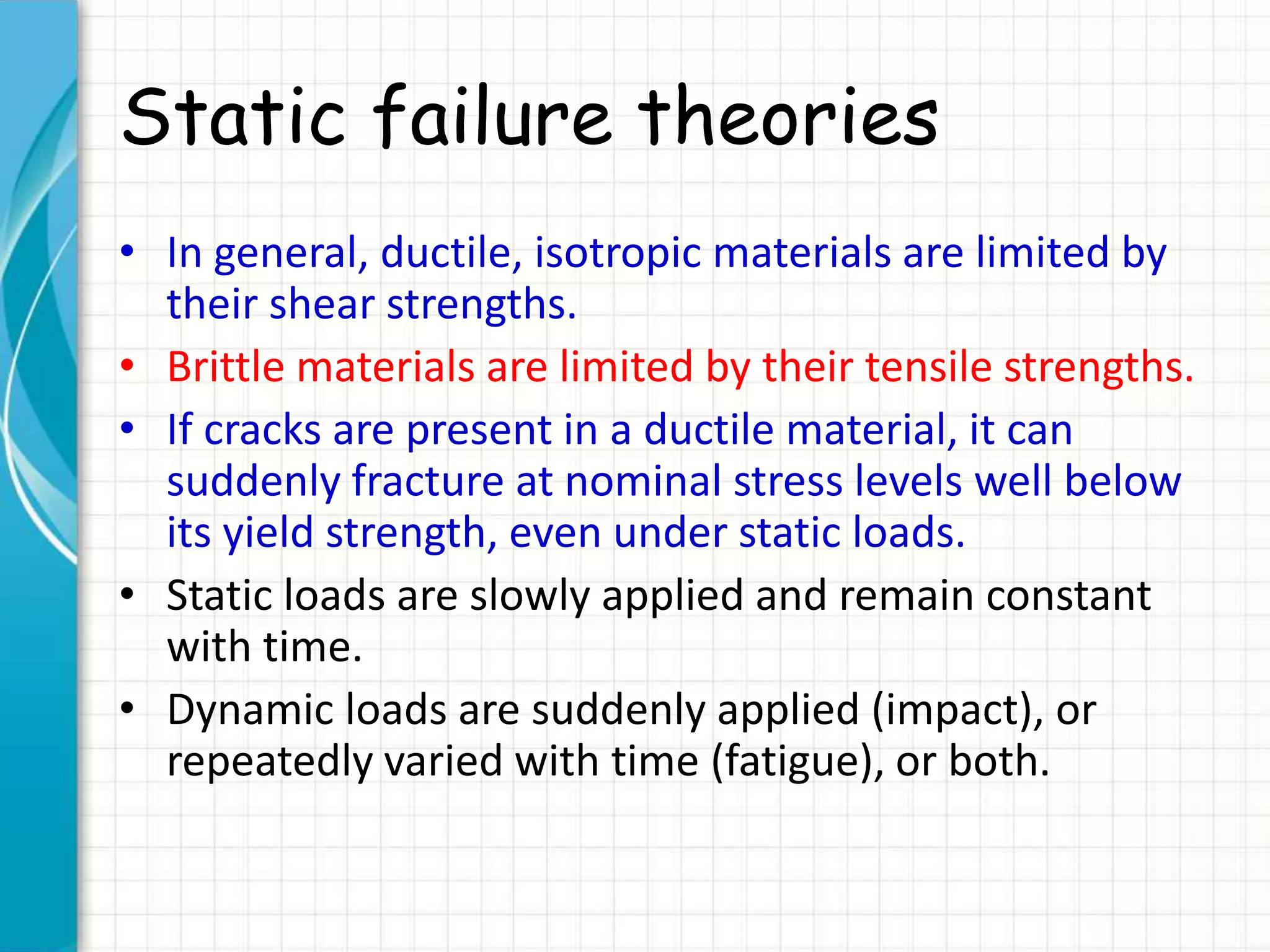
• In general, ductile, isotropic materials are limited by
their shear strengths.
• Brittle materials are limited by their tensile strengths.
• If cracks are present in a ductile material, it can
suddenly fracture at nominal stress levels well below
its yield strength, even under static loads.
• Static loads are slowly applied and remain constant
with time.
• Dynamic loads are suddenly applied (impact), or
repeatedly varied with time (fatigue), or both.
Static failure theories
• In dynamic loading, the distinction between
failure mechanisms of ductile and brittle
materials blurs.
• Ductile materials often fail like brittle
materials in dynamic loading.
Static failure theories
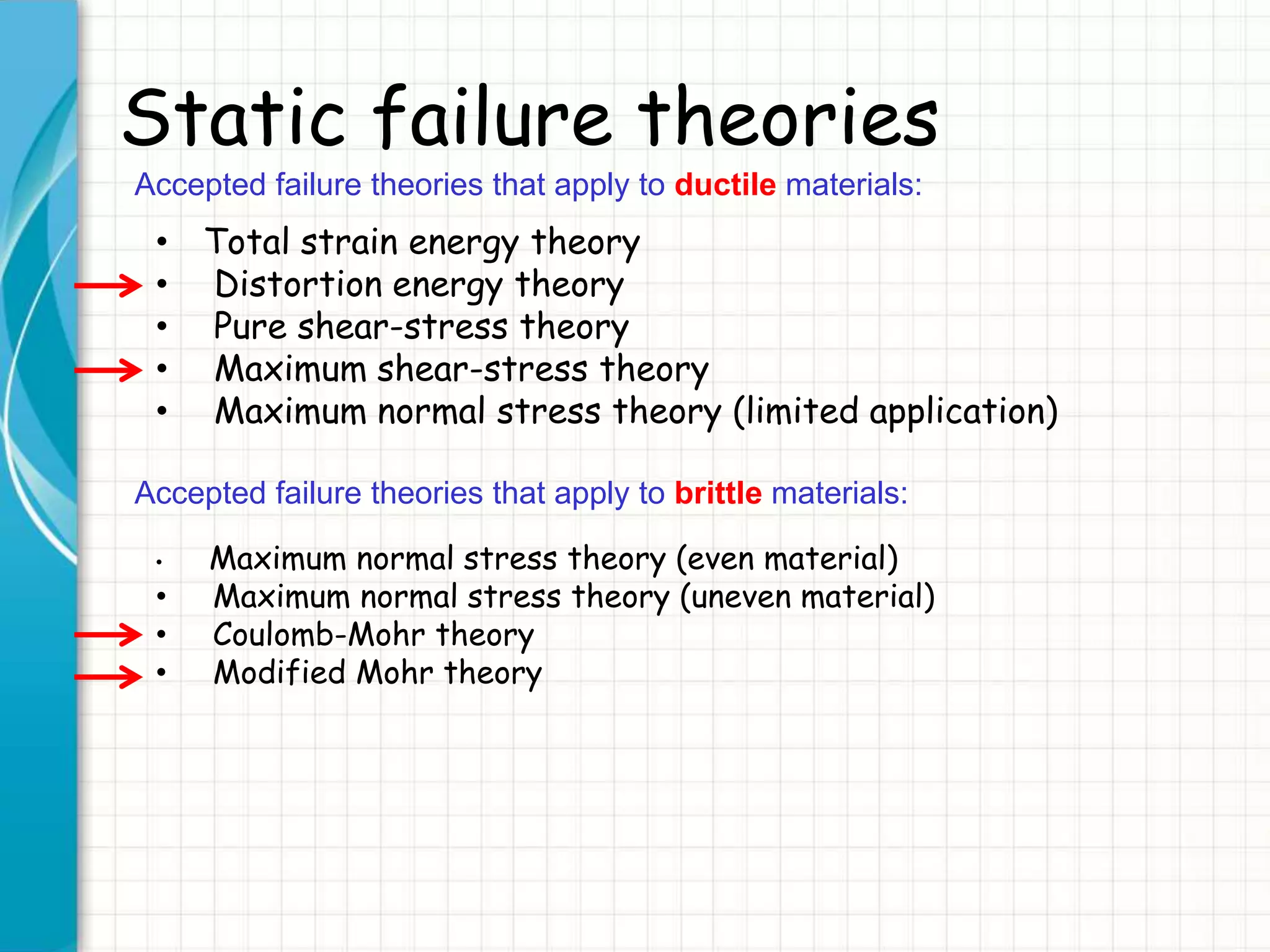
• Total strain energy theory
• Distortion energy theory
• Pure shear-stress theory
• Maximum shear-stress theory
• Maximum normal stress theory (limited application)
Accepted failure theories that apply to ductile materials:
Accepted failure theories that apply to brittle materials:
• Maximum normal stress theory (even material)
• Maximum normal stress theory (uneven material)
• Coulomb-Mohr theory
• Modified Mohr theory
Maximum Normal Stress Theory
• Credited to the English scientist and educator
W. J. M. Rankine (1802–1872)
Maximum Normal Stress Theory
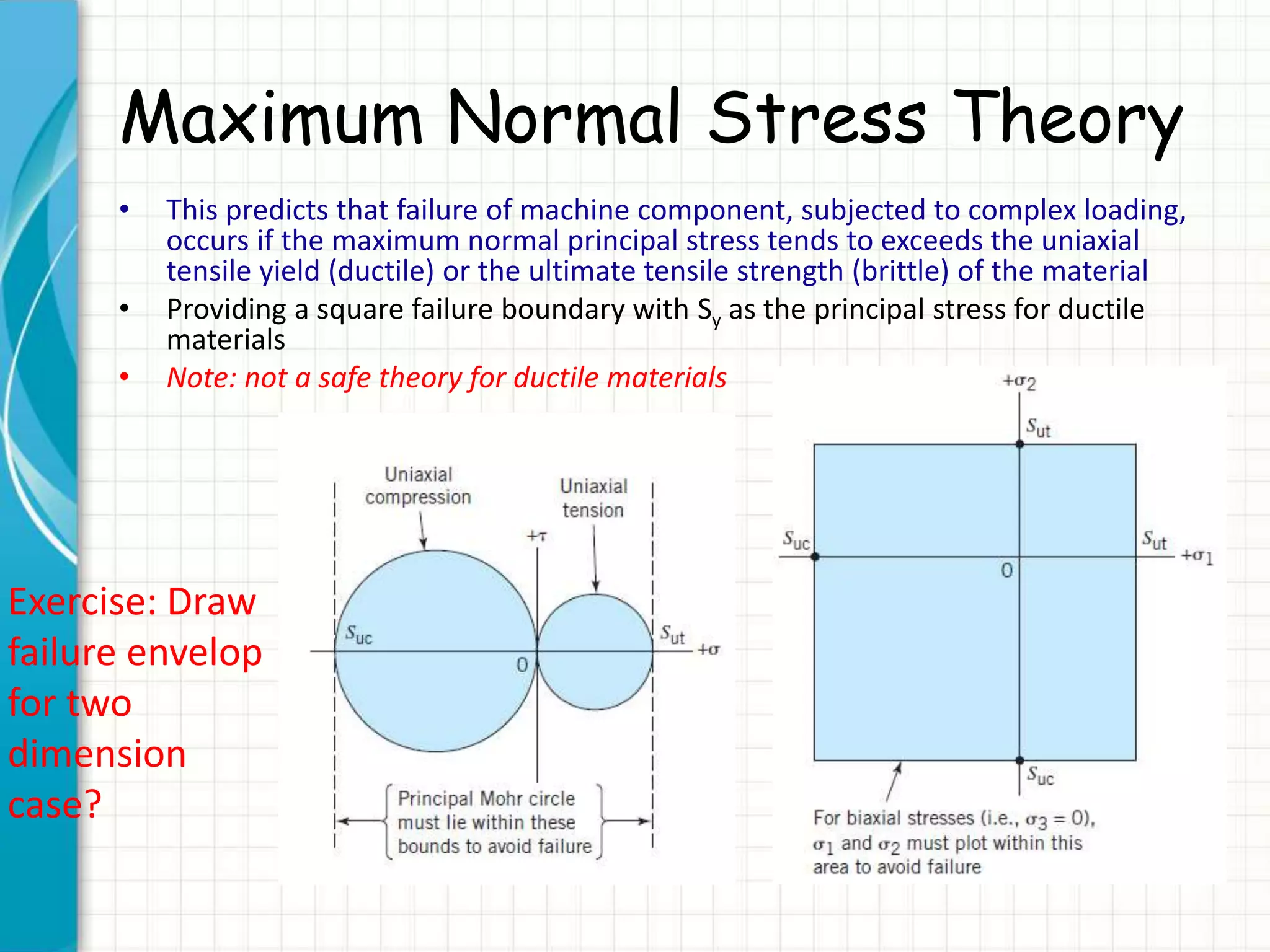
• This predicts that failure of machine component, subjected to complex loading,
occurs if the maximum normal principal stress tends to exceeds the uniaxial
tensile yield (ductile) or the ultimate tensile strength (brittle) of the material
• Providing a square failure boundary with Sy as the principal stress for ductile
materials
• Note: not a safe theory for ductile materials
Exercise: Draw
failure envelop
for two
dimension
case?
Maximum Normal Stress Theory
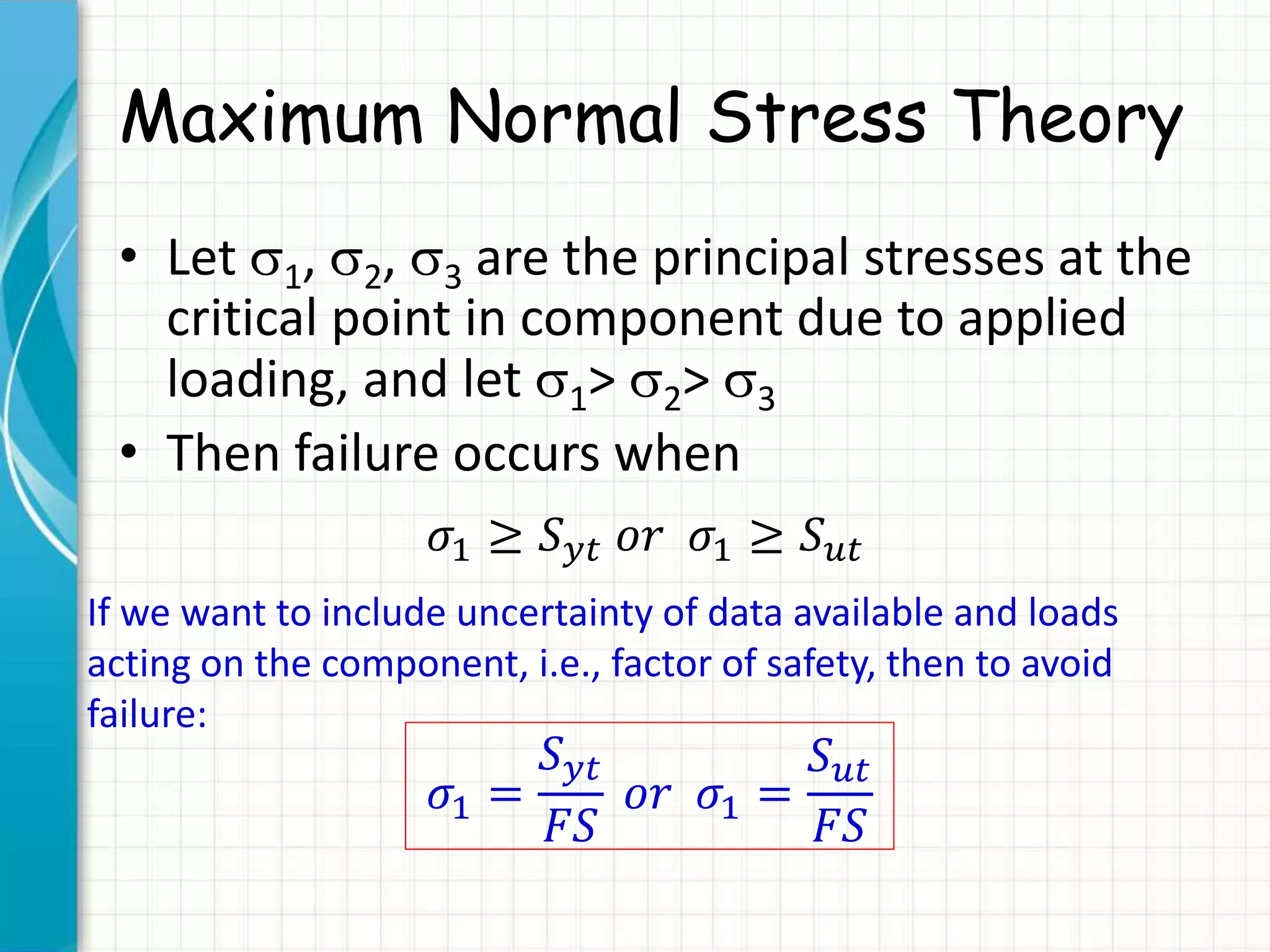
• Let 1, 2, 3 are the principal stresses at the
critical point in component due to applied
loading, and let 1> 2> 3
• Then failure occurs when
𝜎1 ≥ 𝑆 𝑦𝑡 𝑜𝑟 𝜎1 ≥ 𝑆 𝑢𝑡
If we want to include uncertainty of data available and loads
acting on the component, i.e., factor of safety, then to avoid
failure:
𝜎1 =
𝑆 𝑦𝑡
𝐹𝑆
𝑜𝑟 𝜎1 =
𝑆 𝑢𝑡
𝐹𝑆
Maximum Shear-Stress Theory
• The oldest failure theory, originally proposed
by the great French scientist C. A. Coulomb
(1736–1806)
• Tresca modified it in 1864, and J. J. Guest
• Validated by experiments around 1900
• For these reasons the maximum-shear-stress
theory is sometimes called the Tresca-Guest
theory
Maximum Shear-Stress Theory
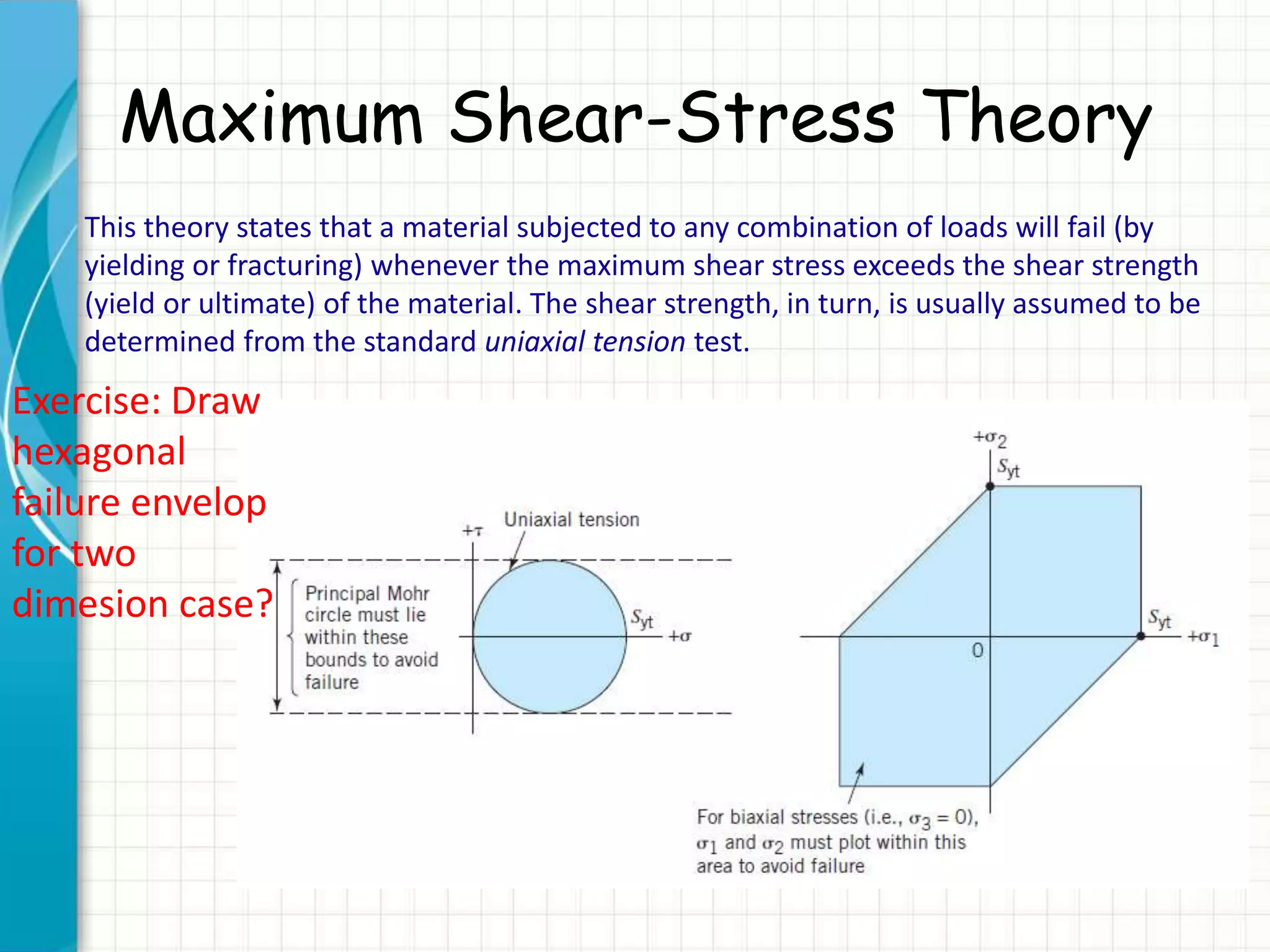
This theory states that a material subjected to any combination of loads will fail (by
yielding or fracturing) whenever the maximum shear stress exceeds the shear strength
(yield or ultimate) of the material. The shear strength, in turn, is usually assumed to be
determined from the standard uniaxial tension test.
Exercise: Draw
hexagonal
failure envelop
for two
dimesion case?
Static failure theories
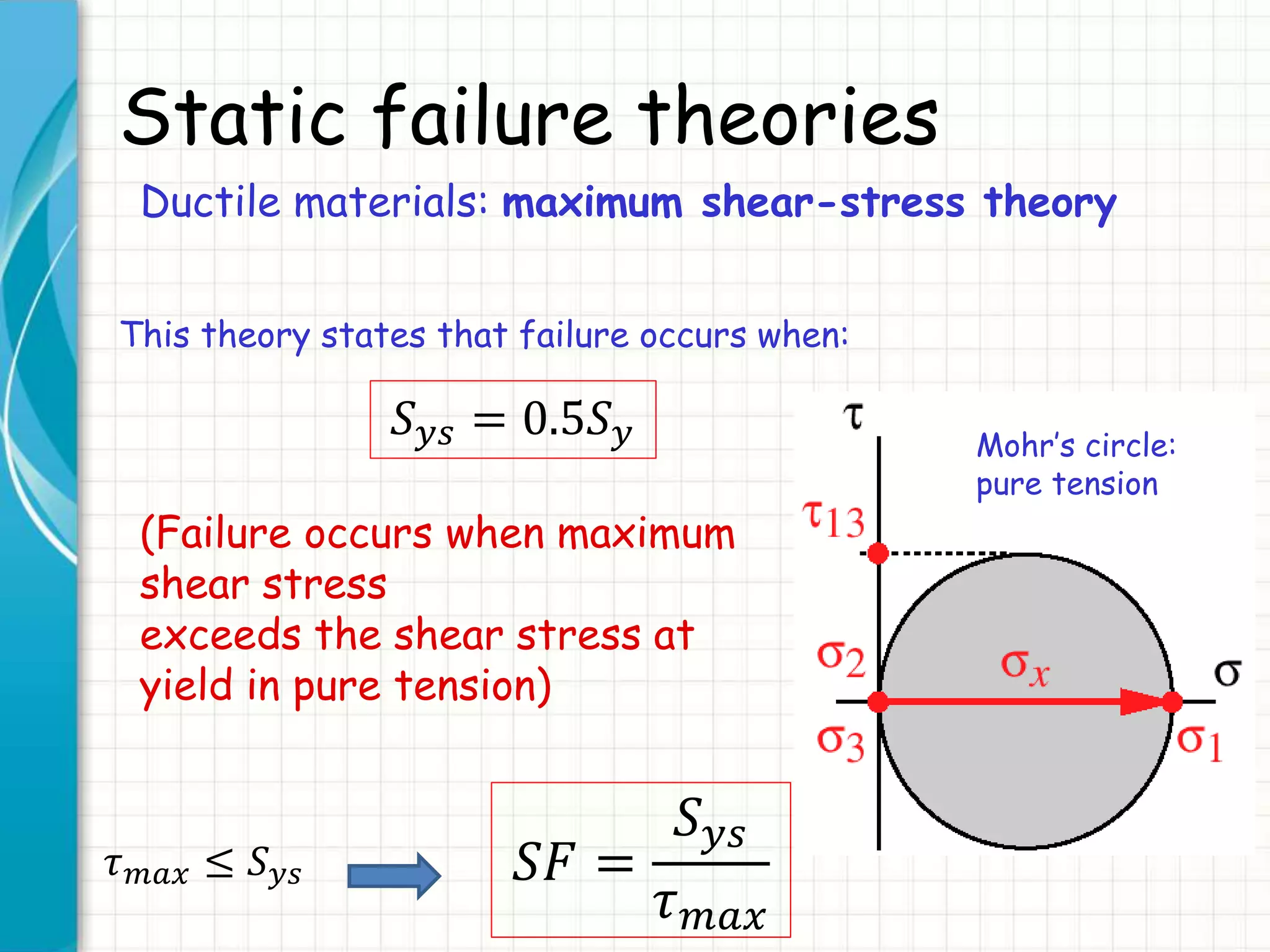
This theory states that failure occurs when:
Ductile materials: maximum shear-stress theory
𝑆 𝑦𝑠 = 0.5𝑆 𝑦
(Failure occurs when maximum
shear stress
exceeds the shear stress at
yield in pure tension)
Mohr’s circle:
pure tension
𝑆𝐹 =
𝑆 𝑦𝑠
𝜏 𝑚𝑎𝑥
𝜏 𝑚𝑎𝑥 ≤ 𝑆 𝑦𝑠
Static failure theories
Ductile materials: maximum shear-stress theory
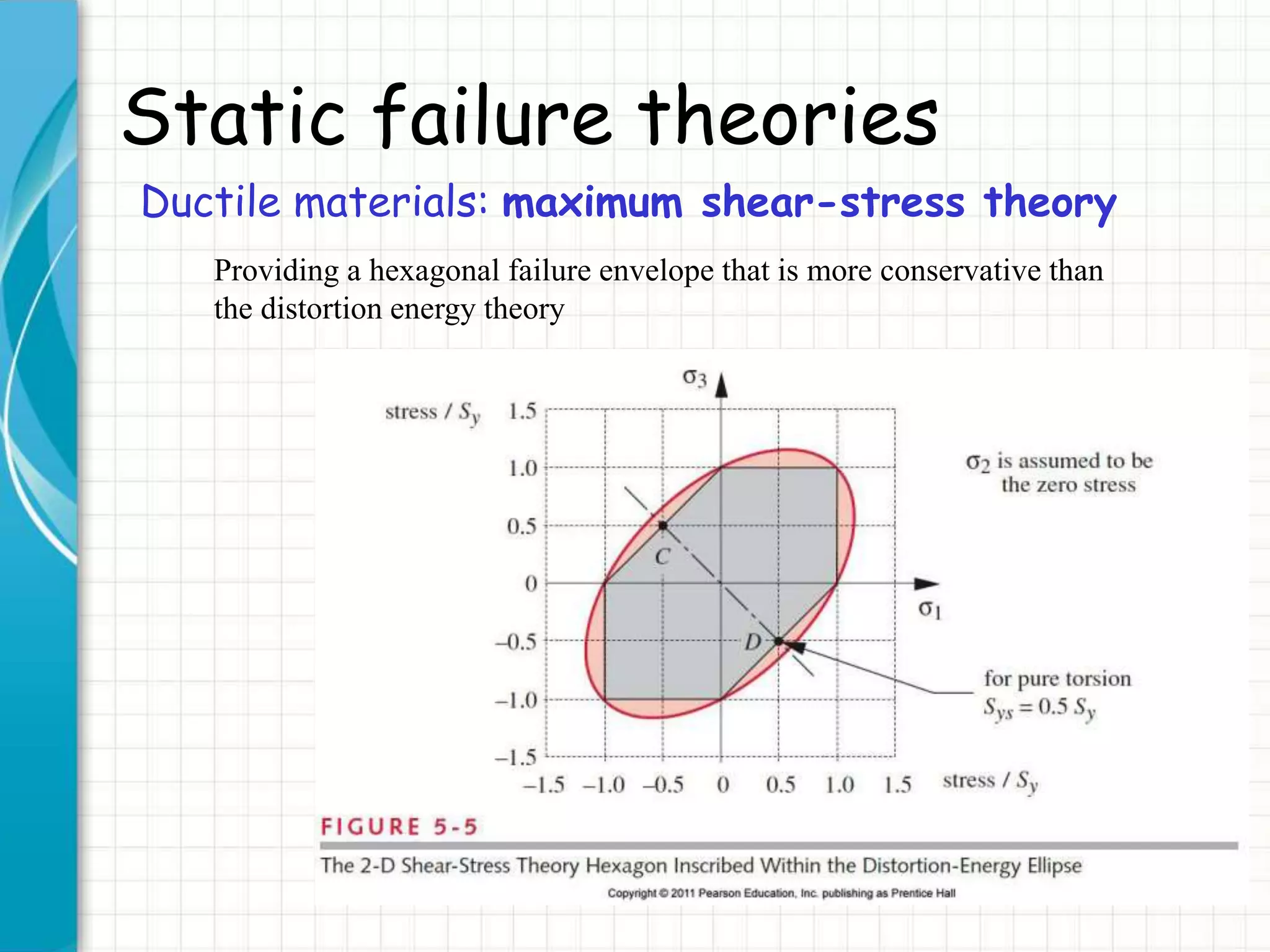
Providing a hexagonal failure envelope that is more conservative than
the distortion energy theory
Maximum Shear Stress Theory
Static failure theories
Ductile materials
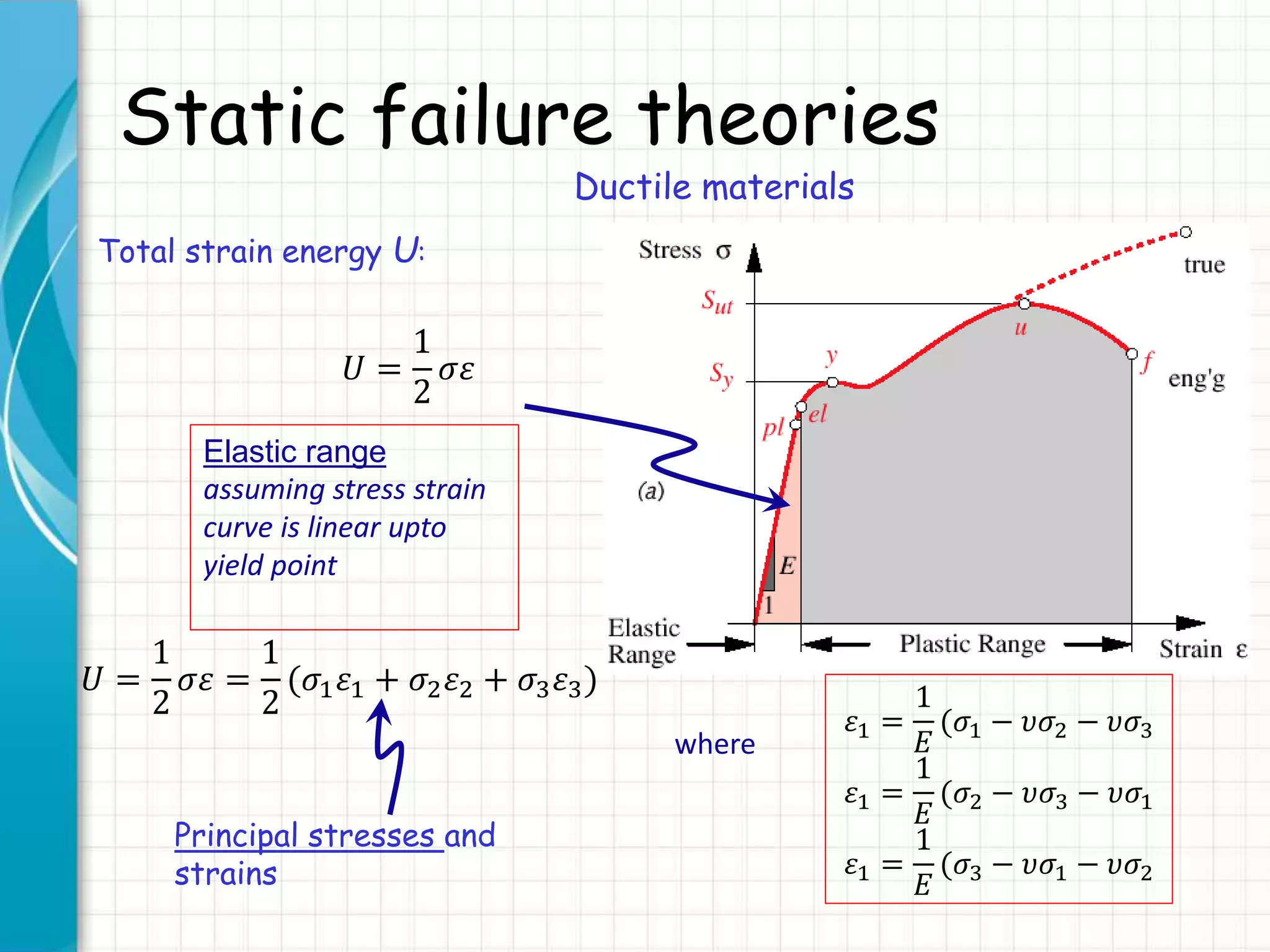
Total strain energy U:
Elastic range
assuming stress strain
curve is linear upto
yield point
𝑈 =
1
2
𝜎𝜀
𝑈 =
1
2
𝜎𝜀 =
1
2
(𝜎1 𝜀1 + 𝜎2 𝜀2 + 𝜎3 𝜀3)
Principal stresses and
strains
𝜀1 =
1
𝐸
(𝜎1 − 𝜐𝜎2 − 𝜐𝜎3
𝜀1 =
1
𝐸
(𝜎2 − 𝜐𝜎3 − 𝜐𝜎1
𝜀1 =
1
𝐸
(𝜎3 − 𝜐𝜎1 − 𝜐𝜎2
where
Static failure theories
Ductile materials: total strain energy
Using previous expressions, total energy is:
𝑈 =
1
2
𝜎𝜀 =
1
2𝐸
[𝜎1
2
+ 𝜎2
2
+ 𝜎3
2
− 2𝜐(𝜎1 𝜎2 + 𝜎2 𝜎3 + 𝜎3 𝜎1)
which can be expressed as 𝑈 = 𝑈ℎ + 𝑈 𝑑
Hydrostatic energy Deformation energy
𝑈ℎ =
3
2
(1 − 2𝜐)
𝐸
𝜎ℎ
2
𝜎ℎ =
𝜎1 + 𝜎2 + 𝜎3
3
Obtained by setting:
𝑈ℎ = 𝑈(𝜎1 = 𝜎2 = 𝜎3 = 𝜎ℎ)
𝑈 𝑑 =
1 + 𝜐
3𝐸
[𝜎1
2 + 𝜎2
2 + 𝜎3
2
−(𝜎1 𝜎2 + 𝜎2 𝜎3 + 𝜎3 𝜎1)]
Obtained by setting:
𝑈 𝑑 = 𝑈 − 𝑈ℎ
Static failure theories
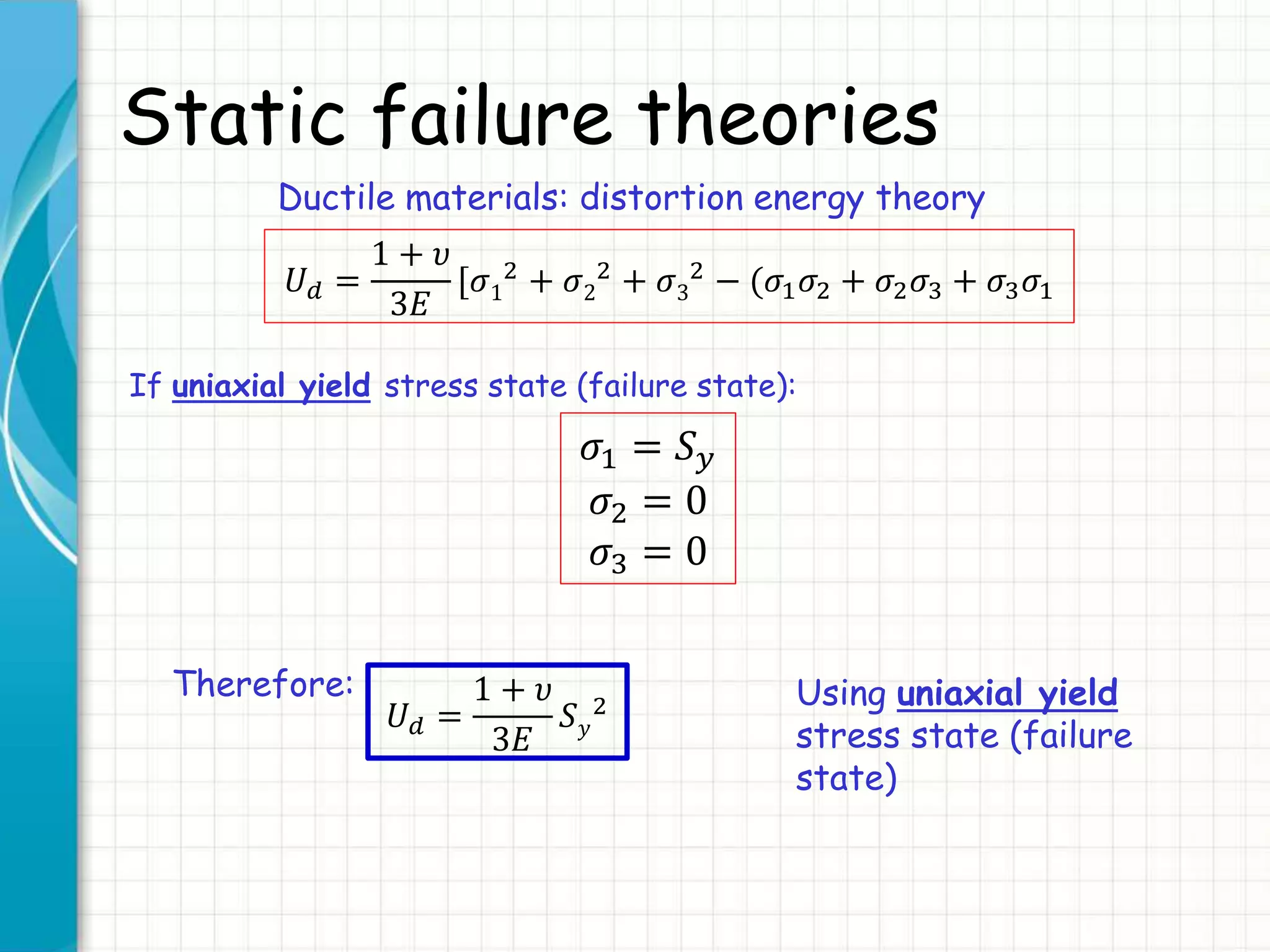
Ductile materials: distortion energy theory
𝑈 𝑑 =
1 + 𝜐
3𝐸
[𝜎1
2 + 𝜎2
2 + 𝜎3
2 − (𝜎1 𝜎2 + 𝜎2 𝜎3 + 𝜎3 𝜎1
If uniaxial yield stress state (failure state):
𝜎1 = 𝑆 𝑦
𝜎2 = 0
𝜎3 = 0
Therefore:
𝑈 𝑑 =
1 + 𝜐
3𝐸
𝑆 𝑦
2 Using uniaxial yield
stress state (failure
state)
Static failure theories
Ductile materials: distortion energy theory
𝑈 𝑑 =
1 + 𝜐
3𝐸
[𝜎1
2 + 𝜎2
2 + 𝜎3
2 − 𝜎1 𝜎2 + 𝜎2 𝜎3 + 𝜎3 𝜎1 ]
For any other state of stresses:
Failure criterion is obtained by setting:
1 + 𝜐
3𝐸
[𝜎1
2
+ 𝜎2
2
+ 𝜎3
2
− (𝜎1 𝜎2 + 𝜎2 𝜎3 + 𝜎3 𝜎1] ≤
1 + 𝜐
3𝐸
𝑆 𝑦
2
Distortion energy:
uniaxial stress at
yield
Distortion energy:
any other state of
stresses
𝜎1
2 + 𝜎2
2 + 𝜎3
2 − 𝜎1 𝜎2 − 𝜎2 𝜎3 − 𝜎3 𝜎1 ≤ 𝑆 𝑦
2
Static failure theories
Ductile materials: distortion energy theory
𝑆 𝑦
2 = 𝜎1
2 + 𝜎2
2 + 𝜎3
2 − 𝜎1 𝜎2 − 𝜎2 𝜎3 − 𝜎3 𝜎1
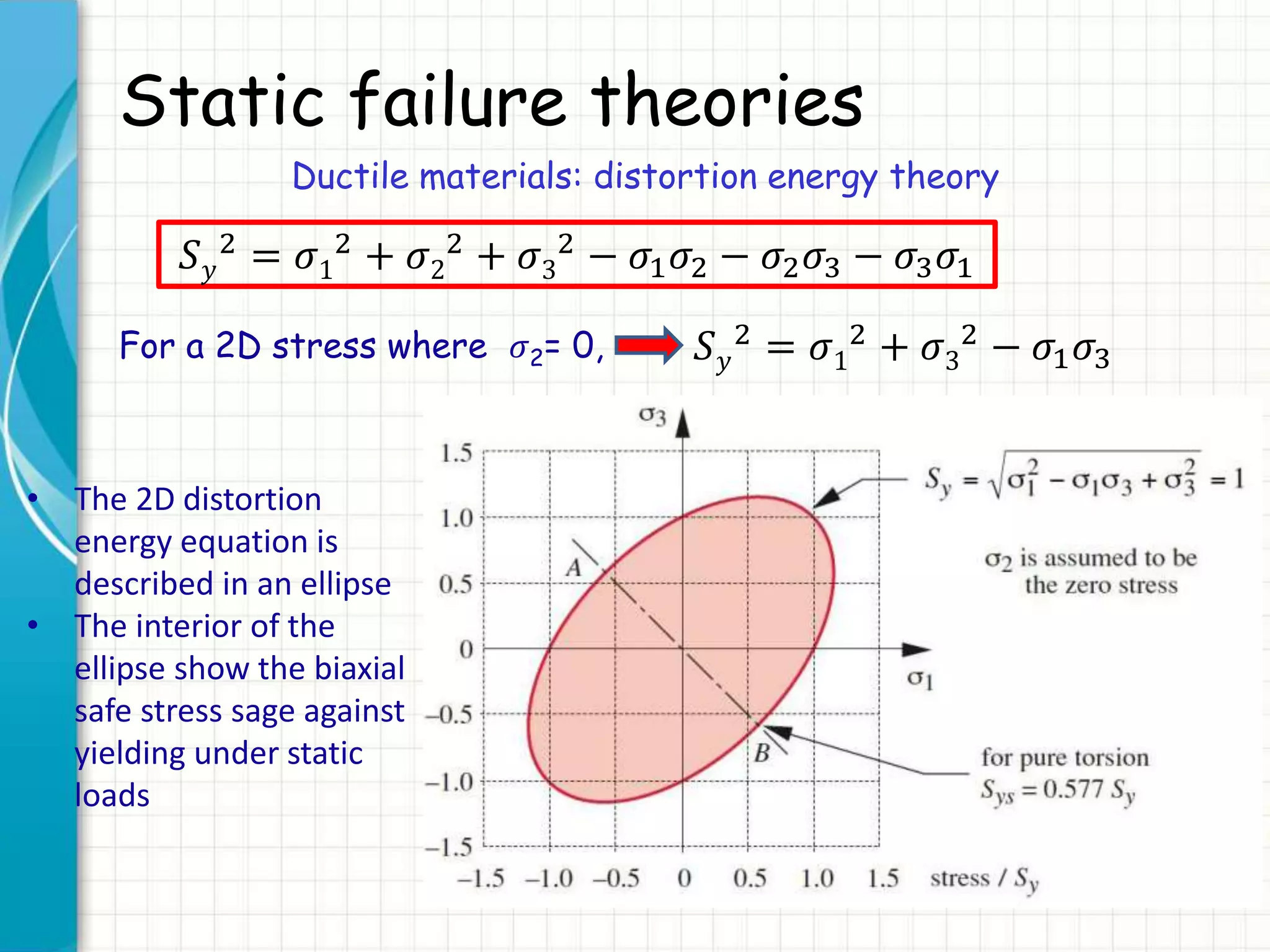
For a 2D stress where 𝜎2= 0, 𝑆 𝑦
2 = 𝜎1
2 + 𝜎3
2 − 𝜎1 𝜎3
• The 2D distortion
energy equation is
described in an ellipse
• The interior of the
ellipse show the biaxial
safe stress sage against
yielding under static
loads
Static failure theories
Ductile materials: distortion energy theory
𝑆 𝑦
2 = 𝜎1
2 + 𝜎2
2 + 𝜎3
2 − 𝜎1 𝜎2 − 𝜎2 𝜎3 − 𝜎3 𝜎1
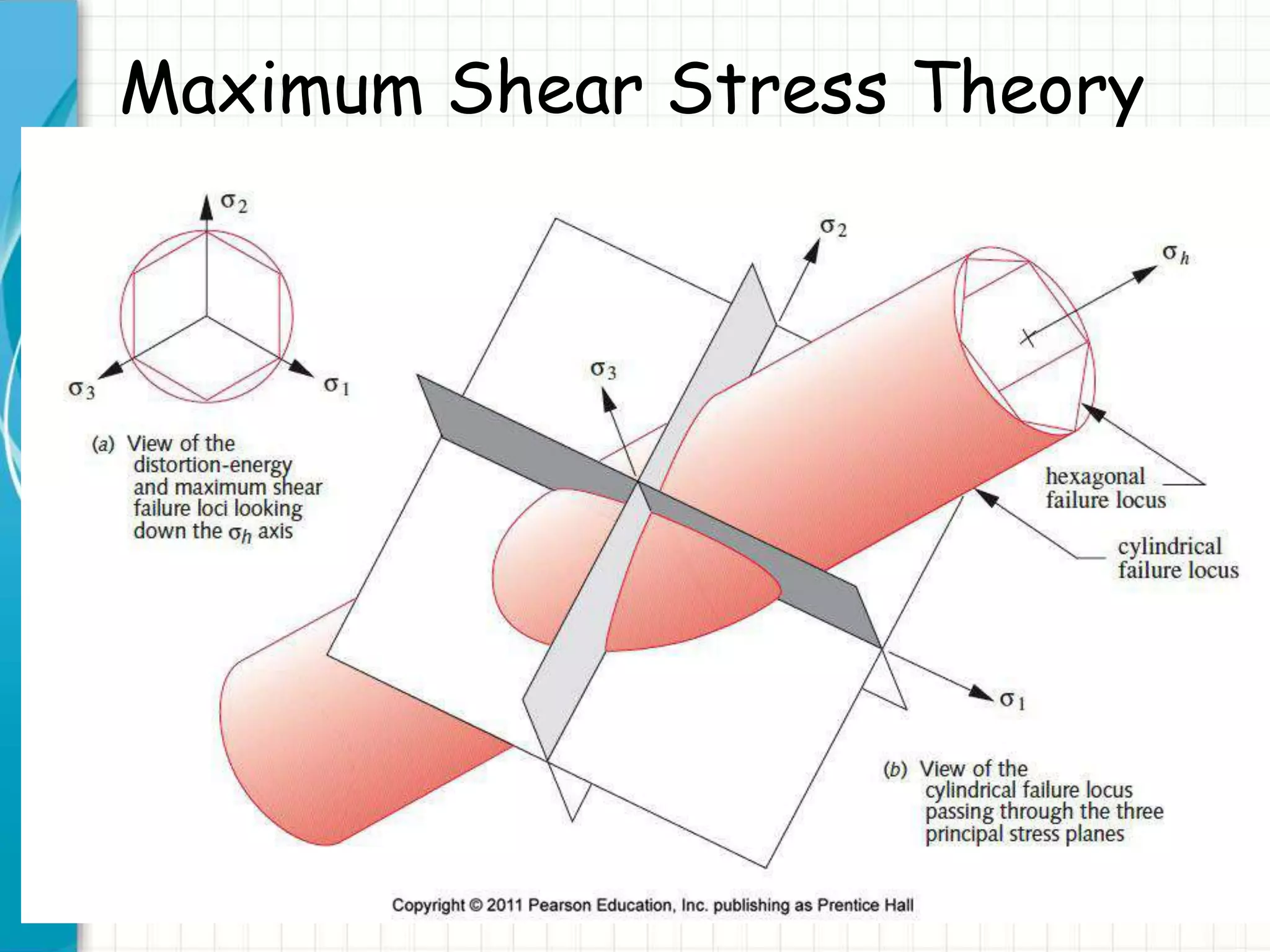
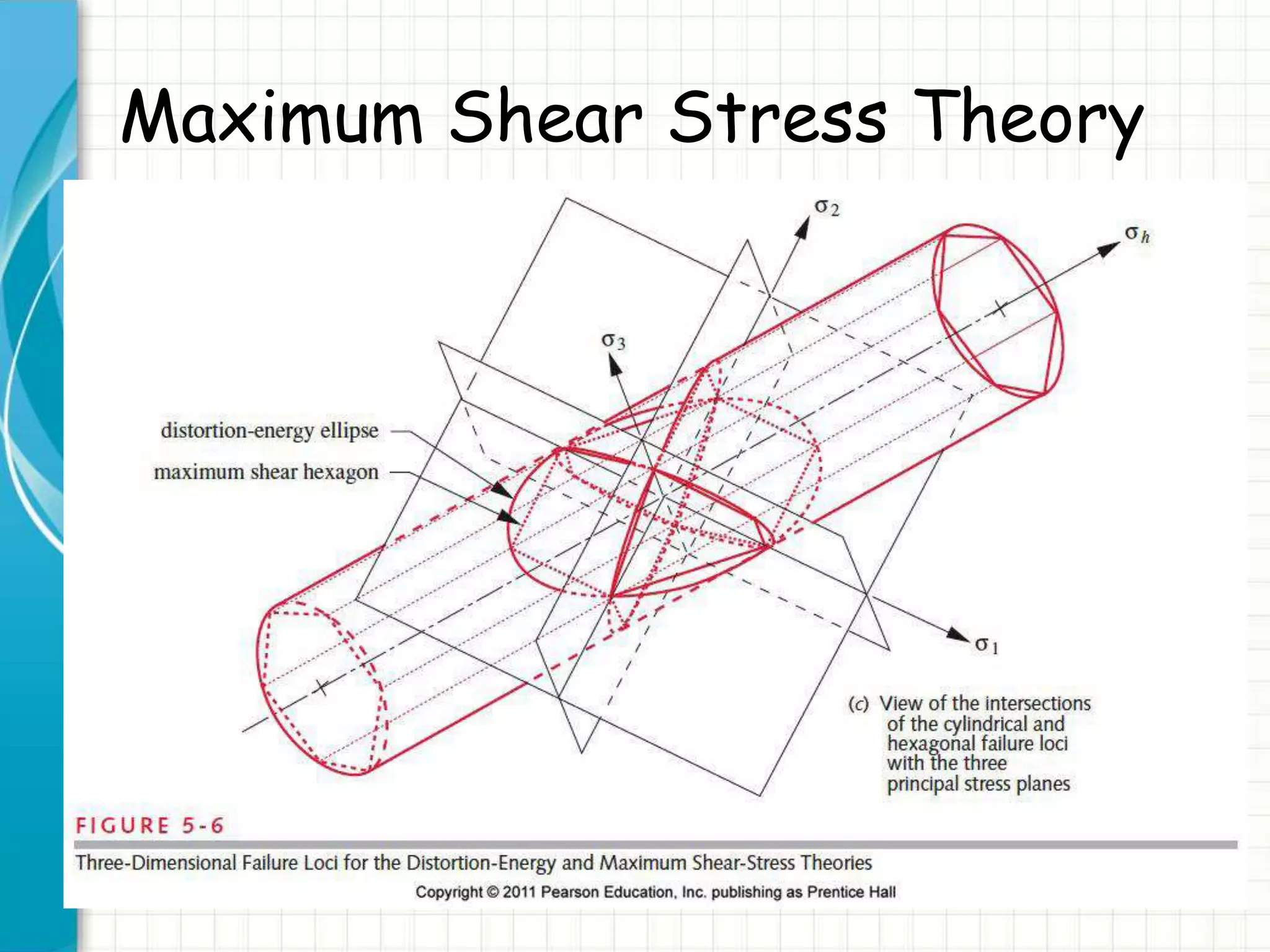
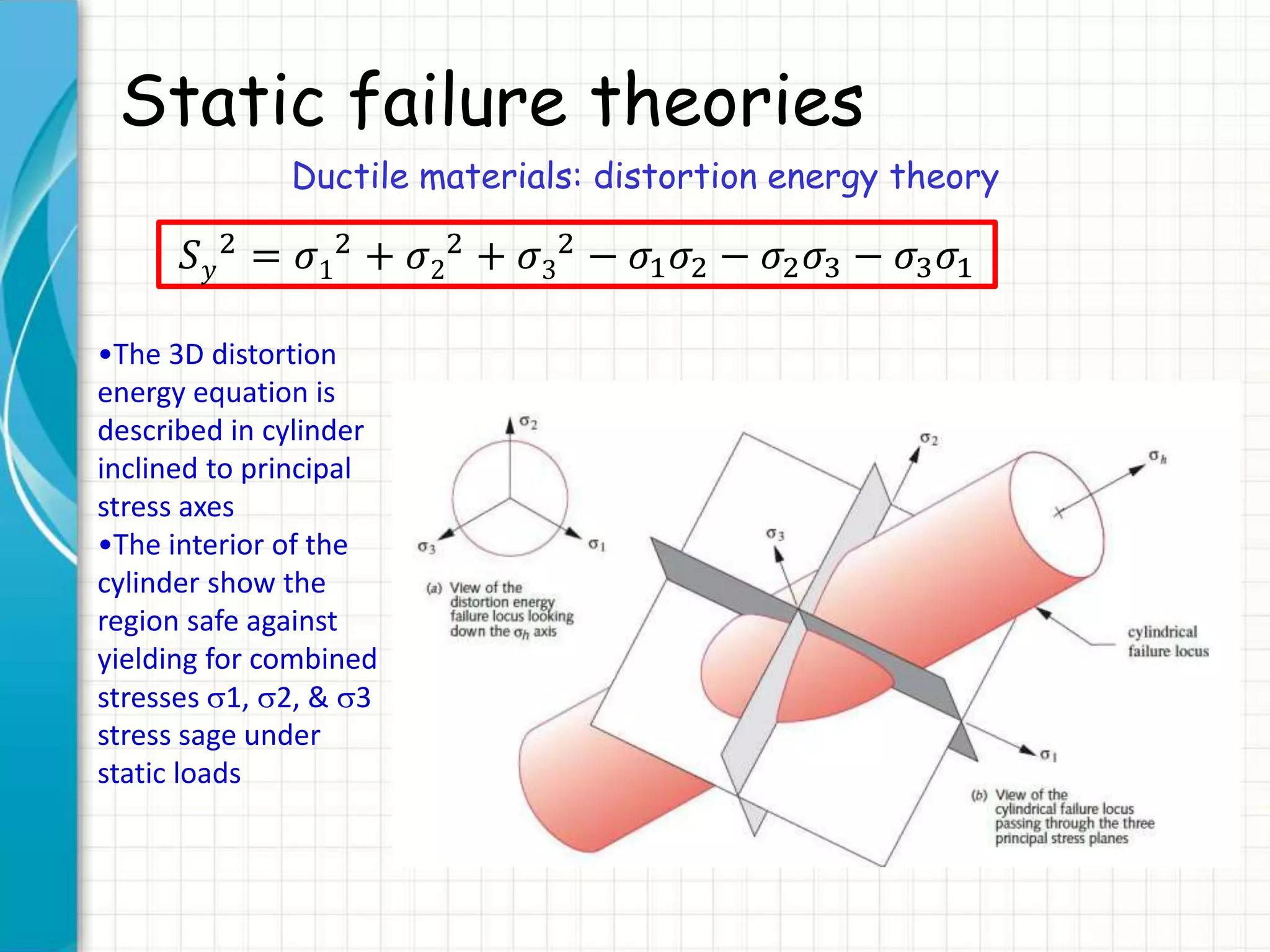
•The 3D distortion
energy equation is
described in cylinder
inclined to principal
stress axes
•The interior of the
cylinder show the
region safe against
yielding for combined
stresses 1, 2, & 3
stress sage under
static loads
Static failure theories
Ductile materials: distortion energy theory
𝑆 𝑦
2 = 𝜎1
2 + 𝜎2
2 + 𝜎3
2 − 𝜎1 𝜎2 − 𝜎2 𝜎3 − 𝜎3 𝜎1
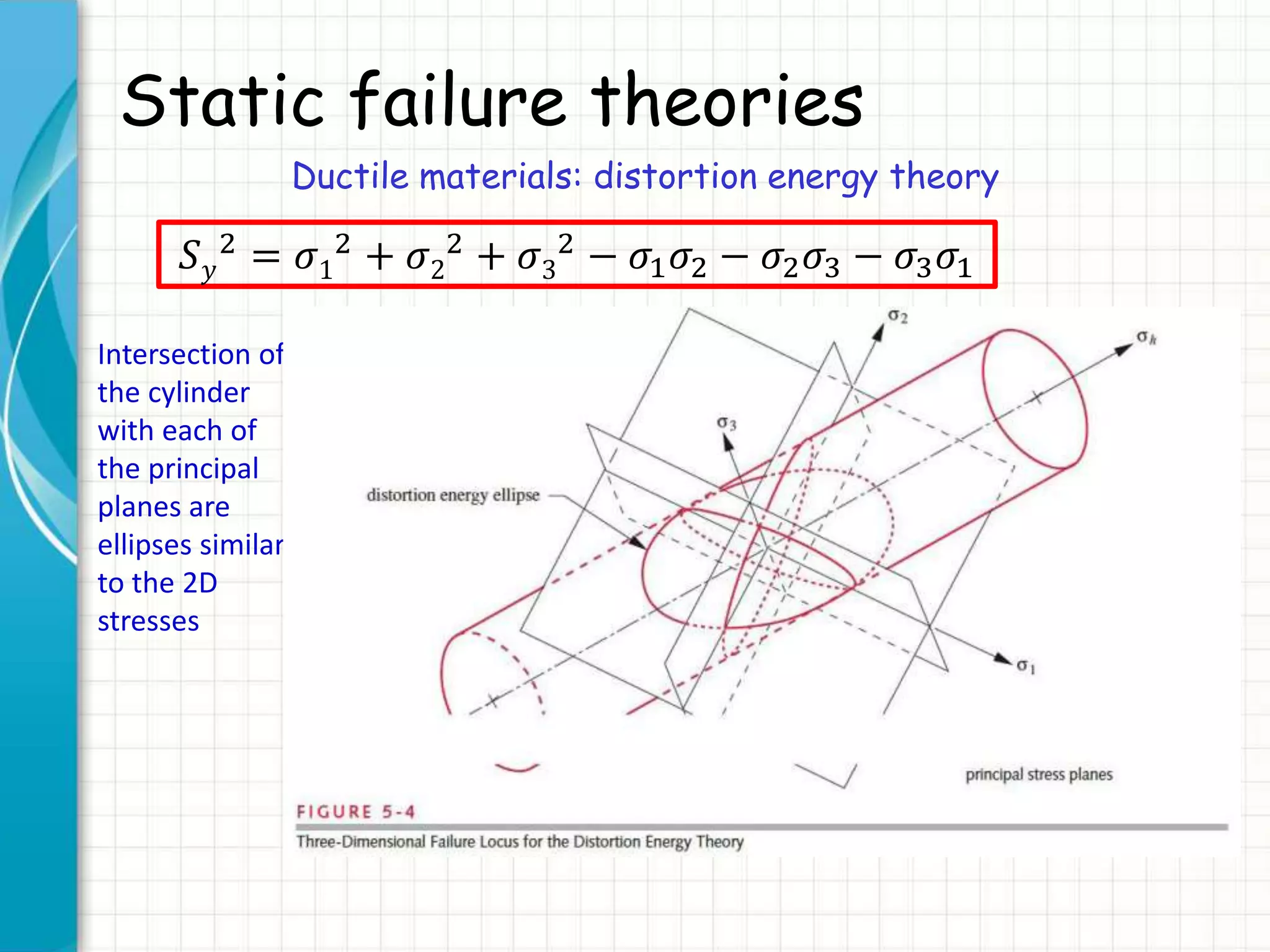
Intersection of
the cylinder
with each of
the principal
planes are
ellipses similar
to the 2D
stresses
Static failure theories
Ductile materials: distortion energy theory
Von Mises effective stress
𝑆 𝑦
2 = [𝜎1
2 + 𝜎2
2 + 𝜎3
2 − 𝜎1 𝜎2 − 𝜎2 𝜎3 − 𝜎3 𝜎1] ≡ 𝜎′ 2
Definition:
𝜎′ = 𝜎1
2
+ 𝜎2
2
+ 𝜎3
2
− 𝜎1 𝜎2 − 𝜎2 𝜎3 − 𝜎3 𝜎1
(Yield surface)
von Mises effective stress
von Mises effective stress: uniaxial stress that would create the
same distortion energy as is created by actual combination of
applied stresses
Distortion Energy Theory (DET)
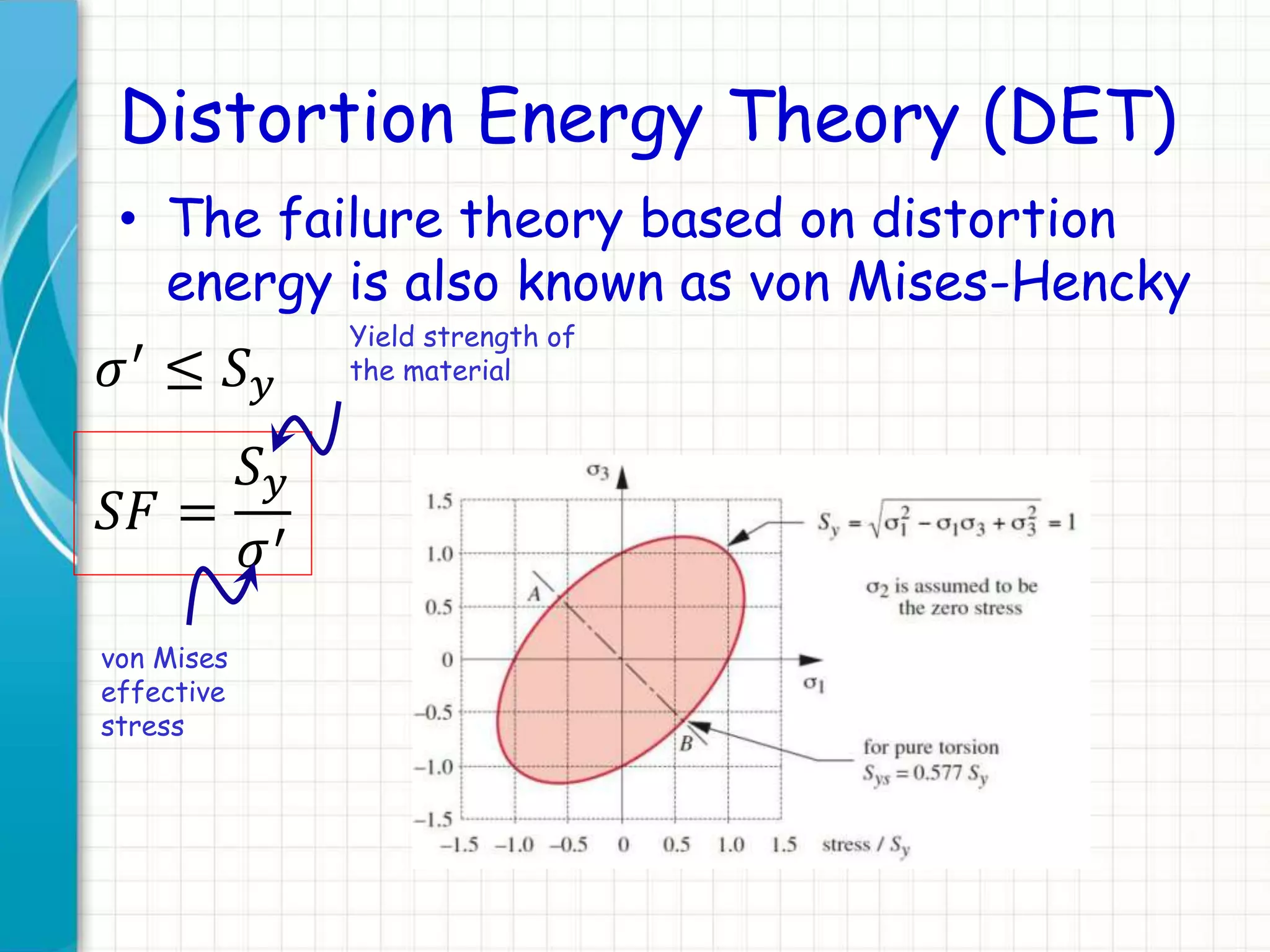
• The failure theory based on distortion
energy is also known as von Mises-Hencky
𝜎′
≤ 𝑆 𝑦
𝑆𝐹 =
𝑆 𝑦
𝜎′
Yield strength of
the material
von Mises
effective
stress
Static failure theories
Ductile materials: distortion energy theory
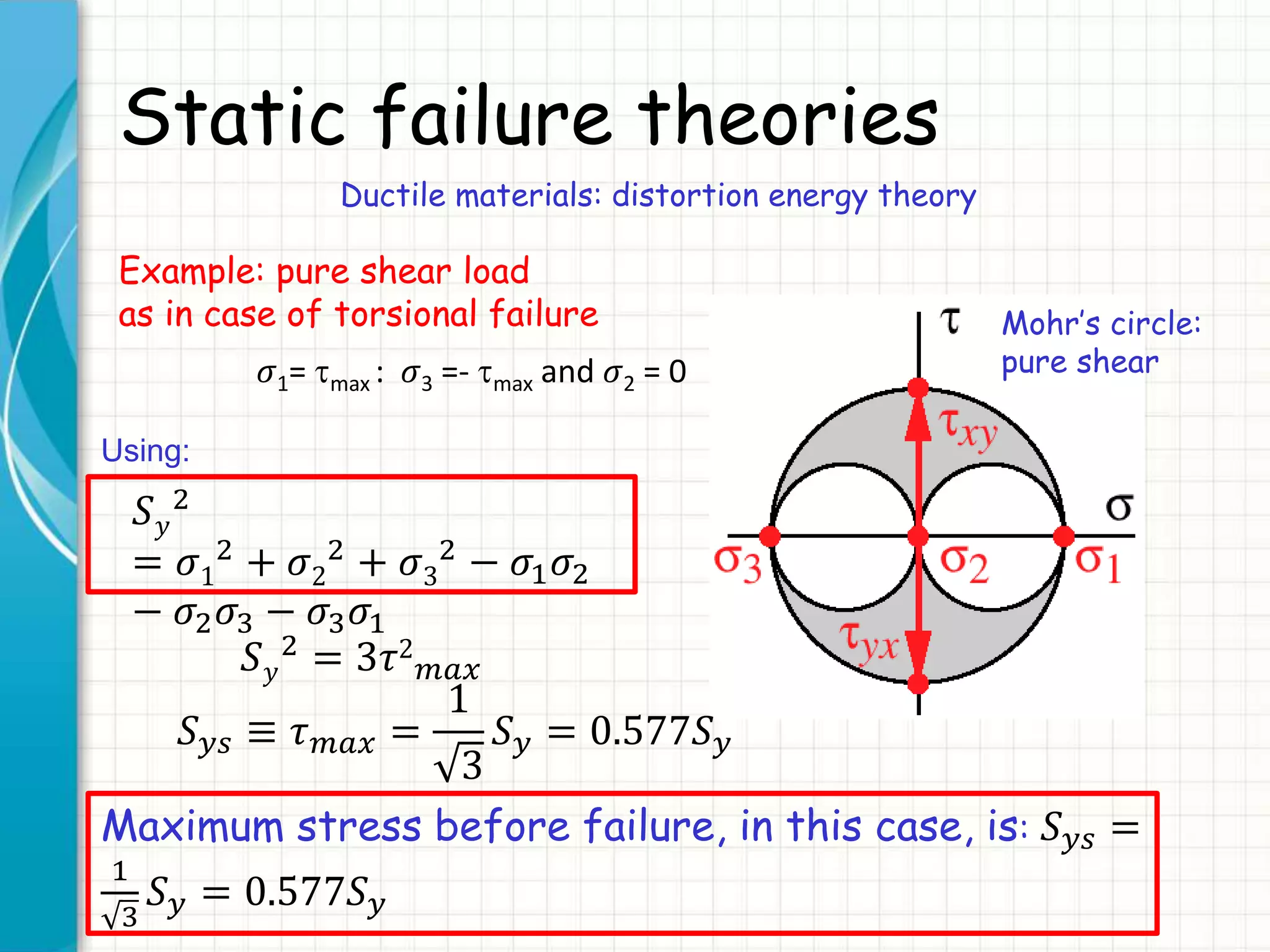
Example: pure shear load
as in case of torsional failure Mohr’s circle:
pure shear𝜎1= max : 𝜎3 =- max and 𝜎2 = 0
𝑆 𝑦
2
= 𝜎1
2
+ 𝜎2
2
+ 𝜎3
2
− 𝜎1 𝜎2
− 𝜎2 𝜎3 − 𝜎3 𝜎1
Using:
𝑆 𝑦
2 = 3𝜏2
𝑚𝑎𝑥
𝑆 𝑦𝑠 ≡ 𝜏 𝑚𝑎𝑥 =
1
3
𝑆 𝑦 = 0.577𝑆 𝑦
Maximum stress before failure, in this case, is: 𝑆 𝑦𝑠 =
1
3
𝑆 𝑦 = 0.577𝑆 𝑦
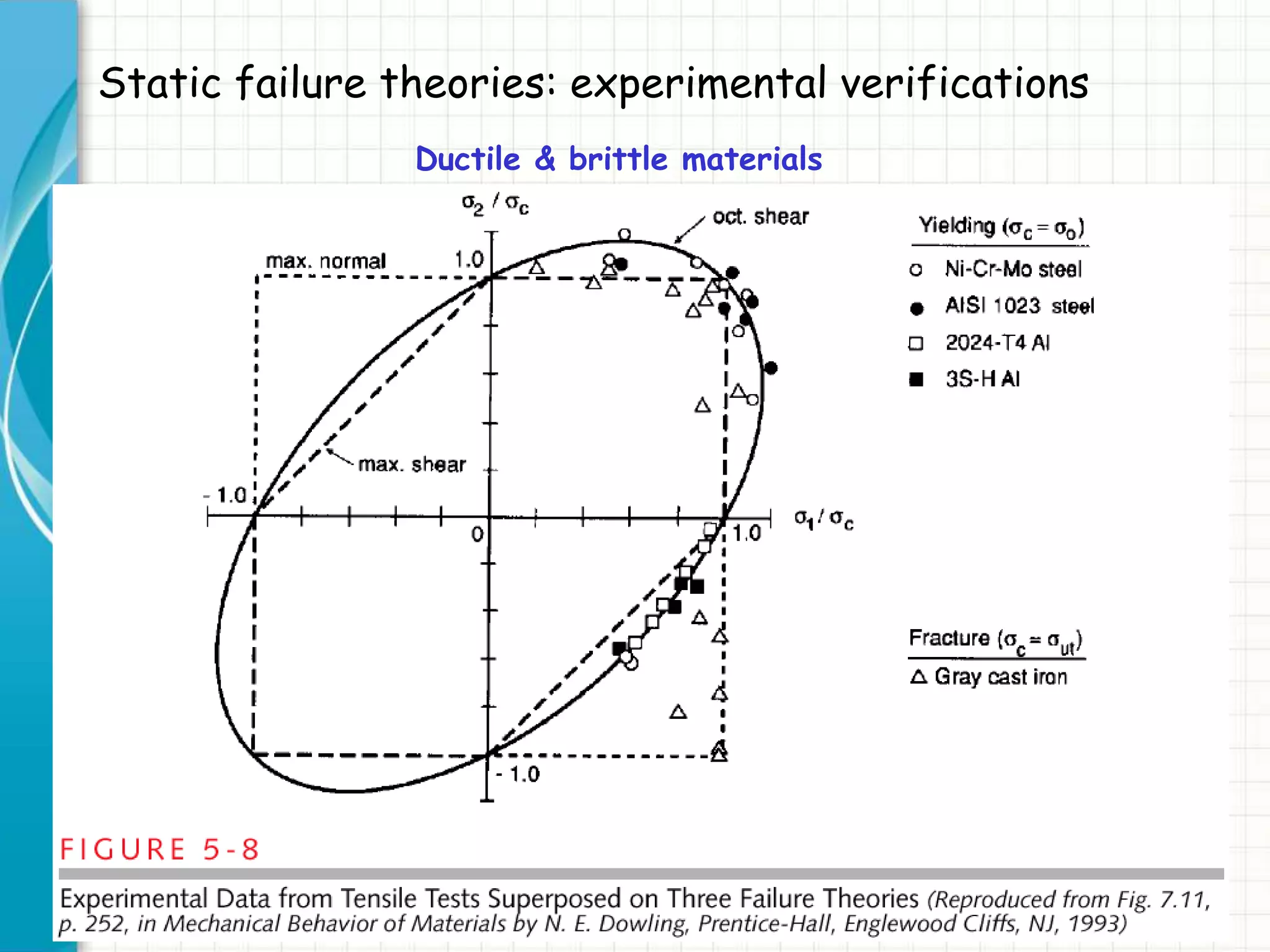
Static failure theories: experimental verifications
Ductile & brittle materials
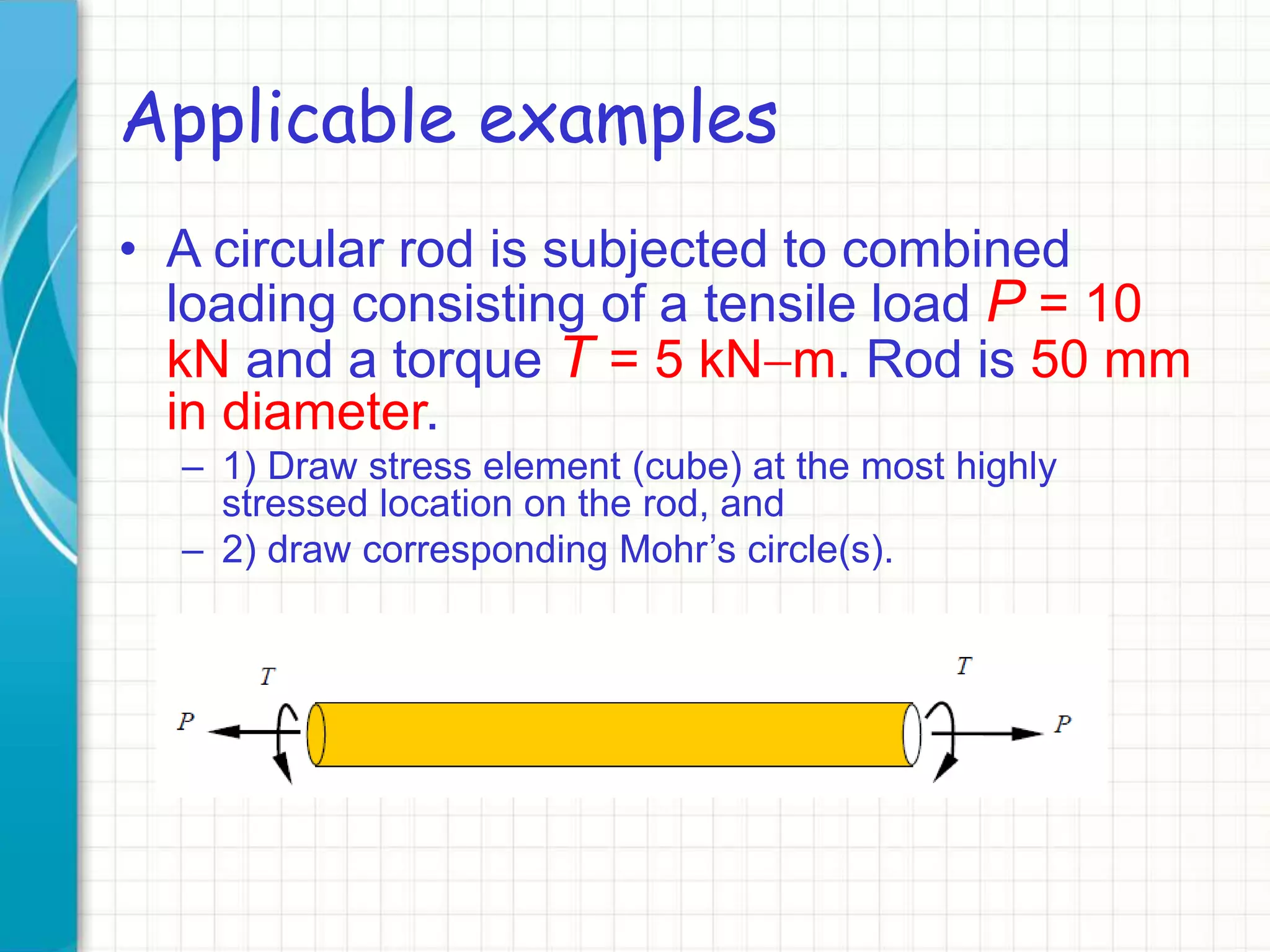
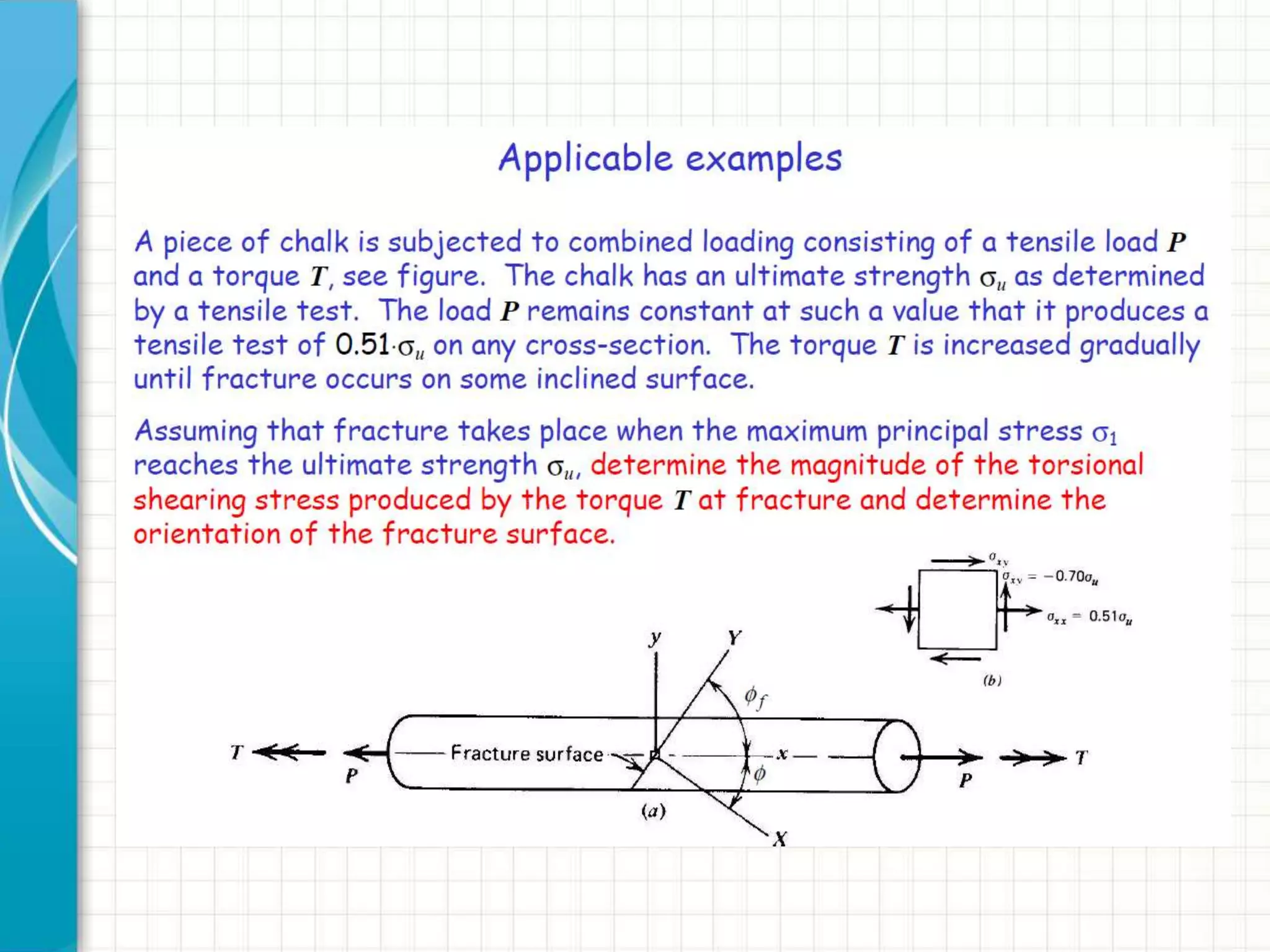
Applicable examples
• A circular rod is subjected to combined
loading consisting of a tensile load P = 10
kN and a torque T = 5 kN-m. Rod is 50 mm
in diameter.
– 1) Draw stress element (cube) at the most highly
stressed location on the rod, and
– 2) draw corresponding Mohr’s circle(s).
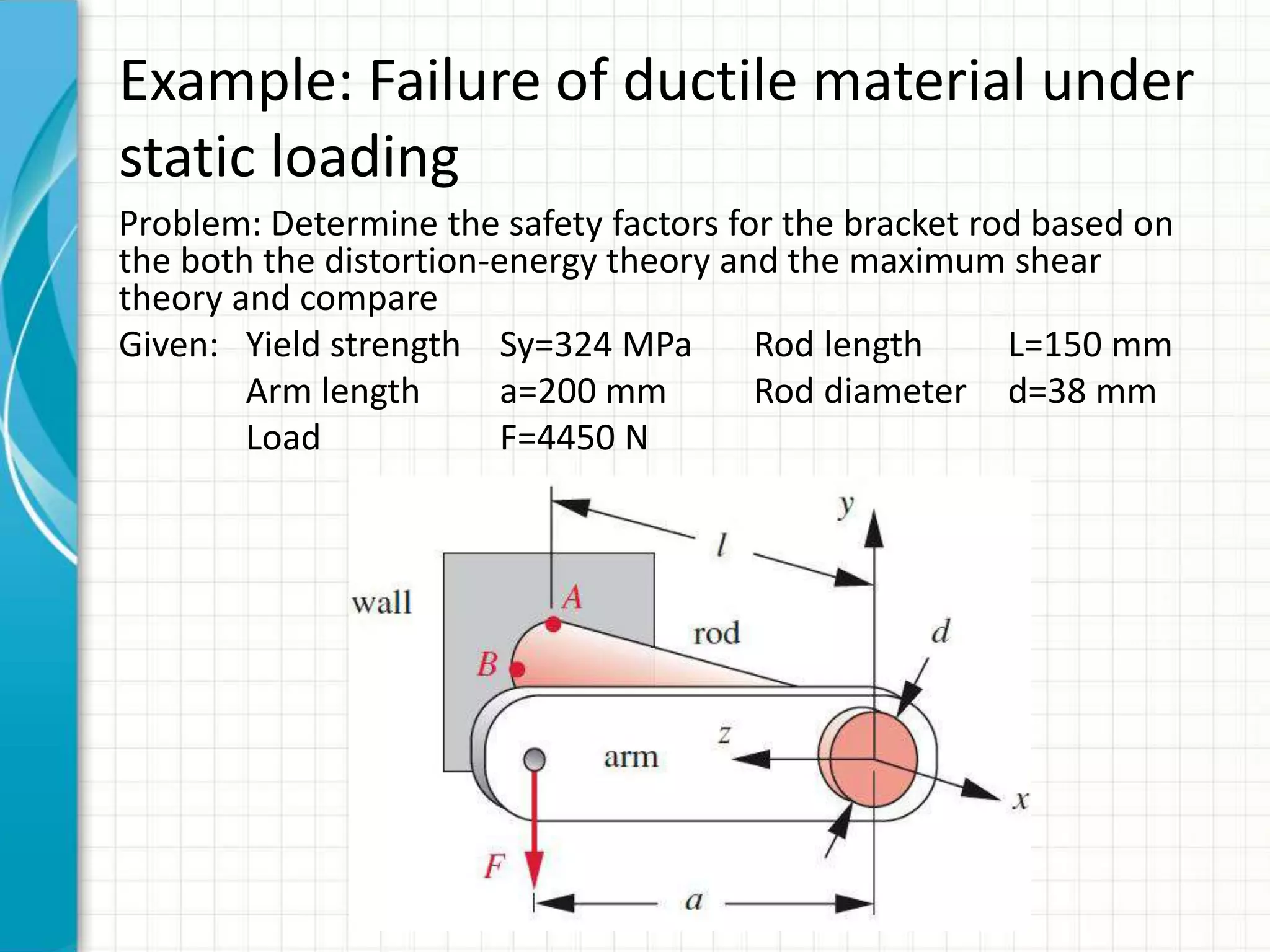
Example: Failure of ductile material under
static loading
Problem: Determine the safety factors for the bracket rod based on
the both the distortion-energy theory and the maximum shear
theory and compare
Given: Yield strength Sy=324 MPa Rod length L=150 mm
Arm length a=200 mm Rod diameter d=38 mm
Load F=4450 N
• Limiting to bending of cantilever and in
torsion
• The shear and moment diagrams will be
similar to a cantilever beam loaded at its end

1 static failure theories ductile r1

  • 1.
    MACHINE DESIGN: STATIC FAILURETHEORIES Dr. Himanshu Chaudhary Associate Professor Dept. of Mech. Eng. MNIT Jaipur
  • 2.
    Static failure theories •Why do parts fail? • You may say “Parts fail because their stresses exceed their strength” • Then what kind of stresses cause the failure: Tensile? Compressive? Shear? • Answer may be: It depends. • It depends on the material and its relative strength in compressive, tension, and shear. • It also depends on the type loading (Static, Fatigue, Impact) and • presence of the cracks in the material
  • 3.
    Static failure theories •The failure may be elastic or fracture • Elastic failure results in excessive deformation, which makes the machine component unfit to perform its function satisfactorily • Fracture results in breaking the component into two parts
  • 4.
    Static failure theories •Question: How do one compare stresses induced to the material properties? – Generally machine parts are subjected to combined loading and to find material properties under real loading condition is practically not economical – Thus, material properties are obtained from simple tension/torsion test – These data like Syt, Sut etc are available in form of table (Design Data Book)
  • 5.
    Static failure theories •Theories of failure provide a relationship between the strength of machine component subjected to complex state of stress with the material properties obtained from simple test (Tensile) Strength of machine component subjected to complex state of stress Strength of standard component subjected to uniaxial state of stress
  • 6.
    Static failure theories •Loads are assumed to not vary over time • Failure theories that apply to: – Ductile materials – Brittle materials • Why do we need different theories ?? Stress-strain curve of a ductile material Stress-strain curve of a brittle material
  • 7.
    Static failure theories:Tension test Why nearly 0o ?? Failure along principal shear stress plane Failure along principal normal stress plane Cast iron has C between 2.1% to 4% and Si between 1% and 3% C contents less than 2.1% are steels.
  • 8.
    Static failure theories: Compressiontest Why doesn’t it fail ?? Why does it fail ?? Why nearly 45o ?? Does not “fail” Shear failure
  • 9.
    Failure along principalshear stress plane Failure along principal normal stress plane
  • 10.
    Static failure theories •In general, ductile, isotropic materials are limited by their shear strengths. • Brittle materials are limited by their tensile strengths. • If cracks are present in a ductile material, it can suddenly fracture at nominal stress levels well below its yield strength, even under static loads. • Static loads are slowly applied and remain constant with time. • Dynamic loads are suddenly applied (impact), or repeatedly varied with time (fatigue), or both.
  • 11.
    Static failure theories •In dynamic loading, the distinction between failure mechanisms of ductile and brittle materials blurs. • Ductile materials often fail like brittle materials in dynamic loading.
  • 12.
    Static failure theories •Total strain energy theory • Distortion energy theory • Pure shear-stress theory • Maximum shear-stress theory • Maximum normal stress theory (limited application) Accepted failure theories that apply to ductile materials: Accepted failure theories that apply to brittle materials: • Maximum normal stress theory (even material) • Maximum normal stress theory (uneven material) • Coulomb-Mohr theory • Modified Mohr theory
  • 13.
    Maximum Normal StressTheory • Credited to the English scientist and educator W. J. M. Rankine (1802–1872)
  • 14.
    Maximum Normal StressTheory • This predicts that failure of machine component, subjected to complex loading, occurs if the maximum normal principal stress tends to exceeds the uniaxial tensile yield (ductile) or the ultimate tensile strength (brittle) of the material • Providing a square failure boundary with Sy as the principal stress for ductile materials • Note: not a safe theory for ductile materials Exercise: Draw failure envelop for two dimension case?
  • 15.
    Maximum Normal StressTheory • Let 1, 2, 3 are the principal stresses at the critical point in component due to applied loading, and let 1> 2> 3 • Then failure occurs when 𝜎1 ≥ 𝑆 𝑦𝑡 𝑜𝑟 𝜎1 ≥ 𝑆 𝑢𝑡 If we want to include uncertainty of data available and loads acting on the component, i.e., factor of safety, then to avoid failure: 𝜎1 = 𝑆 𝑦𝑡 𝐹𝑆 𝑜𝑟 𝜎1 = 𝑆 𝑢𝑡 𝐹𝑆
  • 16.
    Maximum Shear-Stress Theory •The oldest failure theory, originally proposed by the great French scientist C. A. Coulomb (1736–1806) • Tresca modified it in 1864, and J. J. Guest • Validated by experiments around 1900 • For these reasons the maximum-shear-stress theory is sometimes called the Tresca-Guest theory
  • 17.
    Maximum Shear-Stress Theory Thistheory states that a material subjected to any combination of loads will fail (by yielding or fracturing) whenever the maximum shear stress exceeds the shear strength (yield or ultimate) of the material. The shear strength, in turn, is usually assumed to be determined from the standard uniaxial tension test. Exercise: Draw hexagonal failure envelop for two dimesion case?
  • 18.
    Static failure theories Thistheory states that failure occurs when: Ductile materials: maximum shear-stress theory 𝑆 𝑦𝑠 = 0.5𝑆 𝑦 (Failure occurs when maximum shear stress exceeds the shear stress at yield in pure tension) Mohr’s circle: pure tension 𝑆𝐹 = 𝑆 𝑦𝑠 𝜏 𝑚𝑎𝑥 𝜏 𝑚𝑎𝑥 ≤ 𝑆 𝑦𝑠
  • 19.
    Static failure theories Ductilematerials: maximum shear-stress theory Providing a hexagonal failure envelope that is more conservative than the distortion energy theory
  • 20.
  • 21.
  • 22.
    Static failure theories Ductilematerials Total strain energy U: Elastic range assuming stress strain curve is linear upto yield point 𝑈 = 1 2 𝜎𝜀 𝑈 = 1 2 𝜎𝜀 = 1 2 (𝜎1 𝜀1 + 𝜎2 𝜀2 + 𝜎3 𝜀3) Principal stresses and strains 𝜀1 = 1 𝐸 (𝜎1 − 𝜐𝜎2 − 𝜐𝜎3 𝜀1 = 1 𝐸 (𝜎2 − 𝜐𝜎3 − 𝜐𝜎1 𝜀1 = 1 𝐸 (𝜎3 − 𝜐𝜎1 − 𝜐𝜎2 where
  • 23.
    Static failure theories Ductilematerials: total strain energy Using previous expressions, total energy is: 𝑈 = 1 2 𝜎𝜀 = 1 2𝐸 [𝜎1 2 + 𝜎2 2 + 𝜎3 2 − 2𝜐(𝜎1 𝜎2 + 𝜎2 𝜎3 + 𝜎3 𝜎1) which can be expressed as 𝑈 = 𝑈ℎ + 𝑈 𝑑 Hydrostatic energy Deformation energy 𝑈ℎ = 3 2 (1 − 2𝜐) 𝐸 𝜎ℎ 2 𝜎ℎ = 𝜎1 + 𝜎2 + 𝜎3 3 Obtained by setting: 𝑈ℎ = 𝑈(𝜎1 = 𝜎2 = 𝜎3 = 𝜎ℎ) 𝑈 𝑑 = 1 + 𝜐 3𝐸 [𝜎1 2 + 𝜎2 2 + 𝜎3 2 −(𝜎1 𝜎2 + 𝜎2 𝜎3 + 𝜎3 𝜎1)] Obtained by setting: 𝑈 𝑑 = 𝑈 − 𝑈ℎ
  • 24.
    Static failure theories Ductilematerials: distortion energy theory 𝑈 𝑑 = 1 + 𝜐 3𝐸 [𝜎1 2 + 𝜎2 2 + 𝜎3 2 − (𝜎1 𝜎2 + 𝜎2 𝜎3 + 𝜎3 𝜎1 If uniaxial yield stress state (failure state): 𝜎1 = 𝑆 𝑦 𝜎2 = 0 𝜎3 = 0 Therefore: 𝑈 𝑑 = 1 + 𝜐 3𝐸 𝑆 𝑦 2 Using uniaxial yield stress state (failure state)
  • 25.
    Static failure theories Ductilematerials: distortion energy theory 𝑈 𝑑 = 1 + 𝜐 3𝐸 [𝜎1 2 + 𝜎2 2 + 𝜎3 2 − 𝜎1 𝜎2 + 𝜎2 𝜎3 + 𝜎3 𝜎1 ] For any other state of stresses: Failure criterion is obtained by setting: 1 + 𝜐 3𝐸 [𝜎1 2 + 𝜎2 2 + 𝜎3 2 − (𝜎1 𝜎2 + 𝜎2 𝜎3 + 𝜎3 𝜎1] ≤ 1 + 𝜐 3𝐸 𝑆 𝑦 2 Distortion energy: uniaxial stress at yield Distortion energy: any other state of stresses 𝜎1 2 + 𝜎2 2 + 𝜎3 2 − 𝜎1 𝜎2 − 𝜎2 𝜎3 − 𝜎3 𝜎1 ≤ 𝑆 𝑦 2
  • 26.
    Static failure theories Ductilematerials: distortion energy theory 𝑆 𝑦 2 = 𝜎1 2 + 𝜎2 2 + 𝜎3 2 − 𝜎1 𝜎2 − 𝜎2 𝜎3 − 𝜎3 𝜎1 For a 2D stress where 𝜎2= 0, 𝑆 𝑦 2 = 𝜎1 2 + 𝜎3 2 − 𝜎1 𝜎3 • The 2D distortion energy equation is described in an ellipse • The interior of the ellipse show the biaxial safe stress sage against yielding under static loads
  • 27.
    Static failure theories Ductilematerials: distortion energy theory 𝑆 𝑦 2 = 𝜎1 2 + 𝜎2 2 + 𝜎3 2 − 𝜎1 𝜎2 − 𝜎2 𝜎3 − 𝜎3 𝜎1 •The 3D distortion energy equation is described in cylinder inclined to principal stress axes •The interior of the cylinder show the region safe against yielding for combined stresses 1, 2, & 3 stress sage under static loads
  • 28.
    Static failure theories Ductilematerials: distortion energy theory 𝑆 𝑦 2 = 𝜎1 2 + 𝜎2 2 + 𝜎3 2 − 𝜎1 𝜎2 − 𝜎2 𝜎3 − 𝜎3 𝜎1 Intersection of the cylinder with each of the principal planes are ellipses similar to the 2D stresses
  • 29.
    Static failure theories Ductilematerials: distortion energy theory Von Mises effective stress 𝑆 𝑦 2 = [𝜎1 2 + 𝜎2 2 + 𝜎3 2 − 𝜎1 𝜎2 − 𝜎2 𝜎3 − 𝜎3 𝜎1] ≡ 𝜎′ 2 Definition: 𝜎′ = 𝜎1 2 + 𝜎2 2 + 𝜎3 2 − 𝜎1 𝜎2 − 𝜎2 𝜎3 − 𝜎3 𝜎1 (Yield surface) von Mises effective stress von Mises effective stress: uniaxial stress that would create the same distortion energy as is created by actual combination of applied stresses
  • 30.
    Distortion Energy Theory(DET) • The failure theory based on distortion energy is also known as von Mises-Hencky 𝜎′ ≤ 𝑆 𝑦 𝑆𝐹 = 𝑆 𝑦 𝜎′ Yield strength of the material von Mises effective stress
  • 31.
    Static failure theories Ductilematerials: distortion energy theory Example: pure shear load as in case of torsional failure Mohr’s circle: pure shear𝜎1= max : 𝜎3 =- max and 𝜎2 = 0 𝑆 𝑦 2 = 𝜎1 2 + 𝜎2 2 + 𝜎3 2 − 𝜎1 𝜎2 − 𝜎2 𝜎3 − 𝜎3 𝜎1 Using: 𝑆 𝑦 2 = 3𝜏2 𝑚𝑎𝑥 𝑆 𝑦𝑠 ≡ 𝜏 𝑚𝑎𝑥 = 1 3 𝑆 𝑦 = 0.577𝑆 𝑦 Maximum stress before failure, in this case, is: 𝑆 𝑦𝑠 = 1 3 𝑆 𝑦 = 0.577𝑆 𝑦
  • 32.
    Static failure theories:experimental verifications Ductile & brittle materials
  • 33.
    Applicable examples • Acircular rod is subjected to combined loading consisting of a tensile load P = 10 kN and a torque T = 5 kN-m. Rod is 50 mm in diameter. – 1) Draw stress element (cube) at the most highly stressed location on the rod, and – 2) draw corresponding Mohr’s circle(s).
  • 35.
    Example: Failure ofductile material under static loading Problem: Determine the safety factors for the bracket rod based on the both the distortion-energy theory and the maximum shear theory and compare Given: Yield strength Sy=324 MPa Rod length L=150 mm Arm length a=200 mm Rod diameter d=38 mm Load F=4450 N
  • 36.
    • Limiting tobending of cantilever and in torsion • The shear and moment diagrams will be similar to a cantilever beam loaded at its end

Editor's Notes

  • #2 This template can be used as a starter file for presenting training materials in a group setting. Sections Right-click on a slide to add sections. Sections can help to organize your slides or facilitate collaboration between multiple authors. Notes Use the Notes section for delivery notes or to provide additional details for the audience. View these notes in Presentation View during your presentation. Keep in mind the font size (important for accessibility, visibility, videotaping, and online production) Coordinated colors Pay particular attention to the graphs, charts, and text boxes. Consider that attendees will print in black and white or grayscale. Run a test print to make sure your colors work when printed in pure black and white and grayscale. Graphics, tables, and graphs Keep it simple: If possible, use consistent, non-distracting styles and colors. Label all graphs and tables.
  • #7 Give a brief overview of the presentation. Describe the major focus of the presentation and why it is important. Introduce each of the major topics. To provide a road map for the audience, you can repeat this Overview slide throughout the presentation, highlighting the particular topic you will discuss next.
  • #8 Give a brief overview of the presentation. Describe the major focus of the presentation and why it is important. Introduce each of the major topics. To provide a road map for the audience, you can repeat this Overview slide throughout the presentation, highlighting the particular topic you will discuss next.
  • #36 Give a brief overview of the presentation. Describe the major focus of the presentation and why it is important. Introduce each of the major topics. To provide a road map for the audience, you can repeat this Overview slide throughout the presentation, highlighting the particular topic you will discuss next.