Fatigue / Introduction
Theory of Elasticity CE-527 (Fatigue) submitted to Dr. Nildem TAYŞİ By Hussein Ghanim HASAN (PhD. Student)
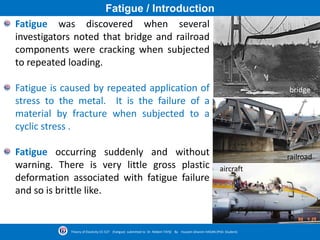
Fatigue was discovered when several
investigators noted that bridge and railroad
components were cracking when subjected
to repeated loading.
Fatigue is caused by repeated application of
stress to the metal. It is the failure of a
material by fracture when subjected to a
cyclic stress .
Fatigue occurring suddenly and without
warning. There is very little gross plastic
deformation associated with fatigue failure
and so is brittle like.
railroad
bridge
aircraft
Fatigue / Introduction
Theory of Elasticity CE-527 (Fatigue) submitted to Dr. Nildem TAYŞİ
Fatigue is an important form of behaviour in all materials
including metals, plastics, rubber and concrete when rotating
and subjected to alternating stresses.
There are many other situations where fatigue failure will be
very dangerous.
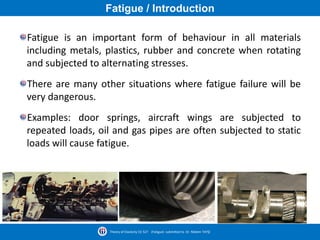
Examples: door springs, aircraft wings are subjected to
repeated loads, oil and gas pipes are often subjected to static
loads will cause fatigue.
Theory of Elasticity CE-527 (Fatigue) submitted to Dr. Nildem TAYŞİ
Fatigue / DEFINITIONS
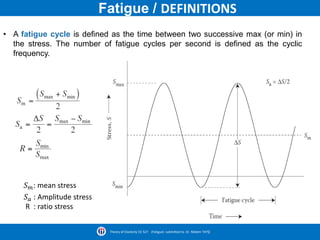
• A fatigue cycle is defined as the time between two successive max (or min) in
the stress. The number of fatigue cycles per second is defined as the cyclic
frequency.
𝑆 𝑚: mean stress
𝑆 𝑎 : Amplitude stress
R : ratio stress
Type of Fatigue loading
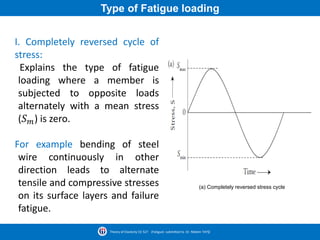
I. Completely reversed cycle of
stress:
Explains the type of fatigue
loading where a member is
subjected to opposite loads
alternately with a mean stress
(𝑆 𝑚) is zero.
For example bending of steel
wire continuously in other
direction leads to alternate
tensile and compressive stresses
on its surface layers and failure
fatigue.
(a) Completely reversed stress cycle
Theory of Elasticity CE-527 (Fatigue) submitted to Dr. Nildem TAYŞİ
Type of Fatigue loading
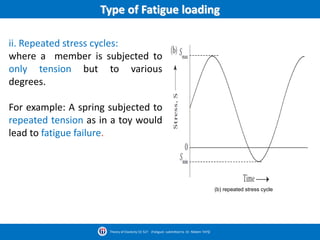
ii. Repeated stress cycles:
where a member is subjected to
only tension but to various
degrees.
For example: A spring subjected to
repeated tension as in a toy would
lead to fatigue failure.
(b) repeated stress cycle
Theory of Elasticity CE-527 (Fatigue) submitted to Dr. Nildem TAYŞİ
Type of Fatigue loading
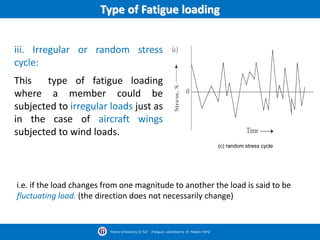
iii. Irregular or random stress
cycle:
This type of fatigue loading
where a member could be
subjected to irregular loads just as
in the case of aircraft wings
subjected to wind loads.
(c) random stress cycle
i.e. if the load changes from one magnitude to another the load is said to be
fluctuating load. (the direction does not necessarily change)
Theory of Elasticity CE-527 (Fatigue) submitted to Dr. Nildem TAYŞİ
Cyclic Stress-Strain Behavior
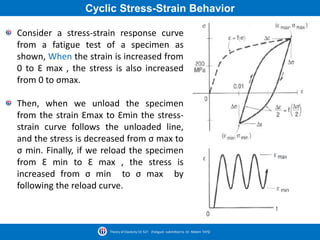
Consider a stress-strain response curve
from a fatigue test of a specimen as
shown, When the strain is increased from
0 to Ԑ max , the stress is also increased
from 0 to σmax.
Then, when we unload the specimen
from the strain Ԑmax to Ԑmin the stress-
strain curve follows the unloaded line,
and the stress is decreased from σ max to
σ min. Finally, if we reload the specimen
from Ԑ min to Ԑ max , the stress is
increased from σ min to σ max by
following the reload curve.
Theory of Elasticity CE-527 (Fatigue) submitted to Dr. Nildem TAYŞİ
Fatigue failure
The crack is developed from a small flaw until it reaches the
critical size.
It is usually developed at high stress gradient area. The stress
gradient becomes larger and larger, and the crack progresses
more rapidly.
Theory of Elasticity CE-527 (Fatigue) submitted to Dr. Nildem TAYŞİ
Fatigue Crack Propagation
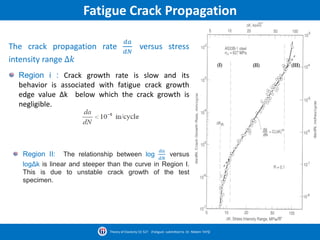
Normally, Crack propagation can be caused by cyclic
loading. Typical constant amplitude crack propagation as
shown in Fig
Theory of Elasticity CE-527 (Fatigue) submitted to Dr. Nildem TAYŞİ
Fatigue Crack Propagation
The crack propagation rate
𝑑𝑎
𝑑𝑁
versus stress
intensity range ∆𝑘
Region i : Crack growth rate is slow and its
behavior is associated with fatigue crack growth
edge value Δk below which the crack growth is
negligible.
Region II: The relationship between log
𝑑𝑎
𝑑𝑁
versus
logΔk is linear and steeper than the curve in Region I.
This is due to unstable crack growth of the test
specimen.
Theory of Elasticity CE-527 (Fatigue) submitted to Dr. Nildem TAYŞİ
Fatigue Crack Propagation
Region III: The crack growth rate is very high and
little fatigue life is involved.
The relationship in this line is
Theory of Elasticity CE-527 (Fatigue) submitted to Dr. Nildem TAYŞİ
The value of m is important since it indicates the degree of
sensitivity of the growth rate of the stress.
Fatigue - Failures
 m
KC
dN
da

if we integrate between the initial size of a crack (𝑎 𝑜) and
the crack size required for fracture to occur (𝑎 𝑓), we find
that the number of cycles to failure is given by
From the steady state crack growth relationship of
Y = dimensionless geometric constant that varies depending on the
geometry of the crack, but usually taken as 1.
Theory of Elasticity CE-527 (Fatigue) submitted to Dr. Nildem TAYŞİ
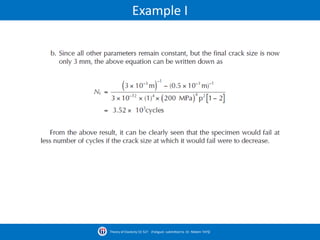
Example I
Theory of Elasticity CE-527 (Fatigue) submitted to Dr. Nildem TAYŞİ
to
Example I
Theory of Elasticity CE-527 (Fatigue) submitted to Dr. Nildem TAYŞİ
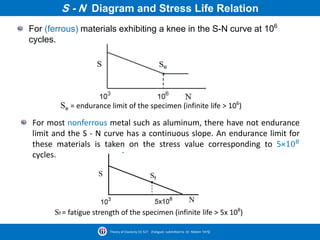
“S-N” curve is mean the
amplitude stress versus cycles to
failure, which when plotted using
the stress amplitude on the
vertical axis and the number of
cycle to failure on the horizontal
axis.
S - N Diagram and Stress Life Relation
S-N curve is A very useful way to visual the failure for a specific
material with the S-N curve.
Theory of Elasticity CE-527 (Fatigue) submitted to Dr. Nildem TAYŞİ
S - N Diagram and Stress Life Relation
Se = endurance limit of the specimen (infinite life > 106
)
For (ferrous) materials exhibiting a knee in the S-N curve at 106
cycles.
Theory of Elasticity CE-527 (Fatigue) submitted to Dr. Nildem TAYŞİ
For most nonferrous metal such as aluminum, there have not endurance
limit and the S - N curve has a continuous slope. An endurance limit for
these materials is taken on the stress value corresponding to 5×10⁸
cycles.
Sf = fatigue strength of the specimen (infinite life > 5x 10⁸
)
Fatigue Strength Diagram
Theory of Elasticity CE-527 (Fatigue) submitted to Dr. Nildem TAYŞİ
Mean Stress Correction for Endurance Limit
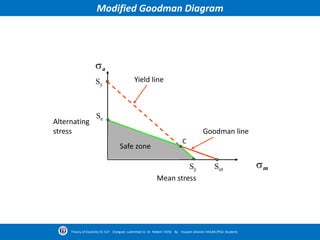
Modified Goodman Diagram
Theory of Elasticity CE-527 (Fatigue) submitted to Dr. Nildem TAYŞİ By Hussein Ghanim HASAN (PhD. Student)
Mean stress
Alternating
stress
m
a
Sut
Goodman line
Sy
Yield line
Sy
Se
Safe zone
C
Factors Affecting the Fatigue Crack Growth
Stress ratio effect
The increasing of R ratio will lead to increase a crack growth
rate.
Frequency effect
At normal environmental condition, frequency has little effect
on fatigue life for metallic structure. However, the growth rate
will be significantly affected if under an adverse environment.
Temperature effect
Fatigue life will be reduced if the temperature is increased.
Surface Roughness:
Smoothly polished specimens have higher fatigue strength.
Theory of Elasticity CE-527 (Fatigue) submitted to Dr. Nildem TAYŞİ
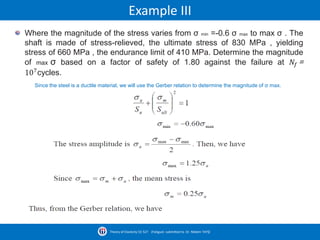
Example III
Where the magnitude of the stress varies from σ min =-0.6 σ max to max σ . The
shaft is made of stress-relieved, the ultimate stress of 830 MPa , yielding
stress of 660 MPa , the endurance limit of 410 MPa. Determine the magnitude
of max σ based on a factor of safety of 1.80 against the failure at 𝑁𝑓 =
107
cycles.
Since the steel is a ductile material, we will use the Gerber relation to determine the magnitude of σ max.
Theory of Elasticity CE-527 (Fatigue) submitted to Dr. Nildem TAYŞİ
Example III
Theory of Elasticity CE-527 (Fatigue) submitted to Dr. Nildem TAYŞİ
Video about a Fatigue test
Theory of Elasticity CE-527 (Fatigue) submitted to Dr. Nildem TAYŞİ By Hussein Ghanim HASAN (PhD. Student)
Theory of Elasticity
CE-527
References
Theory of Elasticity CE-527 (Fatigue) submitted to Dr. Nildem TAYŞİ By Hussein Ghanim HASAN (PhD. Student)
Advanced mechanics of materials, Dr. Sittichai Seangatith. May
(2001)
Experimental Techniques In Materials And Mechanics, C.
Suryanarayana.(2011).
Modern Metal Fatigue Analysis, Draper John (2008)..
Fatigue Damage, Lalanne, C. (2009).
Fatigue / Discussion
Theory of Elasticity CE-527 (Fatigue) submitted to Dr. Nildem TAYŞİ By Hussein Ghanim HASAN (PhD. Student)
Thank You for
your attention

fatigue

  • 2.
    Fatigue / Introduction Theoryof Elasticity CE-527 (Fatigue) submitted to Dr. Nildem TAYŞİ By Hussein Ghanim HASAN (PhD. Student) Fatigue was discovered when several investigators noted that bridge and railroad components were cracking when subjected to repeated loading. Fatigue is caused by repeated application of stress to the metal. It is the failure of a material by fracture when subjected to a cyclic stress . Fatigue occurring suddenly and without warning. There is very little gross plastic deformation associated with fatigue failure and so is brittle like. railroad bridge aircraft
  • 3.
    Fatigue / Introduction Theoryof Elasticity CE-527 (Fatigue) submitted to Dr. Nildem TAYŞİ Fatigue is an important form of behaviour in all materials including metals, plastics, rubber and concrete when rotating and subjected to alternating stresses. There are many other situations where fatigue failure will be very dangerous. Examples: door springs, aircraft wings are subjected to repeated loads, oil and gas pipes are often subjected to static loads will cause fatigue.
  • 4.
    Theory of ElasticityCE-527 (Fatigue) submitted to Dr. Nildem TAYŞİ Fatigue / DEFINITIONS • A fatigue cycle is defined as the time between two successive max (or min) in the stress. The number of fatigue cycles per second is defined as the cyclic frequency. 𝑆 𝑚: mean stress 𝑆 𝑎 : Amplitude stress R : ratio stress
  • 5.
    Type of Fatigueloading I. Completely reversed cycle of stress: Explains the type of fatigue loading where a member is subjected to opposite loads alternately with a mean stress (𝑆 𝑚) is zero. For example bending of steel wire continuously in other direction leads to alternate tensile and compressive stresses on its surface layers and failure fatigue. (a) Completely reversed stress cycle Theory of Elasticity CE-527 (Fatigue) submitted to Dr. Nildem TAYŞİ
  • 6.
    Type of Fatigueloading ii. Repeated stress cycles: where a member is subjected to only tension but to various degrees. For example: A spring subjected to repeated tension as in a toy would lead to fatigue failure. (b) repeated stress cycle Theory of Elasticity CE-527 (Fatigue) submitted to Dr. Nildem TAYŞİ
  • 7.
    Type of Fatigueloading iii. Irregular or random stress cycle: This type of fatigue loading where a member could be subjected to irregular loads just as in the case of aircraft wings subjected to wind loads. (c) random stress cycle i.e. if the load changes from one magnitude to another the load is said to be fluctuating load. (the direction does not necessarily change) Theory of Elasticity CE-527 (Fatigue) submitted to Dr. Nildem TAYŞİ
  • 8.
    Cyclic Stress-Strain Behavior Considera stress-strain response curve from a fatigue test of a specimen as shown, When the strain is increased from 0 to Ԑ max , the stress is also increased from 0 to σmax. Then, when we unload the specimen from the strain Ԑmax to Ԑmin the stress- strain curve follows the unloaded line, and the stress is decreased from σ max to σ min. Finally, if we reload the specimen from Ԑ min to Ԑ max , the stress is increased from σ min to σ max by following the reload curve. Theory of Elasticity CE-527 (Fatigue) submitted to Dr. Nildem TAYŞİ
  • 9.
    Fatigue failure The crackis developed from a small flaw until it reaches the critical size. It is usually developed at high stress gradient area. The stress gradient becomes larger and larger, and the crack progresses more rapidly. Theory of Elasticity CE-527 (Fatigue) submitted to Dr. Nildem TAYŞİ
  • 10.
    Fatigue Crack Propagation Normally,Crack propagation can be caused by cyclic loading. Typical constant amplitude crack propagation as shown in Fig Theory of Elasticity CE-527 (Fatigue) submitted to Dr. Nildem TAYŞİ
  • 11.
    Fatigue Crack Propagation Thecrack propagation rate 𝑑𝑎 𝑑𝑁 versus stress intensity range ∆𝑘 Region i : Crack growth rate is slow and its behavior is associated with fatigue crack growth edge value Δk below which the crack growth is negligible. Region II: The relationship between log 𝑑𝑎 𝑑𝑁 versus logΔk is linear and steeper than the curve in Region I. This is due to unstable crack growth of the test specimen. Theory of Elasticity CE-527 (Fatigue) submitted to Dr. Nildem TAYŞİ
  • 12.
    Fatigue Crack Propagation RegionIII: The crack growth rate is very high and little fatigue life is involved. The relationship in this line is Theory of Elasticity CE-527 (Fatigue) submitted to Dr. Nildem TAYŞİ The value of m is important since it indicates the degree of sensitivity of the growth rate of the stress.
  • 13.
    Fatigue - Failures m KC dN da  if we integrate between the initial size of a crack (𝑎 𝑜) and the crack size required for fracture to occur (𝑎 𝑓), we find that the number of cycles to failure is given by From the steady state crack growth relationship of Y = dimensionless geometric constant that varies depending on the geometry of the crack, but usually taken as 1. Theory of Elasticity CE-527 (Fatigue) submitted to Dr. Nildem TAYŞİ
  • 14.
    Example I Theory ofElasticity CE-527 (Fatigue) submitted to Dr. Nildem TAYŞİ to
  • 15.
    Example I Theory ofElasticity CE-527 (Fatigue) submitted to Dr. Nildem TAYŞİ
  • 16.
    “S-N” curve ismean the amplitude stress versus cycles to failure, which when plotted using the stress amplitude on the vertical axis and the number of cycle to failure on the horizontal axis. S - N Diagram and Stress Life Relation S-N curve is A very useful way to visual the failure for a specific material with the S-N curve. Theory of Elasticity CE-527 (Fatigue) submitted to Dr. Nildem TAYŞİ
  • 17.
    S - NDiagram and Stress Life Relation Se = endurance limit of the specimen (infinite life > 106 ) For (ferrous) materials exhibiting a knee in the S-N curve at 106 cycles. Theory of Elasticity CE-527 (Fatigue) submitted to Dr. Nildem TAYŞİ For most nonferrous metal such as aluminum, there have not endurance limit and the S - N curve has a continuous slope. An endurance limit for these materials is taken on the stress value corresponding to 5×10⁸ cycles. Sf = fatigue strength of the specimen (infinite life > 5x 10⁸ )
  • 18.
    Fatigue Strength Diagram Theoryof Elasticity CE-527 (Fatigue) submitted to Dr. Nildem TAYŞİ Mean Stress Correction for Endurance Limit
  • 19.
    Modified Goodman Diagram Theoryof Elasticity CE-527 (Fatigue) submitted to Dr. Nildem TAYŞİ By Hussein Ghanim HASAN (PhD. Student) Mean stress Alternating stress m a Sut Goodman line Sy Yield line Sy Se Safe zone C
  • 20.
    Factors Affecting theFatigue Crack Growth Stress ratio effect The increasing of R ratio will lead to increase a crack growth rate. Frequency effect At normal environmental condition, frequency has little effect on fatigue life for metallic structure. However, the growth rate will be significantly affected if under an adverse environment. Temperature effect Fatigue life will be reduced if the temperature is increased. Surface Roughness: Smoothly polished specimens have higher fatigue strength. Theory of Elasticity CE-527 (Fatigue) submitted to Dr. Nildem TAYŞİ
  • 21.
    Example III Where themagnitude of the stress varies from σ min =-0.6 σ max to max σ . The shaft is made of stress-relieved, the ultimate stress of 830 MPa , yielding stress of 660 MPa , the endurance limit of 410 MPa. Determine the magnitude of max σ based on a factor of safety of 1.80 against the failure at 𝑁𝑓 = 107 cycles. Since the steel is a ductile material, we will use the Gerber relation to determine the magnitude of σ max. Theory of Elasticity CE-527 (Fatigue) submitted to Dr. Nildem TAYŞİ
  • 22.
    Example III Theory ofElasticity CE-527 (Fatigue) submitted to Dr. Nildem TAYŞİ
  • 23.
    Video about aFatigue test Theory of Elasticity CE-527 (Fatigue) submitted to Dr. Nildem TAYŞİ By Hussein Ghanim HASAN (PhD. Student) Theory of Elasticity CE-527
  • 24.
    References Theory of ElasticityCE-527 (Fatigue) submitted to Dr. Nildem TAYŞİ By Hussein Ghanim HASAN (PhD. Student) Advanced mechanics of materials, Dr. Sittichai Seangatith. May (2001) Experimental Techniques In Materials And Mechanics, C. Suryanarayana.(2011). Modern Metal Fatigue Analysis, Draper John (2008).. Fatigue Damage, Lalanne, C. (2009).
  • 25.
    Fatigue / Discussion Theoryof Elasticity CE-527 (Fatigue) submitted to Dr. Nildem TAYŞİ By Hussein Ghanim HASAN (PhD. Student) Thank You for your attention