FATIGUE TESTING
Presented by-
BIPIN KUMAR MISHRA 2011EME11
SHEELOO SINGH 2011EME08
WHAT IS FATIGUE ?
It has been recognized that a metal subjected to a
repetitive or fluctuating stress will fail at a stress
much lower than that required to cause failure on a
single application of load. Failures occurring under
conditions of dynamic loading are called fatigue.
 Fatigue is an insidious time-dependent type of failure
which can occur without any obvious warning.
 It is believed that more than 95 % of all mechanical
failures can be attributed to fatigue.
FAILURE STAGES….
It is characterized by three
stages>>
1. Crack initiation
2. Crack propagation
3. Final fracture.
…………….
Failure always being the brittle fracture
regardless it is ductile or brittle material.
Mostly fatigue failure occur at stress well
below the static elastic strength of the
material.
EXAMPLES
Material: AISI/SAE 4140 low allow carbon steel
steel pins from agricultural equipment.
Fracture surface of a failed bolt. The fracture surface
exhibited beach marks, which is characteristic of a
fatigue failure.
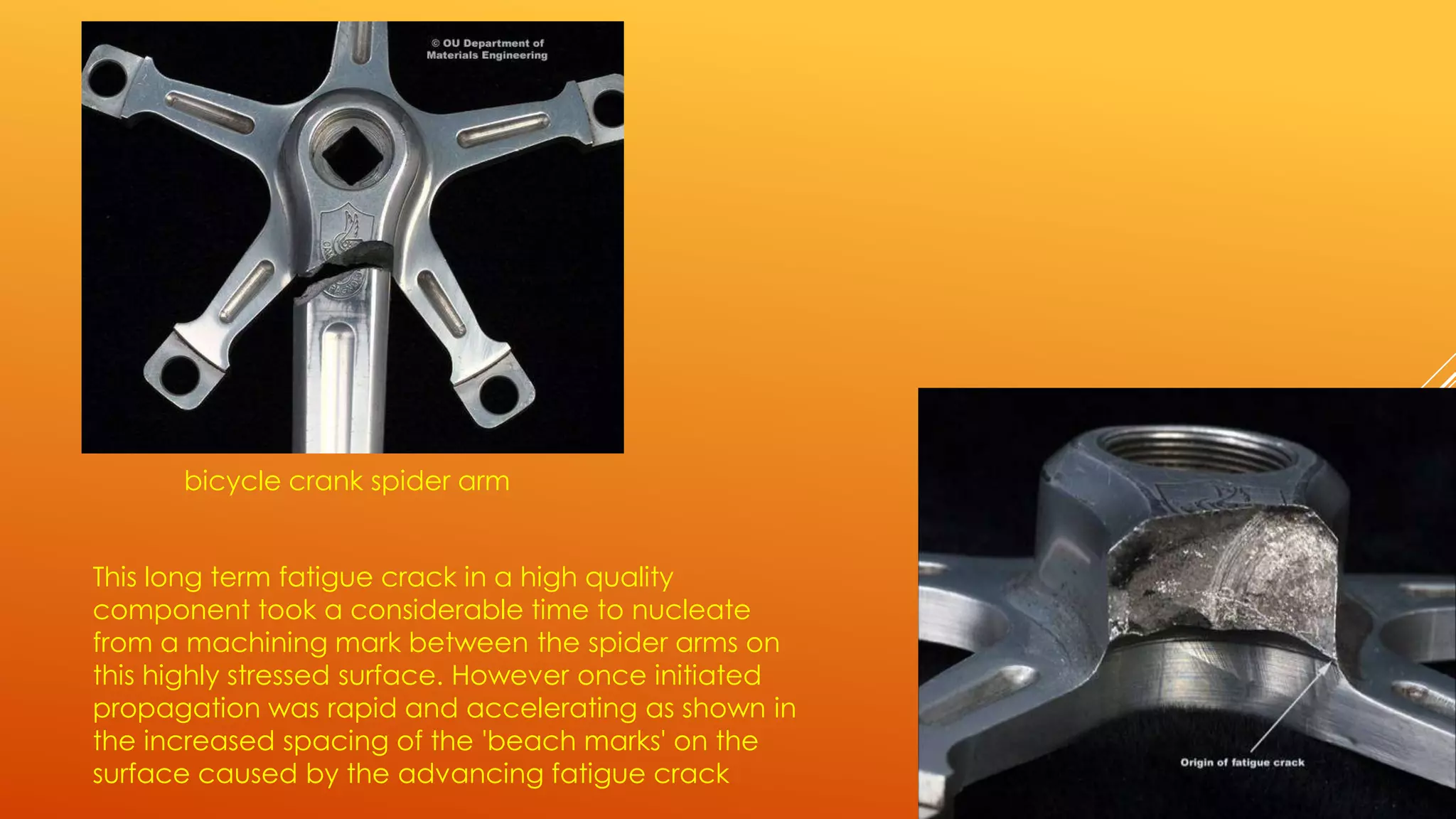
bicycle crank spider arm
This long term fatigue crack in a high quality
component took a considerable time to nucleate
from a machining mark between the spider arms on
this highly stressed surface. However once initiated
propagation was rapid and accelerating as shown in
the increased spacing of the 'beach marks' on the
surface caused by the advancing fatigue crack
DEFINITIONS….
1. Fatigue life(N): it is total number of cycles are required to
bring about final fracture in a specimen at a given stress.
2. Fatigue strength(): It is stress at which a material can
withstand repeatedly N number of cycles before failure.
3. Endurance limit: it is stress below which a material will not
fail for any number of cycles.
4. For ferrous materials it is approximately half of the ultimate
tensile strength.
5. No. of cycles for a non ferrous material is 5x10ˆ8 cycles.
TESTING
Objective of fatigue testing is generally to
determine the fatigue life and/or the location
of danger point i.e. location of failure of a
specimen subjected to sequential stress
amplitude.
TESTING TYPES
There are 2 basics for a classification of the
different methods of fatigue testing-
1. Sequence of the stress amplitude.
2. Nature of the test piece.
CLASSIFICATION BASED ON
SEQUENCE OF STRESS AMPLITUDE
1. Constant Amplitude test
2. Variable Amplitude test
CONSTANT AMPLITUDE TEST
This is the simplest sequence of amplitude
obtained by applying reversals of stress of
constant-amplitude to the test-piece until
failure occurs. Different specimens of the test
series may be subjected to different stress
amplitude but for each individual item, the
amplitude will never be varied.
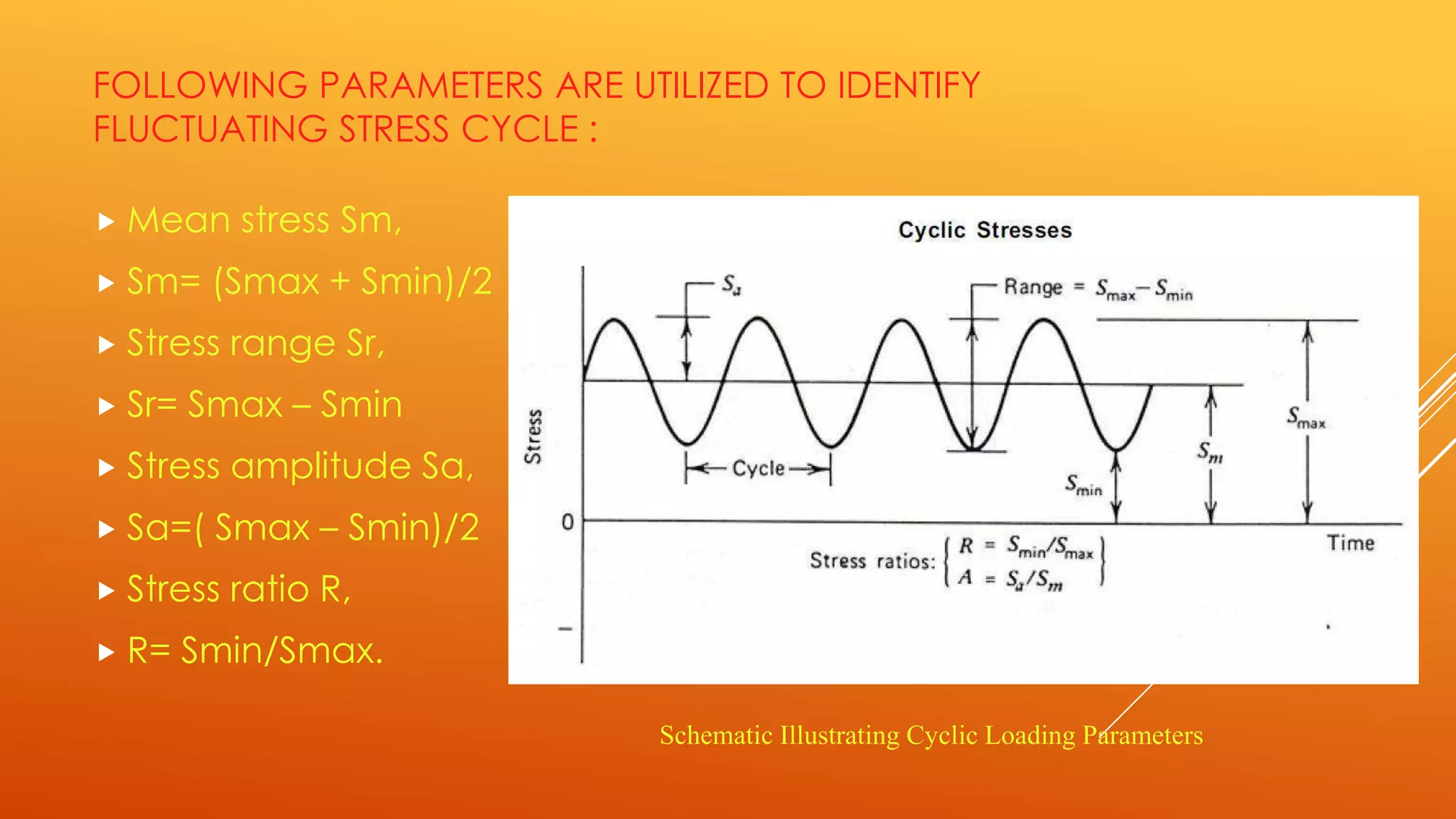
FOLLOWING PARAMETERS ARE UTILIZED TO IDENTIFY
FLUCTUATING STRESS CYCLE :
 Mean stress Sm,
 Sm= (Smax + Smin)/2
 Stress range Sr,
 Sr= Smax – Smin
 Stress amplitude Sa,
 Sa=( Smax – Smin)/2
 Stress ratio R,
 R= Smin/Smax.
Schematic Illustrating Cyclic Loading Parameters
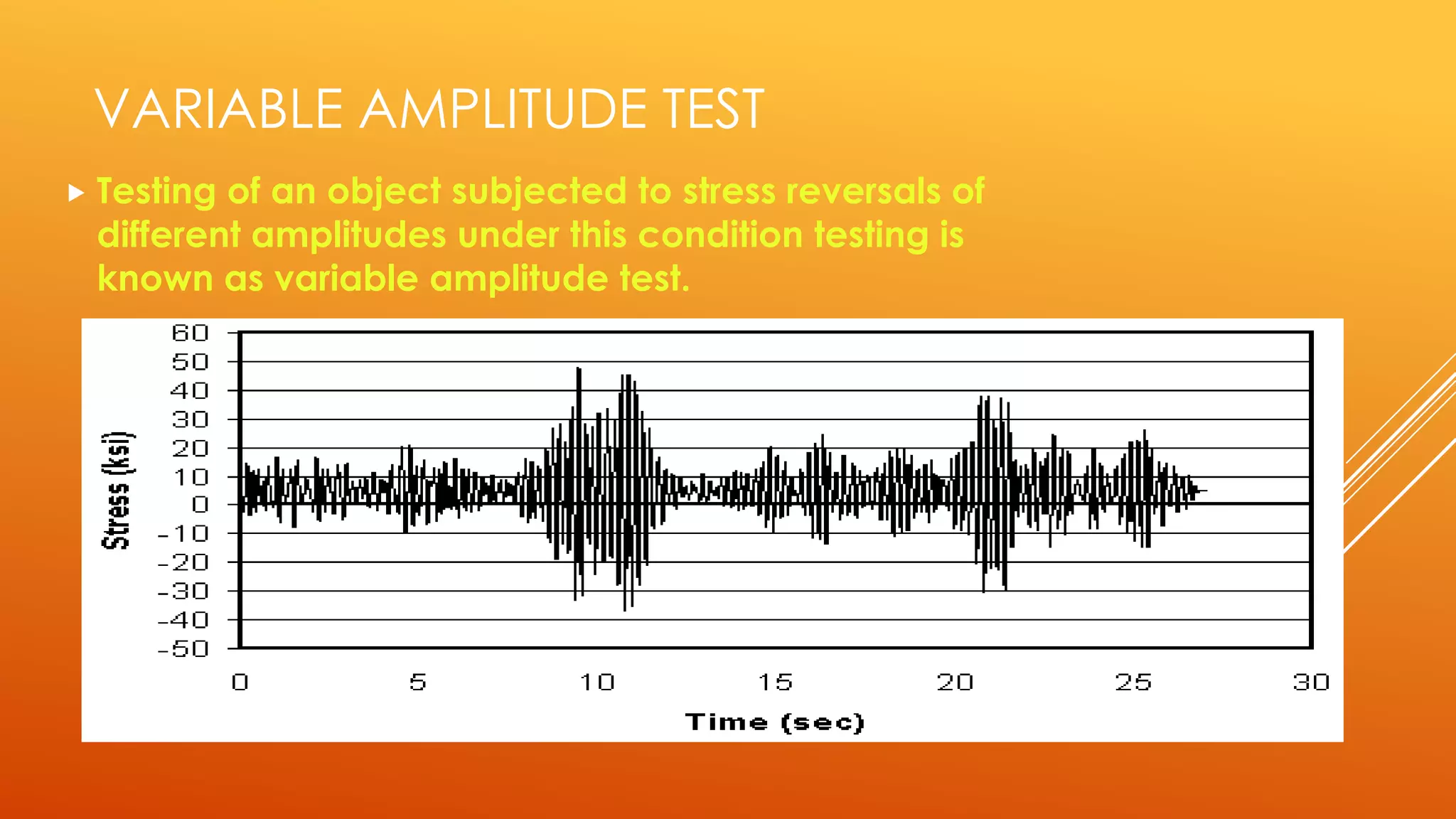
VARIABLE AMPLITUDE TEST
 Testing of an object subjected to stress reversals of
different amplitudes under this condition testing is
known as variable amplitude test.
CLASSIFICATION BASED ON NATURE OF
TEST PIECE:
1. Specimens: test piece made in the standard form as
in shape and size & prepared with good surface
finish for the test.
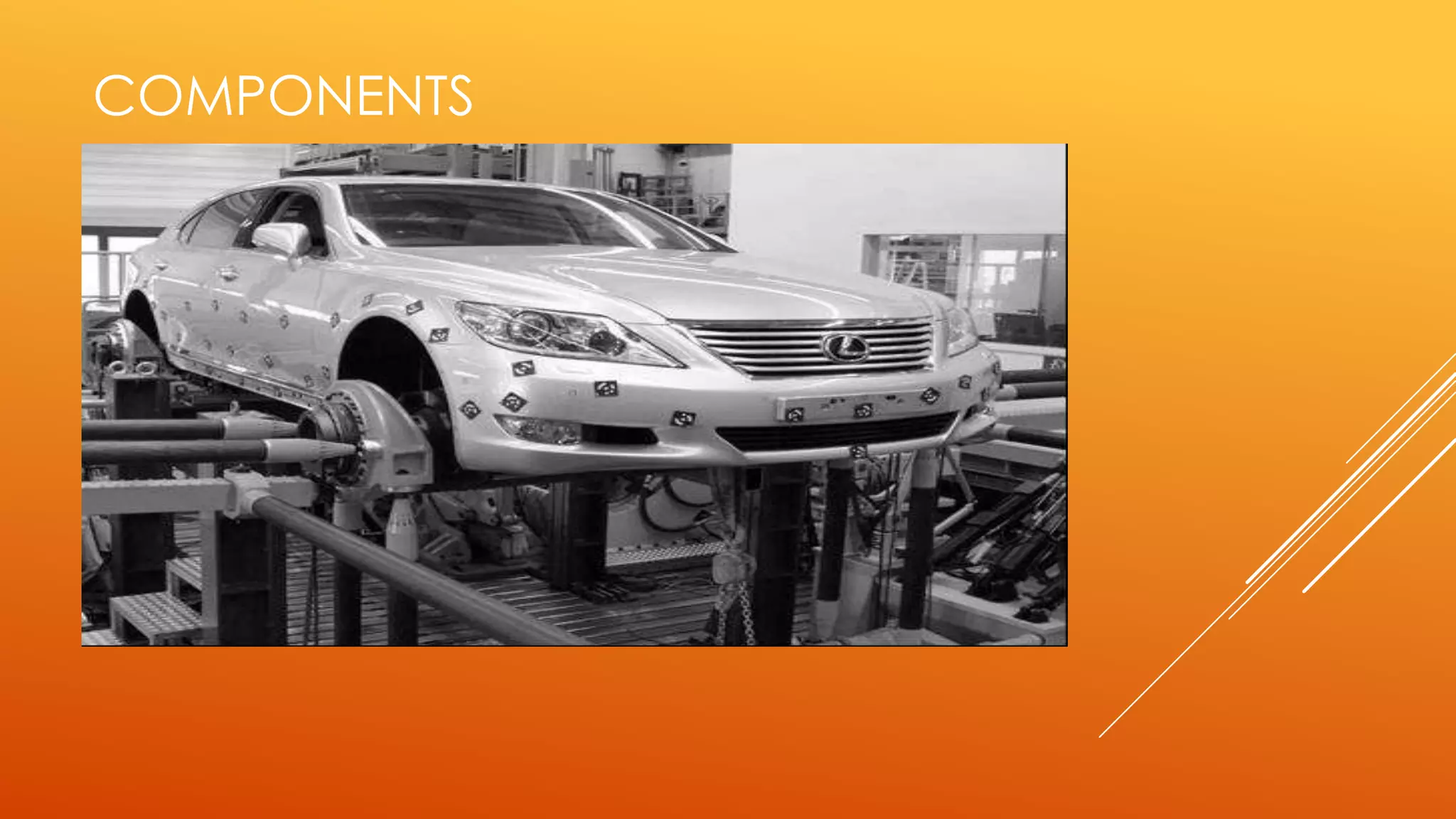
2. Components: It is used to signify any machine
part, actual structure, machine and assembly
including elements simulating actual components.
SPECIMENS
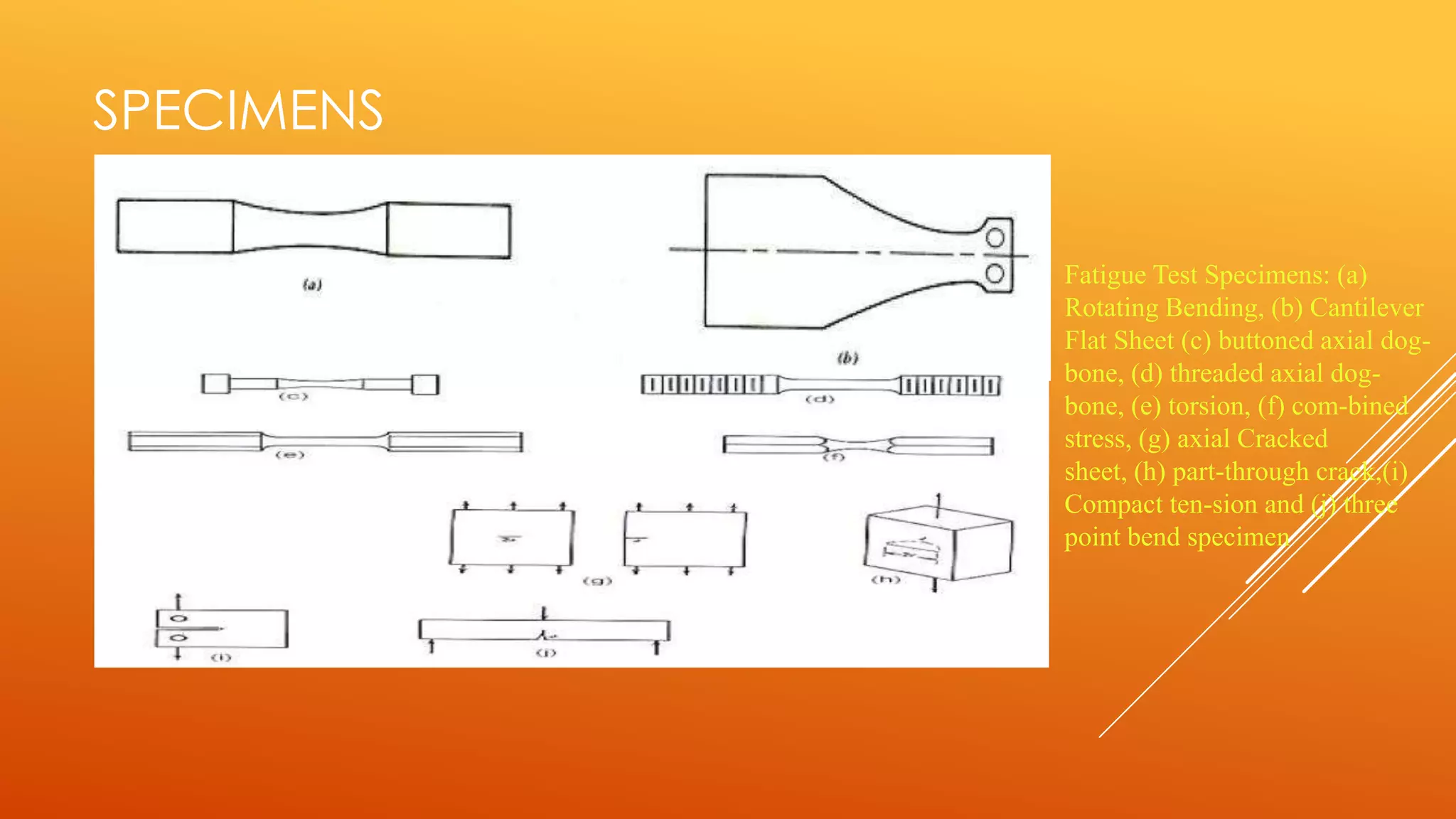
Fatigue Test Specimens: (a)
Rotating Bending, (b) Cantilever
Flat Sheet (c) buttoned axial dog-
bone, (d) threaded axial dog-
bone, (e) torsion, (f) com-bined
stress, (g) axial Cracked
sheet, (h) part-through crack,(i)
Compact ten-sion and (j) three
point bend specimen
COMPONENTS
FATIGUE TESTING MACHINE
 In the simplest type of machine
for fatigue testing, the load
applied is of bending type.
The test specimen may be of
simply supported beam or a cantilever.
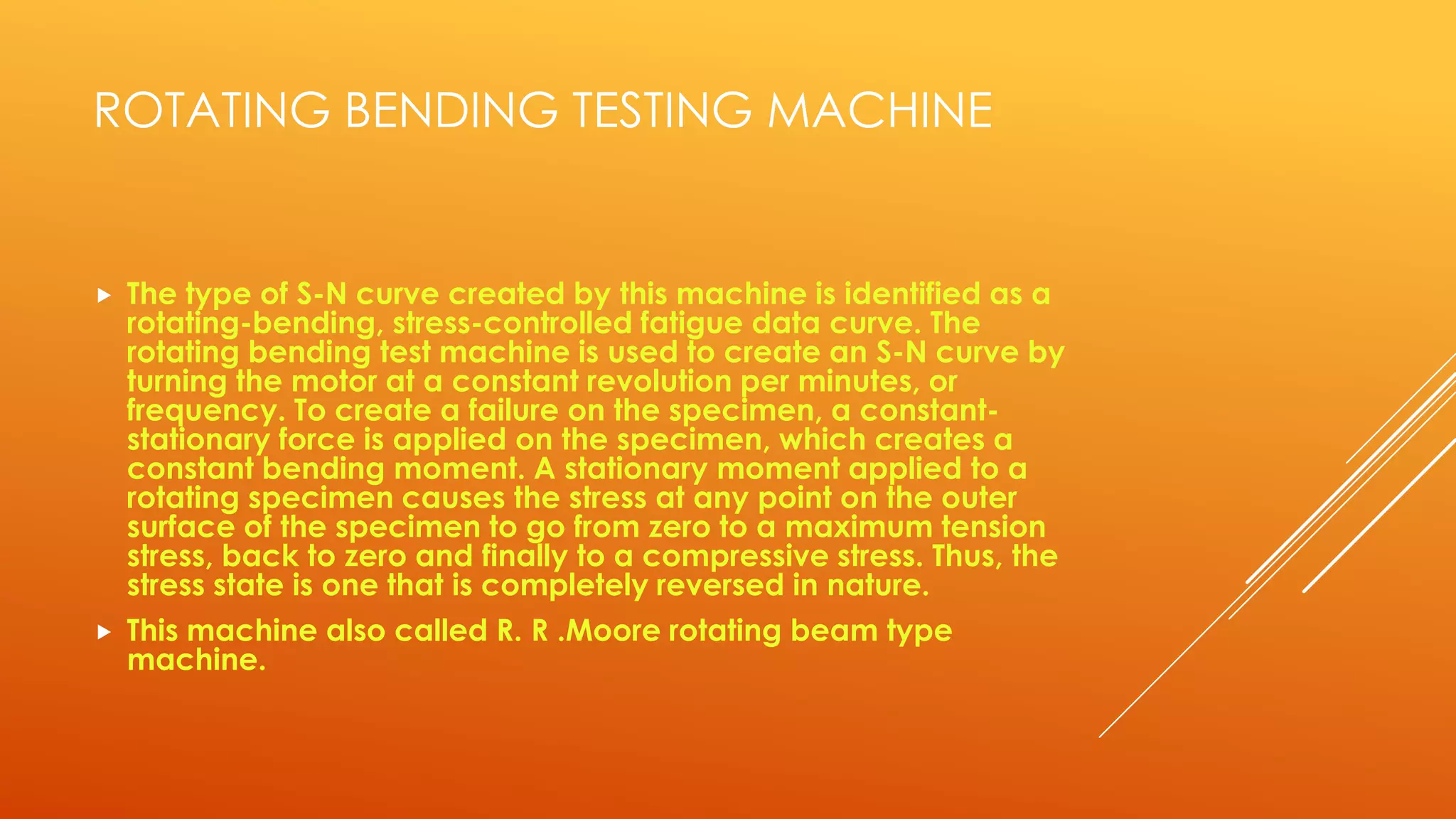
ROTATING BENDING TESTING MACHINE
 The type of S-N curve created by this machine is identified as a
rotating-bending, stress-controlled fatigue data curve. The
rotating bending test machine is used to create an S-N curve by
turning the motor at a constant revolution per minutes, or
frequency. To create a failure on the specimen, a constant-
stationary force is applied on the specimen, which creates a
constant bending moment. A stationary moment applied to a
rotating specimen causes the stress at any point on the outer
surface of the specimen to go from zero to a maximum tension
stress, back to zero and finally to a compressive stress. Thus, the
stress state is one that is completely reversed in nature.
 This machine also called R. R .Moore rotating beam type
machine.
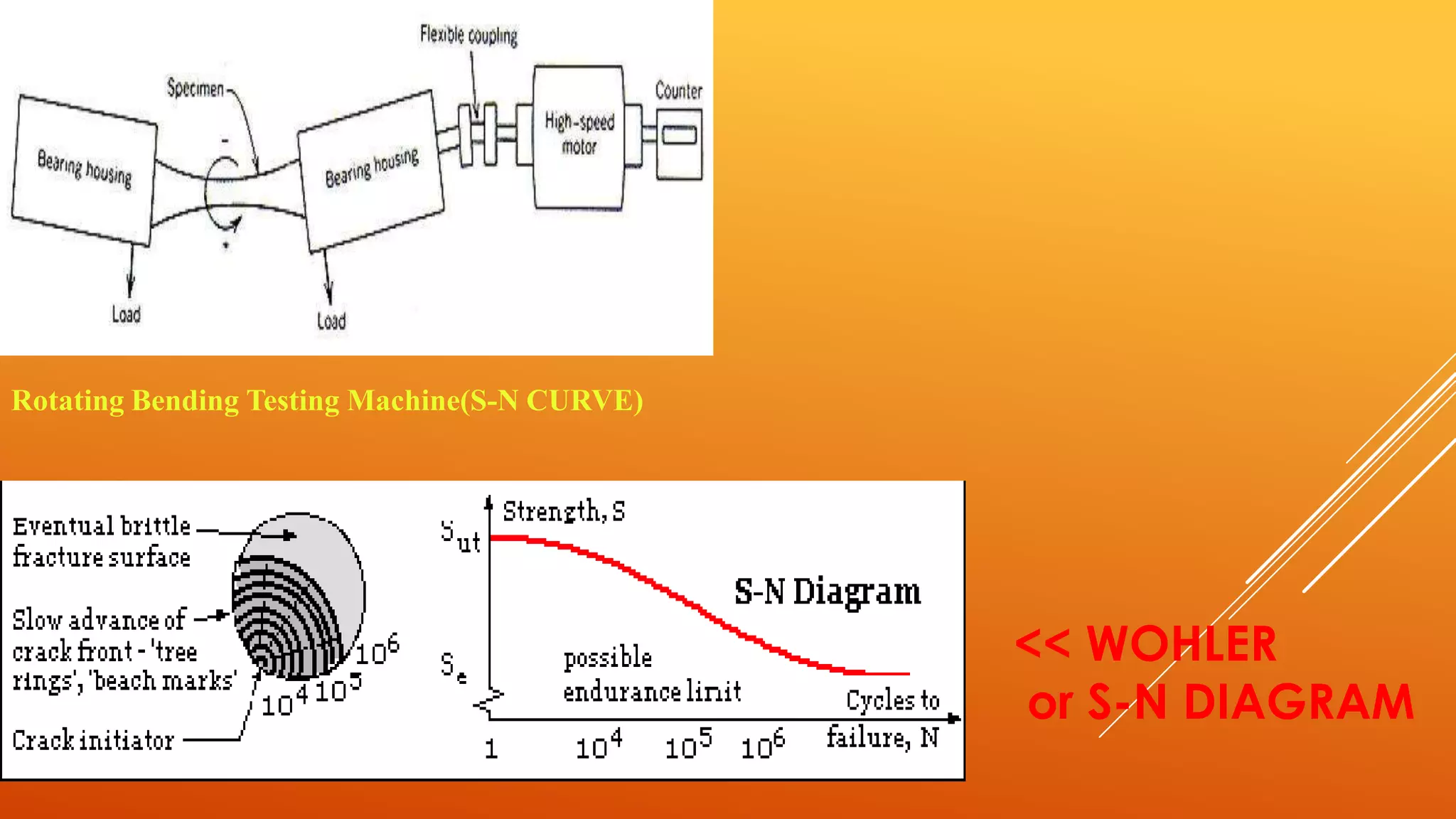
Rotating Bending Testing Machine(S-N CURVE)
<< WOHLER
or S-N DIAGRAM
………
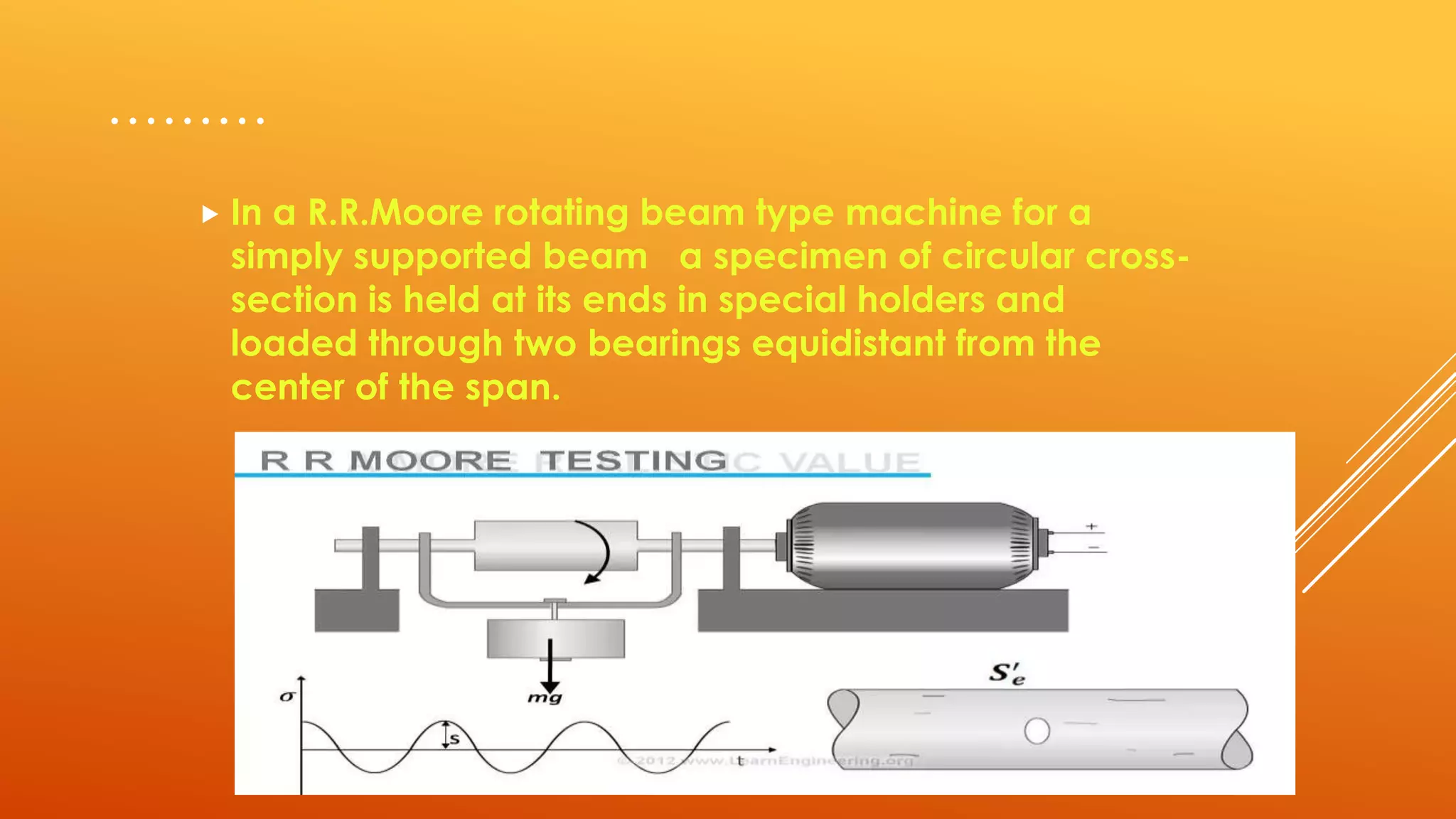
 In a R.R.Moore rotating beam type machine for a
simply supported beam a specimen of circular cross-
section is held at its ends in special holders and
loaded through two bearings equidistant from the
center of the span.
……………..
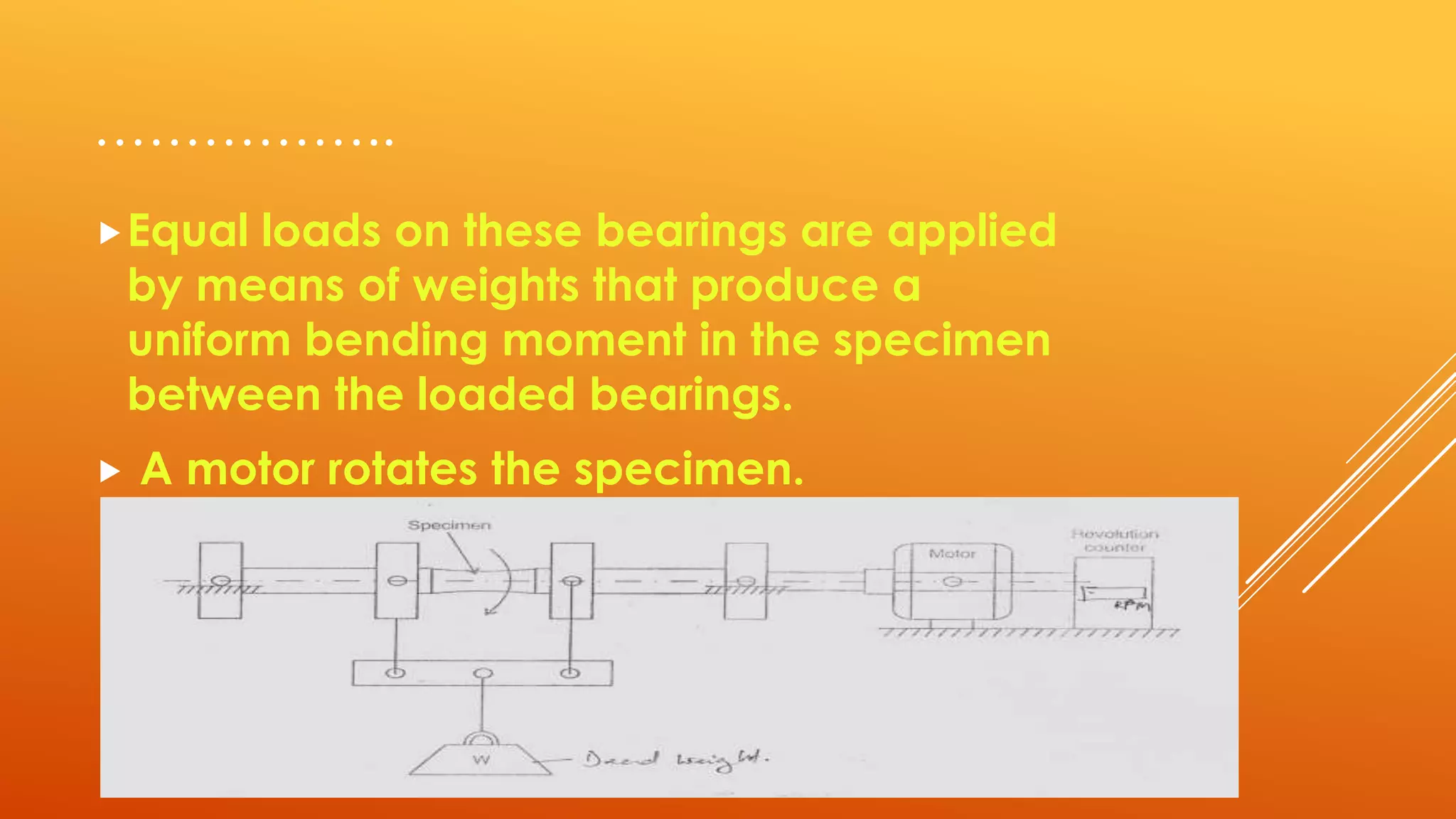
Equal loads on these bearings are applied
by means of weights that produce a
uniform bending moment in the specimen
between the loaded bearings.
 A motor rotates the specimen.
…………….
Bending moment Mb = FL and bending stress S =
Mb/4z
Where L is the length of the specimen and z is the
sectional modulus.
In rotating cantilever beam type, the specimen is
rotated while a gravity load is applied to the free end
by means of a bearing.
 For cantilever specimen the maximum bending
moment is at the fixed end.
…………………….......................................................

Fatigue testing

  • 1.
    FATIGUE TESTING Presented by- BIPINKUMAR MISHRA 2011EME11 SHEELOO SINGH 2011EME08
  • 2.
    WHAT IS FATIGUE? It has been recognized that a metal subjected to a repetitive or fluctuating stress will fail at a stress much lower than that required to cause failure on a single application of load. Failures occurring under conditions of dynamic loading are called fatigue.  Fatigue is an insidious time-dependent type of failure which can occur without any obvious warning.  It is believed that more than 95 % of all mechanical failures can be attributed to fatigue.
  • 3.
    FAILURE STAGES…. It ischaracterized by three stages>> 1. Crack initiation 2. Crack propagation 3. Final fracture.
  • 4.
    ……………. Failure always beingthe brittle fracture regardless it is ductile or brittle material. Mostly fatigue failure occur at stress well below the static elastic strength of the material.
  • 5.
    EXAMPLES Material: AISI/SAE 4140low allow carbon steel steel pins from agricultural equipment. Fracture surface of a failed bolt. The fracture surface exhibited beach marks, which is characteristic of a fatigue failure.
  • 6.
    bicycle crank spiderarm This long term fatigue crack in a high quality component took a considerable time to nucleate from a machining mark between the spider arms on this highly stressed surface. However once initiated propagation was rapid and accelerating as shown in the increased spacing of the 'beach marks' on the surface caused by the advancing fatigue crack
  • 7.
    DEFINITIONS…. 1. Fatigue life(N):it is total number of cycles are required to bring about final fracture in a specimen at a given stress. 2. Fatigue strength(): It is stress at which a material can withstand repeatedly N number of cycles before failure. 3. Endurance limit: it is stress below which a material will not fail for any number of cycles. 4. For ferrous materials it is approximately half of the ultimate tensile strength. 5. No. of cycles for a non ferrous material is 5x10ˆ8 cycles.
  • 8.
    TESTING Objective of fatiguetesting is generally to determine the fatigue life and/or the location of danger point i.e. location of failure of a specimen subjected to sequential stress amplitude.
  • 9.
    TESTING TYPES There are2 basics for a classification of the different methods of fatigue testing- 1. Sequence of the stress amplitude. 2. Nature of the test piece.
  • 10.
    CLASSIFICATION BASED ON SEQUENCEOF STRESS AMPLITUDE 1. Constant Amplitude test 2. Variable Amplitude test
  • 11.
    CONSTANT AMPLITUDE TEST Thisis the simplest sequence of amplitude obtained by applying reversals of stress of constant-amplitude to the test-piece until failure occurs. Different specimens of the test series may be subjected to different stress amplitude but for each individual item, the amplitude will never be varied.
  • 12.
    FOLLOWING PARAMETERS AREUTILIZED TO IDENTIFY FLUCTUATING STRESS CYCLE :  Mean stress Sm,  Sm= (Smax + Smin)/2  Stress range Sr,  Sr= Smax – Smin  Stress amplitude Sa,  Sa=( Smax – Smin)/2  Stress ratio R,  R= Smin/Smax. Schematic Illustrating Cyclic Loading Parameters
  • 13.
    VARIABLE AMPLITUDE TEST Testing of an object subjected to stress reversals of different amplitudes under this condition testing is known as variable amplitude test.
  • 14.
    CLASSIFICATION BASED ONNATURE OF TEST PIECE: 1. Specimens: test piece made in the standard form as in shape and size & prepared with good surface finish for the test. 2. Components: It is used to signify any machine part, actual structure, machine and assembly including elements simulating actual components.
  • 15.
    SPECIMENS Fatigue Test Specimens:(a) Rotating Bending, (b) Cantilever Flat Sheet (c) buttoned axial dog- bone, (d) threaded axial dog- bone, (e) torsion, (f) com-bined stress, (g) axial Cracked sheet, (h) part-through crack,(i) Compact ten-sion and (j) three point bend specimen
  • 16.
  • 17.
    FATIGUE TESTING MACHINE In the simplest type of machine for fatigue testing, the load applied is of bending type. The test specimen may be of simply supported beam or a cantilever.
  • 18.
    ROTATING BENDING TESTINGMACHINE  The type of S-N curve created by this machine is identified as a rotating-bending, stress-controlled fatigue data curve. The rotating bending test machine is used to create an S-N curve by turning the motor at a constant revolution per minutes, or frequency. To create a failure on the specimen, a constant- stationary force is applied on the specimen, which creates a constant bending moment. A stationary moment applied to a rotating specimen causes the stress at any point on the outer surface of the specimen to go from zero to a maximum tension stress, back to zero and finally to a compressive stress. Thus, the stress state is one that is completely reversed in nature.  This machine also called R. R .Moore rotating beam type machine.
  • 19.
    Rotating Bending TestingMachine(S-N CURVE) << WOHLER or S-N DIAGRAM
  • 20.
    ………  In aR.R.Moore rotating beam type machine for a simply supported beam a specimen of circular cross- section is held at its ends in special holders and loaded through two bearings equidistant from the center of the span.
  • 21.
    …………….. Equal loads onthese bearings are applied by means of weights that produce a uniform bending moment in the specimen between the loaded bearings.  A motor rotates the specimen.
  • 22.
    ……………. Bending moment Mb= FL and bending stress S = Mb/4z Where L is the length of the specimen and z is the sectional modulus. In rotating cantilever beam type, the specimen is rotated while a gravity load is applied to the free end by means of a bearing.  For cantilever specimen the maximum bending moment is at the fixed end.
  • 23.