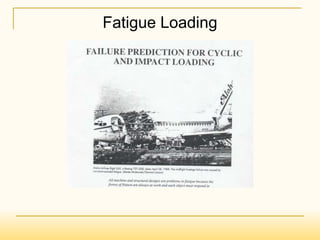
Fatigue Loading
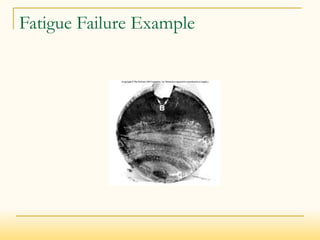
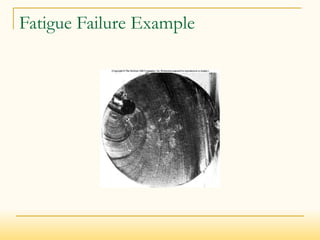
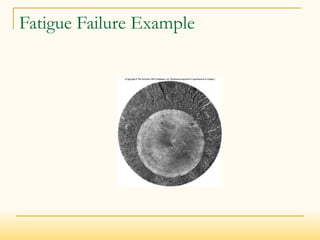
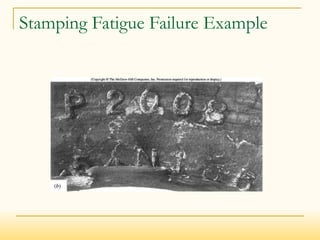
Nature of fatigue failure
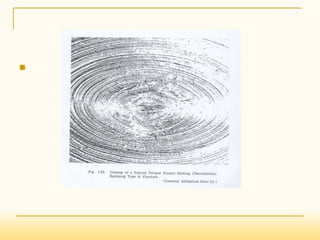
 Starts with a crack
 Usually at a stress concentration
 Crack propagates until the material fractures
suddenly
 Fatigue failure is typically sudden and
complete, and doesn’t give warning
Fatigue Failure Examples
 Various Fatigue Crack Surfaces
 Bolt Fatigue Failure
 Drive AISI 8640 Pin
 Steam Hammer Piston Rod
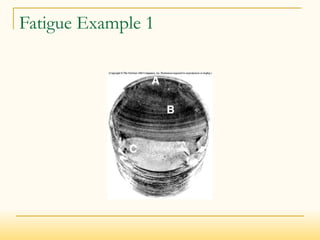
Fatigue Example 1
Fatigue Failure Example
Stamping Fatigue Failure Example

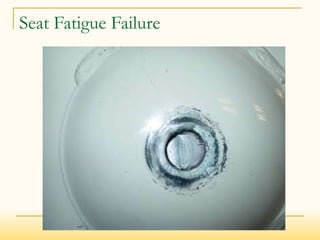
Seat Fatigue Failure
Fatigue
 Fatigue strength and endurance limit
 Estimating FS and EL
 Modifying factors
 Thus far we’ve studied static failure of machine elements
 The second major class of component failure is due to dynamic loading
 Variable stresses
 Repeated stresses
 Alternating stresses
 Fluctuating stresses
 The ultimate strength of a material (Su) is the maximum stress a
material can sustain before failure assuming the load is applied only
once and held
 A material can also fail by being loaded repeatedly to a stress level that
is LESS than Su
 Fatigue failure
Approach to fatigue failure in analysis and design
 Fatigue-life methods (6-3 to 6-6)
 Stress Life Method (Used in this course)
 Strain Life Method
 Linear Elastic Fracture Mechanics Method
 Stress-life method (rest of chapter 6)
 Addresses high cycle Fatigue (>103 ) Well
 Not Accurate for Low Cycle Fatigue (<103)
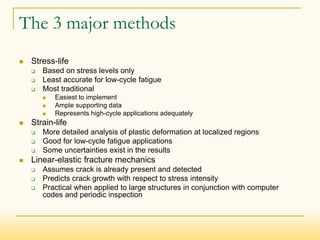
The 3 major methods
 Stress-life
 Based on stress levels only
 Least accurate for low-cycle fatigue
 Most traditional
 Easiest to implement
 Ample supporting data
 Represents high-cycle applications adequately
 Strain-life
 More detailed analysis of plastic deformation at localized regions
 Good for low-cycle fatigue applications
 Some uncertainties exist in the results
 Linear-elastic fracture mechanics
 Assumes crack is already present and detected
 Predicts crack growth with respect to stress intensity
 Practical when applied to large structures in conjunction with computer
codes and periodic inspection
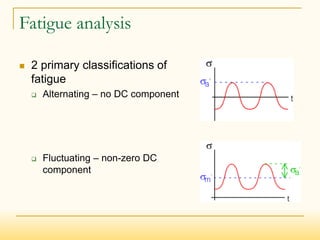
Fatigue analysis
 2 primary classifications of
fatigue
 Alternating – no DC component
 Fluctuating – non-zero DC
component
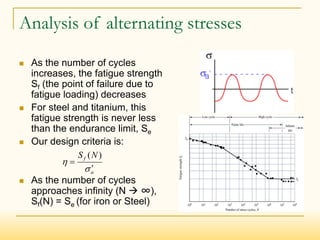
Analysis of alternating stresses
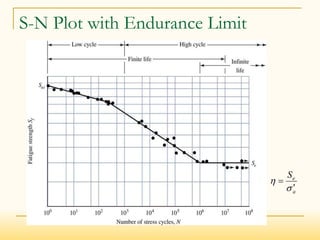
 As the number of cycles
increases, the fatigue strength
Sf (the point of failure due to
fatigue loading) decreases
 For steel and titanium, this
fatigue strength is never less
than the endurance limit, Se
 Our design criteria is:
 As the number of cycles
approaches infinity (N  ∞),
Sf(N) = Se (for iron or Steel)
a
f N
S




)
(
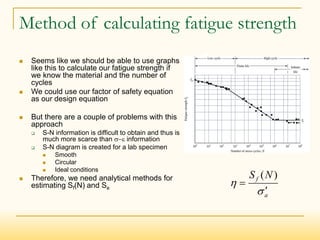
Method of calculating fatigue strength
 Seems like we should be able to use graphs
like this to calculate our fatigue strength if
we know the material and the number of
cycles
 We could use our factor of safety equation
as our design equation
 But there are a couple of problems with this
approach
 S-N information is difficult to obtain and thus is
much more scarce than -e information
 S-N diagram is created for a lab specimen
 Smooth
 Circular
 Ideal conditions
 Therefore, we need analytical methods for
estimating Sf(N) and Se
a
f N
S




)
(
Terminology and notation
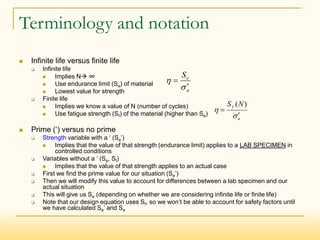
 Infinite life versus finite life
 Infinite life
 Implies N ∞
 Use endurance limit (Se) of material
 Lowest value for strength
 Finite life
 Implies we know a value of N (number of cycles)
 Use fatigue strength (Sf) of the material (higher than Se)
 Prime (‘) versus no prime
 Strength variable with a ‘ (Se’)
 Implies that the value of that strength (endurance limit) applies to a LAB SPECIMEN in
controlled conditions
 Variables without a ‘ (Se, Sf)
 Implies that the value of that strength applies to an actual case
 First we find the prime value for our situation (Se’)
 Then we will modify this value to account for differences between a lab specimen and our
actual situation
 This will give us Se (depending on whether we are considering infinite life or finite life)
 Note that our design equation uses Sf, so we won’t be able to account for safety factors until
we have calculated Se’ and Se
a
f N
S




)
(
a
e
S




Estimating Se’ – Steel and Iron
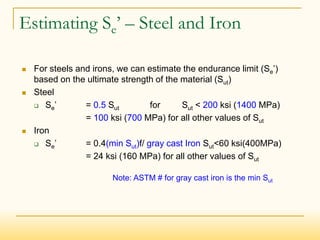
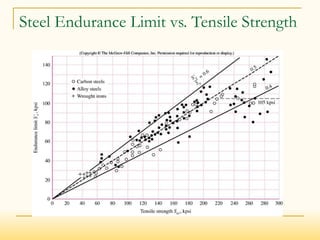
 For steels and irons, we can estimate the endurance limit (Se’)
based on the ultimate strength of the material (Sut)
 Steel
 Se’ = 0.5 Sut for Sut < 200 ksi (1400 MPa)
= 100 ksi (700 MPa) for all other values of Sut
 Iron
 Se’ = 0.4(min Sut)f/ gray cast Iron Sut<60 ksi(400MPa)
= 24 ksi (160 MPa) for all other values of Sut
Note: ASTM # for gray cast iron is the min Sut
S-N Plot with Endurance Limit
a
e
S




a
f N
S




)
(
a
e
S




Estimating Se’ – Aluminum and Copper
Alloys
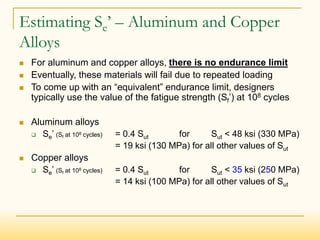
 For aluminum and copper alloys, there is no endurance limit
 Eventually, these materials will fail due to repeated loading
 To come up with an “equivalent” endurance limit, designers
typically use the value of the fatigue strength (Sf’) at 108 cycles
 Aluminum alloys
 Se’ (Sf at 108 cycles) = 0.4 Sut for Sut < 48 ksi (330 MPa)
= 19 ksi (130 MPa) for all other values of Sut
 Copper alloys
 Se’ (Sf at 108 cycles) = 0.4 Sut for Sut < 35 ksi (250 MPa)
= 14 ksi (100 MPa) for all other values of Sut
Correction factors
 Now we have Se’ (infinite life)
 We need to account for differences between the lab specimen and a real
specimen (material, manufacturing, environment, design)
 We use correction factors
 Strength reduction factors
 Marin modification factors
 These will account for differences between an ideal lab specimen and real life
 Se = ka kb kc kd ke kf Se’
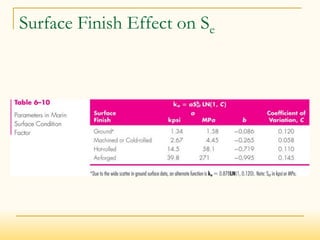
 ka – surface factor
 kb – size factor
 kc – load factor
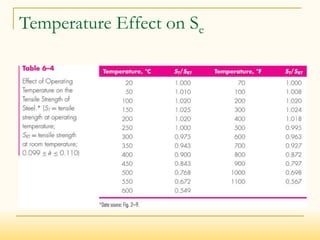
 kd – temperature factor
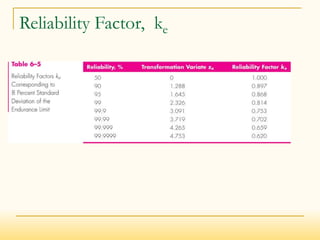
 ke – reliability factor
 Kf – miscellaneous-effects factor
 Modification factors have been found empirically and are described in section 6-9 of
Shigley-Mischke-Budynas (see examples)
 If calculating fatigue strength for finite life, (Sf), use equations on previous slide
Endurance limit modifying factors
 Surface (ka)
 Accounts for different surface finishes
 Ground, machined, cold-drawn, hot-rolled, as-forged
 Size (kb)
 Different factors depending on loading
 Bending and torsion (see pg. 280)
 Axial (kb = 1)
 Loading (kc)
 Endurance limits differ with Sut based on fatigue loading (bending, axial, torsion)
 Temperature (kd)
 Accounts for effects of operating temperature (Not significant factor for T<250 C [482 F])
 Reliability (ke)
 Accounts for scatter of data from actual test results (note ke=1 gives only a 50% reliability)
 Miscellaneous-effects (kf)
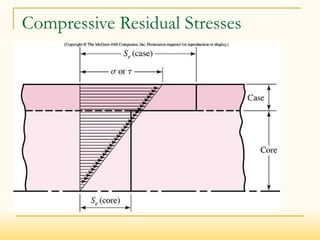
 Accounts for reduction in endurance limit due to all other effects
 Reminder that these must be accounted for
 Residual stresses
 Corrosion
 etc
Surface Finish Effect on Se
Temperature Effect on Se
Reliability Factor, ke
Steel Endurance Limit vs. Tensile Strength
Compressive Residual Stresses
Stress concentration (SC) and fatigue failure
 Unlike with static loading, both ductile and
brittle materials are significantly affected by
stress concentrations for repeated loading
cases
 We use stress concentration factors to modify
the nominal stress
 SC factor is different for ductile and brittle
materials
SC factor – fatigue
  = kfnom+ = kfo
 t = kfstnom = kfsto
 kf is a reduced value of kT and o is the nominal
stress.
 kf called fatigue stress concentration factor
 Why reduced? Some materials are not fully sensitive
to the presence of notches (SC’s) therefore,
depending on the material, we reduce the effect of
the SC
Fatigue SC factor
 kf = [1 + q(kt – 1)]
 kfs = [1 + qshear(kts – 1)]
 kt or kts and nominal stresses
 Table A-15 & 16 (pages 1006-1013 in Appendix)
 q and qshear
 Notch sensitivity factor
 Find using figures 6-20 and 6-21 in book (Shigley) for steels
and aluminums
 Use q = 0.20 for cast iron
 Brittle materials have low sensitivity to notches
 As kf approaches kt, q increasing (sensitivity to notches, SC’s)
 If kf ~ 1, insensitive (q = 0)
 Property of the material
Example
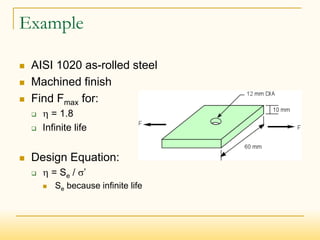
 AISI 1020 as-rolled steel
 Machined finish
 Find Fmax for:
  = 1.8
 Infinite life
 Design Equation:
  = Se / ’
 Se because infinite life
Example, cont.
  = Se / ’
 What do we need?
 Se
 ’
 Considerations?
 Infinite life, steel
 Modification factors
 Stress concentration (hole)
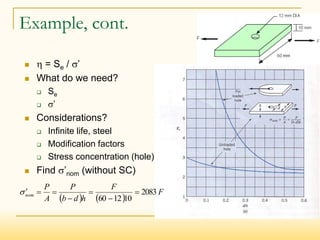
 Find ’nom (without SC)
   
F
F
h
d
b
P
A
P
nom 2083
10
12
60

-

-




Example, cont.
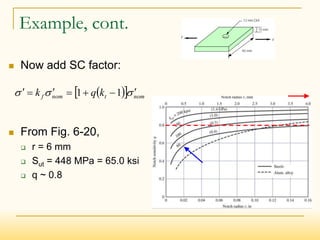
 Now add SC factor:
 From Fig. 6-20,
 r = 6 mm
 Sut = 448 MPa = 65.0 ksi
 q ~ 0.8
 
  nom
t
nom
f k
q
k 

 
-




 1
1
Example, cont.
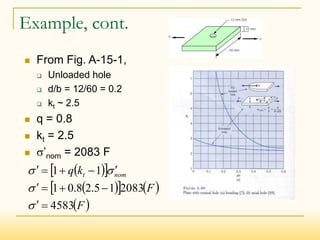
 From Fig. A-15-1,
 Unloaded hole
 d/b = 12/60 = 0.2
 kt ~ 2.5
 q = 0.8
 kt = 2.5
 ’nom = 2083 F
 
 
 
   
 
F
F
k
q nom
t
4583
2083
1
5
.
2
8
.
0
1
1
1


-




-







Example, cont.
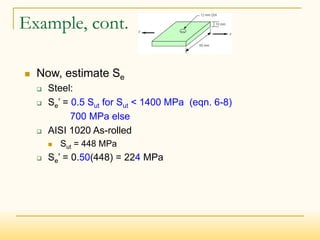
 Now, estimate Se
 Steel:
 Se’ = 0.5 Sut for Sut < 1400 MPa (eqn. 6-8)
700 MPa else
 AISI 1020 As-rolled
 Sut = 448 MPa
 Se’ = 0.50(448) = 224 MPa

7 Machine design fatigue load

  • 1.
  • 2.
    Nature of fatiguefailure  Starts with a crack  Usually at a stress concentration  Crack propagates until the material fractures suddenly  Fatigue failure is typically sudden and complete, and doesn’t give warning
  • 3.
    Fatigue Failure Examples Various Fatigue Crack Surfaces  Bolt Fatigue Failure  Drive AISI 8640 Pin  Steam Hammer Piston Rod
  • 4.
  • 5.
  • 6.
  • 7.
  • 8.
  • 9.
  • 10.
  • 11.
    Fatigue  Fatigue strengthand endurance limit  Estimating FS and EL  Modifying factors  Thus far we’ve studied static failure of machine elements  The second major class of component failure is due to dynamic loading  Variable stresses  Repeated stresses  Alternating stresses  Fluctuating stresses  The ultimate strength of a material (Su) is the maximum stress a material can sustain before failure assuming the load is applied only once and held  A material can also fail by being loaded repeatedly to a stress level that is LESS than Su  Fatigue failure
  • 12.
    Approach to fatiguefailure in analysis and design  Fatigue-life methods (6-3 to 6-6)  Stress Life Method (Used in this course)  Strain Life Method  Linear Elastic Fracture Mechanics Method  Stress-life method (rest of chapter 6)  Addresses high cycle Fatigue (>103 ) Well  Not Accurate for Low Cycle Fatigue (<103)
  • 13.
    The 3 majormethods  Stress-life  Based on stress levels only  Least accurate for low-cycle fatigue  Most traditional  Easiest to implement  Ample supporting data  Represents high-cycle applications adequately  Strain-life  More detailed analysis of plastic deformation at localized regions  Good for low-cycle fatigue applications  Some uncertainties exist in the results  Linear-elastic fracture mechanics  Assumes crack is already present and detected  Predicts crack growth with respect to stress intensity  Practical when applied to large structures in conjunction with computer codes and periodic inspection
  • 14.
    Fatigue analysis  2primary classifications of fatigue  Alternating – no DC component  Fluctuating – non-zero DC component
  • 15.
    Analysis of alternatingstresses  As the number of cycles increases, the fatigue strength Sf (the point of failure due to fatigue loading) decreases  For steel and titanium, this fatigue strength is never less than the endurance limit, Se  Our design criteria is:  As the number of cycles approaches infinity (N  ∞), Sf(N) = Se (for iron or Steel) a f N S     ) (
  • 16.
    Method of calculatingfatigue strength  Seems like we should be able to use graphs like this to calculate our fatigue strength if we know the material and the number of cycles  We could use our factor of safety equation as our design equation  But there are a couple of problems with this approach  S-N information is difficult to obtain and thus is much more scarce than -e information  S-N diagram is created for a lab specimen  Smooth  Circular  Ideal conditions  Therefore, we need analytical methods for estimating Sf(N) and Se a f N S     ) (
  • 17.
    Terminology and notation Infinite life versus finite life  Infinite life  Implies N ∞  Use endurance limit (Se) of material  Lowest value for strength  Finite life  Implies we know a value of N (number of cycles)  Use fatigue strength (Sf) of the material (higher than Se)  Prime (‘) versus no prime  Strength variable with a ‘ (Se’)  Implies that the value of that strength (endurance limit) applies to a LAB SPECIMEN in controlled conditions  Variables without a ‘ (Se, Sf)  Implies that the value of that strength applies to an actual case  First we find the prime value for our situation (Se’)  Then we will modify this value to account for differences between a lab specimen and our actual situation  This will give us Se (depending on whether we are considering infinite life or finite life)  Note that our design equation uses Sf, so we won’t be able to account for safety factors until we have calculated Se’ and Se a f N S     ) ( a e S    
  • 18.
    Estimating Se’ –Steel and Iron  For steels and irons, we can estimate the endurance limit (Se’) based on the ultimate strength of the material (Sut)  Steel  Se’ = 0.5 Sut for Sut < 200 ksi (1400 MPa) = 100 ksi (700 MPa) for all other values of Sut  Iron  Se’ = 0.4(min Sut)f/ gray cast Iron Sut<60 ksi(400MPa) = 24 ksi (160 MPa) for all other values of Sut Note: ASTM # for gray cast iron is the min Sut
  • 19.
    S-N Plot withEndurance Limit a e S     a f N S     ) ( a e S    
  • 20.
    Estimating Se’ –Aluminum and Copper Alloys  For aluminum and copper alloys, there is no endurance limit  Eventually, these materials will fail due to repeated loading  To come up with an “equivalent” endurance limit, designers typically use the value of the fatigue strength (Sf’) at 108 cycles  Aluminum alloys  Se’ (Sf at 108 cycles) = 0.4 Sut for Sut < 48 ksi (330 MPa) = 19 ksi (130 MPa) for all other values of Sut  Copper alloys  Se’ (Sf at 108 cycles) = 0.4 Sut for Sut < 35 ksi (250 MPa) = 14 ksi (100 MPa) for all other values of Sut
  • 21.
    Correction factors  Nowwe have Se’ (infinite life)  We need to account for differences between the lab specimen and a real specimen (material, manufacturing, environment, design)  We use correction factors  Strength reduction factors  Marin modification factors  These will account for differences between an ideal lab specimen and real life  Se = ka kb kc kd ke kf Se’  ka – surface factor  kb – size factor  kc – load factor  kd – temperature factor  ke – reliability factor  Kf – miscellaneous-effects factor  Modification factors have been found empirically and are described in section 6-9 of Shigley-Mischke-Budynas (see examples)  If calculating fatigue strength for finite life, (Sf), use equations on previous slide
  • 22.
    Endurance limit modifyingfactors  Surface (ka)  Accounts for different surface finishes  Ground, machined, cold-drawn, hot-rolled, as-forged  Size (kb)  Different factors depending on loading  Bending and torsion (see pg. 280)  Axial (kb = 1)  Loading (kc)  Endurance limits differ with Sut based on fatigue loading (bending, axial, torsion)  Temperature (kd)  Accounts for effects of operating temperature (Not significant factor for T<250 C [482 F])  Reliability (ke)  Accounts for scatter of data from actual test results (note ke=1 gives only a 50% reliability)  Miscellaneous-effects (kf)  Accounts for reduction in endurance limit due to all other effects  Reminder that these must be accounted for  Residual stresses  Corrosion  etc
  • 23.
  • 24.
  • 25.
  • 26.
    Steel Endurance Limitvs. Tensile Strength
  • 27.
  • 28.
    Stress concentration (SC)and fatigue failure  Unlike with static loading, both ductile and brittle materials are significantly affected by stress concentrations for repeated loading cases  We use stress concentration factors to modify the nominal stress  SC factor is different for ductile and brittle materials
  • 29.
    SC factor –fatigue   = kfnom+ = kfo  t = kfstnom = kfsto  kf is a reduced value of kT and o is the nominal stress.  kf called fatigue stress concentration factor  Why reduced? Some materials are not fully sensitive to the presence of notches (SC’s) therefore, depending on the material, we reduce the effect of the SC
  • 30.
    Fatigue SC factor kf = [1 + q(kt – 1)]  kfs = [1 + qshear(kts – 1)]  kt or kts and nominal stresses  Table A-15 & 16 (pages 1006-1013 in Appendix)  q and qshear  Notch sensitivity factor  Find using figures 6-20 and 6-21 in book (Shigley) for steels and aluminums  Use q = 0.20 for cast iron  Brittle materials have low sensitivity to notches  As kf approaches kt, q increasing (sensitivity to notches, SC’s)  If kf ~ 1, insensitive (q = 0)  Property of the material
  • 31.
    Example  AISI 1020as-rolled steel  Machined finish  Find Fmax for:   = 1.8  Infinite life  Design Equation:   = Se / ’  Se because infinite life
  • 32.
    Example, cont.  = Se / ’  What do we need?  Se  ’  Considerations?  Infinite life, steel  Modification factors  Stress concentration (hole)  Find ’nom (without SC)     F F h d b P A P nom 2083 10 12 60  -  -    
  • 33.
    Example, cont.  Nowadd SC factor:  From Fig. 6-20,  r = 6 mm  Sut = 448 MPa = 65.0 ksi  q ~ 0.8     nom t nom f k q k     -      1 1
  • 34.
    Example, cont.  FromFig. A-15-1,  Unloaded hole  d/b = 12/60 = 0.2  kt ~ 2.5  q = 0.8  kt = 2.5  ’nom = 2083 F             F F k q nom t 4583 2083 1 5 . 2 8 . 0 1 1 1   -     -       
  • 35.
    Example, cont.  Now,estimate Se  Steel:  Se’ = 0.5 Sut for Sut < 1400 MPa (eqn. 6-8) 700 MPa else  AISI 1020 As-rolled  Sut = 448 MPa  Se’ = 0.50(448) = 224 MPa