CALCULUS II / MTH 203 - 050 / SPRING 2010
     Approximate Integration Methods


         Instructor: Silvius Klein
The Midpoint Rule
    y

                             f x is any function, a        x    b
                             Approximate the region under its graph
                             by rectangles.


                                                                                                           x
    a   x0 c1      x1   c2       x2    c3    x3       c4       x4   c5   x5   c6   x6   c7   x7   c8 b   x8

                                                                                              b−a
        Divide [a, b] into n subintervals of equal length ∆x =
                                                                                               n
        In each subinterval take the midpoint: c1 , c2 , ... cn
              b
                  f (x) dx ≈ Mn where
          a

                  Mn = the sum of the areas of the above rectangles
The Midpoint Rule

    a   x0 c1      x1   c2   x2   c3    x3   c4   x4   c5   x5   c6   x6   c7   x7   c8   b   x8


             b
                 f (x) dx ≈ Mn         where
         a

                        Mn = ∆x · [f (c1 ) + f (c2 ) + ... + f (cn )]


        Error bound: EMn = | true value − approximate value |
        Then
                                   K · (b − a)3
                          EMn ≤
                                      24 · n2

        where K = max|f (x)|, for a ≤ x ≤ b
The Trapezoidal Rule
                y

                                                  Use straight lines to
                          f x is any function    approximate the function
                          a x b


                a   x0    x1                x2   x3             b   x4 x

                                                                            b−a
      Divide [a, b] into n subintervals of equal length ∆x =
                                                                             n
           b
               f (x) dx ≈ Tn     where
       a

                Tn = the sum of the areas of the above trapezoids
The Trapezoidal Rule
                   a   x0      x1           x2      x3          b   x4


           b
               f (x) dx ≈ Tn        where
       a

                 ∆x
       Tn =         · [f (x0 ) + 2 · f (x1 ) + 2 · f (x2 ) + ... + 2 · f (xn−1 ) + f (xn )]
                  2


      Error bound: ETn = | true value − approximate value |

                                             K · (b − a)3
                                    ETn ≤
                                               12 · n2

      where K = max|f (x)| for a ≤ x ≤ b
Simpson’s Rule
    y
                      f x is any function, a    x    b
                      Approximate the function by parabolas.


                                                                            x
    a   x0                   x1                       x2       x3      b   x4

        Divide [a, b] into an even number n of subintervals of equal
                       b−a
        length ∆x =
                         n
             b
                 f (x) dx ≈ Sn        where
         a
                 Sn = the sum of the areas under the above parabolas
Simpson’s Rule
           n even

                    a   x0      x1           x2       x3         b   x4

           b
               f (x) dx ≈ Sn     where
       a


                 ∆x
       Sn =         · [f (x0 ) + 4 · f (x1 ) + 2 · f (x2 ) + ... + 4 · f (xn−1 ) + f (xn )]
                  3

      Error bound: ESn = | true value − approximate value |

                                             L · (b − a)5
                                     ESn ≤
                                               180 · n4

      where L = max|f (4) (x)| for a ≤ x ≤ b
Simpson’s Rule - formulas for n = 2 and n = 4 subintervals

      n=2
                      a        x0                      x1                   b    x2


                                    ∆x
                      S2 =             · [f (x0 ) + 4 · f (x1 ) + f (x2 )]
                                     3


      n=4
                  a       x0           x1         x2         x3         b       x4


              ∆x
       S4 =      · [f (x0 ) + 4 · f (x1 ) + 2 · f (x2 ) + 4 · f (x3 ) + f (x2 )]
               3
Example


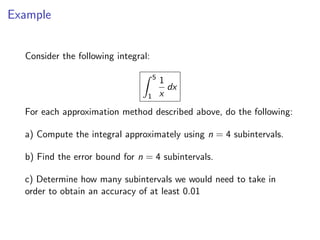
  Consider the following integral:

                                     5
                                         1
                                           dx
                                 1       x
  For each approximation method described above, do the following:

  a) Compute the integral approximately using n = 4 subintervals.

  b) Find the error bound for n = 4 subintervals.

  c) Determine how many subintervals we would need to take in
  order to obtain an accuracy of at least 0.01
5
          1
            dx          n=4           Midpoint Rule
  1       x
We divide the interval [1, 5] into 4 subintervals and we find the
midpoints for each subinterval:

          1       1.5     2     2.5     3      3.5     4     4.5      5

                                5−1
We have: n = 4, so ∆x =           4 = 1, hence the   spacing is 1.
                              1+2   3
The midpoints are c1 =         2 = 2 = 1.5, c2 =     1.5 + 1 = 2.5,
c3 = 2.5 + 1 = 3.5, c4 = 3.5 + 1 = 4.5.
Then
              M4 = ∆x · [f (1.5) + f (2.5) + f (3.5) + f (4.5)] =
                           1   1   1   1
                   =1·[      +   +   +    ] ≈ 1.57
                          1.5 2.5 3.5 4.5
                                  5
                              1
The approximate value of        dx provided by the midpoint rule
                            1 x
with 4 subintervals is then 1.57
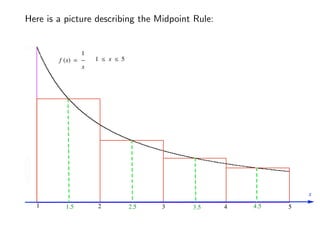
Here is a picture describing the Midpoint Rule:


                1
        f x         1   x   5
                x


                                                                x
  1       1.5       2           2.5   3   3.5     4   4.5   5
The error bound for the Midpoint rule with n points is

                              K · (5 − 1)3
                       |EMn | ≤
                                 24 · n2
Here K = max|f (x)|, where x ∈ [1, 5].
We compute the second derivative of f (x) =     1
                                                x   = x −1

                            f (x) = −x −2
                                                    2
                 f (x) = −(−2)x −3 = 2x −3 =
                                                    x3
As x increases, x23 decreases (the larger the denominator, the
smaller the fraction). Therefore, the largest value that x23 will take
                                                  2
as x ranges from 1 to 5 is when x = 1, so K = 13 = 2. Then

                            2 · (5 − 1)3  1
                 |EM4 | ≤             2
                                         = ≈ 0.33
                               24 · 4     3
This shows that our estimate of 1.57 for the value of the integral
has an error of at most 0.33. This is not a very good estimate
then, since the possible error is quite large.
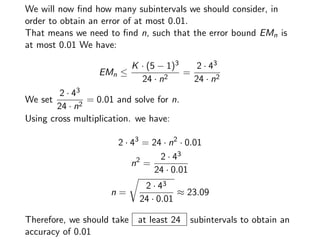
We will now find how many subintervals we should consider, in
order to obtain an error of at most 0.01.
That means we need to find n, such that the error bound EMn is
at most 0.01 We have:

                          K · (5 − 1)3    2 · 43
                  EMn ≤                =
                            24 · n2      24 · n2
         2 · 43
We set          = 0.01 and solve for n.
        24 · n2
Using cross multiplication. we have:

                       2 · 43 = 24 · n2 · 0.01
                                  2 · 43
                           n2 =
                                 24 · 0.01
                             2 · 43
                     n=               ≈ 23.09
                            24 · 0.01

Therefore, we should take at least 24 subintervals to obtain an
accuracy of 0.01
5
          1
            dx           n=4          Trapezoidal Rule
  1       x

                                5−1
We have: n = 4, so ∆x =          4    = 1, hence the spacing is 1.
We divide the interval [1, 5] into 4 subintervals:

                     1      2           3        4         5


Then
             ∆x
      T4 =      · [f (1) + 2 · f (2) + 2 · f (3) + 2 · f (4) + f (5)] =
              2
                     1 1       1     1     1 1
                 =    · [ + 2 · + 2 · + 2 · + ] ≈ 1.68
                     2 1       2     3     4 5
                                 5
                              1
The approximate value of        dx provided by the trapezoidal rule
                            1 x
with 4 subintervals is then 1.68
Here is a picture describing the Trapezoidal Rule:


                   1
             f x       1   x   5
                   x


                                                             x
 1                 2               3                 4   5
The error bound for the trapezoidal rule with n points is

                             K · (5 − 1)3
                        |ETn | ≤
                                12 · n2
Here K = max|f (x)|, where x ∈ [1, 5].
We compute the second derivative of f (x) =     1
                                                x   = x −1

                             f (x) = −x −2
                                                    2
                 f (x) = −(−2)x −3 = 2x −3 =
                                                    x3
As x increases, x23 decreases (the larger the denominator, the
smaller the fraction). Therefore, the largest value that x23 will take
                                                  2
as x ranges from 1 to 5 is when x = 1, so K = 13 = 2. Then

                             2 · (5 − 1)3  2
                  |ET4 | ≤            2
                                          = ≈ 0.66
                                12 · 4     3
This shows that our estimate of 1.68 for the value of the integral
has an error of at most 0.66. This is not a very good estimate
then, since the possible error is quite large.
We will now find how many subintervals we should consider, in
order to obtain an error of at most 0.01.
That means we need to find n, such that the error bound ETn is at
most 0.01 We have:

                          K · (5 − 1)3    2 · 43
                  ETn ≤                =
                            12 · n2      12 · n2
         2 · 43
We set          = 0.01 and solve for n.
        12 · n2
Using cross multiplication. we have:

                       2 · 43 = 12 · n2 · 0.01
                                  2 · 43
                           n2 =
                                 12 · 0.01
                             2 · 43
                     n=               ≈ 32.66
                            12 · 0.01

Therefore, we should take at least 33 subintervals to obtain an
accuracy of 0.01
5
          1
            dx          n=4            Simpson’s Rule
  1       x

We have: n = 4, so ∆x = 5−1 = 1, hence the spacing is 1.
                              4
We divide the interval [1, 5] into 4 subintervals:

                    1         2          3         4          5

Then

                 ∆x
          S4 =      · [f (1) + 4 · f (2) + 2 · f (3) + f (4) + f (5)] =
                  3
                   1 1         1         1        1 1
                 = · [ + 4 · + 2 · + 4 · + ] ≈ 1.62
                   3 1         2         3        4 5
                                   5
                              1
The approximate value of        dx provided by Simpson’s rule
                            1 x
with 4 subintervals is then 1.62
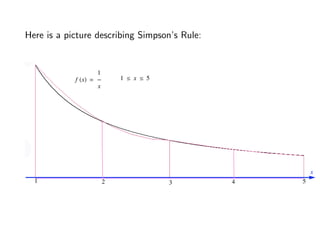
Here is a picture describing Simpson’s Rule:


                  1
            f x           1   x   5
                  x


                                                       x
  1                   2               3        4   5
The error bound for Simpson’s rule with n points is

                                L · (5 − 1)5
                         ESn ≤
                                  180 · n4
Here L = max|f (4) (x)|, where x ∈ [1, 5].

We compute the fourth derivative of f (x) =    1
                                               x   = x −1
                            f (x) = −x −2
                    f (x) = −(−2)x −3 = 2x −3
                   f (x) = 2(−3)x −4 = −6x −4
                                                    24
               f (4) (x) = −6(−4)x −5 = 24x −5 =
                                                    x5
                 24
As x increases, x 5 decreases (the larger the denominator, the
smaller the fraction). Therefore, the largest value that 24 will take
                                                         x5
as x ranges from 1 to 5 is when x = 1, so L = 24 = 24. Then
                                                 13
                           24 · (5 − 1)5
                    ES4 ≤                ≈ 0.53
                              180 · 44
This shows that our estimate of 1.62 for the value of the integral
has an error of at most 0.53. This is not a very good estimate.
We will now find how many subintervals we should consider, in
order to obtain an error of at most 0.01.
That means we need to find n, such that the error bound ESn is at
most 0.01                 L · (5 − 1)5      24 · 45
                  ESn ≤                =
                            180 · n4       180 · n4
         24 · 45
We set           = 0.01 and solve for n. Use cross-multiplication:
        180 · n4
                      24 · 45 = 180 · n4 · 0.01
                                 24 · 45
                         n4 =
                                180 · 0.01
                          4    24 · 45
                    n=                   ≈ 10.8
                              180 · 0.01
Therefore, we should take at least 12 subintervals (an even
number) to obtain an accuracy of 0.01
Note how much more efficient Simpson’s rule is, compared to the
other two methods (12 subintervals are needed to obtain the same
accuracy as the Midpoint rule would produce with 24 subintervals,
or as the Trapezoidal rule would produce with 33 subintervals).

Approximate Integration

  • 1.
    CALCULUS II /MTH 203 - 050 / SPRING 2010 Approximate Integration Methods Instructor: Silvius Klein
  • 2.
    The Midpoint Rule y f x is any function, a x b Approximate the region under its graph by rectangles. x a x0 c1 x1 c2 x2 c3 x3 c4 x4 c5 x5 c6 x6 c7 x7 c8 b x8 b−a Divide [a, b] into n subintervals of equal length ∆x = n In each subinterval take the midpoint: c1 , c2 , ... cn b f (x) dx ≈ Mn where a Mn = the sum of the areas of the above rectangles
  • 3.
    The Midpoint Rule a x0 c1 x1 c2 x2 c3 x3 c4 x4 c5 x5 c6 x6 c7 x7 c8 b x8 b f (x) dx ≈ Mn where a Mn = ∆x · [f (c1 ) + f (c2 ) + ... + f (cn )] Error bound: EMn = | true value − approximate value | Then K · (b − a)3 EMn ≤ 24 · n2 where K = max|f (x)|, for a ≤ x ≤ b
  • 4.
    The Trapezoidal Rule y Use straight lines to f x is any function approximate the function a x b a x0 x1 x2 x3 b x4 x b−a Divide [a, b] into n subintervals of equal length ∆x = n b f (x) dx ≈ Tn where a Tn = the sum of the areas of the above trapezoids
  • 5.
    The Trapezoidal Rule a x0 x1 x2 x3 b x4 b f (x) dx ≈ Tn where a ∆x Tn = · [f (x0 ) + 2 · f (x1 ) + 2 · f (x2 ) + ... + 2 · f (xn−1 ) + f (xn )] 2 Error bound: ETn = | true value − approximate value | K · (b − a)3 ETn ≤ 12 · n2 where K = max|f (x)| for a ≤ x ≤ b
  • 6.
    Simpson’s Rule y f x is any function, a x b Approximate the function by parabolas. x a x0 x1 x2 x3 b x4 Divide [a, b] into an even number n of subintervals of equal b−a length ∆x = n b f (x) dx ≈ Sn where a Sn = the sum of the areas under the above parabolas
  • 7.
    Simpson’s Rule n even a x0 x1 x2 x3 b x4 b f (x) dx ≈ Sn where a ∆x Sn = · [f (x0 ) + 4 · f (x1 ) + 2 · f (x2 ) + ... + 4 · f (xn−1 ) + f (xn )] 3 Error bound: ESn = | true value − approximate value | L · (b − a)5 ESn ≤ 180 · n4 where L = max|f (4) (x)| for a ≤ x ≤ b
  • 8.
    Simpson’s Rule -formulas for n = 2 and n = 4 subintervals n=2 a x0 x1 b x2 ∆x S2 = · [f (x0 ) + 4 · f (x1 ) + f (x2 )] 3 n=4 a x0 x1 x2 x3 b x4 ∆x S4 = · [f (x0 ) + 4 · f (x1 ) + 2 · f (x2 ) + 4 · f (x3 ) + f (x2 )] 3
  • 9.
    Example Considerthe following integral: 5 1 dx 1 x For each approximation method described above, do the following: a) Compute the integral approximately using n = 4 subintervals. b) Find the error bound for n = 4 subintervals. c) Determine how many subintervals we would need to take in order to obtain an accuracy of at least 0.01
  • 10.
    5 1 dx n=4 Midpoint Rule 1 x We divide the interval [1, 5] into 4 subintervals and we find the midpoints for each subinterval: 1 1.5 2 2.5 3 3.5 4 4.5 5 5−1 We have: n = 4, so ∆x = 4 = 1, hence the spacing is 1. 1+2 3 The midpoints are c1 = 2 = 2 = 1.5, c2 = 1.5 + 1 = 2.5, c3 = 2.5 + 1 = 3.5, c4 = 3.5 + 1 = 4.5. Then M4 = ∆x · [f (1.5) + f (2.5) + f (3.5) + f (4.5)] = 1 1 1 1 =1·[ + + + ] ≈ 1.57 1.5 2.5 3.5 4.5 5 1 The approximate value of dx provided by the midpoint rule 1 x with 4 subintervals is then 1.57
  • 11.
    Here is apicture describing the Midpoint Rule: 1 f x 1 x 5 x x 1 1.5 2 2.5 3 3.5 4 4.5 5
  • 12.
    The error boundfor the Midpoint rule with n points is K · (5 − 1)3 |EMn | ≤ 24 · n2 Here K = max|f (x)|, where x ∈ [1, 5]. We compute the second derivative of f (x) = 1 x = x −1 f (x) = −x −2 2 f (x) = −(−2)x −3 = 2x −3 = x3 As x increases, x23 decreases (the larger the denominator, the smaller the fraction). Therefore, the largest value that x23 will take 2 as x ranges from 1 to 5 is when x = 1, so K = 13 = 2. Then 2 · (5 − 1)3 1 |EM4 | ≤ 2 = ≈ 0.33 24 · 4 3 This shows that our estimate of 1.57 for the value of the integral has an error of at most 0.33. This is not a very good estimate then, since the possible error is quite large.
  • 13.
    We will nowfind how many subintervals we should consider, in order to obtain an error of at most 0.01. That means we need to find n, such that the error bound EMn is at most 0.01 We have: K · (5 − 1)3 2 · 43 EMn ≤ = 24 · n2 24 · n2 2 · 43 We set = 0.01 and solve for n. 24 · n2 Using cross multiplication. we have: 2 · 43 = 24 · n2 · 0.01 2 · 43 n2 = 24 · 0.01 2 · 43 n= ≈ 23.09 24 · 0.01 Therefore, we should take at least 24 subintervals to obtain an accuracy of 0.01
  • 14.
    5 1 dx n=4 Trapezoidal Rule 1 x 5−1 We have: n = 4, so ∆x = 4 = 1, hence the spacing is 1. We divide the interval [1, 5] into 4 subintervals: 1 2 3 4 5 Then ∆x T4 = · [f (1) + 2 · f (2) + 2 · f (3) + 2 · f (4) + f (5)] = 2 1 1 1 1 1 1 = · [ + 2 · + 2 · + 2 · + ] ≈ 1.68 2 1 2 3 4 5 5 1 The approximate value of dx provided by the trapezoidal rule 1 x with 4 subintervals is then 1.68
  • 15.
    Here is apicture describing the Trapezoidal Rule: 1 f x 1 x 5 x x 1 2 3 4 5
  • 16.
    The error boundfor the trapezoidal rule with n points is K · (5 − 1)3 |ETn | ≤ 12 · n2 Here K = max|f (x)|, where x ∈ [1, 5]. We compute the second derivative of f (x) = 1 x = x −1 f (x) = −x −2 2 f (x) = −(−2)x −3 = 2x −3 = x3 As x increases, x23 decreases (the larger the denominator, the smaller the fraction). Therefore, the largest value that x23 will take 2 as x ranges from 1 to 5 is when x = 1, so K = 13 = 2. Then 2 · (5 − 1)3 2 |ET4 | ≤ 2 = ≈ 0.66 12 · 4 3 This shows that our estimate of 1.68 for the value of the integral has an error of at most 0.66. This is not a very good estimate then, since the possible error is quite large.
  • 17.
    We will nowfind how many subintervals we should consider, in order to obtain an error of at most 0.01. That means we need to find n, such that the error bound ETn is at most 0.01 We have: K · (5 − 1)3 2 · 43 ETn ≤ = 12 · n2 12 · n2 2 · 43 We set = 0.01 and solve for n. 12 · n2 Using cross multiplication. we have: 2 · 43 = 12 · n2 · 0.01 2 · 43 n2 = 12 · 0.01 2 · 43 n= ≈ 32.66 12 · 0.01 Therefore, we should take at least 33 subintervals to obtain an accuracy of 0.01
  • 18.
    5 1 dx n=4 Simpson’s Rule 1 x We have: n = 4, so ∆x = 5−1 = 1, hence the spacing is 1. 4 We divide the interval [1, 5] into 4 subintervals: 1 2 3 4 5 Then ∆x S4 = · [f (1) + 4 · f (2) + 2 · f (3) + f (4) + f (5)] = 3 1 1 1 1 1 1 = · [ + 4 · + 2 · + 4 · + ] ≈ 1.62 3 1 2 3 4 5 5 1 The approximate value of dx provided by Simpson’s rule 1 x with 4 subintervals is then 1.62
  • 19.
    Here is apicture describing Simpson’s Rule: 1 f x 1 x 5 x x 1 2 3 4 5
  • 20.
    The error boundfor Simpson’s rule with n points is L · (5 − 1)5 ESn ≤ 180 · n4 Here L = max|f (4) (x)|, where x ∈ [1, 5]. We compute the fourth derivative of f (x) = 1 x = x −1 f (x) = −x −2 f (x) = −(−2)x −3 = 2x −3 f (x) = 2(−3)x −4 = −6x −4 24 f (4) (x) = −6(−4)x −5 = 24x −5 = x5 24 As x increases, x 5 decreases (the larger the denominator, the smaller the fraction). Therefore, the largest value that 24 will take x5 as x ranges from 1 to 5 is when x = 1, so L = 24 = 24. Then 13 24 · (5 − 1)5 ES4 ≤ ≈ 0.53 180 · 44 This shows that our estimate of 1.62 for the value of the integral has an error of at most 0.53. This is not a very good estimate.
  • 21.
    We will nowfind how many subintervals we should consider, in order to obtain an error of at most 0.01. That means we need to find n, such that the error bound ESn is at most 0.01 L · (5 − 1)5 24 · 45 ESn ≤ = 180 · n4 180 · n4 24 · 45 We set = 0.01 and solve for n. Use cross-multiplication: 180 · n4 24 · 45 = 180 · n4 · 0.01 24 · 45 n4 = 180 · 0.01 4 24 · 45 n= ≈ 10.8 180 · 0.01 Therefore, we should take at least 12 subintervals (an even number) to obtain an accuracy of 0.01 Note how much more efficient Simpson’s rule is, compared to the other two methods (12 subintervals are needed to obtain the same accuracy as the Midpoint rule would produce with 24 subintervals, or as the Trapezoidal rule would produce with 33 subintervals).