B. Heard
(Not to be posted, used, etc. without my
 permission, students may download one
                   copy for personal use)
 Inany statistics class, you will come across
  factorials, permutations and combinations
     You can use Minitab, your calculator, etc. for
      these types of calculations
         I am going to show you how to use Excel (because it is
          usually something everyone has on their computer)
Factorials
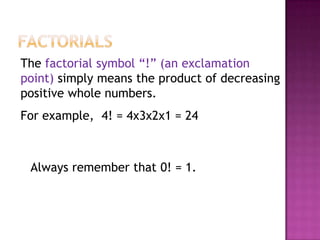
The factorial symbol “!” (an exclamation
point) simply means the product of decreasing
positive whole numbers.
For example, 4! = 4x3x2x1 = 24


 Always remember that 0! = 1.
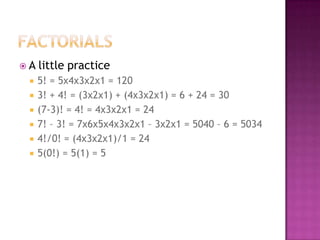
A   little practice
    5! = 5x4x3x2x1 = 120
    3! + 4! = (3x2x1) + (4x3x2x1) = 6 + 24 = 30
    (7-3)! = 4! = 4x3x2x1 = 24
    7! – 3! = 7x6x5x4x3x2x1 – 3x2x1 = 5040 – 6 = 5034
    4!/0! = (4x3x2x1)/1 = 24
    5(0!) = 5(1) = 5
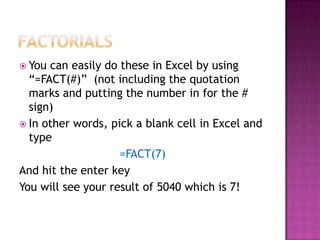
 You can easily do these in Excel by using
  “=FACT(#)” (not including the quotation
  marks and putting the number in for the #
  sign)
 In other words, pick a blank cell in Excel and
  type
                    =FACT(7)
And hit the enter key
You will see your result of 5040 which is 7!
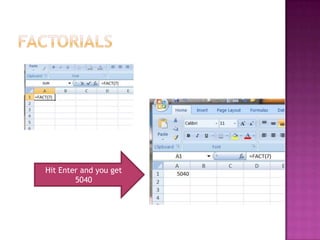
Hit Enter and you get
        5040
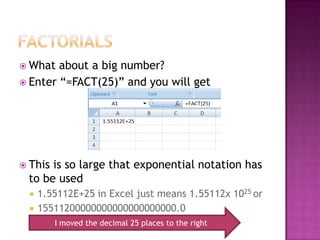
 What  about a big number?
 Enter “=FACT(25)” and you will get


 Thisis so large that exponential notation has
 to be used
     1.55112E+25 in Excel just means 1.55112x 1025 or
     15511200000000000000000000.0
         I moved the decimal 25 places to the right
Permutations
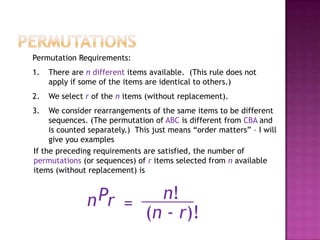
Permutation Requirements:
1.   There are n different items available. (This rule does not
     apply if some of the items are identical to others.)
2.   We select r of the n items (without replacement).
3.   We consider rearrangements of the same items to be different
     sequences. (The permutation of ABC is different from CBA and
     is counted separately.) This just means “order matters” – I will
     give you examples
If the preceding requirements are satisfied, the number of
permutations (or sequences) of r items selected from n available
items (without replacement) is


               n Pr =             n!
                                (n - r)!
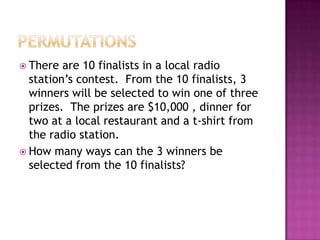
 There  are 10 finalists in a local radio
  station’s contest. From the 10 finalists, 3
  winners will be selected to win one of three
  prizes. The prizes are $10,000 , dinner for
  two at a local restaurant and a t-shirt from
  the radio station.
 How many ways can the 3 winners be
  selected from the 10 finalists?
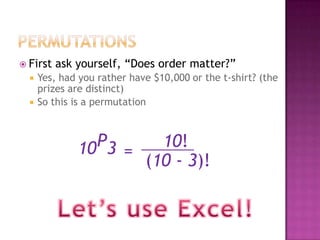
 First   ask yourself, “Does order matter?”
     Yes, had you rather have $10,000 or the t-shirt? (the
      prizes are distinct)
     So this is a permutation


              10 P3         10!
                        =
                          (10 - 3)!
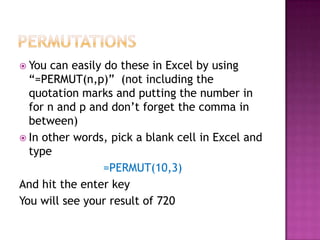
 You can easily do these in Excel by using
  “=PERMUT(n,p)” (not including the
  quotation marks and putting the number in
  for n and p and don’t forget the comma in
  between)
 In other words, pick a blank cell in Excel and
  type
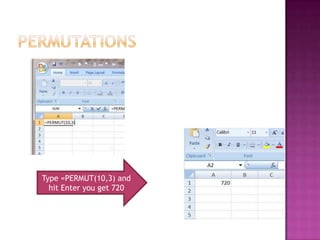
                 =PERMUT(10,3)
And hit the enter key
You will see your result of 720
Type =PERMUT(10,3) and
  hit Enter you get 720
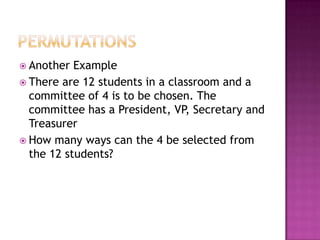
 Another  Example
 There are 12 students in a classroom and a
  committee of 4 is to be chosen. The
  committee has a President, VP, Secretary and
  Treasurer
 How many ways can the 4 be selected from
  the 12 students?
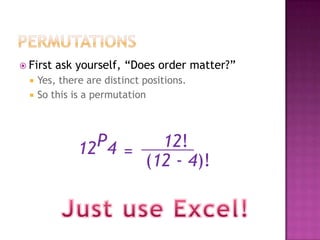
 First   ask yourself, “Does order matter?”
     Yes, there are distinct positions.
     So this is a permutation


               12 P4         12!
                         =
                           (12 - 4)!
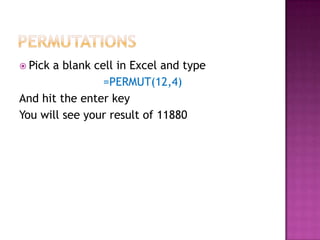
 Picka blank cell in Excel and type
                =PERMUT(12,4)
And hit the enter key
You will see your result of 11880
Combinations
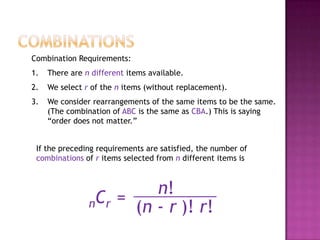
Combination Requirements:
1.   There are n different items available.
2.   We select r of the n items (without replacement).
3.   We consider rearrangements of the same items to be the same.
     (The combination of ABC is the same as CBA.) This is saying
     “order does not matter.”


 If the preceding requirements are satisfied, the number of
 combinations of r items selected from n different items is


                         n!
                nCr = (n - r )! r!
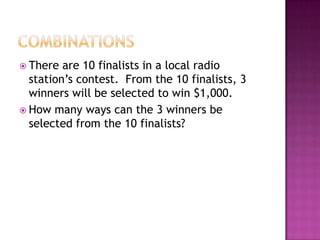
 There  are 10 finalists in a local radio
  station’s contest. From the 10 finalists, 3
  winners will be selected to win $1,000.
 How many ways can the 3 winners be
  selected from the 10 finalists?
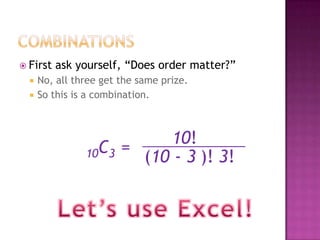
 First   ask yourself, “Does order matter?”
     No, all three get the same prize.
     So this is a combination.


                          10!
                10C3 = (10 - 3 )! 3!
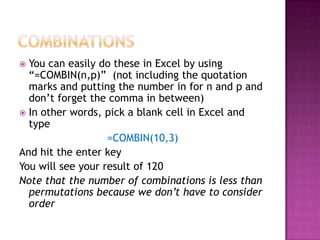
 You can easily do these in Excel by using
  “=COMBIN(n,p)” (not including the quotation
  marks and putting the number in for n and p and
  don’t forget the comma in between)
 In other words, pick a blank cell in Excel and
  type
                   =COMBIN(10,3)
And hit the enter key
You will see your result of 120
Note that the number of combinations is less than
  permutations because we don’t have to consider
  order
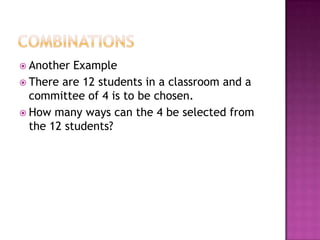
 Another  Example
 There are 12 students in a classroom and a
  committee of 4 is to be chosen.
 How many ways can the 4 be selected from
  the 12 students?
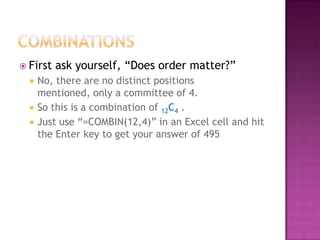
 First   ask yourself, “Does order matter?”
     No, there are no distinct positions
      mentioned, only a committee of 4.
     So this is a combination of 12C4 .
     Just use “=COMBIN(12,4)” in an Excel cell and hit
      the Enter key to get your answer of 495
 What  about those funky questions about how
  many distinct words or orderings you can
  make with the letters in the word “Colorado”
  or “Mississippi” etc.?
 These are “distinct permutation” problems
  and can be easily explained with examples.
 In these problems you generally have some
  duplicates you have to deal with.
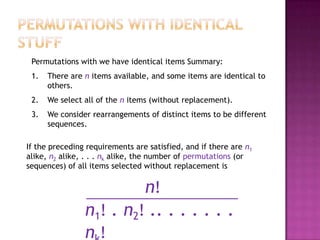
Permutations with we have identical items Summary:
 1.   There are n items available, and some items are identical to
      others.
 2.   We select all of the n items (without replacement).
 3.   We consider rearrangements of distinct items to be different
      sequences.

If the preceding requirements are satisfied, and if there are n1
alike, n2 alike, . . . nk alike, the number of permutations (or
sequences) of all items selected without replacement is


                         n!
                n1! . n2! .. . . . . . .
                n!
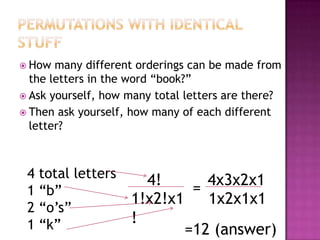
 How  many different orderings can be made from
  the letters in the word “book?”
 Ask yourself, how many total letters are there?
 Then ask yourself, how many of each different
  letter?


 4 total letters      4!       4x3x2x1
 1 “b”                       =
                    1!x2!x1    1x2x1x1
 2 “o’s”
 1 “k”              !
                            =12 (answer)
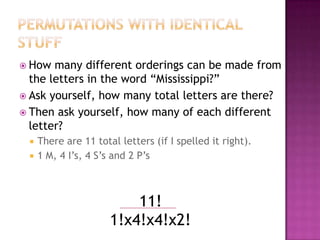
 How  many different orderings can be made from
  the letters in the word “Mississippi?”
 Ask yourself, how many total letters are there?
 Then ask yourself, how many of each different
  letter?
    There are 11 total letters (if I spelled it right).
    1 M, 4 I’s, 4 S’s and 2 P’s


                          11!
                      1!x4!x4!x2!
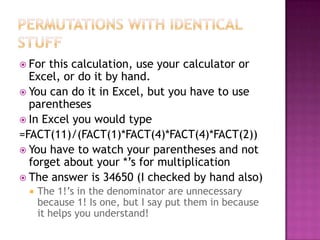
 For this calculation, use your calculator or
  Excel, or do it by hand.
 You can do it in Excel, but you have to use
  parentheses
 In Excel you would type
=FACT(11)/(FACT(1)*FACT(4)*FACT(4)*FACT(2))
 You have to watch your parentheses and not
  forget about your *’s for multiplication
 The answer is 34650 (I checked by hand also)
    The 1!’s in the denominator are unnecessary
     because 1! Is one, but I say put them in because
     it helps you understand!
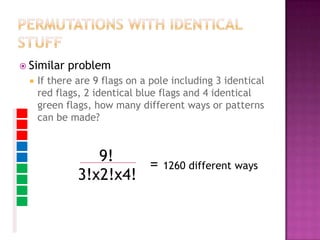
 Similar   problem
     If there are 9 flags on a pole including 3 identical
      red flags, 2 identical blue flags and 4 identical
      green flags, how many different ways or patterns
      can be made?


                  9!    = 1260 different ways
               3!x2!x4!
 Good  luck, I hope this helps.
 If you enjoy reading the humor of an absent
  minded math professor, come be a fan at
  www.facebook.com/cranksmytractor

Factorials permutations and_combinations_using_excel

  • 1.
    B. Heard (Not tobe posted, used, etc. without my permission, students may download one copy for personal use)
  • 2.
     Inany statisticsclass, you will come across factorials, permutations and combinations  You can use Minitab, your calculator, etc. for these types of calculations  I am going to show you how to use Excel (because it is usually something everyone has on their computer)
  • 3.
  • 4.
    The factorial symbol“!” (an exclamation point) simply means the product of decreasing positive whole numbers. For example, 4! = 4x3x2x1 = 24 Always remember that 0! = 1.
  • 5.
    A little practice  5! = 5x4x3x2x1 = 120  3! + 4! = (3x2x1) + (4x3x2x1) = 6 + 24 = 30  (7-3)! = 4! = 4x3x2x1 = 24  7! – 3! = 7x6x5x4x3x2x1 – 3x2x1 = 5040 – 6 = 5034  4!/0! = (4x3x2x1)/1 = 24  5(0!) = 5(1) = 5
  • 6.
     You caneasily do these in Excel by using “=FACT(#)” (not including the quotation marks and putting the number in for the # sign)  In other words, pick a blank cell in Excel and type =FACT(7) And hit the enter key You will see your result of 5040 which is 7!
  • 7.
    Hit Enter andyou get 5040
  • 8.
     What about a big number?  Enter “=FACT(25)” and you will get  Thisis so large that exponential notation has to be used  1.55112E+25 in Excel just means 1.55112x 1025 or  15511200000000000000000000.0 I moved the decimal 25 places to the right
  • 9.
  • 10.
    Permutation Requirements: 1. There are n different items available. (This rule does not apply if some of the items are identical to others.) 2. We select r of the n items (without replacement). 3. We consider rearrangements of the same items to be different sequences. (The permutation of ABC is different from CBA and is counted separately.) This just means “order matters” – I will give you examples If the preceding requirements are satisfied, the number of permutations (or sequences) of r items selected from n available items (without replacement) is n Pr = n! (n - r)!
  • 11.
     There are 10 finalists in a local radio station’s contest. From the 10 finalists, 3 winners will be selected to win one of three prizes. The prizes are $10,000 , dinner for two at a local restaurant and a t-shirt from the radio station.  How many ways can the 3 winners be selected from the 10 finalists?
  • 12.
     First ask yourself, “Does order matter?”  Yes, had you rather have $10,000 or the t-shirt? (the prizes are distinct)  So this is a permutation 10 P3 10! = (10 - 3)!
  • 13.
     You caneasily do these in Excel by using “=PERMUT(n,p)” (not including the quotation marks and putting the number in for n and p and don’t forget the comma in between)  In other words, pick a blank cell in Excel and type =PERMUT(10,3) And hit the enter key You will see your result of 720
  • 14.
    Type =PERMUT(10,3) and hit Enter you get 720
  • 15.
     Another Example  There are 12 students in a classroom and a committee of 4 is to be chosen. The committee has a President, VP, Secretary and Treasurer  How many ways can the 4 be selected from the 12 students?
  • 16.
     First ask yourself, “Does order matter?”  Yes, there are distinct positions.  So this is a permutation 12 P4 12! = (12 - 4)!
  • 17.
     Picka blankcell in Excel and type =PERMUT(12,4) And hit the enter key You will see your result of 11880
  • 18.
  • 19.
    Combination Requirements: 1. There are n different items available. 2. We select r of the n items (without replacement). 3. We consider rearrangements of the same items to be the same. (The combination of ABC is the same as CBA.) This is saying “order does not matter.” If the preceding requirements are satisfied, the number of combinations of r items selected from n different items is n! nCr = (n - r )! r!
  • 20.
     There are 10 finalists in a local radio station’s contest. From the 10 finalists, 3 winners will be selected to win $1,000.  How many ways can the 3 winners be selected from the 10 finalists?
  • 21.
     First ask yourself, “Does order matter?”  No, all three get the same prize.  So this is a combination. 10! 10C3 = (10 - 3 )! 3!
  • 22.
     You caneasily do these in Excel by using “=COMBIN(n,p)” (not including the quotation marks and putting the number in for n and p and don’t forget the comma in between)  In other words, pick a blank cell in Excel and type =COMBIN(10,3) And hit the enter key You will see your result of 120 Note that the number of combinations is less than permutations because we don’t have to consider order
  • 23.
     Another Example  There are 12 students in a classroom and a committee of 4 is to be chosen.  How many ways can the 4 be selected from the 12 students?
  • 24.
     First ask yourself, “Does order matter?”  No, there are no distinct positions mentioned, only a committee of 4.  So this is a combination of 12C4 .  Just use “=COMBIN(12,4)” in an Excel cell and hit the Enter key to get your answer of 495
  • 25.
     What about those funky questions about how many distinct words or orderings you can make with the letters in the word “Colorado” or “Mississippi” etc.?  These are “distinct permutation” problems and can be easily explained with examples.  In these problems you generally have some duplicates you have to deal with.
  • 26.
    Permutations with wehave identical items Summary: 1. There are n items available, and some items are identical to others. 2. We select all of the n items (without replacement). 3. We consider rearrangements of distinct items to be different sequences. If the preceding requirements are satisfied, and if there are n1 alike, n2 alike, . . . nk alike, the number of permutations (or sequences) of all items selected without replacement is n! n1! . n2! .. . . . . . . n!
  • 27.
     How many different orderings can be made from the letters in the word “book?”  Ask yourself, how many total letters are there?  Then ask yourself, how many of each different letter? 4 total letters 4! 4x3x2x1 1 “b” = 1!x2!x1 1x2x1x1 2 “o’s” 1 “k” ! =12 (answer)
  • 28.
     How many different orderings can be made from the letters in the word “Mississippi?”  Ask yourself, how many total letters are there?  Then ask yourself, how many of each different letter?  There are 11 total letters (if I spelled it right).  1 M, 4 I’s, 4 S’s and 2 P’s 11! 1!x4!x4!x2!
  • 29.
     For thiscalculation, use your calculator or Excel, or do it by hand.  You can do it in Excel, but you have to use parentheses  In Excel you would type =FACT(11)/(FACT(1)*FACT(4)*FACT(4)*FACT(2))  You have to watch your parentheses and not forget about your *’s for multiplication  The answer is 34650 (I checked by hand also)  The 1!’s in the denominator are unnecessary because 1! Is one, but I say put them in because it helps you understand!
  • 30.
     Similar problem  If there are 9 flags on a pole including 3 identical red flags, 2 identical blue flags and 4 identical green flags, how many different ways or patterns can be made? 9! = 1260 different ways 3!x2!x4!
  • 31.
     Good luck, I hope this helps.  If you enjoy reading the humor of an absent minded math professor, come be a fan at www.facebook.com/cranksmytractor