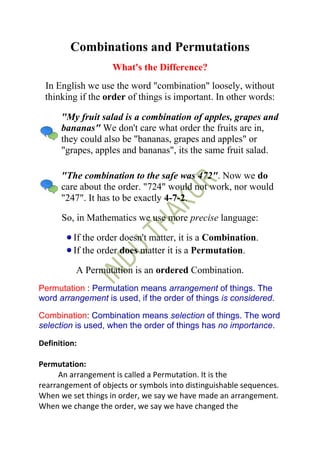
The document discusses the key differences between combinations and permutations. A combination is an unordered selection of objects, while a permutation is an ordered selection where the order matters. Some key points made include:
- A combination does not consider the order of selected objects, while a permutation does.
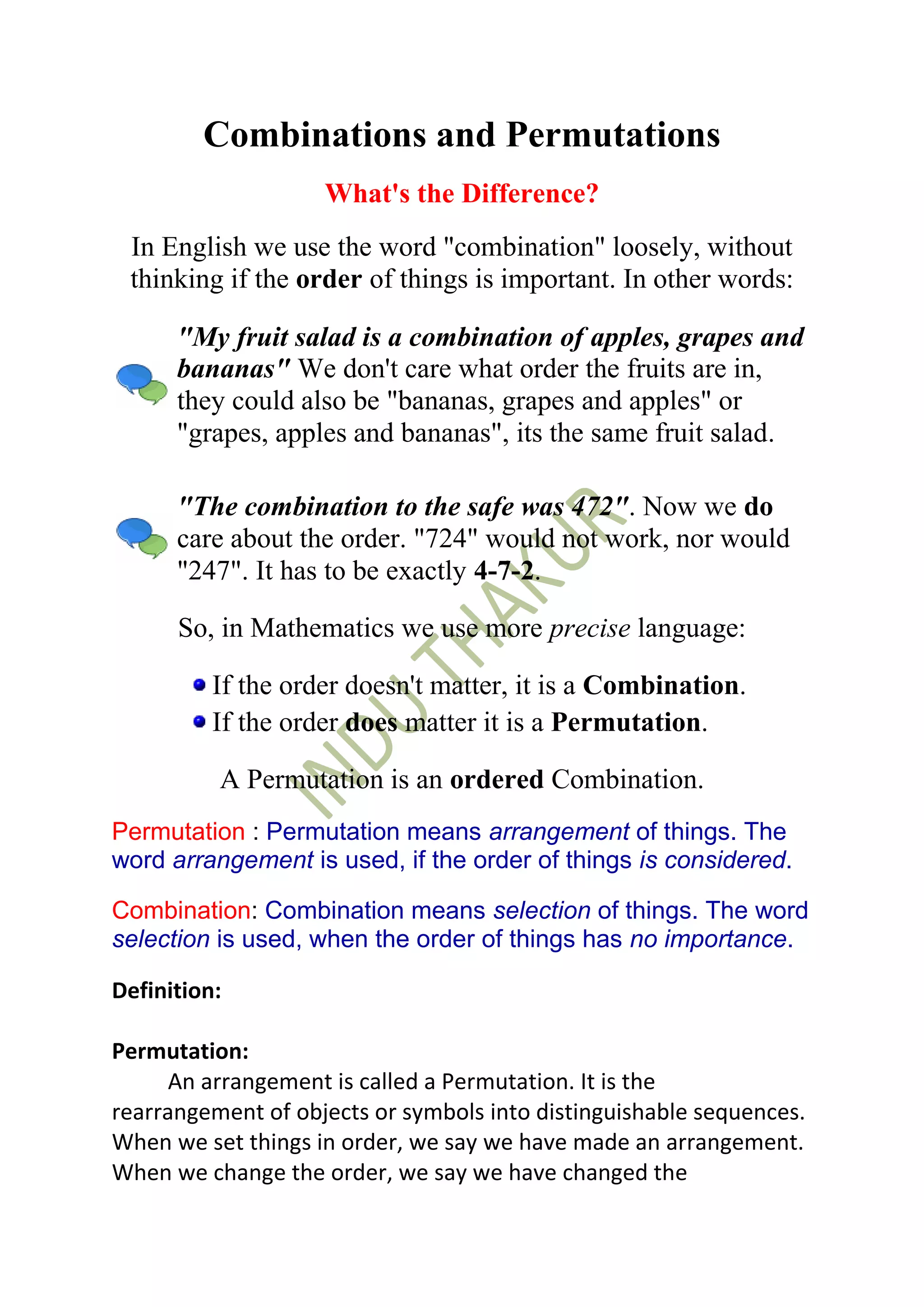
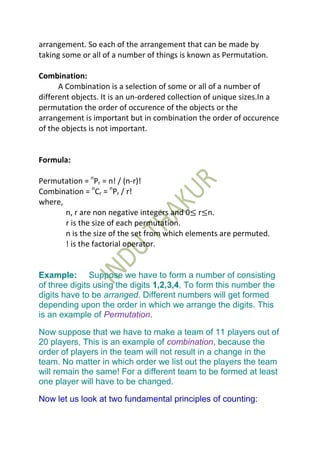
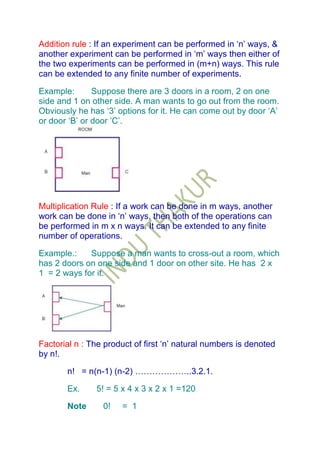
- The number of permutations of n objects taken r at a time is written as nPr and is calculated as n!/(n-r)!, while the number of combinations is written as nCr and is calculated as nPr/r!.
- Examples are given to illustrate the differences, such as forming a number using digits versus selecting players for a team where order does not matter.
- Formulas are provided
![Proof n! =n, (n-1)!
Or (n-1)! = [n x (n-1)!]/n = n! /n
Putting n = 1, we have
O! = 1!/1 = 1
Permutation
Number of permutations of „n‟ different things taken „r‟ at a
time is given by:-
n
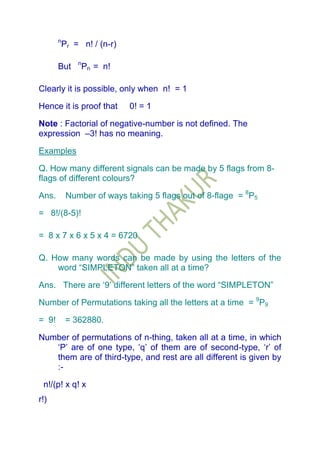
Pr = n!/(n-r)!
Proof: Say we have „n‟ different things a1, a2……, an.
Clearly the first place can be filled up in „n‟ ways. Number of
things left after filling-up the first place = n-1
So the second-place can be filled-up in (n-1) ways. Now
number of things left after filling-up the first and second
places = n - 2
Now the third place can be filled-up in (n-2) ways.
Thus number of ways of filling-up first-place = n
Number of ways of filling-up second-place = n-1
Number of ways of filling-up third-place = n-2
Number of ways of filling-up r-th place = n – (r-1) = n-r+1
By multiplication – rule of counting, total no. of ways of filling
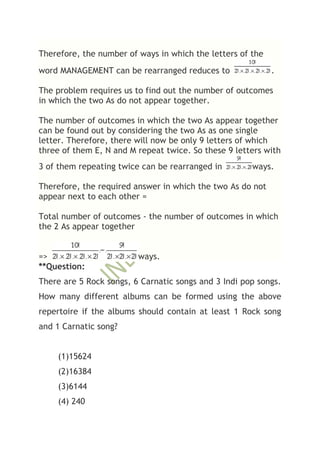
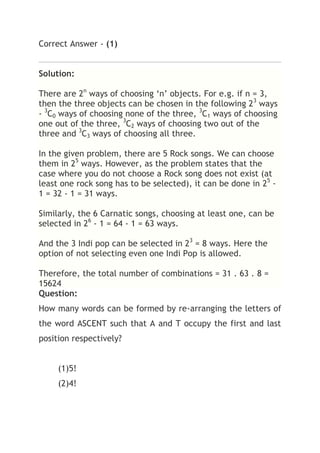
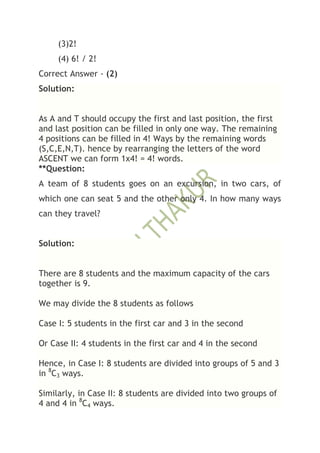
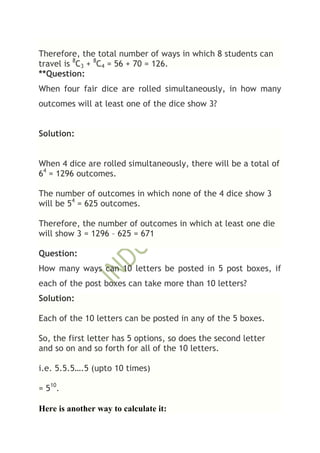
up, first, second -- rth-place together :-](https://image.slidesharecdn.com/combinationsandpermutations-110831022221-phpapp01/85/Combinations-and-permutations-4-320.jpg)
![n (n-1) (n-2) ------------ (n-r+1)
Hence:
n
Pr = n (n-1)(n-2) --------------(n-r+1)
= [n(n-1)(n-2)----------(n-r+1)] [(n-r)(n-r-1)-----3.2.1.] / [(n-r)(n-r-
1)] ----3.2.1
n
Pr = n!/(n-r)!
Number of permutations of „n‟ different things taken all at a
time is given by:-
n
Pn = n!
Proof :
Now we have „n‟ objects, and n-places.
Number of ways of filling-up first-place = n
Number of ways of filling-up second-place = n-1
Number of ways of filling-up third-place = n-2
Number of ways of filling-up r-th place, i.e. last place =1
Number of ways of filling-up first, second, --- n th place
= n (n-1) (n-2) ------ 2.1.
n
Pn = n!
Concept.
n
We have Pr = n!/n-r
Putting r = n, we have :-](https://image.slidesharecdn.com/combinationsandpermutations-110831022221-phpapp01/85/Combinations-and-permutations-5-320.jpg)
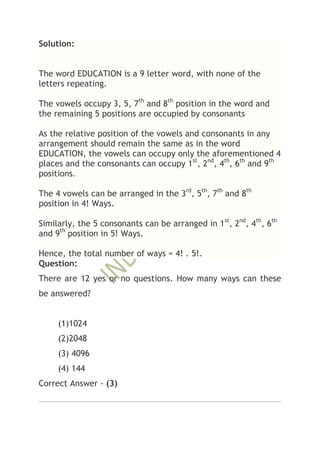
![(iv) Number of ways of selecting zero or more things from „n‟
identical things is given by :- n+1
Example: In how many ways, can zero or more letters be
selected form the letters AAAAA?
Ans. Number of ways of :
Selecting zero 'A's = 1
Selecting one 'A's = 1
Selecting two 'A's =1
Selecting three 'A's = 1
Selecting four 'A's = 1
Selecting five 'A's = 1
=> Required number of ways = 6 [5+1]
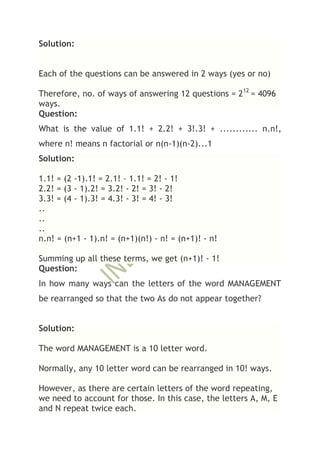
(V) Number of ways of selecting one or more things from „p‟
identical things of one type „q‟ identical things of another
type, „r‟ identical things of the third type and „n‟ different
things is given by :-
(p+1) (q+1) (r+1)2n – 1](https://image.slidesharecdn.com/combinationsandpermutations-110831022221-phpapp01/85/Combinations-and-permutations-8-320.jpg)
![Ans. Here n = 5 [Number of digits]
And r = 4 [ Number of places to be filled-up]
5
Required number is P4 = 5!/1! = 5 x 4 x 3 x 2 x 1
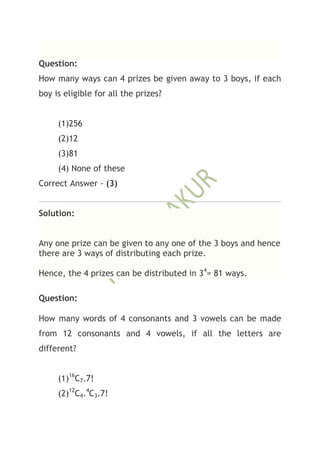
Example: A child has 3 pocket and 4 coins. In how many
ways can he put the coins in his pocket.
Ans. First coin can be put in 3 ways, similarly second, third
and forth coins also can be put in 3 ways.
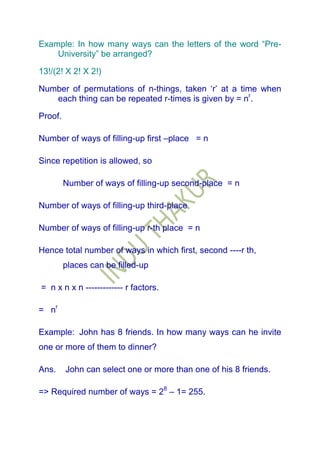
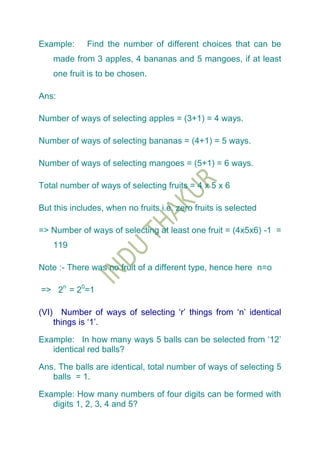
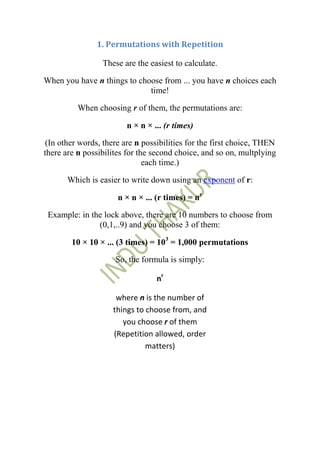
So total number of ways = 3 x 3 x 3 x 3 = 34 = 81
So, we should really call this a "Permutation
Lock"!
Permutations
There are basically two types of permutation:
1. Repetition is Allowed: such as the lock above. It could be
"333".
2. No Repetition: for example the first three people in a running
race. You can't be first and second.](https://image.slidesharecdn.com/combinationsandpermutations-110831022221-phpapp01/85/Combinations-and-permutations-10-320.jpg)
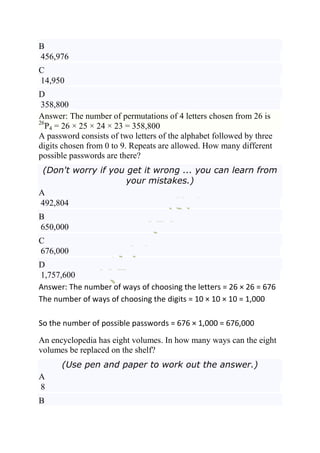
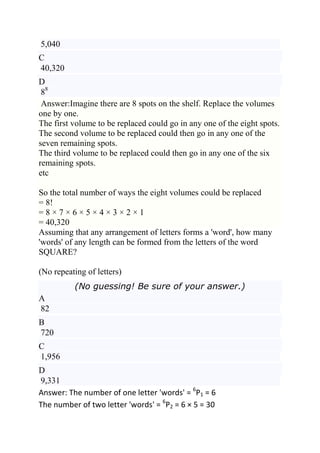
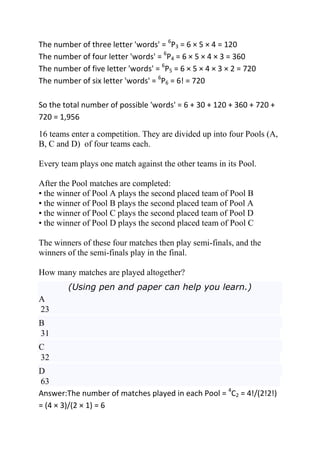
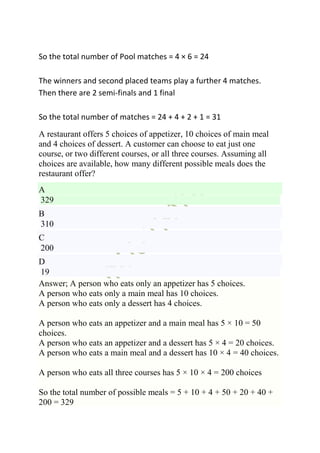
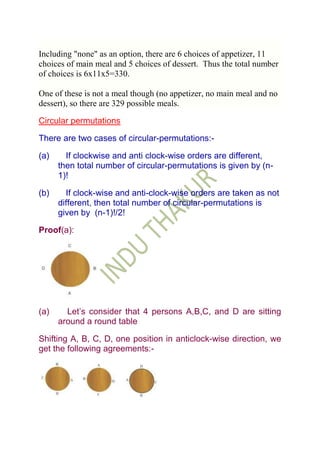
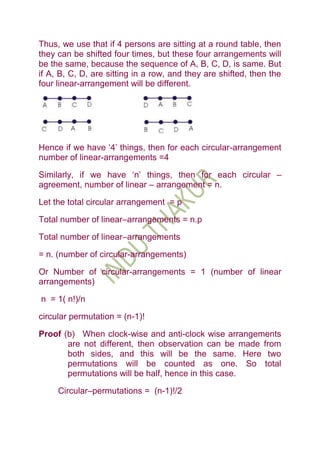
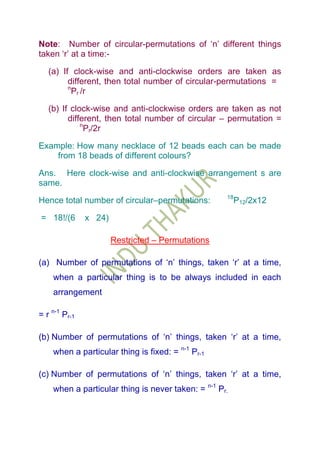
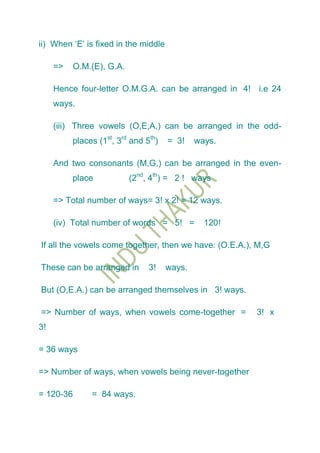
![(d) Number of permutations of „n‟ things, taken „r‟ at a time,
when „m‟ specified things always come together = m! x ( n-
m+1) !
(e) Number of permutations of „n‟ things, taken all at a time,
when „m‟ specified things always come together = n ! - [ m!
x (n-m+1)! ]
Example: How many words can be formed with the letters of
the word „OMEGA‟ when:
(i) „O‟ and „A‟ occupying end places.
(ii) „E‟ being always in the middle
(iii) Vowels occupying odd-places
(iv) Vowels being never together.
Ans.
(i) When „O‟ and „A‟ occupying end-places
=> M.E.G. (OA)
Here (OA) are fixed, hence M, E, G can be arranged in 3!
ways
But (O,A) can be arranged themselves is 2! ways.
=> Total number of words = 3! x 2! = 12 ways.](https://image.slidesharecdn.com/combinationsandpermutations-110831022221-phpapp01/85/Combinations-and-permutations-31-320.jpg)
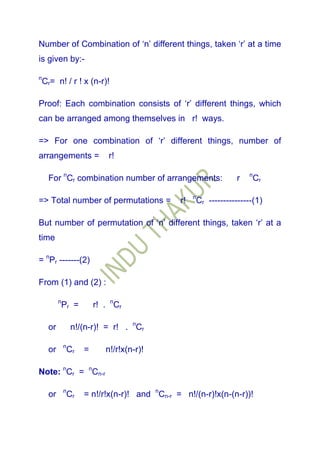
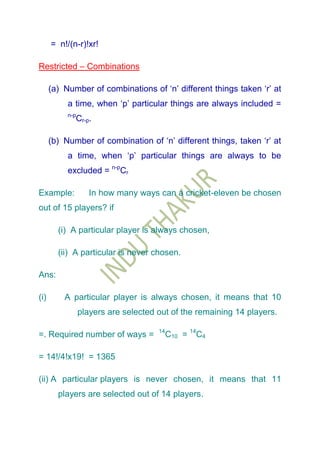
![14
=> Required number of ways = C11
= 14!/11!x3! = 364
(iii) Number of ways of selecting zero or more things from „n‟
different things is given by:- 2n-1
Proof: Number of ways of selecting one thing, out of n-things
= nC1
Number of selecting two things, out of n-things =nC2
Number of ways of selecting three things, out of n-things =nC3
Number of ways of selecting „n‟ things out of „n‟ things = nCn
=>Total number of ways of selecting one or more things out of
n different things
= nC1 + nC2 + nC3 + ------------- + nCn
= (nC0 + nC1 + -----------------nCn) - nC0
= 2n – 1 [ nC0=1]
1. Examples:
1. Suppose we want to select two out of three boys A, B, C.
Then, possible selections are AB, BC and CA.
Note: AB and BA represent the same selection.
2. All the combinations formed by a, b, c taking ab, bc, ca.
3. The only combination that can be formed of three letters a,
b, c taken all at a time is abc.](https://image.slidesharecdn.com/combinationsandpermutations-110831022221-phpapp01/85/Combinations-and-permutations-35-320.jpg)
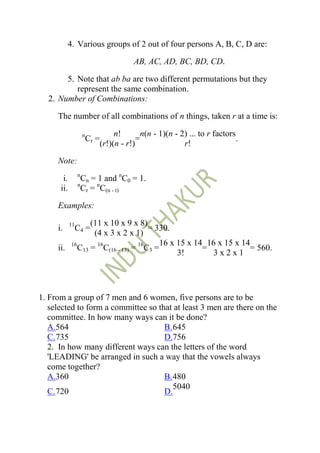
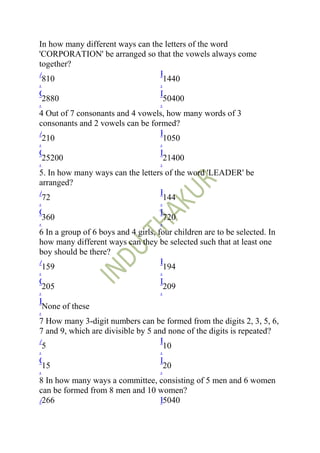
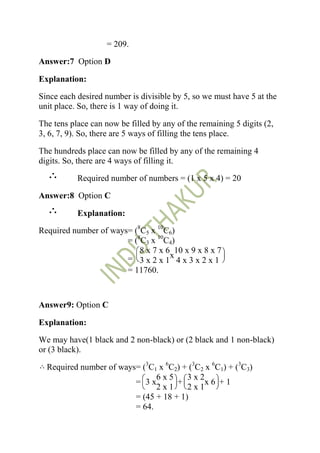
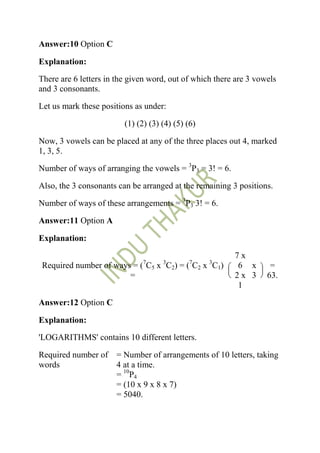
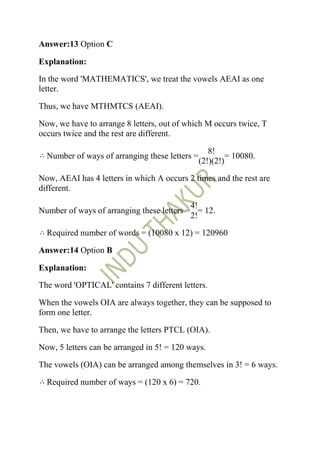
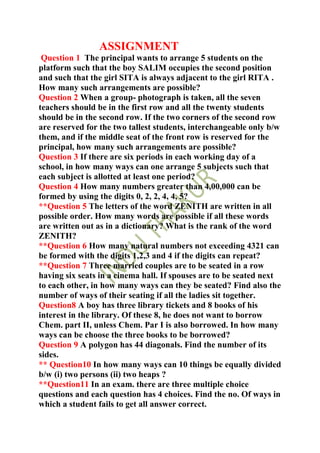
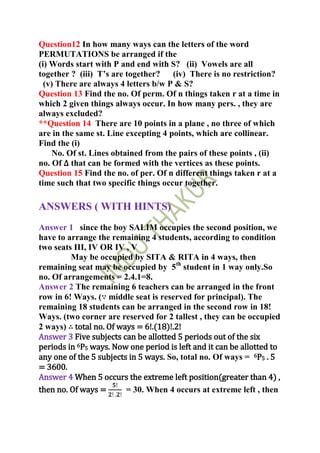
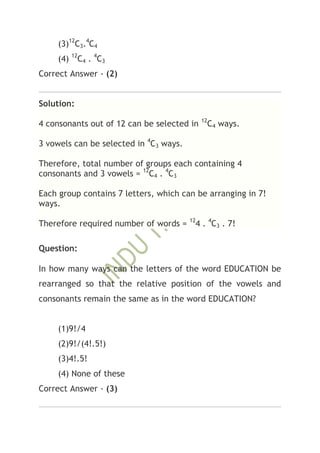
![no. Of ways = 5!/2!=60 ( 0,2,2,4,5[2 appears twice]) ∴ total no. Of
ways 90.
Answer 5 (i) total no. Of possible words = 6!=720
(ii) The no. Of words beginning with E = 5! = 120 , similarly for
H ,I, N or T is 120.
The words start with Z will also be 120 and will have their
rank from 601 to 720.Of these 120 words start with Z, the no. Of
words with E in the second place is 120/5 = 24. ZE**** will have
their rank from 601 to 624. Of these 24 words , NO. Of words
with H(or I or N or T) in the third place is 24/2=6
Rank order : ZEH*** , ZEI***, ZEN*** 601 to 606, 607 to
612, 613 to 618 resp., start with ZEN are 613...ZENHIT, 614...
ZENHTI, 615... ZENIHT,
616... ZENITH.
Answer 6 1- digit nos. = 4, 2-digit nos. = 4x16, 3-digit nos. = 64,
4-digit nos. 256. Out of 256 , let us discard those which are greater
than 4321.
(i) 4 at thousand’s place & hundred’s place= 1.1.4.4=16 ,
4 4 1 1
2 2
3 3
4 4
Similarly (ii) 4 at thousand’s place ,3 at hundred’s place, 3 or 4 in
ten’s = 1.1.2.4=8,
(iii) 4 at thousand’s place ,3 at hundred’s place, 2 in ten’s & 2,3,4
at unit’s= 1.1.1.3=3. Total 4-digit no.greater than 4321 are = 27,
answer is 256-27=313.
Answer 7(i) Let A, B, C be three married couples can be seated =
3! & can sit in 2 ways =2! ∴ req. Ways of seating = 3!.2!.2!.2!=48 .
(ii) three ladies can be seated in 4 ways which are at seat
number (1,2,3), (2,3,4), (3,4,5), (4,5,6). They can interchange their
seats =3! Ways. Men can be seated at three remaining seats in 3! ,
so req. No. Of ways = 4.3!.3!= 144 .
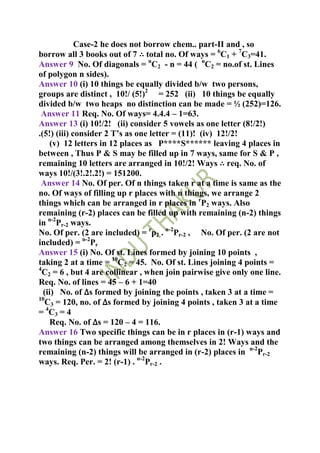
Answer 8 case-1 he borrows chem.. part II, chem.. part I and one
more book out of the remaining 6 (8-2) books.](https://image.slidesharecdn.com/combinationsandpermutations-110831022221-phpapp01/85/Combinations-and-permutations-47-320.jpg)



![SETS [Algebra]](https://cdn.slidesharecdn.com/ss_thumbnails/sets-stdixppt-140421034609-phpapp01-thumbnail.jpg?width=640&height=640&fit=bounds)


![Arithmetic sequences and series[1]](https://cdn.slidesharecdn.com/ss_thumbnails/arithmeticsequencesandseries1-110831022502-phpapp01-thumbnail.jpg?width=640&height=640&fit=bounds)


