

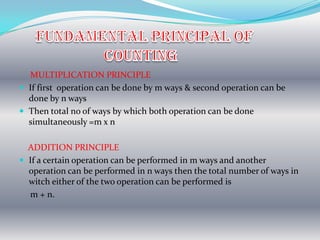



MULTIPLICATION PRINCIPLE
 If first operation can be done by m ways & second operation can be
  done by n ways
 Then total no of ways by which both operation can be done
  simultaneously =m x n

  ADDITION PRINCIPLE
 If a certain operation can be performed in m ways and another
  operation can be performed in n ways then the total number of ways in
  witch either of the two operation can be performed is
  m + n.
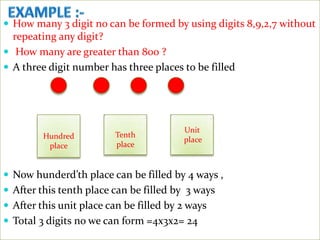
 How many 3 digit no can be formed by using digits 8,9,2,7 without
  repeating any digit?
 How many are greater than 800 ?
 A three digit number has three places to be filled


                                         Unit
         Hundred         Tenth
                                         place
          place          place


 Now hunderd’th place can be filled by 4 ways ,
 After this tenth place can be filled by 3 ways
 After this unit place can be filled by 2 ways
 Total 3 digits no we can form =4x3x2= 24
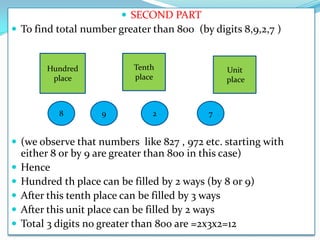
 SECOND PART
 To find total number greater than 800 (by digits 8,9,2,7 )


         Hundred             Tenth               Unit
          place              place               place


            8         9          2           7


 (we observe that numbers like 827 , 972 etc. starting with
    either 8 or by 9 are greater than 800 in this case)
   Hence
   Hundred th place can be filled by 2 ways (by 8 or 9)
   After this tenth place can be filled by 3 ways
   After this unit place can be filled by 2 ways
   Total 3 digits no greater than 800 are =2x3x2=12
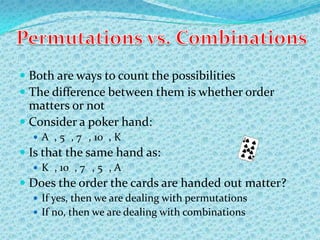
 Both are ways to count the possibilities
 The difference between them is whether order
  matters or not
 Consider a poker hand:
   A , 5 , 7 , 10 , K
 Is that the same hand as:
   K , 10 , 7 , 5 , A
 Does the order the cards are handed out matter?
   If yes, then we are dealing with permutations
   If no, then we are dealing with combinations
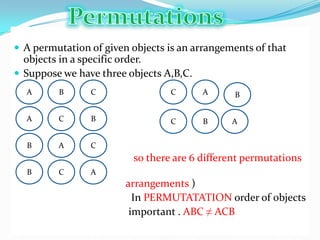
 A permutation of given objects is an arrangements of that
  objects in a specific order.
 Suppose we have three objects A,B,C.
  A      B      C                C       A     B


  A      C      B                C       B     A


  B      A      C
                         so there are 6 different permutations
  (or
   B     C      A
                        arrangements )
                          In PERMUTATATION order of objects
                         important . ABC ≠ ACB
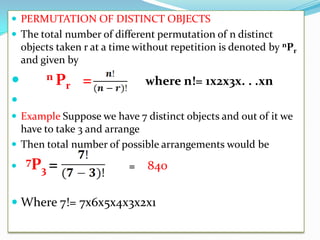
 PERMUTATION OF DISTINCT OBJECTS
 The total number of different permutation of n distinct
    objects taken r at a time without repetition is denoted by nPr
    and given by

        nP      =              where n!= 1x2x3x. . .xn
           r

 Example Suppose we have 7 distinct objects and out of it we
  have to take 3 and arrange
 Then total number of possible arrangements would be

 7P3 =                     =   840

 Where 7!= 7x6x5x4x3x2x1
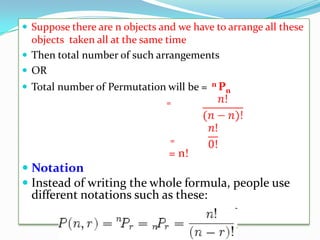
 Suppose there are n objects and we have to arrange all these
  objects taken all at the same time
 Then total number of such arrangements
 OR
 Total number of Permutation will be =   nP
                                            n
                               =


                                =
                                = n!
 Notation
 Instead of writing the whole formula, people use
  different notations such as these:
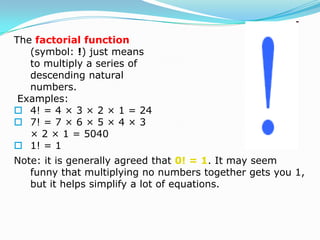
The factorial function
   (symbol: !) just means
   to multiply a series of
   descending natural
   numbers.
 Examples:
 4! = 4 × 3 × 2 × 1 = 24
 7! = 7 × 6 × 5 × 4 × 3
   × 2 × 1 = 5040
 1! = 1
Note: it is generally agreed that 0! = 1. It may seem
   funny that multiplying no numbers together gets you 1,
   but it helps simplify a lot of equations.
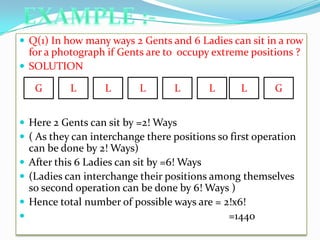
 Q(1) In how many ways 2 Gents and 6 Ladies can sit in a row
  for a photograph if Gents are to occupy extreme positions ?
 SOLUTION

     G      L       L      L      L       L      L       G


 Here 2 Gents can sit by =2! Ways
 ( As they can interchange there positions so first operation
    can be done by 2! Ways)
   After this 6 Ladies can sit by =6! Ways
   (Ladies can interchange their positions among themselves
    so second operation can be done by 6! Ways )
   Hence total number of possible ways are = 2!x6!
                                              =1440
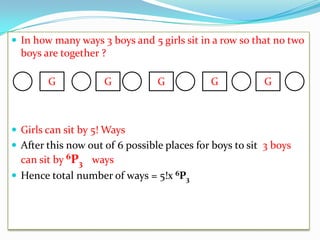
 In how many ways 3 boys and 5 girls sit in a row so that no two
  boys are together ?

        G            G           G           G           G


 Girls can sit by 5! Ways
 After this now out of 6 possible places for boys to sit 3 boys
  can sit by 6P3 ways
 Hence total number of ways = 5!x 6P3
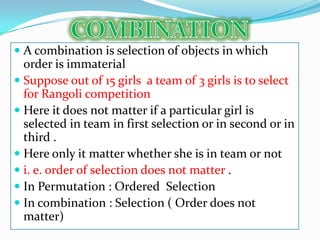
 A combination is selection of objects in which
  order is immaterial
 Suppose out of 15 girls a team of 3 girls is to select
  for Rangoli competition
 Here it does not matter if a particular girl is
  selected in team in first selection or in second or in
  third .
 Here only it matter whether she is in team or not
 i. e. order of selection does not matter .
 In Permutation : Ordered Selection
 In combination : Selection ( Order does not
  matter)
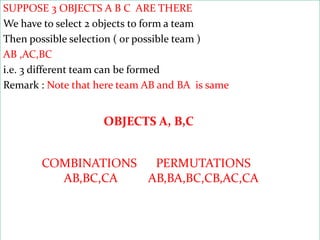
SUPPOSE 3 OBJECTS A B C ARE THERE
We have to select 2 objects to form a team
Then possible selection ( or possible team )
AB ,AC,BC
i.e. 3 different team can be formed
Remark : Note that here team AB and BA is same


                    OBJECTS A, B,C


       COMBINATIONS  PERMUTATIONS
         AB,BC,CA   AB,BA,BC,CB,AC,CA
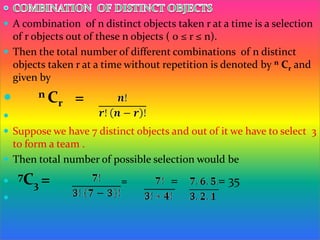
 A combination of n distinct objects taken r at a time is a selection
  of r objects out of these n objects ( 0 ≤ r ≤ n).
 Then the total number of different combinations of n distinct
  objects taken r at a time without repetition is denoted by n Cr and
  given by

      nC
         r      =

 Suppose we have 7 distinct objects and out of it we have to select 3
  to form a team .
 Then total number of possible selection would be

 7C3 =                   =          =          = 35

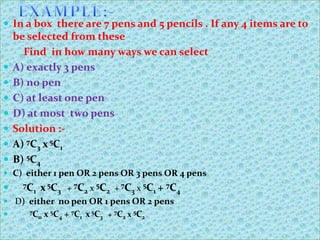
 In a box there are 7 pens and 5 pencils . If any 4 items are to
    be selected from these
      Find in how many ways we can select
   A) exactly 3 pens
   B) no pen
   C) at least one pen
   D) at most two pens
   Solution :-
   A) 7C3 x 5C1
   B) 5C4
 C) either 1 pen OR 2 pens OR 3 pens OR 4 pens
    7C
       1   x 5C3 + 7C2 x 5C2 + 7C3 x 5C1 + 7C4
 D) either no pen OR 1 pens OR 2 pens
      7C    x 5C4 + 7C1 x 5C3 + 7C2 x 5C2
         0
Permutations and-combinations-maths

Permutations and-combinations-maths

  • 4.
    MULTIPLICATION PRINCIPLE  Iffirst operation can be done by m ways & second operation can be done by n ways  Then total no of ways by which both operation can be done simultaneously =m x n ADDITION PRINCIPLE  If a certain operation can be performed in m ways and another operation can be performed in n ways then the total number of ways in witch either of the two operation can be performed is m + n.
  • 5.
     How many3 digit no can be formed by using digits 8,9,2,7 without repeating any digit?  How many are greater than 800 ?  A three digit number has three places to be filled Unit Hundred Tenth place place place  Now hunderd’th place can be filled by 4 ways ,  After this tenth place can be filled by 3 ways  After this unit place can be filled by 2 ways  Total 3 digits no we can form =4x3x2= 24
  • 6.
     SECOND PART To find total number greater than 800 (by digits 8,9,2,7 ) Hundred Tenth Unit place place place 8 9 2 7  (we observe that numbers like 827 , 972 etc. starting with either 8 or by 9 are greater than 800 in this case)  Hence  Hundred th place can be filled by 2 ways (by 8 or 9)  After this tenth place can be filled by 3 ways  After this unit place can be filled by 2 ways  Total 3 digits no greater than 800 are =2x3x2=12
  • 7.
     Both areways to count the possibilities  The difference between them is whether order matters or not  Consider a poker hand:  A , 5 , 7 , 10 , K  Is that the same hand as:  K , 10 , 7 , 5 , A  Does the order the cards are handed out matter?  If yes, then we are dealing with permutations  If no, then we are dealing with combinations
  • 9.
     A permutationof given objects is an arrangements of that objects in a specific order.  Suppose we have three objects A,B,C. A B C C A B A C B C B A B A C so there are 6 different permutations (or B C A arrangements ) In PERMUTATATION order of objects important . ABC ≠ ACB
  • 10.
     PERMUTATION OFDISTINCT OBJECTS  The total number of different permutation of n distinct objects taken r at a time without repetition is denoted by nPr and given by  nP = where n!= 1x2x3x. . .xn r   Example Suppose we have 7 distinct objects and out of it we have to take 3 and arrange  Then total number of possible arrangements would be  7P3 = = 840  Where 7!= 7x6x5x4x3x2x1
  • 11.
     Suppose thereare n objects and we have to arrange all these objects taken all at the same time  Then total number of such arrangements  OR  Total number of Permutation will be = nP n = = = n!  Notation  Instead of writing the whole formula, people use different notations such as these:
  • 12.
    The factorial function (symbol: !) just means to multiply a series of descending natural numbers. Examples:  4! = 4 × 3 × 2 × 1 = 24  7! = 7 × 6 × 5 × 4 × 3 × 2 × 1 = 5040  1! = 1 Note: it is generally agreed that 0! = 1. It may seem funny that multiplying no numbers together gets you 1, but it helps simplify a lot of equations.
  • 13.
     Q(1) Inhow many ways 2 Gents and 6 Ladies can sit in a row for a photograph if Gents are to occupy extreme positions ?  SOLUTION G L L L L L L G  Here 2 Gents can sit by =2! Ways  ( As they can interchange there positions so first operation can be done by 2! Ways)  After this 6 Ladies can sit by =6! Ways  (Ladies can interchange their positions among themselves so second operation can be done by 6! Ways )  Hence total number of possible ways are = 2!x6!  =1440
  • 14.
     In howmany ways 3 boys and 5 girls sit in a row so that no two boys are together ? G G G G G  Girls can sit by 5! Ways  After this now out of 6 possible places for boys to sit 3 boys can sit by 6P3 ways  Hence total number of ways = 5!x 6P3
  • 16.
     A combinationis selection of objects in which order is immaterial  Suppose out of 15 girls a team of 3 girls is to select for Rangoli competition  Here it does not matter if a particular girl is selected in team in first selection or in second or in third .  Here only it matter whether she is in team or not  i. e. order of selection does not matter .  In Permutation : Ordered Selection  In combination : Selection ( Order does not matter)
  • 17.
    SUPPOSE 3 OBJECTSA B C ARE THERE We have to select 2 objects to form a team Then possible selection ( or possible team ) AB ,AC,BC i.e. 3 different team can be formed Remark : Note that here team AB and BA is same OBJECTS A, B,C COMBINATIONS PERMUTATIONS AB,BC,CA AB,BA,BC,CB,AC,CA
  • 18.
     A combinationof n distinct objects taken r at a time is a selection of r objects out of these n objects ( 0 ≤ r ≤ n).  Then the total number of different combinations of n distinct objects taken r at a time without repetition is denoted by n Cr and given by  nC r =   Suppose we have 7 distinct objects and out of it we have to select 3 to form a team .  Then total number of possible selection would be  7C3 = = = = 35 
  • 19.
     In abox there are 7 pens and 5 pencils . If any 4 items are to be selected from these Find in how many ways we can select  A) exactly 3 pens  B) no pen  C) at least one pen  D) at most two pens  Solution :-  A) 7C3 x 5C1  B) 5C4  C) either 1 pen OR 2 pens OR 3 pens OR 4 pens  7C 1 x 5C3 + 7C2 x 5C2 + 7C3 x 5C1 + 7C4  D) either no pen OR 1 pens OR 2 pens  7C x 5C4 + 7C1 x 5C3 + 7C2 x 5C2 0