Week 1 3 Homework Examples
MA 221
Statistics for Decision Making
Professor Brent Heard
Not to be copied or linked to
without my permission
Week 1 Homework Examples
• I sometimes put together a presentation on
working a few homework problems.
• This week, I will do problems similar to number
18, 22 and 24.
Number 18
• Number 18 is a basic “Find the range, mean,
variance and standard deviation” type problem.
I will show you how to do one in Minitab easily.
• Please note that I change the numbers so I don’t
give the exact homework problem.
Number 18
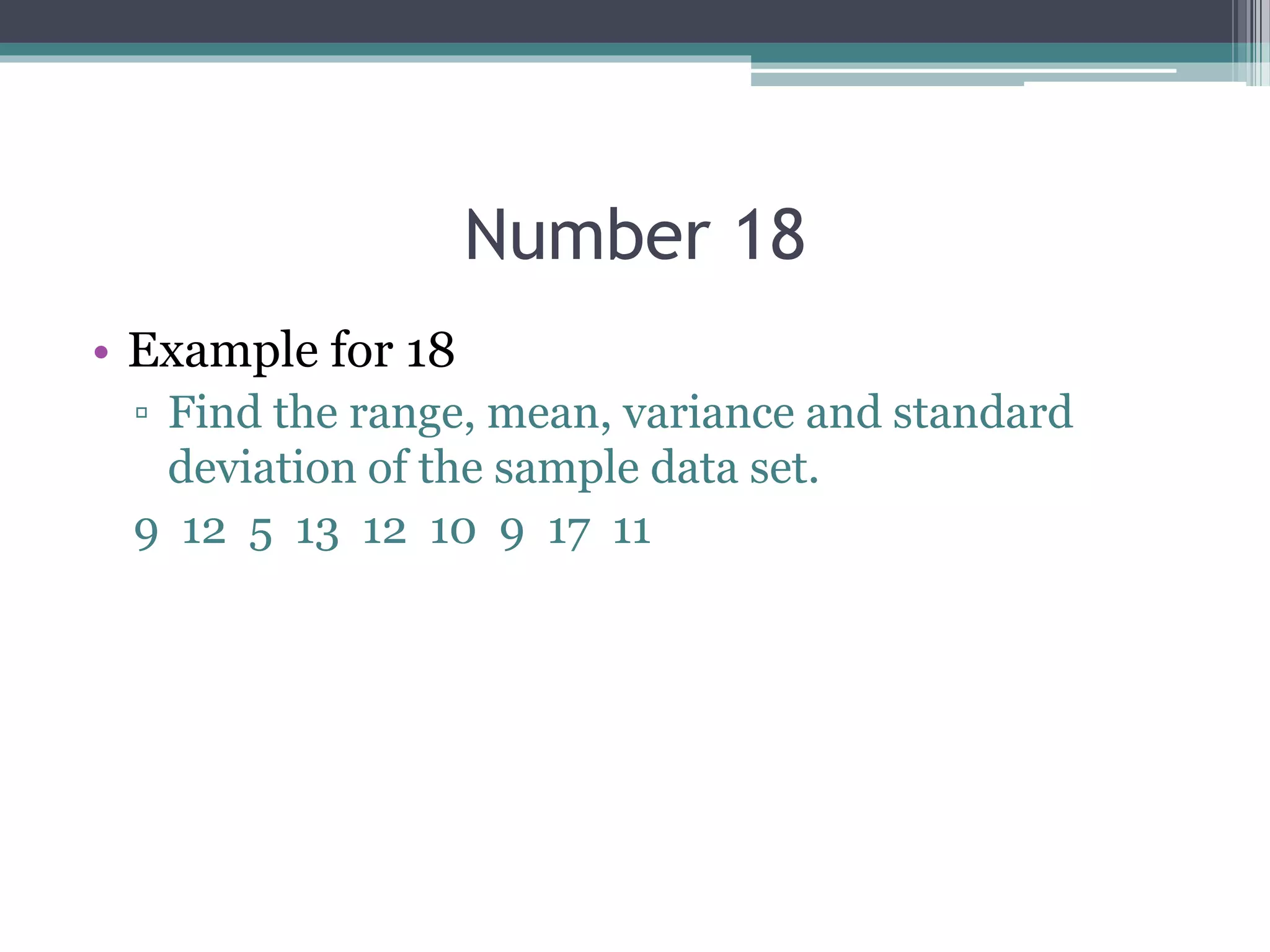
• Example for 18
▫ Find the range, mean, variance and standard
deviation of the sample data set.
9 12 5 13 12 10 9 17 11
Number 18
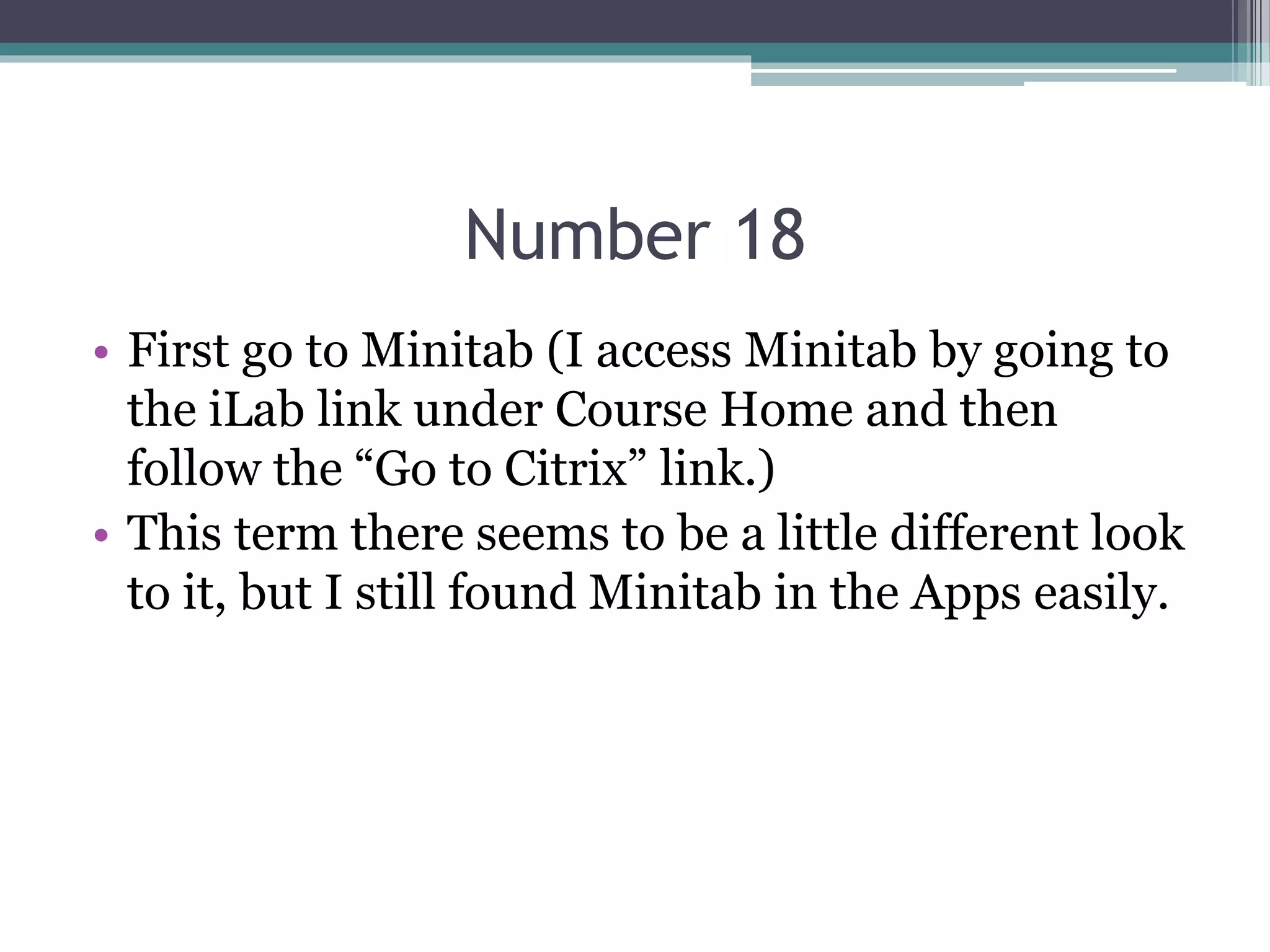
• First go to Minitab (I access Minitab by going to
the iLab link under Course Home and then
follow the “Go to Citrix” link.)
• This term there seems to be a little different look
to it, but I still found Minitab in the Apps easily.
Number 18
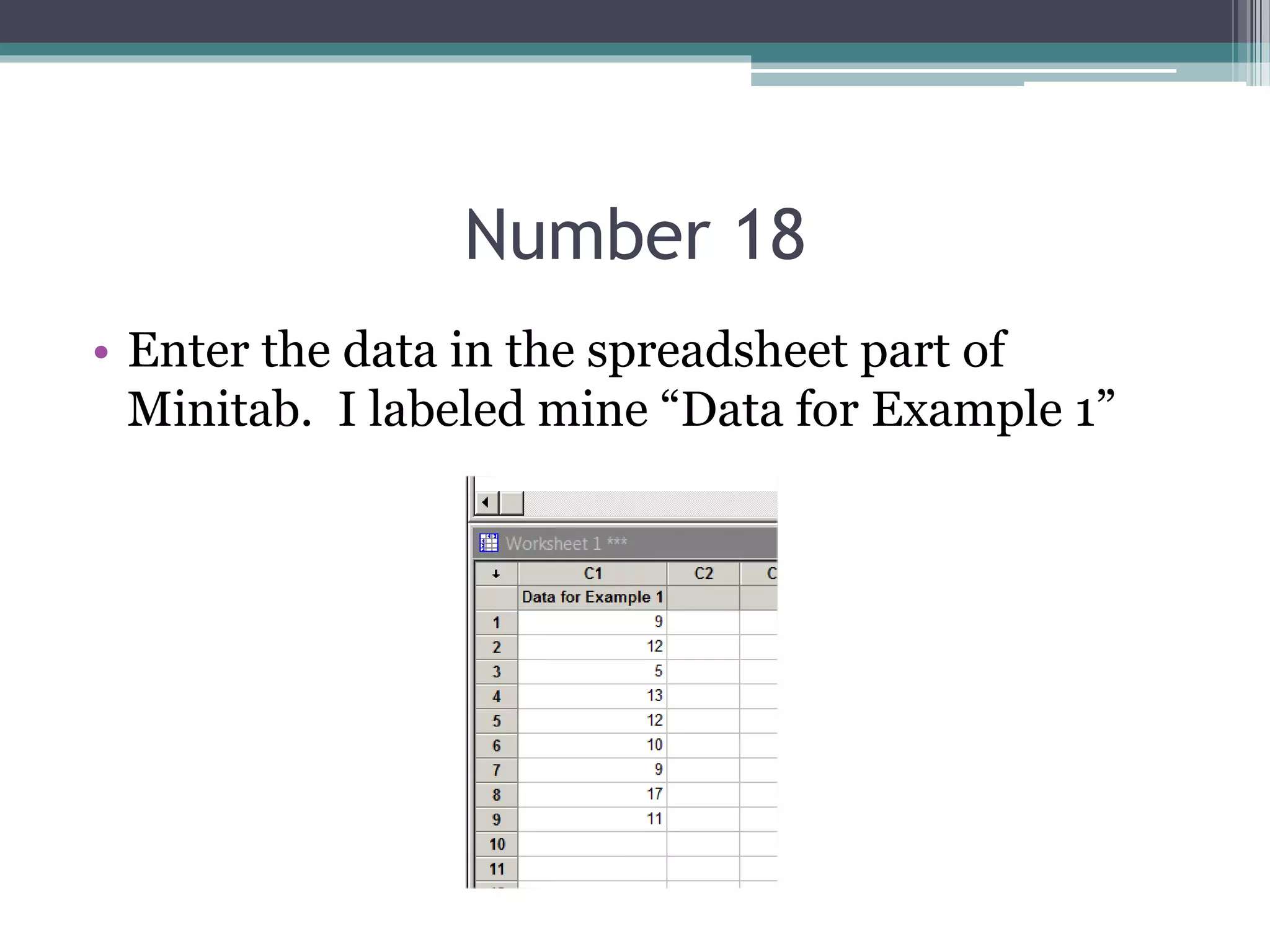
• Enter the data in the spreadsheet part of
Minitab. I labeled mine “Data for Example 1”
Number 18
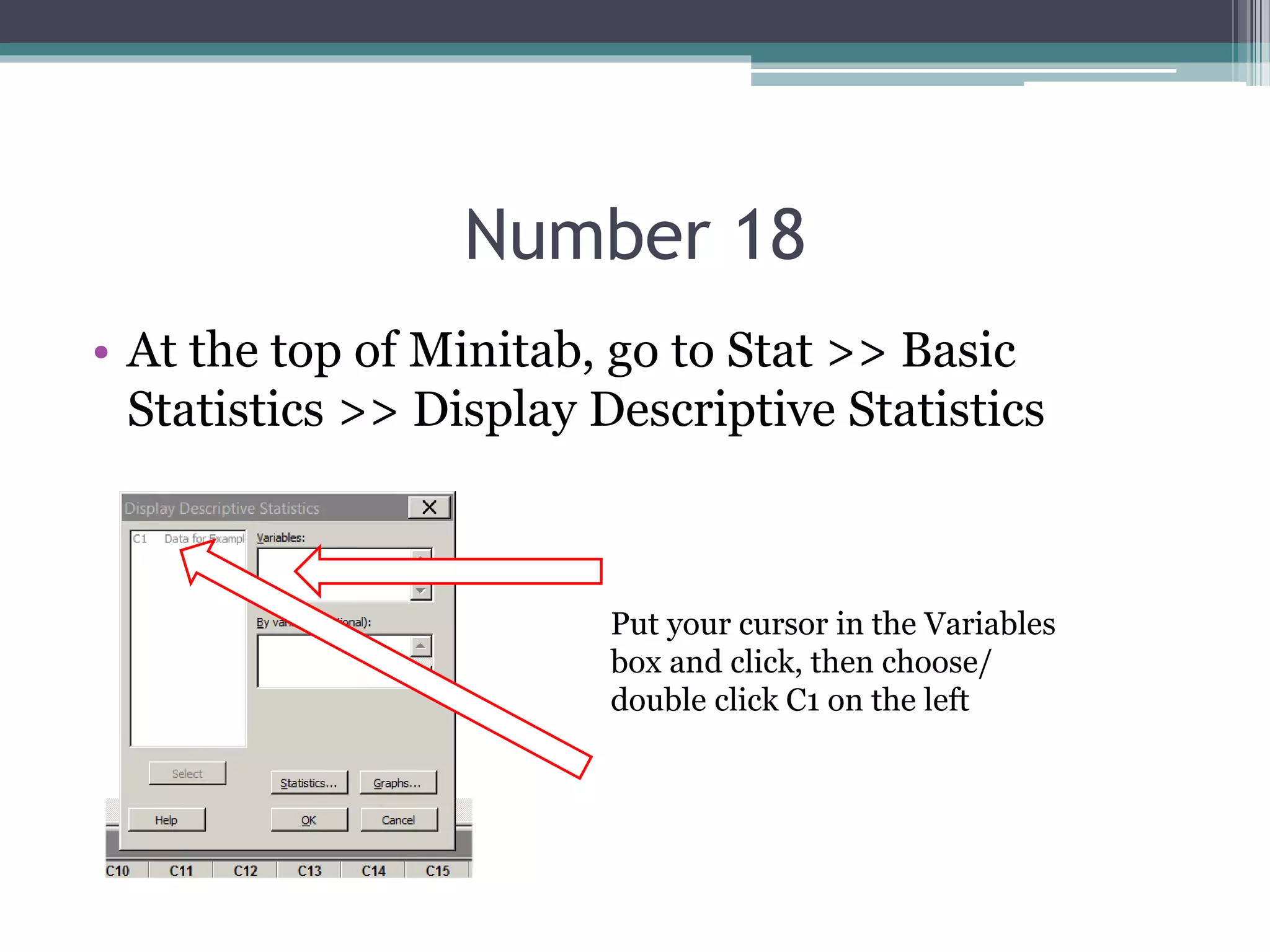
• At the top of Minitab, go to Stat >> Basic
Statistics >> Display Descriptive Statistics
Put your cursor in the Variables
box and click, then choose/
double click C1 on the left
Number 18
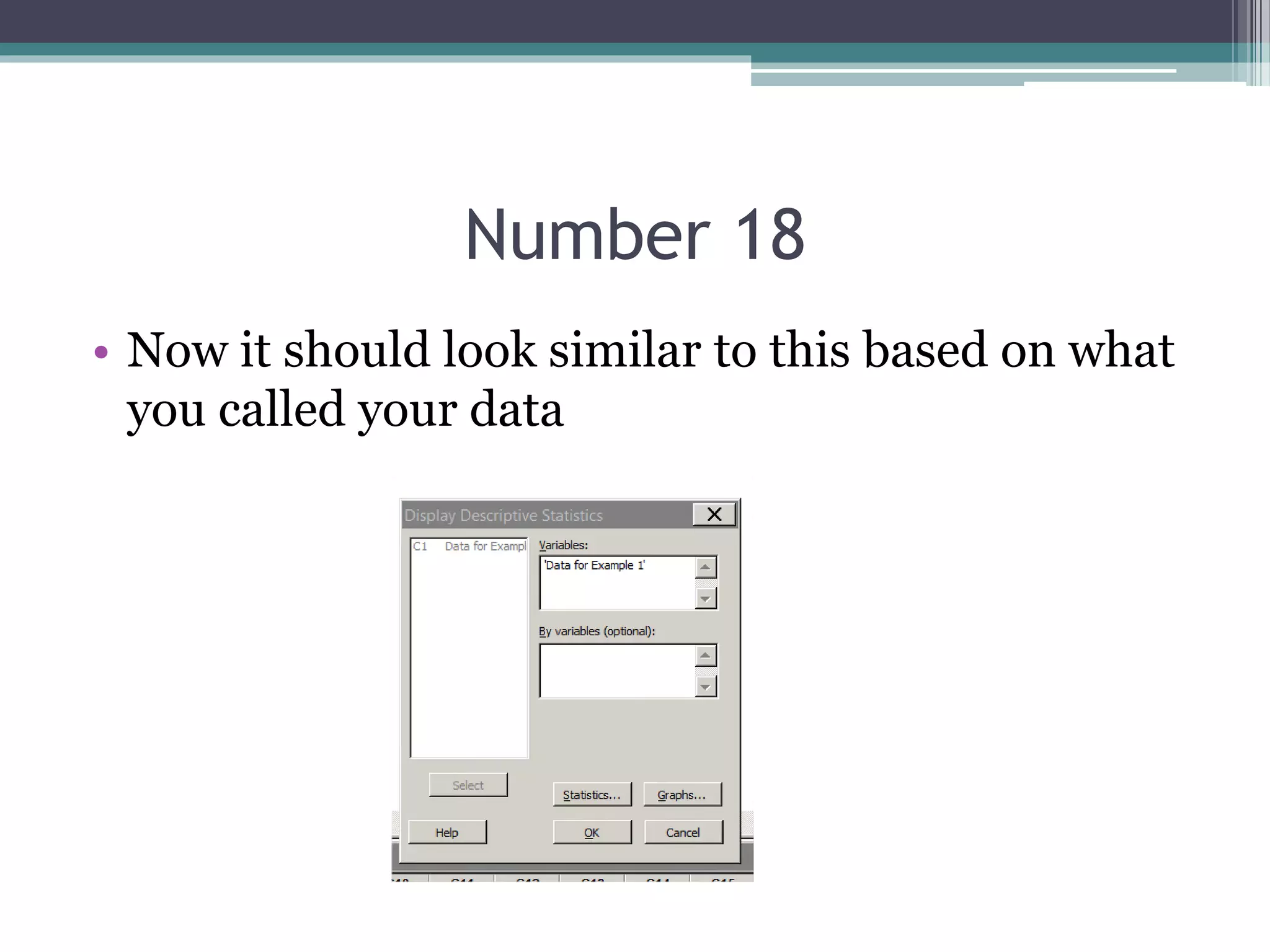
• Now it should look similar to this based on what
you called your data
Number 18
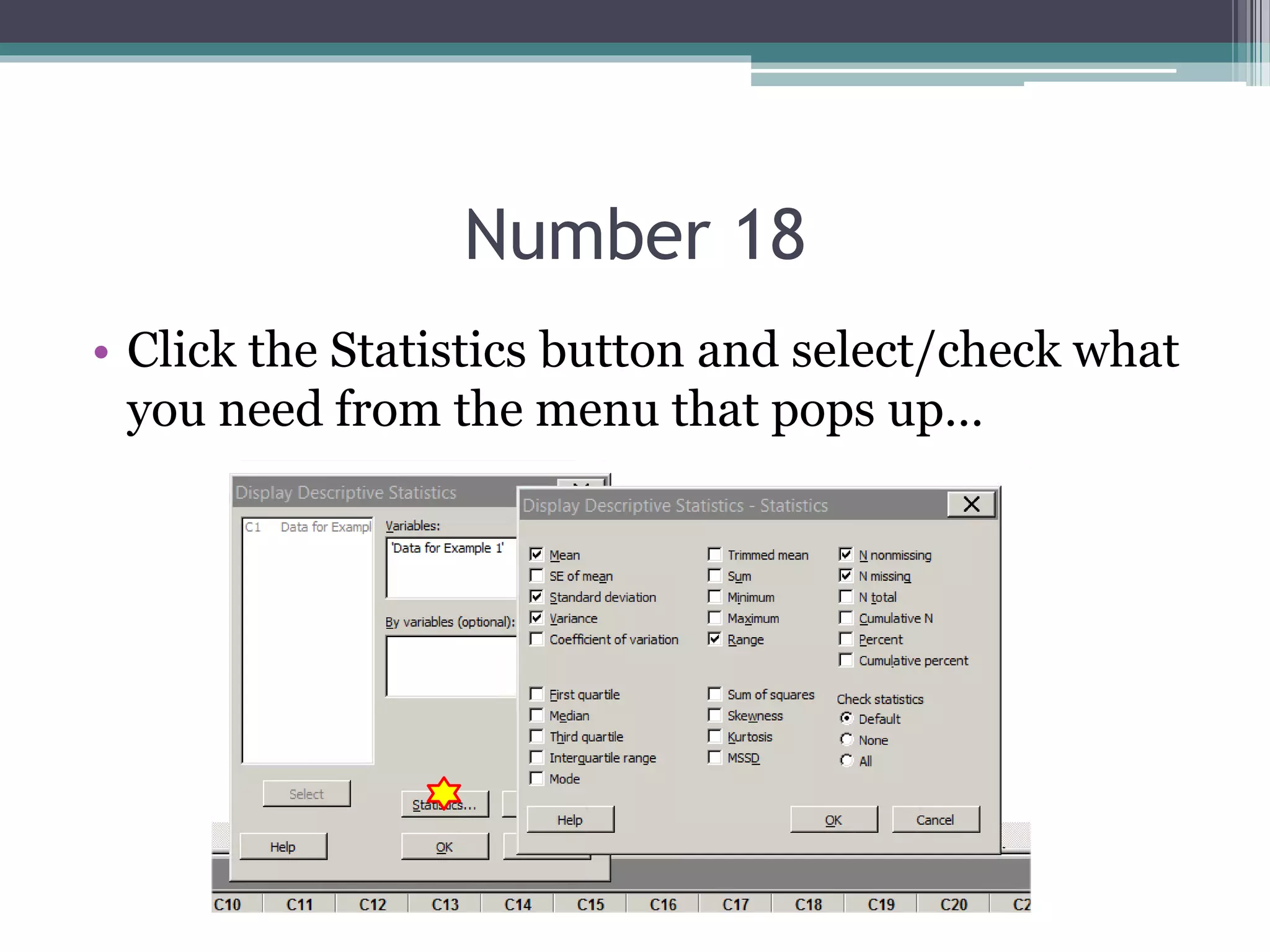
• Click the Statistics button and select/check what
you need from the menu that pops up…
Number 18
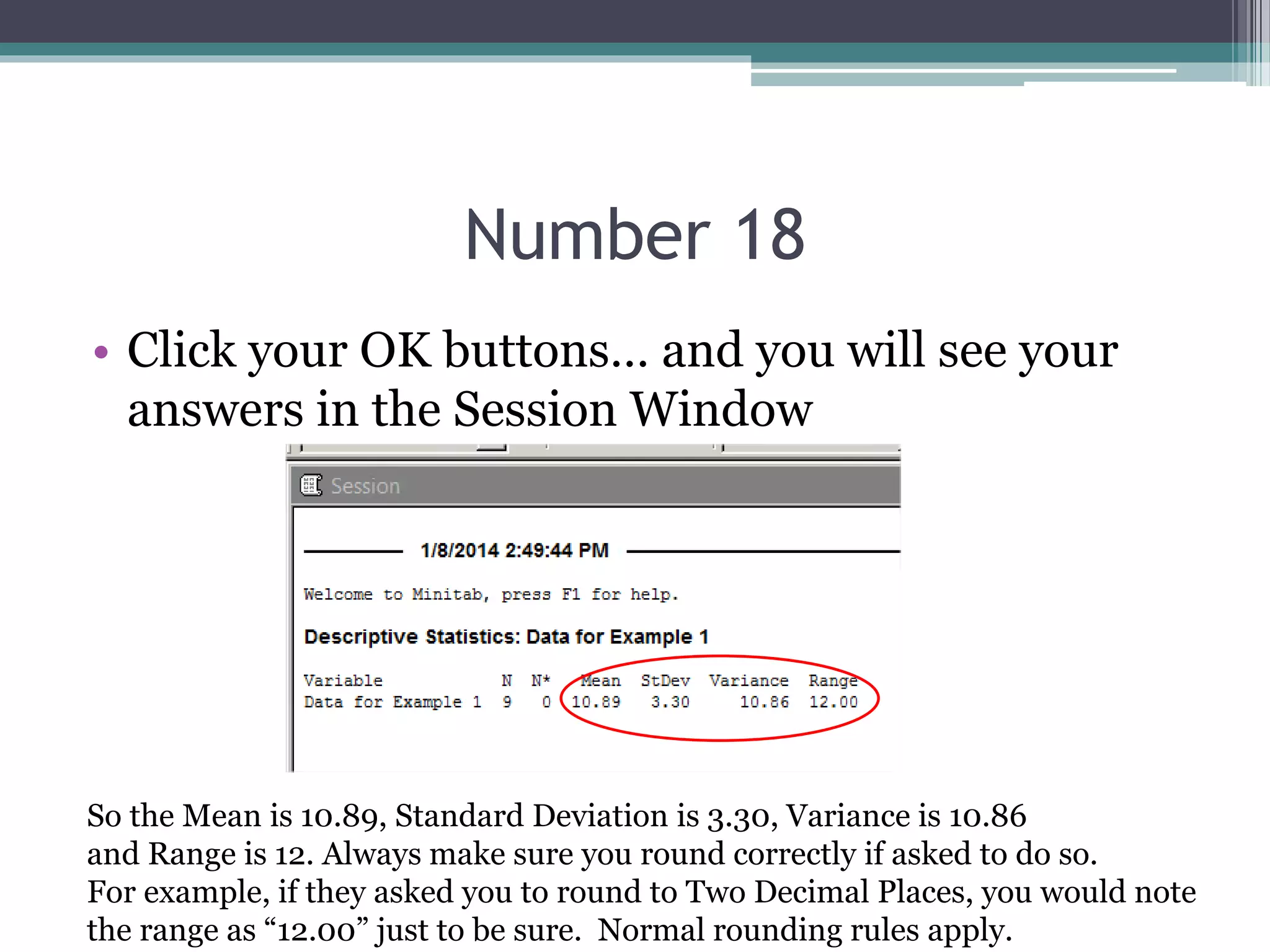
• Click your OK buttons… and you will see your
answers in the Session Window
So the Mean is 10.89, Standard Deviation is 3.30, Variance is 10.86
and Range is 12. Always make sure you round correctly if asked to do so.
For example, if they asked you to round to Two Decimal Places, you would note
the range as “12.00” just to be sure. Normal rounding rules apply.
Number 22
• Number 22 is a box and whisker plot type
problem and is actually very easy.
• By looking at a box and whisker plot, you are
asked to identify (a) the minimum, (b) the
maximum, (c) the first quartile, (d) the second
quartile, (e) the third quartile and (f) the
interquartile range.
Number 22
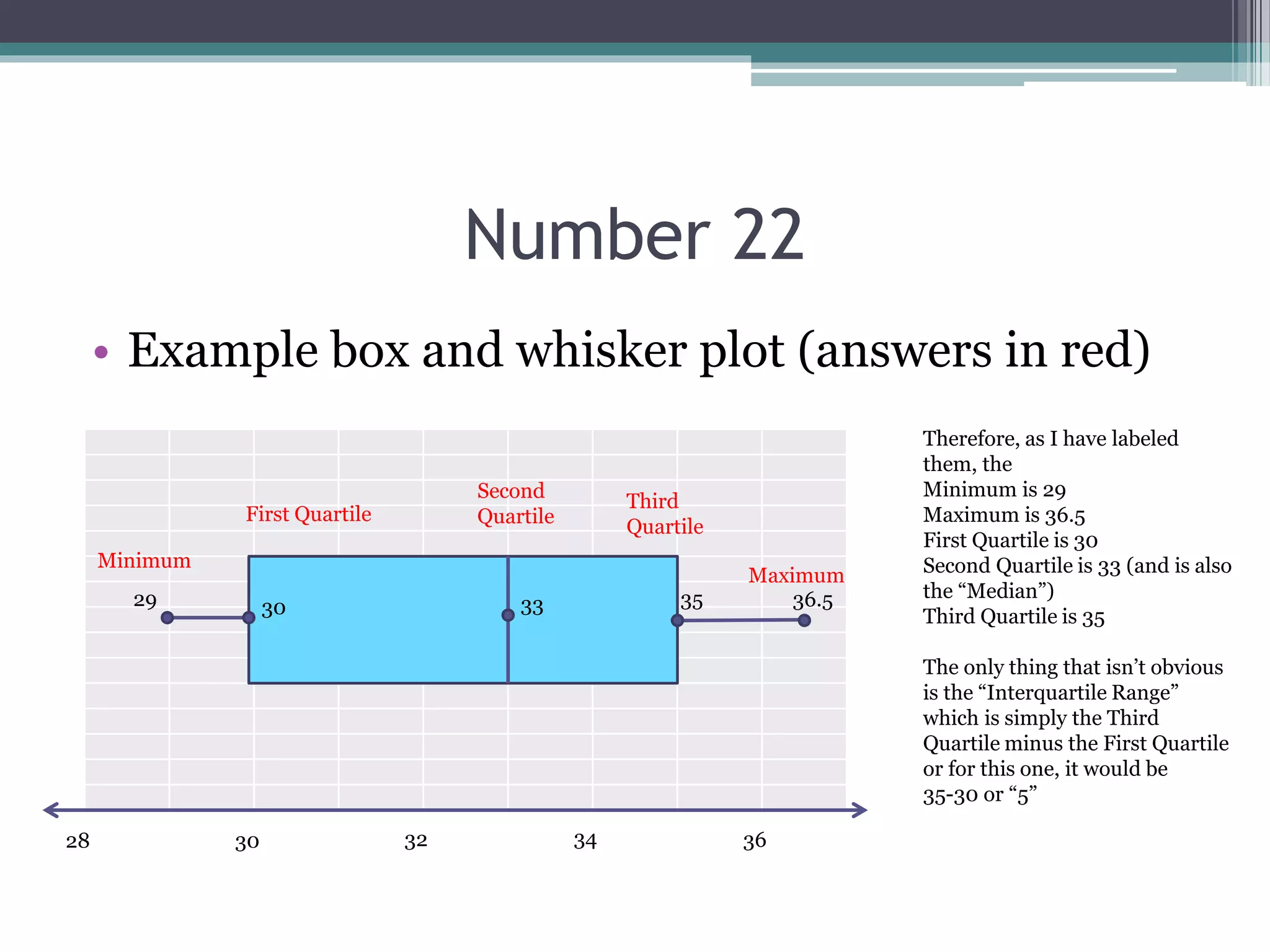
• Example box and whisker plot (answers in red)
28 30 32 34 36
29 30 33 35 36.5
Minimum
First Quartile
Second
Quartile
Third
Quartile
Maximum
Therefore, as I have labeled
them, the
Minimum is 29
Maximum is 36.5
First Quartile is 30
Second Quartile is 33 (and is also
the “Median”)
Third Quartile is 35
The only thing that isn’t obvious
is the “Interquartile Range”
which is simply the Third
Quartile minus the First Quartile
or for this one, it would be
35-30 or “5”
Number 24
• Number 24 is a histogram where we are
matching z scores to a place on the histogram.
• Don’t let this one worry you, it’s actually very
intuitive and easy.
• Let’s look at an example.
Number 24
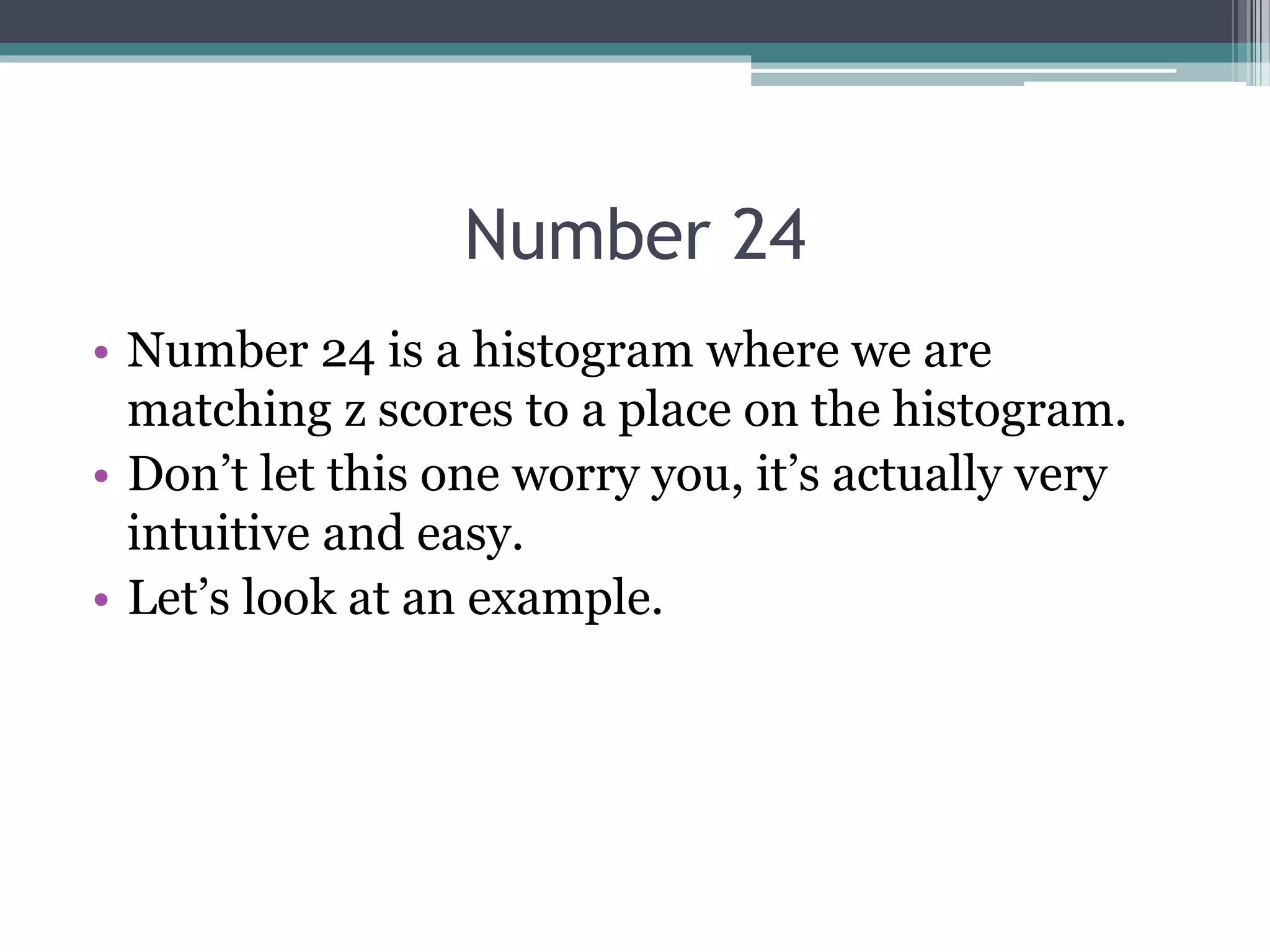
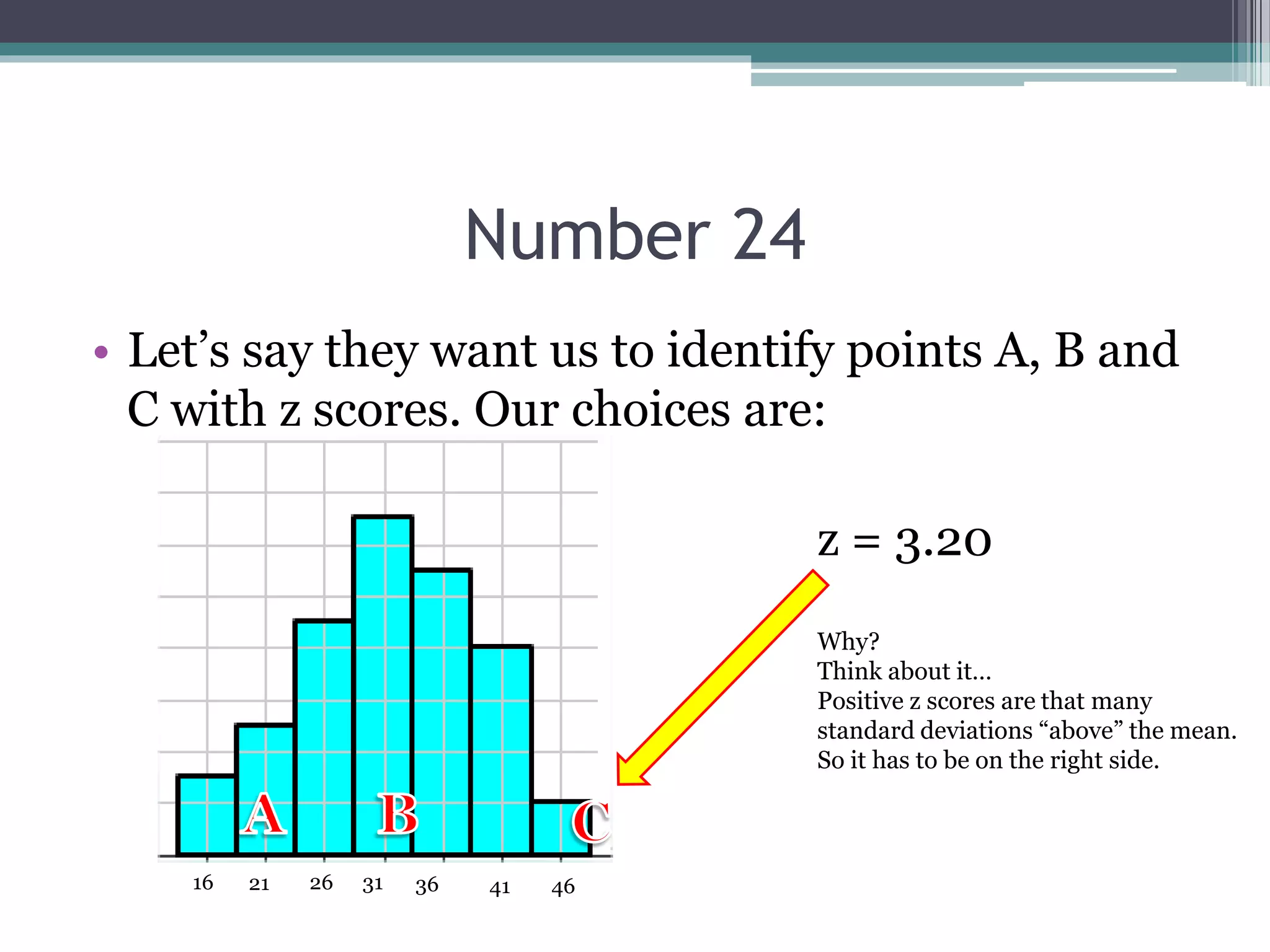
• Let’s say they want us to identify points A, B and
C with z scores. Our choices are:
31 36 41 46262116
z = 0
z = -1.88
z = 3.20
Answers next page
Number 24
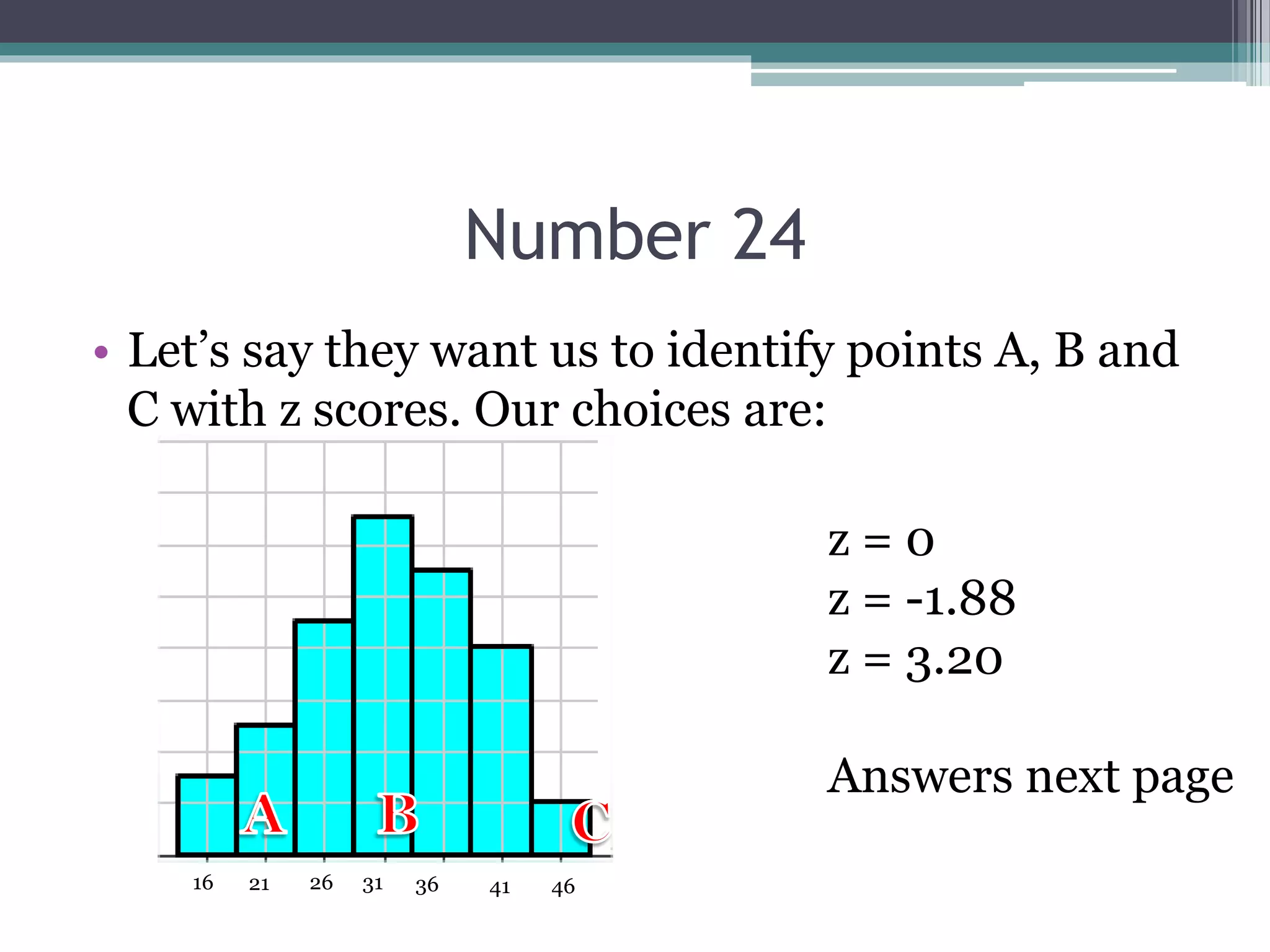
• Let’s say they want us to identify points A, B and
C with z scores. Our choices are:
31 36 41 46262116
z = 0
Why?
Think about it…
A z score of zero means you are right on
the mean. Look where B is and the
shape of the histogram. It looks very
symmetrical, thus the mean would be
toward the middle.
Number 24
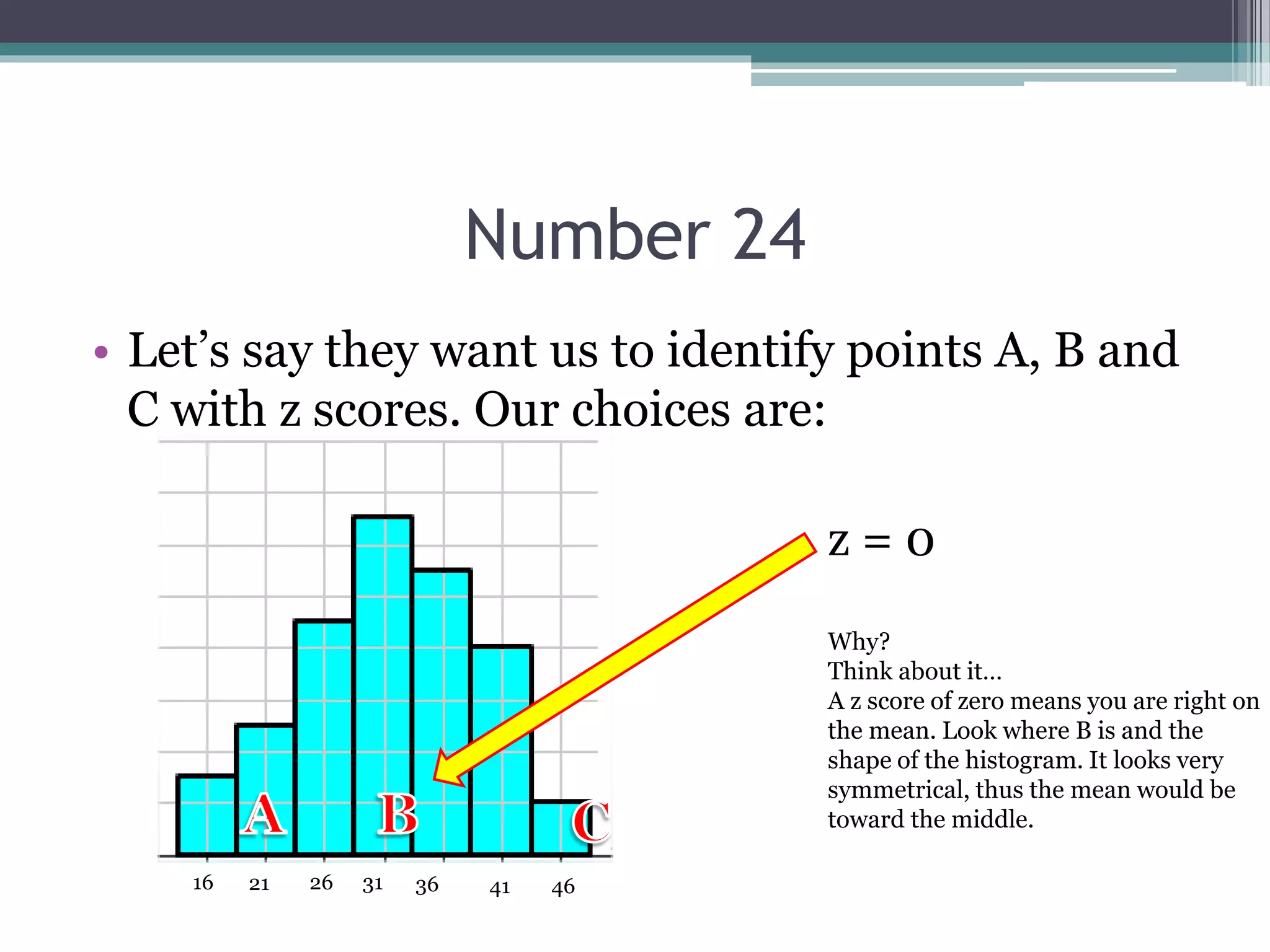
• Let’s say they want us to identify points A, B and
C with z scores. Our choices are:
31 36 41 46262116
z = -1.88
Why?
Think about it…
A negative z score means you are that
many standard deviations “below” the
mean. So with this close to symmetric
histogram, it would be on the “left” side.
Number 24
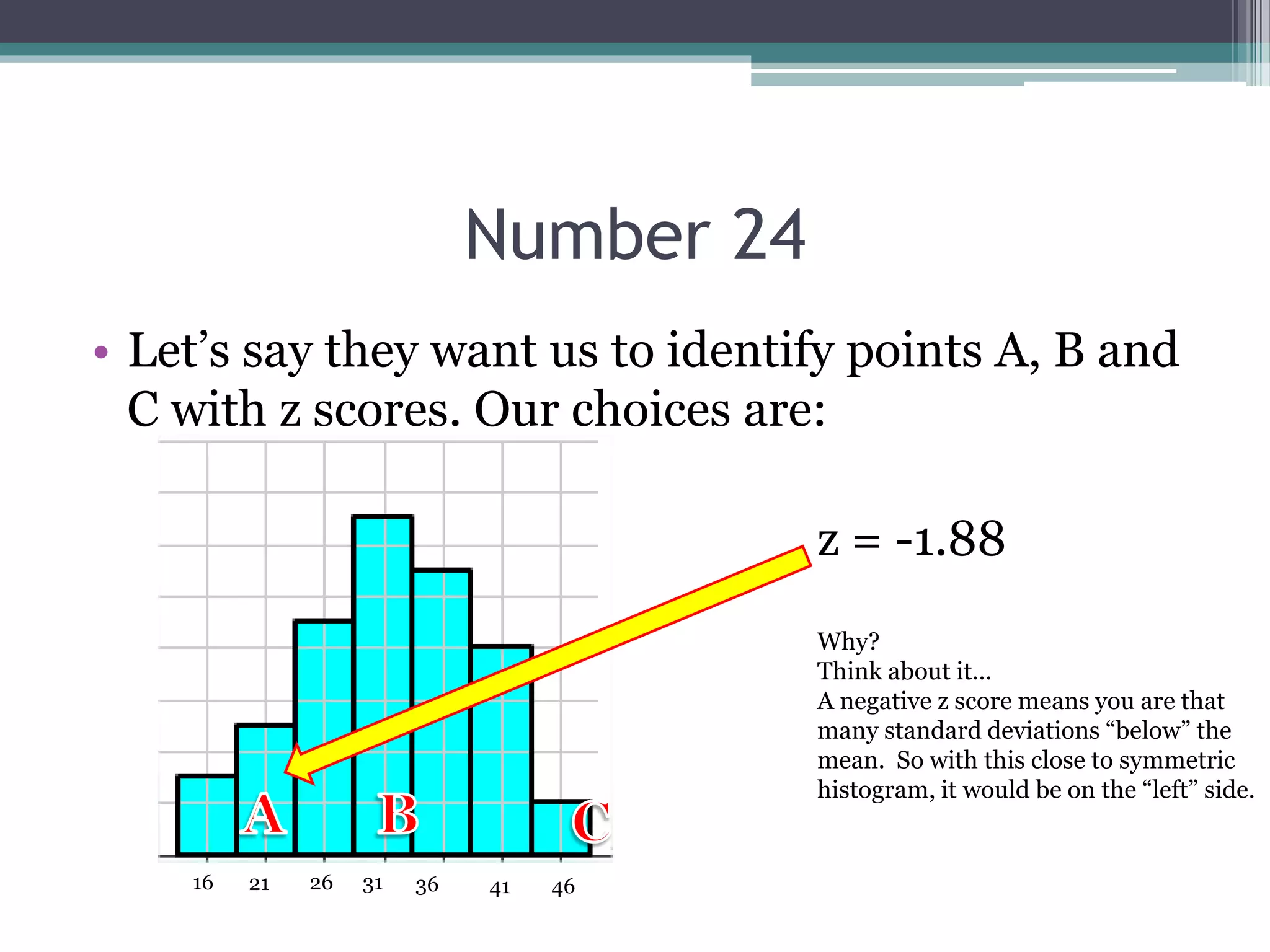
• Let’s say they want us to identify points A, B and
C with z scores. Our choices are:
31 36 41 46262116
z = 3.20
Why?
Think about it…
Positive z scores are that many
standard deviations “above” the mean.
So it has to be on the right side.
Number 24
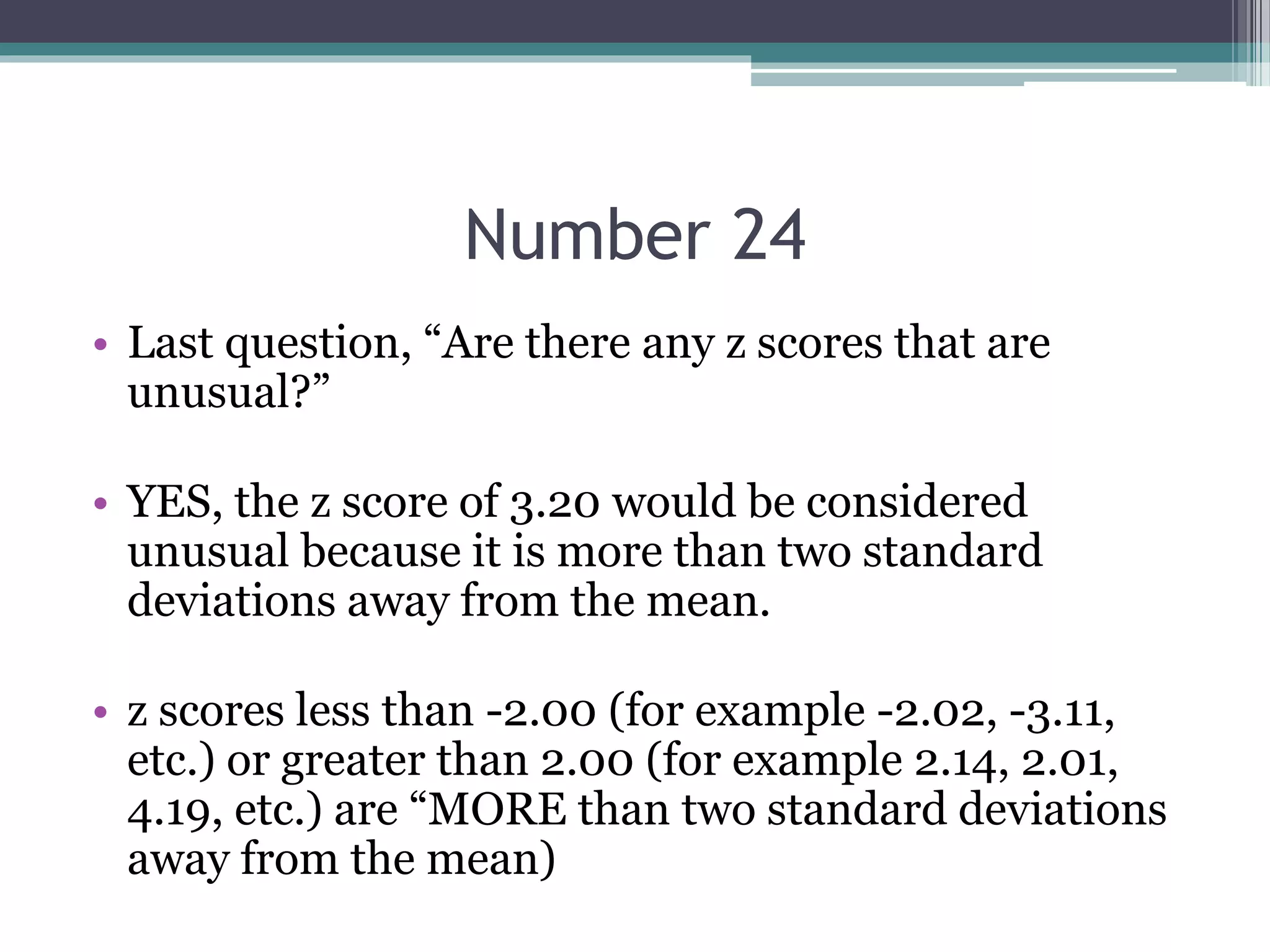
• Last question, “Are there any z scores that are
unusual?”
• YES, the z score of 3.20 would be considered
unusual because it is more than two standard
deviations away from the mean.
• z scores less than -2.00 (for example -2.02, -3.11,
etc.) or greater than 2.00 (for example 2.14, 2.01,
4.19, etc.) are “MORE than two standard deviations
away from the mean)
Week 1 Homework
• Hope you enjoyed this…
• More examples next week….

Week 1 homework help 2015

  • 1.
    Week 1 3Homework Examples MA 221 Statistics for Decision Making Professor Brent Heard Not to be copied or linked to without my permission
  • 2.
    Week 1 HomeworkExamples • I sometimes put together a presentation on working a few homework problems. • This week, I will do problems similar to number 18, 22 and 24.
  • 3.
    Number 18 • Number18 is a basic “Find the range, mean, variance and standard deviation” type problem. I will show you how to do one in Minitab easily. • Please note that I change the numbers so I don’t give the exact homework problem.
  • 4.
    Number 18 • Examplefor 18 ▫ Find the range, mean, variance and standard deviation of the sample data set. 9 12 5 13 12 10 9 17 11
  • 5.
    Number 18 • Firstgo to Minitab (I access Minitab by going to the iLab link under Course Home and then follow the “Go to Citrix” link.) • This term there seems to be a little different look to it, but I still found Minitab in the Apps easily.
  • 6.
    Number 18 • Enterthe data in the spreadsheet part of Minitab. I labeled mine “Data for Example 1”
  • 7.
    Number 18 • Atthe top of Minitab, go to Stat >> Basic Statistics >> Display Descriptive Statistics Put your cursor in the Variables box and click, then choose/ double click C1 on the left
  • 8.
    Number 18 • Nowit should look similar to this based on what you called your data
  • 9.
    Number 18 • Clickthe Statistics button and select/check what you need from the menu that pops up…
  • 10.
    Number 18 • Clickyour OK buttons… and you will see your answers in the Session Window So the Mean is 10.89, Standard Deviation is 3.30, Variance is 10.86 and Range is 12. Always make sure you round correctly if asked to do so. For example, if they asked you to round to Two Decimal Places, you would note the range as “12.00” just to be sure. Normal rounding rules apply.
  • 11.
    Number 22 • Number22 is a box and whisker plot type problem and is actually very easy. • By looking at a box and whisker plot, you are asked to identify (a) the minimum, (b) the maximum, (c) the first quartile, (d) the second quartile, (e) the third quartile and (f) the interquartile range.
  • 12.
    Number 22 • Examplebox and whisker plot (answers in red) 28 30 32 34 36 29 30 33 35 36.5 Minimum First Quartile Second Quartile Third Quartile Maximum Therefore, as I have labeled them, the Minimum is 29 Maximum is 36.5 First Quartile is 30 Second Quartile is 33 (and is also the “Median”) Third Quartile is 35 The only thing that isn’t obvious is the “Interquartile Range” which is simply the Third Quartile minus the First Quartile or for this one, it would be 35-30 or “5”
  • 13.
    Number 24 • Number24 is a histogram where we are matching z scores to a place on the histogram. • Don’t let this one worry you, it’s actually very intuitive and easy. • Let’s look at an example.
  • 14.
    Number 24 • Let’ssay they want us to identify points A, B and C with z scores. Our choices are: 31 36 41 46262116 z = 0 z = -1.88 z = 3.20 Answers next page
  • 15.
    Number 24 • Let’ssay they want us to identify points A, B and C with z scores. Our choices are: 31 36 41 46262116 z = 0 Why? Think about it… A z score of zero means you are right on the mean. Look where B is and the shape of the histogram. It looks very symmetrical, thus the mean would be toward the middle.
  • 16.
    Number 24 • Let’ssay they want us to identify points A, B and C with z scores. Our choices are: 31 36 41 46262116 z = -1.88 Why? Think about it… A negative z score means you are that many standard deviations “below” the mean. So with this close to symmetric histogram, it would be on the “left” side.
  • 17.
    Number 24 • Let’ssay they want us to identify points A, B and C with z scores. Our choices are: 31 36 41 46262116 z = 3.20 Why? Think about it… Positive z scores are that many standard deviations “above” the mean. So it has to be on the right side.
  • 18.
    Number 24 • Lastquestion, “Are there any z scores that are unusual?” • YES, the z score of 3.20 would be considered unusual because it is more than two standard deviations away from the mean. • z scores less than -2.00 (for example -2.02, -3.11, etc.) or greater than 2.00 (for example 2.14, 2.01, 4.19, etc.) are “MORE than two standard deviations away from the mean)
  • 19.
    Week 1 Homework •Hope you enjoyed this… • More examples next week….