MATHEMATICS 9
Solving Equations Transformable to Quadratic
Equation Including Rational Algebraic
Equations
Lesson1: SolvingQuadratic EquationsThatAreNot
W
rittenInStandardForm
Lesson2: Solving RationalAlgebraicEquations
T
ransformableT
oQuadraticEquations
In solving quadratic equation that is not written in standard form,
transform the equation in the standard form ax2 + bx + c = 0 where a,
b, and c are real numbers and a ≠ 0 and then, solve the equation
using any method in solving quadratic equation (extracting square
roots, factoring, completing the square, or quadratic formula).
Lesson1: SolvingQuadraticEquationsThat
AreNotWrittenInStandardForm
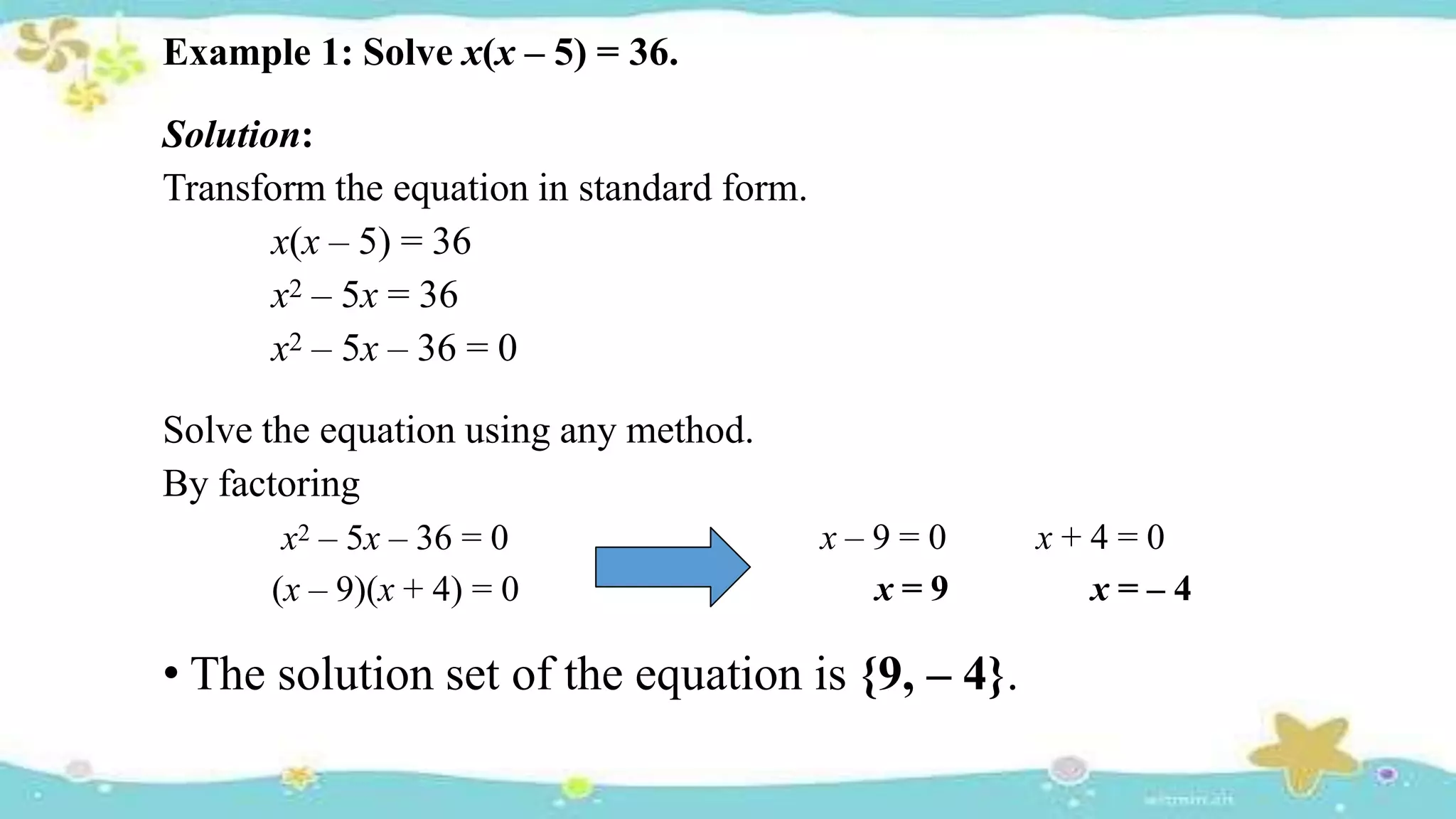
Example 1: Solve x(x – 5) = 36.
Solution:
Transform the equation in standard form.
x(x – 5) = 36
x2 – 5x = 36
x2 – 5x – 36 = 0
Solve the equation using any method.
By factoring
x2 – 5x – 36 = 0
(x – 9)(x + 4) = 0
x – 9 = 0
x = 9
x + 4 = 0
x = – 4
• The solution set of the equation is {9, – 4}.
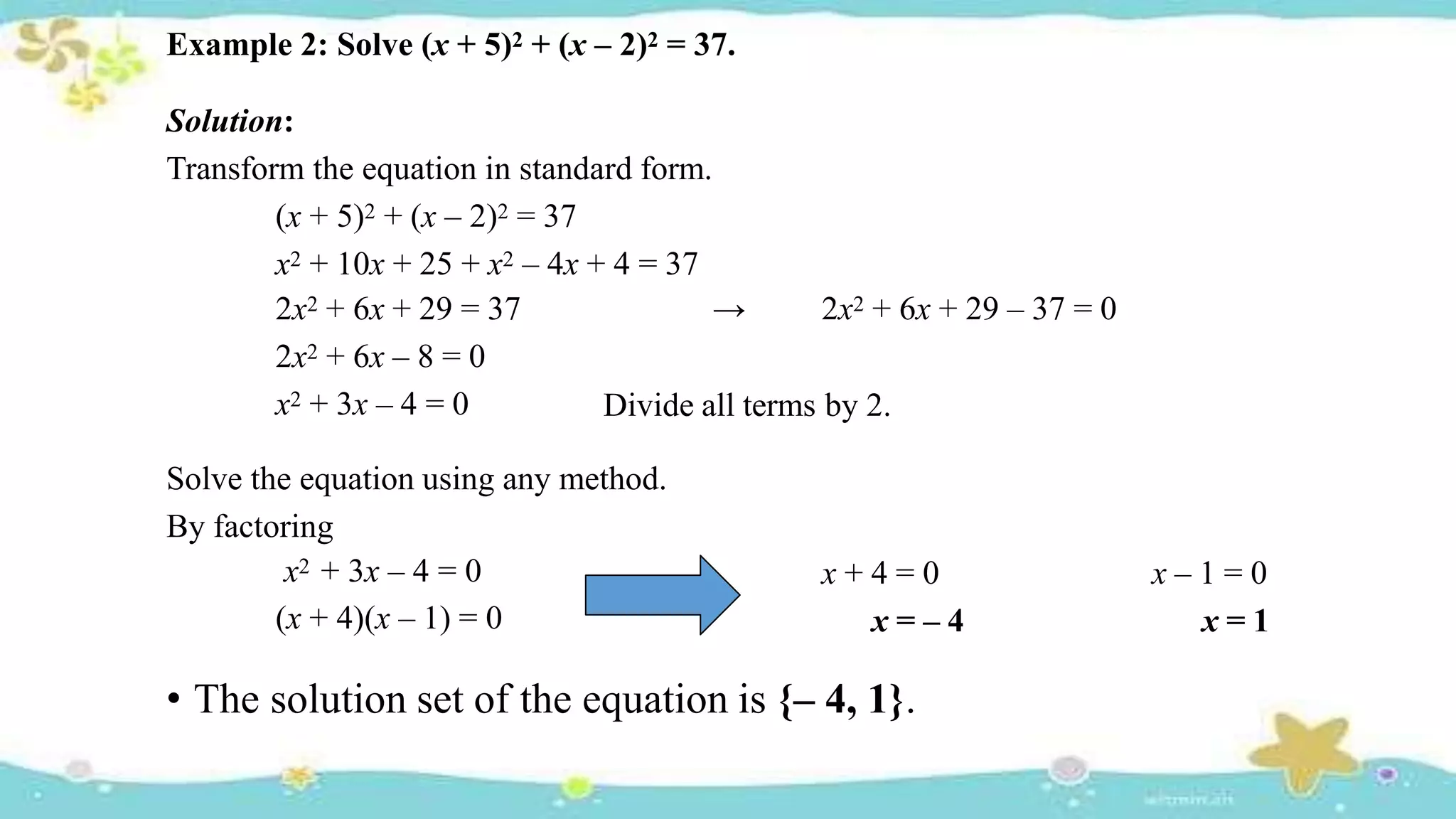
Example 2: Solve (x + 5)2 + (x – 2)2 = 37.
Solution:
Transform the equation in standard form.
(x + 5)2 + (x – 2)2 = 37
x2 + 10x + 25 + x2 – 4x + 4 = 37
2x2 + 6x + 29 = 37
2x2 + 6x – 8 = 0
x2 + 3x – 4 = 0
→ 2x2 + 6x + 29 – 37 = 0
Divide all terms by 2.
Solve the equation using any method.
By factoring
x2 + 3x – 4 = 0
(x + 4)(x – 1) = 0
x + 4 = 0
x = – 4
x – 1 = 0
x = 1
• The solution set of the equation is {– 4, 1}.
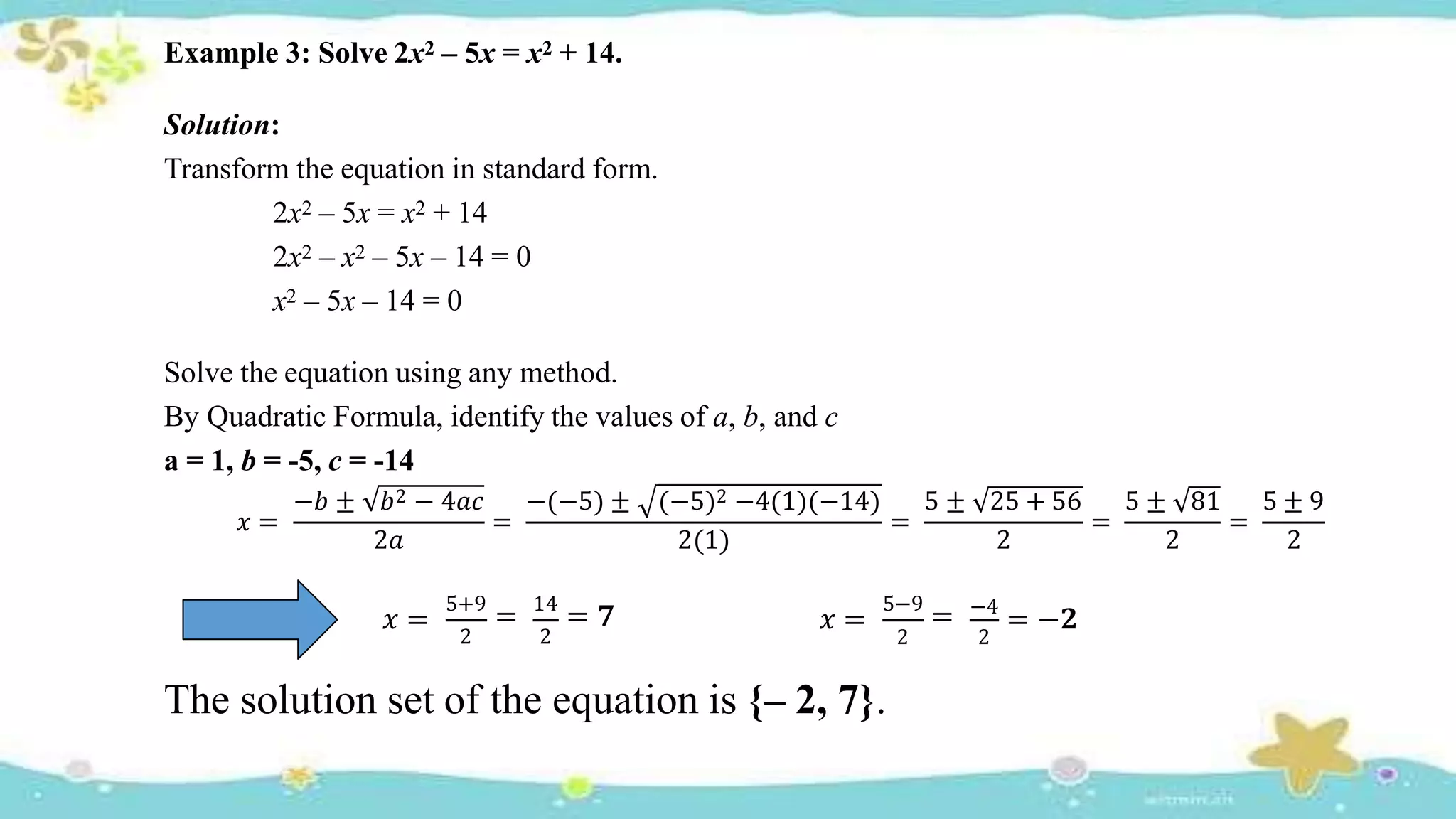
Example 3: Solve 2x2 – 5x = x2 + 14.
Solution:
Transform the equation in standard form.
2x2 – 5x = x2 + 14
2x2 – x2 – 5x – 14 = 0
x2 – 5x – 14 = 0
Solve the equation using any method.
By Quadratic Formula, identify the values of a, b, and c
a = 1, b = -5, c = -14
𝑥 =
2𝑎
=
−𝑏 ± 𝑏2 − 4𝑎𝑐 −(−5) ± (−5)2 −4(1)(−14)
2(1)
=
5 ± 25 + 56
2
=
2
=
5 ± 81 5 ± 9
2
𝑥 =
5+9
= 14
= 𝟕
2 2
𝑥 =
2
5−9
=
2
−4
= −𝟐
The solution set of the equation is {– 2, 7}.
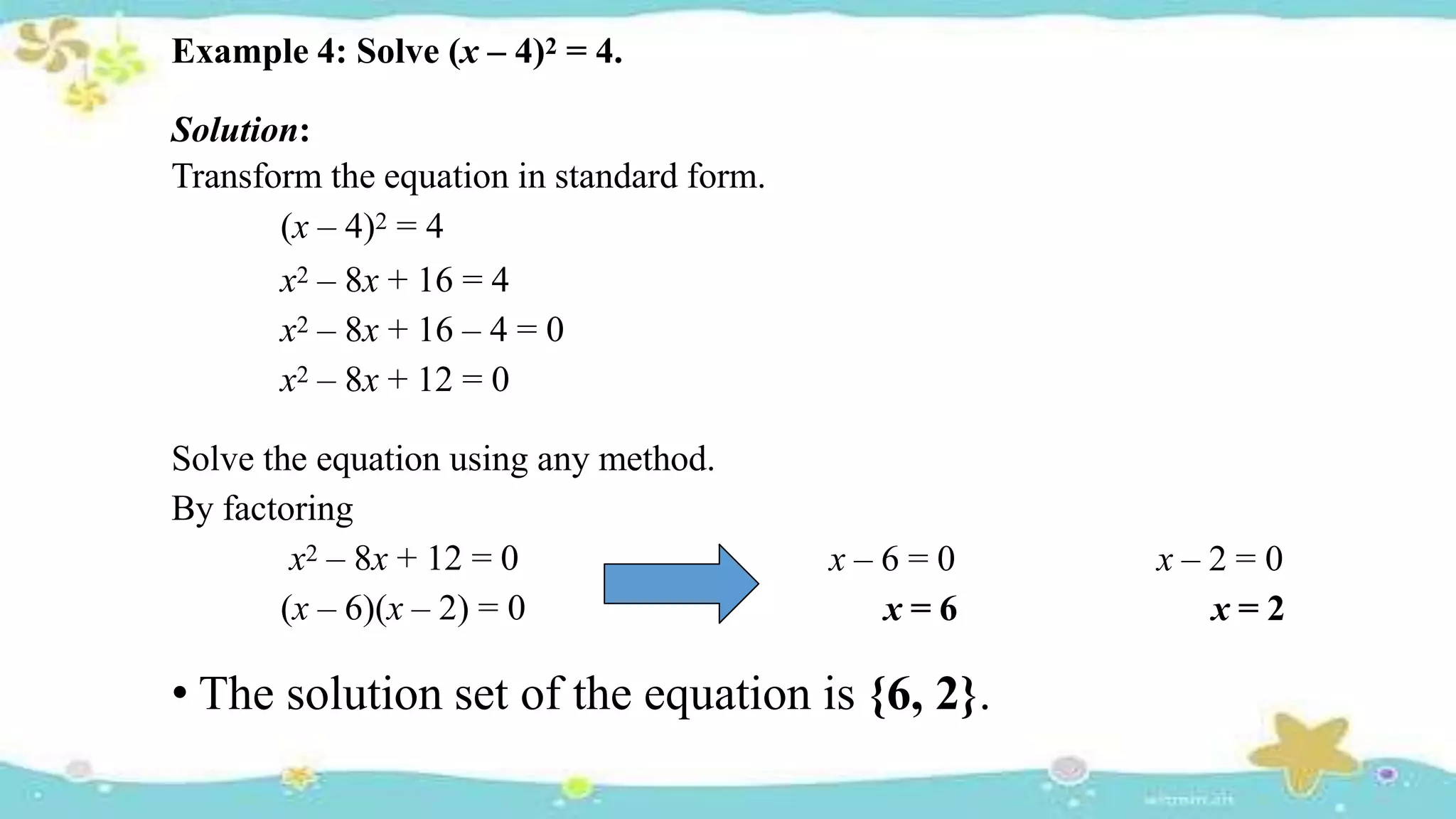
Example 4: Solve (x – 4)2 = 4.
Solution:
Transform the equation in standard form.
(x – 4)2 = 4
x2 – 8x + 16 = 4
x2 – 8x + 16 – 4 = 0
x2 – 8x + 12 = 0
Solve the equation using any method.
By factoring
x2 – 8x + 12 = 0
(x – 6)(x – 2) = 0
x – 6 = 0
x = 6
x – 2 = 0
x = 2
• The solution set of the equation is {6, 2}.
Example 5: Solve (3x + 4)2 – (x – 1)2 = – 5.
→ 8x2 + 26x + 15 + 5 = 0
Solution:
Transform the equation in standard form.
(3x + 4)2 – (x – 1)2 = – 5
9x2 + 24x + 16 – (x2 – 2x + 1) = – 5
9x2 + 24x + 16 – x2 + 2x – 1 = – 5
8x2 + 26x + 15 = – 5
8x2 + 26x + 20 = 0
4x2 + 13x + 10 = 0 Divide all terms by 2.
Solve the equation using any method.
By Quadratic Formula, identify the values of a, b, and c
a = 4, b = 13, c = 10
𝑥 =
2𝑎
=
−𝑏 ± 𝑏2 − 4𝑎𝑐 −(13) ± (13)2 −4(4)(10)
2(4)
=
−13 ± 169 − 160
=
−13 ±
8 8
=
9 −13 ± 3
8
𝑥 =
−13+3
= −10
= − 𝟓
8 8 𝟒
𝑥 =
−13−3
= −16
= −𝟐
8 8
𝟒
• The solution set of the equation is {– 2, − 𝟓
}.
Lesson2: SolvingRationalAlgebraicEquations
T
ransformableT
oQuadraticEquations
There are rational equations that can be transformed
into quadratic equation of the form ax2 + bx + c = 0 where a,
b and c are real numbers, and a ≠ 0 and it can be solved
using the different methods in solving quadratic equation.
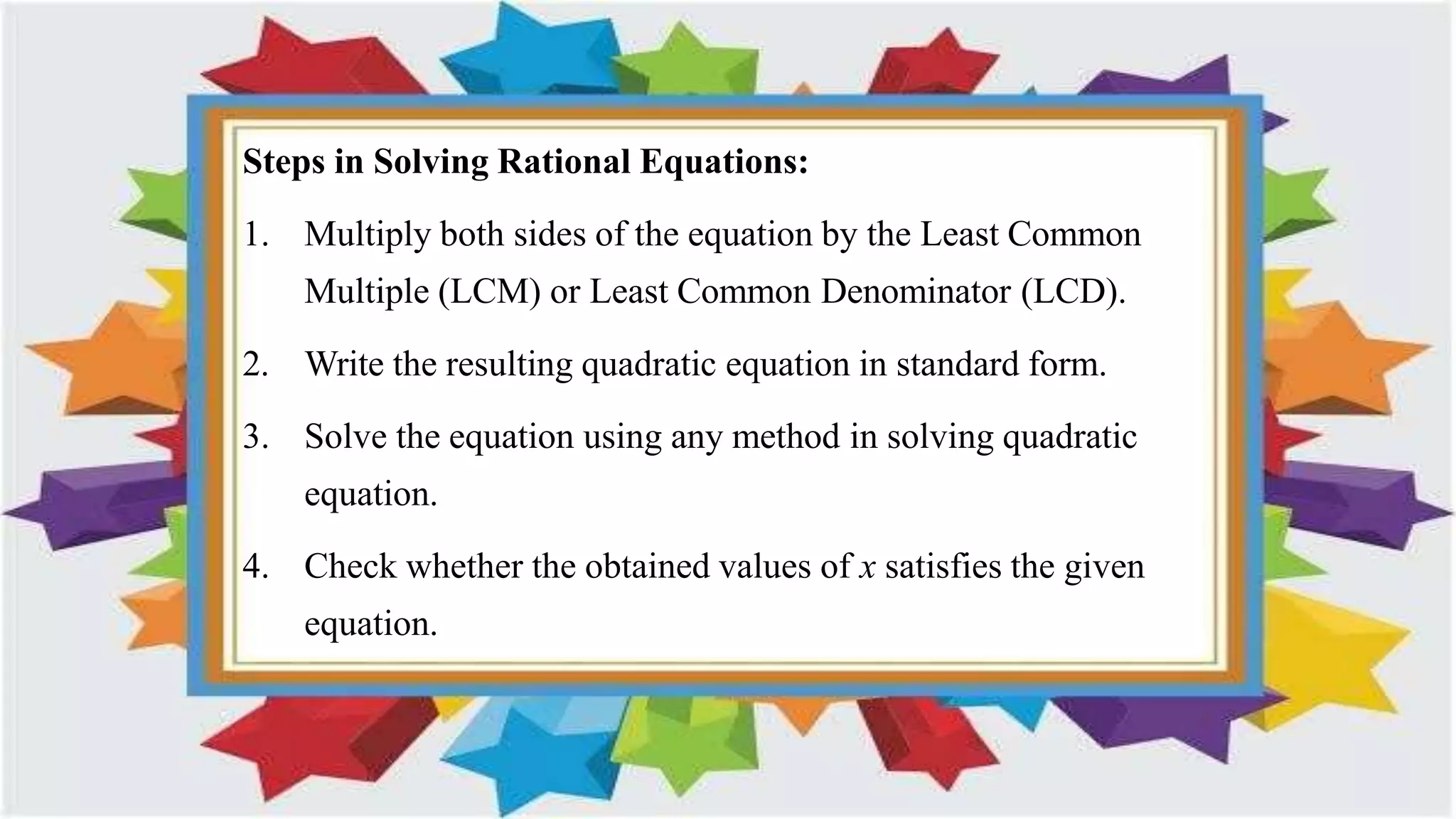
Steps in Solving Rational Equations:
1. Multiply both sides of the equation by the Least Common
Multiple (LCM) or Least Common Denominator (LCD).
2. Write the resulting quadratic equation in standard form.
3. Solve the equation using any method in solving quadratic
equation.
4. Check whether the obtained values of x satisfies the given
equation.
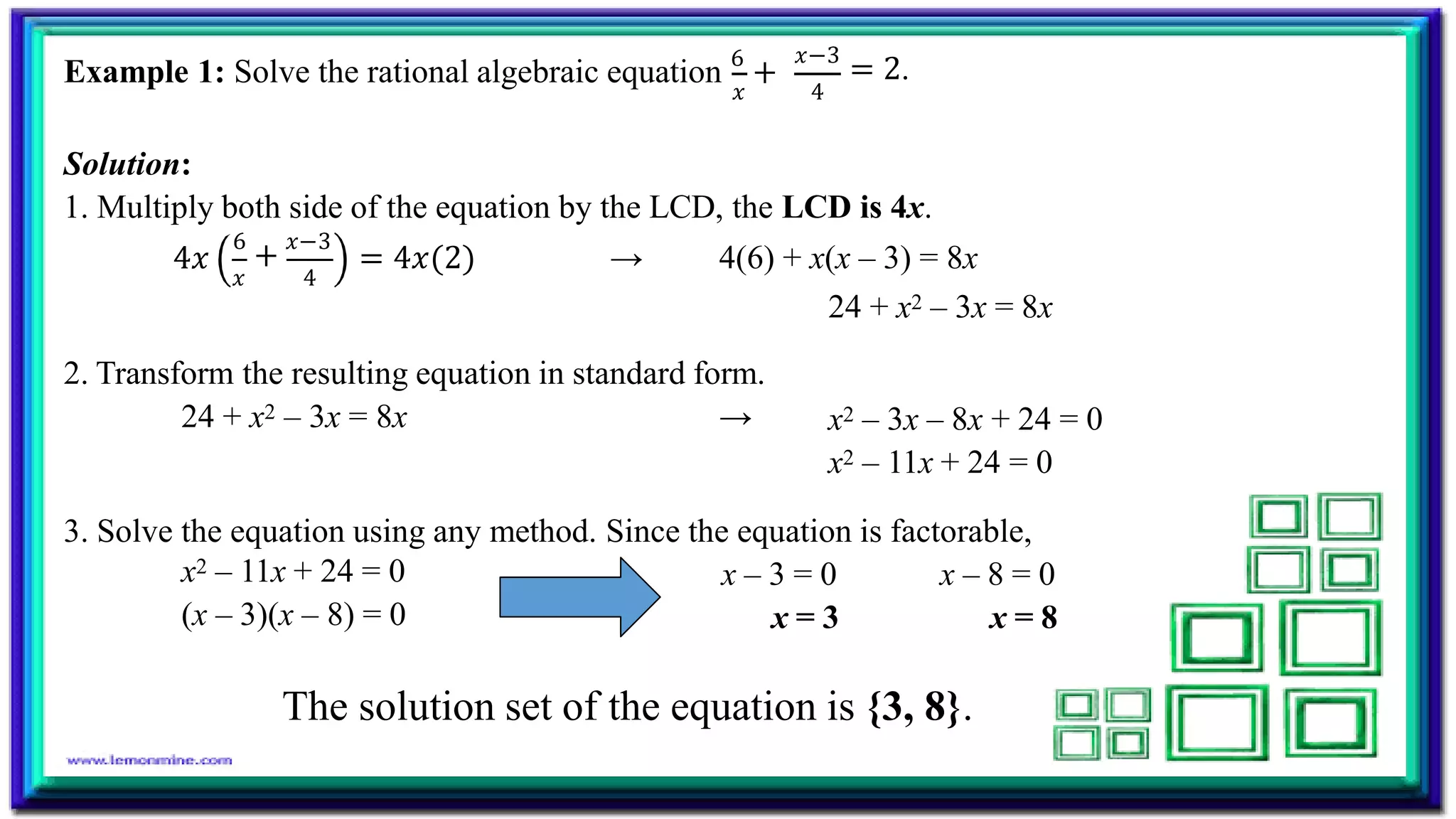
Example 1: Solve the rational algebraic equation 6
+
𝑥 4
𝑥−3
= 2.
Solution:
1. Multiply both side of the equation by the LCD, the LCD is 4x.
4𝑥
6
+ 𝑥−3
𝑥 4
= 4𝑥(2) → 4(6) + x(x – 3) = 8x
24 + x2 – 3x = 8x
2. Transform the resulting equation in standard form.
24 + x2 – 3x = 8x → x2 – 3x – 8x + 24 = 0
x2 – 11x + 24 = 0
3. Solve the equation using any method. Since the equation is factorable,
x2 – 11x + 24 = 0
(x – 3)(x – 8) = 0
x – 3 = 0
x = 3
x – 8 = 0
x = 8
The solution set of the equation is {3, 8}.
1
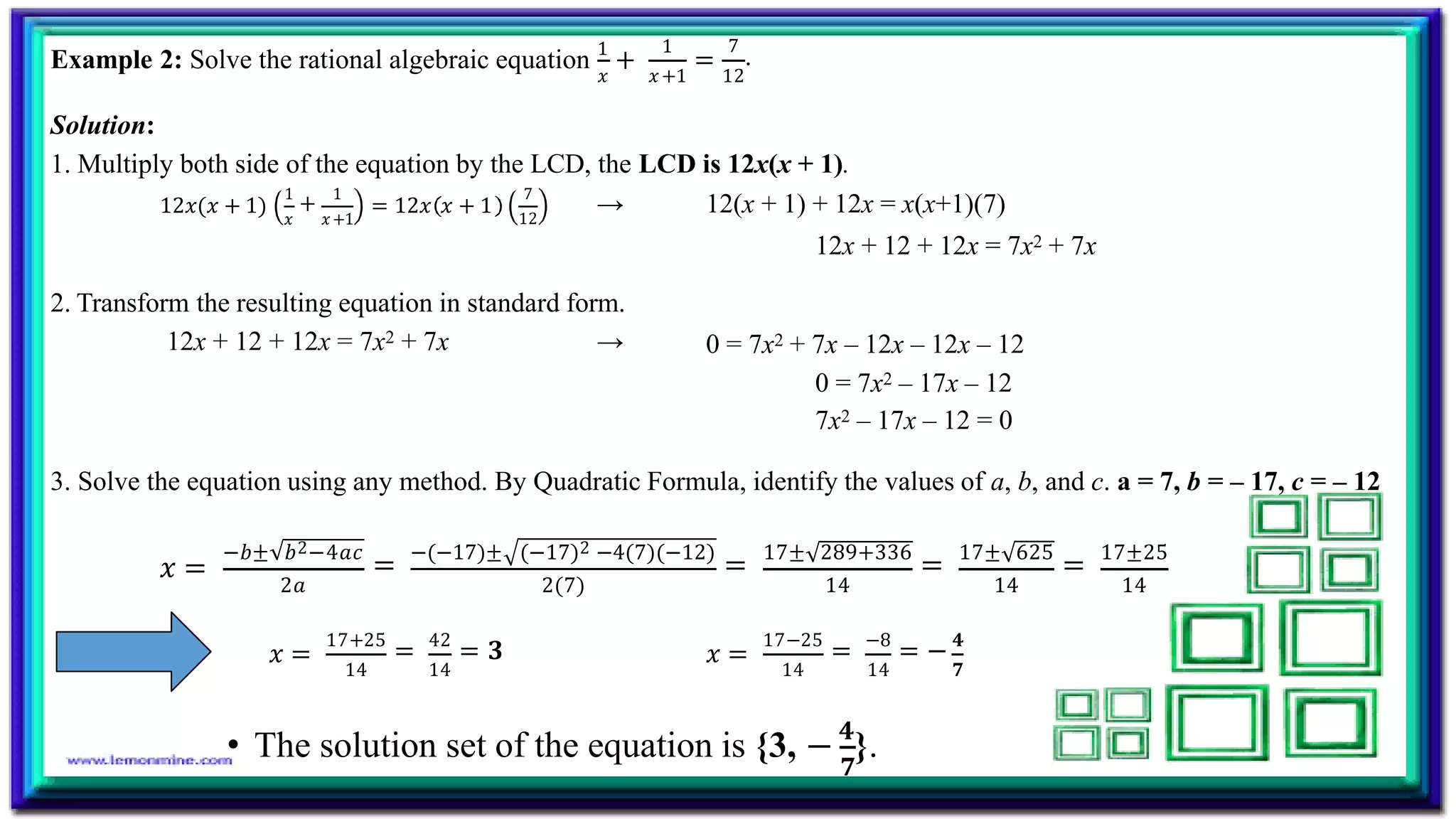
Example 2: Solve the rational algebraic equation 1
+ =
𝑥 𝑥+1 12
7
.
Solution:
1. Multiply both side of the equation by the LCD, the LCD is 12x(x + 1).
12𝑥(𝑥 + 1)
1
+ 1
𝑥 𝑥+1
= 12𝑥 𝑥 + 1
7
12
→ 12(x + 1) + 12x = x(x+1)(7)
12x + 12 + 12x = 7x2 + 7x
2. Transform the resulting equation in standard form.
12x + 12 + 12x = 7x2 + 7x → 0 = 7x2 + 7x – 12x – 12x – 12
0 = 7x2 – 17x – 12
7x2 – 17x – 12 = 0
3. Solve the equation using any method. By Quadratic Formula, identify the values of a, b, and c. a = 7, b = – 17, c = – 12
𝑥 =
−𝑏± 𝑏2−4𝑎𝑐
= −(−17)± (−17)2 −4(7)(−12)
= 17± 289+336
= 17± 625
= 17±25
2𝑎 2(7) 14 14 14
𝑥 = 𝑥 =
17+25
= 42
= 𝟑 17−25
= −8
= − 𝟒
14 14 14 14 𝟕
𝟕
• The solution set of the equation is {3, − 𝟒
}.
8
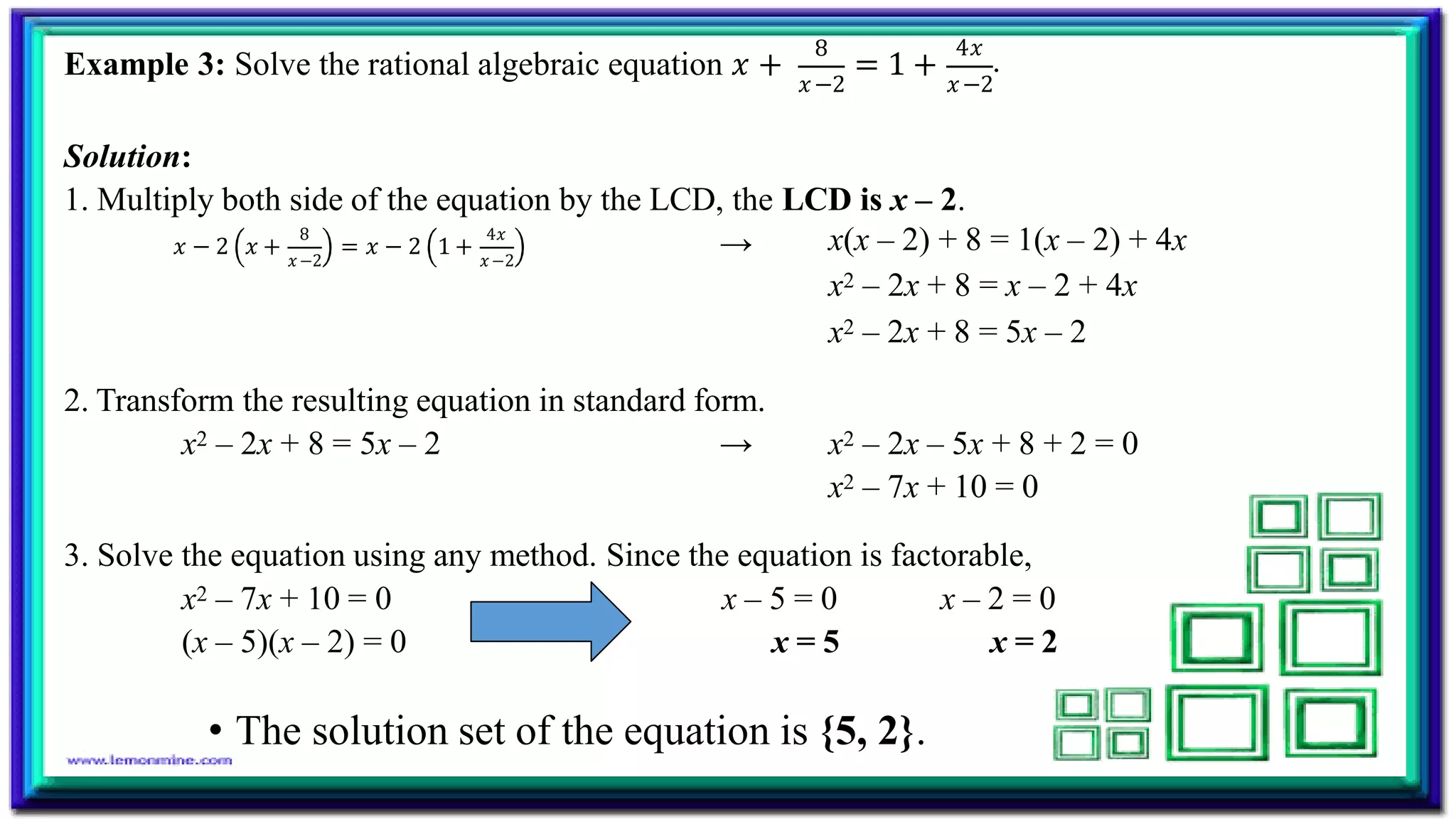
Example 3: Solve the rational algebraic equation 𝑥 + = 1 +
𝑥−2 𝑥−2
4𝑥
.
Solution:
1. Multiply both side of the equation by the LCD, the LCD is x – 2.
𝑥 − 2 𝑥 + = 𝑥 − 2 1 +
8 4𝑥
𝑥−2 𝑥−2
→ x(x – 2) + 8 = 1(x – 2) + 4x
x2 – 2x + 8 = x – 2 + 4x
x2 – 2x + 8 = 5x – 2
2. Transform the resulting equation in standard form.
x2 – 2x + 8 = 5x – 2 → x2 – 2x – 5x + 8 + 2 = 0
x2 – 7x + 10 = 0
3. Solve the equation using any method. Since the equation is factorable,
x2 – 7x + 10 = 0
(x – 5)(x – 2) = 0
x – 5 = 0
x = 5
x – 2 = 0
x = 2
• The solution set of the equation is {5, 2}.
Example 4: Solve the rational algebraic equation 𝑥+3
+
1
3 𝑥 −3
= 4.
Solution:
1. Multiply both side of the equation by the LCD, the LCD is 3(x – 3).
3(𝑥 − 3)
𝑥+3
+ 1
3 𝑥−3
= 3(𝑥 − 3)(4) → (x – 3)(x + 3) + 3(1) = 12(x – 3)
x2 – 9 + 3 = 12x – 36
2. Transform the resulting equation in standard form.
x2 – 6 = 12x – 36 → x2 – 12x – 6 + 36 = 0
x2 – 12x + 30 = 0
3. Solve the equation using any method. By Quadratic Formula, identify the values of a, b, and c. a = 1, b = – 12, c = 30
𝑥 =
−𝑏± 𝑏2−4𝑎𝑐
= −(−12)± (−12)2 −4(1)(30)
= 12± 144−120
= 12± 24
= 12±2 6
2𝑎 2(1) 2 2 2
𝑥 =
12+2 12−2
2 2
6
= 𝟔 + 𝟔 𝑥 = 6
= 𝟔 − 𝟔
• The solution set of the equation is 𝟔 + 𝟔 , 𝟔 − 𝟔 .
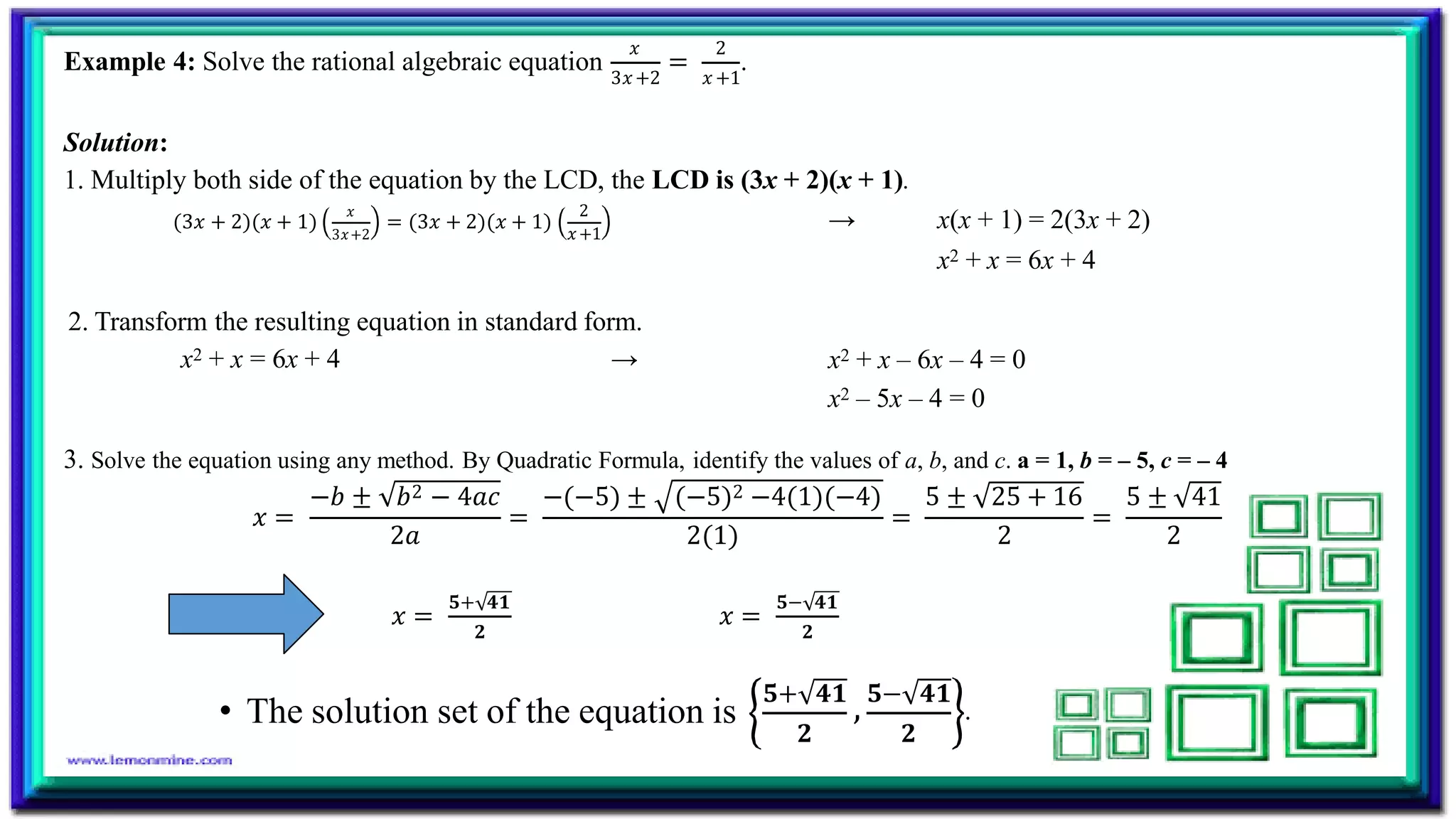
Example 4: Solve the rational algebraic equation
𝑥 2
3𝑥+2 𝑥 +1
= .
Solution:
1. Multiply both side of the equation by the LCD, the LCD is (3x + 2)(x + 1).
𝑥
3𝑥+2
(3𝑥 + 2)(𝑥 + 1) = (3𝑥 + 2)(𝑥 + 1)
2
𝑥+1
→ x(x + 1) = 2(3x + 2)
x2 + x = 6x + 4
2. Transform the resulting equation in standard form.
x2 + x = 6x + 4 → x2 + x – 6x – 4 = 0
x2 – 5x – 4 = 0
3. Solve the equation using any method. By Quadratic Formula, identify the values of a, b, and c. a = 1, b = – 5, c = – 4
𝑥 =
2𝑎
=
−𝑏 ± 𝑏2 − 4𝑎𝑐 −(−5) ± (−5)2 −4(1)(−4)
2(1)
=
5 ± 25 + 16
2
=
5 ± 41
2
𝑥 =
𝟓+ 𝟒𝟏
𝟐
𝑥 =
𝟓− 𝟒𝟏
𝟐
• The solution set of the equation is
𝟓+ 𝟒𝟏
, 𝟓− 𝟒𝟏
.
𝟐 𝟐

rational equation transformable to quadratic equation.pptx

  • 1.
    MATHEMATICS 9 Solving EquationsTransformable to Quadratic Equation Including Rational Algebraic Equations Lesson1: SolvingQuadratic EquationsThatAreNot W rittenInStandardForm Lesson2: Solving RationalAlgebraicEquations T ransformableT oQuadraticEquations
  • 2.
    In solving quadraticequation that is not written in standard form, transform the equation in the standard form ax2 + bx + c = 0 where a, b, and c are real numbers and a ≠ 0 and then, solve the equation using any method in solving quadratic equation (extracting square roots, factoring, completing the square, or quadratic formula). Lesson1: SolvingQuadraticEquationsThat AreNotWrittenInStandardForm
  • 3.
    Example 1: Solvex(x – 5) = 36. Solution: Transform the equation in standard form. x(x – 5) = 36 x2 – 5x = 36 x2 – 5x – 36 = 0 Solve the equation using any method. By factoring x2 – 5x – 36 = 0 (x – 9)(x + 4) = 0 x – 9 = 0 x = 9 x + 4 = 0 x = – 4 • The solution set of the equation is {9, – 4}.
  • 4.
    Example 2: Solve(x + 5)2 + (x – 2)2 = 37. Solution: Transform the equation in standard form. (x + 5)2 + (x – 2)2 = 37 x2 + 10x + 25 + x2 – 4x + 4 = 37 2x2 + 6x + 29 = 37 2x2 + 6x – 8 = 0 x2 + 3x – 4 = 0 → 2x2 + 6x + 29 – 37 = 0 Divide all terms by 2. Solve the equation using any method. By factoring x2 + 3x – 4 = 0 (x + 4)(x – 1) = 0 x + 4 = 0 x = – 4 x – 1 = 0 x = 1 • The solution set of the equation is {– 4, 1}.
  • 5.
    Example 3: Solve2x2 – 5x = x2 + 14. Solution: Transform the equation in standard form. 2x2 – 5x = x2 + 14 2x2 – x2 – 5x – 14 = 0 x2 – 5x – 14 = 0 Solve the equation using any method. By Quadratic Formula, identify the values of a, b, and c a = 1, b = -5, c = -14 𝑥 = 2𝑎 = −𝑏 ± 𝑏2 − 4𝑎𝑐 −(−5) ± (−5)2 −4(1)(−14) 2(1) = 5 ± 25 + 56 2 = 2 = 5 ± 81 5 ± 9 2 𝑥 = 5+9 = 14 = 𝟕 2 2 𝑥 = 2 5−9 = 2 −4 = −𝟐 The solution set of the equation is {– 2, 7}.
  • 6.
    Example 4: Solve(x – 4)2 = 4. Solution: Transform the equation in standard form. (x – 4)2 = 4 x2 – 8x + 16 = 4 x2 – 8x + 16 – 4 = 0 x2 – 8x + 12 = 0 Solve the equation using any method. By factoring x2 – 8x + 12 = 0 (x – 6)(x – 2) = 0 x – 6 = 0 x = 6 x – 2 = 0 x = 2 • The solution set of the equation is {6, 2}.
  • 7.
    Example 5: Solve(3x + 4)2 – (x – 1)2 = – 5. → 8x2 + 26x + 15 + 5 = 0 Solution: Transform the equation in standard form. (3x + 4)2 – (x – 1)2 = – 5 9x2 + 24x + 16 – (x2 – 2x + 1) = – 5 9x2 + 24x + 16 – x2 + 2x – 1 = – 5 8x2 + 26x + 15 = – 5 8x2 + 26x + 20 = 0 4x2 + 13x + 10 = 0 Divide all terms by 2. Solve the equation using any method. By Quadratic Formula, identify the values of a, b, and c a = 4, b = 13, c = 10 𝑥 = 2𝑎 = −𝑏 ± 𝑏2 − 4𝑎𝑐 −(13) ± (13)2 −4(4)(10) 2(4) = −13 ± 169 − 160 = −13 ± 8 8 = 9 −13 ± 3 8 𝑥 = −13+3 = −10 = − 𝟓 8 8 𝟒 𝑥 = −13−3 = −16 = −𝟐 8 8 𝟒 • The solution set of the equation is {– 2, − 𝟓 }.
  • 8.
    Lesson2: SolvingRationalAlgebraicEquations T ransformableT oQuadraticEquations There arerational equations that can be transformed into quadratic equation of the form ax2 + bx + c = 0 where a, b and c are real numbers, and a ≠ 0 and it can be solved using the different methods in solving quadratic equation.
  • 9.
    Steps in SolvingRational Equations: 1. Multiply both sides of the equation by the Least Common Multiple (LCM) or Least Common Denominator (LCD). 2. Write the resulting quadratic equation in standard form. 3. Solve the equation using any method in solving quadratic equation. 4. Check whether the obtained values of x satisfies the given equation.
  • 10.
    Example 1: Solvethe rational algebraic equation 6 + 𝑥 4 𝑥−3 = 2. Solution: 1. Multiply both side of the equation by the LCD, the LCD is 4x. 4𝑥 6 + 𝑥−3 𝑥 4 = 4𝑥(2) → 4(6) + x(x – 3) = 8x 24 + x2 – 3x = 8x 2. Transform the resulting equation in standard form. 24 + x2 – 3x = 8x → x2 – 3x – 8x + 24 = 0 x2 – 11x + 24 = 0 3. Solve the equation using any method. Since the equation is factorable, x2 – 11x + 24 = 0 (x – 3)(x – 8) = 0 x – 3 = 0 x = 3 x – 8 = 0 x = 8 The solution set of the equation is {3, 8}.
  • 11.
    1 Example 2: Solvethe rational algebraic equation 1 + = 𝑥 𝑥+1 12 7 . Solution: 1. Multiply both side of the equation by the LCD, the LCD is 12x(x + 1). 12𝑥(𝑥 + 1) 1 + 1 𝑥 𝑥+1 = 12𝑥 𝑥 + 1 7 12 → 12(x + 1) + 12x = x(x+1)(7) 12x + 12 + 12x = 7x2 + 7x 2. Transform the resulting equation in standard form. 12x + 12 + 12x = 7x2 + 7x → 0 = 7x2 + 7x – 12x – 12x – 12 0 = 7x2 – 17x – 12 7x2 – 17x – 12 = 0 3. Solve the equation using any method. By Quadratic Formula, identify the values of a, b, and c. a = 7, b = – 17, c = – 12 𝑥 = −𝑏± 𝑏2−4𝑎𝑐 = −(−17)± (−17)2 −4(7)(−12) = 17± 289+336 = 17± 625 = 17±25 2𝑎 2(7) 14 14 14 𝑥 = 𝑥 = 17+25 = 42 = 𝟑 17−25 = −8 = − 𝟒 14 14 14 14 𝟕 𝟕 • The solution set of the equation is {3, − 𝟒 }.
  • 12.
    8 Example 3: Solvethe rational algebraic equation 𝑥 + = 1 + 𝑥−2 𝑥−2 4𝑥 . Solution: 1. Multiply both side of the equation by the LCD, the LCD is x – 2. 𝑥 − 2 𝑥 + = 𝑥 − 2 1 + 8 4𝑥 𝑥−2 𝑥−2 → x(x – 2) + 8 = 1(x – 2) + 4x x2 – 2x + 8 = x – 2 + 4x x2 – 2x + 8 = 5x – 2 2. Transform the resulting equation in standard form. x2 – 2x + 8 = 5x – 2 → x2 – 2x – 5x + 8 + 2 = 0 x2 – 7x + 10 = 0 3. Solve the equation using any method. Since the equation is factorable, x2 – 7x + 10 = 0 (x – 5)(x – 2) = 0 x – 5 = 0 x = 5 x – 2 = 0 x = 2 • The solution set of the equation is {5, 2}.
  • 13.
    Example 4: Solvethe rational algebraic equation 𝑥+3 + 1 3 𝑥 −3 = 4. Solution: 1. Multiply both side of the equation by the LCD, the LCD is 3(x – 3). 3(𝑥 − 3) 𝑥+3 + 1 3 𝑥−3 = 3(𝑥 − 3)(4) → (x – 3)(x + 3) + 3(1) = 12(x – 3) x2 – 9 + 3 = 12x – 36 2. Transform the resulting equation in standard form. x2 – 6 = 12x – 36 → x2 – 12x – 6 + 36 = 0 x2 – 12x + 30 = 0 3. Solve the equation using any method. By Quadratic Formula, identify the values of a, b, and c. a = 1, b = – 12, c = 30 𝑥 = −𝑏± 𝑏2−4𝑎𝑐 = −(−12)± (−12)2 −4(1)(30) = 12± 144−120 = 12± 24 = 12±2 6 2𝑎 2(1) 2 2 2 𝑥 = 12+2 12−2 2 2 6 = 𝟔 + 𝟔 𝑥 = 6 = 𝟔 − 𝟔 • The solution set of the equation is 𝟔 + 𝟔 , 𝟔 − 𝟔 .
  • 14.
    Example 4: Solvethe rational algebraic equation 𝑥 2 3𝑥+2 𝑥 +1 = . Solution: 1. Multiply both side of the equation by the LCD, the LCD is (3x + 2)(x + 1). 𝑥 3𝑥+2 (3𝑥 + 2)(𝑥 + 1) = (3𝑥 + 2)(𝑥 + 1) 2 𝑥+1 → x(x + 1) = 2(3x + 2) x2 + x = 6x + 4 2. Transform the resulting equation in standard form. x2 + x = 6x + 4 → x2 + x – 6x – 4 = 0 x2 – 5x – 4 = 0 3. Solve the equation using any method. By Quadratic Formula, identify the values of a, b, and c. a = 1, b = – 5, c = – 4 𝑥 = 2𝑎 = −𝑏 ± 𝑏2 − 4𝑎𝑐 −(−5) ± (−5)2 −4(1)(−4) 2(1) = 5 ± 25 + 16 2 = 5 ± 41 2 𝑥 = 𝟓+ 𝟒𝟏 𝟐 𝑥 = 𝟓− 𝟒𝟏 𝟐 • The solution set of the equation is 𝟓+ 𝟒𝟏 , 𝟓− 𝟒𝟏 . 𝟐 𝟐