ISO CERTIFIED 9001:2008
Email: info.jatinbatra@gmail.com
Website: www.batracomputercentre.comPh. No.: 8222066670, 4000670
Email: info.jatinbatra@gmail.com
Website: www.batracomputercentre.comPh. No.: 8222066670, 4000670
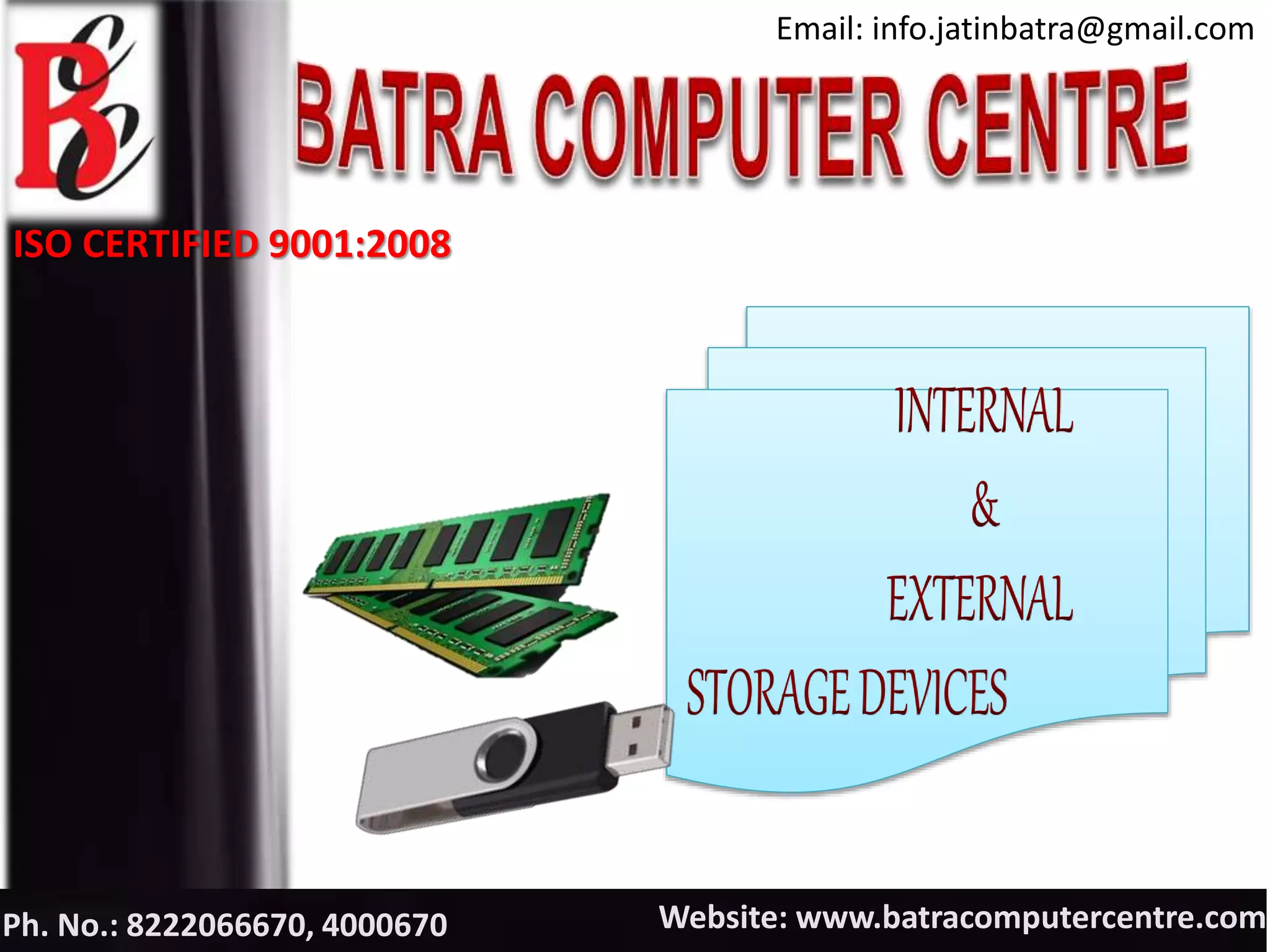
They are the computer's
hardware components that
retain data even after the
power is turned off.
Website: www.batracomputercentre.comPh. No.: 8222066670, 4000670
When people talk about computer memory, they usually
mean a set of chips that acts as a temporary workspace in
the computer.
This memory, called random access memory, or
RAM, stores data and program instructions needed
by the CPU.
RAM holds data and programs while they are being
used. As you use the computer, you constantly work
with the contents of RAM.
Website: www.batracomputercentre.comPh. No.: 8222066670, 4000670
Differences between storage and memory:
The two work differently. Remember that RAM uses chips to
temporarily store information. These chips depend on a constant
supply of power to keep their contents; when the power is lost,
the chips lose their contents.
Storage uses different methods to store information
permanently, so it isn't lost when the power is turned off.
A PC has more storage capacity than memory. Even though
some PCs can hold as much as 1GB of RAM, their hard drives
will be many times larger.
Website: www.batracomputercentre.comPh. No.: 8222066670, 4000670
Storage has two components: storage media and storage devices.
Storage Media
In terms of storage, a medium is an object that physically
holds information or program instructions. Floppy disks,
magnetic tapes, and compact discs are examples of storage
media. (The word media is the plural of medium.)
Storage Devices
A storage device is a piece of hardware that holds the
storage medium, sends data to the medium, and retrieves
data from the medium. Floppy disk drives, hard drives, CD-
ROM and DVD-ROM drives, and tape drives are all
examples of storage devices.
Website: www.batracomputercentre.comPh. No.: 8222066670, 4000670
Computer storage devices are sometimes
classified in a hierarchical structure that
is, primary or secondary.
Website: www.batracomputercentre.comPh. No.: 8222066670, 4000670
The term primary storage is sometimes used to Describe the main
memory, or RAM, in a computer. This is because when the CPU
needs data or instructions, it looks in memory before looking
anywhere else. Most knowledgeable computer users, however,
avoid using the term storage when talking about RAM. This is
because RAM works very differently from storage devices such as
disks or tapes. RAM also loses any data it contains when the
computer is turned off, while disks and tapes can hold data
permanently.
Website: www.batracomputercentre.comPh. No.: 8222066670, 4000670
The term secondary storage is sometimes used to describe devices that
can store data permanently, such as a hard drive, floppy disk, compact
disc, or tape. This is because the computer will look for data on one of
these devices if the data is not in RAM. Many kinds of secondary
storage devices can hold much more data than a computer's RAM can.
Because they can store information permanently (or until you erase it),
secondary storage devices are sometimes called archival storage
devices. This refers to the fact that you can store information on a disk
or tape and then put it away for a long time, only using it again when
you need it.
Website: www.batracomputercentre.comPh. No.: 8222066670, 4000670
Storage devices are divided
into three categories. Each
category has two options based
on the device
Website: www.batracomputercentre.comPh. No.: 8222066670, 4000670
Read-Only Versus Read/Write
A Read-only Device can only read information from the storage
medium. You cannot change the information on the medium or save
new information onto it.
A CD-ROM Drive is an example of a read-only device, because
it does not have the capability to write information onto a disc.
Music CDs or software programs on CDs are CD-Rs. Your CD-ROM
drive will be able to play the music or read the program instructions
from the disc, but you can't change The disc's contents.
Website: www.batracomputercentre.comPh. No.: 8222066670, 4000670
Read-Only Versus Read/Write
A read/write device not only can read information from the storage
medium, but can write information onto the medium, as well. These
devices let you read information from a disk or tape, make changes to
the information, and save new information onto the medium.
Hard drives, Floppy disk drives, tape drives, CD-Rewritable drives (CD-
RW), and DVD-RAM drives are commonly used examples of read/write
devices.
Website: www.batracomputercentre.comPh. No.: 8222066670, 4000670
Sequential Versus Random Access
When equipped with a tape drive, a computer can store information on a
long piece of tape, similar to a cassette tape. A tape drive is an example
of a sequential storage device, which requires the computer to scan from
the beginning of the medium to the end until it finds the information it
needs. This type of storage is cheaper but slower than other types of
storage.
Website: www.batracomputercentre.comPh. No.: 8222066670, 4000670
Sequential Versus Random Access
A random access storage device lets a computer go directly to
the needed information. The device does not have to search the
entire medium to find information. For this reason, random
access storage devices are much faster, and more expensive,
than sequential devices. A hard drive is an example of a random
access storage device.
Website: www.batracomputercentre.comPh. No.: 8222066670, 4000670
Magnetic Versus Optical Storage
Magnetic storage devices are specially treated disks or tapes that record
Information using magnetically sensitive materials. These devices use
electricity to shift magnetic particles so they form a pattern. That way, the
computer can read and store the information.
Common magnetic storage devices include hard
drives, floppy disk drives, and tape drives.
Website: www.batracomputercentre.comPh. No.: 8222066670, 4000670
 An internal storage device is a device installed
inside your computer
An external storage device is a device positioned
outside your computer -Internal & External Storage
Devices can be installed or connected to your
computer
Website: www.batracomputercentre.comPh. No.: 8222066670, 4000670
Magnetic storage Devices are a
storage device that is installed
in your computer
Website: www.batracomputercentre.comPh. No.: 8222066670, 4000670
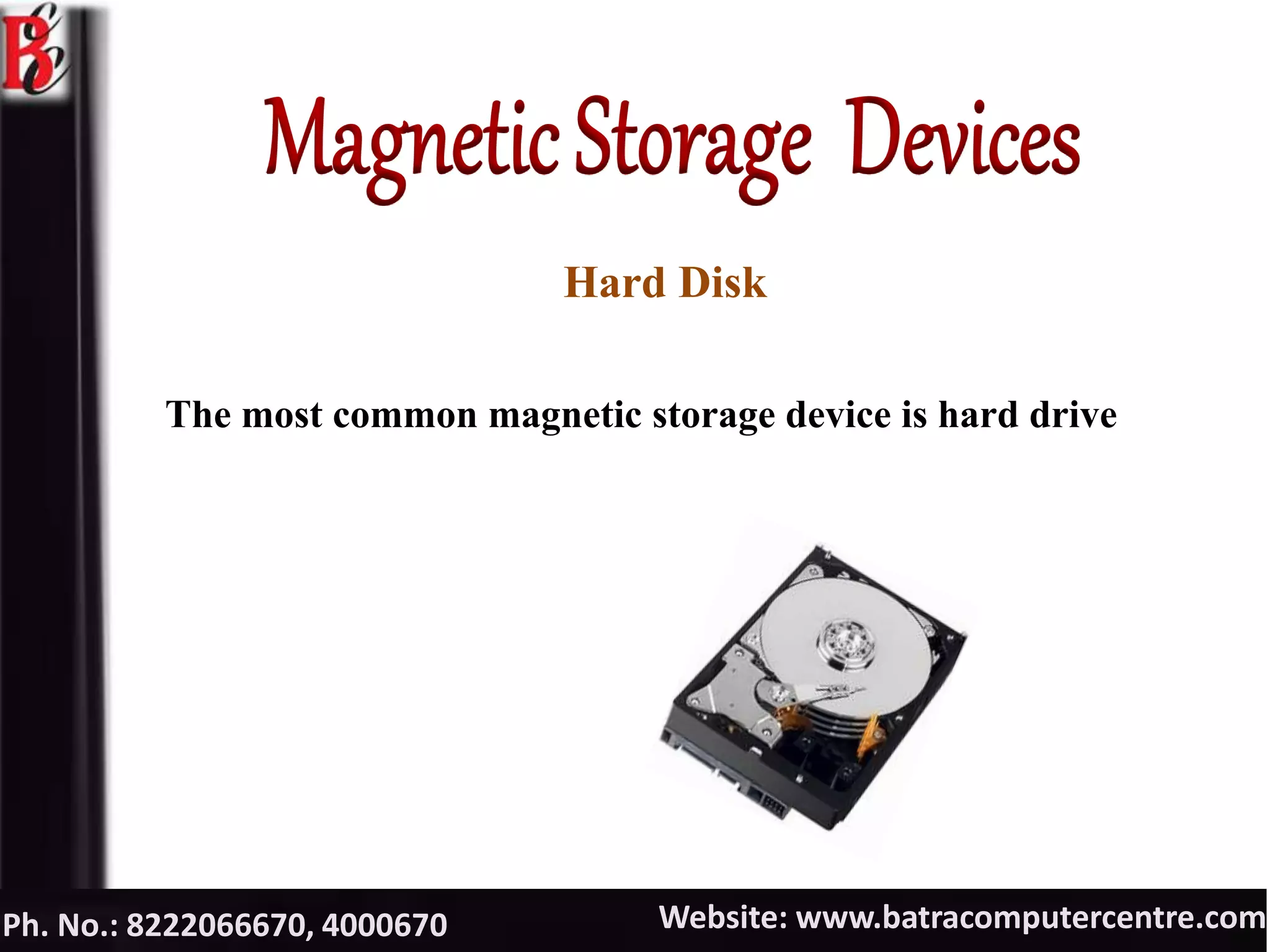
Hard Disk
The most common magnetic storage device is hard drive
Website: www.batracomputercentre.comPh. No.: 8222066670, 4000670
Floppy Disk Drives
A floppy disk drive is a storage device with a slot that
accepts floppy disks. Often internal, but can also be
external.
Website: www.batracomputercentre.comPh. No.: 8222066670, 4000670
Zip & Jaz Drives
Other forms of magnetic storage devices are Apple's iPod, a
portable storage/playback device, and Zip and Jaz drives. These
drives are similar to floppy disk drives; however, they are slightly
larger in size and use a special disk or cartridge to store much
more information often 100 times more!
Website: www.batracomputercentre.comPh. No.: 8222066670, 4000670
 This drive combines both magnetic & optical drive
technologies.
 It uses a removable disk that is inserted in a slot in
front of the drive.
 Can be internal or External.
 Their disks can store several gigabytes of information.
Website: www.batracomputercentre.comPh. No.: 8222066670, 4000670
 It is a storage that can be used in a remote computer.
 Usually located in the internet
Website: www.batracomputercentre.comPh. No.: 8222066670, 4000670
 Let you store a lot of info and lets it be transported easily
 Most commonly known: CD-ROM drive
 These drives are read-only drives.
 You can access data from them but cannot use them to write
data onto a CD.
 A button on the front of the drive opens a tray on which you
insert a CD.
Website: www.batracomputercentre.comPh. No.: 8222066670, 4000670
 Compact Disks, or CD’s capacity: A standard disc can hold
650 MB & newer kinds can store 700 MB
 Digital Video Discs, or DVD’s, have larger storage and holds
at least seven times more info that CD’s.
Website: www.batracomputercentre.comPh. No.: 8222066670, 4000670
ADDRESS:
SCO -15, Dayal Bagh,
Near Hanuman Mandir
Ambala Cantt-13300, Haryana
Ph. No.: 9729666670, 8222066670 &0171-4000670
Email ID: info.jatinbatra@gmail.com
Website: www.batracomputercentre.com
Website: www.batracomputercentre.comPh. No.: 8222066670, 4000670

External & Internal Storage Device ! Batra Computer Centre

  • 1.
    ISO CERTIFIED 9001:2008 Email:info.jatinbatra@gmail.com Website: www.batracomputercentre.comPh. No.: 8222066670, 4000670
  • 2.
    Website: www.batracomputercentre.comPh. No.:8222066670, 4000670 Email: info.jatinbatra@gmail.com
  • 3.
    Website: www.batracomputercentre.comPh. No.:8222066670, 4000670 They are the computer's hardware components that retain data even after the power is turned off.
  • 4.
    Website: www.batracomputercentre.comPh. No.:8222066670, 4000670 When people talk about computer memory, they usually mean a set of chips that acts as a temporary workspace in the computer. This memory, called random access memory, or RAM, stores data and program instructions needed by the CPU. RAM holds data and programs while they are being used. As you use the computer, you constantly work with the contents of RAM.
  • 5.
    Website: www.batracomputercentre.comPh. No.:8222066670, 4000670 Differences between storage and memory: The two work differently. Remember that RAM uses chips to temporarily store information. These chips depend on a constant supply of power to keep their contents; when the power is lost, the chips lose their contents. Storage uses different methods to store information permanently, so it isn't lost when the power is turned off. A PC has more storage capacity than memory. Even though some PCs can hold as much as 1GB of RAM, their hard drives will be many times larger.
  • 6.
    Website: www.batracomputercentre.comPh. No.:8222066670, 4000670 Storage has two components: storage media and storage devices. Storage Media In terms of storage, a medium is an object that physically holds information or program instructions. Floppy disks, magnetic tapes, and compact discs are examples of storage media. (The word media is the plural of medium.) Storage Devices A storage device is a piece of hardware that holds the storage medium, sends data to the medium, and retrieves data from the medium. Floppy disk drives, hard drives, CD- ROM and DVD-ROM drives, and tape drives are all examples of storage devices.
  • 7.
    Website: www.batracomputercentre.comPh. No.:8222066670, 4000670 Computer storage devices are sometimes classified in a hierarchical structure that is, primary or secondary.
  • 8.
    Website: www.batracomputercentre.comPh. No.:8222066670, 4000670 The term primary storage is sometimes used to Describe the main memory, or RAM, in a computer. This is because when the CPU needs data or instructions, it looks in memory before looking anywhere else. Most knowledgeable computer users, however, avoid using the term storage when talking about RAM. This is because RAM works very differently from storage devices such as disks or tapes. RAM also loses any data it contains when the computer is turned off, while disks and tapes can hold data permanently.
  • 9.
    Website: www.batracomputercentre.comPh. No.:8222066670, 4000670 The term secondary storage is sometimes used to describe devices that can store data permanently, such as a hard drive, floppy disk, compact disc, or tape. This is because the computer will look for data on one of these devices if the data is not in RAM. Many kinds of secondary storage devices can hold much more data than a computer's RAM can. Because they can store information permanently (or until you erase it), secondary storage devices are sometimes called archival storage devices. This refers to the fact that you can store information on a disk or tape and then put it away for a long time, only using it again when you need it.
  • 10.
    Website: www.batracomputercentre.comPh. No.:8222066670, 4000670 Storage devices are divided into three categories. Each category has two options based on the device
  • 11.
    Website: www.batracomputercentre.comPh. No.:8222066670, 4000670 Read-Only Versus Read/Write A Read-only Device can only read information from the storage medium. You cannot change the information on the medium or save new information onto it. A CD-ROM Drive is an example of a read-only device, because it does not have the capability to write information onto a disc. Music CDs or software programs on CDs are CD-Rs. Your CD-ROM drive will be able to play the music or read the program instructions from the disc, but you can't change The disc's contents.
  • 12.
    Website: www.batracomputercentre.comPh. No.:8222066670, 4000670 Read-Only Versus Read/Write A read/write device not only can read information from the storage medium, but can write information onto the medium, as well. These devices let you read information from a disk or tape, make changes to the information, and save new information onto the medium. Hard drives, Floppy disk drives, tape drives, CD-Rewritable drives (CD- RW), and DVD-RAM drives are commonly used examples of read/write devices.
  • 13.
    Website: www.batracomputercentre.comPh. No.:8222066670, 4000670 Sequential Versus Random Access When equipped with a tape drive, a computer can store information on a long piece of tape, similar to a cassette tape. A tape drive is an example of a sequential storage device, which requires the computer to scan from the beginning of the medium to the end until it finds the information it needs. This type of storage is cheaper but slower than other types of storage.
  • 14.
    Website: www.batracomputercentre.comPh. No.:8222066670, 4000670 Sequential Versus Random Access A random access storage device lets a computer go directly to the needed information. The device does not have to search the entire medium to find information. For this reason, random access storage devices are much faster, and more expensive, than sequential devices. A hard drive is an example of a random access storage device.
  • 15.
    Website: www.batracomputercentre.comPh. No.:8222066670, 4000670 Magnetic Versus Optical Storage Magnetic storage devices are specially treated disks or tapes that record Information using magnetically sensitive materials. These devices use electricity to shift magnetic particles so they form a pattern. That way, the computer can read and store the information. Common magnetic storage devices include hard drives, floppy disk drives, and tape drives.
  • 16.
    Website: www.batracomputercentre.comPh. No.:8222066670, 4000670  An internal storage device is a device installed inside your computer An external storage device is a device positioned outside your computer -Internal & External Storage Devices can be installed or connected to your computer
  • 17.
    Website: www.batracomputercentre.comPh. No.:8222066670, 4000670 Magnetic storage Devices are a storage device that is installed in your computer
  • 18.
    Website: www.batracomputercentre.comPh. No.:8222066670, 4000670 Hard Disk The most common magnetic storage device is hard drive
  • 19.
    Website: www.batracomputercentre.comPh. No.:8222066670, 4000670 Floppy Disk Drives A floppy disk drive is a storage device with a slot that accepts floppy disks. Often internal, but can also be external.
  • 20.
  • 21.
    Website: www.batracomputercentre.comPh. No.:8222066670, 4000670 Zip & Jaz Drives Other forms of magnetic storage devices are Apple's iPod, a portable storage/playback device, and Zip and Jaz drives. These drives are similar to floppy disk drives; however, they are slightly larger in size and use a special disk or cartridge to store much more information often 100 times more!
  • 22.
    Website: www.batracomputercentre.comPh. No.:8222066670, 4000670  This drive combines both magnetic & optical drive technologies.  It uses a removable disk that is inserted in a slot in front of the drive.  Can be internal or External.  Their disks can store several gigabytes of information.
  • 23.
    Website: www.batracomputercentre.comPh. No.:8222066670, 4000670  It is a storage that can be used in a remote computer.  Usually located in the internet
  • 24.
    Website: www.batracomputercentre.comPh. No.:8222066670, 4000670  Let you store a lot of info and lets it be transported easily  Most commonly known: CD-ROM drive  These drives are read-only drives.  You can access data from them but cannot use them to write data onto a CD.  A button on the front of the drive opens a tray on which you insert a CD.
  • 25.
    Website: www.batracomputercentre.comPh. No.:8222066670, 4000670  Compact Disks, or CD’s capacity: A standard disc can hold 650 MB & newer kinds can store 700 MB  Digital Video Discs, or DVD’s, have larger storage and holds at least seven times more info that CD’s.
  • 26.
  • 27.
    Website: www.batracomputercentre.comPh. No.:8222066670, 4000670 ADDRESS: SCO -15, Dayal Bagh, Near Hanuman Mandir Ambala Cantt-13300, Haryana Ph. No.: 9729666670, 8222066670 &0171-4000670 Email ID: info.jatinbatra@gmail.com Website: www.batracomputercentre.com
  • 28.