Ph. No.: 8222066670, 4000670
Email: info.jatinbatra@gmail.com
Website: www.batracomputercentre.com
Ph. No.: 8222066670, 4000670 Website: www.batracomputercentre.com
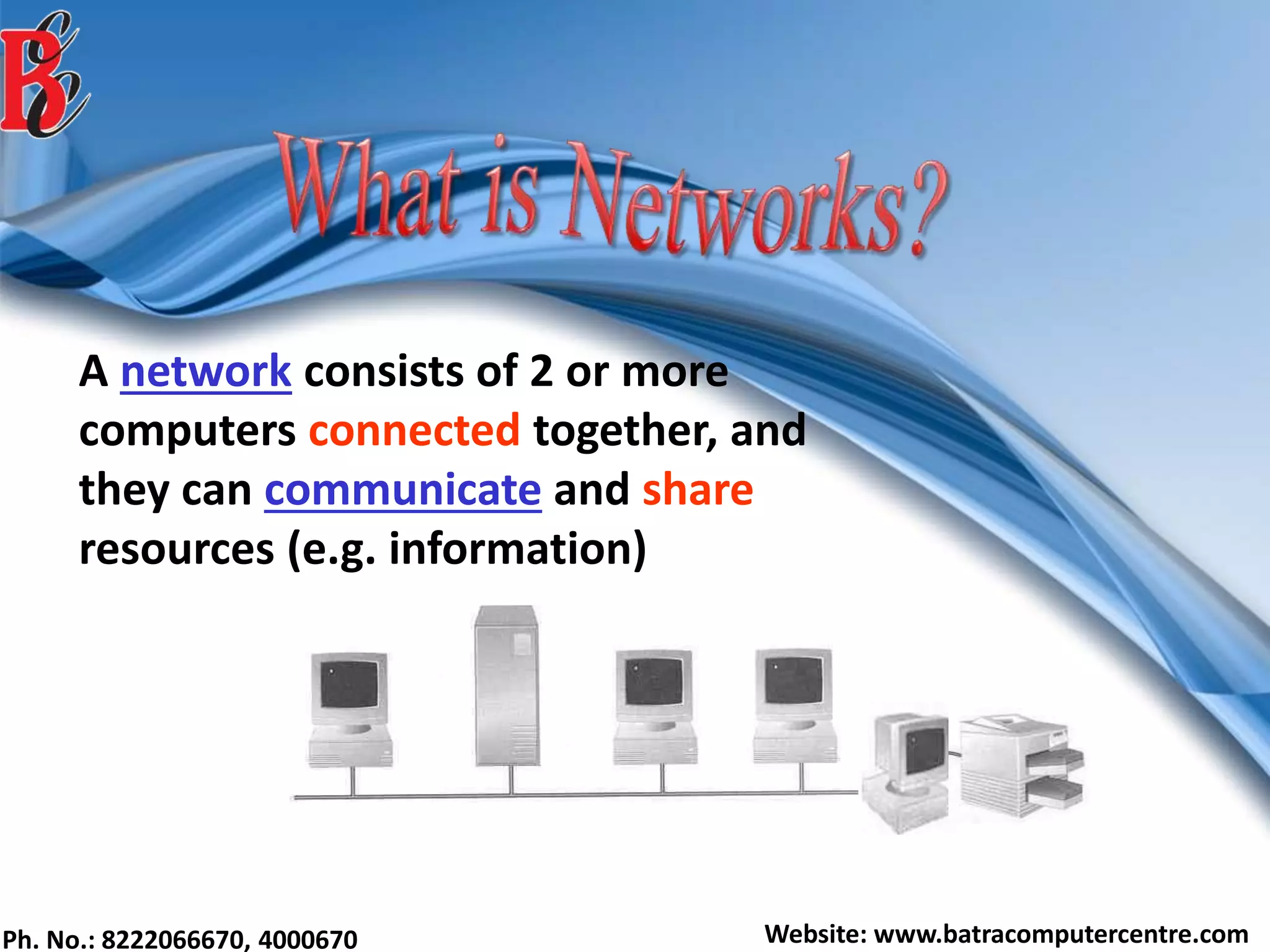
A network consists of 2 or more
computers connected together, and
they can communicate and share
resources (e.g. information)
Ph. No.: 8222066670, 4000670 Website: www.batracomputercentre.com
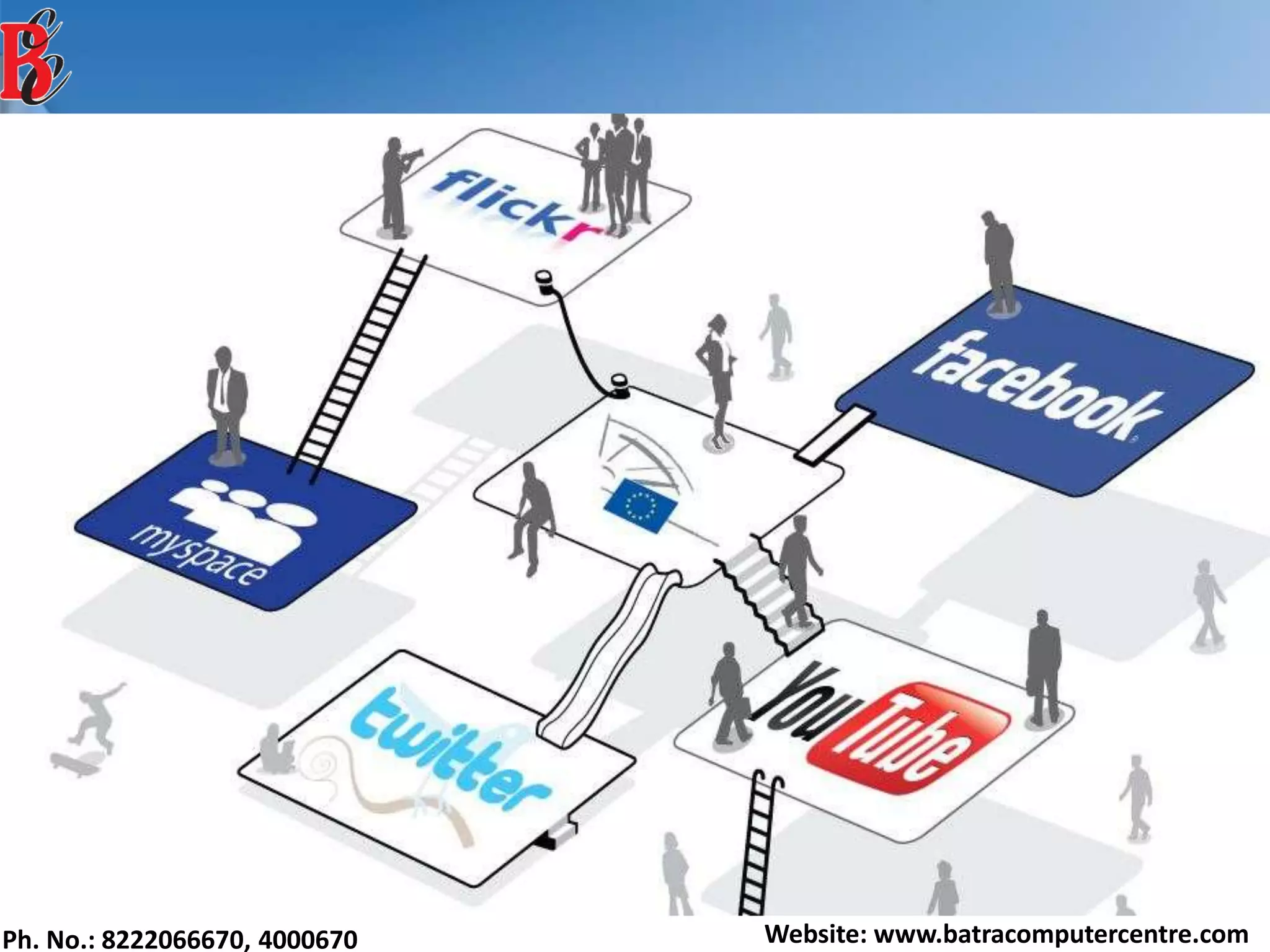
• Sharing information — i.e. data communication
• Do you prefer these?
• Or this?
Ph. No.: 8222066670, 4000670 Website: www.batracomputercentre.com
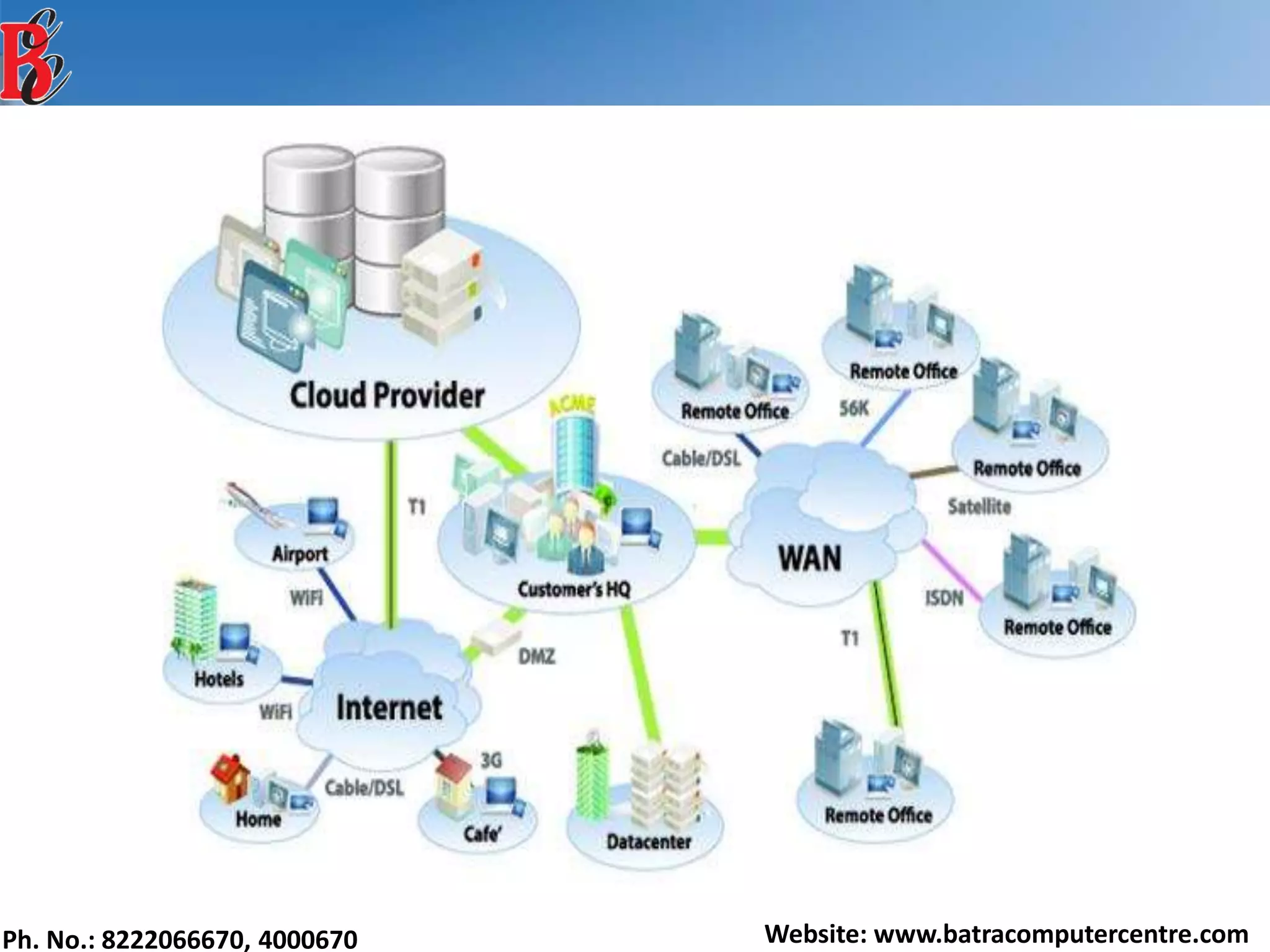
• Sharing hardware or software
• Centralize administration and support
• E.g. print document
• E.g. Internet-based, so everyone can access the same
administrative or support application from their PCs
Ph. No.: 8222066670, 4000670 Website: www.batracomputercentre.com
• Depending on one’s perspective, we can classify
networks in different ways
• Based on transmission media: Wired (UTP, coaxial cables, fiber-optic cables)
and Wireless
• Based on network size: LAN and WAN (and MAN)
• Based on management method: Peer-to-peer and Client/Server
• Based on topology (connectivity): Bus, Star, Ring …
:
:
Ph. No.: 8222066670, 4000670 Website: www.batracomputercentre.com
• Two main categories:
– Guided ― wires, cables
– Unguided ― wireless transmission, e.g. radio,
microwave, infrared, sound, sonar
• We will concentrate on guided media here:
– Twisted-Pair cables:
Unshielded Twisted-Pair (UTP) cables
Shielded Twisted-Pair (STP) cables
– Coaxial cables
– Fiber-optic cables
Ph. No.: 8222066670, 4000670 Website: www.batracomputercentre.com
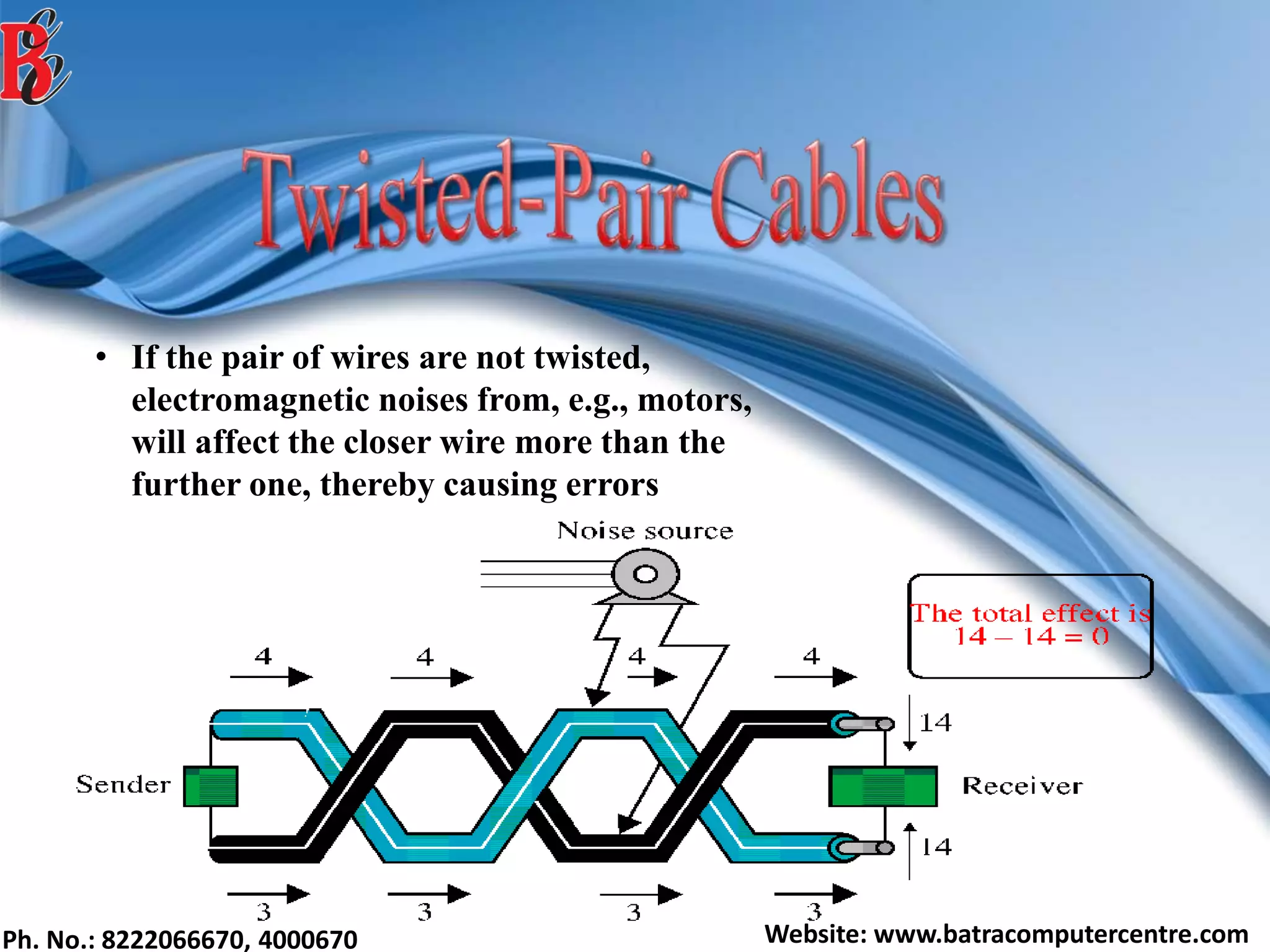
• If the pair of wires are not twisted,
electromagnetic noises from, e.g., motors,
will affect the closer wire more than the
further one, thereby causing errors
Ph. No.: 8222066670, 4000670 Website: www.batracomputercentre.com
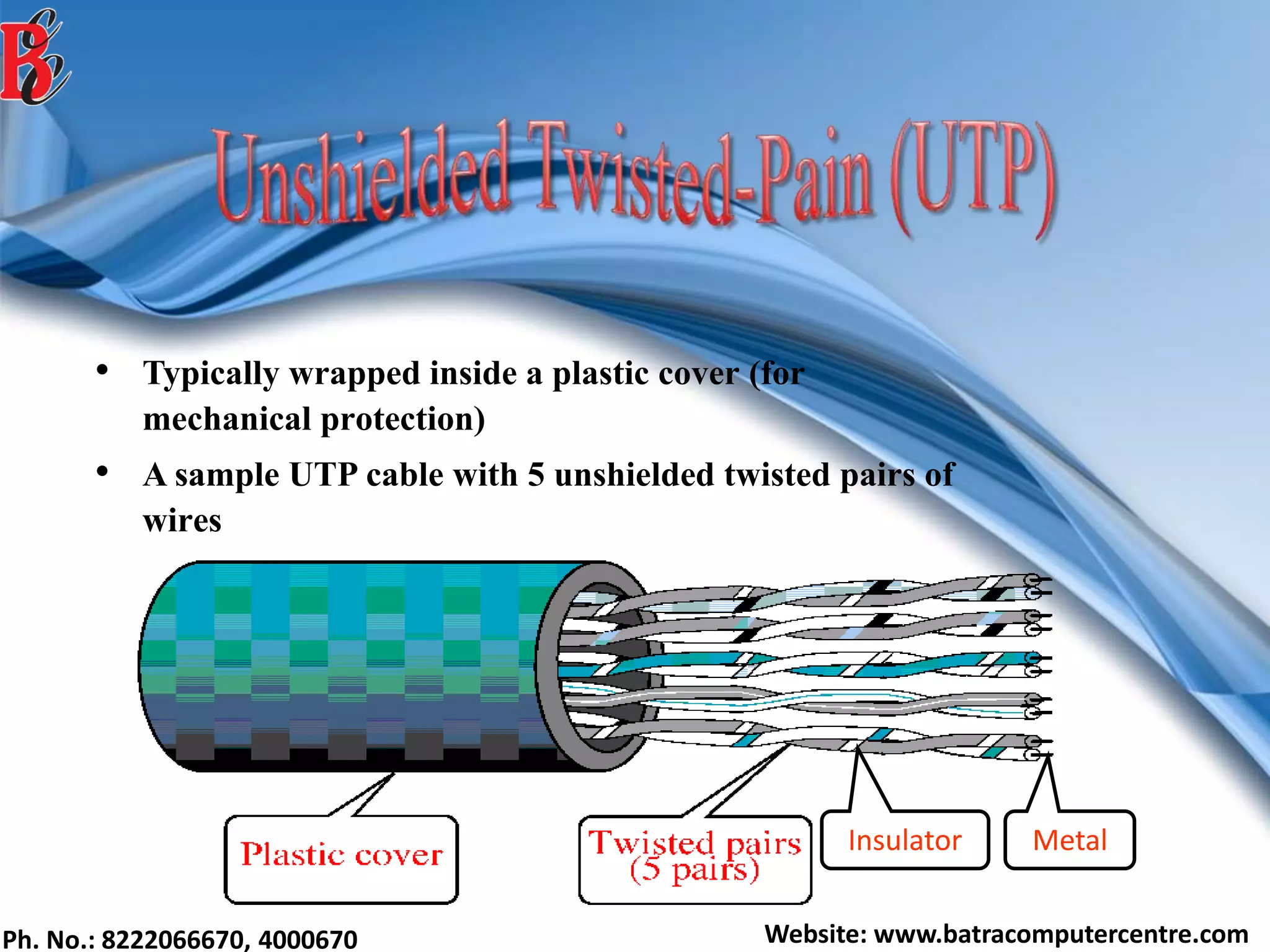
• Typically wrapped inside a plastic cover (for
mechanical protection)
• A sample UTP cable with 5 unshielded twisted pairs of
wires
MetalInsulator
Ph. No.: 8222066670, 4000670 Website: www.batracomputercentre.com
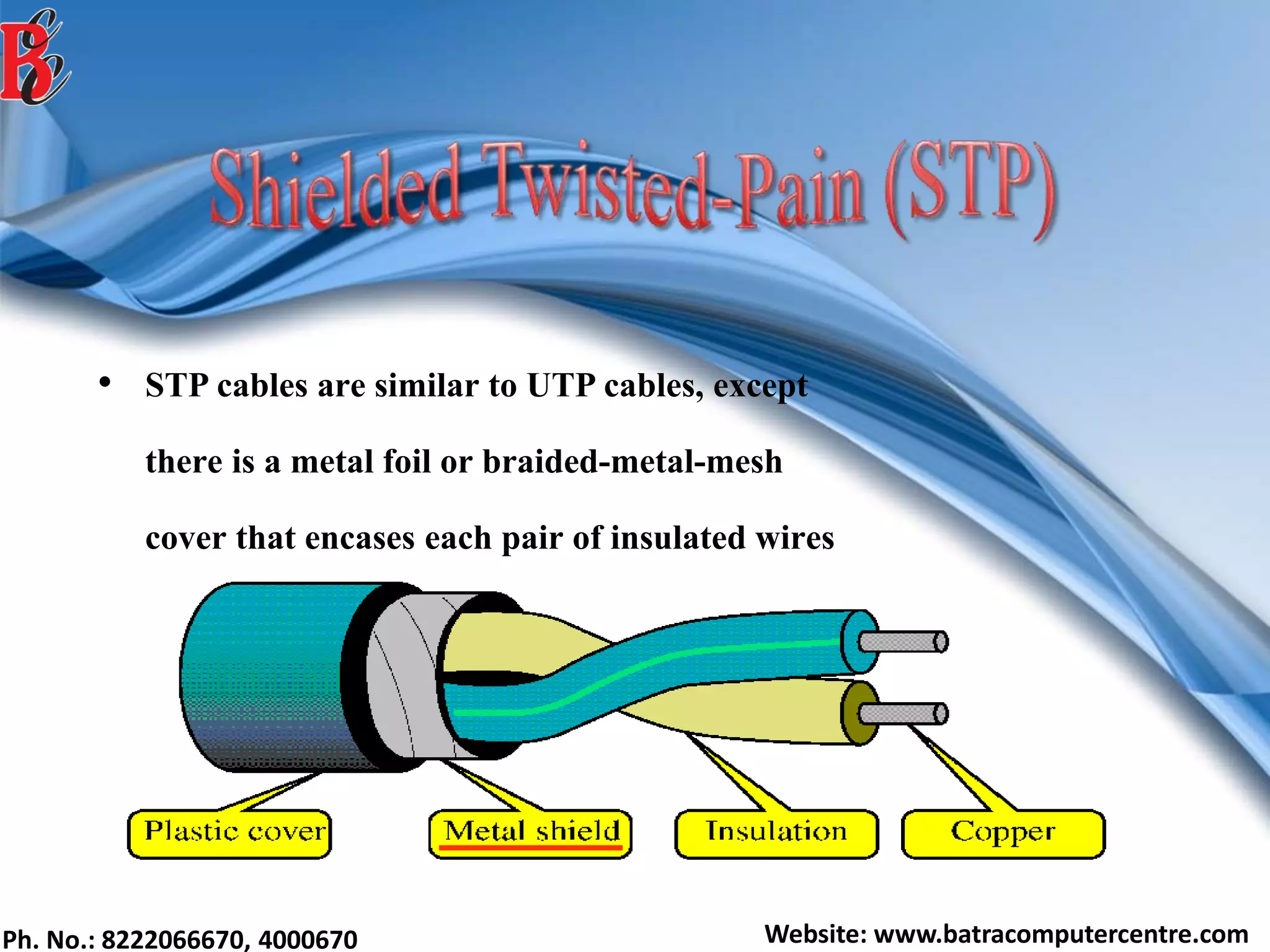
• STP cables are similar to UTP cables, except
there is a metal foil or braided-metal-mesh
cover that encases each pair of insulated wires
Ph. No.: 8222066670, 4000670 Website: www.batracomputercentre.com
EIA classifies UTP cables according to the quality:
• Category 1 ― the lowest quality, only good for voice, mainly
found in very old buildings, not recommended now
• Category 2 ― good for voice and low data rates (up to 4Mbps for
low-speed token ring networks)
• Category 3 ― at least 3 twists per foot, for up to 10 Mbps
(common in phone networks in residential buildings)
• Category 4 ― up to 16 Mbps (mainly for token rings)
• Category 5 (or 5e) ― up to 100 Mbps (common for networks
targeted for high-speed data communications)
• Category 6 ― more twists than Cat 5, up to 1 Gbps
Ph. No.: 8222066670, 4000670 Website: www.batracomputercentre.com
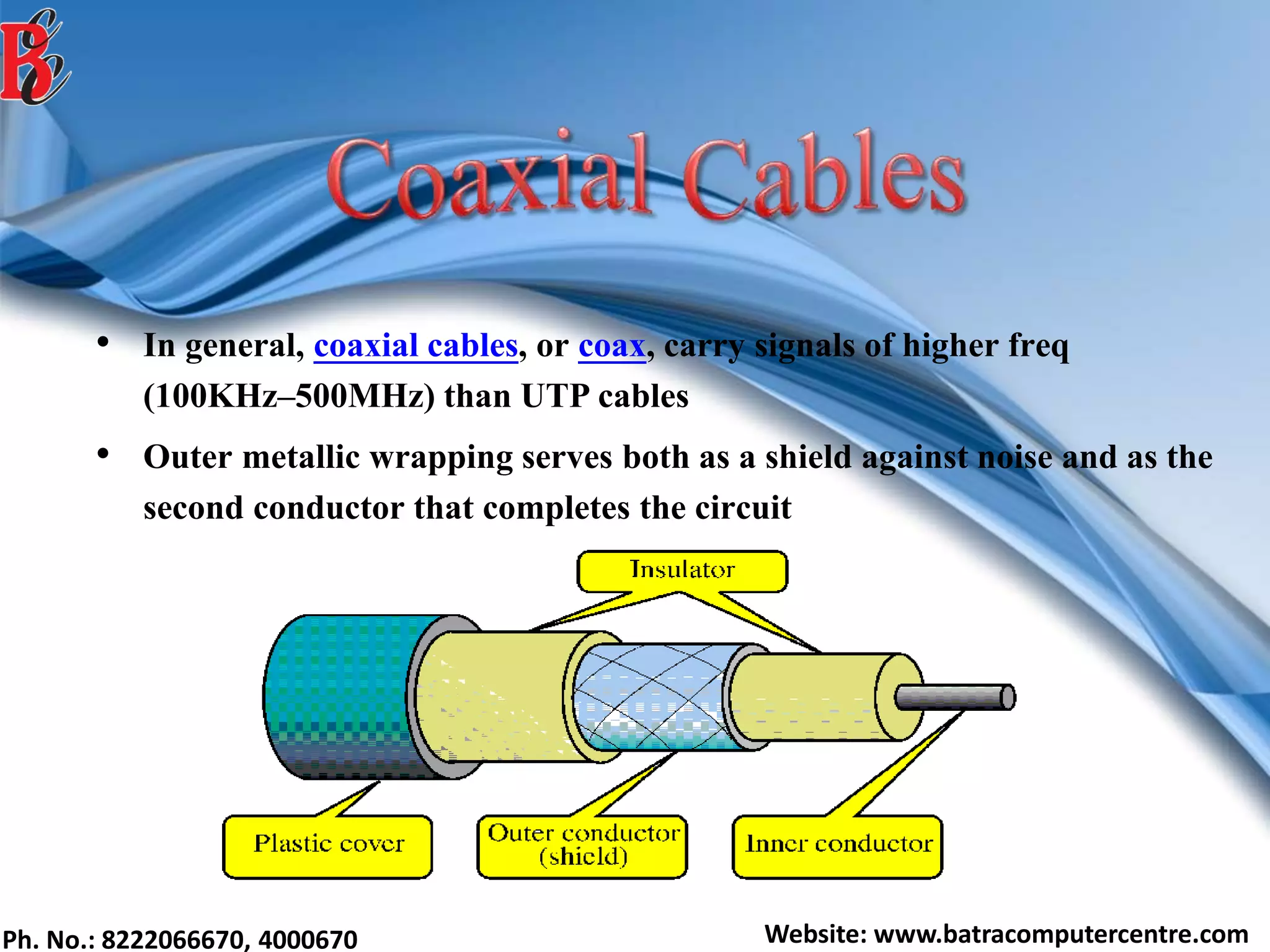
• In general, coaxial cables, or coax, carry signals of higher freq
(100KHz–500MHz) than UTP cables
• Outer metallic wrapping serves both as a shield against noise and as the
second conductor that completes the circuit
Ph. No.: 8222066670, 4000670 Website: www.batracomputercentre.com
• Light travels at 3108 ms-1 in free space and is the fastest possible speed
in the Universe
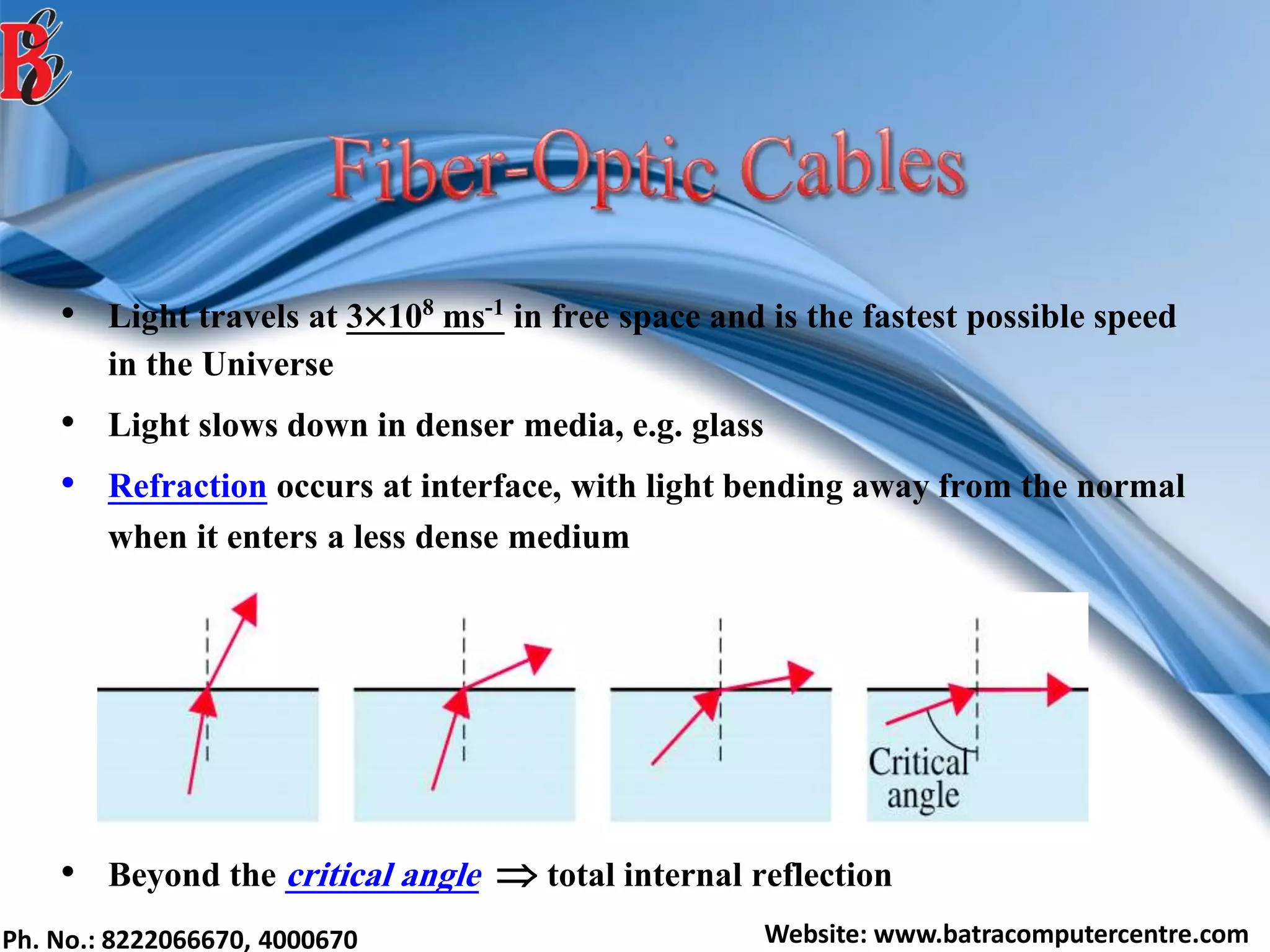
• Light slows down in denser media, e.g. glass
• Refraction occurs at interface, with light bending away from the normal
when it enters a less dense medium
• Beyond the critical angle  total internal reflection
Ph. No.: 8222066670, 4000670 Website: www.batracomputercentre.com
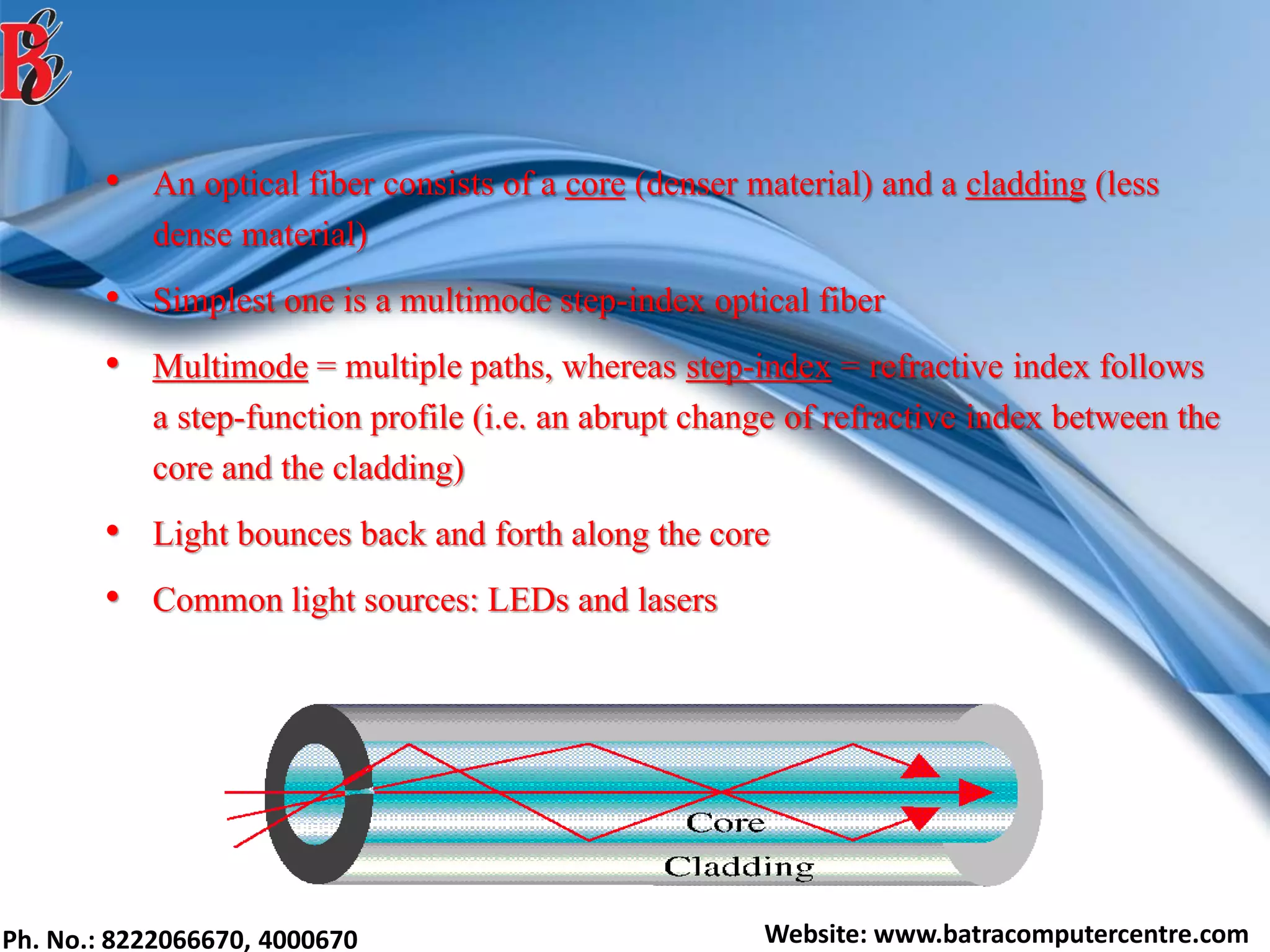
• An optical fiber consists of a core (denser material) and a cladding (less
dense material)
• Simplest one is a multimode step-index optical fiber
• Multimode = multiple paths, whereas step-index = refractive index follows
a step-function profile (i.e. an abrupt change of refractive index between the
core and the cladding)
• Light bounces back and forth along the core
• Common light sources: LEDs and lasers
Ph. No.: 8222066670, 4000670 Website: www.batracomputercentre.com
 Noise resistance ― external light is blocked by outer jacket
 Less signal attenuation ― a signal can run for miles without
regeneration (currently, the lowest measured loss is about ~4% or
0.16dB per km)
 Higher bandwidth ― currently, limits on data rates come from the
signal generation/reception technology, not the fiber itself
 Cost ― Optical fibers are expensive
 Installation/maintenance ― any crack in the core will degrade the
signal, and all connections must be perfectly aligned
Ph. No.: 8222066670, 4000670 Website: www.batracomputercentre.com
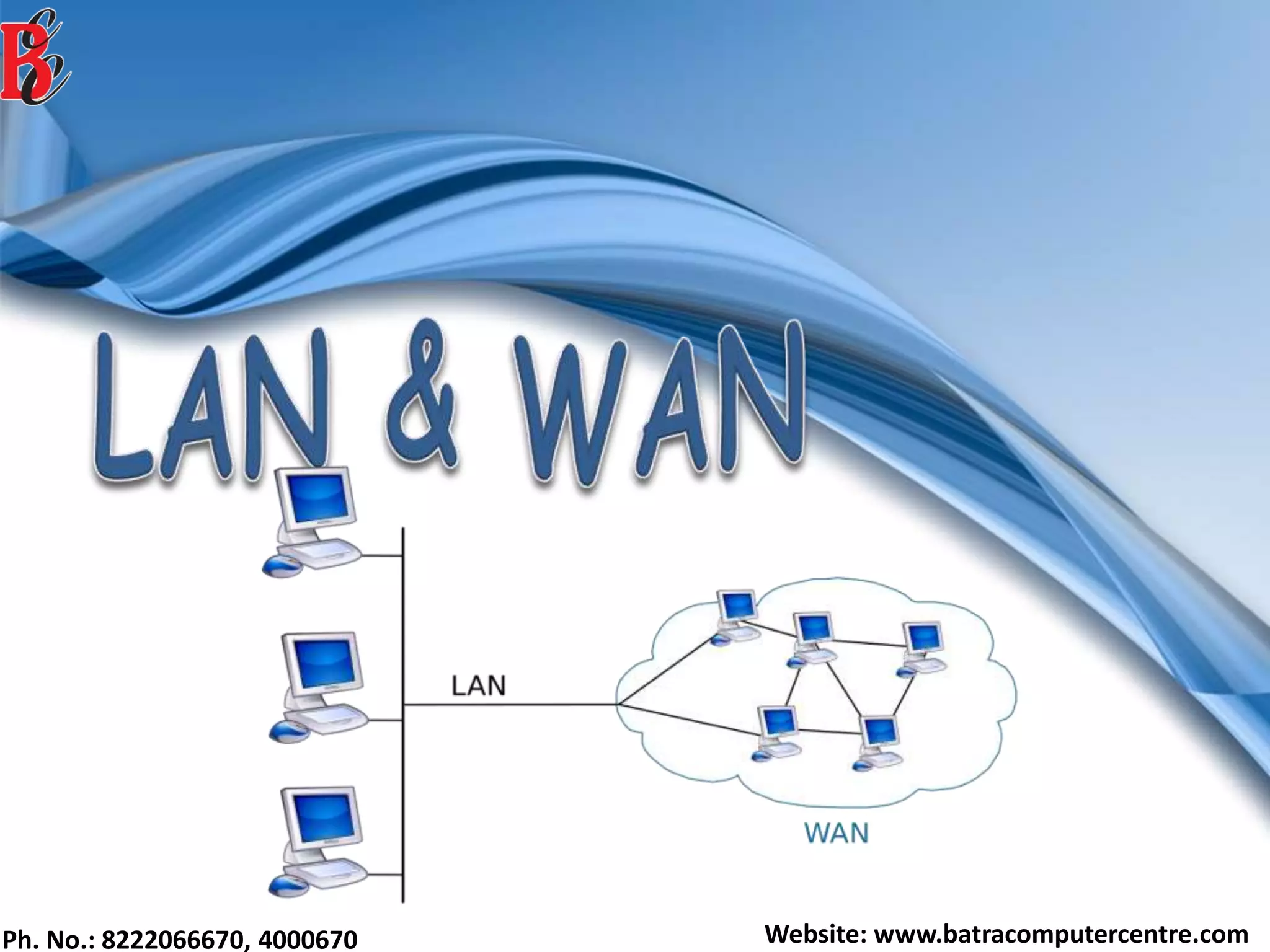
• Local Area Network (LAN)
• Small network, short distance
• A room, a floor, a building
• Limited by no. of computers and distance covered
• Usually one kind of technology throughout the LAN
• Serve a department within an organization
• Examples:
• Network inside the Student Computer Room
• Network inside CF502
• Network inside your home
Ph. No.: 8222066670, 4000670 Website: www.batracomputercentre.com
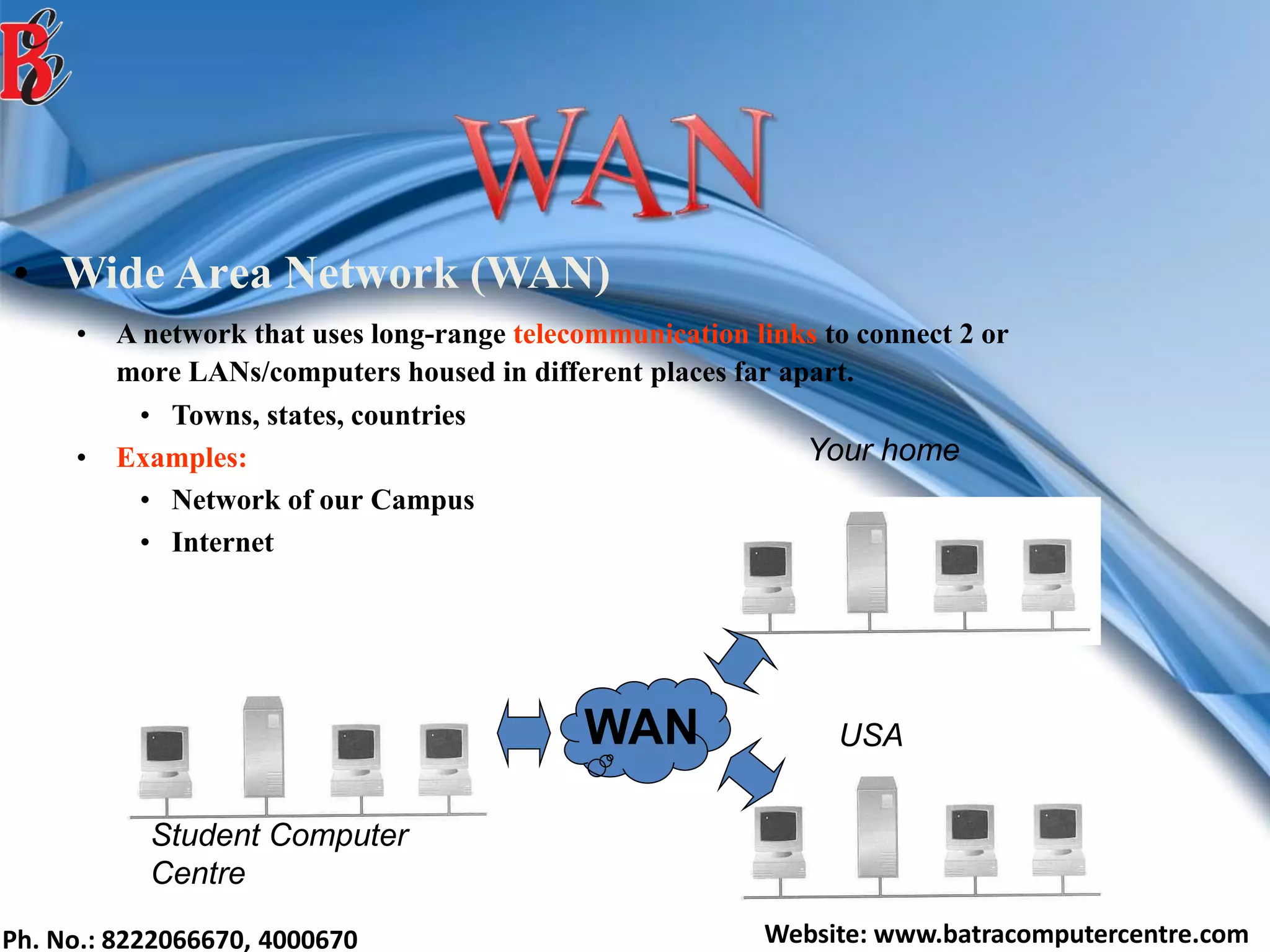
• Wide Area Network (WAN)
• A network that uses long-range telecommunication links to connect 2 or
more LANs/computers housed in different places far apart.
• Towns, states, countries
• Examples:
• Network of our Campus
• Internet
Student Computer
Centre
Your home
USAWAN
Ph. No.: 8222066670, 4000670 Website: www.batracomputercentre.com
Example WAN technologies:
• ISDN – Integrated Service Digital Network
• Basic rate: 192 Kbps Primary rate: 1.544Mbps
• T-Carriers ― basically digital phone lines
• T1: 1.544Mbps T3: 28T1
• Frame relay
• Each link offers 1.544Mbps or even higher
• ATM – Asynchronous Transfer Mode
• Support B-ISDN: 155Mbps or 622Mbps or higher
• SONET – Synchronous Optical Network
• Basic rate OC1: 51.84Mbps
• Support OC12 and up to OC192 (9953.28Mbps) or even higher in the
future
Ph. No.: 8222066670, 4000670 Website: www.batracomputercentre.com
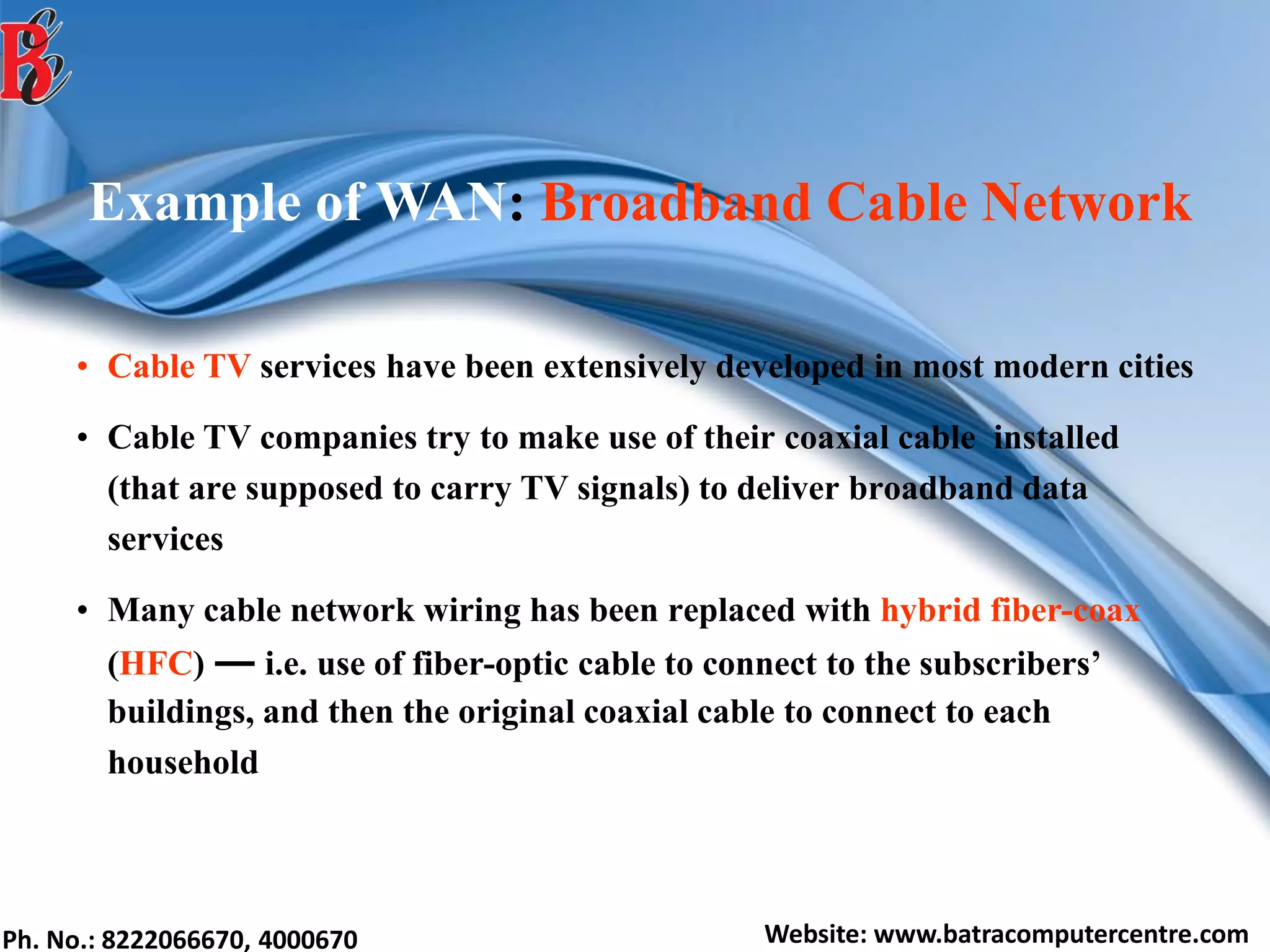
Example of WAN: Broadband Cable Network
• Cable TV services have been extensively developed in most modern cities
• Cable TV companies try to make use of their coaxial cable installed
(that are supposed to carry TV signals) to deliver broadband data
services
• Many cable network wiring has been replaced with hybrid fiber-coax
(HFC) ― i.e. use of fiber-optic cable to connect to the subscribers’
buildings, and then the original coaxial cable to connect to each
household
Ph. No.: 8222066670, 4000670 Website: www.batracomputercentre.com
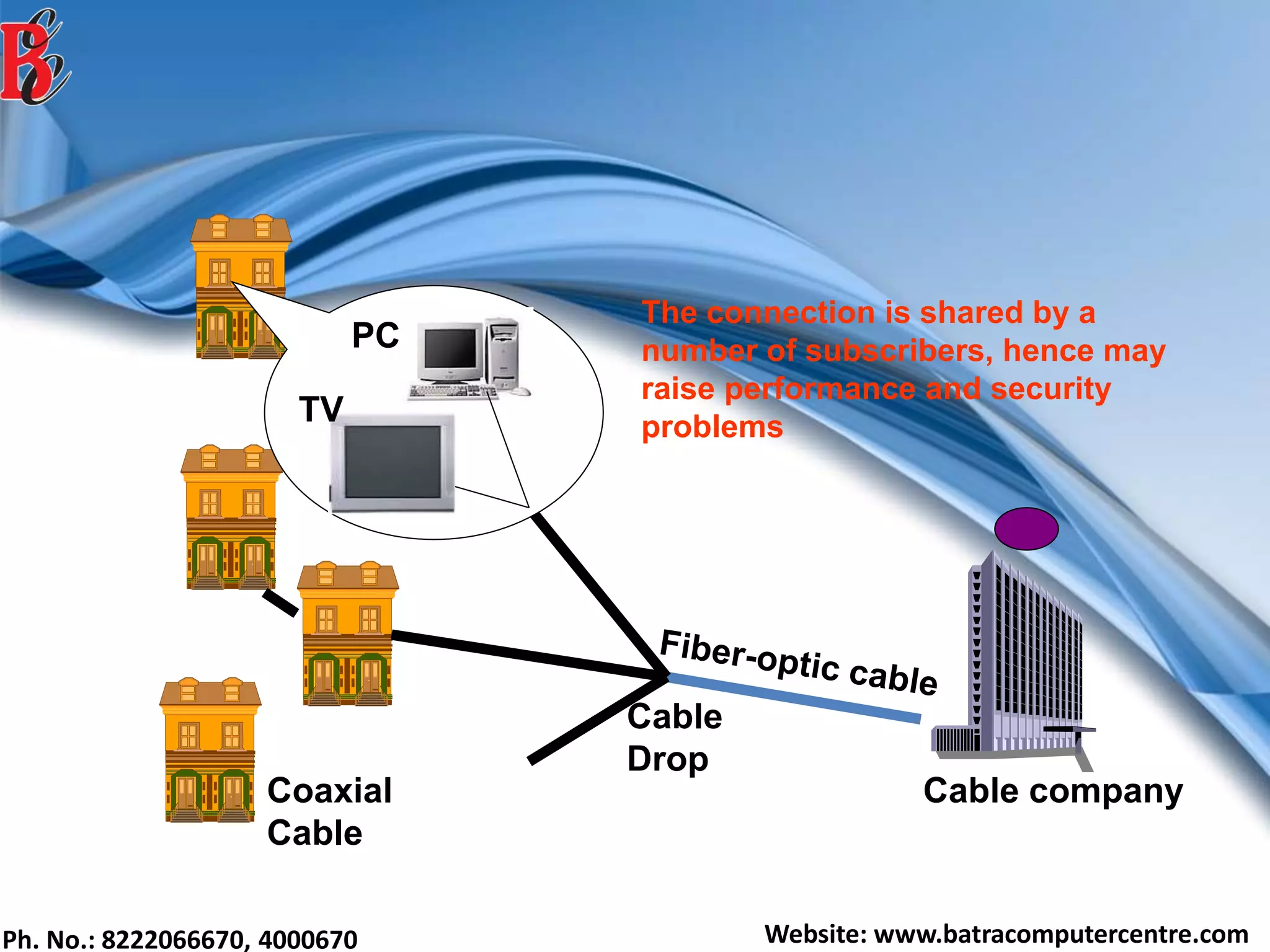
The connection is shared by a
number of subscribers, hence may
raise performance and security
problems
Cable companyCoaxial
Cable
TV
PC
Cable
Drop
Ph. No.: 8222066670, 4000670 Website: www.batracomputercentre.com
• Cable is an asymmetrical technology
• Downstream: max 36 Mbps
• Upstream: max 10 Mbps
• May be reduced to 3 – 10 Mbps downstream and 2 Mbps
upstream, depending on no. of subscribers
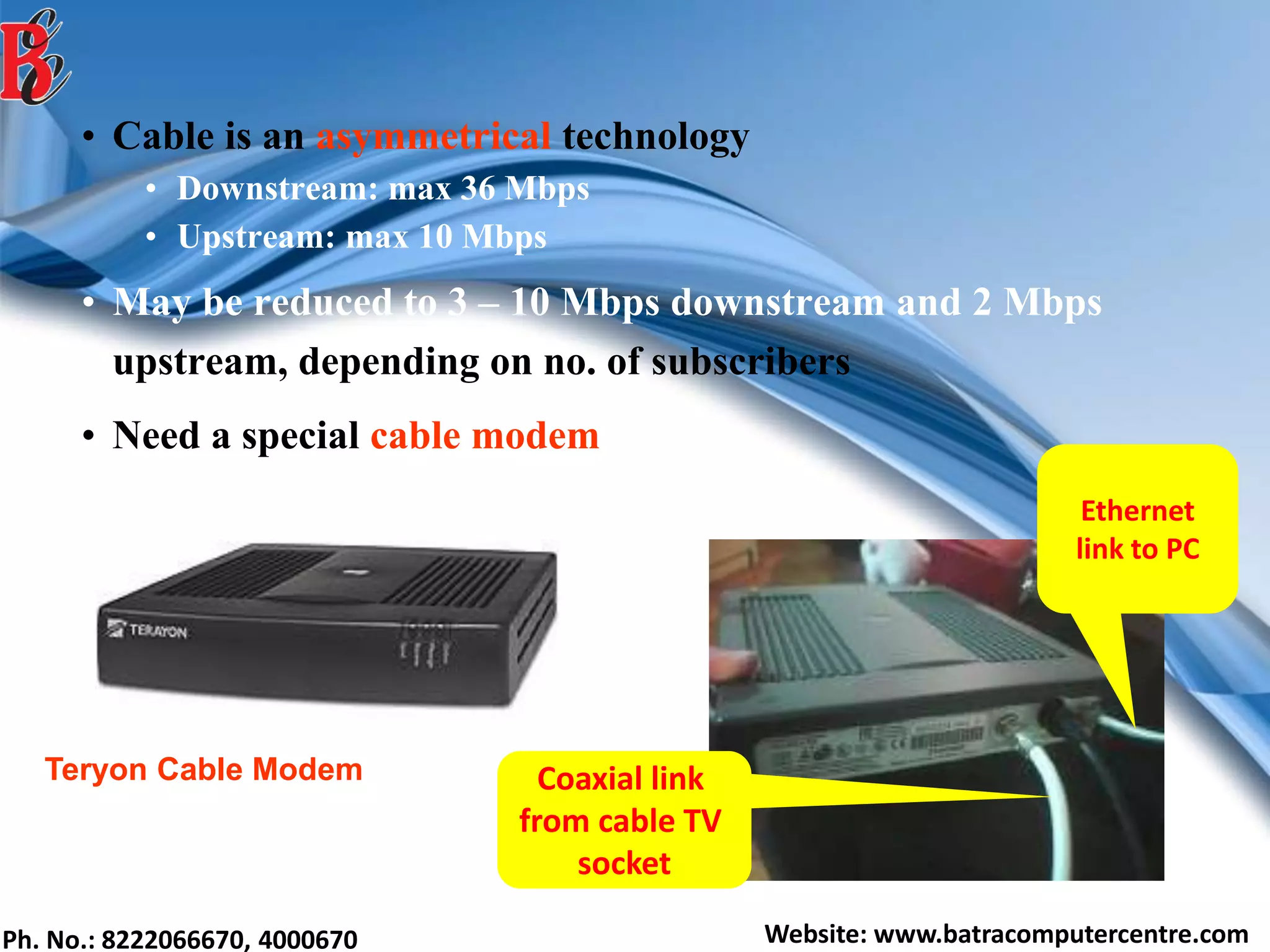
• Need a special cable modem
Ethernet
link to PC
Coaxial link
from cable TV
socket
Teryon Cable Modem
Ph. No.: 8222066670, 4000670 Website: www.batracomputercentre.com
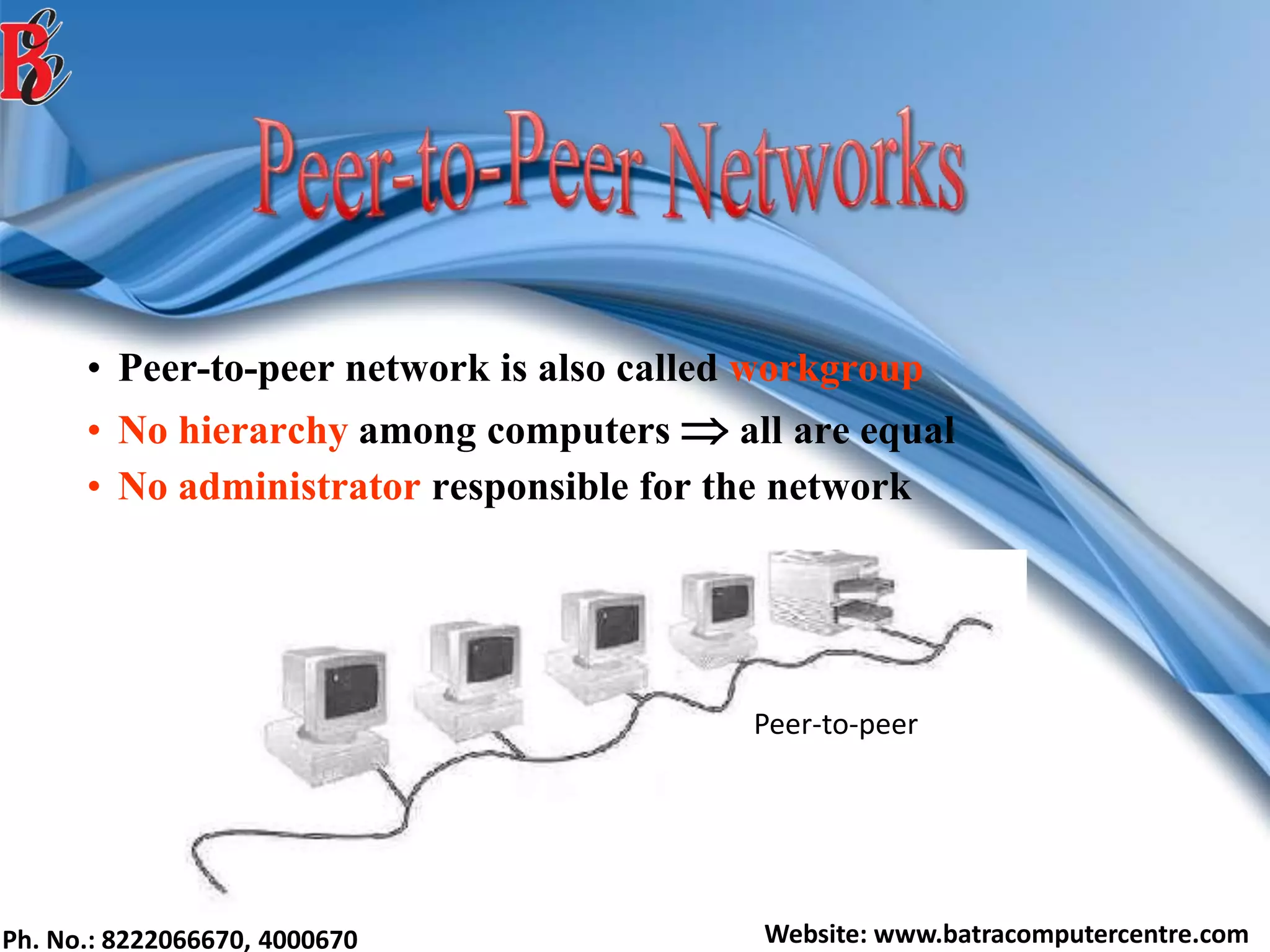
• Peer-to-peer network is also called workgroup
• No hierarchy among computers  all are equal
• No administrator responsible for the network
Peer-to-peer
Ph. No.: 8222066670, 4000670 Website: www.batracomputercentre.com
• Advantages of peer-to-peer networks:
• Low cost
• Simple to configure
• User has full accessibility of the computer
• Disadvantages of peer-to-peer networks:
• May have duplication in resources
• Difficult to uphold security policy
• Difficult to handle uneven loading
• Where peer-to-peer network is appropriate:
• 10 or less users
• No specialized services required
• Security is not an issue
• Only limited growth in the foreseeable future
Ph. No.: 8222066670, 4000670 Website: www.batracomputercentre.com
• Network Clients (Workstation)
• Computers that request network resources or services
• Network Servers
• Computers that manage and provide network resources and services to clients
• Usually have more processing power, memory and hard disk space than
clients
• Run Network Operating System that can manage not only data, but also
users, groups, security, and applications on the network
• Servers often have a more stringent requirement on its performance and
reliability
Ph. No.: 8222066670, 4000670 Website: www.batracomputercentre.com
• Advantages of client/server networks
• Facilitate resource sharing – centrally administrate and
control
• Facilitate system backup and improve fault tolerance
• Enhance security – only administrator can have access
to Server
• Support more users – difficult to achieve with peer-to-
peer networks
• Disadvantages of client/server networks
• High cost for Servers
• Need expert to configure the network
• Introduce a single point of failure to the system
Ph. No.: 8222066670, 4000670 Website: www.batracomputercentre.com
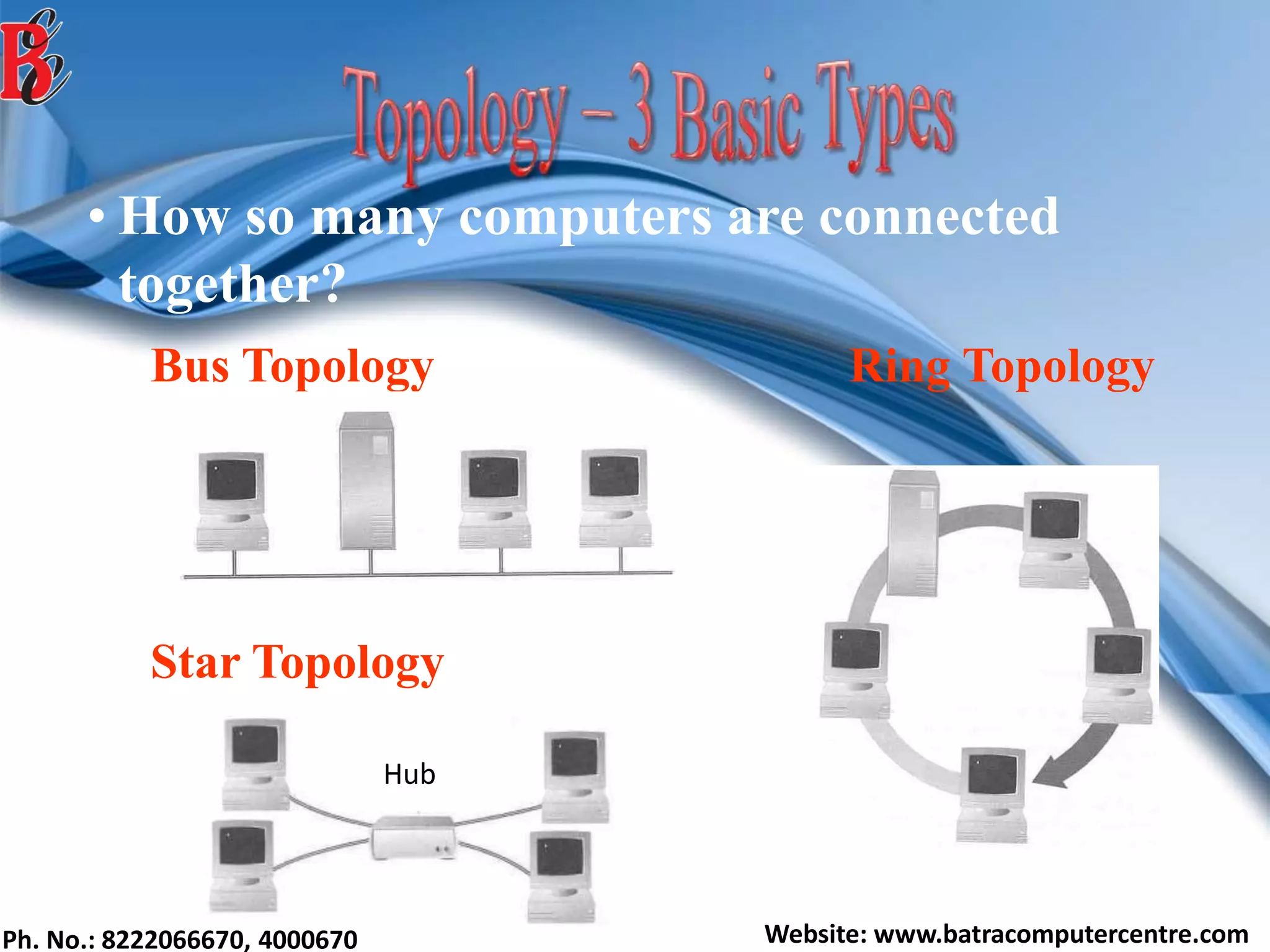
• How so many computers are connected
together?
Bus Topology Ring Topology
Star Topology
Hub
Ph. No.: 8222066670, 4000670 Website: www.batracomputercentre.com
• Bus Topology
• Simple and low-cost
• A single cable called a trunk (backbone, segment)
• Only one computer can send messages at a time
• Passive topology - computer only listen for, not regenerate data
• Star Topology
• Each computer has a cable connected to a single point
• More cabling, hence higher cost
• All signals transmission through the hub; if down, entire network down
• Depending on the intelligence of hub, two or more computers may send
message at the same time
Ph. No.: 8222066670, 4000670 Website: www.batracomputercentre.com
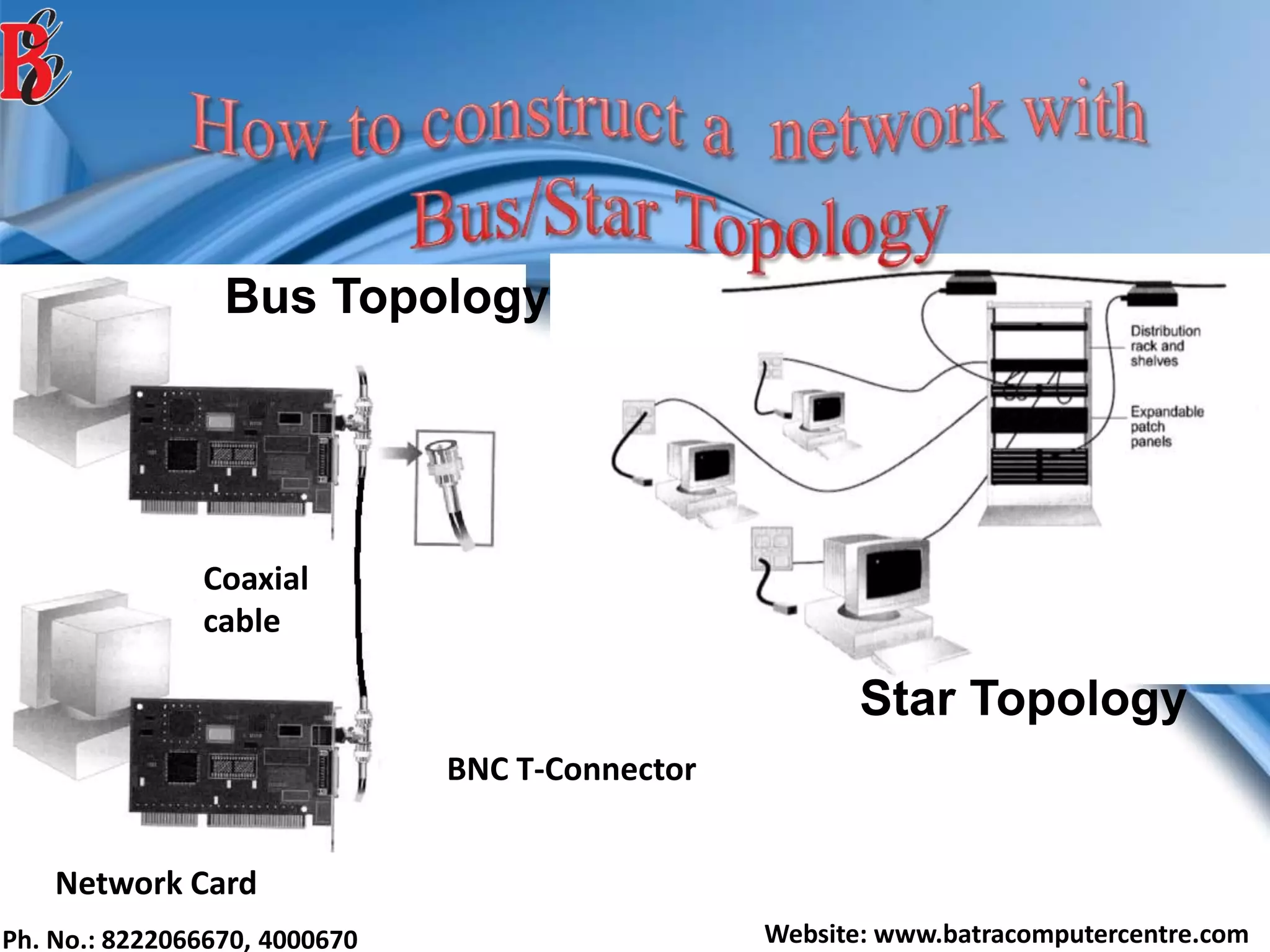
Star Topology
Bus Topology
BNC T-Connector
Coaxial
cable
Network Card
Ph. No.: 8222066670, 4000670 Website: www.batracomputercentre.com
T
T
T
dat
a
T
dat
a
T
dat
a
T dat
a
T dat
a
T dat
a
T Ack
T Ack
T Ack
TAck T
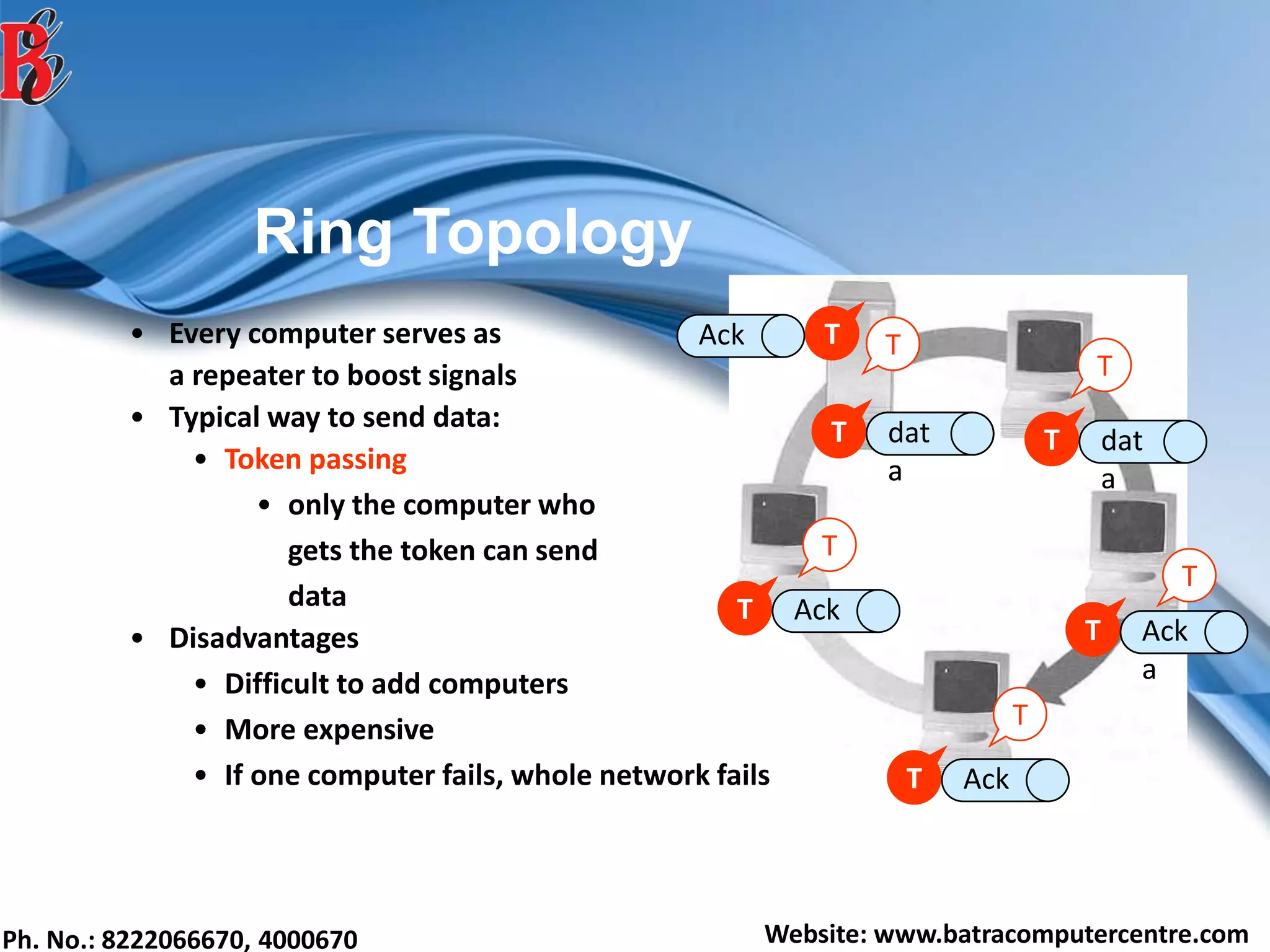
Ring Topology
• Every computer serves as
a repeater to boost signals
• Typical way to send data:
• Token passing
• only the computer who
gets the token can send
data
• Disadvantages
• Difficult to add computers
• More expensive
• If one computer fails, whole network fails
Ph. No.: 8222066670, 4000670 Website: www.batracomputercentre.com
ADDRESS:
SCO -15, Dayal Bagh,
Near Hanuman Mandir
Ambala Cantt-13300, Haryana
Ph. No.: 9729666670, 8222066670 &0171-4000670
Email ID: info.jatinbatra@gmail.com
Website: www.batracomputercentre.com
Ph. No.: 8222066670, 4000670 Website: www.batracomputercentre.com

Networking Training in Ambala ! Batra Computer Centre

  • 1.
    Ph. No.: 8222066670,4000670 Email: info.jatinbatra@gmail.com Website: www.batracomputercentre.com
  • 2.
    Ph. No.: 8222066670,4000670 Website: www.batracomputercentre.com
  • 3.
    Ph. No.: 8222066670,4000670 Website: www.batracomputercentre.com
  • 4.
    Ph. No.: 8222066670,4000670 Website: www.batracomputercentre.com A network consists of 2 or more computers connected together, and they can communicate and share resources (e.g. information)
  • 5.
    Ph. No.: 8222066670,4000670 Website: www.batracomputercentre.com • Sharing information — i.e. data communication • Do you prefer these? • Or this?
  • 6.
    Ph. No.: 8222066670,4000670 Website: www.batracomputercentre.com • Sharing hardware or software • Centralize administration and support • E.g. print document • E.g. Internet-based, so everyone can access the same administrative or support application from their PCs
  • 7.
    Ph. No.: 8222066670,4000670 Website: www.batracomputercentre.com • Depending on one’s perspective, we can classify networks in different ways • Based on transmission media: Wired (UTP, coaxial cables, fiber-optic cables) and Wireless • Based on network size: LAN and WAN (and MAN) • Based on management method: Peer-to-peer and Client/Server • Based on topology (connectivity): Bus, Star, Ring … : :
  • 8.
    Ph. No.: 8222066670,4000670 Website: www.batracomputercentre.com • Two main categories: – Guided ― wires, cables – Unguided ― wireless transmission, e.g. radio, microwave, infrared, sound, sonar • We will concentrate on guided media here: – Twisted-Pair cables: Unshielded Twisted-Pair (UTP) cables Shielded Twisted-Pair (STP) cables – Coaxial cables – Fiber-optic cables
  • 9.
    Ph. No.: 8222066670,4000670 Website: www.batracomputercentre.com • If the pair of wires are not twisted, electromagnetic noises from, e.g., motors, will affect the closer wire more than the further one, thereby causing errors
  • 10.
    Ph. No.: 8222066670,4000670 Website: www.batracomputercentre.com • Typically wrapped inside a plastic cover (for mechanical protection) • A sample UTP cable with 5 unshielded twisted pairs of wires MetalInsulator
  • 11.
    Ph. No.: 8222066670,4000670 Website: www.batracomputercentre.com • STP cables are similar to UTP cables, except there is a metal foil or braided-metal-mesh cover that encases each pair of insulated wires
  • 12.
    Ph. No.: 8222066670,4000670 Website: www.batracomputercentre.com EIA classifies UTP cables according to the quality: • Category 1 ― the lowest quality, only good for voice, mainly found in very old buildings, not recommended now • Category 2 ― good for voice and low data rates (up to 4Mbps for low-speed token ring networks) • Category 3 ― at least 3 twists per foot, for up to 10 Mbps (common in phone networks in residential buildings) • Category 4 ― up to 16 Mbps (mainly for token rings) • Category 5 (or 5e) ― up to 100 Mbps (common for networks targeted for high-speed data communications) • Category 6 ― more twists than Cat 5, up to 1 Gbps
  • 13.
    Ph. No.: 8222066670,4000670 Website: www.batracomputercentre.com • In general, coaxial cables, or coax, carry signals of higher freq (100KHz–500MHz) than UTP cables • Outer metallic wrapping serves both as a shield against noise and as the second conductor that completes the circuit
  • 14.
    Ph. No.: 8222066670,4000670 Website: www.batracomputercentre.com • Light travels at 3108 ms-1 in free space and is the fastest possible speed in the Universe • Light slows down in denser media, e.g. glass • Refraction occurs at interface, with light bending away from the normal when it enters a less dense medium • Beyond the critical angle  total internal reflection
  • 15.
    Ph. No.: 8222066670,4000670 Website: www.batracomputercentre.com • An optical fiber consists of a core (denser material) and a cladding (less dense material) • Simplest one is a multimode step-index optical fiber • Multimode = multiple paths, whereas step-index = refractive index follows a step-function profile (i.e. an abrupt change of refractive index between the core and the cladding) • Light bounces back and forth along the core • Common light sources: LEDs and lasers
  • 16.
    Ph. No.: 8222066670,4000670 Website: www.batracomputercentre.com  Noise resistance ― external light is blocked by outer jacket  Less signal attenuation ― a signal can run for miles without regeneration (currently, the lowest measured loss is about ~4% or 0.16dB per km)  Higher bandwidth ― currently, limits on data rates come from the signal generation/reception technology, not the fiber itself  Cost ― Optical fibers are expensive  Installation/maintenance ― any crack in the core will degrade the signal, and all connections must be perfectly aligned
  • 17.
    Ph. No.: 8222066670,4000670 Website: www.batracomputercentre.com
  • 18.
    Ph. No.: 8222066670,4000670 Website: www.batracomputercentre.com • Local Area Network (LAN) • Small network, short distance • A room, a floor, a building • Limited by no. of computers and distance covered • Usually one kind of technology throughout the LAN • Serve a department within an organization • Examples: • Network inside the Student Computer Room • Network inside CF502 • Network inside your home
  • 19.
    Ph. No.: 8222066670,4000670 Website: www.batracomputercentre.com • Wide Area Network (WAN) • A network that uses long-range telecommunication links to connect 2 or more LANs/computers housed in different places far apart. • Towns, states, countries • Examples: • Network of our Campus • Internet Student Computer Centre Your home USAWAN
  • 20.
    Ph. No.: 8222066670,4000670 Website: www.batracomputercentre.com Example WAN technologies: • ISDN – Integrated Service Digital Network • Basic rate: 192 Kbps Primary rate: 1.544Mbps • T-Carriers ― basically digital phone lines • T1: 1.544Mbps T3: 28T1 • Frame relay • Each link offers 1.544Mbps or even higher • ATM – Asynchronous Transfer Mode • Support B-ISDN: 155Mbps or 622Mbps or higher • SONET – Synchronous Optical Network • Basic rate OC1: 51.84Mbps • Support OC12 and up to OC192 (9953.28Mbps) or even higher in the future
  • 21.
    Ph. No.: 8222066670,4000670 Website: www.batracomputercentre.com Example of WAN: Broadband Cable Network • Cable TV services have been extensively developed in most modern cities • Cable TV companies try to make use of their coaxial cable installed (that are supposed to carry TV signals) to deliver broadband data services • Many cable network wiring has been replaced with hybrid fiber-coax (HFC) ― i.e. use of fiber-optic cable to connect to the subscribers’ buildings, and then the original coaxial cable to connect to each household
  • 22.
    Ph. No.: 8222066670,4000670 Website: www.batracomputercentre.com The connection is shared by a number of subscribers, hence may raise performance and security problems Cable companyCoaxial Cable TV PC Cable Drop
  • 23.
    Ph. No.: 8222066670,4000670 Website: www.batracomputercentre.com • Cable is an asymmetrical technology • Downstream: max 36 Mbps • Upstream: max 10 Mbps • May be reduced to 3 – 10 Mbps downstream and 2 Mbps upstream, depending on no. of subscribers • Need a special cable modem Ethernet link to PC Coaxial link from cable TV socket Teryon Cable Modem
  • 24.
    Ph. No.: 8222066670,4000670 Website: www.batracomputercentre.com • Peer-to-peer network is also called workgroup • No hierarchy among computers  all are equal • No administrator responsible for the network Peer-to-peer
  • 25.
    Ph. No.: 8222066670,4000670 Website: www.batracomputercentre.com • Advantages of peer-to-peer networks: • Low cost • Simple to configure • User has full accessibility of the computer • Disadvantages of peer-to-peer networks: • May have duplication in resources • Difficult to uphold security policy • Difficult to handle uneven loading • Where peer-to-peer network is appropriate: • 10 or less users • No specialized services required • Security is not an issue • Only limited growth in the foreseeable future
  • 26.
    Ph. No.: 8222066670,4000670 Website: www.batracomputercentre.com • Network Clients (Workstation) • Computers that request network resources or services • Network Servers • Computers that manage and provide network resources and services to clients • Usually have more processing power, memory and hard disk space than clients • Run Network Operating System that can manage not only data, but also users, groups, security, and applications on the network • Servers often have a more stringent requirement on its performance and reliability
  • 27.
    Ph. No.: 8222066670,4000670 Website: www.batracomputercentre.com • Advantages of client/server networks • Facilitate resource sharing – centrally administrate and control • Facilitate system backup and improve fault tolerance • Enhance security – only administrator can have access to Server • Support more users – difficult to achieve with peer-to- peer networks • Disadvantages of client/server networks • High cost for Servers • Need expert to configure the network • Introduce a single point of failure to the system
  • 28.
    Ph. No.: 8222066670,4000670 Website: www.batracomputercentre.com • How so many computers are connected together? Bus Topology Ring Topology Star Topology Hub
  • 29.
    Ph. No.: 8222066670,4000670 Website: www.batracomputercentre.com • Bus Topology • Simple and low-cost • A single cable called a trunk (backbone, segment) • Only one computer can send messages at a time • Passive topology - computer only listen for, not regenerate data • Star Topology • Each computer has a cable connected to a single point • More cabling, hence higher cost • All signals transmission through the hub; if down, entire network down • Depending on the intelligence of hub, two or more computers may send message at the same time
  • 30.
    Ph. No.: 8222066670,4000670 Website: www.batracomputercentre.com Star Topology Bus Topology BNC T-Connector Coaxial cable Network Card
  • 31.
    Ph. No.: 8222066670,4000670 Website: www.batracomputercentre.com T T T dat a T dat a T dat a T dat a T dat a T dat a T Ack T Ack T Ack TAck T Ring Topology • Every computer serves as a repeater to boost signals • Typical way to send data: • Token passing • only the computer who gets the token can send data • Disadvantages • Difficult to add computers • More expensive • If one computer fails, whole network fails
  • 32.
    Ph. No.: 8222066670,4000670 Website: www.batracomputercentre.com
  • 33.
    Ph. No.: 8222066670,4000670 Website: www.batracomputercentre.com ADDRESS: SCO -15, Dayal Bagh, Near Hanuman Mandir Ambala Cantt-13300, Haryana Ph. No.: 9729666670, 8222066670 &0171-4000670 Email ID: info.jatinbatra@gmail.com Website: www.batracomputercentre.com
  • 34.
    Ph. No.: 8222066670,4000670 Website: www.batracomputercentre.com