7.1 nth Roots and Rational
Exponents
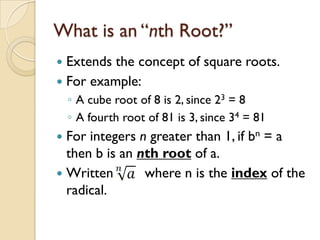
What is an “nth Root?”
 Extends the concept of square roots.
 For example:
    ◦ A cube root of 8 is 2, since 23 = 8
    ◦ A fourth root of 81 is 3, since 34 = 81
 For integers n greater than 1, if bn = a
  then b is an nth root of a.
 Written       where n is the index of the
  radical.
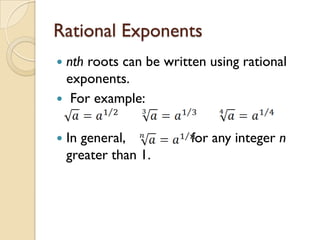
Rational Exponents
nth roots can be written using rational
 exponents.
 For example:


   In general,        for any integer n
    greater than 1.
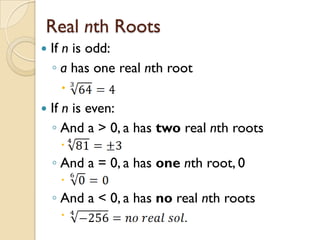
Real nth Roots
 If n is odd:
  ◦ a has one real nth root
     
 If n is even:
  ◦ And a > 0, a has two real nth roots
     
    ◦ And a = 0, a has one nth root, 0
     
    ◦ And a < 0, a has no real nth roots
     
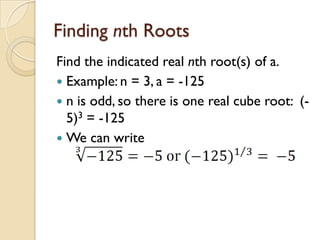
Finding nth Roots
Find the indicated real nth root(s) of a.
 Example: n = 3, a = -125
 n is odd, so there is one real cube root: (-
  5)3 = -125
 We can write
Example:
 n = 4, a = 16
 n is even, and a > 0, so 16 has two real 4th
  roots: 24 = 16 and (-2)4 = 16
 We can write
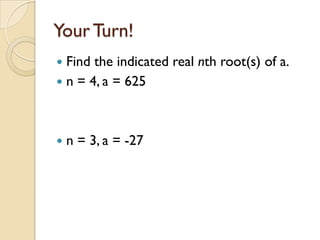
Your Turn!
 Find the indicated real nth root(s) of a.
 n = 4, a = 625


   n = 3, a = -27
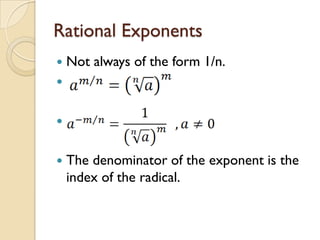
Rational Exponents
   Not always of the form 1/n.






   The denominator of the exponent is the
    index of the radical.
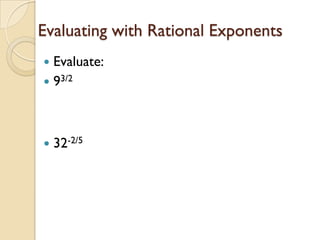
Evaluating with Rational Exponents
 Evaluate:
 93/2


   32-2/5
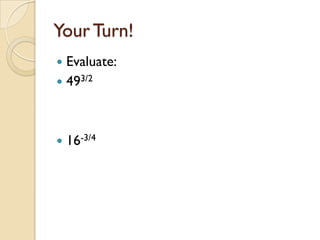
Your Turn!
 Evaluate:
 493/2


   16-3/4
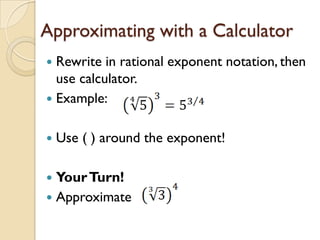
Approximating with a Calculator
 Rewrite in rational exponent notation, then
  use calculator.
 Example:


   Use ( ) around the exponent!

 Your Turn!
 Approximate
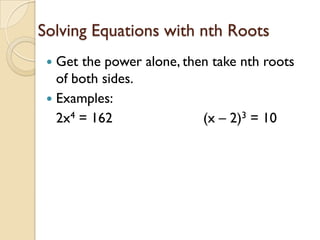
Solving Equations with nth Roots
  Get the power alone, then take nth roots
   of both sides.
  Examples:
   2x4 = 162               (x – 2)3 = 10
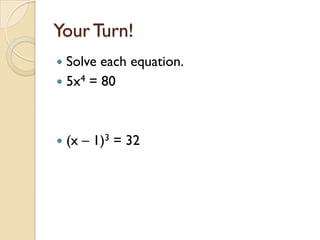
Your Turn!
 Solve each equation.
 5x4 = 80


   (x – 1)3 = 32

7.1 nth roots and rational exponents

  • 1.
    7.1 nth Rootsand Rational Exponents
  • 2.
    What is an“nth Root?”  Extends the concept of square roots.  For example: ◦ A cube root of 8 is 2, since 23 = 8 ◦ A fourth root of 81 is 3, since 34 = 81  For integers n greater than 1, if bn = a then b is an nth root of a.  Written where n is the index of the radical.
  • 3.
    Rational Exponents nth rootscan be written using rational exponents.  For example:  In general, for any integer n greater than 1.
  • 4.
    Real nth Roots If n is odd: ◦ a has one real nth root   If n is even: ◦ And a > 0, a has two real nth roots  ◦ And a = 0, a has one nth root, 0  ◦ And a < 0, a has no real nth roots 
  • 5.
    Finding nth Roots Findthe indicated real nth root(s) of a.  Example: n = 3, a = -125  n is odd, so there is one real cube root: (- 5)3 = -125  We can write
  • 6.
    Example:  n =4, a = 16  n is even, and a > 0, so 16 has two real 4th roots: 24 = 16 and (-2)4 = 16  We can write
  • 7.
    Your Turn!  Findthe indicated real nth root(s) of a.  n = 4, a = 625  n = 3, a = -27
  • 8.
    Rational Exponents  Not always of the form 1/n.    The denominator of the exponent is the index of the radical.
  • 9.
    Evaluating with RationalExponents  Evaluate:  93/2  32-2/5
  • 10.
  • 11.
    Approximating with aCalculator  Rewrite in rational exponent notation, then use calculator.  Example:  Use ( ) around the exponent!  Your Turn!  Approximate
  • 12.
    Solving Equations withnth Roots  Get the power alone, then take nth roots of both sides.  Examples: 2x4 = 162 (x – 2)3 = 10
  • 13.
    Your Turn!  Solveeach equation.  5x4 = 80  (x – 1)3 = 32