Exponential Functions
Chapter 4 Inverse, Exponential, and Logarithmic
Functions
Concepts & Objectives
 Exponential Functions
 Use exponent properties to solve equations
 Substitute values into exponential functions
Properties of Exponents
 Recall that for a variable x and integers a and b:

 
a b a b
x x x


a
a b
b
x
x
x
  
b
a ab
x x
 b
a b a
x x
  
a b
x x a b
Simplifying Exponents
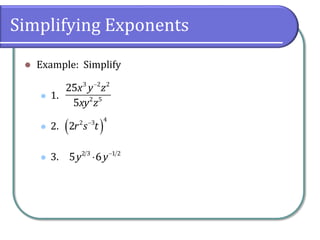
 Example: Simplify
 1.
 2.
 3.

3 2 2
2 5
25
5
x y z
xy z
 
 4
2 3
2r s t


2 3 1 2
5 6
y y
Simplifying Exponents
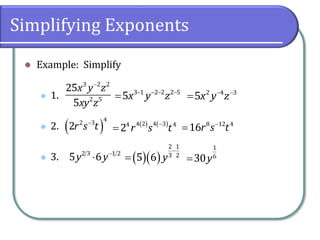
 Example: Simplify
 1.
 2.
 3.

3 2 2
2 5
25
5
x y z
xy z
 
 4
2 3
2r s t


2 3 1 2
5 6
y y
   
 3 1 2 2 2 5
5x y z
   

 4 2 4 3
4 4
2 r s t
  


2 1
3 2
5 6 y
 
 2 4 3
5x y z

 8 12 4
16r s t

1
6
30y
Exponential Functions
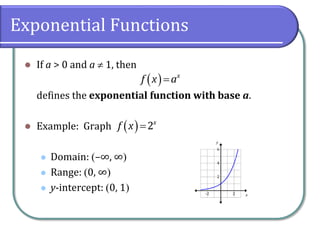
 If a > 0 and a  1, then
defines the exponential function with base a.
 Example: Graph
 Domain: –∞, ∞
 Range: 0, ∞
 y-intercept: 0, 1
  x
f x a
 2x
f x
Exponential Functions (cont.)
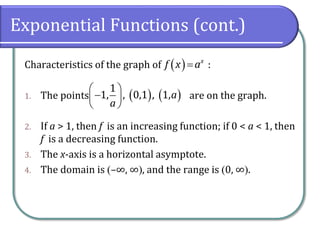
Characteristics of the graph of :
1. The points are on the graph.
2. If a > 1, then f is an increasing function; if 0 < a < 1, then
f is a decreasing function.
3. The x-axis is a horizontal asymptote.
4. The domain is –∞, ∞, and the range is 0, ∞.
  x
f x a
   
 

 
 
1
1, , 0,1 , 1,a
a
Exponential Equations
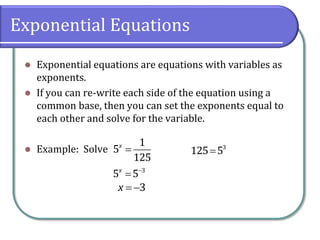
 Exponential equations are equations with variables as
exponents.
 If you can re-write each side of the equation using a
common base, then you can set the exponents equal to
each other and solve for the variable.
 Example: Solve 
1
5
125
x

 3
5 5
x
3
x
 3
125 5
Exponential Equations (cont.)
 Example: Solve  

1 3
3 9
x x
Exponential Equations (cont.)
 Example: Solve  

1 3
3 9
x x
 2
9 3
 



3
1 2
3 3
x
x
 
  
1 2 3
x x
  
1 2 6
x x

7 x
 


 2 3
1
3 3 x
x
Exponential Equations (cont.)
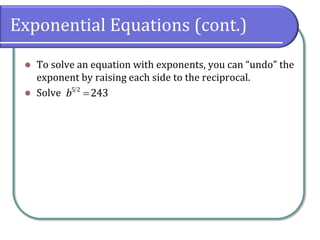
 To solve an equation with exponents, you can “undo” the
exponent by raising each side to the reciprocal.
 Solve 
5 2
243
b
Exponential Equations (cont.)
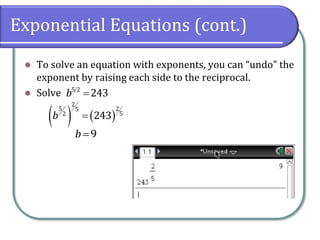
 To solve an equation with exponents, you can “undo” the
exponent by raising each side to the reciprocal.
 Solve 
5 2
243
b
   

2
2
5 5
5
2
243
b
9
b
Compound Interest
 The formula for compound interest (interest paid on
both principal and interest) is an important application
of exponential functions.
 Recall that the formula for simple interest, I = Prt, where
P is principal (amount deposited), r is annual rate of
interest, and t is time in years.
Compound Interest (cont.)
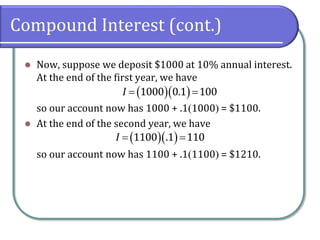
 Now, suppose we deposit $1000 at 10% annual interest.
At the end of the first year, we have
so our account now has 1000 + .11000 = $1100.
 At the end of the second year, we have
so our account now has 1100 + .11100 = $1210.
  
 
1000 0.1 100
I
  
 
1100 .1 110
I
Compound Interest (cont.)
 Another way to write 1000 + .11000 is
 After the second year, this gives us
   
 
  
1000 1 .1 .1 1000 1 .1   
  
1000 1 .1 1 .1
 
 
2
1000 1 .1
 

1000 1 .1
Compound Interest (cont.)
 If we continue, we end up with
This leads us to the general formula.
Year Account
1 $1100 10001 + .1
2 $1210 10001 + .12
3 $1331 10001 + .13
4 $1464.10 10001 + .14
t 10001 + .1t
Compound Interest Formulas
 For interest compounded n times per year:
 For interest compounded continuously:
where e is the irrational constant 2.718281…
 
 
 
 
1
tn
r
A P
n
 rt
A Pe
Examples
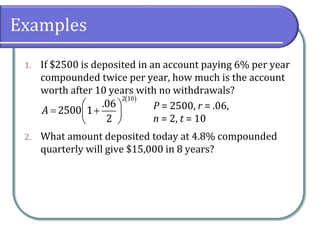
1. If $2500 is deposited in an account paying 6% per year
compounded twice per year, how much is the account
worth after 10 years with no withdrawals?
2. What amount deposited today at 4.8% compounded
quarterly will give $15,000 in 8 years?
Examples
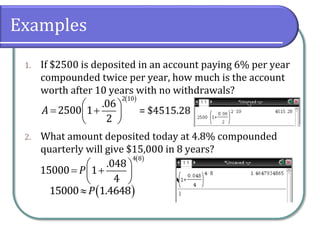
1. If $2500 is deposited in an account paying 6% per year
compounded twice per year, how much is the account
worth after 10 years with no withdrawals?
2. What amount deposited today at 4.8% compounded
quarterly will give $15,000 in 8 years?
 
 
 
 
 
2 10
.06
2500 1
2
A P = 2500, r = .06,
n = 2, t = 10
Examples
1. If $2500 is deposited in an account paying 6% per year
compounded twice per year, how much is the account
worth after 10 years with no withdrawals?
2. What amount deposited today at 4.8% compounded
quarterly will give $15,000 in 8 years?
 
 
 
 
 
2 10
.06
2500 1
2
A
Examples
1. If $2500 is deposited in an account paying 6% per year
compounded twice per year, how much is the account
worth after 10 years with no withdrawals?
2. What amount deposited today at 4.8% compounded
quarterly will give $15,000 in 8 years?
 
 
 
 
 
2 10
.06
2500 1
2
A = $4515.28
Examples
1. If $2500 is deposited in an account paying 6% per year
compounded twice per year, how much is the account
worth after 10 years with no withdrawals?
2. What amount deposited today at 4.8% compounded
quarterly will give $15,000 in 8 years?
 
 
 
 
 
2 10
.06
2500 1
2
A
 
 
 
 
 
4 8
.048
15000 1
4
P A = 15000, r = .048,
n = 4, t = 8
= $4515.28
Examples
1. If $2500 is deposited in an account paying 6% per year
compounded twice per year, how much is the account
worth after 10 years with no withdrawals?
2. What amount deposited today at 4.8% compounded
quarterly will give $15,000 in 8 years?
 
 
 
 
 
2 10
.06
2500 1
2
A
 
 
 
 
 
4 8
.048
15000 1
4
P
 

15000 1.4648
P
= $4515.28
Examples
1. If $2500 is deposited in an account paying 6% per year
compounded twice per year, how much is the account
worth after 10 years with no withdrawals?
2. What amount deposited today at 4.8% compounded
quarterly will give $15,000 in 8 years?
 
 
 
 
 
2 10
.06
2500 1
2
A
 
 
 
 
 
4 8
.048
15000 1
4
P
 

15000 1.4648
P
= $4515.28
Examples
1. If $2500 is deposited in an account paying 6% per year
compounded twice per year, how much is the account
worth after 10 years with no withdrawals?
2. What amount deposited today at 4.8% compounded
quarterly will give $15,000 in 8 years?
 
 
 
 
 
2 10
.06
2500 1
2
A
 
 
 
 
 
4 8
.048
15000 1
4
P
 

15000 1.4648
P
$10,240.35
P
= $4515.28
Examples
3. If $8000 is deposited in an account paying 5% interest
compounded continuously, how much is the account
worth at the end of 6 years?
4. Which is a better deal, depositing $7000 at 6.25%
compounded every month for 5 years or 5.75%
compounded continuously for 6 years?
Examples
3. If $8000 is deposited in an account paying 5% interest
compounded continuously, how much is the account
worth at the end of 6 years?
4. Which is a better deal, depositing $7000 at 6.25%
compounded every month for 5 years or 5.75%
compounded continuously for 6 years?
  
 .05 6
8000
A e
$10,798.87
A
 
 
 
 
 

12 5
.0625
7000 1
12
$9560.11
A
  


.0575 6
7000
$9883.93
A e
Classwork
 4.2 Assignment (College Algebra)
 Page 429: 50-68 (even), page 413: 52-66 (even),
page 385: 32-42 (even)
 4.2 Classwork Check
 Quiz 4.1

4.2 Exponential Functions

  • 1.
    Exponential Functions Chapter 4Inverse, Exponential, and Logarithmic Functions
  • 2.
    Concepts & Objectives Exponential Functions  Use exponent properties to solve equations  Substitute values into exponential functions
  • 3.
    Properties of Exponents Recall that for a variable x and integers a and b:    a b a b x x x   a a b b x x x    b a ab x x  b a b a x x    a b x x a b
  • 4.
    Simplifying Exponents  Example:Simplify  1.  2.  3.  3 2 2 2 5 25 5 x y z xy z    4 2 3 2r s t   2 3 1 2 5 6 y y
  • 5.
    Simplifying Exponents  Example:Simplify  1.  2.  3.  3 2 2 2 5 25 5 x y z xy z    4 2 3 2r s t   2 3 1 2 5 6 y y      3 1 2 2 2 5 5x y z       4 2 4 3 4 4 2 r s t      2 1 3 2 5 6 y    2 4 3 5x y z   8 12 4 16r s t  1 6 30y
  • 6.
    Exponential Functions  Ifa > 0 and a  1, then defines the exponential function with base a.  Example: Graph  Domain: –∞, ∞  Range: 0, ∞  y-intercept: 0, 1   x f x a  2x f x
  • 7.
    Exponential Functions (cont.) Characteristicsof the graph of : 1. The points are on the graph. 2. If a > 1, then f is an increasing function; if 0 < a < 1, then f is a decreasing function. 3. The x-axis is a horizontal asymptote. 4. The domain is –∞, ∞, and the range is 0, ∞.   x f x a            1 1, , 0,1 , 1,a a
  • 8.
    Exponential Equations  Exponentialequations are equations with variables as exponents.  If you can re-write each side of the equation using a common base, then you can set the exponents equal to each other and solve for the variable.  Example: Solve  1 5 125 x   3 5 5 x 3 x  3 125 5
  • 9.
    Exponential Equations (cont.) Example: Solve    1 3 3 9 x x
  • 10.
    Exponential Equations (cont.) Example: Solve    1 3 3 9 x x  2 9 3      3 1 2 3 3 x x      1 2 3 x x    1 2 6 x x  7 x      2 3 1 3 3 x x
  • 11.
    Exponential Equations (cont.) To solve an equation with exponents, you can “undo” the exponent by raising each side to the reciprocal.  Solve  5 2 243 b
  • 12.
    Exponential Equations (cont.) To solve an equation with exponents, you can “undo” the exponent by raising each side to the reciprocal.  Solve  5 2 243 b      2 2 5 5 5 2 243 b 9 b
  • 13.
    Compound Interest  Theformula for compound interest (interest paid on both principal and interest) is an important application of exponential functions.  Recall that the formula for simple interest, I = Prt, where P is principal (amount deposited), r is annual rate of interest, and t is time in years.
  • 14.
    Compound Interest (cont.) Now, suppose we deposit $1000 at 10% annual interest. At the end of the first year, we have so our account now has 1000 + .11000 = $1100.  At the end of the second year, we have so our account now has 1100 + .11100 = $1210.      1000 0.1 100 I      1100 .1 110 I
  • 15.
    Compound Interest (cont.) Another way to write 1000 + .11000 is  After the second year, this gives us          1000 1 .1 .1 1000 1 .1       1000 1 .1 1 .1     2 1000 1 .1    1000 1 .1
  • 16.
    Compound Interest (cont.) If we continue, we end up with This leads us to the general formula. Year Account 1 $1100 10001 + .1 2 $1210 10001 + .12 3 $1331 10001 + .13 4 $1464.10 10001 + .14 t 10001 + .1t
  • 17.
    Compound Interest Formulas For interest compounded n times per year:  For interest compounded continuously: where e is the irrational constant 2.718281…         1 tn r A P n  rt A Pe
  • 18.
    Examples 1. If $2500is deposited in an account paying 6% per year compounded twice per year, how much is the account worth after 10 years with no withdrawals? 2. What amount deposited today at 4.8% compounded quarterly will give $15,000 in 8 years?
  • 19.
    Examples 1. If $2500is deposited in an account paying 6% per year compounded twice per year, how much is the account worth after 10 years with no withdrawals? 2. What amount deposited today at 4.8% compounded quarterly will give $15,000 in 8 years?           2 10 .06 2500 1 2 A P = 2500, r = .06, n = 2, t = 10
  • 20.
    Examples 1. If $2500is deposited in an account paying 6% per year compounded twice per year, how much is the account worth after 10 years with no withdrawals? 2. What amount deposited today at 4.8% compounded quarterly will give $15,000 in 8 years?           2 10 .06 2500 1 2 A
  • 21.
    Examples 1. If $2500is deposited in an account paying 6% per year compounded twice per year, how much is the account worth after 10 years with no withdrawals? 2. What amount deposited today at 4.8% compounded quarterly will give $15,000 in 8 years?           2 10 .06 2500 1 2 A = $4515.28
  • 22.
    Examples 1. If $2500is deposited in an account paying 6% per year compounded twice per year, how much is the account worth after 10 years with no withdrawals? 2. What amount deposited today at 4.8% compounded quarterly will give $15,000 in 8 years?           2 10 .06 2500 1 2 A           4 8 .048 15000 1 4 P A = 15000, r = .048, n = 4, t = 8 = $4515.28
  • 23.
    Examples 1. If $2500is deposited in an account paying 6% per year compounded twice per year, how much is the account worth after 10 years with no withdrawals? 2. What amount deposited today at 4.8% compounded quarterly will give $15,000 in 8 years?           2 10 .06 2500 1 2 A           4 8 .048 15000 1 4 P    15000 1.4648 P = $4515.28
  • 24.
    Examples 1. If $2500is deposited in an account paying 6% per year compounded twice per year, how much is the account worth after 10 years with no withdrawals? 2. What amount deposited today at 4.8% compounded quarterly will give $15,000 in 8 years?           2 10 .06 2500 1 2 A           4 8 .048 15000 1 4 P    15000 1.4648 P = $4515.28
  • 25.
    Examples 1. If $2500is deposited in an account paying 6% per year compounded twice per year, how much is the account worth after 10 years with no withdrawals? 2. What amount deposited today at 4.8% compounded quarterly will give $15,000 in 8 years?           2 10 .06 2500 1 2 A           4 8 .048 15000 1 4 P    15000 1.4648 P $10,240.35 P = $4515.28
  • 26.
    Examples 3. If $8000is deposited in an account paying 5% interest compounded continuously, how much is the account worth at the end of 6 years? 4. Which is a better deal, depositing $7000 at 6.25% compounded every month for 5 years or 5.75% compounded continuously for 6 years?
  • 27.
    Examples 3. If $8000is deposited in an account paying 5% interest compounded continuously, how much is the account worth at the end of 6 years? 4. Which is a better deal, depositing $7000 at 6.25% compounded every month for 5 years or 5.75% compounded continuously for 6 years?     .05 6 8000 A e $10,798.87 A            12 5 .0625 7000 1 12 $9560.11 A      .0575 6 7000 $9883.93 A e
  • 28.
    Classwork  4.2 Assignment(College Algebra)  Page 429: 50-68 (even), page 413: 52-66 (even), page 385: 32-42 (even)  4.2 Classwork Check  Quiz 4.1