By: Ms. Ball
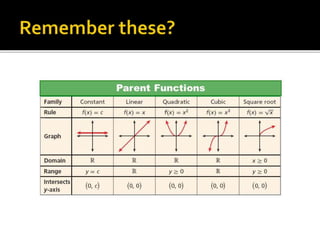
 Take a moment and quietly discuss with a
neighbor, what are some parent functions
that you remember from earlier in this unit?
 Do you recall the nameAND the equation?
 Now that we remember some of our parent
functions, we can start to manipulate, or
transform them!
 Before we start, can you guess what a
transformation is?
 Think about different things that transform in the
world… what usually happens?
 Definition:
 The graph of a function is transformed when its
parent function is changed.
 There are three (3) types of transformations:
1. Shifts
2. Reflections
3. Stretches and Compressions
 Definition:
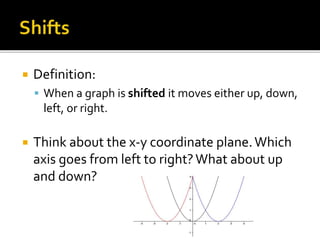
 When a graph is shifted it moves either up, down,
left, or right.
 Think about the x-y coordinate plane.Which
axis goes from left to right?What about up
and down?
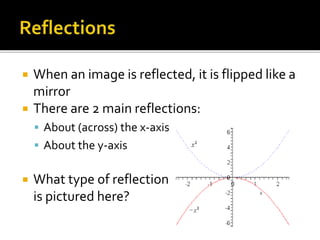
 When an image is reflected, it is flipped like a
mirror
 There are 2 main reflections:
 About (across) the x-axis
 About the y-axis
 What type of reflection
is pictured here?
 The coefficients of a function determine how
much it is stretched or compressed
 Given y = f(x),
 Horizontal stretching/compression will give you
y = f(ax), where “a” is a constant
 Vertical stretching/compression will give you
y = a f(x), again “a” is a constant
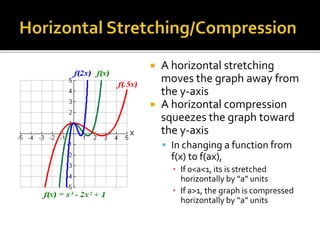
 A horizontal stretching
moves the graph away from
the y-axis
 A horizontal compression
squeezes the graph toward
the y-axis
 In changing a function from
f(x) to f(ax),
▪ If 0<a<1, its is stretched
horizontally by “a” units
▪ If a>1, the graph is compressed
horizontally by “a” units
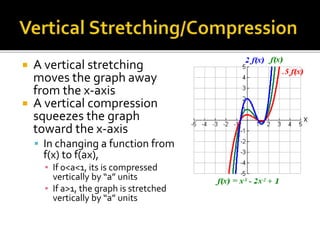
 A vertical stretching
moves the graph away
from the x-axis
 A vertical compression
squeezes the graph
toward the x-axis
 In changing a function from
f(x) to f(ax),
▪ If 0<a<1, its is compressed
vertically by “a” units
▪ If a>1, the graph is stretched
vertically by “a” units
 Here’s a short video to go over what we just learned…
https://www.youtube.com/watch?v=7S5HF38DnUY
 Using the quadratic as your parent function,
write the equations of the given
transformations:
 Shifted 5 units up
 Shifted 3 units left, and stretched horizontally by
2
 Reflected across the y-axis, and shifted up 4

Transformations of functions

  • 1.
  • 2.
     Take amoment and quietly discuss with a neighbor, what are some parent functions that you remember from earlier in this unit?  Do you recall the nameAND the equation?
  • 4.
     Now thatwe remember some of our parent functions, we can start to manipulate, or transform them!  Before we start, can you guess what a transformation is?  Think about different things that transform in the world… what usually happens?
  • 5.
     Definition:  Thegraph of a function is transformed when its parent function is changed.  There are three (3) types of transformations: 1. Shifts 2. Reflections 3. Stretches and Compressions
  • 6.
     Definition:  Whena graph is shifted it moves either up, down, left, or right.  Think about the x-y coordinate plane.Which axis goes from left to right?What about up and down?
  • 7.
     When animage is reflected, it is flipped like a mirror  There are 2 main reflections:  About (across) the x-axis  About the y-axis  What type of reflection is pictured here?
  • 8.
     The coefficientsof a function determine how much it is stretched or compressed  Given y = f(x),  Horizontal stretching/compression will give you y = f(ax), where “a” is a constant  Vertical stretching/compression will give you y = a f(x), again “a” is a constant
  • 9.
     A horizontalstretching moves the graph away from the y-axis  A horizontal compression squeezes the graph toward the y-axis  In changing a function from f(x) to f(ax), ▪ If 0<a<1, its is stretched horizontally by “a” units ▪ If a>1, the graph is compressed horizontally by “a” units
  • 10.
     A verticalstretching moves the graph away from the x-axis  A vertical compression squeezes the graph toward the x-axis  In changing a function from f(x) to f(ax), ▪ If 0<a<1, its is compressed vertically by “a” units ▪ If a>1, the graph is stretched vertically by “a” units
  • 11.
     Here’s ashort video to go over what we just learned… https://www.youtube.com/watch?v=7S5HF38DnUY
  • 12.
     Using thequadratic as your parent function, write the equations of the given transformations:  Shifted 5 units up  Shifted 3 units left, and stretched horizontally by 2  Reflected across the y-axis, and shifted up 4