Cleaves/Hobbs: Business Math, 7e Copyright 2005 by Pearson Education, Inc. Upper Saddle River, NJ 07458 All Rights Reserved
Mathematics
of
Investment
Simple Interest and
Simple Discount
1
Cleaves/Hobbs: Business Math, 7e Copyright 2005 by Pearson Education, Inc. Upper Saddle River, NJ 07458 All Rights Reserved
The Simple Interest Formula
• Find simple interest by using the simple interest
formula.
• Find the maturity of a loan.
• Convert months to a fractional or decimal part of the
year.
• Find the principal, rate or time using the simple
interest formula.
2
Cleaves/Hobbs: Business Math, 7e Copyright 2005 by Pearson Education, Inc. Upper Saddle River, NJ 07458 All Rights Reserved
Key Terms
• Interest: an amount paid or earned for the use of money.
• Simple interest: interest earned when a loan or
investment is repaid in a lump sum.
• Principal: the amount of money borrowed or invested.
• Rate: the percent of the principal paid as interest per time
period.
• Time: the number of days, months or years that the
money is borrowed or invested.
3
Cleaves/Hobbs: Business Math, 7e Copyright 2005 by Pearson Education, Inc. Upper Saddle River, NJ 07458 All Rights Reserved
The Simple Interest Formula
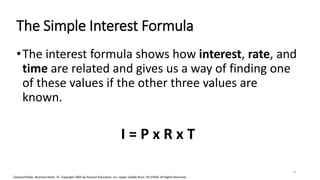
•The interest formula shows how interest, rate, and
time are related and gives us a way of finding one
of these values if the other three values are
known.
I = P x R x T
4
Cleaves/Hobbs: Business Math, 7e Copyright 2005 by Pearson Education, Inc. Upper Saddle River, NJ 07458 All Rights Reserved
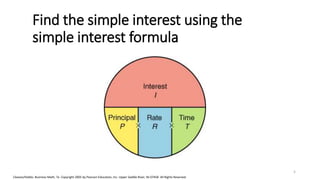
Find the simple interest using the
simple interest formula
5
Cleaves/Hobbs: Business Math, 7e Copyright 2005 by Pearson Education, Inc. Upper Saddle River, NJ 07458 All Rights Reserved
Identify the principal, rate and time.
P= R x B
• The interest is a percentage.
• Principal is the amount borrowed or invested.
• Rate of interest is a percent for a given time period,
usually one year.
• Time must be expressed in the same unit of time as the
rate. (i.e. one year)
6
Cleaves/Hobbs: Business Math, 7e Copyright 2005 by Pearson Education, Inc. Upper Saddle River, NJ 07458 All Rights Reserved
Find the interest paid on a loan.
•Principal = (P) $1,500.
•Interest rate = 9% (or 0.09)
•Time = 1 year
•Interest = P x R x T
•Interest = 1,500 x 0.09 x 1
•Interest = $135
•The interest on the loan is $135. 7
Cleaves/Hobbs: Business Math, 7e Copyright 2005 by Pearson Education, Inc. Upper Saddle River, NJ 07458 All Rights Reserved
Try these examples.
• Find the interest on a 2-year loan of $4,000 at a 6%
rate.
•$480
• Find the interest earned on a 3-year investment of
$5,000 at 4.5% interest.
•$675
8
Cleaves/Hobbs: Business Math, 7e Copyright 2005 by Pearson Education, Inc. Upper Saddle River, NJ 07458 All Rights Reserved
Find the maturity value of a loan.
•Maturity value: the total amount of money due by
the end of a loan period; the amount of the loan and
interest.
•If the principal and the interest are known, add
them.
•MV = principal + PRT
•MV = P(1+RT)
9
Cleaves/Hobbs: Business Math, 7e Copyright 2005 by Pearson Education, Inc. Upper Saddle River, NJ 07458 All Rights Reserved
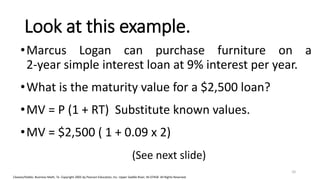
Look at this example.
•Marcus Logan can purchase furniture on a
2-year simple interest loan at 9% interest per year.
•What is the maturity value for a $2,500 loan?
•MV = P (1 + RT) Substitute known values.
•MV = $2,500 ( 1 + 0.09 x 2)
(See next slide)
10
Cleaves/Hobbs: Business Math, 7e Copyright 2005 by Pearson Education, Inc. Upper Saddle River, NJ 07458 All Rights Reserved
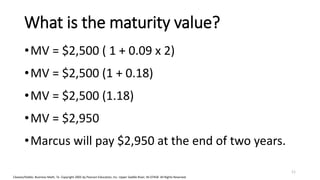
What is the maturity value?
•MV = $2,500 ( 1 + 0.09 x 2)
•MV = $2,500 (1 + 0.18)
•MV = $2,500 (1.18)
•MV = $2,950
•Marcus will pay $2,950 at the end of two years.
11
Cleaves/Hobbs: Business Math, 7e Copyright 2005 by Pearson Education, Inc. Upper Saddle River, NJ 07458 All Rights Reserved
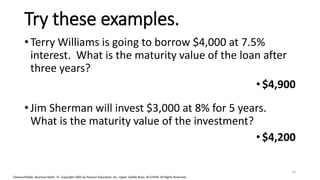
Try these examples.
• Terry Williams is going to borrow $4,000 at 7.5%
interest. What is the maturity value of the loan after
three years?
•$4,900
• Jim Sherman will invest $3,000 at 8% for 5 years.
What is the maturity value of the investment?
•$4,200
12
Cleaves/Hobbs: Business Math, 7e Copyright 2005 by Pearson Education, Inc. Upper Saddle River, NJ 07458 All Rights Reserved
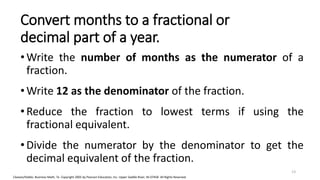
Convert months to a fractional or
decimal part of a year.
•Write the number of months as the numerator of a
fraction.
•Write 12 as the denominator of the fraction.
•Reduce the fraction to lowest terms if using the
fractional equivalent.
•Divide the numerator by the denominator to get the
decimal equivalent of the fraction.
13
Cleaves/Hobbs: Business Math, 7e Copyright 2005 by Pearson Education, Inc. Upper Saddle River, NJ 07458 All Rights Reserved
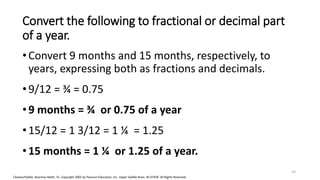
Convert the following to fractional or decimal part
of a year.
•Convert 9 months and 15 months, respectively, to
years, expressing both as fractions and decimals.
•9/12 = ¾ = 0.75
•9 months = ¾ or 0.75 of a year
•15/12 = 1 3/12 = 1 ¼ = 1.25
•15 months = 1 ¼ or 1.25 of a year.
14
Cleaves/Hobbs: Business Math, 7e Copyright 2005 by Pearson Education, Inc. Upper Saddle River, NJ 07458 All Rights Reserved
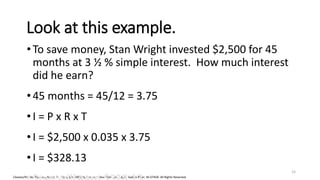
Look at this example.
•To save money, Stan Wright invested $2,500 for 45
months at 3 ½ % simple interest. How much interest
did he earn?
•45 months = 45/12 = 3.75
•I = P x R x T
•I = $2,500 x 0.035 x 3.75
•I = $328.13
15
Cleaves/Hobbs: Business Math, 7e Copyright 2005 by Pearson Education, Inc. Upper Saddle River, NJ 07458 All Rights Reserved
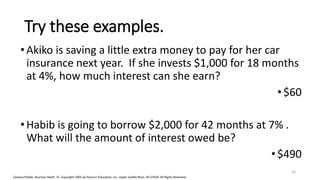
Try these examples.
•Akiko is saving a little extra money to pay for her car
insurance next year. If she invests $1,000 for 18 months
at 4%, how much interest can she earn?
• $60
•Habib is going to borrow $2,000 for 42 months at 7% .
What will the amount of interest owed be?
•$490
16
Cleaves/Hobbs: Business Math, 7e Copyright 2005 by Pearson Education, Inc. Upper Saddle River, NJ 07458 All Rights Reserved
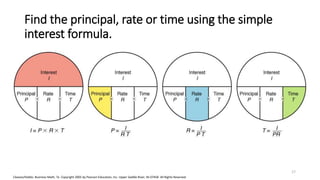
Find the principal, rate or time using the simple
interest formula.
17
Cleaves/Hobbs: Business Math, 7e Copyright 2005 by Pearson Education, Inc. Upper Saddle River, NJ 07458 All Rights Reserved
Find the principal using the simple interest
formula.
• P = I / RT
• Judy paid $108 in interest on a loan that she had for
6 months. The interest rate was 12%. How much
was the principal?
• Substitute the known values and solve.
• P = 108/ 0.12 x 0.5
• P = $1,800
18
Cleaves/Hobbs: Business Math, 7e Copyright 2005 by Pearson Education, Inc. Upper Saddle River, NJ 07458 All Rights Reserved
Find the rate using the simple interest
formula.
• R = I / PT
• Sam wants to borrow $1,500 for 15 months and will have to
pay $225 in interest. What is the rate he is being charged?
• Substitute the known values and solve.
• R = 225/ $1,500 x 1.25
• R = .12 or 12%
• The rate Sam will pay is 12%.
19
Cleaves/Hobbs: Business Math, 7e Copyright 2005 by Pearson Education, Inc. Upper Saddle River, NJ 07458 All Rights Reserved
Find the time using the simple interest formula.
• T = I / RP
• Shelby borrowed $10,000 at 8% and paid $1,600 in interest.
What was the length of the loan?
• Substitute the known values and solve.
• T = $1,600/0.08 x $10,000
• T = 2
• The length of the loan was two years.
20
Cleaves/Hobbs: Business Math, 7e Copyright 2005 by Pearson Education, Inc. Upper Saddle River, NJ 07458 All Rights Reserved
Ordinary and Exact Time and Interest
• Find ordinary and exact time.
• Find the due date.
• Find the interest using the ordinary and exact interest
rates.
• Find simple interest using a table.
21
Cleaves/Hobbs: Business Math, 7e Copyright 2005 by Pearson Education, Inc. Upper Saddle River, NJ 07458 All Rights Reserved
Find ordinary and exact time.
•Ordinary time: time that is based on counting 30
days in each month.
•Exact time: time that is based on counting the exact
number of days in a time period.
22
Cleaves/Hobbs: Business Math, 7e Copyright 2005 by Pearson Education, Inc. Upper Saddle River, NJ 07458 All Rights Reserved
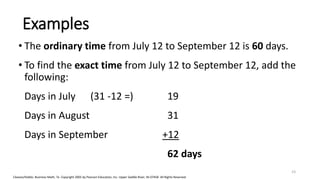
Examples
• The ordinary time from July 12 to September 12 is 60 days.
• To find the exact time from July 12 to September 12, add the
following:
Days in July (31 -12 =) 19
Days in August 31
Days in September +12
62 days
23
Cleaves/Hobbs: Business Math, 7e Copyright 2005 by Pearson Education, Inc. Upper Saddle River, NJ 07458 All Rights Reserved
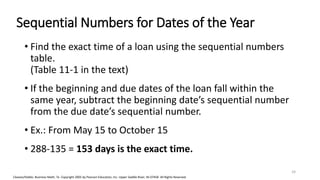
Sequential Numbers for Dates of the Year
• Find the exact time of a loan using the sequential numbers
table.
(Table 11-1 in the text)
• If the beginning and due dates of the loan fall within the
same year, subtract the beginning date’s sequential number
from the due date’s sequential number.
• Ex.: From May 15 to October 15
• 288-135 = 153 days is the exact time.
24
Cleaves/Hobbs: Business Math, 7e Copyright 2005 by Pearson Education, Inc. Upper Saddle River, NJ 07458 All Rights Reserved
Beginning and due dates in different years.
•Subtract the beginning date’s sequential number from
365.
•Add the due date’s sequential number to the result
from the previous step.
•If February 29 falls between the two dates, add 1. (Is it a
leap year?)
25
Cleaves/Hobbs: Business Math, 7e Copyright 2005 by Pearson Education, Inc. Upper Saddle River, NJ 07458 All Rights Reserved
Look at this example.
•Find the exact time from May 15 on Year 1 to March 15
in Year 2.
•365 – 135 = 230
•230 + 74 = 304 days
•The exact time is 304 days.
•Note: If Year 2 is a leap year, the exact time is 305 days.
26
Cleaves/Hobbs: Business Math, 7e Copyright 2005 by Pearson Education, Inc. Upper Saddle River, NJ 07458 All Rights Reserved
Try this example.
• A loan made on September 5 is due July 5 of the following
year.
• Find: a) ordinary time
b) exact time in a non-leap year
c) exact time in a leap year.
• Ordinary time = 300 days
• Exact time (non-leap year) = 303 days
• Exact time (leap year) = 304 days
27
Cleaves/Hobbs: Business Math, 7e Copyright 2005 by Pearson Education, Inc. Upper Saddle River, NJ 07458 All Rights Reserved
Find the ordinary interest rate per day and the exact
interest rate per day.
•Ordinary interest: a rate per day that assumes 360 days
per year.
•Exact interest: a rate per day that assumes 365 days
per year.
•Banker’s rule: calculating interest on a loan based on
ordinary interest and exact time which yields a slightly
higher amount of interest.
28
Cleaves/Hobbs: Business Math, 7e Copyright 2005 by Pearson Education, Inc. Upper Saddle River, NJ 07458 All Rights Reserved
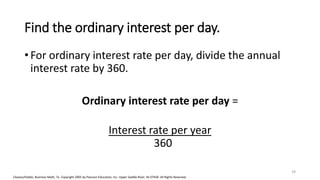
Find the ordinary interest per day.
• For ordinary interest rate per day, divide the annual
interest rate by 360.
Ordinary interest rate per day =
Interest rate per year
360
29
Cleaves/Hobbs: Business Math, 7e Copyright 2005 by Pearson Education, Inc. Upper Saddle River, NJ 07458 All Rights Reserved
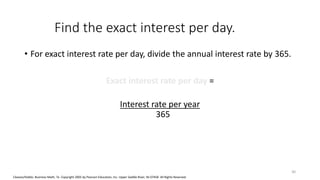
Find the exact interest per day.
• For exact interest rate per day, divide the annual interest rate by 365.
Exact interest rate per day =
Interest rate per year
365
30
Cleaves/Hobbs: Business Math, 7e Copyright 2005 by Pearson Education, Inc. Upper Saddle River, NJ 07458 All Rights Reserved
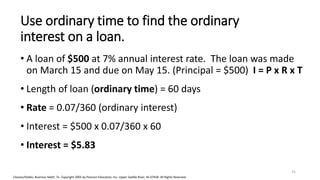
Use ordinary time to find the ordinary
interest on a loan.
• A loan of $500 at 7% annual interest rate. The loan was made
on March 15 and due on May 15. (Principal = $500) I = P x R x T
• Length of loan (ordinary time) = 60 days
• Rate = 0.07/360 (ordinary interest)
• Interest = $500 x 0.07/360 x 60
• Interest = $5.83
31
Cleaves/Hobbs: Business Math, 7e Copyright 2005 by Pearson Education, Inc. Upper Saddle River, NJ 07458 All Rights Reserved
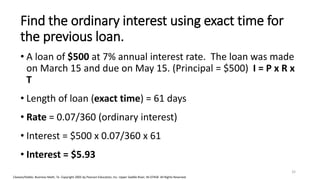
Find the ordinary interest using exact time for
the previous loan.
• A loan of $500 at 7% annual interest rate. The loan was made
on March 15 and due on May 15. (Principal = $500) I = P x R x
T
• Length of loan (exact time) = 61 days
• Rate = 0.07/360 (ordinary interest)
• Interest = $500 x 0.07/360 x 61
• Interest = $5.93
32
Cleaves/Hobbs: Business Math, 7e Copyright 2005 by Pearson Education, Inc. Upper Saddle River, NJ 07458 All Rights Reserved
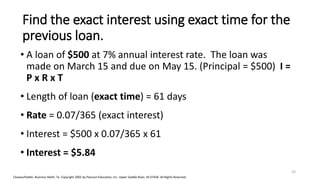
Find the exact interest using exact time for the
previous loan.
• A loan of $500 at 7% annual interest rate. The loan was
made on March 15 and due on May 15. (Principal = $500) I =
P x R x T
• Length of loan (exact time) = 61 days
• Rate = 0.07/365 (exact interest)
• Interest = $500 x 0.07/365 x 61
• Interest = $5.84
33
Cleaves/Hobbs: Business Math, 7e Copyright 2005 by Pearson Education, Inc. Upper Saddle River, NJ 07458 All Rights Reserved
Find simple interest using a table.
1. Identify the amount of money that the table uses as
the principal. (Usually $1, $100 or $1000)
2. Divide the loan principal by the table principal.
3. Select the days row corresponding to the time
period (in days) of the loan.
(continue on next slide)
34
Cleaves/Hobbs: Business Math, 7e Copyright 2005 by Pearson Education, Inc. Upper Saddle River, NJ 07458 All Rights Reserved
Find simple interest using a table.
4. Select the annual rate column corresponding to
the annual interest rate of the loan.
5. Locate the value in the cell where the two
intersect.
6. Multiply the quotient from step 2 by the value
from step 5.
35
Cleaves/Hobbs: Business Math, 7e Copyright 2005 by Pearson Education, Inc. Upper Saddle River, NJ 07458 All Rights Reserved
Look at this example.
• Find the exact interest on a loan of $6,500 at 7.5% annually for
45 days.
• Use Table 11-2 in your text to locate the interest for $100.
Move across the 45-days row to the 7.5% column.
• The number is 0.924658.
• Divide $6,500 by $100 ( = 65)
• Multiply 0.924658 x 65 = $860.11
• The exact interest is $860.11
36
Cleaves/Hobbs: Business Math, 7e Copyright 2005 by Pearson Education, Inc. Upper Saddle River, NJ 07458 All Rights Reserved
Try these examples.
• Find the exact interest on a $5,000 loan for 30 days at
8%.
•$32.88
• Find the exact interest on a $1,800 loan for 20 days at
8.5%.
•$8.38
37
Cleaves/Hobbs: Business Math, 7e Copyright 2005 by Pearson Education, Inc. Upper Saddle River, NJ 07458 All Rights Reserved
Find the bank discount and proceeds for a
simple discount note.
•For the bank discount, use:
Bank discount = face value x disc. rate x time
[I = P x R x T]
•For the proceeds, use:
Proceeds = face value – bank discount
A = P - I
38
Cleaves/Hobbs: Business Math, 7e Copyright 2005 by Pearson Education, Inc. Upper Saddle River, NJ 07458 All Rights Reserved
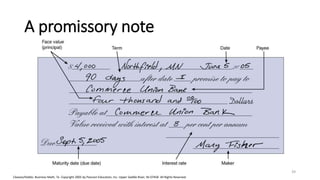
A promissory note
39
Cleaves/Hobbs: Business Math, 7e Copyright 2005 by Pearson Education, Inc. Upper Saddle River, NJ 07458 All Rights Reserved
Find the third party discount and proceeds for a
third party discount note.
• For the bank discount, use:
Third party discount = maturity value of the original
note x discount rate x discount period.
• For the proceeds, use:
Proceeds = maturity value of original note – third-
party discount
A = P - I
40
Cleaves/Hobbs: Business Math, 7e Copyright 2005 by Pearson Education, Inc. Upper Saddle River, NJ 07458 All Rights Reserved
Look at this example.
•Mihoc Trailer Sales made a note of $10,000 with
Darcy Mihoc,owner, at 9% simple interest based on
exact interest and exact time. The note is made on
August 12 and due November 10. Since Mihoc Trailer
Sales needs cash, the note is taken to a third party on
September 5.
•The third-party agrees to accept the note with a 13%
annual discount using the banker’s rule.
•Find the proceeds of the note.
41
Cleaves/Hobbs: Business Math, 7e Copyright 2005 by Pearson Education, Inc. Upper Saddle River, NJ 07458 All Rights Reserved
Mihoc Trailer Sales
• To find the proceeds, we find the maturity value of the
original note, then the third-party discount.
• Exact time is 90 days (314-224)
• Exact interest rate is .09/365
• MV = P(1+ RT)
• MV = $10,000 ( 1 + 0.09/365 x 90)
• MV = $10.221.92
42
Cleaves/Hobbs: Business Math, 7e Copyright 2005 by Pearson Education, Inc. Upper Saddle River, NJ 07458 All Rights Reserved
Find the proceeds of the note.
• Exact time of the discount period is 66 days.
(314 - 248) period between Sept. 5 and Nov. 10.
• Ordinary discount rate is 0.13/ 360.
• Third party discount = I = PRT
• Third party discount = $10,221.92 ( 0.13/360)(66)
• Third party discount = $243.62
• Proceeds = A = P – I
• Proceeds = $10,221.92 - $243.62 = $9,978.30
43

Simple Interest.ppt

  • 1.
    Cleaves/Hobbs: Business Math,7e Copyright 2005 by Pearson Education, Inc. Upper Saddle River, NJ 07458 All Rights Reserved Mathematics of Investment Simple Interest and Simple Discount 1
  • 2.
    Cleaves/Hobbs: Business Math,7e Copyright 2005 by Pearson Education, Inc. Upper Saddle River, NJ 07458 All Rights Reserved The Simple Interest Formula • Find simple interest by using the simple interest formula. • Find the maturity of a loan. • Convert months to a fractional or decimal part of the year. • Find the principal, rate or time using the simple interest formula. 2
  • 3.
    Cleaves/Hobbs: Business Math,7e Copyright 2005 by Pearson Education, Inc. Upper Saddle River, NJ 07458 All Rights Reserved Key Terms • Interest: an amount paid or earned for the use of money. • Simple interest: interest earned when a loan or investment is repaid in a lump sum. • Principal: the amount of money borrowed or invested. • Rate: the percent of the principal paid as interest per time period. • Time: the number of days, months or years that the money is borrowed or invested. 3
  • 4.
    Cleaves/Hobbs: Business Math,7e Copyright 2005 by Pearson Education, Inc. Upper Saddle River, NJ 07458 All Rights Reserved The Simple Interest Formula •The interest formula shows how interest, rate, and time are related and gives us a way of finding one of these values if the other three values are known. I = P x R x T 4
  • 5.
    Cleaves/Hobbs: Business Math,7e Copyright 2005 by Pearson Education, Inc. Upper Saddle River, NJ 07458 All Rights Reserved Find the simple interest using the simple interest formula 5
  • 6.
    Cleaves/Hobbs: Business Math,7e Copyright 2005 by Pearson Education, Inc. Upper Saddle River, NJ 07458 All Rights Reserved Identify the principal, rate and time. P= R x B • The interest is a percentage. • Principal is the amount borrowed or invested. • Rate of interest is a percent for a given time period, usually one year. • Time must be expressed in the same unit of time as the rate. (i.e. one year) 6
  • 7.
    Cleaves/Hobbs: Business Math,7e Copyright 2005 by Pearson Education, Inc. Upper Saddle River, NJ 07458 All Rights Reserved Find the interest paid on a loan. •Principal = (P) $1,500. •Interest rate = 9% (or 0.09) •Time = 1 year •Interest = P x R x T •Interest = 1,500 x 0.09 x 1 •Interest = $135 •The interest on the loan is $135. 7
  • 8.
    Cleaves/Hobbs: Business Math,7e Copyright 2005 by Pearson Education, Inc. Upper Saddle River, NJ 07458 All Rights Reserved Try these examples. • Find the interest on a 2-year loan of $4,000 at a 6% rate. •$480 • Find the interest earned on a 3-year investment of $5,000 at 4.5% interest. •$675 8
  • 9.
    Cleaves/Hobbs: Business Math,7e Copyright 2005 by Pearson Education, Inc. Upper Saddle River, NJ 07458 All Rights Reserved Find the maturity value of a loan. •Maturity value: the total amount of money due by the end of a loan period; the amount of the loan and interest. •If the principal and the interest are known, add them. •MV = principal + PRT •MV = P(1+RT) 9
  • 10.
    Cleaves/Hobbs: Business Math,7e Copyright 2005 by Pearson Education, Inc. Upper Saddle River, NJ 07458 All Rights Reserved Look at this example. •Marcus Logan can purchase furniture on a 2-year simple interest loan at 9% interest per year. •What is the maturity value for a $2,500 loan? •MV = P (1 + RT) Substitute known values. •MV = $2,500 ( 1 + 0.09 x 2) (See next slide) 10
  • 11.
    Cleaves/Hobbs: Business Math,7e Copyright 2005 by Pearson Education, Inc. Upper Saddle River, NJ 07458 All Rights Reserved What is the maturity value? •MV = $2,500 ( 1 + 0.09 x 2) •MV = $2,500 (1 + 0.18) •MV = $2,500 (1.18) •MV = $2,950 •Marcus will pay $2,950 at the end of two years. 11
  • 12.
    Cleaves/Hobbs: Business Math,7e Copyright 2005 by Pearson Education, Inc. Upper Saddle River, NJ 07458 All Rights Reserved Try these examples. • Terry Williams is going to borrow $4,000 at 7.5% interest. What is the maturity value of the loan after three years? •$4,900 • Jim Sherman will invest $3,000 at 8% for 5 years. What is the maturity value of the investment? •$4,200 12
  • 13.
    Cleaves/Hobbs: Business Math,7e Copyright 2005 by Pearson Education, Inc. Upper Saddle River, NJ 07458 All Rights Reserved Convert months to a fractional or decimal part of a year. •Write the number of months as the numerator of a fraction. •Write 12 as the denominator of the fraction. •Reduce the fraction to lowest terms if using the fractional equivalent. •Divide the numerator by the denominator to get the decimal equivalent of the fraction. 13
  • 14.
    Cleaves/Hobbs: Business Math,7e Copyright 2005 by Pearson Education, Inc. Upper Saddle River, NJ 07458 All Rights Reserved Convert the following to fractional or decimal part of a year. •Convert 9 months and 15 months, respectively, to years, expressing both as fractions and decimals. •9/12 = ¾ = 0.75 •9 months = ¾ or 0.75 of a year •15/12 = 1 3/12 = 1 ¼ = 1.25 •15 months = 1 ¼ or 1.25 of a year. 14
  • 15.
    Cleaves/Hobbs: Business Math,7e Copyright 2005 by Pearson Education, Inc. Upper Saddle River, NJ 07458 All Rights Reserved Look at this example. •To save money, Stan Wright invested $2,500 for 45 months at 3 ½ % simple interest. How much interest did he earn? •45 months = 45/12 = 3.75 •I = P x R x T •I = $2,500 x 0.035 x 3.75 •I = $328.13 15
  • 16.
    Cleaves/Hobbs: Business Math,7e Copyright 2005 by Pearson Education, Inc. Upper Saddle River, NJ 07458 All Rights Reserved Try these examples. •Akiko is saving a little extra money to pay for her car insurance next year. If she invests $1,000 for 18 months at 4%, how much interest can she earn? • $60 •Habib is going to borrow $2,000 for 42 months at 7% . What will the amount of interest owed be? •$490 16
  • 17.
    Cleaves/Hobbs: Business Math,7e Copyright 2005 by Pearson Education, Inc. Upper Saddle River, NJ 07458 All Rights Reserved Find the principal, rate or time using the simple interest formula. 17
  • 18.
    Cleaves/Hobbs: Business Math,7e Copyright 2005 by Pearson Education, Inc. Upper Saddle River, NJ 07458 All Rights Reserved Find the principal using the simple interest formula. • P = I / RT • Judy paid $108 in interest on a loan that she had for 6 months. The interest rate was 12%. How much was the principal? • Substitute the known values and solve. • P = 108/ 0.12 x 0.5 • P = $1,800 18
  • 19.
    Cleaves/Hobbs: Business Math,7e Copyright 2005 by Pearson Education, Inc. Upper Saddle River, NJ 07458 All Rights Reserved Find the rate using the simple interest formula. • R = I / PT • Sam wants to borrow $1,500 for 15 months and will have to pay $225 in interest. What is the rate he is being charged? • Substitute the known values and solve. • R = 225/ $1,500 x 1.25 • R = .12 or 12% • The rate Sam will pay is 12%. 19
  • 20.
    Cleaves/Hobbs: Business Math,7e Copyright 2005 by Pearson Education, Inc. Upper Saddle River, NJ 07458 All Rights Reserved Find the time using the simple interest formula. • T = I / RP • Shelby borrowed $10,000 at 8% and paid $1,600 in interest. What was the length of the loan? • Substitute the known values and solve. • T = $1,600/0.08 x $10,000 • T = 2 • The length of the loan was two years. 20
  • 21.
    Cleaves/Hobbs: Business Math,7e Copyright 2005 by Pearson Education, Inc. Upper Saddle River, NJ 07458 All Rights Reserved Ordinary and Exact Time and Interest • Find ordinary and exact time. • Find the due date. • Find the interest using the ordinary and exact interest rates. • Find simple interest using a table. 21
  • 22.
    Cleaves/Hobbs: Business Math,7e Copyright 2005 by Pearson Education, Inc. Upper Saddle River, NJ 07458 All Rights Reserved Find ordinary and exact time. •Ordinary time: time that is based on counting 30 days in each month. •Exact time: time that is based on counting the exact number of days in a time period. 22
  • 23.
    Cleaves/Hobbs: Business Math,7e Copyright 2005 by Pearson Education, Inc. Upper Saddle River, NJ 07458 All Rights Reserved Examples • The ordinary time from July 12 to September 12 is 60 days. • To find the exact time from July 12 to September 12, add the following: Days in July (31 -12 =) 19 Days in August 31 Days in September +12 62 days 23
  • 24.
    Cleaves/Hobbs: Business Math,7e Copyright 2005 by Pearson Education, Inc. Upper Saddle River, NJ 07458 All Rights Reserved Sequential Numbers for Dates of the Year • Find the exact time of a loan using the sequential numbers table. (Table 11-1 in the text) • If the beginning and due dates of the loan fall within the same year, subtract the beginning date’s sequential number from the due date’s sequential number. • Ex.: From May 15 to October 15 • 288-135 = 153 days is the exact time. 24
  • 25.
    Cleaves/Hobbs: Business Math,7e Copyright 2005 by Pearson Education, Inc. Upper Saddle River, NJ 07458 All Rights Reserved Beginning and due dates in different years. •Subtract the beginning date’s sequential number from 365. •Add the due date’s sequential number to the result from the previous step. •If February 29 falls between the two dates, add 1. (Is it a leap year?) 25
  • 26.
    Cleaves/Hobbs: Business Math,7e Copyright 2005 by Pearson Education, Inc. Upper Saddle River, NJ 07458 All Rights Reserved Look at this example. •Find the exact time from May 15 on Year 1 to March 15 in Year 2. •365 – 135 = 230 •230 + 74 = 304 days •The exact time is 304 days. •Note: If Year 2 is a leap year, the exact time is 305 days. 26
  • 27.
    Cleaves/Hobbs: Business Math,7e Copyright 2005 by Pearson Education, Inc. Upper Saddle River, NJ 07458 All Rights Reserved Try this example. • A loan made on September 5 is due July 5 of the following year. • Find: a) ordinary time b) exact time in a non-leap year c) exact time in a leap year. • Ordinary time = 300 days • Exact time (non-leap year) = 303 days • Exact time (leap year) = 304 days 27
  • 28.
    Cleaves/Hobbs: Business Math,7e Copyright 2005 by Pearson Education, Inc. Upper Saddle River, NJ 07458 All Rights Reserved Find the ordinary interest rate per day and the exact interest rate per day. •Ordinary interest: a rate per day that assumes 360 days per year. •Exact interest: a rate per day that assumes 365 days per year. •Banker’s rule: calculating interest on a loan based on ordinary interest and exact time which yields a slightly higher amount of interest. 28
  • 29.
    Cleaves/Hobbs: Business Math,7e Copyright 2005 by Pearson Education, Inc. Upper Saddle River, NJ 07458 All Rights Reserved Find the ordinary interest per day. • For ordinary interest rate per day, divide the annual interest rate by 360. Ordinary interest rate per day = Interest rate per year 360 29
  • 30.
    Cleaves/Hobbs: Business Math,7e Copyright 2005 by Pearson Education, Inc. Upper Saddle River, NJ 07458 All Rights Reserved Find the exact interest per day. • For exact interest rate per day, divide the annual interest rate by 365. Exact interest rate per day = Interest rate per year 365 30
  • 31.
    Cleaves/Hobbs: Business Math,7e Copyright 2005 by Pearson Education, Inc. Upper Saddle River, NJ 07458 All Rights Reserved Use ordinary time to find the ordinary interest on a loan. • A loan of $500 at 7% annual interest rate. The loan was made on March 15 and due on May 15. (Principal = $500) I = P x R x T • Length of loan (ordinary time) = 60 days • Rate = 0.07/360 (ordinary interest) • Interest = $500 x 0.07/360 x 60 • Interest = $5.83 31
  • 32.
    Cleaves/Hobbs: Business Math,7e Copyright 2005 by Pearson Education, Inc. Upper Saddle River, NJ 07458 All Rights Reserved Find the ordinary interest using exact time for the previous loan. • A loan of $500 at 7% annual interest rate. The loan was made on March 15 and due on May 15. (Principal = $500) I = P x R x T • Length of loan (exact time) = 61 days • Rate = 0.07/360 (ordinary interest) • Interest = $500 x 0.07/360 x 61 • Interest = $5.93 32
  • 33.
    Cleaves/Hobbs: Business Math,7e Copyright 2005 by Pearson Education, Inc. Upper Saddle River, NJ 07458 All Rights Reserved Find the exact interest using exact time for the previous loan. • A loan of $500 at 7% annual interest rate. The loan was made on March 15 and due on May 15. (Principal = $500) I = P x R x T • Length of loan (exact time) = 61 days • Rate = 0.07/365 (exact interest) • Interest = $500 x 0.07/365 x 61 • Interest = $5.84 33
  • 34.
    Cleaves/Hobbs: Business Math,7e Copyright 2005 by Pearson Education, Inc. Upper Saddle River, NJ 07458 All Rights Reserved Find simple interest using a table. 1. Identify the amount of money that the table uses as the principal. (Usually $1, $100 or $1000) 2. Divide the loan principal by the table principal. 3. Select the days row corresponding to the time period (in days) of the loan. (continue on next slide) 34
  • 35.
    Cleaves/Hobbs: Business Math,7e Copyright 2005 by Pearson Education, Inc. Upper Saddle River, NJ 07458 All Rights Reserved Find simple interest using a table. 4. Select the annual rate column corresponding to the annual interest rate of the loan. 5. Locate the value in the cell where the two intersect. 6. Multiply the quotient from step 2 by the value from step 5. 35
  • 36.
    Cleaves/Hobbs: Business Math,7e Copyright 2005 by Pearson Education, Inc. Upper Saddle River, NJ 07458 All Rights Reserved Look at this example. • Find the exact interest on a loan of $6,500 at 7.5% annually for 45 days. • Use Table 11-2 in your text to locate the interest for $100. Move across the 45-days row to the 7.5% column. • The number is 0.924658. • Divide $6,500 by $100 ( = 65) • Multiply 0.924658 x 65 = $860.11 • The exact interest is $860.11 36
  • 37.
    Cleaves/Hobbs: Business Math,7e Copyright 2005 by Pearson Education, Inc. Upper Saddle River, NJ 07458 All Rights Reserved Try these examples. • Find the exact interest on a $5,000 loan for 30 days at 8%. •$32.88 • Find the exact interest on a $1,800 loan for 20 days at 8.5%. •$8.38 37
  • 38.
    Cleaves/Hobbs: Business Math,7e Copyright 2005 by Pearson Education, Inc. Upper Saddle River, NJ 07458 All Rights Reserved Find the bank discount and proceeds for a simple discount note. •For the bank discount, use: Bank discount = face value x disc. rate x time [I = P x R x T] •For the proceeds, use: Proceeds = face value – bank discount A = P - I 38
  • 39.
    Cleaves/Hobbs: Business Math,7e Copyright 2005 by Pearson Education, Inc. Upper Saddle River, NJ 07458 All Rights Reserved A promissory note 39
  • 40.
    Cleaves/Hobbs: Business Math,7e Copyright 2005 by Pearson Education, Inc. Upper Saddle River, NJ 07458 All Rights Reserved Find the third party discount and proceeds for a third party discount note. • For the bank discount, use: Third party discount = maturity value of the original note x discount rate x discount period. • For the proceeds, use: Proceeds = maturity value of original note – third- party discount A = P - I 40
  • 41.
    Cleaves/Hobbs: Business Math,7e Copyright 2005 by Pearson Education, Inc. Upper Saddle River, NJ 07458 All Rights Reserved Look at this example. •Mihoc Trailer Sales made a note of $10,000 with Darcy Mihoc,owner, at 9% simple interest based on exact interest and exact time. The note is made on August 12 and due November 10. Since Mihoc Trailer Sales needs cash, the note is taken to a third party on September 5. •The third-party agrees to accept the note with a 13% annual discount using the banker’s rule. •Find the proceeds of the note. 41
  • 42.
    Cleaves/Hobbs: Business Math,7e Copyright 2005 by Pearson Education, Inc. Upper Saddle River, NJ 07458 All Rights Reserved Mihoc Trailer Sales • To find the proceeds, we find the maturity value of the original note, then the third-party discount. • Exact time is 90 days (314-224) • Exact interest rate is .09/365 • MV = P(1+ RT) • MV = $10,000 ( 1 + 0.09/365 x 90) • MV = $10.221.92 42
  • 43.
    Cleaves/Hobbs: Business Math,7e Copyright 2005 by Pearson Education, Inc. Upper Saddle River, NJ 07458 All Rights Reserved Find the proceeds of the note. • Exact time of the discount period is 66 days. (314 - 248) period between Sept. 5 and Nov. 10. • Ordinary discount rate is 0.13/ 360. • Third party discount = I = PRT • Third party discount = $10,221.92 ( 0.13/360)(66) • Third party discount = $243.62 • Proceeds = A = P – I • Proceeds = $10,221.92 - $243.62 = $9,978.30 43