EXPLORATION OF
RADARS AND SOFTWARE DEFINED RADIOS
USING VISUALSIM
Deepak Shankar
Founder
Mirabilis Design Inc.
Email: dshankar@mirabilisdesign.com
About Mirabilis Design
Software company based in Silicon Valley providing electronics design solutions
Development centers in US, India, China and Czech republic
Visualize, optimize and validate the system specification prior to development
Customers in Aerospace, Defense, Semiconductors and Automotive
VisualSim Architect- Modeling and simulation software
Largest source of system modeling blocks and analysis tools
Select the “Right” configuration to match customer request
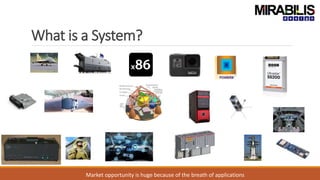
What is a System?
Market opportunity is huge because of the breath of applications
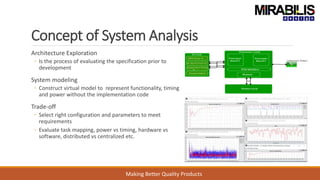
Concept of System Analysis
Architecture Exploration
◦ Is the process of evaluating the specification prior to
development
System modeling
◦ Construct virtual model to represent functionality, timing
and power without the implementation code
Trade-off
◦ Select right configuration and parameters to meet
requirements
◦ Evaluate task mapping, power vs timing, hardware vs
software, distributed vs centralized etc.
Making Better Quality Products
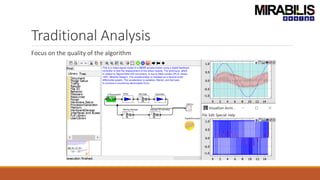
Traditional Analysis
Focus on the quality of the algorithm
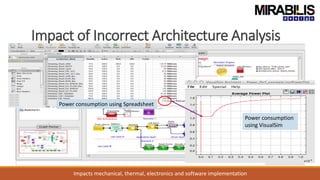
Impact of Incorrect Architecture Analysis
Impacts mechanical, thermal, electronics and software implementation
Power consumption using Spreadsheet
Power consumption
using VisualSim
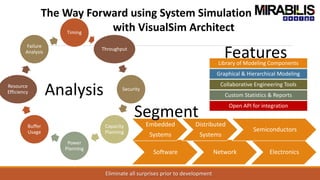
Library of Modeling Components
Graphical & Hierarchical Modeling
Collaborative Engineering Tools
Custom Statistics & Reports
Open API for integration
Timing
Throughput
Security
Capacity
Planning
Power
Planning
Buffer
Usage
Resource
Efficiency
Failure
Analysis
The Way Forward using System Simulation
with VisualSim Architect
Software Network Electronics
Analysis
Embedded
Systems
Distributed
Systems
Semiconductors
Eliminate all surprises prior to development
Features
Segment
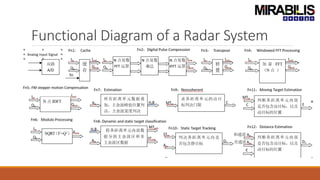
Functional Diagram of a Radar System
Architecture Design Challenges
What should be the hardware configuration for this application?
Does the processing meet the timing deadline?
Which tasks consume the most time and memory bandwidth?
Can I modify the sequence or change the prior or create an offset that would get better
performance without changing the hardware
What is the power consumed by the system?
Can I increase the number of sensors or handle larger data sizes?
What is the individual processing and resource capacity for each task- input to the developers?
What are the corner cases for additional test development?
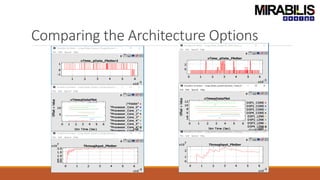
Comparing the Architecture Options
Secondary PCI Bus, 64 Bit Up to 66 MHz
ADSP-TS201S
TigerSHARC DSP
DSP #1
512MB~1024MB
SDRAM
8片TSOPII54
QL5064
QuickLogic
64-bit Embedded
PCI Controller
ADSP-TS201S
TigerSHARC DSP
DSP #2
64-bit, 83.3 MHz DSP Cluster Bus 1
LINK
LINK
LINK
LINK
LINK
VirtexII-Pro
XILINX
LINK to
VirtexII-Pro
RocketIO
(4 Channels)
to VXS P0
Boot
Flash
peripheral
8-bit bus
QL5064 Peripheral
8-bit bus
DSP1 Ints&Flags
DSP2 Ints&Flags
DSP3 Ints&Flags
DSP4 Ints&Flags
QL5064 Peripheral
8-bit bus
ADSP-TS201S
TigerSHARC DSP
DSP #3
512MB~1024MB
SDRAM
8片TSOPII54
QL5064
QuickLogic
64-bit Embedded
PCI Controller
ADSP-TS201S
TigerSHARC DSP
DSP #4
64-bit, 83.3 MHz DSP Cluster Bus 2
LINK
Boot
Flash
peripheral
8-bit bus
LINK to
VirtexII-Pro
LINK to
VirtexII-Pro
LINK to
VirtexII-Pro
DSP 1 LINK
DSP 2 LINK
DSP 3 LINK
DSP 4 LINK
PCI 64/66
IPcore
PowerPC
405e
RS232接口
RS232
串行接口
to P2
PCI 64位/66MHz
PMC槽
Boot
Flash
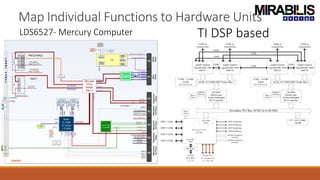
Map Individual Functions to Hardware Units
LDS6527- Mercury Computer TI DSP based
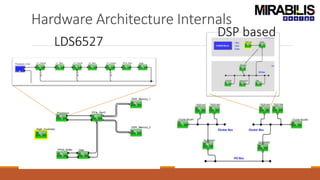
Hardware Architecture Internals
LDS6527
DSP based
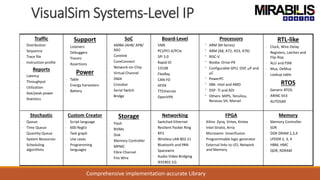
VisualSim Systems-Level IP
Comprehensive implementation-accurate Library
Traffic
• Distribution
• Sequence
• Trace file
• Instruction profile
Reports
• Latency
• Throughput
• Utilization
• Ave/peak power
• Statistics
Support
• Listeners
• Debuggers
• Tracers
• Assertions
Power
• Table
• Energy harvesters
• Battery
SoC
• AMBA (AHB/ APB/
AXI)
• Corelink
• CoreConnect
• Network-on-Chip
• Virtual Channel
• DMA
• Crossbar
• Serial Switch
• Bridge
Board-Level
• VME
• PCI/PCI-X/PCIe
• SPI 3.0
• Rapid IO
• 1553B
• FlexRay
• CAN-FD
• AFDX
• TTEthernet
• OpenVPX
Processors
• ARM (M-Series)
• ARM (A8, A72, A53, A76)
• RISC-V
• Nvidia- Drive-PX
• Configurable GPU, DSP, mP and
mC
• PowerPC
• X86- Intel and AMD
• DSP- TI and ADI
• Others: MIPS, Tensilica,
Renesas SH, Marvel
RTL-like
• Clock, Wire-Delay
• Registers, Latches and
Flip-flop
• ALU and FSM
• Mux, DeMux
• Lookup table
RTOS
• Generic RTOS
• ARINC 653
• AUTOSAR
Stochastic
• Queue
• Time Queue
• Quantity Queue
• System Resources
• Scheduling
algorithms
Custom Creator
• Script language
• 600 RegEx
• Task graph
• Use cases
• Programming
languages
Storage
• Flash
• NVMe
• Disk
• Memory Controller
• MPMC
• Fibre Channel
• Fire Wire
Networking
• Switched Ethernet
• Resilient Packet Ring
• RP3
• Wireless LAN 802.11
• Bluetooth and PAN
• Spacewire
• Audio-Video Bridging
• IEEE802.1Q
FPGA
• Xilinx- Zynq, Virtex, Kintex
• Intel-Stratix, Arria
• Microsemi- Smartfusion
• Programmable logic generator
• External links to I/O, Network
and Memory
Memory
• Memory Controller
• SDR
• DDR DRAM 2,3,4
• LPDDR 2, 3, 4
• HBM, HMC
• QDR, RDRAM
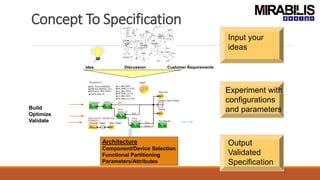
Concept To Specification
Idea Discussion
Input your
ideas
Customer Requirements
Build
Optimize
Validate
Architecture
Component/Device Selection
Functional Partitioning
Parameters/Attributes
Experiment with
configurations
and parameters
Output
Validated
Specification
Examples of VisualSim Usage
Multiple Vendors Avionics and Flight Control
◦ Design a reconnaissance aircraft with Mercury servers, BAE interface ASICs and internal software
◦ Measure processing MIPS and networking bandwidth for different virtual channels and data input rates
◦ Reduce the battery usage and the battery size for the proposed system
Designing OpenVPX and SpaceVPX
◦ Compare SpacevPX and OpenVPX for high performance computing applications
◦ Identify system bottlenecks as data rates, processing requirements and storage accesses are increased
◦ Tested the interoperability of different vendors
China Aerospace Radar
◦ Validate the algorithm sequence and assignment to hardware platform for different traffic and data sizes
◦ Compare Xilinx Ultrascale MPSoC, TI DSP and Kintex
◦ Trade-off compute-intensive vs. memory-intensive
Examples of VisualSim Usage
Gradual Failure
◦ Determine the longest duration of sustained basic operation for a gradual power failure
◦ Test for various power loss rates and combination of instrument activities to maximize return on investment
◦ Select the right schedule for shutting down sub-systems
Hardware and Software Failure
◦ Evaluate the recovery time and continued operation using redundant boards
◦ Modify the different failure combinations
◦ Determine the best case continued operation requirements
Network failure
◦ Impact of re-routing because of a link shutdown
◦ Experiment with different routing algorithms
◦ Measure the latency from Source to data center
Examples of VisualSim Usage
Mission Planning
◦ Compute resource and battery requirements for different Cubesat orbits
◦ Experiment with processing and battery charge during charging and discharging periods
◦ Vary the activities in each orbit and vary the sub-systems used for each task
Cybersecurity
◦ Evaluate the overhead for computing hash values for packets on Gateways
◦ Provide feedback to development teams on the available resources for each algorithm
◦ Generate documentation with anticipated parameter values to attach with the specification
Software-Defined Radio
◦ Study the processing overhead of different encryption algorithms
◦ Using Analog Devices ADC and Xilinx Virtex 5 FPGA
◦ Determine ways to reduce overhead by using local BRAM for block buffering
Examples of VisualSim Usage
JPL Europa Clipper
◦ Determine corner cases with wait states and termination requests that cause long delays and data loss
◦ Reuse legacy architecture with Radiation-hardened parts
◦ Determine the maximum number of sensors assignment to each board and the DMA speed
JPL Nexus Project
◦ Select a standard bus topology for interfacing between boards and for the backplane
◦ Standardized on RapidIO for future projects from 12 bus families for a set of traffic profiles
◦ Developed reusable project to work on multiple projects
US Air Force Processor vs FPGA
◦ Create a table of preferred parts based on battery capacity, orbital activities, sensor rates and error conditions
◦ Compared FPGAs, DSP and ARM-based processor families
◦ Established a list of criteria to select the board for each spacecraft sub-system
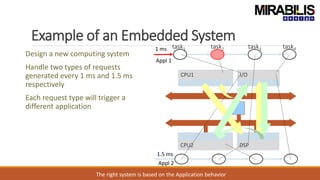
Example of an Embedded System
Design a new computing system
Handle two types of requests
generated every 1 ms and 1.5 ms
respectively
Each request type will trigger a
different application
I/O
DSP
CPU1
CPU2
task1 task2 task3 task4
The right system is based on the Application behavior
Appl 1
1 ms
1.5 ms
Appl 2
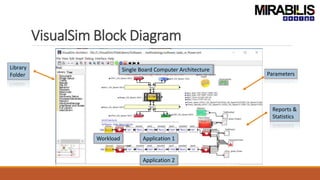
VisualSim Block Diagram
Library
Folder Parameters
Reports &
Statistics
Single Board Computer Architecture
Application 1
Application 2
Workload
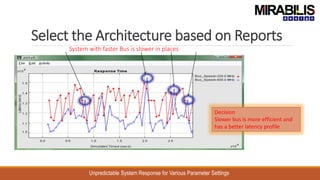
Select the Architecture based on Reports
System with faster Bus is slower in places
Unpredictable System Response for Various Parameter Settings
Decision
Slower bus is more efficient and
has a better latency profile
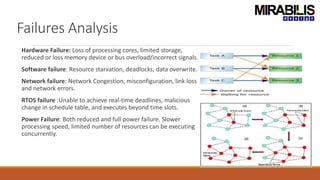
Failures Analysis
Hardware Failure: Loss of processing cores, limited storage,
reduced or loss memory device or bus overload/incorrect signals.
Software failure: Resource starvation, deadlocks, data overwrite.
Network failure: Network Congestion, misconfiguration, link loss
and network errors.
RTOS failure :Unable to achieve real-time deadlines, malicious
change in schedule table, and executes beyond time slots.
Power Failure: Both reduced and full power failure. Slower
processing speed, limited number of resources can be executing
concurrently.
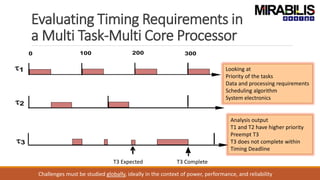
Evaluating Timing Requirements in
a Multi Task-Multi Core Processor
T3 Expected T3 Complete
Looking at
Priority of the tasks
Data and processing requirements
Scheduling algorithm
System electronics
Analysis output
T1 and T2 have higher priority
Preempt T3
T3 does not complete within
Timing Deadline
Challenges must be studied globally, ideally in the context of power, performance, and reliability
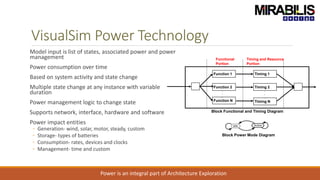
VisualSim Power Technology
Model input is list of states, associated power and power
management
Power consumption over time
Based on system activity and state change
Multiple state change at any instance with variable
duration
Power management logic to change state
Supports network, interface, hardware and software
Power impact entities
◦ Generation- wind, solar, motor, steady, custom
◦ Storage- types of batteries
◦ Consumption- rates, devices and clocks
◦ Management- time and custom
Power is an integral part of Architecture Exploration
Block Power Mode Diagram
Function 1
Function 2
Function N
.
.
.
Functional
Portion
Timing 1
Timing 2
Timing N
.
.
.
Timing and Resource
Portion
Block Functional and Timing Diagram
SYSTEM DESIGN AND EXPLORATION
USING VISUALSIM
Deepak Shankar
Founder
Mirabilis Design Inc.
Email: dshankar@mirabilisdesign.com
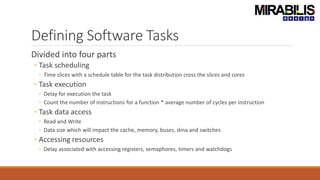
Defining Software Tasks
Divided into four parts
◦ Task scheduling
◦ Time slices with a schedule table for the task distribution cross the slices and cores
◦ Task execution
◦ Delay for execution the task
◦ Count the number of instructions for a function * average number of cycles per instruction
◦ Task data access
◦ Read and Write
◦ Data size which will impact the cache, memory, buses, dma and switches
◦ Accessing resources
◦ Delay associated with accessing registers, semaphores, timers and watchdogs
Defining Existing or New Processors
Gather the following information from the data sheet
◦ Pipeline
◦ Instruction set with number of cycles for each instruction
◦ Cache and memory hierarchy
◦ Context switching time
◦ SIMD/MIMD/Out-of-order queues and number per cycle
Connect the VisualSim blocks and update the parameters
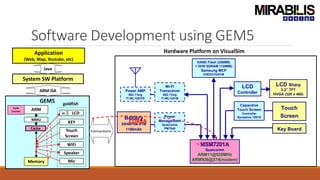
Software Development using GEM5
MSM7201A
Qualcomm
ARM11@528MHz
ARM926@274(modem)
LCD Sharp
3.2” TFT
HVGA (320 x 480)
LCD
Controller
Touch
Screen
NAND Flash (256MB)
+ DDR SDRAM (128MB)
Samsung MCP
K5E2G1GACM
Wi-Fi
Transceiver
802.11b/g
TI WL1251B
Power AMP
802.11b/g
TI WL1251FE
Power
Management
Qualcomm
PM7540
Battery
35H00106-01M
1150mAh
Capacitive
Touch Screen
Controller
Synaptics 1007A
Key Board
Hardware Platform on VisualSim
transactions
CORBA
GEM5
System SW Platform
Application
(Web, Map, Youtube, etc)
ARM
Java
ARM ISA
MMU
Memory
LCD
KEY
Touch
Screen
WiFi
Speaker
Mic
Cache
goldfish
Cycle
Counter
FB
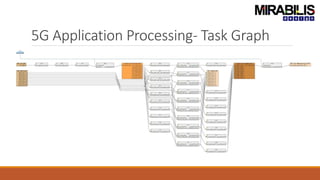
5G Application Processing- Task Graph
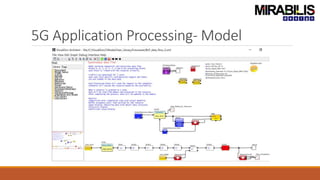
5G Application Processing- Model
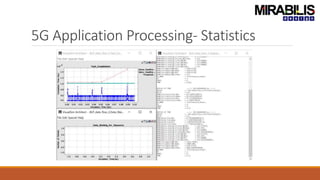
5G Application Processing- Statistics
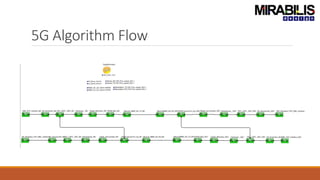
5G Algorithm Flow
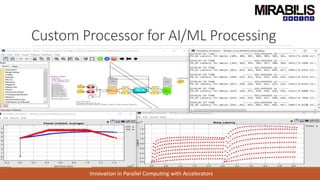
Custom Processor for AI/ML Processing
Innovation in Parallel Computing with Accelerators

Exploration of Radars and Software Defined Radios using VisualSim

  • 1.
    EXPLORATION OF RADARS ANDSOFTWARE DEFINED RADIOS USING VISUALSIM Deepak Shankar Founder Mirabilis Design Inc. Email: dshankar@mirabilisdesign.com
  • 2.
    About Mirabilis Design Softwarecompany based in Silicon Valley providing electronics design solutions Development centers in US, India, China and Czech republic Visualize, optimize and validate the system specification prior to development Customers in Aerospace, Defense, Semiconductors and Automotive VisualSim Architect- Modeling and simulation software Largest source of system modeling blocks and analysis tools Select the “Right” configuration to match customer request
  • 3.
    What is aSystem? Market opportunity is huge because of the breath of applications
  • 4.
    Concept of SystemAnalysis Architecture Exploration ◦ Is the process of evaluating the specification prior to development System modeling ◦ Construct virtual model to represent functionality, timing and power without the implementation code Trade-off ◦ Select right configuration and parameters to meet requirements ◦ Evaluate task mapping, power vs timing, hardware vs software, distributed vs centralized etc. Making Better Quality Products
  • 5.
    Traditional Analysis Focus onthe quality of the algorithm
  • 6.
    Impact of IncorrectArchitecture Analysis Impacts mechanical, thermal, electronics and software implementation Power consumption using Spreadsheet Power consumption using VisualSim
  • 7.
    Library of ModelingComponents Graphical & Hierarchical Modeling Collaborative Engineering Tools Custom Statistics & Reports Open API for integration Timing Throughput Security Capacity Planning Power Planning Buffer Usage Resource Efficiency Failure Analysis The Way Forward using System Simulation with VisualSim Architect Software Network Electronics Analysis Embedded Systems Distributed Systems Semiconductors Eliminate all surprises prior to development Features Segment
  • 8.
    Functional Diagram ofa Radar System
  • 9.
    Architecture Design Challenges Whatshould be the hardware configuration for this application? Does the processing meet the timing deadline? Which tasks consume the most time and memory bandwidth? Can I modify the sequence or change the prior or create an offset that would get better performance without changing the hardware What is the power consumed by the system? Can I increase the number of sensors or handle larger data sizes? What is the individual processing and resource capacity for each task- input to the developers? What are the corner cases for additional test development?
  • 10.
  • 11.
    Secondary PCI Bus,64 Bit Up to 66 MHz ADSP-TS201S TigerSHARC DSP DSP #1 512MB~1024MB SDRAM 8片TSOPII54 QL5064 QuickLogic 64-bit Embedded PCI Controller ADSP-TS201S TigerSHARC DSP DSP #2 64-bit, 83.3 MHz DSP Cluster Bus 1 LINK LINK LINK LINK LINK VirtexII-Pro XILINX LINK to VirtexII-Pro RocketIO (4 Channels) to VXS P0 Boot Flash peripheral 8-bit bus QL5064 Peripheral 8-bit bus DSP1 Ints&Flags DSP2 Ints&Flags DSP3 Ints&Flags DSP4 Ints&Flags QL5064 Peripheral 8-bit bus ADSP-TS201S TigerSHARC DSP DSP #3 512MB~1024MB SDRAM 8片TSOPII54 QL5064 QuickLogic 64-bit Embedded PCI Controller ADSP-TS201S TigerSHARC DSP DSP #4 64-bit, 83.3 MHz DSP Cluster Bus 2 LINK Boot Flash peripheral 8-bit bus LINK to VirtexII-Pro LINK to VirtexII-Pro LINK to VirtexII-Pro DSP 1 LINK DSP 2 LINK DSP 3 LINK DSP 4 LINK PCI 64/66 IPcore PowerPC 405e RS232接口 RS232 串行接口 to P2 PCI 64位/66MHz PMC槽 Boot Flash Map Individual Functions to Hardware Units LDS6527- Mercury Computer TI DSP based
  • 12.
  • 13.
    VisualSim Systems-Level IP Comprehensiveimplementation-accurate Library Traffic • Distribution • Sequence • Trace file • Instruction profile Reports • Latency • Throughput • Utilization • Ave/peak power • Statistics Support • Listeners • Debuggers • Tracers • Assertions Power • Table • Energy harvesters • Battery SoC • AMBA (AHB/ APB/ AXI) • Corelink • CoreConnect • Network-on-Chip • Virtual Channel • DMA • Crossbar • Serial Switch • Bridge Board-Level • VME • PCI/PCI-X/PCIe • SPI 3.0 • Rapid IO • 1553B • FlexRay • CAN-FD • AFDX • TTEthernet • OpenVPX Processors • ARM (M-Series) • ARM (A8, A72, A53, A76) • RISC-V • Nvidia- Drive-PX • Configurable GPU, DSP, mP and mC • PowerPC • X86- Intel and AMD • DSP- TI and ADI • Others: MIPS, Tensilica, Renesas SH, Marvel RTL-like • Clock, Wire-Delay • Registers, Latches and Flip-flop • ALU and FSM • Mux, DeMux • Lookup table RTOS • Generic RTOS • ARINC 653 • AUTOSAR Stochastic • Queue • Time Queue • Quantity Queue • System Resources • Scheduling algorithms Custom Creator • Script language • 600 RegEx • Task graph • Use cases • Programming languages Storage • Flash • NVMe • Disk • Memory Controller • MPMC • Fibre Channel • Fire Wire Networking • Switched Ethernet • Resilient Packet Ring • RP3 • Wireless LAN 802.11 • Bluetooth and PAN • Spacewire • Audio-Video Bridging • IEEE802.1Q FPGA • Xilinx- Zynq, Virtex, Kintex • Intel-Stratix, Arria • Microsemi- Smartfusion • Programmable logic generator • External links to I/O, Network and Memory Memory • Memory Controller • SDR • DDR DRAM 2,3,4 • LPDDR 2, 3, 4 • HBM, HMC • QDR, RDRAM
  • 14.
    Concept To Specification IdeaDiscussion Input your ideas Customer Requirements Build Optimize Validate Architecture Component/Device Selection Functional Partitioning Parameters/Attributes Experiment with configurations and parameters Output Validated Specification
  • 15.
    Examples of VisualSimUsage Multiple Vendors Avionics and Flight Control ◦ Design a reconnaissance aircraft with Mercury servers, BAE interface ASICs and internal software ◦ Measure processing MIPS and networking bandwidth for different virtual channels and data input rates ◦ Reduce the battery usage and the battery size for the proposed system Designing OpenVPX and SpaceVPX ◦ Compare SpacevPX and OpenVPX for high performance computing applications ◦ Identify system bottlenecks as data rates, processing requirements and storage accesses are increased ◦ Tested the interoperability of different vendors China Aerospace Radar ◦ Validate the algorithm sequence and assignment to hardware platform for different traffic and data sizes ◦ Compare Xilinx Ultrascale MPSoC, TI DSP and Kintex ◦ Trade-off compute-intensive vs. memory-intensive
  • 16.
    Examples of VisualSimUsage Gradual Failure ◦ Determine the longest duration of sustained basic operation for a gradual power failure ◦ Test for various power loss rates and combination of instrument activities to maximize return on investment ◦ Select the right schedule for shutting down sub-systems Hardware and Software Failure ◦ Evaluate the recovery time and continued operation using redundant boards ◦ Modify the different failure combinations ◦ Determine the best case continued operation requirements Network failure ◦ Impact of re-routing because of a link shutdown ◦ Experiment with different routing algorithms ◦ Measure the latency from Source to data center
  • 17.
    Examples of VisualSimUsage Mission Planning ◦ Compute resource and battery requirements for different Cubesat orbits ◦ Experiment with processing and battery charge during charging and discharging periods ◦ Vary the activities in each orbit and vary the sub-systems used for each task Cybersecurity ◦ Evaluate the overhead for computing hash values for packets on Gateways ◦ Provide feedback to development teams on the available resources for each algorithm ◦ Generate documentation with anticipated parameter values to attach with the specification Software-Defined Radio ◦ Study the processing overhead of different encryption algorithms ◦ Using Analog Devices ADC and Xilinx Virtex 5 FPGA ◦ Determine ways to reduce overhead by using local BRAM for block buffering
  • 18.
    Examples of VisualSimUsage JPL Europa Clipper ◦ Determine corner cases with wait states and termination requests that cause long delays and data loss ◦ Reuse legacy architecture with Radiation-hardened parts ◦ Determine the maximum number of sensors assignment to each board and the DMA speed JPL Nexus Project ◦ Select a standard bus topology for interfacing between boards and for the backplane ◦ Standardized on RapidIO for future projects from 12 bus families for a set of traffic profiles ◦ Developed reusable project to work on multiple projects US Air Force Processor vs FPGA ◦ Create a table of preferred parts based on battery capacity, orbital activities, sensor rates and error conditions ◦ Compared FPGAs, DSP and ARM-based processor families ◦ Established a list of criteria to select the board for each spacecraft sub-system
  • 19.
    Example of anEmbedded System Design a new computing system Handle two types of requests generated every 1 ms and 1.5 ms respectively Each request type will trigger a different application I/O DSP CPU1 CPU2 task1 task2 task3 task4 The right system is based on the Application behavior Appl 1 1 ms 1.5 ms Appl 2
  • 20.
    VisualSim Block Diagram Library FolderParameters Reports & Statistics Single Board Computer Architecture Application 1 Application 2 Workload
  • 21.
    Select the Architecturebased on Reports System with faster Bus is slower in places Unpredictable System Response for Various Parameter Settings Decision Slower bus is more efficient and has a better latency profile
  • 22.
    Failures Analysis Hardware Failure:Loss of processing cores, limited storage, reduced or loss memory device or bus overload/incorrect signals. Software failure: Resource starvation, deadlocks, data overwrite. Network failure: Network Congestion, misconfiguration, link loss and network errors. RTOS failure :Unable to achieve real-time deadlines, malicious change in schedule table, and executes beyond time slots. Power Failure: Both reduced and full power failure. Slower processing speed, limited number of resources can be executing concurrently.
  • 23.
    Evaluating Timing Requirementsin a Multi Task-Multi Core Processor T3 Expected T3 Complete Looking at Priority of the tasks Data and processing requirements Scheduling algorithm System electronics Analysis output T1 and T2 have higher priority Preempt T3 T3 does not complete within Timing Deadline Challenges must be studied globally, ideally in the context of power, performance, and reliability
  • 24.
    VisualSim Power Technology Modelinput is list of states, associated power and power management Power consumption over time Based on system activity and state change Multiple state change at any instance with variable duration Power management logic to change state Supports network, interface, hardware and software Power impact entities ◦ Generation- wind, solar, motor, steady, custom ◦ Storage- types of batteries ◦ Consumption- rates, devices and clocks ◦ Management- time and custom Power is an integral part of Architecture Exploration Block Power Mode Diagram Function 1 Function 2 Function N . . . Functional Portion Timing 1 Timing 2 Timing N . . . Timing and Resource Portion Block Functional and Timing Diagram
  • 25.
    SYSTEM DESIGN ANDEXPLORATION USING VISUALSIM Deepak Shankar Founder Mirabilis Design Inc. Email: dshankar@mirabilisdesign.com
  • 26.
    Defining Software Tasks Dividedinto four parts ◦ Task scheduling ◦ Time slices with a schedule table for the task distribution cross the slices and cores ◦ Task execution ◦ Delay for execution the task ◦ Count the number of instructions for a function * average number of cycles per instruction ◦ Task data access ◦ Read and Write ◦ Data size which will impact the cache, memory, buses, dma and switches ◦ Accessing resources ◦ Delay associated with accessing registers, semaphores, timers and watchdogs
  • 27.
    Defining Existing orNew Processors Gather the following information from the data sheet ◦ Pipeline ◦ Instruction set with number of cycles for each instruction ◦ Cache and memory hierarchy ◦ Context switching time ◦ SIMD/MIMD/Out-of-order queues and number per cycle Connect the VisualSim blocks and update the parameters
  • 28.
    Software Development usingGEM5 MSM7201A Qualcomm ARM11@528MHz ARM926@274(modem) LCD Sharp 3.2” TFT HVGA (320 x 480) LCD Controller Touch Screen NAND Flash (256MB) + DDR SDRAM (128MB) Samsung MCP K5E2G1GACM Wi-Fi Transceiver 802.11b/g TI WL1251B Power AMP 802.11b/g TI WL1251FE Power Management Qualcomm PM7540 Battery 35H00106-01M 1150mAh Capacitive Touch Screen Controller Synaptics 1007A Key Board Hardware Platform on VisualSim transactions CORBA GEM5 System SW Platform Application (Web, Map, Youtube, etc) ARM Java ARM ISA MMU Memory LCD KEY Touch Screen WiFi Speaker Mic Cache goldfish Cycle Counter FB
  • 29.
  • 30.
  • 31.
  • 32.
  • 33.
    Custom Processor forAI/ML Processing Innovation in Parallel Computing with Accelerators