USING AI FOR OPTIMAL TIME SENSITIVE NETWORKING IN
AVIONICS
Tom Jose
R&D
Mirabilis Design Inc.
Email: tjose@mirabilisdesign.com
Deepak Shankar
Founder
Mirabilis Design Inc.
Email: Deepak.shankar@mirabilisdesign.com
Mohini Yadav
R&D
Mirabilis Design Inc.
Email: myadav@mirabilisdesign.com
DASC 2020
Outline
•Introduction
•Research Methods
•Results
•Conclusion
•Future works
DASC 2020
Issues at hand
•Wiring adds up significant amount of weight to the avionics system
• Airbus A380 contains 500 Km of cables
•Current Communication architecture used cannot support the future requirements for data
bandwidth and connectivity
• 10 Gbps or higher for In Flight Entertainment system as backbone and for remote media loading
•Monitored data from different points in the network needs to be multiplexed into a single flight
data recorder.
DASC 2020
Solution
•Using Ethernet as backbone gives very high bandwidth for data
•But Ethernet is not deterministic and hence time critical packets might get delayed or even
worse, gets dropped
•By applying Time Sensitive Networking protocols (IEEE 802.1), a deterministic behaviour for time
critical applications can be observed in theory.
•Point to points connections wont be necessary here which in turn would reduces the wiring
substantially.
DASC 2020
Research Methods
•We used a System Level Modelling tool called VisualSim Architect for validating the solution.
• VisualSim Architect already had the IEEE 802.1 protocols added to their library and offered
customization to the users along with full visibility to code written
• This helped us to create different test cases and carry out the research much more efficiently
• VisualSim Architect already had template designs using 1553 bus and AFDX which made the comparison
between these easier.
•We tested the virtual prototypes under extreme stress and analysed the end to end latency
across different traffic classes, Buffer occupancy , credit plots etc
• Different traffic classes under study were:
• CDT – Very high priority and is time critical, Control data packets
• AVB – High priority but not as critical as CDT, Audio Video packets
• BE – Low priority, Best Effort packets
DASC 2020
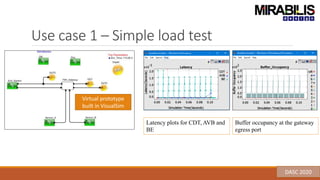
Use case 1 – Simple load test
Virtual prototype
built in VisualSim
Latency plots for CDT, AVB and
BE
Buffer occupancy at the gateway
egress port
DASC 2020
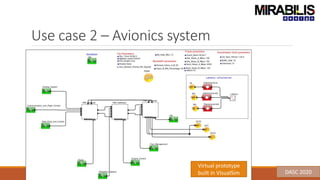
Use case 2 – Avionics system
Virtual prototype
built in VisualSim DASC 2020
Use case 2 - Results
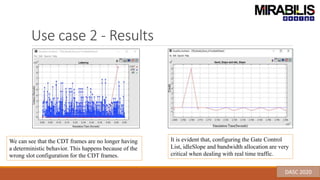
We can see that the CDT frames are no longer having
a deterministic behavior. This happens because of the
wrong slot configuration for the CDT frames.
It is evident that, configuring the Gate Control
List, idleSlope and bandwidth allocation are very
critical when dealing with real time traffic.
DASC 2020
Results after adding AI algorithm to
select right configuration
We can see that a deterministic response times for the
CDT frames were maintained by using AI
algorithms. .
We trained the algorithm with more than thousand
parameter combinations and the algorithm was able
to provide the optimal configurations for the system.
DASC 2020
Conclusion
•TSN standards when implemented without the optimal configuration, we obtained non deterministic
behavior for all traffic classes.
•While when implemented with the aid of AI, we observed deterministic behavior for the critical real time
traffic and even though non deterministic, a much stable response times from best effort frames were also
observed.
DASC 2020
Future works
•Future work aims at improving the safety island architecture for the avionics system.
•The presented use cases in this presentation will be discussed in future work, where faults will be injected
and performance will be analyzed.
DASC 2020
DASC 2020

Using ai for optimal time sensitive networking in avionics

  • 1.
    USING AI FOROPTIMAL TIME SENSITIVE NETWORKING IN AVIONICS Tom Jose R&D Mirabilis Design Inc. Email: tjose@mirabilisdesign.com Deepak Shankar Founder Mirabilis Design Inc. Email: Deepak.shankar@mirabilisdesign.com Mohini Yadav R&D Mirabilis Design Inc. Email: myadav@mirabilisdesign.com DASC 2020
  • 2.
  • 3.
    Issues at hand •Wiringadds up significant amount of weight to the avionics system • Airbus A380 contains 500 Km of cables •Current Communication architecture used cannot support the future requirements for data bandwidth and connectivity • 10 Gbps or higher for In Flight Entertainment system as backbone and for remote media loading •Monitored data from different points in the network needs to be multiplexed into a single flight data recorder. DASC 2020
  • 4.
    Solution •Using Ethernet asbackbone gives very high bandwidth for data •But Ethernet is not deterministic and hence time critical packets might get delayed or even worse, gets dropped •By applying Time Sensitive Networking protocols (IEEE 802.1), a deterministic behaviour for time critical applications can be observed in theory. •Point to points connections wont be necessary here which in turn would reduces the wiring substantially. DASC 2020
  • 5.
    Research Methods •We useda System Level Modelling tool called VisualSim Architect for validating the solution. • VisualSim Architect already had the IEEE 802.1 protocols added to their library and offered customization to the users along with full visibility to code written • This helped us to create different test cases and carry out the research much more efficiently • VisualSim Architect already had template designs using 1553 bus and AFDX which made the comparison between these easier. •We tested the virtual prototypes under extreme stress and analysed the end to end latency across different traffic classes, Buffer occupancy , credit plots etc • Different traffic classes under study were: • CDT – Very high priority and is time critical, Control data packets • AVB – High priority but not as critical as CDT, Audio Video packets • BE – Low priority, Best Effort packets DASC 2020
  • 6.
    Use case 1– Simple load test Virtual prototype built in VisualSim Latency plots for CDT, AVB and BE Buffer occupancy at the gateway egress port DASC 2020
  • 7.
    Use case 2– Avionics system Virtual prototype built in VisualSim DASC 2020
  • 8.
    Use case 2- Results We can see that the CDT frames are no longer having a deterministic behavior. This happens because of the wrong slot configuration for the CDT frames. It is evident that, configuring the Gate Control List, idleSlope and bandwidth allocation are very critical when dealing with real time traffic. DASC 2020
  • 9.
    Results after addingAI algorithm to select right configuration We can see that a deterministic response times for the CDT frames were maintained by using AI algorithms. . We trained the algorithm with more than thousand parameter combinations and the algorithm was able to provide the optimal configurations for the system. DASC 2020
  • 10.
    Conclusion •TSN standards whenimplemented without the optimal configuration, we obtained non deterministic behavior for all traffic classes. •While when implemented with the aid of AI, we observed deterministic behavior for the critical real time traffic and even though non deterministic, a much stable response times from best effort frames were also observed. DASC 2020
  • 11.
    Future works •Future workaims at improving the safety island architecture for the avionics system. •The presented use cases in this presentation will be discussed in future work, where faults will be injected and performance will be analyzed. DASC 2020
  • 12.