ExpEriEntial lEarninG MEtHOD
DR. C. BEULAH JAYARANI
M.Sc., M.A, M.Ed, M.Phil (Edn), M.Phil (ZOO), NET, Ph.D
ASST. PROFESSOR,
LOYOLA COLLEGE OF EDUCATION, CHENNAI - 34
UNIT - IV
B.Ed - TNTEU
intrODUCtiOn
• Experiential learning integrates cognitive and behavioral
learning theories as an applied approach to "learning by
doing" that enables learners to gain experience in the
application of learning concepts.
5/21/2021 Dr. C. Beulah Jayarani 2
COnt…,
 Learning is the modification of behaviour through experience.
 The process has continuity and is carried through various years.
 Perfection in learning is achieved only through active interaction and experience.
 The learning mind reacts to external conditions and modified with experience the
learner gains.
 The process of learning takes place at 3 levels:
*Depending on prior experience of learner,
*Intellectual ability,
*Presentation of materials.
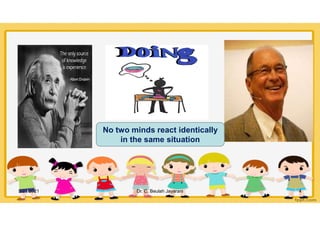
No two minds react identically
in the same situation
5/21/2021 Dr. C. Beulah Jayarani 4
pUrpOSE OF ExpEriEntial lEarninG
TO MODIFY THE
BEHAVIOUR OF THE
INDIVIDUAL
5/21/2021 Dr. C. Beulah Jayarani 5
5/21/2021 Dr. C. Beulah Jayarani 6
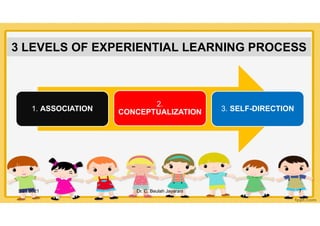
3 LEVELS OF EXPERIENTIAL LEARNING PROCESS
1. ASSOCIATION
2.
CONCEPTUALIZATION 3. SELF-DIRECTION
5/21/2021 Dr. C. Beulah Jayarani 7
5/21/2021 Dr. C. Beulah Jayarani 8
COnt…
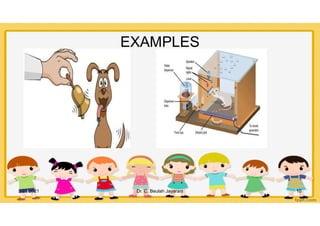
• All initial learning consists in the formation of association.
• Most of the knowledge and attitudes are learnt by association.
• This type of learning is comparatively easier to evaluate.
5/21/2021 Dr. C. Beulah Jayarani 9
EXAMPLES
5/21/2021 Dr. C. Beulah Jayarani 10
COnCEptUaliZatiOn
5/21/2021 Dr. C. Beulah Jayarani 11
COnt…
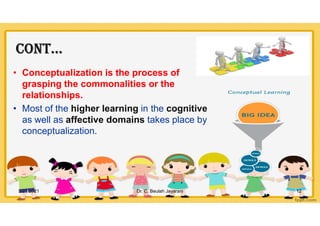
• Conceptualization is the process of
grasping the commonalities or the
relationships.
• Most of the higher learning in the cognitive
as well as affective domains takes place by
conceptualization.
5/21/2021 Dr. C. Beulah Jayarani 12
SElF- DirECtiOn
• In self directions is achieved as
people progress from association and
move on to conceptualization.
 Emotional or affective dimension of
learning is the strength.
• Can work independently on his own
initiative.
• Characterizes the creative artist.
5/21/2021 Dr. C. Beulah Jayarani 13
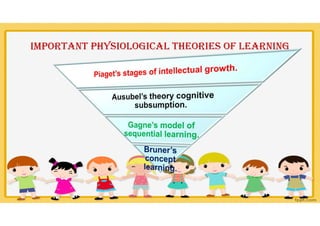
iMpOrtant pHySiOlOGiCal tHEOriES OF lEarninG
lEarninG ExpEriEnCE
Children learn by feeling, thinking and acting.
Stimulation of active participation by teachers.
Not a part of syllabus but interaction of learner.
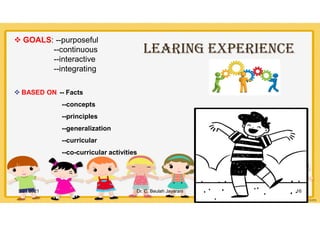
lEarinG ExpEriEnCE
 GOALS: --purposeful
--continuous
--interactive
--integrating
 BASED ON: -- Facts
--concepts
--principles
--generalization
--curricular
--co-curricular activities
5/21/2021 Dr. C. Beulah Jayarani 16
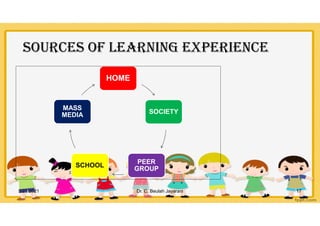
SOUrCES OF lEarninG ExpEriEnCE
HOME
SOCIETY
PEER
GROUP
SCHOOL
MASS
MEDIA
5/21/2021 Dr. C. Beulah Jayarani 17
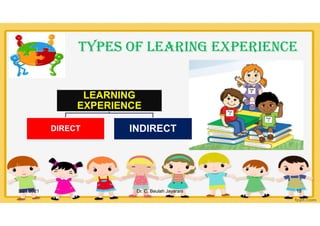
typES OF lEarinG ExpEriEnCE
5/21/2021 Dr. C. Beulah Jayarani 18
LEARNING
EXPERIENCE
DIRECT INDIRECT
DirECt ExpEriEnCE
5/21/2021 Dr. C. Beulah Jayarani 19
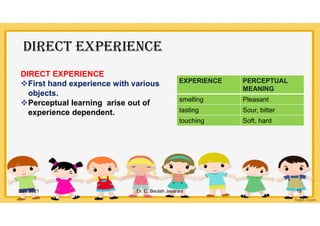
DIRECT EXPERIENCE
First hand experience with various
objects.
Perceptual learning arise out of
experience dependent.
EXPERIENCE PERCEPTUAL
MEANING
smelling Pleasant
tasting Sour, bitter
touching Soft, hard
inDirECt ExpEriEnCE
5/21/2021 Dr. C. Beulah Jayarani 20
INDIRECT EXPERIENCE
Experiences which are not real.
Example: earthquake, feeling of travelling by air or sea.
It can be appreciated and can experience through imagination
only.
CHaraCtEriStiCS OF GOOD lEarninG ExpEriEnCE
• Learning experience Instructional objectives
• Must satisfy psychological need of the learner
• Should be meaningful, appreciate the maturity level of the
learner, relate to the life situation, reinforced, intensive etc.,
• Should be varied, rich in content and novel
• Must be related to the availability of material & time
5/21/2021 Dr. C. Beulah Jayarani 21
aDVantaGES:
• Accelerates learning
• Increases them team work
• Learning helps to develop skills
• It increase student focus in the classroom
• Mistakes becomes valuable.
5/21/2021 Dr. C. Beulah Jayarani 22
liMitatiOnS/CHallEnGES:
• Participant can loose objectivity
• Reflection is difficult skill
• Limited class time / access to resources
• Inadequate group work skills
5/21/2021 Dr. C. Beulah Jayarani 23
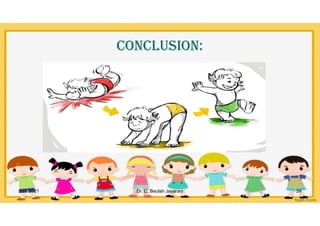
COnClUSiOn:
5/21/2021 Dr. C. Beulah Jayarani 24
rEFErEnCE
“Teaching of Biological Science”
TNTEU – Study Material
Ram Publications
Sri Krishna Publications
Kaviyamala Publications
Google Images
5/21/2021 Dr. C. Beulah Jayarani 25

Experiential learning method

  • 1.
    ExpEriEntial lEarninG MEtHOD DR.C. BEULAH JAYARANI M.Sc., M.A, M.Ed, M.Phil (Edn), M.Phil (ZOO), NET, Ph.D ASST. PROFESSOR, LOYOLA COLLEGE OF EDUCATION, CHENNAI - 34 UNIT - IV B.Ed - TNTEU
  • 2.
    intrODUCtiOn • Experiential learningintegrates cognitive and behavioral learning theories as an applied approach to "learning by doing" that enables learners to gain experience in the application of learning concepts. 5/21/2021 Dr. C. Beulah Jayarani 2
  • 3.
    COnt…,  Learning isthe modification of behaviour through experience.  The process has continuity and is carried through various years.  Perfection in learning is achieved only through active interaction and experience.  The learning mind reacts to external conditions and modified with experience the learner gains.  The process of learning takes place at 3 levels: *Depending on prior experience of learner, *Intellectual ability, *Presentation of materials.
  • 4.
    No two mindsreact identically in the same situation 5/21/2021 Dr. C. Beulah Jayarani 4
  • 5.
    pUrpOSE OF ExpEriEntiallEarninG TO MODIFY THE BEHAVIOUR OF THE INDIVIDUAL 5/21/2021 Dr. C. Beulah Jayarani 5
  • 6.
    5/21/2021 Dr. C.Beulah Jayarani 6
  • 7.
    3 LEVELS OFEXPERIENTIAL LEARNING PROCESS 1. ASSOCIATION 2. CONCEPTUALIZATION 3. SELF-DIRECTION 5/21/2021 Dr. C. Beulah Jayarani 7
  • 8.
    5/21/2021 Dr. C.Beulah Jayarani 8
  • 9.
    COnt… • All initiallearning consists in the formation of association. • Most of the knowledge and attitudes are learnt by association. • This type of learning is comparatively easier to evaluate. 5/21/2021 Dr. C. Beulah Jayarani 9
  • 10.
    EXAMPLES 5/21/2021 Dr. C.Beulah Jayarani 10
  • 11.
  • 12.
    COnt… • Conceptualization isthe process of grasping the commonalities or the relationships. • Most of the higher learning in the cognitive as well as affective domains takes place by conceptualization. 5/21/2021 Dr. C. Beulah Jayarani 12
  • 13.
    SElF- DirECtiOn • Inself directions is achieved as people progress from association and move on to conceptualization.  Emotional or affective dimension of learning is the strength. • Can work independently on his own initiative. • Characterizes the creative artist. 5/21/2021 Dr. C. Beulah Jayarani 13
  • 14.
  • 15.
    lEarninG ExpEriEnCE Children learnby feeling, thinking and acting. Stimulation of active participation by teachers. Not a part of syllabus but interaction of learner.
  • 16.
    lEarinG ExpEriEnCE  GOALS:--purposeful --continuous --interactive --integrating  BASED ON: -- Facts --concepts --principles --generalization --curricular --co-curricular activities 5/21/2021 Dr. C. Beulah Jayarani 16
  • 17.
    SOUrCES OF lEarninGExpEriEnCE HOME SOCIETY PEER GROUP SCHOOL MASS MEDIA 5/21/2021 Dr. C. Beulah Jayarani 17
  • 18.
    typES OF lEarinGExpEriEnCE 5/21/2021 Dr. C. Beulah Jayarani 18 LEARNING EXPERIENCE DIRECT INDIRECT
  • 19.
    DirECt ExpEriEnCE 5/21/2021 Dr.C. Beulah Jayarani 19 DIRECT EXPERIENCE First hand experience with various objects. Perceptual learning arise out of experience dependent. EXPERIENCE PERCEPTUAL MEANING smelling Pleasant tasting Sour, bitter touching Soft, hard
  • 20.
    inDirECt ExpEriEnCE 5/21/2021 Dr.C. Beulah Jayarani 20 INDIRECT EXPERIENCE Experiences which are not real. Example: earthquake, feeling of travelling by air or sea. It can be appreciated and can experience through imagination only.
  • 21.
    CHaraCtEriStiCS OF GOODlEarninG ExpEriEnCE • Learning experience Instructional objectives • Must satisfy psychological need of the learner • Should be meaningful, appreciate the maturity level of the learner, relate to the life situation, reinforced, intensive etc., • Should be varied, rich in content and novel • Must be related to the availability of material & time 5/21/2021 Dr. C. Beulah Jayarani 21
  • 22.
    aDVantaGES: • Accelerates learning •Increases them team work • Learning helps to develop skills • It increase student focus in the classroom • Mistakes becomes valuable. 5/21/2021 Dr. C. Beulah Jayarani 22
  • 23.
    liMitatiOnS/CHallEnGES: • Participant canloose objectivity • Reflection is difficult skill • Limited class time / access to resources • Inadequate group work skills 5/21/2021 Dr. C. Beulah Jayarani 23
  • 24.
    COnClUSiOn: 5/21/2021 Dr. C.Beulah Jayarani 24
  • 25.
    rEFErEnCE “Teaching of BiologicalScience” TNTEU – Study Material Ram Publications Sri Krishna Publications Kaviyamala Publications Google Images 5/21/2021 Dr. C. Beulah Jayarani 25