Benjamin Bloom  Taxonomy of Cognitive Processes Sets-Up The Theory of Multiple Intelligences
Benjamin Bloom Created a learning taxonomy in 1956 Taxonomy ( taxis :list/ nomos :law) A list is more properly referred to as a Vocabulary. However, Bloom used this term because a taxon is interconnected.  Meaning that the cognitive process and dimensions of knowledge listed are connected
Two Parts Cognitive process: Refers to information processing and the  development of concepts.   Dimension of knowledge: The process of representation.
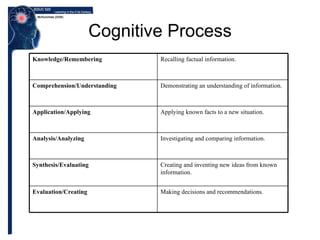
Cognitive Process Making decisions and recommendations. Evaluation/Creating Creating and inventing new ideas from known information. Synthesis/Evaluating Investigating and comparing information. Analysis/Analyzing Applying known facts to a new situation.  Application/Applying Demonstrating an understanding of information. Comprehension/Understanding Recalling factual information. Knowledge/Remembering
Dimensions of Knowledge x Information “95% of the test questions students encounter requires them to think only at the lowest possible level…the recall of information.”  [Bloom 1956]
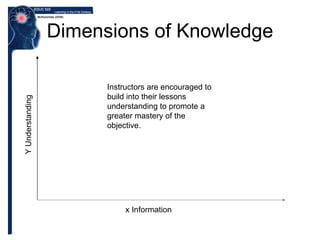
Dimensions of Knowledge x  Information Y Understanding Instructors are encouraged to build into their lessons understanding to promote a greater mastery of the objective.
Dimensions of Knowledge M Application x  Information Y  Understanding Use of the information is measured at the x/y intercept
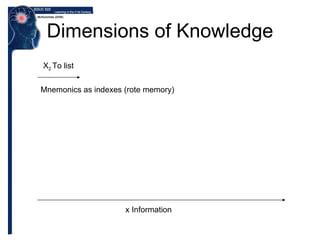
Dimensions of Knowledge x Information X 2  To list Mnemonics as indexes (rote memory)
Dimensions of Knowledge Y Understanding Y 2  To explain Increase ability of students’ to state an  opinion, predict an outcome, and compare, summarizing cause & effect.
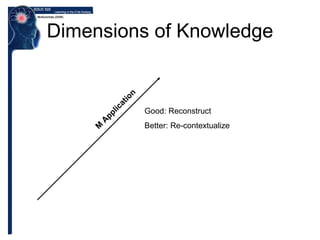
Dimensions of Knowledge M Application Good: Reconstruct  Better: Re-contextualize
Dimensions of Knowledge M Application level 3 x Information level 1 Y Understanding level 2 X 2  To list Y 2  To explain Level 4 Range of Analysis Synthesis Creation
Dimensions of Knowledge M Application x Information Y Understanding
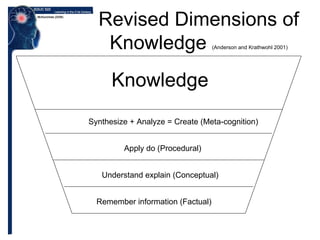
Knowledge Remember information (Factual) Understand explain (Conceptual) Apply do (Procedural) Synthesize + Analyze = Create (Meta-cognition) Revised Dimensions of Knowledge  (Anderson and Krathwohl 2001)
Cognitive Process Dimensions of knowledge 6 levels/parts Cognitive, psychomotor, Affective domains are equally important  Bloom
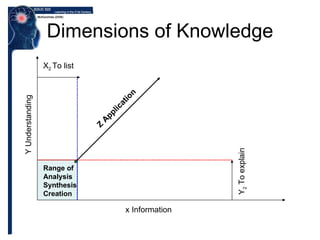
Dimensions of Knowledge Z Application x Information Y Understanding X 2  To list Y 2  To explain Range of Analysis Synthesis Creation
References Bloom, B. (1956)Taxonomy of Educational Objectives: The Classification of Educational Goals; Hand Book 1 : cognitive domain. New York. David Mackay.   Anderson, L.W., and Krathwohl (eds). (2001)  A Taxonomy of Learning, Teaching, and Accessing: A revision of Bloom’s Taxonomy of Education Objectives. New York. Longman.

Blooms taxonomy Expanding past rote memory

  • 1.
    Benjamin Bloom Taxonomy of Cognitive Processes Sets-Up The Theory of Multiple Intelligences
  • 2.
    Benjamin Bloom Createda learning taxonomy in 1956 Taxonomy ( taxis :list/ nomos :law) A list is more properly referred to as a Vocabulary. However, Bloom used this term because a taxon is interconnected. Meaning that the cognitive process and dimensions of knowledge listed are connected
  • 3.
    Two Parts Cognitiveprocess: Refers to information processing and the development of concepts. Dimension of knowledge: The process of representation.
  • 4.
    Cognitive Process Makingdecisions and recommendations. Evaluation/Creating Creating and inventing new ideas from known information. Synthesis/Evaluating Investigating and comparing information. Analysis/Analyzing Applying known facts to a new situation. Application/Applying Demonstrating an understanding of information. Comprehension/Understanding Recalling factual information. Knowledge/Remembering
  • 5.
    Dimensions of Knowledgex Information “95% of the test questions students encounter requires them to think only at the lowest possible level…the recall of information.” [Bloom 1956]
  • 6.
    Dimensions of Knowledgex Information Y Understanding Instructors are encouraged to build into their lessons understanding to promote a greater mastery of the objective.
  • 7.
    Dimensions of KnowledgeM Application x Information Y Understanding Use of the information is measured at the x/y intercept
  • 8.
    Dimensions of Knowledgex Information X 2 To list Mnemonics as indexes (rote memory)
  • 9.
    Dimensions of KnowledgeY Understanding Y 2 To explain Increase ability of students’ to state an opinion, predict an outcome, and compare, summarizing cause & effect.
  • 10.
    Dimensions of KnowledgeM Application Good: Reconstruct Better: Re-contextualize
  • 11.
    Dimensions of KnowledgeM Application level 3 x Information level 1 Y Understanding level 2 X 2 To list Y 2 To explain Level 4 Range of Analysis Synthesis Creation
  • 12.
    Dimensions of KnowledgeM Application x Information Y Understanding
  • 13.
    Knowledge Remember information(Factual) Understand explain (Conceptual) Apply do (Procedural) Synthesize + Analyze = Create (Meta-cognition) Revised Dimensions of Knowledge (Anderson and Krathwohl 2001)
  • 14.
    Cognitive Process Dimensionsof knowledge 6 levels/parts Cognitive, psychomotor, Affective domains are equally important Bloom
  • 15.
    Dimensions of KnowledgeZ Application x Information Y Understanding X 2 To list Y 2 To explain Range of Analysis Synthesis Creation
  • 16.
    References Bloom, B.(1956)Taxonomy of Educational Objectives: The Classification of Educational Goals; Hand Book 1 : cognitive domain. New York. David Mackay. Anderson, L.W., and Krathwohl (eds). (2001) A Taxonomy of Learning, Teaching, and Accessing: A revision of Bloom’s Taxonomy of Education Objectives. New York. Longman.