Bloom’s Taxonomy Ceanlia Vermeulen
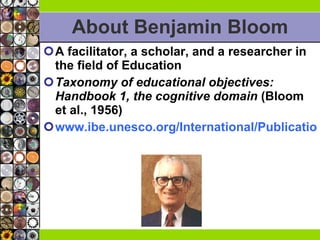
About Benjamin Bloom A facilitator, a scholar, and a researcher in the field of Education  Taxonomy of   educational objectives: Handbook 1, the cognitive domain  (Bloom et al., 1956) www.ibe.unesco.org/International/Publications/Thinkers/ThinkersPdf/bloome.pdf
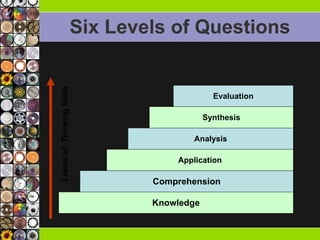
Six Levels of Questions Knowledge Comprehension Application Analysis Synthesis Evaluation Levels of  Thinking Skills
Knowledge Level Recall of information Knowledge of data, events, and places Knowledge of major ideas Mastery of Subject matter Question Cues:  List, define, tell, describe, identify, show, label,  collect, examine, who, when , where, etc. List the major cities in South Africa .  Define the capital city of South Africa.
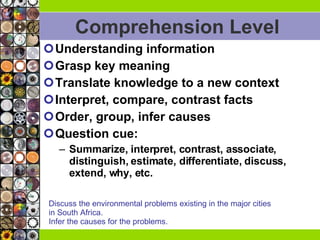
Comprehension Level  Understanding information Grasp key meaning Translate knowledge to a new context Interpret, compare, contrast facts Order, group, infer causes Question cue:  Summarize, interpret, contrast, associate, distinguish, estimate, differentiate, discuss, extend, why, etc. Discuss the environmental problems existing in the major cities  in South Africa. Infer the causes for the problems.
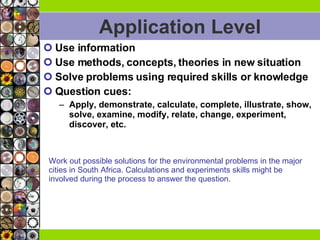
Application Level Use information Use methods, concepts, theories in new situation Solve problems using required skills or knowledge Question cues:  Apply, demonstrate, calculate, complete, illustrate, show, solve, examine, modify, relate, change, experiment, discover, etc.  Work out possible solutions for the environmental problems in the major  cities in South Africa. Calculations and experiments skills might be  involved during the process to answer the question.
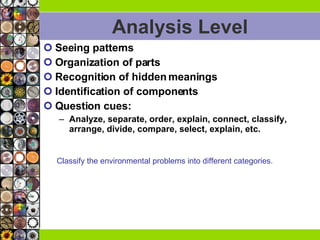
Analysis Level Seeing patterns Organization of parts Recognition of hidden meanings Identification of components Question cues: Analyze, separate, order, explain, connect, classify, arrange, divide, compare, select, explain, etc.  Classify the environmental problems into different categories.
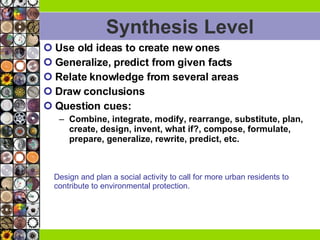
Synthesis Level Use old ideas to create new ones Generalize, predict from given facts Relate knowledge from several areas Draw conclusions Question cues:  Combine, integrate, modify, rearrange, substitute, plan, create, design, invent, what if?, compose, formulate, prepare, generalize, rewrite, predict, etc.  Design and plan a social activity to call for more urban residents to  contribute to environmental protection.
Evaluation Level Compare and discriminate between ideas Judge and appreciate value of concepts, theories, and principles Make choice based on reasoned argument Verify values of evidence Recognize subjectivity  Question Cues:  Assess, decide, rank, grade, test, measure, recommend, convince, select, judge, discriminate, support, conclude, etc.  Recommend the most practical and economic environment protecting plan to the city government. Use evidences and arguments to support your recommendations and convince the ministers.
Exercises Identify the capital of Australia from the following list: Melbourne, Sydney, Canberra  Knowledge  Comprehension  Application  Analysis  Synthesis  Evaluation
Exercises What classification of animals would a FROG belong to? mammal / bird / fish / reptile / amphibian / insect  Analysis Comprehension  Application  Knowledge Synthesis  Evaluation
Exercises Predict what would have happened to early Native Americans if they did not follow the migration of buffaloes: They would hunt and eat other animals instead / They would starve / They would get all their food by farming Synthesis Comprehension  Application  Analysis  Knowledge  Evaluation
Great !!! Good job !! This is a basic question of knowledge to test whether learners recall the knowledge being taught.  Next Question
Great !!! Good job !! The learners are asked about the classification of animals and apply his/her knowledge to answer this question. The facilitators should follow the question by asking the learner to justify the answers.  Next Question
Great !!! Good job !! The learners are asked to PREDICT what  would happen based on the given facts and their previous knowledge related.
Sorry, that’s not correct.  Back to Question
Thank you! Ceanlia Vermeulen [email_address] Cell: 082 905 9339

About Benjamin Bloom

  • 1.
  • 2.
    About Benjamin BloomA facilitator, a scholar, and a researcher in the field of Education Taxonomy of educational objectives: Handbook 1, the cognitive domain (Bloom et al., 1956) www.ibe.unesco.org/International/Publications/Thinkers/ThinkersPdf/bloome.pdf
  • 3.
    Six Levels ofQuestions Knowledge Comprehension Application Analysis Synthesis Evaluation Levels of Thinking Skills
  • 4.
    Knowledge Level Recallof information Knowledge of data, events, and places Knowledge of major ideas Mastery of Subject matter Question Cues: List, define, tell, describe, identify, show, label, collect, examine, who, when , where, etc. List the major cities in South Africa . Define the capital city of South Africa.
  • 5.
    Comprehension Level Understanding information Grasp key meaning Translate knowledge to a new context Interpret, compare, contrast facts Order, group, infer causes Question cue: Summarize, interpret, contrast, associate, distinguish, estimate, differentiate, discuss, extend, why, etc. Discuss the environmental problems existing in the major cities in South Africa. Infer the causes for the problems.
  • 6.
    Application Level Useinformation Use methods, concepts, theories in new situation Solve problems using required skills or knowledge Question cues: Apply, demonstrate, calculate, complete, illustrate, show, solve, examine, modify, relate, change, experiment, discover, etc. Work out possible solutions for the environmental problems in the major cities in South Africa. Calculations and experiments skills might be involved during the process to answer the question.
  • 7.
    Analysis Level Seeingpatterns Organization of parts Recognition of hidden meanings Identification of components Question cues: Analyze, separate, order, explain, connect, classify, arrange, divide, compare, select, explain, etc. Classify the environmental problems into different categories.
  • 8.
    Synthesis Level Useold ideas to create new ones Generalize, predict from given facts Relate knowledge from several areas Draw conclusions Question cues: Combine, integrate, modify, rearrange, substitute, plan, create, design, invent, what if?, compose, formulate, prepare, generalize, rewrite, predict, etc. Design and plan a social activity to call for more urban residents to contribute to environmental protection.
  • 9.
    Evaluation Level Compareand discriminate between ideas Judge and appreciate value of concepts, theories, and principles Make choice based on reasoned argument Verify values of evidence Recognize subjectivity Question Cues: Assess, decide, rank, grade, test, measure, recommend, convince, select, judge, discriminate, support, conclude, etc. Recommend the most practical and economic environment protecting plan to the city government. Use evidences and arguments to support your recommendations and convince the ministers.
  • 10.
    Exercises Identify thecapital of Australia from the following list: Melbourne, Sydney, Canberra Knowledge Comprehension Application Analysis Synthesis Evaluation
  • 11.
    Exercises What classificationof animals would a FROG belong to? mammal / bird / fish / reptile / amphibian / insect Analysis Comprehension Application Knowledge Synthesis Evaluation
  • 12.
    Exercises Predict whatwould have happened to early Native Americans if they did not follow the migration of buffaloes: They would hunt and eat other animals instead / They would starve / They would get all their food by farming Synthesis Comprehension Application Analysis Knowledge Evaluation
  • 13.
    Great !!! Goodjob !! This is a basic question of knowledge to test whether learners recall the knowledge being taught. Next Question
  • 14.
    Great !!! Goodjob !! The learners are asked about the classification of animals and apply his/her knowledge to answer this question. The facilitators should follow the question by asking the learner to justify the answers. Next Question
  • 15.
    Great !!! Goodjob !! The learners are asked to PREDICT what would happen based on the given facts and their previous knowledge related.
  • 16.
    Sorry, that’s notcorrect. Back to Question
  • 17.
    Sorry, that’s notcorrect. Back to Question
  • 18.
    Sorry, that’s notcorrect. Back to Question
  • 19.
    Thank you! CeanliaVermeulen [email_address] Cell: 082 905 9339