Social Emotional Development in Special Needs Children 0-5 years
This document summarizes the stages of social-emotional development from ages 0-5 and provides guidance on supporting children's development, including those with special needs. It discusses 7 stages of typical social-emotional development milestones and strategies caregivers can use to support the child at each stage. For children with special needs, it notes development may follow a different trajectory and recommends focusing on sensory processing, frequent short interactions, following the child's lead, and giving meaning to their actions. The importance of social play is also discussed.
Social Emotional Development in Special Needs Children 0-5 years
1.
And Children WithSpecial
Needs (0-5 years)
Michelle Fitzpatrick, MA
June 4, 2014
SOCIAL~EMOTIONAL
DEVELOPMENT
Special Topics in Early Childhood Series
HappyPaleoKids.com
With Parents Helping Parents
2.
About Me -Michelle
• Education
• BA, Mills College, Psychology
• MA, Mills College, Infant Mental Health
• Work History
• Infant Developmental Specialist, Baby Builders, Oakland
• Early Start Service Coordinator, SARC, Campbell
• Mental Health Counselor, Pre-to-Three, San Mateo County
• …more!
• Currently
• Stay at home mom (Annie, 4; Rosie, 2; Elizabeth, 1)
• Blog: HappyPaleoKids.com examines the intersection of child
development and nutrition
What is Social-EmotionalDevelopment?
• Social development – learning the values, skills, and
knowledge to effectively relate to others and participate in
the world around us
• Emotions serve a social purpose: they allow us to have
insight into another’s internal state
• Primary emotions: anger, fear, surprise, disgust, joy, interest,
sadness
• Secondary emotions (self-conscious emotions):
embarrassed, shame, jealousy, pride, guilt
Foley (1999)
Emotion Regulation
• Whatis emotion?
• A physiological response to the
environment
• What is emotion regulation?
• The ability to monitor and adjust an
emotional response to the
environment in order to reach a goal
• Infants are born with a few strategies for
regulating emotions
• Sucking, gaze aversion, crossing legs,
arms to midline
• Strategies to self-regulate increase as
we mature
(Crockenberg & Leerkes, 2000; Siegel, 1999)
Emotion Regulation
• MutualRegulation/ Emotional Attunement
• Caregiver is aware of and responds in a way that matches the
child’s emotional state and demonstrates she understands the
child’s internal state
• Social Referencing
• Looking toward a caregiver to determine how to respond
(Crockenberg & Leerkes, 2000; Siegel, 1999)
11.
Child-Parent Attachment
• Infantsform relationships with people
“stronger and wiser” in their environment in
order to be protected
• Overtime, they develop mental
representations of those relationships based
on experiences
• They use those mental representations to
make predictions about future interactions,
as well as about the world in general
• Children use their caregivers as a Secure
Base/ Safe Haven from which to explore
(Bowlby, 1969/1982; Ainsowrth et. al, 1978)
12.
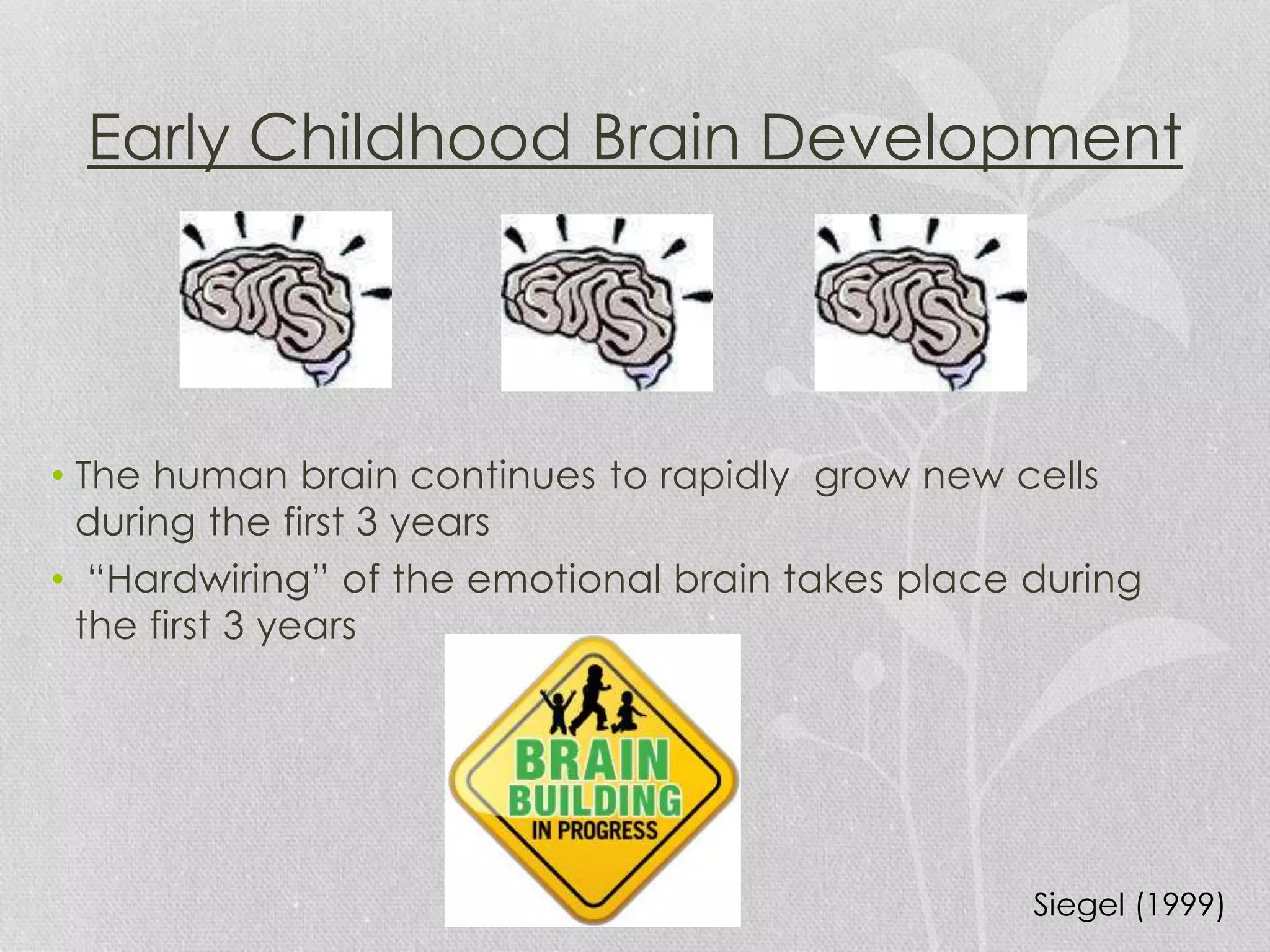
Early Childhood BrainDevelopment
• The human brain continues to rapidly grow new cells
during the first 3 years
• “Hardwiring” of the emotional brain takes place during
the first 3 years
Siegel (1999)
Stages of SocialEmotional Development:
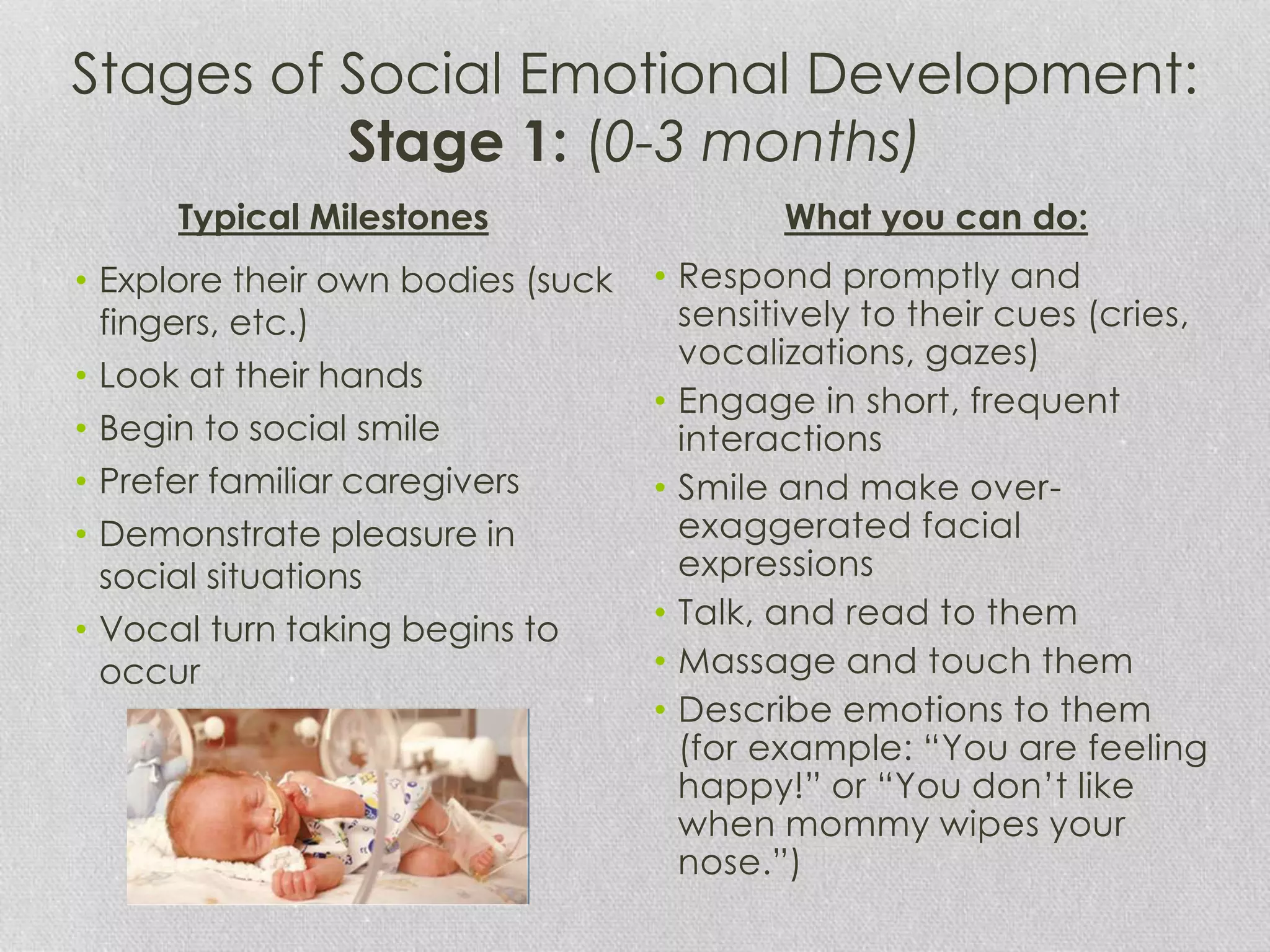
Stage 1: (0-3 months)
• Explore their own bodies (suck
fingers, etc.)
• Look at their hands
• Begin to social smile
• Prefer familiar caregivers
• Demonstrate pleasure in
social situations
• Vocal turn taking begins to
occur
• Respond promptly and
sensitively to their cues (cries,
vocalizations, gazes)
• Engage in short, frequent
interactions
• Smile and make over-
exaggerated facial
expressions
• Talk, and read to them
• Massage and touch them
• Describe emotions to them
(for example: “You are feeling
happy!” or “You don’t like
when mommy wipes your
nose.”)
Typical Milestones What you can do:
15.
Stages of SocialEmotional Development:
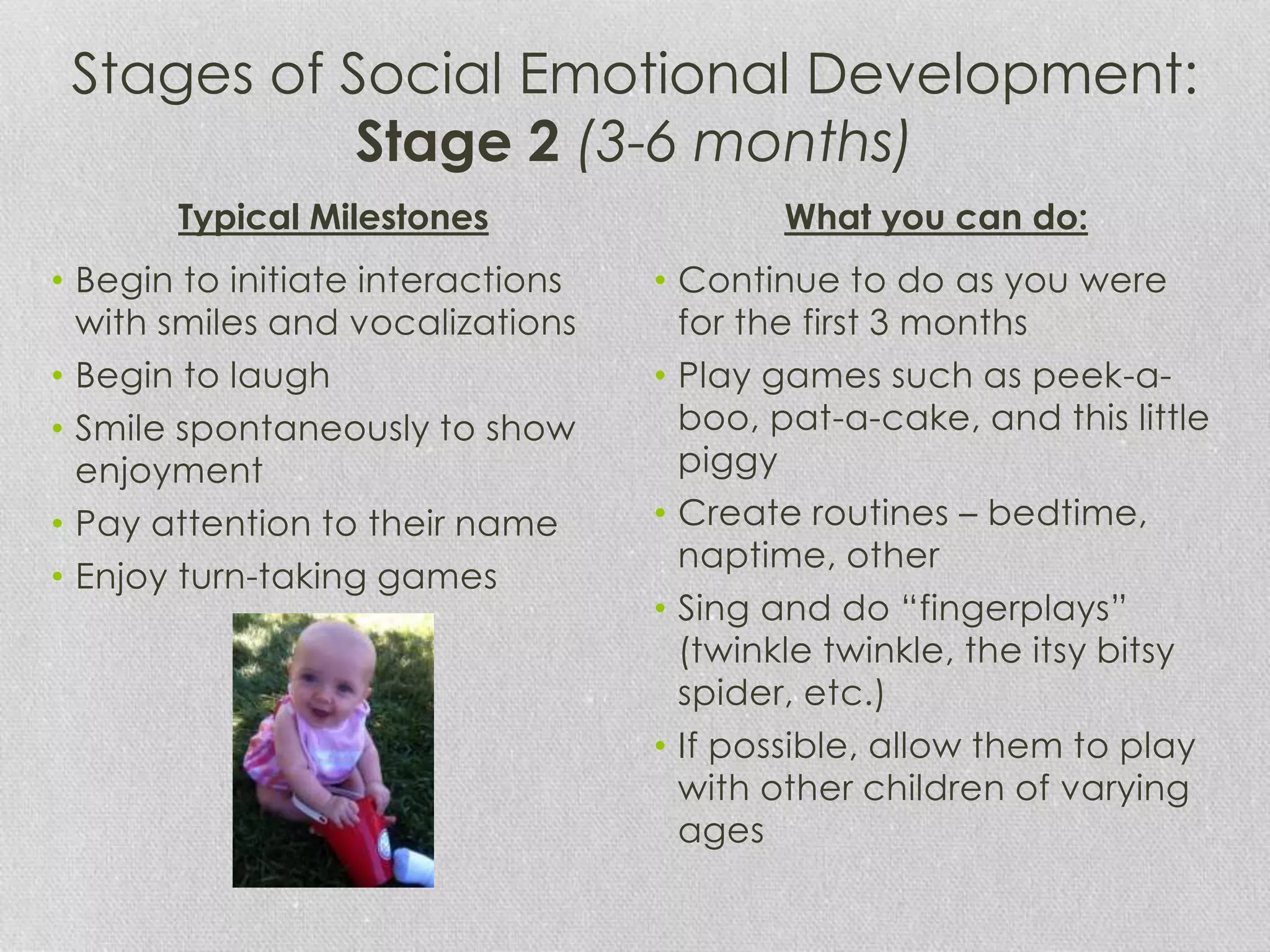
Stage 2 (3-6 months)
• Begin to initiate interactions
with smiles and vocalizations
• Begin to laugh
• Smile spontaneously to show
enjoyment
• Pay attention to their name
• Enjoy turn-taking games
• Continue to do as you were
for the first 3 months
• Play games such as peek-a-
boo, pat-a-cake, and this little
piggy
• Create routines – bedtime,
naptime, other
• Sing and do “fingerplays”
(twinkle twinkle, the itsy bitsy
spider, etc.)
• If possible, allow them to play
with other children of varying
ages
Typical Milestones What you can do:
16.
Stages of SocialEmotional Development:
Stage 3 (6-9 months)
• Clearly express several
emotions (fear, anger, joy)
• Clearly prefer familiar
caregivers and friends
• Respond to language and
gestures
• Use gestures and vocalizations
to communicate
• Continue as you have been
doing for months 0-6,
especially:
• Respond promptly and
sensitively to their cues
• Smile, talk, and read to them
• Massage/touch them
• Play games & sing
• Describe emotional
experiences to them
• Have routines
• Expose them to other children
& extended family
Typical Milestones What you can do:
17.
Stages of SocialEmotional Development:
Stage 4 (9-12 months)
• Understanding themselves as
separate from others
• Becoming more independent
(feeding themselves, perhaps
becoming mobile)
• Assist in getting dressed
• Cry when separated from
caregivers
• Show happiness upon
reuniting with caregivers
• Offer them opportunities to
explore their environment and
come back to you when
scared (“secure base”)
• Create separation and
reunion routines
• Continue as you have been
doing, with longer stretches of
play, as their attention span
increases
Typical Milestones What you can do:
18.
Stages of SocialEmotional Development:
Stage 5 (1-2 years)
• Demonstrate a wider arrange
of emotions, including some
“social” emotions (empathy,
compassion, etc.)
• Recognize themselves in a
mirror
• Show affection for familiar
people
• Play by themselves
• Imitate adult behavior
• Become assertive (“no!”)
• Respond promptly and
sensitively to their cues
• Talk, sing, and read with your
child
• Describe emotional
experiences
• Create routines
• Offer opportunity to play with
other children
Typical Milestones What you can do:
19.
Stages of SocialEmotional Development:
Stage 6 (2-3 years)
• Engage in independent and
parallel play
• Begin to engage in social play
• Begin symbolic play games
such as “house”
• Rapid mood shifts
• Increased fearfulness
• Continued assertiveness
(“no”) as they explore self-
identity
• Form a gender identity
• Become more independent
(toilet training, dressing self)
• Have preferred friends and
understand friendship
• Talk, sing, and read with your
child
• Describe emotional
experiences
• Create routines
• Offer opportunity to play with
other children
• Set clear limits and boundaries
• Offer opportunities to practice
new independent skills
• Offer options for child to
choose from (red shirt or blue
shirt, standing or sitting, etc.)
• Acknowledge fears
Typical Milestones What you can do:
20.
Stages of SocialEmotional Development:
Stage 7 (3-4 years)
• Become more independent
and participate in self-care
• Follow directions
• Share and take turns with
assistance
• Greater understanding of
“self” and “other”
• Increased expression of social
emotions
• Initiate or join play with other
children
• More elaborate dramatic play
• Continue as you have been
• Engage in dramatic play with
your child
• Allow child to explore and be
independent
• Act as a “secure base” when
child is upset
• Provide social stimulation (via
playdates, preschool, etc.)
Typical Milestones What you can do:
21.
Stages of SocialEmotional Development:
Stage 8 (4-5 years)
• Have some understanding of
moral reasoning (things being
fair/unfair, good/bad
behavior)
• Compares self with others
• Develops friendships
• Shows awareness of others’
feelings
• Enjoys dramatic play with
other children
• Demonstrates a wide range of
emotions, sometimes over-
exaggerating emotions
• Pays attention to details in
dramatic play
• Continue as you have been
• Apologize when you make
mistakes
• Explain reasons for rules and
behaviors
• Label behavior as “good” or
“bad” – do not label the child
as “good” or “bad”
Typical Milestones What you can do:
The Importance ofSocial Play
• Provides children with an
opportunity to:
• Practice social skills
• Make sense of cultural norms
and values
• Process experiences
• Prepare for future
responsibilities
• Practice communication skills
• Practice negotiation with
peers
• Socialize each other (teach
each other what is
acceptable/unacceptable
behavior)
(Brown, 1999)
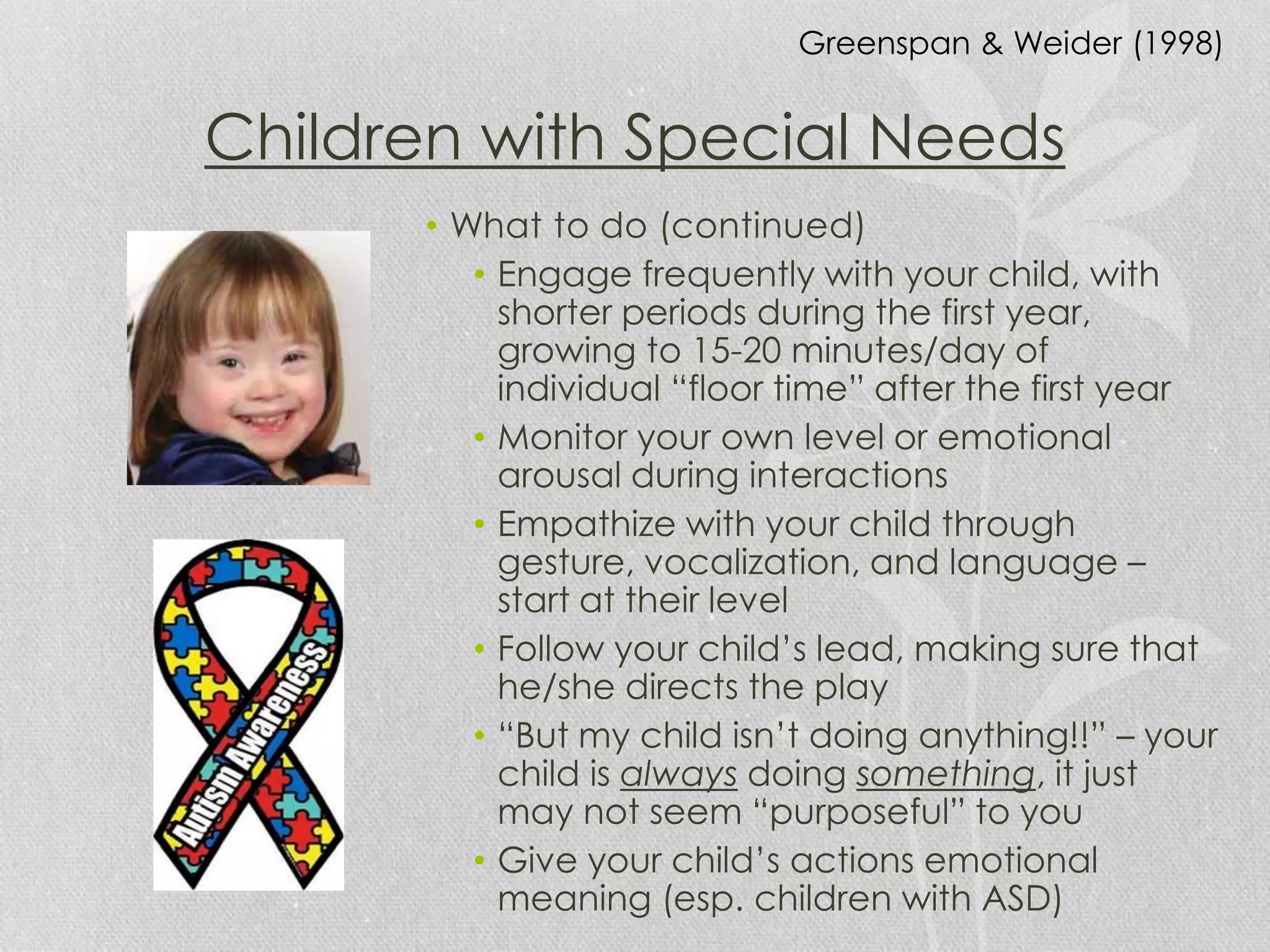
Children with SpecialNeeds
• Special Needs complicate the
development of emotion regulation and
social skills
• Think of development as occurring along
a trajectory instead of as a static set of
stages
• Delays in other areas of development
influence social-emotional development
• Cognitive delays
• Motor delays
• Sensory processing delays
• Communication
• A note about autism: By definition,
Autistic Spectrum Disorders (ASD) are
disorders of social interaction, although
social delays may have roots in sensory
processing and motor planning. Meet
your child where they are.
Greenspan & Weider (1998)
27.
Children with SpecialNeeds
• What to do:
• Use your child’s diagnosis to understand challenges to learning
and not as a label for limitations
• Begin with “Sensory Processing” – emotional processing is taking
sensory processing to an abstract level
• Change the environment to your child’s sensitivities in order to
reach the “zone of optimal arousal” (turn on/off lights, remove
noises, play “white noise,” remove toys, etc.)
Greenspan & Weider (1998)
28.
Children with SpecialNeeds
• What to do (continued)
• Engage frequently with your child, with
shorter periods during the first year,
growing to 15-20 minutes/day of
individual “floor time” after the first year
• Monitor your own level or emotional
arousal during interactions
• Empathize with your child through
gesture, vocalization, and language –
start at their level
• Follow your child’s lead, making sure that
he/she directs the play
• “But my child isn’t doing anything!!” – your
child is always doing something, it just
may not seem “purposeful” to you
• Give your child’s actions emotional
meaning (esp. children with ASD)
Greenspan & Weider (1998)
Special thanks toDenny de
Harne and Parents Helping
Parents!
THANK YOU!!!
Editor's Notes
#2 Ice Breaker: Introduce yourself and your child(ren). Come up with an adjective to describe your child that starts with the first letter of their name. Examples:
Reader Rosie
Excitable Elizabeth
Agreeable Annie
#9 Emotion regulation strategies developed in the first year underly the attachment relationship and the achievement of trust, autonomy, and mastery during the preschool years.
#13 Bike path analogy
Brain areas of emotion are closely linked to those for cognition and communication
#14 This is a discussion of “typical” development
Note that almost no child fits this “typical” child mode and that the range of what is “normal” varies widely
Didn’t even want to include ages for each stage, instead wanted to call them stage 1, 2, 3, 4
Note that cognitive development underlies all of the skills described – overlap in all areas of development
Inner representation of themselves and inner representation of themselves in relationship to others
#15 2-3 month shift in brain organization and myelination
#28 Sometimes children need a purely sensory experience to set their “re-set” button
#29 - ASD: give purpose/intent to their behavior; do this by labelling or giving a purpose to an action – stereotyped behavior? Give it a function.
#31 Closing exercise: “Worries in a hat” – Everyone completes this sentence on a piece of paper: “Today I worry for my child that ___.”
















![Neurodiversity in the Classroom [Handouts]](https://cdn.slidesharecdn.com/ss_thumbnails/november72014-edmontonalberta-neurodiversity-breakouthandouts-141107182612-conversion-gate01-thumbnail.jpg?width=640&height=640&fit=bounds)


