BLOOM’S
TAXONOMY
What is your thinking level?
Evaluation
Synthesis
Analysis
Application
Comprehension
Knowledge
Making decisions and
supporting views;
requires
understanding of
values.
Combining information to
form a unique product;
requires creativity and
originality.
Using information to solve
problems; transferring
abstract or theoretical ideas
to practical situations.
Identifying connections and
relationships and how they
apply. Restating in
your own words;
paraphrasing,
summarizing,
translating.
Memorizing verbatim
information. Being able to
remember, but not
necessarily fully
understanding the
material.
Bloom’s Taxonomy
Identifying
components;
determining
arrangement, logic,
and semantics.
GraduateSchoolUndergraduateHighSchool
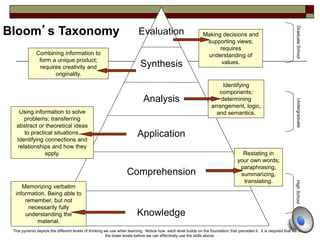
This pyramid depicts the different levels of thinking we use when learning. Notice how each level builds on the foundation that precedes it. It is required that we learn
the lower levels before we can effectively use the skills above.
BLOOM’S TAXONOMY
Competence Skills Demonstrated
Knowledge The recall of specific information
Comprehension Understanding of what was read
Application Converting abstract content to concrete
situations
Analysis Comparison and contrast of the content to
personal experiences
Synthesis Organization of thoughts, ideas, and information
from the content
Evaluation Judgment and evaluation of characters, actions,
outcomes, etc., for personal reflection and
understanding
KNOWLEDGE
Memorization
 Observation and recall of information
 Knowledge of dates, events, places
 Knowledge of major ideas
 Mastery of subject matter
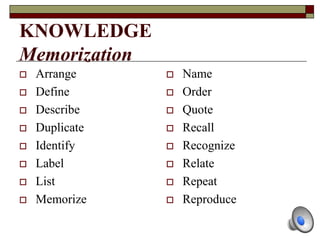
KNOWLEDGE
Memorization
 Arrange
 Define
 Describe
 Duplicate
 Identify
 Label
 List
 Memorize
 Name
 Order
 Quote
 Recall
 Recognize
 Relate
 Repeat
 Reproduce
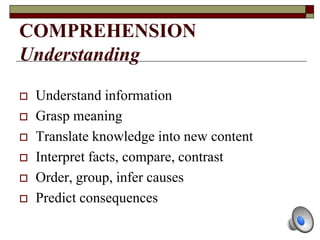
COMPREHENSION
Understanding
 Understand information
 Grasp meaning
 Translate knowledge into new content
 Interpret facts, compare, contrast
 Order, group, infer causes
 Predict consequences
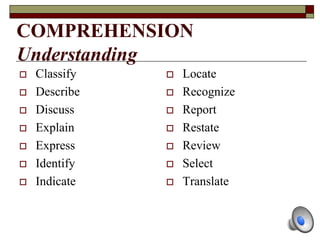
COMPREHENSION
Understanding
 Classify
 Describe
 Discuss
 Explain
 Express
 Identify
 Indicate
 Locate
 Recognize
 Report
 Restate
 Review
 Select
 Translate
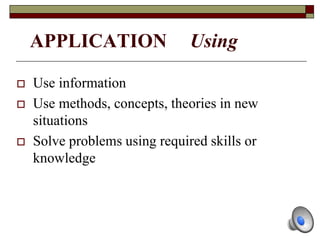
APPLICATION Using
 Use information
 Use methods, concepts, theories in new
situations
 Solve problems using required skills or
knowledge
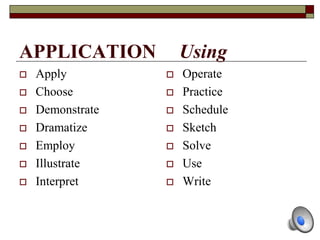
APPLICATION Using
 Apply
 Choose
 Demonstrate
 Dramatize
 Employ
 Illustrate
 Interpret
 Operate
 Practice
 Schedule
 Sketch
 Solve
 Use
 Write
ANALYSIS Taking apart
 Recognition of patterns
 Organization of parts
 Discovery of hidden meanings
 Identification of components
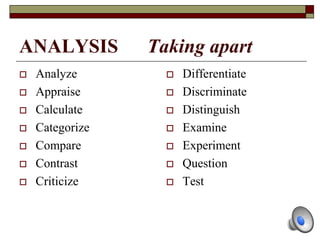
ANALYSIS Taking apart
 Analyze
 Appraise
 Calculate
 Categorize
 Compare
 Contrast
 Criticize
 Differentiate
 Discriminate
 Distinguish
 Examine
 Experiment
 Question
 Test
SYNTHESIS Putting together
 Use old ideas to create new ones
 Generalize from given facts
 Relate knowledge from several areas
 Predict, draw conclusions
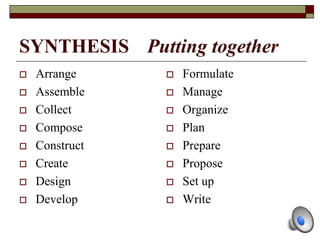
SYNTHESIS Putting together
 Arrange
 Assemble
 Collect
 Compose
 Construct
 Create
 Design
 Develop
 Formulate
 Manage
 Organize
 Plan
 Prepare
 Propose
 Set up
 Write
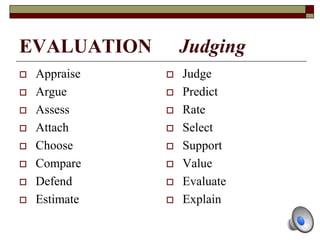
EVALUATION Judging
 Compare and discriminate between ideas
 Assess value of theories, presentations
 Make choices based on reasoned argument
 Verify value of evidence
 Recognize subjectivity
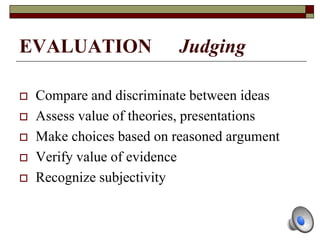
EVALUATION Judging
 Appraise
 Argue
 Assess
 Attach
 Choose
 Compare
 Defend
 Estimate
 Judge
 Predict
 Rate
 Select
 Support
 Value
 Evaluate
 Explain
Evaluation
Synthesis
Analysis
Application
Comprehension
Knowledge
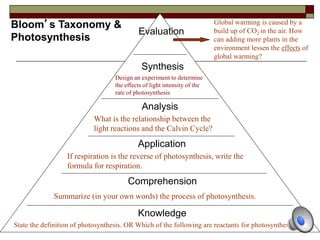
Bloom’s Taxonomy &
Photosynthesis
State the definition of photosynthesis. OR Which of the following are reactants for photosynthesis?
Summarize (in your own words) the process of photosynthesis.
If respiration is the reverse of photosynthesis, write the
formula for respiration.
What is the relationship between the
light reactions and the Calvin Cycle?
Design an experiment to determine
the effects of light intensity of the
rate of photosynthesis
Global warming is caused by a
build up of CO2 in the air. How
can adding more plants in the
environment lessen the effects of
global warming?
BLOOM’S
TAXONOMY
applied to
GOLDILOCKS AND THE THREE
BEARS
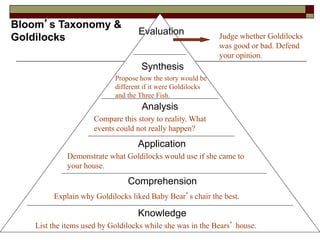
Evaluation
Synthesis
Analysis
Application
Comprehension
Knowledge
Bloom’s Taxonomy &
Goldilocks
List the items used by Goldilocks while she was in the Bears’ house.
Explain why Goldilocks liked Baby Bear’s chair the best.
Demonstrate what Goldilocks would use if she came to
your house.
Compare this story to reality. What
events could not really happen?
Propose how the story would be
different if it were Goldilocks
and the Three Fish.
Judge whether Goldilocks
was good or bad. Defend
your opinion.
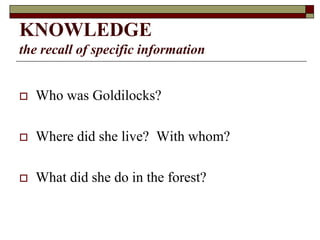
KNOWLEDGE
the recall of specific information
 Who was Goldilocks?
 Where did she live? With whom?
 What did she do in the forest?
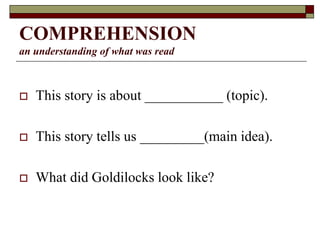
COMPREHENSION
an understanding of what was read
 This story is about ___________ (topic).
 This story tells us _________(main idea).
 What did Goldilocks look like?
APPLICATION
the converting of abstract content to concrete situations
 How were the bears like real people?
 Why did Goldilocks go into the little house?
 Draw a picture of what the bears’ house
looked like.
 Draw a map showing Goldilocks’ house, the
path in the forest, the bears’ house, etc.
ANALYSIS
the comparison and contrast of the content to personal
experience
 How did each bear react to what Goldilocks
did?
 How would you react?
 Compare Goldilocks to any of your friends.
 Do you know any animals (pets) that act
human?
SYNTHESIS
the organization of thoughts, ideas, and information from the
content
 List the events of the story in sequence.
 Do you know any other stories about little girls or
boys who escaped from danger?
 Make a 3D scene of the bears’ house and the forest.
 Make a puppet out of one of the characters. Using
the puppet, act out his/her part of the story.
EVALUATION
the judgment and evaluation of characters, actions, outcomes,
etc., for personal reflection and understanding
 Why were the bears angry with Goldilocks?
 Do you think Goldilocks was happy to get
home? Explain your answer.
 Do you think she learned anything by going into
the bears’ house? Explain your answer.
 Would you have gone into the bears’ house?
Why or why not?
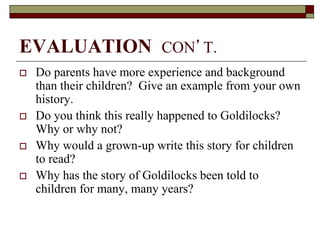
EVALUATION CON’T.
 Do parents have more experience and background
than their children? Give an example from your own
history.
 Do you think this really happened to Goldilocks?
Why or why not?
 Why would a grown-up write this story for children
to read?
 Why has the story of Goldilocks been told to
children for many, many years?
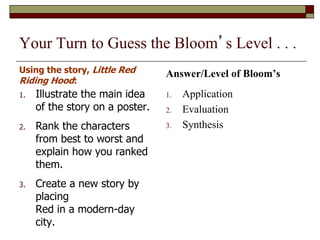
Your Turn to Guess the Bloom’s Level . . .
Using the story, Little Red
Riding Hood:
1. Illustrate the main idea
of the story on a poster.
2. Rank the characters
from best to worst and
explain how you ranked
them.
3. Create a new story by
placing
Red in a modern-day
city.
Answer/Level of Bloom’s
1. Application
2. Evaluation
3. Synthesis
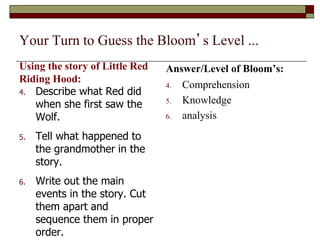
Your Turn to Guess the Bloom’s Level ...
Using the story of Little Red
Riding Hood:
4. Describe what Red did
when she first saw the
Wolf.
5. Tell what happened to
the grandmother in the
story.
6. Write out the main
events in the story. Cut
them apart and
sequence them in proper
order.
Answer/Level of Bloom’s:
4. Comprehension
5. Knowledge
6. analysis
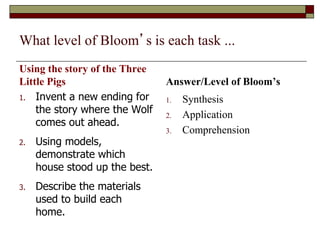
What level of Bloom’s is each task ...
Using the story of the Three
Little Pigs
1. Invent a new ending for
the story where the Wolf
comes out ahead.
2. Using models,
demonstrate which
house stood up the best.
3. Describe the materials
used to build each
home.
Answer/Level of Bloom’s
1. Synthesis
2. Application
3. Comprehension
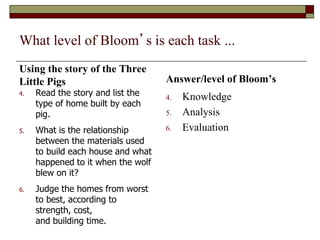
What level of Bloom’s is each task ...
Using the story of the Three
Little Pigs
4. Read the story and list the
type of home built by each
pig.
5. What is the relationship
between the materials used
to build each house and what
happened to it when the wolf
blew on it?
6. Judge the homes from worst
to best, according to
strength, cost,
and building time.
Answer/level of Bloom’s
4. Knowledge
5. Analysis
6. Evaluation
According to Bloom’s Taxonomy
what is your thinking level?

Blooms taxonomy

  • 1.
  • 2.
    Evaluation Synthesis Analysis Application Comprehension Knowledge Making decisions and supportingviews; requires understanding of values. Combining information to form a unique product; requires creativity and originality. Using information to solve problems; transferring abstract or theoretical ideas to practical situations. Identifying connections and relationships and how they apply. Restating in your own words; paraphrasing, summarizing, translating. Memorizing verbatim information. Being able to remember, but not necessarily fully understanding the material. Bloom’s Taxonomy Identifying components; determining arrangement, logic, and semantics. GraduateSchoolUndergraduateHighSchool This pyramid depicts the different levels of thinking we use when learning. Notice how each level builds on the foundation that precedes it. It is required that we learn the lower levels before we can effectively use the skills above.
  • 3.
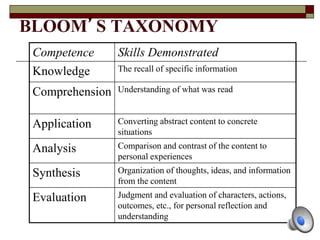
    BLOOM’S TAXONOMY Competence SkillsDemonstrated Knowledge The recall of specific information Comprehension Understanding of what was read Application Converting abstract content to concrete situations Analysis Comparison and contrast of the content to personal experiences Synthesis Organization of thoughts, ideas, and information from the content Evaluation Judgment and evaluation of characters, actions, outcomes, etc., for personal reflection and understanding
  • 4.
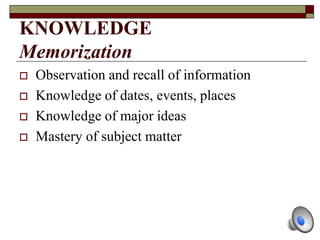
    KNOWLEDGE Memorization  Observation andrecall of information  Knowledge of dates, events, places  Knowledge of major ideas  Mastery of subject matter
  • 5.
    KNOWLEDGE Memorization  Arrange  Define Describe  Duplicate  Identify  Label  List  Memorize  Name  Order  Quote  Recall  Recognize  Relate  Repeat  Reproduce
  • 6.
    COMPREHENSION Understanding  Understand information Grasp meaning  Translate knowledge into new content  Interpret facts, compare, contrast  Order, group, infer causes  Predict consequences
  • 7.
    COMPREHENSION Understanding  Classify  Describe Discuss  Explain  Express  Identify  Indicate  Locate  Recognize  Report  Restate  Review  Select  Translate
  • 8.
    APPLICATION Using  Useinformation  Use methods, concepts, theories in new situations  Solve problems using required skills or knowledge
  • 9.
    APPLICATION Using  Apply Choose  Demonstrate  Dramatize  Employ  Illustrate  Interpret  Operate  Practice  Schedule  Sketch  Solve  Use  Write
  • 10.
    ANALYSIS Taking apart Recognition of patterns  Organization of parts  Discovery of hidden meanings  Identification of components
  • 11.
    ANALYSIS Taking apart Analyze  Appraise  Calculate  Categorize  Compare  Contrast  Criticize  Differentiate  Discriminate  Distinguish  Examine  Experiment  Question  Test
  • 12.
    SYNTHESIS Putting together Use old ideas to create new ones  Generalize from given facts  Relate knowledge from several areas  Predict, draw conclusions
  • 13.
    SYNTHESIS Putting together Arrange  Assemble  Collect  Compose  Construct  Create  Design  Develop  Formulate  Manage  Organize  Plan  Prepare  Propose  Set up  Write
  • 14.
    EVALUATION Judging  Compareand discriminate between ideas  Assess value of theories, presentations  Make choices based on reasoned argument  Verify value of evidence  Recognize subjectivity
  • 15.
    EVALUATION Judging  Appraise Argue  Assess  Attach  Choose  Compare  Defend  Estimate  Judge  Predict  Rate  Select  Support  Value  Evaluate  Explain
  • 16.
    Evaluation Synthesis Analysis Application Comprehension Knowledge Bloom’s Taxonomy & Photosynthesis Statethe definition of photosynthesis. OR Which of the following are reactants for photosynthesis? Summarize (in your own words) the process of photosynthesis. If respiration is the reverse of photosynthesis, write the formula for respiration. What is the relationship between the light reactions and the Calvin Cycle? Design an experiment to determine the effects of light intensity of the rate of photosynthesis Global warming is caused by a build up of CO2 in the air. How can adding more plants in the environment lessen the effects of global warming?
  • 17.
  • 18.
    Evaluation Synthesis Analysis Application Comprehension Knowledge Bloom’s Taxonomy & Goldilocks Listthe items used by Goldilocks while she was in the Bears’ house. Explain why Goldilocks liked Baby Bear’s chair the best. Demonstrate what Goldilocks would use if she came to your house. Compare this story to reality. What events could not really happen? Propose how the story would be different if it were Goldilocks and the Three Fish. Judge whether Goldilocks was good or bad. Defend your opinion.
  • 19.
    KNOWLEDGE the recall ofspecific information  Who was Goldilocks?  Where did she live? With whom?  What did she do in the forest?
  • 20.
    COMPREHENSION an understanding ofwhat was read  This story is about ___________ (topic).  This story tells us _________(main idea).  What did Goldilocks look like?
  • 21.
    APPLICATION the converting ofabstract content to concrete situations  How were the bears like real people?  Why did Goldilocks go into the little house?  Draw a picture of what the bears’ house looked like.  Draw a map showing Goldilocks’ house, the path in the forest, the bears’ house, etc.
  • 22.
    ANALYSIS the comparison andcontrast of the content to personal experience  How did each bear react to what Goldilocks did?  How would you react?  Compare Goldilocks to any of your friends.  Do you know any animals (pets) that act human?
  • 23.
    SYNTHESIS the organization ofthoughts, ideas, and information from the content  List the events of the story in sequence.  Do you know any other stories about little girls or boys who escaped from danger?  Make a 3D scene of the bears’ house and the forest.  Make a puppet out of one of the characters. Using the puppet, act out his/her part of the story.
  • 24.
    EVALUATION the judgment andevaluation of characters, actions, outcomes, etc., for personal reflection and understanding  Why were the bears angry with Goldilocks?  Do you think Goldilocks was happy to get home? Explain your answer.  Do you think she learned anything by going into the bears’ house? Explain your answer.  Would you have gone into the bears’ house? Why or why not?
  • 25.
    EVALUATION CON’T.  Doparents have more experience and background than their children? Give an example from your own history.  Do you think this really happened to Goldilocks? Why or why not?  Why would a grown-up write this story for children to read?  Why has the story of Goldilocks been told to children for many, many years?
  • 26.
    Your Turn toGuess the Bloom’s Level . . . Using the story, Little Red Riding Hood: 1. Illustrate the main idea of the story on a poster. 2. Rank the characters from best to worst and explain how you ranked them. 3. Create a new story by placing Red in a modern-day city. Answer/Level of Bloom’s 1. Application 2. Evaluation 3. Synthesis
  • 27.
    Your Turn toGuess the Bloom’s Level ... Using the story of Little Red Riding Hood: 4. Describe what Red did when she first saw the Wolf. 5. Tell what happened to the grandmother in the story. 6. Write out the main events in the story. Cut them apart and sequence them in proper order. Answer/Level of Bloom’s: 4. Comprehension 5. Knowledge 6. analysis
  • 28.
    What level ofBloom’s is each task ... Using the story of the Three Little Pigs 1. Invent a new ending for the story where the Wolf comes out ahead. 2. Using models, demonstrate which house stood up the best. 3. Describe the materials used to build each home. Answer/Level of Bloom’s 1. Synthesis 2. Application 3. Comprehension
  • 29.
    What level ofBloom’s is each task ... Using the story of the Three Little Pigs 4. Read the story and list the type of home built by each pig. 5. What is the relationship between the materials used to build each house and what happened to it when the wolf blew on it? 6. Judge the homes from worst to best, according to strength, cost, and building time. Answer/level of Bloom’s 4. Knowledge 5. Analysis 6. Evaluation
  • 30.
    According to Bloom’sTaxonomy what is your thinking level?