EXPERIMENT NO. 2 
OBJECTIVE 
To plot Swing Curve for one Machine System 
SOFTWARE USED 
MATLAB 
THEORY 
Basic Model of a Synchronous Generator 
Assumptions for representing the generator by classical model 
Some assumptions are made to represent a synchronous generator mathematically by a 
classical model. The assumptions are: 
1. The saliency of the generator is neglected, that is the generator is assumed to be of 
cylindrical type rotor 
2. The effect of damper windings, present on the rotor of the synchronous generators, is 
neglected. 
3. The input mechanical power to the generator is assumed to be constant during the 
period of study. 
4. The exciter dynamics are not considered and the field current is assumed to be 
constant so that the generator stator induced voltage is always constant. 
For the sake of understanding the classical model better the case of a generator connected to 
an infinite bus through a transformer and transmission lines is considered. This type of 
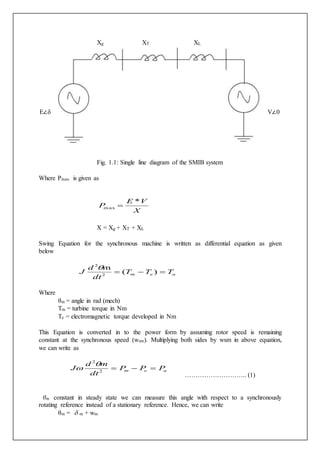
system is called as Single Machine Infinite Bus (SMIB) system. The single line diagram of 
SMIB system is shown in Fig. 1.1. Since resistance of synchronous generator stator, 
transformer and the transmission line are relatively negligible as compared to the 
corresponding reactance, only reactance of synchronous generator, transformer and 
transmission line are considered. Here, infinite bus represents rest of the system or grid, 
where the voltage magnitude and frequency are held constant. The infinite bus can act like 
infinite source or sink. It can also be considered as a generator with infinite inertia and fixed 
voltage. In Fig. 2.1, E ∠  represents the complex internal voltage of the synchronous 
generator behind the transient reactance X ' g 
. it can be assumed to be a reactance of the 
generator during transients. VT T is the terminal voltage of the synchronous generator. XT , X L 
represent the transformer and line reactance. The complex infinite bus voltage is represented 
as V ∠ 0 . The infinite bus voltage is a taken as the reference because of which the angle is 
taken as zero. The generator internal voltage angle is defined with respect to the infinite bus 
voltage angle. 
The input mechanical power is represented as Pm 
And the output electrical power is represented as Pe 
The inertia constant of the generator is represented as H 
From Fig. 1.1, the real power output of generator, Pe. can be computed as 
Pe = Pmax sin
Xg XT XL 
E∠δ V∠0 
Fig. 1.1: Single line diagram of the SMIB system 
Where Pmax is given as 
E V 
X 
P 
* 
max  
X = Xg + XT + XL 
Swing Equation for the synchronous machine is written as differential equation as given 
below 
2 
J  (  )  
m e a T T T 
d 
dt 
m 
2 
Where 
θm = angle in rad (mech) 
Tm = turbine torque in Nm 
Te = electromagnetic torque developed in Nm 
This Equation is converted in to the power form by assuming rotor speed is remaining 
constant at the synchronous speed (wsm). Multiplying both sides by wsm in above equation, 
we can write as 
2 
J    2 
m e a P P P 
d m 
dt 
 
……………………….. (1) 
θm constant in steady state we can measure this angle with respect to a synchronously 
rotating reference instead of a stationary reference. Hence, we can write 
θm =  m + wm
But, the rate of change of the rotor mechanical angle θ m with respect to time. 
Wm = dθm /dt rps . 
d /dt = Wm - Wms 
δ is known as rotor angle and equation (1) is written as 
2 
M    2 
m e a P P P 
d 
dt 
……………………………….(2) 
In other form of equation (2) Is 
m e a P P P 
d 
2 
dt 
H 
f 
   
 2 
……………………………………(3) 
Equation (3) is known as Swing Equation and it is describes rotor dynamics of Synchronous 
Machine. 
m a P P P 
d 
dt 
H 
f 
   
 
 
 
sin 2 max 
2 
Since, the mechanical power input Pm and the maximum power output of the generator Pmax 
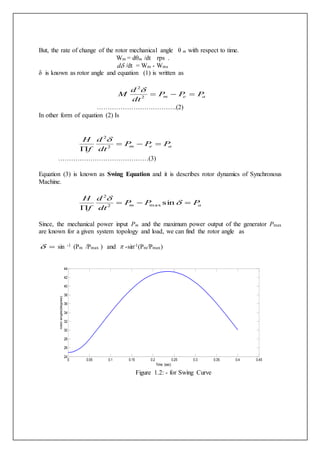
are known for a given system topology and load, we can find the rotor angle as 
  sin -1 (Pm /Pmax ) and  -sin-1(Pm/Pmax) 
0 0.05 0.1 0.15 0.2 0.25 0.3 0.35 0.4 0.45 
Figure 1.2: - for Swing Curve 
44 
42 
40 
38 
36 
34 
32 
30 
28 
26 
24 
Time (sec) 
rotor angle(degree)
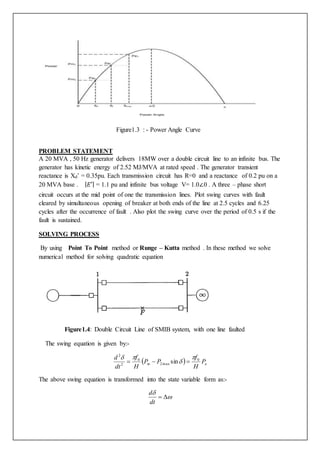
Figure1.3 : - Power Angle Curve 
PROBLEM STATEMENT 
A 20 MVA , 50 Hz generator delivers 18MW over a double circuit line to an infinite bus. The 
generator has kinetic energy of 2.52 MJ/MVA at rated speed . The generator transient 
reactance is Xd’ = 0.35pu. Each transmission circuit has R=0 and a reactance of 0.2 pu on a 
20 MVA base . |퐸′| = 1.1 pu and infinite bus voltage V= 1.0∠0 . A three – phase short 
circuit occurs at the mid point of one the transmission lines. Plot swing curves with fault 
cleared by simultaneous opening of breaker at both ends of the line at 2.5 cycles and 6.25 
cycles after the occurrence of fault . Also plot the swing curve over the period of 0.5 s if the 
fault is sustained. 
SOLVING PROCESS 
By using Point To Point method or Runge – Kutta method . In these method we solve 
numerical method for solving quadratic equation 
Figure1.4: Double Circuit Line of SMIB system, with one line faulted 
The swing equation is given by:- 
f 
d 0 
 m  a P 
H 
P P 
f 
H 
dt 
2max 
0 
2 
2 
sin 
 
 
  
   
The above swing equation is transformed into the state variable form as:- 
 
d 
 
  
dt
a P 
f 
d   0 
H 
dt 
 
 
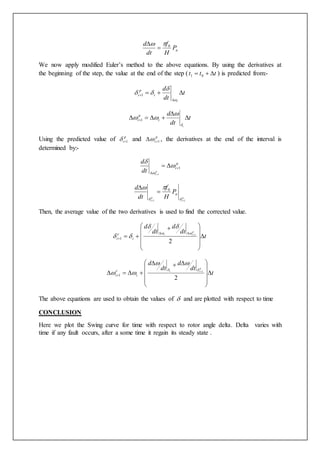
We now apply modified Euler’s method to the above equations. By using the derivatives at 
the beginning of the step, the value at the end of the step ( t t t  1 0 ) is predicted from:- 
p 
i    
t 
d 
dt 
i 
i 
 
 
 
 
  1 
p 
i  
t 
d 
dt 
i 
i 
 
     
 
 
  1 
i1  and p 
Using the predicted value of p 
i 1  , the derivatives at the end of the interval is 
determined by:- 
p 
i 
p 
i 
d 
dt 
1 
1 
 
 
  
 
 
 
 
p 
i 
  
p 
i 
a P 
f 
0 
H 
d 
dt 
 
  
1 1 
 
  
Then, the average value of the two derivatives is used to find the corrected value. 
 
 
  
 
  
     
c 
i  
t 
dt 
d 
dt 
d 
p 
i i 
i 
 
 
 
 
 2 
 
 
1 
1 
  
  
 
 
    
 
  
c 
i  
t 
dt 
d 
dt 
d 
p 
i i 
     
i 
 
 
 
 
 2 
 
 
1 
1 
  
  
The above equations are used to obtain the values of  and are plotted with respect to time 
CONCLUSION 
Here we plot the Swing curve for time with respect to rotor angle delta. Delta varies with 
time if any fault occurs, after a some time it regain its steady state .
APPENDIX 
Matlab coding 
clear 
t = 0 
tf=0 
tfinal =0.5 
tc=0.125 
tstep=9.95 
M=2.52/(180*50) 
j=2 
de1ta=21.64*pi/180 
ddelta=0 
time(1)=0 
ang(1)=21.64 
Pm=0.9 
Pnaxbf=2.44 
Pmaxdf=0.88 
Pmaxaf=2.00 
while t<tfinal, 
if ( t==tf ), 
Paminus=0.9-Pmaxbf*sin(delta) 
Paplus=O.9-Pmaxdf*sine(delta) 
Paav=(Paminus+Paplus)/2 
Pa=Paav 
end 
if ( t==tc ) , 
Paminus=0.9-Pmaxdf*sin(delta) 
Paplus=0.9-Pmaxaf*sin(delta) 
Paav=(Paminus+Paplus)/2 
Pa=Paav 
end 
if (t>tf & t<tc ), 
Pa=Pm-Pmaxdf*sin(delta) 
end 
if (t>tc) , 
Pa=Pm-Pmaxaf*sin(delta) 
end 
t,Pa 
ddelta=ddelta+(tstep*tstep*pa/M) 
delta=(delta*180/pi+ddelta)*pi/180 
deltadeg=det1a*180/Pi 
t=t+tstep 
pause 
time(i)=t 
ang(i)= deltadeg 
ang(i)=deltadeg 
i=i+1 
end 
axis([0 0.6 0 160]) 
plot(time,ang,'ko')

Exp 2 (1)2. To plot Swing Curve for one Machine System

  • 1.
    EXPERIMENT NO. 2 OBJECTIVE To plot Swing Curve for one Machine System SOFTWARE USED MATLAB THEORY Basic Model of a Synchronous Generator Assumptions for representing the generator by classical model Some assumptions are made to represent a synchronous generator mathematically by a classical model. The assumptions are: 1. The saliency of the generator is neglected, that is the generator is assumed to be of cylindrical type rotor 2. The effect of damper windings, present on the rotor of the synchronous generators, is neglected. 3. The input mechanical power to the generator is assumed to be constant during the period of study. 4. The exciter dynamics are not considered and the field current is assumed to be constant so that the generator stator induced voltage is always constant. For the sake of understanding the classical model better the case of a generator connected to an infinite bus through a transformer and transmission lines is considered. This type of system is called as Single Machine Infinite Bus (SMIB) system. The single line diagram of SMIB system is shown in Fig. 1.1. Since resistance of synchronous generator stator, transformer and the transmission line are relatively negligible as compared to the corresponding reactance, only reactance of synchronous generator, transformer and transmission line are considered. Here, infinite bus represents rest of the system or grid, where the voltage magnitude and frequency are held constant. The infinite bus can act like infinite source or sink. It can also be considered as a generator with infinite inertia and fixed voltage. In Fig. 2.1, E ∠  represents the complex internal voltage of the synchronous generator behind the transient reactance X ' g . it can be assumed to be a reactance of the generator during transients. VT T is the terminal voltage of the synchronous generator. XT , X L represent the transformer and line reactance. The complex infinite bus voltage is represented as V ∠ 0 . The infinite bus voltage is a taken as the reference because of which the angle is taken as zero. The generator internal voltage angle is defined with respect to the infinite bus voltage angle. The input mechanical power is represented as Pm And the output electrical power is represented as Pe The inertia constant of the generator is represented as H From Fig. 1.1, the real power output of generator, Pe. can be computed as Pe = Pmax sin
  • 2.
    Xg XT XL E∠δ V∠0 Fig. 1.1: Single line diagram of the SMIB system Where Pmax is given as E V X P * max  X = Xg + XT + XL Swing Equation for the synchronous machine is written as differential equation as given below 2 J  (  )  m e a T T T d dt m 2 Where θm = angle in rad (mech) Tm = turbine torque in Nm Te = electromagnetic torque developed in Nm This Equation is converted in to the power form by assuming rotor speed is remaining constant at the synchronous speed (wsm). Multiplying both sides by wsm in above equation, we can write as 2 J    2 m e a P P P d m dt  ……………………….. (1) θm constant in steady state we can measure this angle with respect to a synchronously rotating reference instead of a stationary reference. Hence, we can write θm =  m + wm
  • 3.
    But, the rateof change of the rotor mechanical angle θ m with respect to time. Wm = dθm /dt rps . d /dt = Wm - Wms δ is known as rotor angle and equation (1) is written as 2 M    2 m e a P P P d dt ……………………………….(2) In other form of equation (2) Is m e a P P P d 2 dt H f     2 ……………………………………(3) Equation (3) is known as Swing Equation and it is describes rotor dynamics of Synchronous Machine. m a P P P d dt H f       sin 2 max 2 Since, the mechanical power input Pm and the maximum power output of the generator Pmax are known for a given system topology and load, we can find the rotor angle as   sin -1 (Pm /Pmax ) and  -sin-1(Pm/Pmax) 0 0.05 0.1 0.15 0.2 0.25 0.3 0.35 0.4 0.45 Figure 1.2: - for Swing Curve 44 42 40 38 36 34 32 30 28 26 24 Time (sec) rotor angle(degree)
  • 4.
    Figure1.3 : -Power Angle Curve PROBLEM STATEMENT A 20 MVA , 50 Hz generator delivers 18MW over a double circuit line to an infinite bus. The generator has kinetic energy of 2.52 MJ/MVA at rated speed . The generator transient reactance is Xd’ = 0.35pu. Each transmission circuit has R=0 and a reactance of 0.2 pu on a 20 MVA base . |퐸′| = 1.1 pu and infinite bus voltage V= 1.0∠0 . A three – phase short circuit occurs at the mid point of one the transmission lines. Plot swing curves with fault cleared by simultaneous opening of breaker at both ends of the line at 2.5 cycles and 6.25 cycles after the occurrence of fault . Also plot the swing curve over the period of 0.5 s if the fault is sustained. SOLVING PROCESS By using Point To Point method or Runge – Kutta method . In these method we solve numerical method for solving quadratic equation Figure1.4: Double Circuit Line of SMIB system, with one line faulted The swing equation is given by:- f d 0  m  a P H P P f H dt 2max 0 2 2 sin        The above swing equation is transformed into the state variable form as:-  d    dt
  • 5.
    a P f d   0 H dt   We now apply modified Euler’s method to the above equations. By using the derivatives at the beginning of the step, the value at the end of the step ( t t t  1 0 ) is predicted from:- p i    t d dt i i       1 p i  t d dt i i           1 i1  and p Using the predicted value of p i 1  , the derivatives at the end of the interval is determined by:- p i p i d dt 1 1         p i   p i a P f 0 H d dt    1 1    Then, the average value of the two derivatives is used to find the corrected value.             c i  t dt d dt d p i i i      2   1 1              c i  t dt d dt d p i i      i      2   1 1     The above equations are used to obtain the values of  and are plotted with respect to time CONCLUSION Here we plot the Swing curve for time with respect to rotor angle delta. Delta varies with time if any fault occurs, after a some time it regain its steady state .
  • 6.
    APPENDIX Matlab coding clear t = 0 tf=0 tfinal =0.5 tc=0.125 tstep=9.95 M=2.52/(180*50) j=2 de1ta=21.64*pi/180 ddelta=0 time(1)=0 ang(1)=21.64 Pm=0.9 Pnaxbf=2.44 Pmaxdf=0.88 Pmaxaf=2.00 while t<tfinal, if ( t==tf ), Paminus=0.9-Pmaxbf*sin(delta) Paplus=O.9-Pmaxdf*sine(delta) Paav=(Paminus+Paplus)/2 Pa=Paav end if ( t==tc ) , Paminus=0.9-Pmaxdf*sin(delta) Paplus=0.9-Pmaxaf*sin(delta) Paav=(Paminus+Paplus)/2 Pa=Paav end if (t>tf & t<tc ), Pa=Pm-Pmaxdf*sin(delta) end if (t>tc) , Pa=Pm-Pmaxaf*sin(delta) end t,Pa ddelta=ddelta+(tstep*tstep*pa/M) delta=(delta*180/pi+ddelta)*pi/180 deltadeg=det1a*180/Pi t=t+tstep pause time(i)=t ang(i)= deltadeg ang(i)=deltadeg i=i+1 end axis([0 0.6 0 160]) plot(time,ang,'ko')