10-Jun-24
Prepared by
Mrs.K.Krishnaveni
Assistant Professor
Department of Chemistry
Kongu Engineering College
Perundurai, Erode
Unit – III – Electrochemical Storage Devices
UNIT - III
ELECTROCHEMICALSTORAGEDEVICES
Batteries -Introduction – Types of Batteries – discharging and charging of battery -
characteristics of battery –battery rating- various tests on battery- – Primary battery:
silver button cell- Secondary battery :Ni-Cd battery-modern battery: lithium ion battery-
maintenance of batteries-choices of batteries for electric vehicle applications.
Fuel Cells: Introduction- importance and classification of fuel cells - description,
principle, components, applications of fuel cells: H2-O2 fuel cell, alkaline fuel cell,
phomolten carbonate fuel cell and direct methanol fuel cells.
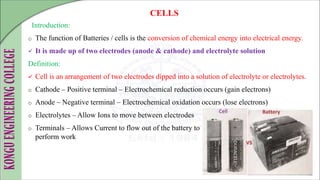
Introduction:
o The function of Batteries / cells is the conversion of chemical energy into electrical energy.
 It is made up of two electrodes (anode & cathode) and electrolyte solution
Definition:
 Cell is an arrangement of two electrodes dipped into a solution of electrolyte or electrolytes.
o Cathode – Positive terminal – Electrochemical reduction occurs (gain electrons)
o Anode – Negative terminal – Electrochemical oxidation occurs (lose electrons)
o Electrolytes – Allow Ions to move between electrodes
o Terminals – Allows Current to flow out of the battery to
perform work
CELLS
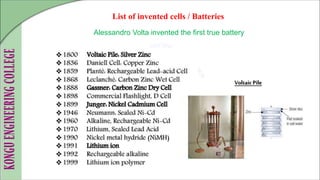
List of invented cells / Batteries
Alessandro Volta invented the first true battery
o Due to increasing human activity in technology, a number of battery dependent appliances
have come into existence.
o It is used in wrist watches, electric calling bells, space vehicles and missile firing units.
Importance of Cells / Batteries /
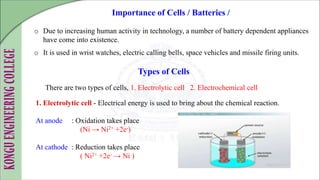
There are two types of cells, 1. Electrolytic cell 2. Electrochemical cell
Types of Cells
- Electrical energy is used to bring about the chemical reaction.
At anode : Oxidation takes place
(Ni → Ni2+ +2e-)
At cathode : Reduction takes place
( Ni2+ +2e- → Ni )
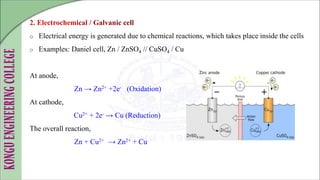
o Electrical energy is generated due to chemical reactions, which takes place inside the cells
o Examples: Daniel cell, Zn / ZnSO4 // CuSO4 / Cu
At anode,
Zn → Zn2+ +2e- (Oxidation)
At cathode,
Cu2+ + 2e- → Cu (Reduction)
The overall reaction,
Zn + Cu2+ → Zn2+ + Cu
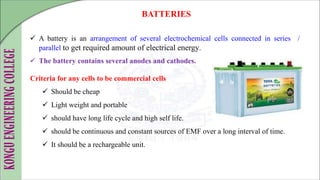
 A battery is an arrangement of several electrochemical cells connected in series /
parallel to get required amount of electrical energy.
 The battery contains several anodes and cathodes.
BATTERIES
Criteria for any cells to be commercial cells
 Should be cheap
 Light weight and portable
 should have long life cycle and high self life.
 should be continuous and constant sources of EMF over a long interval of time.
 It should be a rechargeable unit.
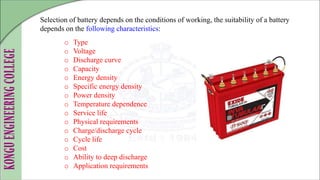
Selection of battery depends on the conditions of working, the suitability of a battery
depends on the following characteristics:
o Type
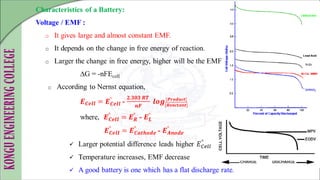
o Voltage
o Discharge curve
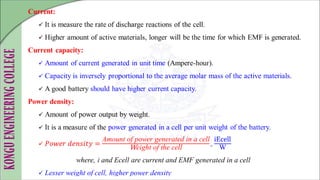
o Capacity
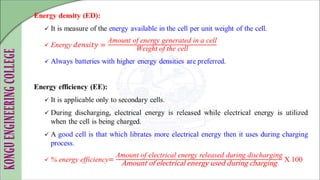
o Energy density
o Specific energy density
o Power density
o Temperature dependence
o Service life
o Physical requirements
o Charge/discharge cycle
o Cycle life
o Cost
o Ability to deep discharge
o Application requirements
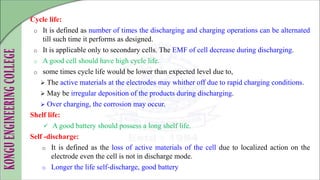
Cycle life:
o It is defined as number of times the discharging and charging operations can be alternated
till such time it performs as designed.
o It is applicable only to secondary cells. The EMF of cell decrease during discharging.
o A good cell should have high cycle life.
o some times cycle life would be lower than expected level due to,
 The active materials at the electrodes may whither off due to rapid charging conditions.
 May be irregular deposition of the products during discharging.
 Over charging, the corrosion may occur.
Shelf life:
 A good battery should possess a long shelf life.
Self -discharge:
o It is defined as the loss of active materials of the cell due to localized action on the
electrode even the cell is not in discharge mode.
o Longer the life self-discharge, good battery
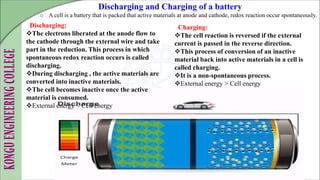
Discharging:
The electrons liberated at the anode flow to
the cathode through the external wire and take
part in the reduction. This process in which
spontaneous redox reaction occurs is called
discharging.
During discharging , the active materials are
converted into inactive materials.
The cell becomes inactive once the active
material is consumed.
External energy < Cell energy
Charging:
The cell reaction is reversed if the external
current is passed in the reverse direction.
This process of conversion of an inactive
material back into active materials in a cell is
called charging.
It is a non-spontaneous process.
External energy > Cell energy
Discharging and Charging of a battery
o A cell is a battery that is packed that active materials at anode and cathode, redox reaction occur spontaneously.
The batteries are classified into
o Primary batteries
o Secondary batteries
1. Primary battery (Non-rechargeable)
 The electrode and its reaction cannot be reversed by passing electrical energy externally.
 During discharging the chemical compounds are permanently changed and electrical energy
is released until the original compounds are completely exhausted.
 In such batteries the reaction occurs only once and it is not rechargeable
 Lower discharge rate than secondary batteries
 Examples: Dry Leclanche cell - Zinc Carbon – Used in flashlights, toys
Heavy Duty Zinc Chloride – Used in radios, recorders
Alkaline – Used in all of the above
Lithium – Used in photoflash
Silver Mercury Oxide – Used in Hearing aid, watches, calculators,
Silver button cell – Small devices like above
Types of Batteries
2. Secondary battery (Chargeable)
o The electrode reactions can be reserved by passing electrical energy externally.
o During discharging the chemical compounds which are changed can be reconstituted by
the application of an electrical potential between the electrodes – “electrochemical
reaction is reversible”
o They can be recharged by passing electrical current and used endlessly.
o Used when short periods of storage are required
o Higher discharge rate than primary batteries.
o Thus such cells can be Rechargeable and used many times.
o Examples: Lead Acid Battery
Nickel Cadmium Battery
Nickel Metal Hydride Battery
Lithium Ion Battery
Primary battery - Silver button battery
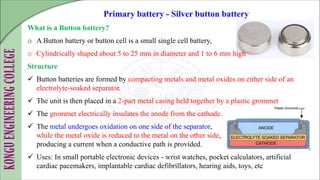
What is a Button battery?
o A Button battery or button cell is a small single cell battery,
o Cylindrically shaped about 5 to 25 mm in diameter and 1 to 6 mm high
Structure
 Button batteries are formed by compacting metals and metal oxides on either side of an
electrolyte-soaked separator.
 The unit is then placed in a 2-part metal casing held together by a plastic grommet
 The grommet electrically insulates the anode from the cathode.
 The metal undergoes oxidation on one side of the separator,
while the metal oxide is reduced to the metal on the other side,
producing a current when a conductive path is provided.
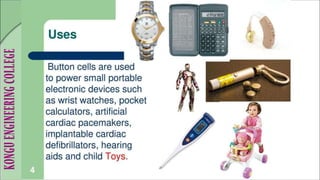
 Uses: In small portable electronic devices - wrist watches, pocket calculators, artificial
cardiac pacemakers, implantable cardiac defibrillators, hearing aids, toys, etc
Importance
o Button-type silver oxide batteries gives high-energy per
unit volume and stable operating voltage.
o Also, it is designed to use zero mercury.
o Maxell is the first company in Japan to successfully
market button-type silver oxide batteries.
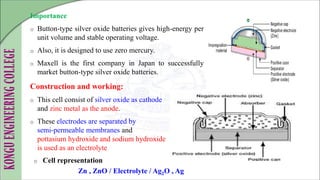
Construction and working:
o This cell consist of silver oxide as cathode
and zinc metal as the anode.
o These electrodes are separated by
semi-permeable membranes and
pottasium hydroxide and sodium hydroxide
is used as an electrolyte
o Cell representation
Zn , ZnO / Electrolyte / Ag2O , Ag
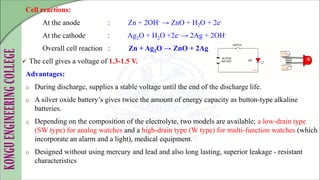
Cell reactions:
At the anode : Zn + 2OH- → ZnO + H2O + 2e-
At the cathode : Ag2O + H2O +2e- → 2Ag + 2OH-
Overall cell reaction : Zn + Ag2O → ZnO + 2Ag
 The cell gives a voltage of 1.3-1.5 V.
Advantages:
o During discharge, supplies a stable voltage until the end of the discharge life.
o A silver oxide battery’s gives twice the amount of energy capacity as button-type alkaline
batteries.
o Depending on the composition of the electrolyte, two models are available; a low-drain type
(SW type) for analog watches and a high-drain type (W type) for multi-function watches (which
incorporate an alarm and a light), medical equipment.
o Designed without using mercury and lead and also long lasting, superior leakage - resistant
characteristics
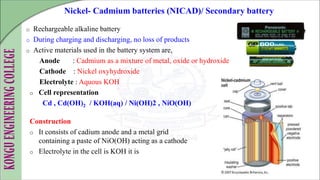
o Rechargeable alkaline battery
o During charging and discharging, no loss of products
o Active materials used in the battery system are,
Anode : Cadmium as a mixture of metal, oxide or hydroxide
Cathode : Nickel oxyhydroxide
Electrolyte : Aquous KOH
o Cell representation
Cd , Cd(OH)2 / KOH(aq) / Ni(OH)2 , NiO(OH)
Construction
o It consists of cadium anode and a metal grid
containing a paste of NiO(OH) acting as a cathode
o Electrolyte in the cell is KOH it is
Nickel- Cadmium batteries (NICAD)/ Secondary battery
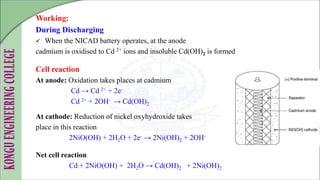
Working:
During Discharging
 When the NICAD battery operates, at the anode
cadmium is oxidised to Cd 2+ ions and insoluble Cd(OH)2 is formed
Cell reaction
At anode: Oxidation takes places at cadmium
Cd → Cd 2+ + 2e-
Cd 2+ + 2OH- → Cd(OH)2
At cathode: Reduction of nickel oxyhydroxide takes
place in this reaction
2NiO(OH) + 2H2O + 2e- → 2Ni(OH)2 + 2OH-
Net cell reaction
Cd + 2NiO(OH) + 2H2O → Cd(OH)2 + 2Ni(OH)2
During Charging
o When current is passed in the opposite direction, the electrode reaction gets reversed.
o As a result, cadmium gets deposited on the anode and
NiO(OH) gets deposited on the cathode.
At cathode:
Cd(OH)2 → Cd 2+ + 2OH-
Cd 2+ + 2e- → Cd
At anode:
2Ni(OH)2 + 2OH- → 2NiO(OH) + 2H2O + 2e-
Net cell reaction
Cd(OH)2 + 2Ni(OH)2 → Cd + 2NiO(OH) + 2H2O
 The cell voltage of battery is 1.4 V, which is irrespective of the size of electrodes.
Applications:
 Ni-Cd batteries may be used individually or assembled into battery packs
containing two or more cells.
 Ni-Cd batteries are used in cordless and wireless telephones, emergency lighting
and other applications.
 With a low internal resistance, they can supply a high surge current. This makes
them a favourable choice for remote controlled model airplanes, boats, cars and
camera flash units.
Advantages:
 Delivers high current output
 Have ability to deliver full power output until end of cycle
 It tolerates overcharging
 It withstands up to 500 cycles of charging
 It has longer life(less than 20 years) than lead storage cell
 Operate in a range of temperatures.
 No gas evolution occurs at the active electrodes.
 They have low internal resistance.
 Like a dry cell, it can be packed in a sealed container.
Disadvantages:
o Cadmium is not an eco-friendly material - Materials are toxic and the recycling
infrastructure for larger nickel-cadmium batteries is very limited
o Less tolerance towards temperature as compared to other batteries.
o It is three to five times more expensive than lead-acid
o Self discharge up to 10% in a day.
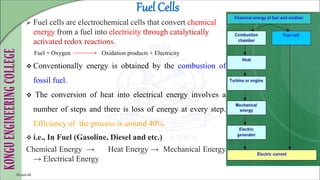
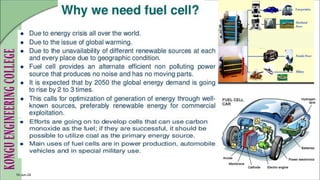
 Fuel cells are electrochemical cells that convert chemical
energy from a fuel into electricity through catalytically
activated redox reactions.
 Conventionally energy is obtained by the combustion of
fossil fuel.
 The conversion of heat into electrical energy involves a
number of steps and there is loss of energy at every step.
Efficiency of the process is around 40%.
 i.e., In Fuel (Gasoline, Diesel and etc.)
Chemical Energy → Heat Energy → Mechanical Energy
→ Electrical Energy
10-Jun-24
Fuel Cells
Fuel + Oxygen Oxidation products + Electricity
To overcome these, the device fuel cells were demonstrated which are a clean,
efficient, reliable, and quiet source of power. Fuel cells do not need to be periodically
recharged like batteries, but instead continue to produce electricity as long as a fuel
source is provided.
In Fuel cells the chemical energy is directly converted to electrical energy.
Chemical Energy → Electrical Energy
This direction conversion of chemical energy into electrical energy has 100%
efficiency.
Fuel cells are used today in a range of applications, from providing power to homes
and industries, keeping critical facilities like hospitals, grocery stores, and moving a
variety of vehicles including cars, buses, trucks, trains, and more.
10-Jun-24
10-Jun-24
Fuel Cells
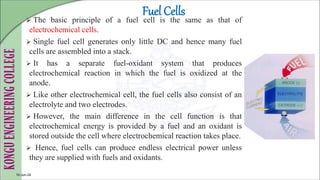
 The basic principle of a fuel cell is the same as that of
electrochemical cells.
 Single fuel cell generates only little DC and hence many fuel
cells are assembled into a stack.
 It has a separate fuel-oxidant system that produces
electrochemical reaction in which the fuel is oxidized at the
anode.
 Like other electrochemical cell, the fuel cells also consist of an
electrolyte and two electrodes.
 However, the main difference in the cell function is that
electrochemical energy is provided by a fuel and an oxidant is
stored outside the cell where electrochemical reaction takes place.
 Hence, fuel cells can produce endless electrical power unless
they are supplied with fuels and oxidants.
10-Jun-24
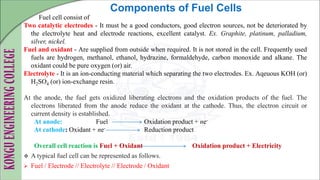
Fuel cell consist of
Two catalytic electrodes - It must be a good conductors, good electron sources, not be deteriorated by
the electrolyte heat and electrode reactions, excellent catalyst. Ex. Graphite, platinum, palladium,
silver, nickel.
Fuel and oxidant - Are supplied from outside when required. It is not stored in the cell. Frequently used
fuels are hydrogen, methanol, ethanol, hydrazine, formaldehyde, carbon monoxide and alkane. The
oxidant could be pure oxygen (or) air.
Electrolyte - It is an ion-conducting material which separating the two electrodes. Ex. Aqeuous KOH (or)
H2SO4 (or) ion-exchange resin.
At the anode, the fuel gets oxidized liberating electrons and the oxidation products of the fuel. The
electrons liberated from the anode reduce the oxidant at the cathode. Thus, the electron circuit or
current density is established.
At anode: Fuel Oxidation product + ne-
At cathode: Oxidant + ne- Reduction product
Overall cell reaction is Fuel + Oxidant Oxidation product + Electricity
 A typical fuel cell can be represented as follows.
 Fuel / Electrode // Electrolyte // Electrode / Oxidant
Components of Fuel Cells
10-Jun-24
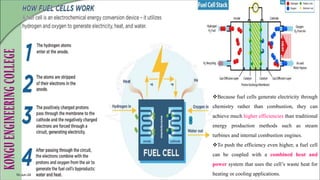
Because fuel cells generate electricity through
chemistry rather than combustion, they can
achieve much higher efficiencies than traditional
energy production methods such as steam
turbines and internal combustion engines.
To push the efficiency even higher, a fuel cell
can be coupled with a combined heat and
power system that uses the cell’s waste heat for
heating or cooling applications.
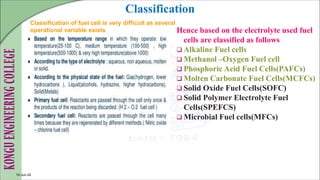
Classification
Hence based on the electrolyte used fuel
cells are classified as follows
 Alkaline Fuel cells
 Methanol –Oxygen Fuel cell
 Phosphoric Acid Fuel Cells(PAFCs)
 Molten Carbonate Fuel Cells(MCFCs)
 Solid Oxide Fuel Cells(SOFC)
 Solid Polymer Electrolyte Fuel
Cells(SPEFCS)
 Microbial Fuel cells(MFCs)
10-Jun-24
Classification of fuel cell is very difficult as several
operational variable exists
Alkaline fuel cell (AFC)
 Low temperature fuel cells (80°C) are used.
 Porous carbon charged with Mi/Pd acts as anode.
 Porous carbon charged with Ag-catalyst acts as cathode.
 Hydrogen gas is fuel at anode.
 Oxygen gas is fuel at cathode.
 Aqueous KOH solution is used as electrolyte
Phosphoric acid fuel cell (PAFC)
 Porous C + SiC + Teflon charged with Pt-catalyst acts as anode.
 Porous C + SiC + Teflon charged with Ag-catalyst acts cathode.
 Pure H2 gas is anodic fuel.
 Pure O2 gas is cathodic fuel.
 Concentrated phosphoric acid is used as electrolyte.
10-Jun-24
Molten carbonate fuel cell (MCFC)
 Anode is porous Ni/Ni – Cr alloy.
 Cathode is porous NiO.
 H2 gas or CO gas is fuel at anode
 O2 gas is fuel at cathode and it operates between 600 to 650°C.
 Fused carbonate (eutectic mixture of 32% Li2CO3 + 48% NiAlCO3 +
K2CO3) in porous inorganic material is used as electrolytic.
Polymer electrolyte fuel cell (DMFC)
 Two different porous gas diffused carbon electrodes charged with
platinum acts as both anode and cathode.
 Methanol is used as anode fuel.
 O2 gas is used as cathode fuel which is stable at 20°C to 90°C.
 Nafion membrane with 50% water as electrolyte is used as electrolyte.
 (Nafion, i.e., per fluorinated cation exchange polymer membrane)
10-Jun-24
Alkaline Fuel Cells
In alkaline fuel cells, the electrolyte used is an alkali, such as potassium hydroxide (30–
40% aqueous solution).
The alkaline fuel cells make use of high purity hydrogen as fuel and oxygen as oxidant.
This kind of fuel cell is otherwise known as hydrogen – oxygen fuel cell.
These are low temperature (80°C) fuel cells
This type of fuel cell is being developed for transport applications as well as for
stationary fuel cell applications and portable fuel cell applications.
AFC’s are also called Bacon fuel cells after their British inventor Francis Thomas
Bacon.
10-Jun-24
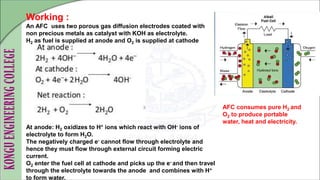
Working :
An AFC uses two porous gas diffusion electrodes coated with
non precious metals as catalyst with KOH as electrolyte.
H2 as fuel is supplied at anode and O2 is supplied at cathode
At anode: H2 oxidizes to H+ ions which react with OH- ions of
electrolyte to form H2O.
The negatively charged e- cannot flow through electrolyte and
hence they must flow through external circuit forming electric
current.
O2 enter the fuel cell at cathode and picks up the e- and then travel
through the electrolyte towards the anode and combines with H+
to form water.
AFC consumes pure H2 and
O2 to produce portable
water, heat and electricity.
Advantages
It is simple, lighter and compact due to their thin sheet of polymer electrolyte.
It operates at low temperature.
Their reaction starts quickly.
It operates at any orientation.
It just emits water vapour and no other harmful chemicals to the environment.
The efficiency is higher than about 75 %.
It can replaces the use of batteries and causes less noise pollution.
Low maintenance cost
10-Jun-24
 Disadvantages
It is very sensitive to CO and sulphur poisoning sine hydrogen is obtained from the fossil fuels
through reforming.
Even trace amount of CO2 in fuel/air affect cell’s operation by converting KOH electrolyte
into potassium carbonate (solid) that blocks pores in the electrode and also reduce the
conductivity of fuel cell.
CO2 + 2KOH K2CO3 + H2O
It requires pure H2 gas which is difficult to store.
It is very sensitive to low humidity.
It needs high cost platinum as catalyst for its functioning, which makes the cell costreally
expensive.
10-Jun-24
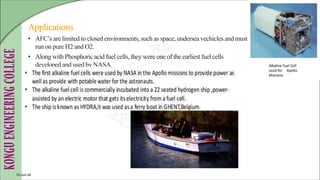
Applications
• AFC’s are limited to closed environments, such as space, undersea vechicles and must
run on pure H2 and O2.
• Along with Phosphoric acid fuel cells, they were one of the earliest fuel cells
developed and used by NASA.
10-Jun-24
MOLTEN CARBONATE FUEL CELLS (MCFCS)
10-Jun-24
MOLTEN CARBONATE FUEL CELLS (MCFCS)
It is a second generation fuel cells.
The molten carbonate fuel cell operates at approximately 650°C (1200°F).
The high operating temperature is needed to achieve sufficient conductivity of the
carbonate electrolyte.
 A benefit associated with this high temperature is that noble metal catalysts are not
required for the cell processing.
 Molten lithium-potassium carbonate salts are the electrolytes.
 H2 (or) CO is the fuel, while O2 is the oxidant.
 As high temperature is employed, fairly less expensive catalysts like Ni (or) NiO
are used.
 The anode comprises porous Ni with 1-2 % chromium and the cathode comprises
Ni with1-2% lithium.
10-Jun-24
10-Jun-24
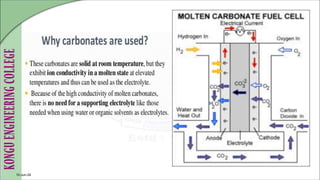
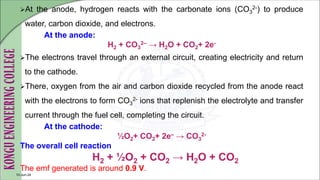
At the anode, hydrogen reacts with the carbonate ions (CO3
2-) to produce
water, carbon dioxide, and electrons.
At the anode:
H2 + CO3
2– → H2O + CO2+ 2e-
The electrons travel through an external circuit, creating electricity and return
to the cathode.
There, oxygen from the air and carbon dioxide recycled from the anode react
with the electrons to form CO3
2- ions that replenish the electrolyte and transfer
current through the fuel cell, completing the circuit.
At the cathode:
½O2+ CO2+ 2e– → CO3
2-
The overall cell reaction
H2 + ½O2 + CO2 → H2O + CO2
The emf generated is around 0.9 V.
10-Jun-24
10-Jun-24
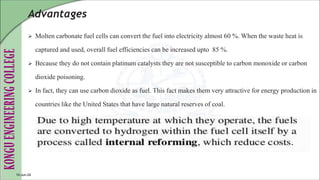
Advantages
 Molten carbonate fuel cells can convert the fuel into electricity almost 60 %. When the waste heat is
captured and used, overall fuel efficiencies can be increased upto 85 %.
 Because they do not contain platinum catalysts they are not susceptible to carbon monoxide or carbon
dioxide poisoning.
 In fact, they can use carbon dioxide as fuel. This fact makes them very attractive for energy production in
countries like the United States that have large natural reserves of coal.
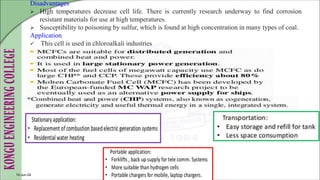
Disadvantages
 High temperatures decrease cell life. There is currently research underway to find corrosion
resistant materials for use at high temperatures.
 Susceptibility to poisoning by sulfur, which is found at high concentration in many types of coal.
Application
 This cell is used in chloroalkali industries
10-Jun-24
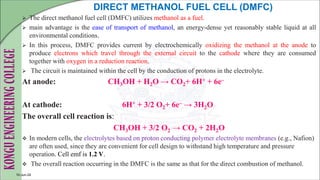
DIRECT METHANOL FUEL CELL (DMFC)
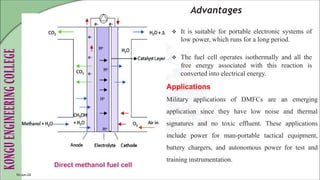
 The direct methanol fuel cell (DMFC) utilizes methanol as a fuel.
 main advantage is the ease of transport of methanol, an energy-dense yet reasonably stable liquid at all
environmental conditions.
 In this process, DMFC provides current by electrochemically oxidizing the methanol at the anode to
produce electrons which travel through the external circuit to the cathode where they are consumed
together with oxygen in a reduction reaction.
 The circuit is maintained within the cell by the conduction of protons in the electrolyte.
At anode: CH3OH + H2O → CO2+ 6H+ + 6e–
At cathode: 6H+ + 3/2 O2+ 6e– → 3H2O
The overall cell reaction is:
CH3OH + 3/2 O2 → CO2 + 2H2O
 In modern cells, the electrolytes based on proton conducting polymer electrolyte membranes (e.g., Nafion)
are often used, since they are convenient for cell design to withstand high temperature and pressure
operation. Cell emf is 1.2 V.
 The overall reaction occurring in the DMFC is the same as that for the direct combustion of methanol.
10-Jun-24
Advantages
 It is suitable for portable electronic systems of
low power, which runs for a long period.
 The fuel cell operates isothermally and all the
free energy associated with this reaction is
converted into electrical energy.
10-Jun-24
Direct methanol fuel cell
Applications
Military applications of DMFCs are an emerging
application since they have low noise and thermal
signatures and no toxic effluent. These applications
include power for man-portable tactical equipment,
battery chargers, and autonomous power for test and
training instrumentation.
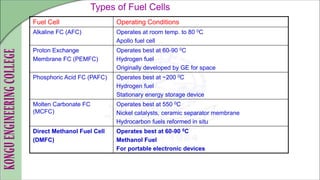
Types of Fuel Cells
Fuel Cell Operating Conditions
Alkaline FC (AFC) Operates at room temp. to 80 0C
Apollo fuel cell
Proton Exchange
Membrane FC (PEMFC)
Operates best at 60-90 0C
Hydrogen fuel
Originally developed by GE for space
Phosphoric Acid FC (PAFC) Operates best at ~200 0C
Hydrogen fuel
Stationary energy storage device
Molten Carbonate FC
(MCFC)
Operates best at 550 0C
Nickel catalysts, ceramic separator membrane
Hydrocarbon fuels reformed in situ
Direct Methanol Fuel Cell
(DMFC)
Operates best at 60-90 0C
Methanol Fuel
For portable electronic devices
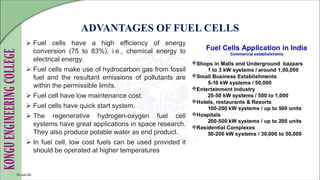
ADVANTAGES OF FUEL CELLS
 Fuel cells have a high efficiency of energy
conversion (75 to 83%), i.e., chemical energy to
electrical energy.
 Fuel cells make use of hydrocarbon gas from fossil
fuel and the resultant emissions of pollutants are
within the permissible limits.
 Fuel cell have low maintenance cost.
 Fuel cells have quick start system.
 The regenerative hydrogen-oxygen fuel cell
systems have great applications in space research.
They also produce potable water as end product.
 In fuel cell, low cost fuels can be used provided it
should be operated at higher temperatures
10-Jun-24
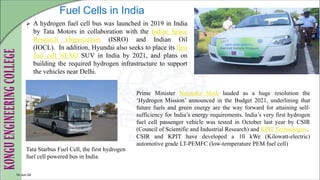
Fuel Cells in India
 A hydrogen fuel cell bus was launched in 2019 in India
by Tata Motors in collaboration with the Indian Space
Research Organization (ISRO) and Indian Oil
(IOCL). In addition, Hyundai also seeks to place its first
fuel cell NEXO SUV in India by 2021, and plans on
building the required hydrogen infrastructure to support
the vehicles near Delhi.
10-Jun-24
Tata Starbus Fuel Cell, the first hydrogen
fuel cell powered bus in India.
Prime Minister Narendra Modi lauded as a huge resolution the
‘Hydrogen Mission’ announced in the Budget 2021, underlining that
future fuels and green energy are the way forward for attaining self-
sufficiency for India’s energy requirements. India’s very first hydrogen
fuel cell passenger vehicle was tested in October last year by CSIR
(Council of Scientific and Industrial Research) and KPIT Technologies.
CSIR and KPIT have developed a 10 kWe (Kilowatt-electric)
automotive grade LT-PEMFC (low-temperature PEM fuel cell)

Unit-III-ELECTROCHEMICAL STORAGE DEVICES.ppt

  • 1.
    10-Jun-24 Prepared by Mrs.K.Krishnaveni Assistant Professor Departmentof Chemistry Kongu Engineering College Perundurai, Erode Unit – III – Electrochemical Storage Devices
  • 2.
    UNIT - III ELECTROCHEMICALSTORAGEDEVICES Batteries-Introduction – Types of Batteries – discharging and charging of battery - characteristics of battery –battery rating- various tests on battery- – Primary battery: silver button cell- Secondary battery :Ni-Cd battery-modern battery: lithium ion battery- maintenance of batteries-choices of batteries for electric vehicle applications. Fuel Cells: Introduction- importance and classification of fuel cells - description, principle, components, applications of fuel cells: H2-O2 fuel cell, alkaline fuel cell, phomolten carbonate fuel cell and direct methanol fuel cells.
  • 3.
    Introduction: o The functionof Batteries / cells is the conversion of chemical energy into electrical energy.  It is made up of two electrodes (anode & cathode) and electrolyte solution Definition:  Cell is an arrangement of two electrodes dipped into a solution of electrolyte or electrolytes. o Cathode – Positive terminal – Electrochemical reduction occurs (gain electrons) o Anode – Negative terminal – Electrochemical oxidation occurs (lose electrons) o Electrolytes – Allow Ions to move between electrodes o Terminals – Allows Current to flow out of the battery to perform work CELLS
  • 4.
    List of inventedcells / Batteries Alessandro Volta invented the first true battery
  • 5.
    o Due toincreasing human activity in technology, a number of battery dependent appliances have come into existence. o It is used in wrist watches, electric calling bells, space vehicles and missile firing units. Importance of Cells / Batteries / There are two types of cells, 1. Electrolytic cell 2. Electrochemical cell Types of Cells - Electrical energy is used to bring about the chemical reaction. At anode : Oxidation takes place (Ni → Ni2+ +2e-) At cathode : Reduction takes place ( Ni2+ +2e- → Ni )
  • 6.
    o Electrical energyis generated due to chemical reactions, which takes place inside the cells o Examples: Daniel cell, Zn / ZnSO4 // CuSO4 / Cu At anode, Zn → Zn2+ +2e- (Oxidation) At cathode, Cu2+ + 2e- → Cu (Reduction) The overall reaction, Zn + Cu2+ → Zn2+ + Cu
  • 7.
     A batteryis an arrangement of several electrochemical cells connected in series / parallel to get required amount of electrical energy.  The battery contains several anodes and cathodes. BATTERIES Criteria for any cells to be commercial cells  Should be cheap  Light weight and portable  should have long life cycle and high self life.  should be continuous and constant sources of EMF over a long interval of time.  It should be a rechargeable unit.
  • 8.
    Selection of batterydepends on the conditions of working, the suitability of a battery depends on the following characteristics: o Type o Voltage o Discharge curve o Capacity o Energy density o Specific energy density o Power density o Temperature dependence o Service life o Physical requirements o Charge/discharge cycle o Cycle life o Cost o Ability to deep discharge o Application requirements
  • 12.
    Cycle life: o Itis defined as number of times the discharging and charging operations can be alternated till such time it performs as designed. o It is applicable only to secondary cells. The EMF of cell decrease during discharging. o A good cell should have high cycle life. o some times cycle life would be lower than expected level due to,  The active materials at the electrodes may whither off due to rapid charging conditions.  May be irregular deposition of the products during discharging.  Over charging, the corrosion may occur. Shelf life:  A good battery should possess a long shelf life. Self -discharge: o It is defined as the loss of active materials of the cell due to localized action on the electrode even the cell is not in discharge mode. o Longer the life self-discharge, good battery
  • 13.
    Discharging: The electrons liberatedat the anode flow to the cathode through the external wire and take part in the reduction. This process in which spontaneous redox reaction occurs is called discharging. During discharging , the active materials are converted into inactive materials. The cell becomes inactive once the active material is consumed. External energy < Cell energy Charging: The cell reaction is reversed if the external current is passed in the reverse direction. This process of conversion of an inactive material back into active materials in a cell is called charging. It is a non-spontaneous process. External energy > Cell energy Discharging and Charging of a battery o A cell is a battery that is packed that active materials at anode and cathode, redox reaction occur spontaneously.
  • 14.
    The batteries areclassified into o Primary batteries o Secondary batteries 1. Primary battery (Non-rechargeable)  The electrode and its reaction cannot be reversed by passing electrical energy externally.  During discharging the chemical compounds are permanently changed and electrical energy is released until the original compounds are completely exhausted.  In such batteries the reaction occurs only once and it is not rechargeable  Lower discharge rate than secondary batteries  Examples: Dry Leclanche cell - Zinc Carbon – Used in flashlights, toys Heavy Duty Zinc Chloride – Used in radios, recorders Alkaline – Used in all of the above Lithium – Used in photoflash Silver Mercury Oxide – Used in Hearing aid, watches, calculators, Silver button cell – Small devices like above Types of Batteries
  • 15.
    2. Secondary battery(Chargeable) o The electrode reactions can be reserved by passing electrical energy externally. o During discharging the chemical compounds which are changed can be reconstituted by the application of an electrical potential between the electrodes – “electrochemical reaction is reversible” o They can be recharged by passing electrical current and used endlessly. o Used when short periods of storage are required o Higher discharge rate than primary batteries. o Thus such cells can be Rechargeable and used many times. o Examples: Lead Acid Battery Nickel Cadmium Battery Nickel Metal Hydride Battery Lithium Ion Battery
  • 17.
    Primary battery -Silver button battery What is a Button battery? o A Button battery or button cell is a small single cell battery, o Cylindrically shaped about 5 to 25 mm in diameter and 1 to 6 mm high Structure  Button batteries are formed by compacting metals and metal oxides on either side of an electrolyte-soaked separator.  The unit is then placed in a 2-part metal casing held together by a plastic grommet  The grommet electrically insulates the anode from the cathode.  The metal undergoes oxidation on one side of the separator, while the metal oxide is reduced to the metal on the other side, producing a current when a conductive path is provided.  Uses: In small portable electronic devices - wrist watches, pocket calculators, artificial cardiac pacemakers, implantable cardiac defibrillators, hearing aids, toys, etc
  • 18.
    Importance o Button-type silveroxide batteries gives high-energy per unit volume and stable operating voltage. o Also, it is designed to use zero mercury. o Maxell is the first company in Japan to successfully market button-type silver oxide batteries. Construction and working: o This cell consist of silver oxide as cathode and zinc metal as the anode. o These electrodes are separated by semi-permeable membranes and pottasium hydroxide and sodium hydroxide is used as an electrolyte o Cell representation Zn , ZnO / Electrolyte / Ag2O , Ag
  • 19.
    Cell reactions: At theanode : Zn + 2OH- → ZnO + H2O + 2e- At the cathode : Ag2O + H2O +2e- → 2Ag + 2OH- Overall cell reaction : Zn + Ag2O → ZnO + 2Ag  The cell gives a voltage of 1.3-1.5 V. Advantages: o During discharge, supplies a stable voltage until the end of the discharge life. o A silver oxide battery’s gives twice the amount of energy capacity as button-type alkaline batteries. o Depending on the composition of the electrolyte, two models are available; a low-drain type (SW type) for analog watches and a high-drain type (W type) for multi-function watches (which incorporate an alarm and a light), medical equipment. o Designed without using mercury and lead and also long lasting, superior leakage - resistant characteristics
  • 21.
    o Rechargeable alkalinebattery o During charging and discharging, no loss of products o Active materials used in the battery system are, Anode : Cadmium as a mixture of metal, oxide or hydroxide Cathode : Nickel oxyhydroxide Electrolyte : Aquous KOH o Cell representation Cd , Cd(OH)2 / KOH(aq) / Ni(OH)2 , NiO(OH) Construction o It consists of cadium anode and a metal grid containing a paste of NiO(OH) acting as a cathode o Electrolyte in the cell is KOH it is Nickel- Cadmium batteries (NICAD)/ Secondary battery
  • 22.
    Working: During Discharging  Whenthe NICAD battery operates, at the anode cadmium is oxidised to Cd 2+ ions and insoluble Cd(OH)2 is formed Cell reaction At anode: Oxidation takes places at cadmium Cd → Cd 2+ + 2e- Cd 2+ + 2OH- → Cd(OH)2 At cathode: Reduction of nickel oxyhydroxide takes place in this reaction 2NiO(OH) + 2H2O + 2e- → 2Ni(OH)2 + 2OH- Net cell reaction Cd + 2NiO(OH) + 2H2O → Cd(OH)2 + 2Ni(OH)2
  • 23.
    During Charging o Whencurrent is passed in the opposite direction, the electrode reaction gets reversed. o As a result, cadmium gets deposited on the anode and NiO(OH) gets deposited on the cathode. At cathode: Cd(OH)2 → Cd 2+ + 2OH- Cd 2+ + 2e- → Cd At anode: 2Ni(OH)2 + 2OH- → 2NiO(OH) + 2H2O + 2e- Net cell reaction Cd(OH)2 + 2Ni(OH)2 → Cd + 2NiO(OH) + 2H2O  The cell voltage of battery is 1.4 V, which is irrespective of the size of electrodes.
  • 24.
    Applications:  Ni-Cd batteriesmay be used individually or assembled into battery packs containing two or more cells.  Ni-Cd batteries are used in cordless and wireless telephones, emergency lighting and other applications.  With a low internal resistance, they can supply a high surge current. This makes them a favourable choice for remote controlled model airplanes, boats, cars and camera flash units.
  • 25.
    Advantages:  Delivers highcurrent output  Have ability to deliver full power output until end of cycle  It tolerates overcharging  It withstands up to 500 cycles of charging  It has longer life(less than 20 years) than lead storage cell  Operate in a range of temperatures.  No gas evolution occurs at the active electrodes.  They have low internal resistance.  Like a dry cell, it can be packed in a sealed container. Disadvantages: o Cadmium is not an eco-friendly material - Materials are toxic and the recycling infrastructure for larger nickel-cadmium batteries is very limited o Less tolerance towards temperature as compared to other batteries. o It is three to five times more expensive than lead-acid o Self discharge up to 10% in a day.
  • 26.
     Fuel cellsare electrochemical cells that convert chemical energy from a fuel into electricity through catalytically activated redox reactions.  Conventionally energy is obtained by the combustion of fossil fuel.  The conversion of heat into electrical energy involves a number of steps and there is loss of energy at every step. Efficiency of the process is around 40%.  i.e., In Fuel (Gasoline, Diesel and etc.) Chemical Energy → Heat Energy → Mechanical Energy → Electrical Energy 10-Jun-24 Fuel Cells Fuel + Oxygen Oxidation products + Electricity
  • 27.
    To overcome these,the device fuel cells were demonstrated which are a clean, efficient, reliable, and quiet source of power. Fuel cells do not need to be periodically recharged like batteries, but instead continue to produce electricity as long as a fuel source is provided. In Fuel cells the chemical energy is directly converted to electrical energy. Chemical Energy → Electrical Energy This direction conversion of chemical energy into electrical energy has 100% efficiency. Fuel cells are used today in a range of applications, from providing power to homes and industries, keeping critical facilities like hospitals, grocery stores, and moving a variety of vehicles including cars, buses, trucks, trains, and more. 10-Jun-24
  • 28.
  • 29.
    Fuel Cells  Thebasic principle of a fuel cell is the same as that of electrochemical cells.  Single fuel cell generates only little DC and hence many fuel cells are assembled into a stack.  It has a separate fuel-oxidant system that produces electrochemical reaction in which the fuel is oxidized at the anode.  Like other electrochemical cell, the fuel cells also consist of an electrolyte and two electrodes.  However, the main difference in the cell function is that electrochemical energy is provided by a fuel and an oxidant is stored outside the cell where electrochemical reaction takes place.  Hence, fuel cells can produce endless electrical power unless they are supplied with fuels and oxidants. 10-Jun-24
  • 30.
    Fuel cell consistof Two catalytic electrodes - It must be a good conductors, good electron sources, not be deteriorated by the electrolyte heat and electrode reactions, excellent catalyst. Ex. Graphite, platinum, palladium, silver, nickel. Fuel and oxidant - Are supplied from outside when required. It is not stored in the cell. Frequently used fuels are hydrogen, methanol, ethanol, hydrazine, formaldehyde, carbon monoxide and alkane. The oxidant could be pure oxygen (or) air. Electrolyte - It is an ion-conducting material which separating the two electrodes. Ex. Aqeuous KOH (or) H2SO4 (or) ion-exchange resin. At the anode, the fuel gets oxidized liberating electrons and the oxidation products of the fuel. The electrons liberated from the anode reduce the oxidant at the cathode. Thus, the electron circuit or current density is established. At anode: Fuel Oxidation product + ne- At cathode: Oxidant + ne- Reduction product Overall cell reaction is Fuel + Oxidant Oxidation product + Electricity  A typical fuel cell can be represented as follows.  Fuel / Electrode // Electrolyte // Electrode / Oxidant Components of Fuel Cells
  • 31.
    10-Jun-24 Because fuel cellsgenerate electricity through chemistry rather than combustion, they can achieve much higher efficiencies than traditional energy production methods such as steam turbines and internal combustion engines. To push the efficiency even higher, a fuel cell can be coupled with a combined heat and power system that uses the cell’s waste heat for heating or cooling applications.
  • 32.
    Classification Hence based onthe electrolyte used fuel cells are classified as follows  Alkaline Fuel cells  Methanol –Oxygen Fuel cell  Phosphoric Acid Fuel Cells(PAFCs)  Molten Carbonate Fuel Cells(MCFCs)  Solid Oxide Fuel Cells(SOFC)  Solid Polymer Electrolyte Fuel Cells(SPEFCS)  Microbial Fuel cells(MFCs) 10-Jun-24 Classification of fuel cell is very difficult as several operational variable exists
  • 33.
    Alkaline fuel cell(AFC)  Low temperature fuel cells (80°C) are used.  Porous carbon charged with Mi/Pd acts as anode.  Porous carbon charged with Ag-catalyst acts as cathode.  Hydrogen gas is fuel at anode.  Oxygen gas is fuel at cathode.  Aqueous KOH solution is used as electrolyte Phosphoric acid fuel cell (PAFC)  Porous C + SiC + Teflon charged with Pt-catalyst acts as anode.  Porous C + SiC + Teflon charged with Ag-catalyst acts cathode.  Pure H2 gas is anodic fuel.  Pure O2 gas is cathodic fuel.  Concentrated phosphoric acid is used as electrolyte. 10-Jun-24
  • 34.
    Molten carbonate fuelcell (MCFC)  Anode is porous Ni/Ni – Cr alloy.  Cathode is porous NiO.  H2 gas or CO gas is fuel at anode  O2 gas is fuel at cathode and it operates between 600 to 650°C.  Fused carbonate (eutectic mixture of 32% Li2CO3 + 48% NiAlCO3 + K2CO3) in porous inorganic material is used as electrolytic. Polymer electrolyte fuel cell (DMFC)  Two different porous gas diffused carbon electrodes charged with platinum acts as both anode and cathode.  Methanol is used as anode fuel.  O2 gas is used as cathode fuel which is stable at 20°C to 90°C.  Nafion membrane with 50% water as electrolyte is used as electrolyte.  (Nafion, i.e., per fluorinated cation exchange polymer membrane) 10-Jun-24
  • 35.
    Alkaline Fuel Cells Inalkaline fuel cells, the electrolyte used is an alkali, such as potassium hydroxide (30– 40% aqueous solution). The alkaline fuel cells make use of high purity hydrogen as fuel and oxygen as oxidant. This kind of fuel cell is otherwise known as hydrogen – oxygen fuel cell. These are low temperature (80°C) fuel cells This type of fuel cell is being developed for transport applications as well as for stationary fuel cell applications and portable fuel cell applications. AFC’s are also called Bacon fuel cells after their British inventor Francis Thomas Bacon. 10-Jun-24
  • 36.
    Working : An AFCuses two porous gas diffusion electrodes coated with non precious metals as catalyst with KOH as electrolyte. H2 as fuel is supplied at anode and O2 is supplied at cathode At anode: H2 oxidizes to H+ ions which react with OH- ions of electrolyte to form H2O. The negatively charged e- cannot flow through electrolyte and hence they must flow through external circuit forming electric current. O2 enter the fuel cell at cathode and picks up the e- and then travel through the electrolyte towards the anode and combines with H+ to form water. AFC consumes pure H2 and O2 to produce portable water, heat and electricity.
  • 37.
    Advantages It is simple,lighter and compact due to their thin sheet of polymer electrolyte. It operates at low temperature. Their reaction starts quickly. It operates at any orientation. It just emits water vapour and no other harmful chemicals to the environment. The efficiency is higher than about 75 %. It can replaces the use of batteries and causes less noise pollution. Low maintenance cost 10-Jun-24
  • 38.
     Disadvantages It isvery sensitive to CO and sulphur poisoning sine hydrogen is obtained from the fossil fuels through reforming. Even trace amount of CO2 in fuel/air affect cell’s operation by converting KOH electrolyte into potassium carbonate (solid) that blocks pores in the electrode and also reduce the conductivity of fuel cell. CO2 + 2KOH K2CO3 + H2O It requires pure H2 gas which is difficult to store. It is very sensitive to low humidity. It needs high cost platinum as catalyst for its functioning, which makes the cell costreally expensive. 10-Jun-24
  • 39.
    Applications • AFC’s arelimited to closed environments, such as space, undersea vechicles and must run on pure H2 and O2. • Along with Phosphoric acid fuel cells, they were one of the earliest fuel cells developed and used by NASA. 10-Jun-24
  • 40.
    MOLTEN CARBONATE FUELCELLS (MCFCS) 10-Jun-24
  • 41.
    MOLTEN CARBONATE FUELCELLS (MCFCS) It is a second generation fuel cells. The molten carbonate fuel cell operates at approximately 650°C (1200°F). The high operating temperature is needed to achieve sufficient conductivity of the carbonate electrolyte.  A benefit associated with this high temperature is that noble metal catalysts are not required for the cell processing.  Molten lithium-potassium carbonate salts are the electrolytes.  H2 (or) CO is the fuel, while O2 is the oxidant.  As high temperature is employed, fairly less expensive catalysts like Ni (or) NiO are used.  The anode comprises porous Ni with 1-2 % chromium and the cathode comprises Ni with1-2% lithium. 10-Jun-24
  • 42.
  • 43.
    At the anode,hydrogen reacts with the carbonate ions (CO3 2-) to produce water, carbon dioxide, and electrons. At the anode: H2 + CO3 2– → H2O + CO2+ 2e- The electrons travel through an external circuit, creating electricity and return to the cathode. There, oxygen from the air and carbon dioxide recycled from the anode react with the electrons to form CO3 2- ions that replenish the electrolyte and transfer current through the fuel cell, completing the circuit. At the cathode: ½O2+ CO2+ 2e– → CO3 2- The overall cell reaction H2 + ½O2 + CO2 → H2O + CO2 The emf generated is around 0.9 V. 10-Jun-24
  • 44.
    10-Jun-24 Advantages  Molten carbonatefuel cells can convert the fuel into electricity almost 60 %. When the waste heat is captured and used, overall fuel efficiencies can be increased upto 85 %.  Because they do not contain platinum catalysts they are not susceptible to carbon monoxide or carbon dioxide poisoning.  In fact, they can use carbon dioxide as fuel. This fact makes them very attractive for energy production in countries like the United States that have large natural reserves of coal.
  • 45.
    Disadvantages  High temperaturesdecrease cell life. There is currently research underway to find corrosion resistant materials for use at high temperatures.  Susceptibility to poisoning by sulfur, which is found at high concentration in many types of coal. Application  This cell is used in chloroalkali industries 10-Jun-24
  • 46.
    DIRECT METHANOL FUELCELL (DMFC)  The direct methanol fuel cell (DMFC) utilizes methanol as a fuel.  main advantage is the ease of transport of methanol, an energy-dense yet reasonably stable liquid at all environmental conditions.  In this process, DMFC provides current by electrochemically oxidizing the methanol at the anode to produce electrons which travel through the external circuit to the cathode where they are consumed together with oxygen in a reduction reaction.  The circuit is maintained within the cell by the conduction of protons in the electrolyte. At anode: CH3OH + H2O → CO2+ 6H+ + 6e– At cathode: 6H+ + 3/2 O2+ 6e– → 3H2O The overall cell reaction is: CH3OH + 3/2 O2 → CO2 + 2H2O  In modern cells, the electrolytes based on proton conducting polymer electrolyte membranes (e.g., Nafion) are often used, since they are convenient for cell design to withstand high temperature and pressure operation. Cell emf is 1.2 V.  The overall reaction occurring in the DMFC is the same as that for the direct combustion of methanol. 10-Jun-24
  • 47.
    Advantages  It issuitable for portable electronic systems of low power, which runs for a long period.  The fuel cell operates isothermally and all the free energy associated with this reaction is converted into electrical energy. 10-Jun-24 Direct methanol fuel cell Applications Military applications of DMFCs are an emerging application since they have low noise and thermal signatures and no toxic effluent. These applications include power for man-portable tactical equipment, battery chargers, and autonomous power for test and training instrumentation.
  • 48.
    Types of FuelCells Fuel Cell Operating Conditions Alkaline FC (AFC) Operates at room temp. to 80 0C Apollo fuel cell Proton Exchange Membrane FC (PEMFC) Operates best at 60-90 0C Hydrogen fuel Originally developed by GE for space Phosphoric Acid FC (PAFC) Operates best at ~200 0C Hydrogen fuel Stationary energy storage device Molten Carbonate FC (MCFC) Operates best at 550 0C Nickel catalysts, ceramic separator membrane Hydrocarbon fuels reformed in situ Direct Methanol Fuel Cell (DMFC) Operates best at 60-90 0C Methanol Fuel For portable electronic devices
  • 49.
    ADVANTAGES OF FUELCELLS  Fuel cells have a high efficiency of energy conversion (75 to 83%), i.e., chemical energy to electrical energy.  Fuel cells make use of hydrocarbon gas from fossil fuel and the resultant emissions of pollutants are within the permissible limits.  Fuel cell have low maintenance cost.  Fuel cells have quick start system.  The regenerative hydrogen-oxygen fuel cell systems have great applications in space research. They also produce potable water as end product.  In fuel cell, low cost fuels can be used provided it should be operated at higher temperatures 10-Jun-24
  • 50.
    Fuel Cells inIndia  A hydrogen fuel cell bus was launched in 2019 in India by Tata Motors in collaboration with the Indian Space Research Organization (ISRO) and Indian Oil (IOCL). In addition, Hyundai also seeks to place its first fuel cell NEXO SUV in India by 2021, and plans on building the required hydrogen infrastructure to support the vehicles near Delhi. 10-Jun-24 Tata Starbus Fuel Cell, the first hydrogen fuel cell powered bus in India. Prime Minister Narendra Modi lauded as a huge resolution the ‘Hydrogen Mission’ announced in the Budget 2021, underlining that future fuels and green energy are the way forward for attaining self- sufficiency for India’s energy requirements. India’s very first hydrogen fuel cell passenger vehicle was tested in October last year by CSIR (Council of Scientific and Industrial Research) and KPIT Technologies. CSIR and KPIT have developed a 10 kWe (Kilowatt-electric) automotive grade LT-PEMFC (low-temperature PEM fuel cell)