Modelling and design of a reversible three-phase
switching mode rectifier
J.-J.Shieh
C.-T. Pan
Z.-J.Cuey

Indexing terms: Three-phase switching mode rect$er, Active switch, Current sensor, Pulse width modulation, Closed-form control law

Abstract: A reversible three-phase switching mode
rectifier consisting of a four-active-switch and
without current sensor is proposed. To achieve
controllable power factor, clean sinusoidal input
current, adjustable DC output voltage, and
bidirectional power flow capability, a closed-form
pulse width modulation (PWM) duty cycle
function is derived. The popularly used state
space averaging technique is extended for
modelling the reversible three-phase four-activeswitch rectifier. The space vector representation
technique is then used to simplify the modelling
process without sacrificing accuracy and valid
frequency range. Both steady-state and small
signal analyses are made. Results show that the
proposed closed-form control law for the rectifier
can indeed achieve the desired property.
Moreover, the rectifier also possesses a
bidirectional power flow capability, which is
useful for many applications. Finally, a prototype
hardware
circuit
was
constructed
and
experimental
results
are
presented
for
demonstration. Guidelines for determining the
LC parameters and the PI controller gains are
described briefly in the text.

1

Introduction

Three-phase diode rectifiers or thyristor rectifiers are
used frequently in many industrial applications which
require a high-power DC supply or as an intermediate
D C link in AC/AC convertors. However, these rectifiers can pollute the AC supply with significant levels of
low frequency harmonics, pulsating input current (electromagnetic interference (EMI)), and excessive VAR
[ 1, 21. With tough regulations and severe economic
restraints, the design of a three-phase switching mode
rectifier which draws nearly sinusoidal three-phase
input currents with unity power factor is very important from the point of view of energy saving and also
to satisfy forthcoming harmonic standards such as

IEEE 519 or IEC 555-2 [3, 41. As a result of recent
rapid progress in high speed power semiconductor
devices, it is now possible to use pulse width modulation (PWM) technology to achieve the above functions.
Several switching mode rectifier topologies have been
proposed to achieve almost sinusoidal waveform with
near-unity power factor [5-91. These rectifiers require
the use of current sensors to correct power factor and/
or eliminate harmonics. From the viewpoints of cost
reduction and enhanced reliability, using fewer active
switches and detector sensors and having higher efficiency are always important goals. Hence, several
switching mode rectifier topologies using fewer switches
have been proposed [lo-121. However, these rectifiers
either require many extra diodes, which incurs more
conduction losses, or are operated in discontinuous
mode, which increases the stress on switches. Also,
existing configurations having a regeneration capability
still require six active switches and some current sensors to shape the desired current. Although Ribeiro et
al. [13] proposed a four-switch convertor with regeneration capability for induction motor drives, it still
required current sensors to improve the input power
factor.
In this paper, a closed-form PWM duty cycle control
for a four-active-switch three-phase switching mode
rectifier is proposed to achieve sinusoidal input current,
controllable power factor, bidirectional capability, and
adjustable D C output voltage without current sensors.
Hence, the hardware circuit can be simplified and the
cost can be reduced.
L

-

L

,

Rs

'c

I

l

Fig. 1 Main circuit

o
f

switching mode rectifier

0 IEE, 1997

2

Z E E Proceedinfis online no. 19971253

N
the proposed reversible four-switch three-phase

control law

Paper first received 19th August 1996 and in revised form 3rd March
1997
The authors are with the Department of Electrical Engineering, National
Tsing Hua University, Hsinchu, Taiwan, 30043
IEE Proc-Electr. Power Appl., Vol. 144, No. 6, November 1997

Derivation of the closed-form PWM duty cycle

The main circuit of the proposed reversible three-phase
switching mode rectifier (SMR) with sinusoidal input
current and regulated DC output voltage is shown in
389
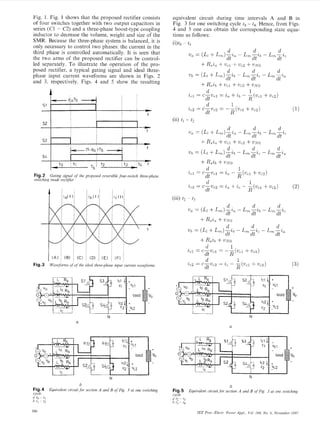
Fig. 1. Fig. 1 shows that the proposed rectifier consists
of four switches together with two output capacitors in
series (C1 = C2) and a three-phase boost-type coupling
inductor to decrease the volume, weight and size of the
SMR. Because the three-phase system is balanced, it is
only necessary to control two phases: the current in the
third phase is controlled automatically. It is seen that
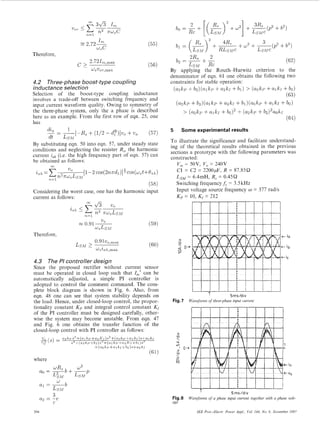
the two arms of the proposed rectifier can be controlled separately. To illustrate the operation of the proposed rectifier, a typical gating signal and ideal threephase input current waveforms are shown in Figs. 2
and 3, respectively. Figs. 4 and 5 show the resulting

SI

equivalent circuit during time intervals A and B in
Fig. 3 for one switching cycle to - t4. Hence, from Figs.
4 and 5 one can obtain the corresponding state equations as follows:

W O

tl

~

d .
d
d .
Lm)-%, - Lm-Zb - L ~ m - 2 ~
dt
dt
dt
+ Rsi, U,I uC2 UNO
d .
d .
d .
U b = (Ll
Lm)-2b - Lm -2, - Lm -2,
dt
dt
dt
Rsib U,I
V,Z
UNO
d
.
1
i c l = C-Vc1 = 2,
% b - -(ucl
vCz)
dt
R
d
1
ic2 = c-vc2
= - - U,1 + v c 2 )
R(
(1)
dt
= (L1 f

+

+ + +
+

+

t
d,oTs

+

+ +

4
-

(ii) t ,

-

+

t2

d .

+

d .

d .

( L I Lm)-t, - Lm-zb - Lm-tc
dt
dt
dt
Rsi, V,I
vCz ' U N O

+ + +

+

;

Ub

=

(L1

+

d .
dt

Lm)-%b

d .

Lm-2,
dt

-

+ Rsib + U N O

TS

d
i d = C--'Uc1
dt

Fig.2 Gating jignu1 of the pvoposed reversible four-switch three-phax

switchinp mode rectifier

d
dt

= c-vcz

ic2

(iii) t2

.

1

= 2,
= 2,

+

+

-I+
'

-

d .

dt

U&)

1
2, -

+ U&)

(2)

t3

~

U,

d
+ Lm)-t, .
dt
+ Rsi, +
d .
= (Ll + Lm)
dt
+ Rsib +
= (Ll

-

d .

Lm-'lb
dt

-

d .
Lm-2~
dt

UNO

vb

-ab

d .

d

-

Lm -2,
dt

-

Lm -aa
dt

UNO

d

Zcl

(A)

Fig.3

j (B) !

(C)

(D)

(E)

ic2

= C--vc2

(F)

Waveforms of o the ideal three-phase input current wavejorms
f

I

= C-Ucl

I

I

dt
d

dt

=

1

R (w c l

--

.

= 2,

1
- +I

+vc2)

+ U&)

(3)

I

N
a

a

N
b

Fig. 4

cycle
a 10

0I,
390

~

~

tl
I2

Equivalent circuit for section A and B o Fig. 3 at one switching
f

b

Fig.5

cycle
a

12

b 23

~

~

Equivalent circuit for section A and B o Fig. 3 at one switching
f

ti
ti

IEE Proc -Electr Power Appl., Vol. 144, No 6, November 1997
(iv) t3

-

Substituting eqns. 8 and 9 into eqn. 5 yields the complete state space averaged model as follows:

t4

U, =

d .

(LI+ L,)-%,
dt

-

d .

Lm-2b

dt

d .

- Lm-2,

d

dt

-X

= AX

dt

+ BU

(11)

where

x = [%a
d
1
=ib
i, - -(Uc1 + ' U C 2 )
(4)
dt
R
where R, is the resistance, L is the sum of the per phase
leakage inductance (LI)and mutual inductance (L,) of
the three-phase coupling inductor, C and R are the
capacitance and load resistance, respectively, and vNo
represents the potential difference from N to point 0.
Similarly, the twelve other equivalent circuits and the
corresponding state equations for the remaining time
intervals can be obtained. Hence, by using the state
space averaging technique [ 141 and neglecting the ESR
of the two capacitors, we obtain the state averaged
equation as follows:
ic2

c

+

= c-uc2

0

L+2L,,L

0

0

0

L+2L,,

0 0

L+ZL,,

0

0

0

-

1

0 01

0

0

0

0

0

0 0

-

0

0

-do

-R,

0

-db

%LI+L,
(13)

LSM

A=

--~
R,
LSM
(1

0

-~ 1

0

6LSM

-x, 0

6L;M

0

2
c

J
-

-'(-1+2%--1J)
6LSM

1
(1+2y--s)
GLSlM

LSM
I)

(1+2s--y)

--

--J--l+27,--z)

BLSM

(-z-c-v)

-&(2-"-Y)

LSM

- RC
_

- RIC
_

- -1

2
c

2C

1 0 0 0 0
0 1 0 0 0
0 0 1 0 0

B=-11

L ~ " o o o l o

v
,

dt

CO

-&I I;:I
0 c-

0IT

(12)

'UcZ]

Wcl

0 0 0 0 1
Next, assume input voltages and input currents as follows:
'Ua =
cos wt

Z " 1

2 1,

d

ic

0

'Ub

U=['U,

T
zb

-

v <1
"C2

-

-db

2 , = I , cos(wt - 4)

2,

(5)

where d, and db are duty ratios of switch S , and S3,
respectively.
Assume that the three-phase source is balanced, i.e.
'U,+'Ub+'U,=o
Z,$ib+Zc=o
(6)
Substituting eqn. 6 into eqn. 5 , we obtain
1
'UNO = --[(da
db)'UU,l (1
d,
db)Vu,2]
(7)
3
Now, let

+

+ + +

= I , cos ut

v,1 = vcz =

1

-(I
2

+ y)

I!/ 5 1

z =

-[V,
V
O

cos(4,)

2&

(9)

where x and y denote the time varying part modulation
indices which will be determined later. The duty ratios
of S, and S,, namely d, and d b are defined in sequence
as follows:
1
da -Z 1 - d - _1(1 - Z)
d b E 1 - db = -(I - y)
"-2
2
-

(10)
IEE Psoc.-Elects. Power Appl., Vol. 144. No. 6 , November 1997

-

1

4

1

(18)

f0

Then, by substituting eqn. 18 into eqn. 11 and considering eqns. 16 and 17, the following PWM duty cycle
control law can be obtained explicitly:

-

db =

+-

(
2.ir
3
where V, is the maximum input phase voltage and I,
is the maximum input phase current with phase shift @
included for adjusting power factor.
Assume that the steady state values of vc1and vc2can
be approximated as follows:

Y = -[Vm
-

-

4)

RsIm COS(#^ - 4)]
cos(h)

VO

+ W L S M I ,sin($,
+ W L S M Isin(4b
~

RsIm cos($b

-

d))]

-

4)
(19)

where

4,

wt

30'

&b E w t -

90'

(20)
In addition, the two capacitor state equations can be
obtained by substituting eqn. 19 into the last two rows
of eqn. 11, i.e.
E

-

391
.

1

$cl

+ y i b - 2,)

= -(II:Z,
2

-

vo
R

1
V,
z ( x i a y i b f i c )- (21)
R
At steady state, the DC output voltage is almost constant. Hence
d
d
= -dt c 1 +U&) F 0
(U
.

+

%e2

From eqns. 19-22, one obtains the following relation:

[:

V, = -ImR(Vm COS$

-

1

ImRs)

(23)

Since one of the goals is to eliminate the necessity for a
current sensor, I,* will be considered as a command
signal. If adjustable phase capability is required, 4 can
also be considered as a command signal. Thus, the
desired control law can be rewritten as follows:
II: =

2&

-[V,

+ W L S M I ;sin($,

cos($,)

v,

-

RSIL C O S ( &

a&

7~ = -[Vm

-

q5*)

$*)I

+ W L S M sin(q5b
I~

COS(&,)

-

-

4")

vo
cos($b - $*)I
(24)
If the duty ratios are controlled according to these
equations, the input line current will be forced to be
sinusoidal. Also, by closed-loop implementation, I, can
be controlled automatically and indirectly without
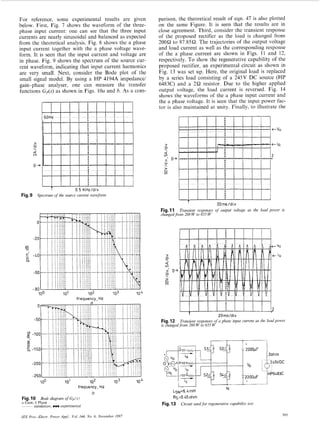
using any current sensor. Fig. 6 shows the schematic
diagram of the control function.

Vb

['U,

'U,]

=Re{[l
= Re{[l

U2

U]V,}

u]is}
u2 ald,}
(29)
Application of the above space vector notation yields
the following compact form:
[Za

Zb

[dl

d2

ZC]

U2

dg]=Re{[l

v

va,b.c

-!-

LSM

R
,

la,b,c

3
+ -Re{i,d,}

d
2
- = --U,
dtuo

I

(31)
c
In the synchronous rotating reference frame, the above
equations can be expressed in terms of direct and quadrature components as follows:

Re

I

d"

z~~-DdId
d
3

Fig.6 Complete block diugmm of the closed-loop control

3
Small signal model of the switching mode
rectifier

For simplicity, states vcl and vc2in eqn. 12 are replaced
with vo (= vcl + vC2),resulting in the following approx-

=

+ -D41q
3

c

-

-V,
2

(34)

Re

C

From eqns. 32-34 one obtains the steady state closedform PWM duty cycle control law corresponding to
eqn. 24 as follows:
1

Dd

=

-(Vm

-

R,I,*

-

wLsMIQ*)

U0

0
-R,

d

-

LSM

dt

0
2d2
C

+-L S1M
where
392

0

1

di

-~

D , = -(RsI,*

LSM

U,

wLsMI;)

(35)

I 4 = -I*m sin 4"
"

(36)

where

I;

I; cos 4"

1

Then, define the following perturbation equations:

Id = Id0 f

.o

-

f,

1,. = I& + I ;
U, =

v,+ 6,

I,*= 140 + f q
I" = I" + I "
4
40
4
(37)

IEE Proc.-Electr. Power Appl.. Vol. 144, No. 6, November 1997
Due to the well-controlled output voltage, eqn. 35 can
be approximated as follows without much influence:
1

-(Vm

Dd

-

R,I,"

- wLsMI,*)

[

V O

Dq

1
-(R,I,*

-

~Lsn/rI,*)

(38)

vo

By substituting eqn. 38 into eqns. 32-34 and linearising
these equations, one obtains the following small signal
model:

where
1

a1

= -(V

m

-

RsI&

-

wLsMI,",)

1
= -(wLsMI,*, - R,I,*,)
vu

1

P1

= T(R,IdO

P2

=

-

+ z9-b
L,,

+ $ (( & ) 2

+ &)')] }
e

EGP(s)

(47)

where

4
Some design guidelines for the switching
mode rectifier

V O

a
2

+ &P

W~SMIqO)

1

E(wLSMId0 + &I@)

(40)

For easy implementation, the resistance of the threephase coupling inductor is neglected (R, = 0) and only
unity power factor is considered, i.e.

I; = I;
I* = 0
4
(41)
Hence, substituting eqn. 41 into eqn. 38, one obtains
the desired control law as follows:

4.7 Output capacitance selection
Selection of the output capacitor involves a trade-off
between rectifier volume and output DC voltage quality, which is dependent on the specific application.
From the previous result of eqn. 23, theoretically, the
output voltage will be pure DC. However, a little ripple
will exist on the output voltage from the switching
action, and this can be estimated from the last row of
eqn. 25 as follows:

where dL@i_1,2,3 the practical PWM duty cycle and
is
can be denoted by the Fourier series as follows:

d@ = di+

1-[1
1

nr
7

n=l

Hence, the simplified small signal model becomes

-

2 cos(2n7rdi) sin(nw,t

+ dni)]

i = 1,2,3

(50)

where wsis switching angular frequency and

On% = tan-'
(43)
where

b - WLSMIk,
Vo

e - WLSMIqO
Vo

V,

p= -

sin(2 n n d , )
1 - cos(2n7rd,)

i = 1,2,3

(51)

Substituting eqns. 50, 51 and 17 into eqn. 49, at steady
state, the ripple component of output voltage vorcan
be obtained:
3
7Jo7=
z=1

V O

(44)
Therefore, applying Laplace transformation to eqn. 43
yields the following transfer functions:

n=l

I,, Ff
nrrJl+(nw,RC)Z

x (1 - 2 ( - 1 ) n
xsin[wt-+(z-I)

cos[zn.rr

e

sin(wt-c-(z-l)

9 )I 1+

9 sin(nw,t+O,,)
1
(52)

where

Em = [(Vm ImR,cosq5- I , w L s ~ s i n 4 ) ~
+(ImR, sin 4 - I,WLSM cos 4 ) 2 ]
(53)

ImR, sin q5 - I,WLSM COS 4
(54)
- I,R,
cos 4 - I,WLSM sin 4
Assuming (ncoSRQ2>> 1 and considering the worst
case, one has the following approximate output ripple
voltage:

E = V,

IEE Proc.-Electr. Power Appl., Vol. 144, No. 6. November 1997

393
3&

O0

I,

n=l

4.2 Three-phase boost-type coupling
inductance selection
Selection of the boost-type coupling inductance
involves a trade-off between switching frequency and
input current waveform quality. Owing to symmetry of
the three-phase system, only the a phase is described
here as an example. From the first row of eqn. 25, one
has

(58)
Considering the worst case, one has the harmonic input
current as follows:

c
m

5

2
+ -RC
Lsnn

~

By appl$ng the Routh-Hurwitz criterion to the
denominator of eqn. 61 one obtains the following two
constraints for stable operation:
( a z k p b 2 ) ( U l k P aakr b l ) > (aokp + a l k I + bo)
(63)
( a 2 k p b a ) ( a i k p a2kr
bl)(aokp
a ~ +k o )~
b

+

+

+

+
> (aokp + U l S I +

+

+

+

+ (aakp + b 2 ) 2 a o k
(64)

5

By substituting eqn. 50 into eqn. 57, under steady state
conditions and neglecting the resister R,,the harmonic
current iah(i.e. the high frequency part of eqn. 57) can
be obtained as follows:

2R,

=

b2

Some experimental results

To illustrate the significance and facilitate understanding of the theoretical results obtained in the previous
sections a prototype with the following parameters was
constructed:
V, = 50V, V, = 240V
C1 = C2 = 2200wF, R = 87.85Q
LsM = 6.4mH, R,y= 0.45Q
Switching frequency f , = 3.5kHz
Input voltage source frequency w = 377 radls
Kp = 10, KI = 212

U0

&

n2irw,LSM

n=l

& 0.91z

U0
WSLSI1.I

(59)

Therefore,
5

4.3 The PI controller design
Since the proposed rectifier without current sensor
must be operated in closed loop such that I,* can be
automatically adjusted, a simple PI controller is
adopted to control the comment command. The complete block diagram is shown in Fig. 6. Also, from
eqn. 48 one can see that system stability depends on
the load. Hence, under closed-loop control, the proportionality constant K p and integral control constant KI
of the PI controller must be designed carefully, otherwise the system may become unstable. From eqn. 47
and Fig. 6 one obtains the transfer function of the
closed-loop control with PI controller as follows:

'r
5 ms /d i v
Waveforms o three-phase iitput current
f

Fig.7

>
._
D


<

I
n

,0
-

._

-f

TII


>

where
a0

=

c
0
u
WRS
~

b+-p

W2

LSM
a1

w

=b
LSM

a2

3
= -e
C

394

I

Fig.8

5ms/div

Waveform of a phase input current together with a phase volt-

age
IEE Proc -Elect7 Power A p p l , Vol 144, No 6, November I997
For reference, some experimental results are given
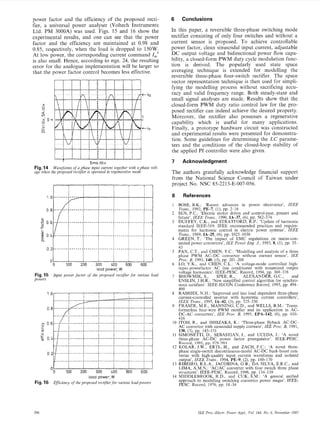
below. First, Fig. 7 shows the waveform of the threephase input current: one can see that the three input
currents are nearly sinusoidal and balanced as expected
from the theoretical analysis. Fig. 8 shows the a phase
input current together with the a phase voltage waveform. It is seen that the input current and voltage are
in phase. Fig. 9 shows the spectrum of the source current waveform, indicating that input current harmonics
are very small. Next, consider the Bode plot of the
small signal model. By using a HP 4194A impedance/
gain-phase analyser, one can measure the transfer
functions Gp(s)as shown in Figs. 100 and b. As a com-

parison, the theoretical result of eqn. 47 is also plotted
on the same Figure. It is seen that the results are in
close agreement. Third, consider the transient response
of the proposed rectifier as the load is changed from
200Q to 87.85Q. The trajectories of the output voltage
and load current as well as the corresponding response
of the a phase current are shown in Figs. 11 and 12,
respectively. To show the regenerative capability of the
proposed rectifier, an experimental circuit as shown in
Fig. 13 was set up. Here, the original load is replaced
by a series load consisting of a 245V DC source (HP
6483C) and a 2Q resistor. Due to the higher applied
output voltage, the load current is reversed. Fig. 14
shows the waveforms of the a phase input current and
the a phase voltage. It is seen that the input power factor is also maintained at unity. Finally, to illustrate the

Va
5
.-

U

.>
_


U


Q

‘R

;
i
>.- o+

Pi

O+


U

>
0

m

T

0.5 KHz/div

Fig.9 Spectrum ofthe source current waveform
Fig. 11 Transient responses of output voltage as the load power is
changed from 288 W to 655 W

102
frequency, Hz

1o3

104

20ms/div

I
.

Fig. 12 Transient responses o j a phase input current as the load power

i changedfvom 288 W to 655 W
s

7

10’

1
00

102
frequency, Hz

10

b

Fig. 10 Bode diagram o Gp(s)
f
U

Gain; b Phase

simulation;

0.0

experimental

IEE Proc-Electr. Power A p p l , Vol. 144, No 6, November 1997

1

IC

1

LsM-~.m H
I

I

LN

RS -0.L5ohm
Fig. 13 Circuit used f o r regenerative capability test
395
power factor and the efficiency of the proposed rectifier, a universal power analyser (Voltech Instruments
Ltd. PM 3000A) was used. Figs. 15 and 16 show the
experimental results, and one can see that the power
factor and the efficiency are maintained at 0.98 and
0.85, respectively, when the load is dropped to 150W.
At low power, the corresponding current command I,*
is also small. Hence, according to eqn. 24, the resulting
error for the analogue implementation will be larger so
that the power factor control becomes less effective.

6

t
5 ms /d iv
Fig, 14 Waveforms of a phase input current together with a phase voltage when the proposed rect$er is operated in regenerative mode

7

I

I

1

Conclusions

In this paper, a reversible three-phase switching mode
rectifier consisting of only four switches and without a
current sensor is proposed. To achieve controllable
power factor, clean sinusoidal input current, adjustable
DC output voltage and bidirectional power flow capability, a closed-form PWM duty cycle modulation function is derived. The popularly used state space
averaging technique is extended for modelling the
reversible three-phase four-switch rectifier. The space
vector representation technique is then used for simplifying the modelling process without sacrificing accuracy and valid frequency range. Both steady-state and
small signal analyses are made. Results show that the
closed-form PWM duty ratio control law for the proposed rectifier can indeed achieve the desired property.
Moreover, the rectifier also possesses a regenerative
capability which is useful for many applications.
Finally, a prototype hardware circuit was constructed
and experimental results were presented for demonstration. Some guidelines for determining the LC parameters and the conditions of the closed-loop stability of
the applied PI controller were also given.
Acknowledgment

The authors gratefully acknowledge financial support
from the National Science Council of Taiwan under
project No. NSC 85-2213-E-007-056.
8

References

1 BOSE, B.K.: ‘Recent advances in power electronics’, IEEE
Trans., 1992, P C 7 , (I), pp. 2-16

Load power, W

Fig. 15 Input power factor of the proposed rect2jer for various load
powers

2 SEN, P.C.: ‘Electric motor drives and control-past, present and
future’, IEEE Trans., 1990, IA-37, ( 6 ) , pp. 562-574
3 DUFFEY, C.K., and STRATFORD, R.P.: ‘Update of harmonic
standard IEEE-5 19: IEEE recommended oractices and reauirements for harmonic control in electric p’ower systems’, i E E E
Trans., 1989, IA-25, (6), pp. 1025-1030
4 GREEN, T.: ‘The imoact of EMC regulations on mains-connected power convertok’, IEE Power Eni. J., 1993, 8, (I), pp. 3543
5 PAN, C.T., and CHEN, T.C.: ‘Modelling and analysis of a three
phase PWM AC-DC convertor without current sensor’, IEE
Proc. B, 1993, 140, (3), pp. 201-208
6 LO, Y.K., and CHEN, C.L.: ‘A voltage-mode controlled highinput-powerfactor AC line conditioner with minimized output
voltage harmonics’. IEEE-PESC. Record, 1994, pp. 369-376
SPEE, R.,
ALEXANDER, G.C.,
and
7 BHOWMIK, S.,
ENSLIN, J.H.R.: ‘New simplified control algorithm for synchronous rectifiers’. IEEE-IECON Conference Record, 1995, pp. 4 9 4
499
8 RASHIDI, N.H.: ‘Improved and less load dependent three-phase
current-controlled inverter with hysteretic current controllers’,
IEEE Trans., 1995, IA-42, () pp. 325-330
3,
9 FRASER, M.E., MANNING, C.D., and WELLS, B.M.: ‘Transformerless four-wire PWM rectifier and its application in ACDC-AC converters’, IEE Proc. B, 1995, EPA-142, (6), pp. 410416
10 ITOH, R., and ISHIZAKA, K.: ‘Three-phase flyback AC-DCAC convertor with sinusoidal supply.currents’, IEE Proc. B, 1991,
-138, () pp. 143-151
3,
11 SIMONETTI, D., SEBASTIAN, J., and UCEDA. J.: ‘A novel
three-uhase AC-DC Dower factor orerenulator’. IEEE-PESC.
. Recotd, 1995, pp. 979-984

load power, W

Fig. 16 Eficiency

396

o the proposed rect$erfor various load powers
f

12 KOLAR, J.W., ERTL, H., and ZACH, F.C.: ‘A novel threeuhase sinde-switch discontinuous-model AC-DC buck-boost con;erter wzh high-quality input current waveforms and isolated
output’. IEEE Trans., 1994, P C 9 , (2), pp. 160-170
13 RIBEIRO, R.L.A., JACOBINA, G.B., DA SILVA, E.R.C., and
LIMA, A.M.N.: ‘ACIAC converter with four switch three phase
structures’. IEEE-PESC. Record, 1996, pp. 134-139
14 MIDDLEBROOK, R.D., and CUK, S.M.: ‘A general unified
approach to modelling switching convertor power stages’. IEEEPESC. Record, 1976, pp. 18-34

IEE Proc-Electr. Powev Appl., Vol. 144, No. 6, November 1557

modeling of three phase rectifier

  • 1.
    Modelling and designof a reversible three-phase switching mode rectifier J.-J.Shieh C.-T. Pan Z.-J.Cuey Indexing terms: Three-phase switching mode rect$er, Active switch, Current sensor, Pulse width modulation, Closed-form control law Abstract: A reversible three-phase switching mode rectifier consisting of a four-active-switch and without current sensor is proposed. To achieve controllable power factor, clean sinusoidal input current, adjustable DC output voltage, and bidirectional power flow capability, a closed-form pulse width modulation (PWM) duty cycle function is derived. The popularly used state space averaging technique is extended for modelling the reversible three-phase four-activeswitch rectifier. The space vector representation technique is then used to simplify the modelling process without sacrificing accuracy and valid frequency range. Both steady-state and small signal analyses are made. Results show that the proposed closed-form control law for the rectifier can indeed achieve the desired property. Moreover, the rectifier also possesses a bidirectional power flow capability, which is useful for many applications. Finally, a prototype hardware circuit was constructed and experimental results are presented for demonstration. Guidelines for determining the LC parameters and the PI controller gains are described briefly in the text. 1 Introduction Three-phase diode rectifiers or thyristor rectifiers are used frequently in many industrial applications which require a high-power DC supply or as an intermediate D C link in AC/AC convertors. However, these rectifiers can pollute the AC supply with significant levels of low frequency harmonics, pulsating input current (electromagnetic interference (EMI)), and excessive VAR [ 1, 21. With tough regulations and severe economic restraints, the design of a three-phase switching mode rectifier which draws nearly sinusoidal three-phase input currents with unity power factor is very important from the point of view of energy saving and also to satisfy forthcoming harmonic standards such as IEEE 519 or IEC 555-2 [3, 41. As a result of recent rapid progress in high speed power semiconductor devices, it is now possible to use pulse width modulation (PWM) technology to achieve the above functions. Several switching mode rectifier topologies have been proposed to achieve almost sinusoidal waveform with near-unity power factor [5-91. These rectifiers require the use of current sensors to correct power factor and/ or eliminate harmonics. From the viewpoints of cost reduction and enhanced reliability, using fewer active switches and detector sensors and having higher efficiency are always important goals. Hence, several switching mode rectifier topologies using fewer switches have been proposed [lo-121. However, these rectifiers either require many extra diodes, which incurs more conduction losses, or are operated in discontinuous mode, which increases the stress on switches. Also, existing configurations having a regeneration capability still require six active switches and some current sensors to shape the desired current. Although Ribeiro et al. [13] proposed a four-switch convertor with regeneration capability for induction motor drives, it still required current sensors to improve the input power factor. In this paper, a closed-form PWM duty cycle control for a four-active-switch three-phase switching mode rectifier is proposed to achieve sinusoidal input current, controllable power factor, bidirectional capability, and adjustable D C output voltage without current sensors. Hence, the hardware circuit can be simplified and the cost can be reduced. L - L , Rs 'c I l Fig. 1 Main circuit o f switching mode rectifier 0 IEE, 1997 2 Z E E Proceedinfis online no. 19971253 N the proposed reversible four-switch three-phase control law Paper first received 19th August 1996 and in revised form 3rd March 1997 The authors are with the Department of Electrical Engineering, National Tsing Hua University, Hsinchu, Taiwan, 30043 IEE Proc-Electr. Power Appl., Vol. 144, No. 6, November 1997 Derivation of the closed-form PWM duty cycle The main circuit of the proposed reversible three-phase switching mode rectifier (SMR) with sinusoidal input current and regulated DC output voltage is shown in 389
  • 2.
    Fig. 1. Fig.1 shows that the proposed rectifier consists of four switches together with two output capacitors in series (C1 = C2) and a three-phase boost-type coupling inductor to decrease the volume, weight and size of the SMR. Because the three-phase system is balanced, it is only necessary to control two phases: the current in the third phase is controlled automatically. It is seen that the two arms of the proposed rectifier can be controlled separately. To illustrate the operation of the proposed rectifier, a typical gating signal and ideal threephase input current waveforms are shown in Figs. 2 and 3, respectively. Figs. 4 and 5 show the resulting SI equivalent circuit during time intervals A and B in Fig. 3 for one switching cycle to - t4. Hence, from Figs. 4 and 5 one can obtain the corresponding state equations as follows: W O tl ~ d . d d . Lm)-%, - Lm-Zb - L ~ m - 2 ~ dt dt dt + Rsi, U,I uC2 UNO d . d . d . U b = (Ll Lm)-2b - Lm -2, - Lm -2, dt dt dt Rsib U,I V,Z UNO d . 1 i c l = C-Vc1 = 2, % b - -(ucl vCz) dt R d 1 ic2 = c-vc2 = - - U,1 + v c 2 ) R( (1) dt = (L1 f + + + + + + t d,oTs + + + 4 - (ii) t , - + t2 d . + d . d . ( L I Lm)-t, - Lm-zb - Lm-tc dt dt dt Rsi, V,I vCz ' U N O + + + + ; Ub = (L1 + d . dt Lm)-%b d . Lm-2, dt - + Rsib + U N O TS d i d = C--'Uc1 dt Fig.2 Gating jignu1 of the pvoposed reversible four-switch three-phax switchinp mode rectifier d dt = c-vcz ic2 (iii) t2 . 1 = 2, = 2, + + -I+ ' - d . dt U&) 1 2, - + U&) (2) t3 ~ U, d + Lm)-t, . dt + Rsi, + d . = (Ll + Lm) dt + Rsib + = (Ll - d . Lm-'lb dt - d . Lm-2~ dt UNO vb -ab d . d - Lm -2, dt - Lm -aa dt UNO d Zcl (A) Fig.3 j (B) ! (C) (D) (E) ic2 = C--vc2 (F) Waveforms of o the ideal three-phase input current wavejorms f I = C-Ucl I I dt d dt = 1 R (w c l -- . = 2, 1 - +I +vc2) + U&) (3) I N a a N b Fig. 4 cycle a 10 0I, 390 ~ ~ tl I2 Equivalent circuit for section A and B o Fig. 3 at one switching f b Fig.5 cycle a 12 b 23 ~ ~ Equivalent circuit for section A and B o Fig. 3 at one switching f ti ti IEE Proc -Electr Power Appl., Vol. 144, No 6, November 1997
  • 3.
    (iv) t3 - Substituting eqns.8 and 9 into eqn. 5 yields the complete state space averaged model as follows: t4 U, = d . (LI+ L,)-%, dt - d . Lm-2b dt d . - Lm-2, d dt -X = AX dt + BU (11) where x = [%a d 1 =ib i, - -(Uc1 + ' U C 2 ) (4) dt R where R, is the resistance, L is the sum of the per phase leakage inductance (LI)and mutual inductance (L,) of the three-phase coupling inductor, C and R are the capacitance and load resistance, respectively, and vNo represents the potential difference from N to point 0. Similarly, the twelve other equivalent circuits and the corresponding state equations for the remaining time intervals can be obtained. Hence, by using the state space averaging technique [ 141 and neglecting the ESR of the two capacitors, we obtain the state averaged equation as follows: ic2 c + = c-uc2 0 L+2L,,L 0 0 0 L+2L,, 0 0 L+ZL,, 0 0 0 - 1 0 01 0 0 0 0 0 0 0 - 0 0 -do -R, 0 -db %LI+L, (13) LSM A= --~ R, LSM (1 0 -~ 1 0 6LSM -x, 0 6L;M 0 2 c J - -'(-1+2%--1J) 6LSM 1 (1+2y--s) GLSlM LSM I) (1+2s--y) -- --J--l+27,--z) BLSM (-z-c-v) -&(2-"-Y) LSM - RC _ - RIC _ - -1 2 c 2C 1 0 0 0 0 0 1 0 0 0 0 0 1 0 0 B=-11 L ~ " o o o l o v , dt CO -&I I;:I 0 c- 0IT (12) 'UcZ] Wcl 0 0 0 0 1 Next, assume input voltages and input currents as follows: 'Ua = cos wt Z " 1 2 1, d ic 0 'Ub U=['U, T zb - v <1 "C2 - -db 2 , = I , cos(wt - 4) 2, (5) where d, and db are duty ratios of switch S , and S3, respectively. Assume that the three-phase source is balanced, i.e. 'U,+'Ub+'U,=o Z,$ib+Zc=o (6) Substituting eqn. 6 into eqn. 5 , we obtain 1 'UNO = --[(da db)'UU,l (1 d, db)Vu,2] (7) 3 Now, let + + + + = I , cos ut v,1 = vcz = 1 -(I 2 + y) I!/ 5 1 z = -[V, V O cos(4,) 2& (9) where x and y denote the time varying part modulation indices which will be determined later. The duty ratios of S, and S,, namely d, and d b are defined in sequence as follows: 1 da -Z 1 - d - _1(1 - Z) d b E 1 - db = -(I - y) "-2 2 - (10) IEE Psoc.-Elects. Power Appl., Vol. 144. No. 6 , November 1997 - 1 4 1 (18) f0 Then, by substituting eqn. 18 into eqn. 11 and considering eqns. 16 and 17, the following PWM duty cycle control law can be obtained explicitly: - db = +- ( 2.ir 3 where V, is the maximum input phase voltage and I, is the maximum input phase current with phase shift @ included for adjusting power factor. Assume that the steady state values of vc1and vc2can be approximated as follows: Y = -[Vm - - 4) RsIm COS(#^ - 4)] cos(h) VO + W L S M I ,sin($, + W L S M Isin(4b ~ RsIm cos($b - d))] - 4) (19) where 4, wt 30' &b E w t - 90' (20) In addition, the two capacitor state equations can be obtained by substituting eqn. 19 into the last two rows of eqn. 11, i.e. E - 391
  • 4.
    . 1 $cl + y ib - 2,) = -(II:Z, 2 - vo R 1 V, z ( x i a y i b f i c )- (21) R At steady state, the DC output voltage is almost constant. Hence d d = -dt c 1 +U&) F 0 (U . + %e2 From eqns. 19-22, one obtains the following relation: [: V, = -ImR(Vm COS$ - 1 ImRs) (23) Since one of the goals is to eliminate the necessity for a current sensor, I,* will be considered as a command signal. If adjustable phase capability is required, 4 can also be considered as a command signal. Thus, the desired control law can be rewritten as follows: II: = 2& -[V, + W L S M I ;sin($, cos($,) v, - RSIL C O S ( & a& 7~ = -[Vm - q5*) $*)I + W L S M sin(q5b I~ COS(&,) - - 4") vo cos($b - $*)I (24) If the duty ratios are controlled according to these equations, the input line current will be forced to be sinusoidal. Also, by closed-loop implementation, I, can be controlled automatically and indirectly without using any current sensor. Fig. 6 shows the schematic diagram of the control function. Vb ['U, 'U,] =Re{[l = Re{[l U2 U]V,} u]is} u2 ald,} (29) Application of the above space vector notation yields the following compact form: [Za Zb [dl d2 ZC] U2 dg]=Re{[l v va,b.c -!- LSM R , la,b,c 3 + -Re{i,d,} d 2 - = --U, dtuo I (31) c In the synchronous rotating reference frame, the above equations can be expressed in terms of direct and quadrature components as follows: Re I d" z~~-DdId d 3 Fig.6 Complete block diugmm of the closed-loop control 3 Small signal model of the switching mode rectifier For simplicity, states vcl and vc2in eqn. 12 are replaced with vo (= vcl + vC2),resulting in the following approx- = + -D41q 3 c - -V, 2 (34) Re C From eqns. 32-34 one obtains the steady state closedform PWM duty cycle control law corresponding to eqn. 24 as follows: 1 Dd = -(Vm - R,I,* - wLsMIQ*) U0 0 -R, d - LSM dt 0 2d2 C +-L S1M where 392 0 1 di -~ D , = -(RsI,* LSM U, wLsMI;) (35) I 4 = -I*m sin 4" " (36) where I; I; cos 4" 1 Then, define the following perturbation equations: Id = Id0 f .o - f, 1,. = I& + I ; U, = v,+ 6, I,*= 140 + f q I" = I" + I " 4 40 4 (37) IEE Proc.-Electr. Power Appl.. Vol. 144, No. 6, November 1997
  • 5.
    Due to thewell-controlled output voltage, eqn. 35 can be approximated as follows without much influence: 1 -(Vm Dd - R,I," - wLsMI,*) [ V O Dq 1 -(R,I,* - ~Lsn/rI,*) (38) vo By substituting eqn. 38 into eqns. 32-34 and linearising these equations, one obtains the following small signal model: where 1 a1 = -(V m - RsI& - wLsMI,",) 1 = -(wLsMI,*, - R,I,*,) vu 1 P1 = T(R,IdO P2 = - + z9-b L,, + $ (( & ) 2 + &)')] } e EGP(s) (47) where 4 Some design guidelines for the switching mode rectifier V O a 2 + &P W~SMIqO) 1 E(wLSMId0 + &I@) (40) For easy implementation, the resistance of the threephase coupling inductor is neglected (R, = 0) and only unity power factor is considered, i.e. I; = I; I* = 0 4 (41) Hence, substituting eqn. 41 into eqn. 38, one obtains the desired control law as follows: 4.7 Output capacitance selection Selection of the output capacitor involves a trade-off between rectifier volume and output DC voltage quality, which is dependent on the specific application. From the previous result of eqn. 23, theoretically, the output voltage will be pure DC. However, a little ripple will exist on the output voltage from the switching action, and this can be estimated from the last row of eqn. 25 as follows: where dL@i_1,2,3 the practical PWM duty cycle and is can be denoted by the Fourier series as follows: d@ = di+ 1-[1 1 nr 7 n=l Hence, the simplified small signal model becomes - 2 cos(2n7rdi) sin(nw,t + dni)] i = 1,2,3 (50) where wsis switching angular frequency and On% = tan-' (43) where b - WLSMIk, Vo e - WLSMIqO Vo V, p= - sin(2 n n d , ) 1 - cos(2n7rd,) i = 1,2,3 (51) Substituting eqns. 50, 51 and 17 into eqn. 49, at steady state, the ripple component of output voltage vorcan be obtained: 3 7Jo7= z=1 V O (44) Therefore, applying Laplace transformation to eqn. 43 yields the following transfer functions: n=l I,, Ff nrrJl+(nw,RC)Z x (1 - 2 ( - 1 ) n xsin[wt-+(z-I) cos[zn.rr e sin(wt-c-(z-l) 9 )I 1+ 9 sin(nw,t+O,,) 1 (52) where Em = [(Vm ImR,cosq5- I , w L s ~ s i n 4 ) ~ +(ImR, sin 4 - I,WLSM cos 4 ) 2 ] (53) ImR, sin q5 - I,WLSM COS 4 (54) - I,R, cos 4 - I,WLSM sin 4 Assuming (ncoSRQ2>> 1 and considering the worst case, one has the following approximate output ripple voltage: E = V, IEE Proc.-Electr. Power Appl., Vol. 144, No. 6. November 1997 393
  • 6.
    3& O0 I, n=l 4.2 Three-phase boost-typecoupling inductance selection Selection of the boost-type coupling inductance involves a trade-off between switching frequency and input current waveform quality. Owing to symmetry of the three-phase system, only the a phase is described here as an example. From the first row of eqn. 25, one has (58) Considering the worst case, one has the harmonic input current as follows: c m 5 2 + -RC Lsnn ~ By appl$ng the Routh-Hurwitz criterion to the denominator of eqn. 61 one obtains the following two constraints for stable operation: ( a z k p b 2 ) ( U l k P aakr b l ) > (aokp + a l k I + bo) (63) ( a 2 k p b a ) ( a i k p a2kr bl)(aokp a ~ +k o )~ b + + + + > (aokp + U l S I + + + + + (aakp + b 2 ) 2 a o k (64) 5 By substituting eqn. 50 into eqn. 57, under steady state conditions and neglecting the resister R,,the harmonic current iah(i.e. the high frequency part of eqn. 57) can be obtained as follows: 2R, = b2 Some experimental results To illustrate the significance and facilitate understanding of the theoretical results obtained in the previous sections a prototype with the following parameters was constructed: V, = 50V, V, = 240V C1 = C2 = 2200wF, R = 87.85Q LsM = 6.4mH, R,y= 0.45Q Switching frequency f , = 3.5kHz Input voltage source frequency w = 377 radls Kp = 10, KI = 212 U0 & n2irw,LSM n=l & 0.91z U0 WSLSI1.I (59) Therefore, 5 4.3 The PI controller design Since the proposed rectifier without current sensor must be operated in closed loop such that I,* can be automatically adjusted, a simple PI controller is adopted to control the comment command. The complete block diagram is shown in Fig. 6. Also, from eqn. 48 one can see that system stability depends on the load. Hence, under closed-loop control, the proportionality constant K p and integral control constant KI of the PI controller must be designed carefully, otherwise the system may become unstable. From eqn. 47 and Fig. 6 one obtains the transfer function of the closed-loop control with PI controller as follows: 'r 5 ms /d i v Waveforms o three-phase iitput current f Fig.7 > ._ D < I n ,0 - ._ -f TII > where a0 = c 0 u WRS ~ b+-p W2 LSM a1 w =b LSM a2 3 = -e C 394 I Fig.8 5ms/div Waveform of a phase input current together with a phase volt- age IEE Proc -Elect7 Power A p p l , Vol 144, No 6, November I997
  • 7.
    For reference, someexperimental results are given below. First, Fig. 7 shows the waveform of the threephase input current: one can see that the three input currents are nearly sinusoidal and balanced as expected from the theoretical analysis. Fig. 8 shows the a phase input current together with the a phase voltage waveform. It is seen that the input current and voltage are in phase. Fig. 9 shows the spectrum of the source current waveform, indicating that input current harmonics are very small. Next, consider the Bode plot of the small signal model. By using a HP 4194A impedance/ gain-phase analyser, one can measure the transfer functions Gp(s)as shown in Figs. 100 and b. As a com- parison, the theoretical result of eqn. 47 is also plotted on the same Figure. It is seen that the results are in close agreement. Third, consider the transient response of the proposed rectifier as the load is changed from 200Q to 87.85Q. The trajectories of the output voltage and load current as well as the corresponding response of the a phase current are shown in Figs. 11 and 12, respectively. To show the regenerative capability of the proposed rectifier, an experimental circuit as shown in Fig. 13 was set up. Here, the original load is replaced by a series load consisting of a 245V DC source (HP 6483C) and a 2Q resistor. Due to the higher applied output voltage, the load current is reversed. Fig. 14 shows the waveforms of the a phase input current and the a phase voltage. It is seen that the input power factor is also maintained at unity. Finally, to illustrate the Va 5 .- U .> _ U Q ‘R ; i >.- o+ Pi O+ U > 0 m T 0.5 KHz/div Fig.9 Spectrum ofthe source current waveform Fig. 11 Transient responses of output voltage as the load power is changed from 288 W to 655 W 102 frequency, Hz 1o3 104 20ms/div I . Fig. 12 Transient responses o j a phase input current as the load power i changedfvom 288 W to 655 W s 7 10’ 1 00 102 frequency, Hz 10 b Fig. 10 Bode diagram o Gp(s) f U Gain; b Phase simulation; 0.0 experimental IEE Proc-Electr. Power A p p l , Vol. 144, No 6, November 1997 1 IC 1 LsM-~.m H I I LN RS -0.L5ohm Fig. 13 Circuit used f o r regenerative capability test 395
  • 8.
    power factor andthe efficiency of the proposed rectifier, a universal power analyser (Voltech Instruments Ltd. PM 3000A) was used. Figs. 15 and 16 show the experimental results, and one can see that the power factor and the efficiency are maintained at 0.98 and 0.85, respectively, when the load is dropped to 150W. At low power, the corresponding current command I,* is also small. Hence, according to eqn. 24, the resulting error for the analogue implementation will be larger so that the power factor control becomes less effective. 6 t 5 ms /d iv Fig, 14 Waveforms of a phase input current together with a phase voltage when the proposed rect$er is operated in regenerative mode 7 I I 1 Conclusions In this paper, a reversible three-phase switching mode rectifier consisting of only four switches and without a current sensor is proposed. To achieve controllable power factor, clean sinusoidal input current, adjustable DC output voltage and bidirectional power flow capability, a closed-form PWM duty cycle modulation function is derived. The popularly used state space averaging technique is extended for modelling the reversible three-phase four-switch rectifier. The space vector representation technique is then used for simplifying the modelling process without sacrificing accuracy and valid frequency range. Both steady-state and small signal analyses are made. Results show that the closed-form PWM duty ratio control law for the proposed rectifier can indeed achieve the desired property. Moreover, the rectifier also possesses a regenerative capability which is useful for many applications. Finally, a prototype hardware circuit was constructed and experimental results were presented for demonstration. Some guidelines for determining the LC parameters and the conditions of the closed-loop stability of the applied PI controller were also given. Acknowledgment The authors gratefully acknowledge financial support from the National Science Council of Taiwan under project No. NSC 85-2213-E-007-056. 8 References 1 BOSE, B.K.: ‘Recent advances in power electronics’, IEEE Trans., 1992, P C 7 , (I), pp. 2-16 Load power, W Fig. 15 Input power factor of the proposed rect2jer for various load powers 2 SEN, P.C.: ‘Electric motor drives and control-past, present and future’, IEEE Trans., 1990, IA-37, ( 6 ) , pp. 562-574 3 DUFFEY, C.K., and STRATFORD, R.P.: ‘Update of harmonic standard IEEE-5 19: IEEE recommended oractices and reauirements for harmonic control in electric p’ower systems’, i E E E Trans., 1989, IA-25, (6), pp. 1025-1030 4 GREEN, T.: ‘The imoact of EMC regulations on mains-connected power convertok’, IEE Power Eni. J., 1993, 8, (I), pp. 3543 5 PAN, C.T., and CHEN, T.C.: ‘Modelling and analysis of a three phase PWM AC-DC convertor without current sensor’, IEE Proc. B, 1993, 140, (3), pp. 201-208 6 LO, Y.K., and CHEN, C.L.: ‘A voltage-mode controlled highinput-powerfactor AC line conditioner with minimized output voltage harmonics’. IEEE-PESC. Record, 1994, pp. 369-376 SPEE, R., ALEXANDER, G.C., and 7 BHOWMIK, S., ENSLIN, J.H.R.: ‘New simplified control algorithm for synchronous rectifiers’. IEEE-IECON Conference Record, 1995, pp. 4 9 4 499 8 RASHIDI, N.H.: ‘Improved and less load dependent three-phase current-controlled inverter with hysteretic current controllers’, IEEE Trans., 1995, IA-42, () pp. 325-330 3, 9 FRASER, M.E., MANNING, C.D., and WELLS, B.M.: ‘Transformerless four-wire PWM rectifier and its application in ACDC-AC converters’, IEE Proc. B, 1995, EPA-142, (6), pp. 410416 10 ITOH, R., and ISHIZAKA, K.: ‘Three-phase flyback AC-DCAC convertor with sinusoidal supply.currents’, IEE Proc. B, 1991, -138, () pp. 143-151 3, 11 SIMONETTI, D., SEBASTIAN, J., and UCEDA. J.: ‘A novel three-uhase AC-DC Dower factor orerenulator’. IEEE-PESC. . Recotd, 1995, pp. 979-984 load power, W Fig. 16 Eficiency 396 o the proposed rect$erfor various load powers f 12 KOLAR, J.W., ERTL, H., and ZACH, F.C.: ‘A novel threeuhase sinde-switch discontinuous-model AC-DC buck-boost con;erter wzh high-quality input current waveforms and isolated output’. IEEE Trans., 1994, P C 9 , (2), pp. 160-170 13 RIBEIRO, R.L.A., JACOBINA, G.B., DA SILVA, E.R.C., and LIMA, A.M.N.: ‘ACIAC converter with four switch three phase structures’. IEEE-PESC. Record, 1996, pp. 134-139 14 MIDDLEBROOK, R.D., and CUK, S.M.: ‘A general unified approach to modelling switching convertor power stages’. IEEEPESC. Record, 1976, pp. 18-34 IEE Proc-Electr. Powev Appl., Vol. 144, No. 6, November 1557