
Pharmaceutically Important Cellulose
Submitted By:-
Parbhat Saini
ID No:-2016H108177P
M.Pharm-1st Year
BITS PILANI
1
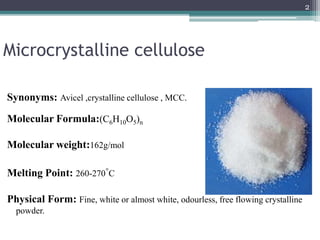
Microcrystalline cellulose
Synonyms: Avicel ,crystalline cellulose , MCC.
Molecular Formula:(C6H10O5)n
Molecular weight:162g/mol
Melting Point: 260-270◦C
Physical Form: Fine, white or almost white, odourless, free flowing crystalline
powder.
2
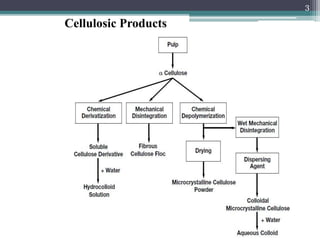
Cellulosic Products
3
• Origin Of Avicel-PH:
• In 1962, O. A. Battista and P. A. Smith reported the
preparation by the American Viscose Company of
microcrystalline cellulose from cellulose, hence the origin
of the product name “Avicel”.
• The “PH” designation indicates that the product is suitable
for pharmaceutical use.
• Cellulose is present in much of the food of man but is inert
to human digestive enzymes making it GRAS or generally
recognized as safe for human consumption by the United
States Food and Drug Administration (FDA) and other
governmental agencies throughout the world.
• The process that produces Avicel-PH microcrystalline
cellulose alters only the cellulose physical form and
eliminates impurities.
4
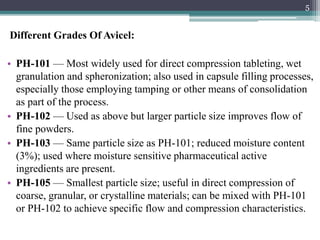
Different Grades Of Avicel:
• PH-101 — Most widely used for direct compression tableting, wet
granulation and spheronization; also used in capsule filling processes,
especially those employing tamping or other means of consolidation
as part of the process.
• PH-102 — Used as above but larger particle size improves flow of
fine powders.
• PH-103 — Same particle size as PH-101; reduced moisture content
(3%); used where moisture sensitive pharmaceutical active
ingredients are present.
• PH-105 — Smallest particle size; useful in direct compression of
coarse, granular, or crystalline materials; can be mixed with PH-101
or PH-102 to achieve specific flow and compression characteristics.
5
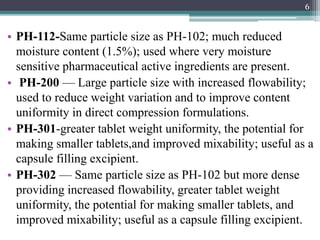
• PH-112-Same particle size as PH-102; much reduced
moisture content (1.5%); used where very moisture
sensitive pharmaceutical active ingredients are present.
• PH-200 — Large particle size with increased flowability;
used to reduce weight variation and to improve content
uniformity in direct compression formulations.
• PH-301-greater tablet weight uniformity, the potential for
making smaller tablets,and improved mixability; useful as a
capsule filling excipient.
• PH-302 — Same particle size as PH-102 but more dense
providing increased flowability, greater tablet weight
uniformity, the potential for making smaller tablets, and
improved mixability; useful as a capsule filling excipient.
6
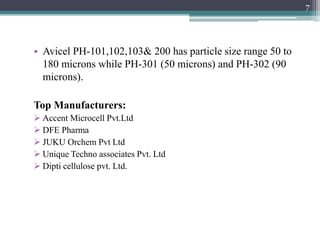
• Avicel PH-101,102,103& 200 has particle size range 50 to
180 microns while PH-301 (50 microns) and PH-302 (90
microns).
Top Manufacturers:
 Accent Microcell Pvt.Ltd
 DFE Pharma
 JUKU Orchem Pvt Ltd
 Unique Techno associates Pvt. Ltd
 Dipti cellulose pvt. Ltd.
7
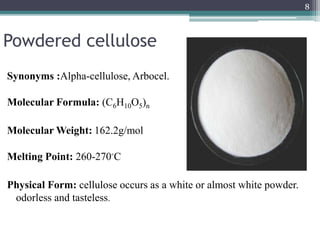
Powdered cellulose
Synonyms :Alpha-cellulose, Arbocel.
Molecular Formula: (C6H10O5)n
Molecular Weight: 162.2g/mol
Melting Point: 260-270◦C
Physical Form: cellulose occurs as a white or almost white powder.
odorless and tasteless.
8
• Powdered cellulose is chemically inert and is thus not metabolized by the human
body. Because it is not digested, it has no functional caloric value. It is commonly
used by formulators as an alternative to lactose.
• Various grades of ARBOCEL are available. The granular grade, ARBOCEL A
300 provides excellent flow and the fine, fibrous grades, M 80 and P 290, offer
improved binding properties. All grades exhibit low moisture absorption, assuring
good shelf life stability.
• ARBOCEL offers:
• 100% plant derived
• Physiologically inert
• Chemically inert
• High plastic deformation
• Low residual moisture content
• High compressibility
• Accelerated disintegration
• Binding properties and fibrous structure, leading to stable tablets with low friability
• Pesticide-free and herbicide-free
• Free of genetically modified organisms (GMOs), organic volatile impurities, and
organic solvents
9
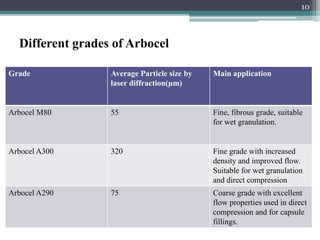
Different grades of Arbocel
Grade Average Particle size by
laser diffraction(μm)
Main application
Arbocel M80 55 Fine, fibrous grade, suitable
for wet granulation.
Arbocel A300 320 Fine grade with increased
density and improved flow.
Suitable for wet granulation
and direct compression
Arbocel A290 75 Coarse grade with excellent
flow properties used in direct
compression and for capsule
fillings.
10
Applications:
• Powdered cellulose is used as a tablet diluent and filler in two-piece hard
capsules.
• In both contexts it acts as a bulking agent to increase the physical size of
the dosage form for formulations containing a small amount of active
substance.
• It is also used as the powder base material of powder dosage forms.
• Suspending agent in aqueous suspensions for peroral delivery.
11
Top manufacturers:
• Suhal Cellulose Pvt Ltd.
• Accent Microcell Pvt Ltd.
• JRS PHARMA Pvt Ltd.
12
Carboxymethyl Cellulose
 Synonyms:Sodium carboxymethylcellulose(SCMC)
Chemical Formula:C8H15NaO8
Molecular weight:262.1g/mol
Melting Point: 300◦C
Physical Form: It occurs as a white to almost white,odorless,
tasteless, granular powder. It is hygroscopic after drying.
13
Applications in Pharmaceutical Formulation or
Technology:
• Carboxymethylcellulose sodium is widely used in oral and topical
pharmaceutical formulations, primarily for its viscosity-increasing
properties.
• Carboxymethylcellulose sodium may also be used as a tablet binder and
disintegrant, and to stabilize emulsions,used as eye lubricant.
• Higher concentrations, usually 3–6%, of the medium-viscosity grade are
used to produce gels that can be used as the base for applications and
pastes.
• Carboxymethylcellulose sodium is also used in cosmetics,
toiletries,surgical prosthetics, personal hygiene, and food products.
14
 At pH 3, CMC is insoluble .
 CMC is acid unstable, especially if heat is applied.
„Monovalent salts- soluble. „
Divalent salts-hazy „.
Trivalent salts- gel or precipitate.
Top Manufacturers:
 CP Kelco Ltd
 Dow Ltd
 Sino CMC Co..Ltd
 T J Cellulose Pvt Ltd
 Intrachem Group SA
15
Points To Remember:
• MCC Slightly soluble in 5% w/v sodium hydroxide
solution,practically insoluble in water, dilute acids, and most
organic solvents.
• Microcrystalline cellulose is incompatible with strong oxidizing
agents,enalapril,isosorbide mononitrate.
• CMC Practically insoluble in acetone, ethanol (95%), ether and
toluene.
• Carboxymethylcellulose sodium is incompatible with strongly
• acidic solutions and with the soluble salts of iron and some other
• metals, such as aluminum, mercury, and zinc.
• Powdered cellulose incompatible with strong oxidizing agents,
bromine pentafluoride and fluorine.
16
References:
• 1. Fox, C.D., Reier, G.E., Richman, M.D.,Shangraw, R.F.,
“Microcrystalline Cellulose in Tableting,” Drug and Cosmetic
Industry,Vol. 92, (2), p. 161, 1963.
• 2.Handbook of pharmaceutical exicipients-6th edition.pdf
• 3.JRSPHARMA.COM/technical information.
• 4. Beal, H.M., Shah, S., Varsano, J.“Pharmaceutical
Applications of Microcrystalline Cellulose I:
Tableting,”University of Connecticut, unpublished research
report, 1963.
17
Thank You

Exicipients

  • 1.
    Pharmaceutically Important Cellulose SubmittedBy:- Parbhat Saini ID No:-2016H108177P M.Pharm-1st Year BITS PILANI 1
  • 2.
    Microcrystalline cellulose Synonyms: Avicel,crystalline cellulose , MCC. Molecular Formula:(C6H10O5)n Molecular weight:162g/mol Melting Point: 260-270◦C Physical Form: Fine, white or almost white, odourless, free flowing crystalline powder. 2
  • 3.
  • 4.
    • Origin OfAvicel-PH: • In 1962, O. A. Battista and P. A. Smith reported the preparation by the American Viscose Company of microcrystalline cellulose from cellulose, hence the origin of the product name “Avicel”. • The “PH” designation indicates that the product is suitable for pharmaceutical use. • Cellulose is present in much of the food of man but is inert to human digestive enzymes making it GRAS or generally recognized as safe for human consumption by the United States Food and Drug Administration (FDA) and other governmental agencies throughout the world. • The process that produces Avicel-PH microcrystalline cellulose alters only the cellulose physical form and eliminates impurities. 4
  • 5.
    Different Grades OfAvicel: • PH-101 — Most widely used for direct compression tableting, wet granulation and spheronization; also used in capsule filling processes, especially those employing tamping or other means of consolidation as part of the process. • PH-102 — Used as above but larger particle size improves flow of fine powders. • PH-103 — Same particle size as PH-101; reduced moisture content (3%); used where moisture sensitive pharmaceutical active ingredients are present. • PH-105 — Smallest particle size; useful in direct compression of coarse, granular, or crystalline materials; can be mixed with PH-101 or PH-102 to achieve specific flow and compression characteristics. 5
  • 6.
    • PH-112-Same particlesize as PH-102; much reduced moisture content (1.5%); used where very moisture sensitive pharmaceutical active ingredients are present. • PH-200 — Large particle size with increased flowability; used to reduce weight variation and to improve content uniformity in direct compression formulations. • PH-301-greater tablet weight uniformity, the potential for making smaller tablets,and improved mixability; useful as a capsule filling excipient. • PH-302 — Same particle size as PH-102 but more dense providing increased flowability, greater tablet weight uniformity, the potential for making smaller tablets, and improved mixability; useful as a capsule filling excipient. 6
  • 7.
    • Avicel PH-101,102,103&200 has particle size range 50 to 180 microns while PH-301 (50 microns) and PH-302 (90 microns). Top Manufacturers:  Accent Microcell Pvt.Ltd  DFE Pharma  JUKU Orchem Pvt Ltd  Unique Techno associates Pvt. Ltd  Dipti cellulose pvt. Ltd. 7
  • 8.
    Powdered cellulose Synonyms :Alpha-cellulose,Arbocel. Molecular Formula: (C6H10O5)n Molecular Weight: 162.2g/mol Melting Point: 260-270◦C Physical Form: cellulose occurs as a white or almost white powder. odorless and tasteless. 8
  • 9.
    • Powdered celluloseis chemically inert and is thus not metabolized by the human body. Because it is not digested, it has no functional caloric value. It is commonly used by formulators as an alternative to lactose. • Various grades of ARBOCEL are available. The granular grade, ARBOCEL A 300 provides excellent flow and the fine, fibrous grades, M 80 and P 290, offer improved binding properties. All grades exhibit low moisture absorption, assuring good shelf life stability. • ARBOCEL offers: • 100% plant derived • Physiologically inert • Chemically inert • High plastic deformation • Low residual moisture content • High compressibility • Accelerated disintegration • Binding properties and fibrous structure, leading to stable tablets with low friability • Pesticide-free and herbicide-free • Free of genetically modified organisms (GMOs), organic volatile impurities, and organic solvents 9
  • 10.
    Different grades ofArbocel Grade Average Particle size by laser diffraction(μm) Main application Arbocel M80 55 Fine, fibrous grade, suitable for wet granulation. Arbocel A300 320 Fine grade with increased density and improved flow. Suitable for wet granulation and direct compression Arbocel A290 75 Coarse grade with excellent flow properties used in direct compression and for capsule fillings. 10
  • 11.
    Applications: • Powdered celluloseis used as a tablet diluent and filler in two-piece hard capsules. • In both contexts it acts as a bulking agent to increase the physical size of the dosage form for formulations containing a small amount of active substance. • It is also used as the powder base material of powder dosage forms. • Suspending agent in aqueous suspensions for peroral delivery. 11
  • 12.
    Top manufacturers: • SuhalCellulose Pvt Ltd. • Accent Microcell Pvt Ltd. • JRS PHARMA Pvt Ltd. 12
  • 13.
    Carboxymethyl Cellulose  Synonyms:Sodiumcarboxymethylcellulose(SCMC) Chemical Formula:C8H15NaO8 Molecular weight:262.1g/mol Melting Point: 300◦C Physical Form: It occurs as a white to almost white,odorless, tasteless, granular powder. It is hygroscopic after drying. 13
  • 14.
    Applications in PharmaceuticalFormulation or Technology: • Carboxymethylcellulose sodium is widely used in oral and topical pharmaceutical formulations, primarily for its viscosity-increasing properties. • Carboxymethylcellulose sodium may also be used as a tablet binder and disintegrant, and to stabilize emulsions,used as eye lubricant. • Higher concentrations, usually 3–6%, of the medium-viscosity grade are used to produce gels that can be used as the base for applications and pastes. • Carboxymethylcellulose sodium is also used in cosmetics, toiletries,surgical prosthetics, personal hygiene, and food products. 14
  • 15.
     At pH3, CMC is insoluble .  CMC is acid unstable, especially if heat is applied. „Monovalent salts- soluble. „ Divalent salts-hazy „. Trivalent salts- gel or precipitate. Top Manufacturers:  CP Kelco Ltd  Dow Ltd  Sino CMC Co..Ltd  T J Cellulose Pvt Ltd  Intrachem Group SA 15
  • 16.
    Points To Remember: •MCC Slightly soluble in 5% w/v sodium hydroxide solution,practically insoluble in water, dilute acids, and most organic solvents. • Microcrystalline cellulose is incompatible with strong oxidizing agents,enalapril,isosorbide mononitrate. • CMC Practically insoluble in acetone, ethanol (95%), ether and toluene. • Carboxymethylcellulose sodium is incompatible with strongly • acidic solutions and with the soluble salts of iron and some other • metals, such as aluminum, mercury, and zinc. • Powdered cellulose incompatible with strong oxidizing agents, bromine pentafluoride and fluorine. 16
  • 17.
    References: • 1. Fox,C.D., Reier, G.E., Richman, M.D.,Shangraw, R.F., “Microcrystalline Cellulose in Tableting,” Drug and Cosmetic Industry,Vol. 92, (2), p. 161, 1963. • 2.Handbook of pharmaceutical exicipients-6th edition.pdf • 3.JRSPHARMA.COM/technical information. • 4. Beal, H.M., Shah, S., Varsano, J.“Pharmaceutical Applications of Microcrystalline Cellulose I: Tableting,”University of Connecticut, unpublished research report, 1963. 17
  • 18.