TABLETS
PRESENTED BY: ANOOP SINGH
E-Mail: aaanoopsingh@gmail.com
INTRODUCTION
Tablet is defined as a compressed solid dosage
form containing medicaments with or
without excipients. According to the Indian
Pharmacopoeia Pharmaceutical tablets are
solid, flat or biconvex dishes, unit dosage
form, prepared by compressing a drug or a
mixture of drugs, with or without diluents
The advantages of the Tabletdosage
form are:
• They are unit dosage form and offer the greatest
capabilitiesof all oral dosage form forthegreatest dose
precision and the least contentvariability.
• Cost is lowest of all oral dosageform.
• Lighter andcompact.
• Easiestand cheapest to package and strip.
• Easy toswallowing with least tendency for hang-up.
• Sustained release product is possible byenteric coating.
• Objectionableodourand bittertastecan be masked by
coating technique.
• Suitable for large scaleproduction.
• Greatest chemical and microbial stability over alloral
dosage form.
• Product identification is easy and rapid requiring no
additional steps when employing an embossedand/or
monogrammed punch face.
Disadvantages of Tablet dosage formare:
• Difficult to swallow in caseof children and unconscious
patients.
• Somedrugs resistcompression intodensecompacts, owing to
amorphous nature, low densitycharacter.
• Drugs with poorwetting, slow dissolution properties, optimum
absorption high in GIT may be difficult to formulate or
manufacture as a tablet that will still provide adequate or full
drug bioavailability.
• Bittertesting drugs, drugs with an objectionableodorordrugs
that are sensitive to oxygen may require encapsulation or
coating. In such cases, capsule may offer the best and lowest
cost.
Different types of Tablets
(A) Tablets ingested orally:
1. Compressed tablet, e.g. Paracetamol tablet
2. Multiple compressed tablet
3. Repeat action tablet
4.Delayed release tablet, e.g. Enteric coatedBisacodyl
tablet
5. Sugar coated tablet, e.g. Multivitamintablet
6. Film coated tablet, e.g. Metronidazoletablet
7. Chewable tablet, e.g. Antacidtablet
(B) Tablets used in oralcavity:
1. Buccal tablet, e.g. Vitamin-ctablet
2. Sublingual tablet, e.g. Vicks Menthol tablet
3. Troches or lozenges
4. Dental cone
(c) Tablets administered by otherroute:
1. Implantation tablet
2. Vaginal tablet, e.g. Clotrimazoletablet
(D) Tablets used to preparesolution:
1. Effervescent tablet, e.g. Dispirintablet (Aspirin)
2. Dispensing tablet, e.g. Enzymetablet (Digiplex)
3. Hypodermic tablet
4. Tablet triturates e.g. Enzyme tablet(Digiplex)
Tablet Ingredients
In addition toactive ingredients, tabletcontainsa numberof inert
materials known as additivesorexcipients. Differentexcipients are:
1. Diluent
2. Binder andadhesive
3. Disintegrents
4. Lubricants andglidants
5. Colouring agents
6. Flavoring agents
7. Sweetening agents
EXCIEPIENTS- functions
• Impartweight, accuracy, & volume(itsallow acccuracy of
dose)
• Improve solubility
• Increase stability
• Enhance bioavailability
• Modifying drug release
• Assist pdtidentification
• Increase patientacceptability
• Facilitate dosage formdesign
• 1. Diluent: Diluents are fillers used to make required bulk
of the tablet when the drug dosage itself is inadequate to
produce the bulk. Secondary reason is to provide better
tablet properties such as improve cohesion, to permit use of
direct compression manufacturing or to promote flow. A
diluent should have following properties:
1. They must be nontoxic
2.They must be commerciallyavailable in acceptable
grade
3. There cost must below
4. They must be physiologicallyinert
5.They must be physically & chemically stable by
themselves & in combination with thedrugs.
6. They must be free from all microbialcontamination.
7. Theydo not alter the bioavailability of drug.
8. They must be colorcompatible.
Commonly used tabletdiluents
1. Lactose-anhydrous and spray driedlactose
2. Directly compressed starch-Sta Rx1500
3. Hydrolyzed starch-Emdex and Celutab
4. Microcrystalline cellulose-Avicel (PH 101and PH 102)
5. Dibasic calcium phosphatedehydrate
6. Calcium sulphatedihydrate
7. Mannitol
8. Sorbitol
9. Sucrose- Sugartab, DiPac, Nutab
10. Dextrose
2. Binders and Adhesives: These materials are
added eitherdry or in wet- form to form granules
or to form cohesive compacts for directly
compressed tablet.
• Example: Acacia, tragacanth- Solution for 10-25%
Conc.
• Cellulose derivatives- Methyl cellulose, Hydroxy
propyl methyl cellulose, Hydroxy propyl cellulose
• Gelatin- 10-20% solution
• Glucose- 50% solution
• Polyvinylpyrrolidone (PVP)- 2% conc.
• Starch paste-10-20% solution
• Sodium alginate
• Sorbitol
3. Disintegrants: Added to a tablet formulation to
facilitate its breaking or disintegration when it
contact in water in theGIT.
• Example: Starch- 5-20% of tabletweight.
• Starch derivative – Primogel and Explotab(1-8%)
• Clays- Veegum HV, bentonite 10% level incolored
tabletonly
• Cellulose
• Cellulose derivatives- Ac- Di-Sol (sodiumcarboxy
methyl cellulose)
• Alginate
• PVP (Polyvinylpyrrolidone), cross-linked
• Superdisintegrants: Swells up to ten foldwithin
30 seconds when contactwater.
• Example:
cellulose,
(polymer),
Crosscarmellose- cross-linked
Crosspovidone- cross-linked povidone
Sodium starch glycolate- cross-linked
starch. These cross-linked products swells with in30
secondswhen in contact with water.
• A portion of disintegrant is added
granulation and a portion
before
before
compression, which serveas glidantsor lubricant.
• 4. Lubricant and Glidants: Lubricants are intended to
prevent adhesion of the tablet materials to the
surface of dies and punches, reduce inter particle
friction and may improve the rate of flow of the tablet
granulation.
Glidants are intended to promote flow of granules or
powder material by reducing the friction between the
particles.
• Example: Lubricants- Stearic acid, Stearic acid salt -
Stearic acid, Magnesium stearate, Talc, PEG (Polyethylene
glycols), Surfactants
• Glidants- Corn Starch – 5-10% conc., Talc-5% conc., Silica
derivative - Colloidal silicas such as Cab-O- Sil, Syloid,
Aerosil in 0.25-3% conc.
• 5. Coloring agent: The useof colorsand dyes in a
tablet has threepurposes:
(1) Masking of off colordrugs
(2) Product Identification
(3) Production of more elegantproduct
• All coloring agents must be approved and certified by FDA.
Two forms of colors are used in tablet preparation – FD &C
and D & C dyes. These dyes are applied as solution in the
granulating agent or Lake form of these dyes. Lakes are
dyes absorbed on hydrous oxide and employed as dry
powdercoloring.
• Example: FD & C yellow 6-sunset yellow,FD & C yellow 5-
Tartrazine ,FD & C green 3- Fast Green,FD & C blue 1-
Brilliant Blue ,FD & C blue 2 - Indigocarmine
6.Flavoring agents: For chewabletablet-
flavor oil areused
7. Sweetening agents: For chewabletablets:
Sugar, mannitol.
• Saccharine (artificial): 500 time’s sweeterthan
sucrose
• Disadvantage: Bitter aftertasteand
carcinogenic
• Aspartame (artificial)
• Disadvantage: Lack of stability in presenceof
moisture.
Lactose
• Non-reactive in anhydrous or hydrousform
• Hydrous form undergoes maillard reaction leadingto
browning and discoloration of certain drugs, hence
anhydrous form ispreferred
• Butanhydrous form picks up moisture when exposed to
humidity.
• In wetgranulation, hydrous lactose of twovarietiesare
used 60-80 mesh (coarse) and 80-100 mesh (regular)
grade.
• Lactose formulation show goodrelease.
• Low costdiluent
• But maydiscolor in presenceof aminedrug bases orsalts
of alkalinecompounds
Spray dried lactose
 Lactose is placed in aqueous solution,removed
impurities and spraydried
 Mixture of large alpha monohydrate crystals and
spherical aggregates of smallercrystals
 Good flowability but less compressibility
 Poor dilutionpotential
 Less compressibility upon initialcompaction
 Problem of browning due to contamination of 5-
hydroxyfurfural which was accelerated in the presence
of basic amine drugs and catalyzed by tartarate, citrate
and acetate ions
– Fast-Flow lactose (early 1970s)
• Spherical aggregates of microcrystals lactose
monohydrate
• Held together bya higherconcentration of glass
(amorphous lactose)
• Much morecompressible
• Highly fluid
• Non hygroscopic
• Tablets are three to fourtimes harder than regular
spraydried
– Tabletose: aggromerate form of lactose
• Morecompressible than spraydried but less
compressible than Fast Flolactose
Starch
• Can becorn, wheat or potatosource
• USP gradeof starch has poor flow & compression
characteristics
• Also has high moisture content between between 11 &14
%.
• Speciallydried starches also havestandard moisture level
of 2-4%
• Therefore used in wetgranulation
Sta 1500:
• Intactstarchgrains and ruptured starchgrains that
have been partiallyhydrolyzed
and subsequentlyaggromerated
• Free flowing, self lubricating, containingslightly
high MC (10 %)
• Due towhich does not form hard compacts
• Dilution potential is minimal, notgenerally used as
filler-binder but as fillerdisintegrant
• Retains thedisintegrant propertiesof starchwithout
increasing the fluidity and compressibility ofthe
total formulation
• Flowpromoters likecolloidal silicon dioxide is
needed.
• Lubricants tend to dramatically soften tablets
containing high concentrations of Starch1500
Dextrose
 90-92% dextrose, 3-5% maltose and theremainder
higher glucosepolysaccharides
 Available both anhydrous and a hydrateproduct
 Excellent compressibility and goodflow
 Contain 8-10% moisture and may increasehardness
aftercompression
 Largest particle size, therefore blending problemmay
occur
 Cerelose is alsoavilable
Cellulose
– Microcrystalline cellulose (Avicel)
Derived from a special grade of purified alphawood
cellulose by severe acid hydrolysis to remove the
amorphous cellulose portions, yielding particles
consisting of bundles of needlelike microcrystals
• PH101 powderand PH102 are the twogrades
available.
• mostcompressible with Highestdilution potential
• A strong compact formed due to strong hydrogen
bonds ,and ruptured due to passage ofwater
• Extremely low coefficient of friction, nolubricant
• Not used as only filler becauseof itscost and
density,
• used in theconc of 10-25% as a filler-binder-
disintegrant,
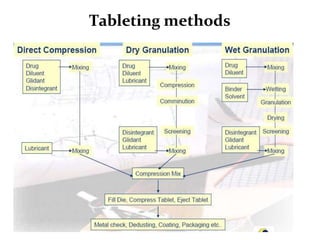
Tableting methods
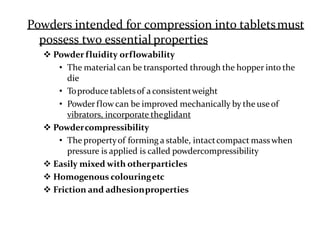
Powders intended for compression into tabletsmust
possess two essential properties
 Powder fluidity orflowability
• The material can be transported through the hopper into the
die
• Toproduce tabletsof a consistentweight
• Powder flowcan be improved mechanically by the useof
vibrators, incorporate theglidant
 Powdercompressibility
• The propertyof forming a stable, intactcompact masswhen
pressure is applied is called powdercompressibility
 Easily mixed with otherparticles
 Homogenous colouringetc
 Friction and adhesionproperties
Slugging (dry granulation):
a. Blend is forced into dies of large capacitytablet
press and compacted using flat facedpunches.
b. compacted masses are called slugs and processis
called slugging.
c. Slugs milled or screened to produce goodfree
flowing granules forcompression.
Dry compaction/Rollercompaction
 On a large scale compression granulation can also be
performed on a rollercompactor.
 Granulation by dry compaction can also be achieved by
passing powders between two rollers that compact the
material at pressure of up to 10 tons per linear inch.
 Materials of very low density require roller compaction to
achieve a bulk density sufficient to allow encapsulation or
compression.
 One of the best examples of this process is the
densification of aluminum hydroxide.
 Rollercompactor iscapable of producing as much as 500
kg/hr of compacted ribbon like materials which can be
then screened and milled in togranules forcompression.
Limitations of drygranulation
1 Dry granulation often produces a higher percentage of
fines or non compacted products, which could
compromise thequalityorcreateyield problems for the
tablet.
2 It requiresdrugs orexcipients with cohesive properties.
Wetgranulation
The most popular method (over 70%)
Granulation isdone
 Toprevent segregation of the constituents of thepowder
blend.
 Toimprove flowability of the powdermixture.
 Toimprove the compaction characteristics of thepowder
mixture due to better distribution of the binder within
thegranules.
 Toimprove homogeneity and thus ensurecontent
uniformity
Wetgranulation isa process of using a solution binder to the
powder mixture. The amount of liquid can be properly
managed; overwetting = the granules to betoo
hard, underwetting =too soft and friable.
Aqueous solutions are safer than othersolvents.
Procedure of WetGranulation
Step 1: Weighing and Blending
Step 2: wet granulate prepared by adding the bindersolution
Step 3: Screening thedamp mass into pellets orgranules (6-
8mesh)
Step 4: Drying the granulation in thermostaticallycontrolled
ovens
Step 5: Dry screening:
Step 6: Mixing with other ingredients: Adry
lubricant, antiadherent and glidant is added to the
granuleseither bydusting over the spread-outgranulesor
by blending with the granules. Dry binder, colorant or
disintegrant may be also added in this step.
Step 7: Tableting: Last step in which the tablet is fed into the
die cavity and thencompressed.
Limitations of wetgranulation:
1 Multiple separate steps areinvolved.
2 Not suitable for heat and moisture sensitivedrugs
Equipments
Traditionally, dry mixing in wet granulation process
has been carried outusing,
 Sigma blade mixer,
 Heavy-duty planetary mixer.
List of equipments used ingranulation
High Shear granulation:
i)Little ford Lodgiegranulator
ii)Little ford MGT granulator
iii)Diosnagranulator
iv)Gral mixer
Granulator with dryingfacility:
i) Fluidized bed granulator
ii) Day nauta mixerprocessor
iii) Doublecone or twin shell processor
iv) Topogranulator
Special granulator:
i) Rotogranulator
ii) Marumerizer
Compression
Tableting procedure
 Filling
 Compression
 Ejection
Tablet compression machines
• Hopper for holding and feeding granulationto be
compressed
• Dies thatdefine the sizeand shapeof the tablet
• Punches forcompressing thegranulation within thedies
• Cam tracks forguiding the movementof the punches
• Feeding mechanisms for moving granulation fromthe
hopper into thedies
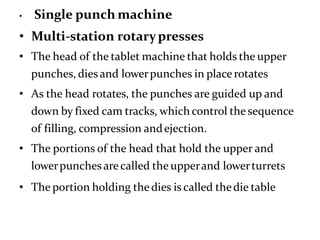
• Single punch machine
• Multi-station rotarypresses
• The head of the tablet machine that holds the upper
punches, dies and lowerpunches in place rotates
• As the head rotates, the punches are guided up and
down by fixed cam tracks, which control the sequence
of filling, compression andejection.
• The portions of the head that hold the upper and
lowerpunchesarecalled the upperand lowerturrets
• The portion holding thedies is called thedie table
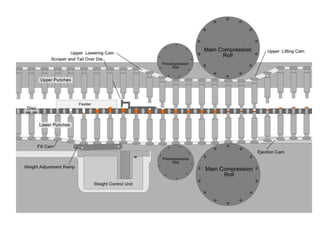
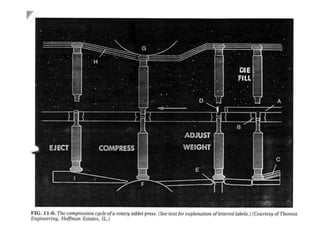
Compression cycle
• Granules from hopperempty in the feed frame (A)
containing several interconnected compartments.
• Thesecompartments spread thegranulation overawide
area to provide time for thedies (B) to fill.
• The pull down cam (C) guides the lower punches to the
bottom, allowing the dies tooverfill
• The punches then pass over a weight-control cam
(E), which reduces the fill in thedies to thedesired
amount
• A swipe off blade (D) at the end of the feed frame removes
the excess granulation and directs it around the turret and
back into the front of the feedframe
• The lower punches travel over the lowercompression roll
(F) while simultaneously the upperpunches ride beneath
the upper compression roll(G)
• The upperpunches enter a fixed distance into the
dies, while the lower punches are raised to squeezeand
compact thegranulation within thedies
• After the moment of compression, the upper punches are
withdrawn as they follow the upperpunch raising cam (H)
• The lower punches ride up thecam (I) which brings the
tablets flush with orslightlyabove the surface of thedies
• The tablets strike a sweep off blade affixed to the front of
the feed frame (A) and slidedown achute intoa receptacle
• At the same time, the lower punches re-enter the pull
down cam (C) and the cycle isrepeated
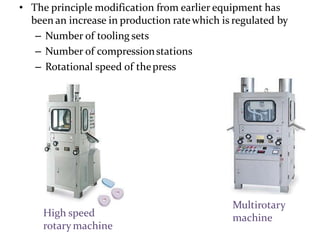
• The principle modification from earlier equipment has
been an increase in production ratewhich is regulated by
– Number of tooling sets
– Number of compressionstations
– Rotational speed of thepress
Multirotary
machineHigh speed
rotary machine
Processing problems
• Capping is the partial or complete separation of the
top or bottom crowns of a tablet from the main body
of the tablet.
• Lamination is separation of a tablet into twoor more
distinct layers. Both of these problems usually result
from air entrapmentduring processing.
• Picking is removal of a tablet’ssurface material bya
punch.
• Sticking is adhesion of tablet material to a die wall.
These twoproblems result from excessive moistureor
substances with low melting temperatures in the
formulation
• Mottling is an unequal colordistributionon a tablet, with
lightordark areas standing on otherwise uniform surface.
This results from useof adrug with a colordifferent from
that of the tablet excipients or from a drug with colored
degradation products.
• Weight variation-granule size distribution,poor
fiow,punchvariation
• Hardness variation
• Double impression-monograms or engraving onpunch
Reference
• The theory and practice of industrial
pharmacy by Leon Lachman,A.lieberman
THANKYOU

Tablets ppt

  • 1.
    TABLETS PRESENTED BY: ANOOPSINGH E-Mail: aaanoopsingh@gmail.com
  • 2.
    INTRODUCTION Tablet is definedas a compressed solid dosage form containing medicaments with or without excipients. According to the Indian Pharmacopoeia Pharmaceutical tablets are solid, flat or biconvex dishes, unit dosage form, prepared by compressing a drug or a mixture of drugs, with or without diluents
  • 3.
    The advantages ofthe Tabletdosage form are: • They are unit dosage form and offer the greatest capabilitiesof all oral dosage form forthegreatest dose precision and the least contentvariability. • Cost is lowest of all oral dosageform. • Lighter andcompact. • Easiestand cheapest to package and strip. • Easy toswallowing with least tendency for hang-up. • Sustained release product is possible byenteric coating.
  • 4.
    • Objectionableodourand bittertastecanbe masked by coating technique. • Suitable for large scaleproduction. • Greatest chemical and microbial stability over alloral dosage form. • Product identification is easy and rapid requiring no additional steps when employing an embossedand/or monogrammed punch face.
  • 5.
    Disadvantages of Tabletdosage formare: • Difficult to swallow in caseof children and unconscious patients. • Somedrugs resistcompression intodensecompacts, owing to amorphous nature, low densitycharacter. • Drugs with poorwetting, slow dissolution properties, optimum absorption high in GIT may be difficult to formulate or manufacture as a tablet that will still provide adequate or full drug bioavailability. • Bittertesting drugs, drugs with an objectionableodorordrugs that are sensitive to oxygen may require encapsulation or coating. In such cases, capsule may offer the best and lowest cost.
  • 6.
    Different types ofTablets (A) Tablets ingested orally: 1. Compressed tablet, e.g. Paracetamol tablet 2. Multiple compressed tablet 3. Repeat action tablet 4.Delayed release tablet, e.g. Enteric coatedBisacodyl tablet 5. Sugar coated tablet, e.g. Multivitamintablet 6. Film coated tablet, e.g. Metronidazoletablet 7. Chewable tablet, e.g. Antacidtablet (B) Tablets used in oralcavity: 1. Buccal tablet, e.g. Vitamin-ctablet 2. Sublingual tablet, e.g. Vicks Menthol tablet 3. Troches or lozenges 4. Dental cone
  • 7.
    (c) Tablets administeredby otherroute: 1. Implantation tablet 2. Vaginal tablet, e.g. Clotrimazoletablet (D) Tablets used to preparesolution: 1. Effervescent tablet, e.g. Dispirintablet (Aspirin) 2. Dispensing tablet, e.g. Enzymetablet (Digiplex) 3. Hypodermic tablet 4. Tablet triturates e.g. Enzyme tablet(Digiplex)
  • 8.
    Tablet Ingredients In additiontoactive ingredients, tabletcontainsa numberof inert materials known as additivesorexcipients. Differentexcipients are: 1. Diluent 2. Binder andadhesive 3. Disintegrents 4. Lubricants andglidants 5. Colouring agents 6. Flavoring agents 7. Sweetening agents
  • 9.
    EXCIEPIENTS- functions • Impartweight,accuracy, & volume(itsallow acccuracy of dose) • Improve solubility • Increase stability • Enhance bioavailability • Modifying drug release • Assist pdtidentification • Increase patientacceptability • Facilitate dosage formdesign
  • 10.
    • 1. Diluent:Diluents are fillers used to make required bulk of the tablet when the drug dosage itself is inadequate to produce the bulk. Secondary reason is to provide better tablet properties such as improve cohesion, to permit use of direct compression manufacturing or to promote flow. A diluent should have following properties: 1. They must be nontoxic 2.They must be commerciallyavailable in acceptable grade 3. There cost must below 4. They must be physiologicallyinert 5.They must be physically & chemically stable by themselves & in combination with thedrugs. 6. They must be free from all microbialcontamination. 7. Theydo not alter the bioavailability of drug. 8. They must be colorcompatible.
  • 11.
    Commonly used tabletdiluents 1.Lactose-anhydrous and spray driedlactose 2. Directly compressed starch-Sta Rx1500 3. Hydrolyzed starch-Emdex and Celutab 4. Microcrystalline cellulose-Avicel (PH 101and PH 102) 5. Dibasic calcium phosphatedehydrate 6. Calcium sulphatedihydrate 7. Mannitol 8. Sorbitol 9. Sucrose- Sugartab, DiPac, Nutab 10. Dextrose
  • 12.
    2. Binders andAdhesives: These materials are added eitherdry or in wet- form to form granules or to form cohesive compacts for directly compressed tablet. • Example: Acacia, tragacanth- Solution for 10-25% Conc. • Cellulose derivatives- Methyl cellulose, Hydroxy propyl methyl cellulose, Hydroxy propyl cellulose • Gelatin- 10-20% solution • Glucose- 50% solution • Polyvinylpyrrolidone (PVP)- 2% conc. • Starch paste-10-20% solution • Sodium alginate • Sorbitol
  • 13.
    3. Disintegrants: Addedto a tablet formulation to facilitate its breaking or disintegration when it contact in water in theGIT. • Example: Starch- 5-20% of tabletweight. • Starch derivative – Primogel and Explotab(1-8%) • Clays- Veegum HV, bentonite 10% level incolored tabletonly • Cellulose • Cellulose derivatives- Ac- Di-Sol (sodiumcarboxy methyl cellulose) • Alginate • PVP (Polyvinylpyrrolidone), cross-linked
  • 14.
    • Superdisintegrants: Swellsup to ten foldwithin 30 seconds when contactwater. • Example: cellulose, (polymer), Crosscarmellose- cross-linked Crosspovidone- cross-linked povidone Sodium starch glycolate- cross-linked starch. These cross-linked products swells with in30 secondswhen in contact with water. • A portion of disintegrant is added granulation and a portion before before compression, which serveas glidantsor lubricant.
  • 15.
    • 4. Lubricantand Glidants: Lubricants are intended to prevent adhesion of the tablet materials to the surface of dies and punches, reduce inter particle friction and may improve the rate of flow of the tablet granulation. Glidants are intended to promote flow of granules or powder material by reducing the friction between the particles. • Example: Lubricants- Stearic acid, Stearic acid salt - Stearic acid, Magnesium stearate, Talc, PEG (Polyethylene glycols), Surfactants • Glidants- Corn Starch – 5-10% conc., Talc-5% conc., Silica derivative - Colloidal silicas such as Cab-O- Sil, Syloid, Aerosil in 0.25-3% conc.
  • 16.
    • 5. Coloringagent: The useof colorsand dyes in a tablet has threepurposes: (1) Masking of off colordrugs (2) Product Identification (3) Production of more elegantproduct • All coloring agents must be approved and certified by FDA. Two forms of colors are used in tablet preparation – FD &C and D & C dyes. These dyes are applied as solution in the granulating agent or Lake form of these dyes. Lakes are dyes absorbed on hydrous oxide and employed as dry powdercoloring. • Example: FD & C yellow 6-sunset yellow,FD & C yellow 5- Tartrazine ,FD & C green 3- Fast Green,FD & C blue 1- Brilliant Blue ,FD & C blue 2 - Indigocarmine
  • 17.
    6.Flavoring agents: Forchewabletablet- flavor oil areused 7. Sweetening agents: For chewabletablets: Sugar, mannitol. • Saccharine (artificial): 500 time’s sweeterthan sucrose • Disadvantage: Bitter aftertasteand carcinogenic • Aspartame (artificial) • Disadvantage: Lack of stability in presenceof moisture.
  • 18.
    Lactose • Non-reactive inanhydrous or hydrousform • Hydrous form undergoes maillard reaction leadingto browning and discoloration of certain drugs, hence anhydrous form ispreferred • Butanhydrous form picks up moisture when exposed to humidity. • In wetgranulation, hydrous lactose of twovarietiesare used 60-80 mesh (coarse) and 80-100 mesh (regular) grade. • Lactose formulation show goodrelease. • Low costdiluent • But maydiscolor in presenceof aminedrug bases orsalts of alkalinecompounds
  • 19.
    Spray dried lactose Lactose is placed in aqueous solution,removed impurities and spraydried  Mixture of large alpha monohydrate crystals and spherical aggregates of smallercrystals  Good flowability but less compressibility  Poor dilutionpotential  Less compressibility upon initialcompaction  Problem of browning due to contamination of 5- hydroxyfurfural which was accelerated in the presence of basic amine drugs and catalyzed by tartarate, citrate and acetate ions
  • 20.
    – Fast-Flow lactose(early 1970s) • Spherical aggregates of microcrystals lactose monohydrate • Held together bya higherconcentration of glass (amorphous lactose) • Much morecompressible • Highly fluid • Non hygroscopic • Tablets are three to fourtimes harder than regular spraydried – Tabletose: aggromerate form of lactose • Morecompressible than spraydried but less compressible than Fast Flolactose
  • 21.
    Starch • Can becorn,wheat or potatosource • USP gradeof starch has poor flow & compression characteristics • Also has high moisture content between between 11 &14 %. • Speciallydried starches also havestandard moisture level of 2-4% • Therefore used in wetgranulation
  • 22.
    Sta 1500: • Intactstarchgrainsand ruptured starchgrains that have been partiallyhydrolyzed and subsequentlyaggromerated • Free flowing, self lubricating, containingslightly high MC (10 %) • Due towhich does not form hard compacts • Dilution potential is minimal, notgenerally used as filler-binder but as fillerdisintegrant • Retains thedisintegrant propertiesof starchwithout increasing the fluidity and compressibility ofthe total formulation • Flowpromoters likecolloidal silicon dioxide is needed. • Lubricants tend to dramatically soften tablets containing high concentrations of Starch1500
  • 23.
    Dextrose  90-92% dextrose,3-5% maltose and theremainder higher glucosepolysaccharides  Available both anhydrous and a hydrateproduct  Excellent compressibility and goodflow  Contain 8-10% moisture and may increasehardness aftercompression  Largest particle size, therefore blending problemmay occur  Cerelose is alsoavilable
  • 24.
    Cellulose – Microcrystalline cellulose(Avicel) Derived from a special grade of purified alphawood cellulose by severe acid hydrolysis to remove the amorphous cellulose portions, yielding particles consisting of bundles of needlelike microcrystals • PH101 powderand PH102 are the twogrades available. • mostcompressible with Highestdilution potential • A strong compact formed due to strong hydrogen bonds ,and ruptured due to passage ofwater • Extremely low coefficient of friction, nolubricant • Not used as only filler becauseof itscost and density, • used in theconc of 10-25% as a filler-binder- disintegrant,
  • 25.
  • 26.
    Powders intended forcompression into tabletsmust possess two essential properties  Powder fluidity orflowability • The material can be transported through the hopper into the die • Toproduce tabletsof a consistentweight • Powder flowcan be improved mechanically by the useof vibrators, incorporate theglidant  Powdercompressibility • The propertyof forming a stable, intactcompact masswhen pressure is applied is called powdercompressibility  Easily mixed with otherparticles  Homogenous colouringetc  Friction and adhesionproperties
  • 27.
    Slugging (dry granulation): a.Blend is forced into dies of large capacitytablet press and compacted using flat facedpunches. b. compacted masses are called slugs and processis called slugging. c. Slugs milled or screened to produce goodfree flowing granules forcompression.
  • 28.
    Dry compaction/Rollercompaction  Ona large scale compression granulation can also be performed on a rollercompactor.  Granulation by dry compaction can also be achieved by passing powders between two rollers that compact the material at pressure of up to 10 tons per linear inch.  Materials of very low density require roller compaction to achieve a bulk density sufficient to allow encapsulation or compression.  One of the best examples of this process is the densification of aluminum hydroxide.  Rollercompactor iscapable of producing as much as 500 kg/hr of compacted ribbon like materials which can be then screened and milled in togranules forcompression.
  • 29.
    Limitations of drygranulation 1Dry granulation often produces a higher percentage of fines or non compacted products, which could compromise thequalityorcreateyield problems for the tablet. 2 It requiresdrugs orexcipients with cohesive properties.
  • 30.
    Wetgranulation The most popularmethod (over 70%) Granulation isdone  Toprevent segregation of the constituents of thepowder blend.  Toimprove flowability of the powdermixture.  Toimprove the compaction characteristics of thepowder mixture due to better distribution of the binder within thegranules.  Toimprove homogeneity and thus ensurecontent uniformity Wetgranulation isa process of using a solution binder to the powder mixture. The amount of liquid can be properly managed; overwetting = the granules to betoo hard, underwetting =too soft and friable. Aqueous solutions are safer than othersolvents.
  • 31.
    Procedure of WetGranulation Step1: Weighing and Blending Step 2: wet granulate prepared by adding the bindersolution Step 3: Screening thedamp mass into pellets orgranules (6- 8mesh) Step 4: Drying the granulation in thermostaticallycontrolled ovens Step 5: Dry screening: Step 6: Mixing with other ingredients: Adry lubricant, antiadherent and glidant is added to the granuleseither bydusting over the spread-outgranulesor by blending with the granules. Dry binder, colorant or disintegrant may be also added in this step. Step 7: Tableting: Last step in which the tablet is fed into the die cavity and thencompressed.
  • 32.
    Limitations of wetgranulation: 1Multiple separate steps areinvolved. 2 Not suitable for heat and moisture sensitivedrugs Equipments Traditionally, dry mixing in wet granulation process has been carried outusing,  Sigma blade mixer,  Heavy-duty planetary mixer.
  • 33.
    List of equipmentsused ingranulation High Shear granulation: i)Little ford Lodgiegranulator ii)Little ford MGT granulator iii)Diosnagranulator iv)Gral mixer Granulator with dryingfacility: i) Fluidized bed granulator ii) Day nauta mixerprocessor iii) Doublecone or twin shell processor iv) Topogranulator Special granulator: i) Rotogranulator ii) Marumerizer
  • 34.
    Compression Tableting procedure  Filling Compression  Ejection Tablet compression machines • Hopper for holding and feeding granulationto be compressed • Dies thatdefine the sizeand shapeof the tablet • Punches forcompressing thegranulation within thedies • Cam tracks forguiding the movementof the punches • Feeding mechanisms for moving granulation fromthe hopper into thedies
  • 35.
    • Single punchmachine • Multi-station rotarypresses • The head of the tablet machine that holds the upper punches, dies and lowerpunches in place rotates • As the head rotates, the punches are guided up and down by fixed cam tracks, which control the sequence of filling, compression andejection. • The portions of the head that hold the upper and lowerpunchesarecalled the upperand lowerturrets • The portion holding thedies is called thedie table
  • 36.
    Compression cycle • Granulesfrom hopperempty in the feed frame (A) containing several interconnected compartments. • Thesecompartments spread thegranulation overawide area to provide time for thedies (B) to fill. • The pull down cam (C) guides the lower punches to the bottom, allowing the dies tooverfill • The punches then pass over a weight-control cam (E), which reduces the fill in thedies to thedesired amount • A swipe off blade (D) at the end of the feed frame removes the excess granulation and directs it around the turret and back into the front of the feedframe • The lower punches travel over the lowercompression roll (F) while simultaneously the upperpunches ride beneath the upper compression roll(G)
  • 37.
    • The upperpunchesenter a fixed distance into the dies, while the lower punches are raised to squeezeand compact thegranulation within thedies • After the moment of compression, the upper punches are withdrawn as they follow the upperpunch raising cam (H) • The lower punches ride up thecam (I) which brings the tablets flush with orslightlyabove the surface of thedies • The tablets strike a sweep off blade affixed to the front of the feed frame (A) and slidedown achute intoa receptacle • At the same time, the lower punches re-enter the pull down cam (C) and the cycle isrepeated
  • 40.
    • The principlemodification from earlier equipment has been an increase in production ratewhich is regulated by – Number of tooling sets – Number of compressionstations – Rotational speed of thepress Multirotary machineHigh speed rotary machine
  • 41.
    Processing problems • Cappingis the partial or complete separation of the top or bottom crowns of a tablet from the main body of the tablet. • Lamination is separation of a tablet into twoor more distinct layers. Both of these problems usually result from air entrapmentduring processing. • Picking is removal of a tablet’ssurface material bya punch. • Sticking is adhesion of tablet material to a die wall. These twoproblems result from excessive moistureor substances with low melting temperatures in the formulation
  • 42.
    • Mottling isan unequal colordistributionon a tablet, with lightordark areas standing on otherwise uniform surface. This results from useof adrug with a colordifferent from that of the tablet excipients or from a drug with colored degradation products. • Weight variation-granule size distribution,poor fiow,punchvariation • Hardness variation • Double impression-monograms or engraving onpunch
  • 43.
    Reference • The theoryand practice of industrial pharmacy by Leon Lachman,A.lieberman
  • 44.