SOLUBILITY ENHANCEMENT BY
MICRONIZATION
6/4/2016 1sagar kishor savale
Mr. Sagar Kishor Savale
[Department of Pharmaceutics]
avengersagar16@gmail.com
2015-2016
Department of Pharmacy (Pharmaceutics) | Sagar savale
Contents
1) What is solubility ?
2) Need of enhancing drug solubility
3) Different methods of enhancing solubility
4) Approximate solubility
5) Micronization technology
6) Pharmaceutical applications
7) Examples of miconization process
8) Reference.
6/4/2016 2sagar kishor savale
SOLUBILITY
1-3
 The term solubility is defined as maximum amount of solute that can be
dissolved in a given amount of solvent.
 Solubility depends on:
 The physical form of the solid
 The nature and composition of solvent medium
 Temperature and pressure of system
6/4/2016 3sagar kishor savale
Need of enhancing solubility
 To enhance the solubility of poorly aqueous soluble drugs
 poorly aqueous soluble drugs are administered at much higher doses than
actually desired, leading to associated toxicity problems
 Enhancing bioavailability of poorly water soluble drug molecule
6/4/2016 4sagar kishor savale
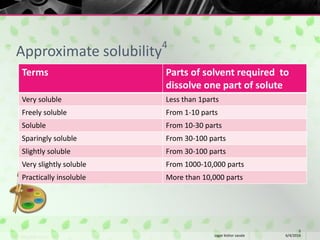
Approximate solubility
4
Terms Parts of solvent required to
dissolve one part of solute
Very soluble Less than 1parts
Freely soluble From 1-10 parts
Soluble From 10-30 parts
Sparingly soluble From 30-100 parts
Slightly soluble From 30-100 parts
Very slightly soluble From 1000-10,000 parts
Practically insoluble More than 10,000 parts
6/4/2016
5
sagar kishor savale
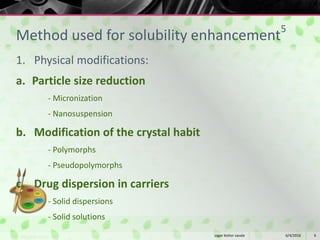
Method used for solubility enhancement
5
1. Physical modifications:
a. Particle size reduction
- Micronization
- Nanosuspension
b. Modification of the crystal habit
- Polymorphs
- Pseudopolymorphs
c. Drug dispersion in carriers
- Solid dispersions
- Solid solutions
6/4/2016 6sagar kishor savale
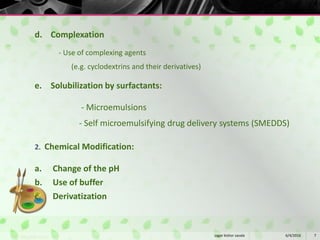
d. Complexation
- Use of complexing agents
(e.g. cyclodextrins and their derivatives)
e. Solubilization by surfactants:
- Microemulsions
- Self microemulsifying drug delivery systems (SMEDDS)
2. Chemical Modification:
a. Change of the pH
b. Use of buffer
c. Derivatization
6/4/2016 7sagar kishor savale
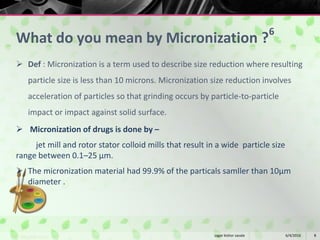
What do you mean by Micronization ?
6
 Def : Micronization is a term used to describe size reduction where resulting
particle size is less than 10 microns. Micronization size reduction involves
acceleration of particles so that grinding occurs by particle-to-particle
impact or impact against solid surface.
 Micronization of drugs is done by –
jet mill and rotor stator colloid mills that result in a wide particle size
range between 0.1–25 µm.
 The micronization material had 99.9% of the particals samller than 10µm
diameter .
6/4/2016 8sagar kishor savale
Micronization Techniques
7
1) Ball mill
2) Rotor sartor colloidal mill
3) Jet mill
4) Hammer mill
5) Super critical fluid
6) High pressure homogenization
6/4/2016 9sagar kishor savale
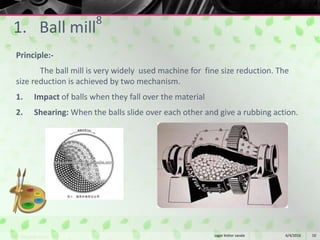
1. Ball mill
8
Principle:-
The ball mill is very widely used machine for fine size reduction. The
size reduction is achieved by two mechanism.
1. Impact of balls when they fall over the material
2. Shearing: When the balls slide over each other and give a rubbing action.
6/4/2016 10sagar kishor savale
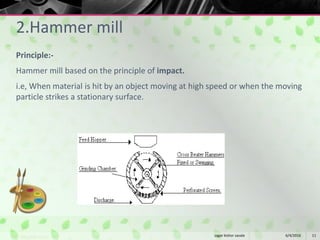
2.Hammer mill
Principle:-
Hammer mill based on the principle of impact.
i.e, When material is hit by an object moving at high speed or when the moving
particle strikes a stationary surface.
6/4/2016 11sagar kishor savale
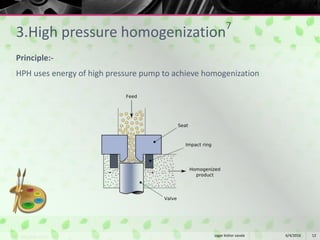
3.High pressure homogenization7
Principle:-
HPH uses energy of high pressure pump to achieve homogenization
6/4/2016 12sagar kishor savale
4.Jet mill
Principle:-Fluid jet mill uses energy of fluid (high pressure air) to achieve ultra
fine grinding of pharmaceutical powders.
6/4/2016 13sagar kishor savale
The most studied SF-based micronization techniques are
9
 Rapid Expansion of Supercritical Solutions (RESS)
 Supercritical Anti Solvent precipitation (SAS)
 Supercritical fluids Assisted Atomization (SAA)
 Particles generation from Gas Saturated Solutions (PGSS)
 Supercritical Carbon dioxide Assisted Nebulization (CAN-
BD) with a Bubble Dryer.
6/4/2016 14sagar kishor savale
What is Super Critical Fluid?
 A fluid is compressed beyond its Pc and heated beyond its Tc.
Why we choose CO2:
 nonflammable, nontoxic, Low dielectric constant, inexpensive, mild Tc.
Solubility
 Non polar or light molecules easily dissolve in CO2.
 Heavy molecules have a very poor solubility.
6/4/2016 15sagar kishor savale
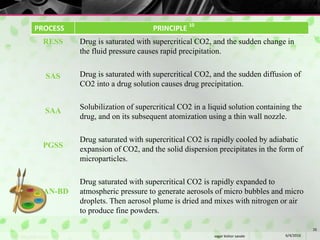
PROCESS PRINCIPLE
10
6/4/2016
16
sagar kishor savale
Drug is saturated with supercritical CO2, and the sudden change in
the fluid pressure causes rapid precipitation.
Drug is saturated with supercritical CO2, and the sudden diffusion of
CO2 into a drug solution causes drug precipitation.
Solubilization of supercritical CO2 in a liquid solution containing the
drug, and on its subsequent atomization using a thin wall nozzle.
Drug saturated with supercritical CO2 is rapidly cooled by adiabatic
expansion of CO2, and the solid dispersion precipitates in the form of
microparticles.
Drug saturated with supercritical CO2 is rapidly expanded to
atmospheric pressure to generate aerosols of micro bubbles and micro
droplets. Then aerosol plume is dried and mixes with nitrogen or air
to produce fine powders.
RESS
SAS
SAA
PGSS
CAN-BD
Reference
1. Martin, A, Bustamanate, P, and Chun, A, H, C, “Physical Pharmacy” B.I.
Wavely Pvt. Ltd, New Delhi, 1994; 4, 223.
2. Neuberg, C, Hydrotrophy, Biochem J. Pharm, 1989; 75(7), 577.
3. Osol, A, (Eds.) in: “Remington’s Pharmaceutical sciences” Mack Publishing
Company, Eastern Pennsylvania, 1990; 18, 203.
4. Indian pharmacopeia-2007,gove. Of India, ministry of health and family
welfare, published by the India Pharmacopoeia commission, Ghaziabad,
page no..143
5. Adam M.et. Al; solution and solubility.
http:www.cop.ufl.edu/safezone/prokai/pa5100/pha5110
6. Innovative milling and micronization thecniques for pharmaceutical
industry by sharon a.yaeger.
6/4/2016 17sagar kishor savale
6/4/2016 18sagar kishor savale
7. Miller RH ,peters k., nanosuspensions for the formulation of poorly soluble
drug .1 prepartion by a size reduction technique. Int J pharm 1998; 160:229-237
8. R.S.Gaud,P.G.Yeole,A.V.Yadav,S.B.Gokhale,Text book of Pharmaceutics,
Published by Nirali Prakashan,Page no.152-155
9. Wong D. H., Kim M. S., Lee S., Jeong S.P., Hwang S.J. Improved physicochemical
characteristics of felodipine solid dispersion particles by supercritical anti-
solvent precipitation process. International Journal of Pharmaceutics, 2005;
301, 199-208.
10. Dohrn R., Bertakis E., Behrend O., Voutsas E., Tassios D. Melting point
depression by using supercritical CO2 for a novel melt dispersion
micronization process. Journal of Molecular Liquids, 2007; 131-132.
24/09/2014 18MICRONIZATION GOHIL VIKRANT
6/4/2016 19sagar kishor savale
6/4/2016 20sagar kishor savale

Micronization - Solubility Enhancement by Micronization

  • 1.
    SOLUBILITY ENHANCEMENT BY MICRONIZATION 6/4/20161sagar kishor savale Mr. Sagar Kishor Savale [Department of Pharmaceutics] avengersagar16@gmail.com 2015-2016 Department of Pharmacy (Pharmaceutics) | Sagar savale
  • 2.
    Contents 1) What issolubility ? 2) Need of enhancing drug solubility 3) Different methods of enhancing solubility 4) Approximate solubility 5) Micronization technology 6) Pharmaceutical applications 7) Examples of miconization process 8) Reference. 6/4/2016 2sagar kishor savale
  • 3.
    SOLUBILITY 1-3  The termsolubility is defined as maximum amount of solute that can be dissolved in a given amount of solvent.  Solubility depends on:  The physical form of the solid  The nature and composition of solvent medium  Temperature and pressure of system 6/4/2016 3sagar kishor savale
  • 4.
    Need of enhancingsolubility  To enhance the solubility of poorly aqueous soluble drugs  poorly aqueous soluble drugs are administered at much higher doses than actually desired, leading to associated toxicity problems  Enhancing bioavailability of poorly water soluble drug molecule 6/4/2016 4sagar kishor savale
  • 5.
    Approximate solubility 4 Terms Partsof solvent required to dissolve one part of solute Very soluble Less than 1parts Freely soluble From 1-10 parts Soluble From 10-30 parts Sparingly soluble From 30-100 parts Slightly soluble From 30-100 parts Very slightly soluble From 1000-10,000 parts Practically insoluble More than 10,000 parts 6/4/2016 5 sagar kishor savale
  • 6.
    Method used forsolubility enhancement 5 1. Physical modifications: a. Particle size reduction - Micronization - Nanosuspension b. Modification of the crystal habit - Polymorphs - Pseudopolymorphs c. Drug dispersion in carriers - Solid dispersions - Solid solutions 6/4/2016 6sagar kishor savale
  • 7.
    d. Complexation - Useof complexing agents (e.g. cyclodextrins and their derivatives) e. Solubilization by surfactants: - Microemulsions - Self microemulsifying drug delivery systems (SMEDDS) 2. Chemical Modification: a. Change of the pH b. Use of buffer c. Derivatization 6/4/2016 7sagar kishor savale
  • 8.
    What do youmean by Micronization ? 6  Def : Micronization is a term used to describe size reduction where resulting particle size is less than 10 microns. Micronization size reduction involves acceleration of particles so that grinding occurs by particle-to-particle impact or impact against solid surface.  Micronization of drugs is done by – jet mill and rotor stator colloid mills that result in a wide particle size range between 0.1–25 µm.  The micronization material had 99.9% of the particals samller than 10µm diameter . 6/4/2016 8sagar kishor savale
  • 9.
    Micronization Techniques 7 1) Ballmill 2) Rotor sartor colloidal mill 3) Jet mill 4) Hammer mill 5) Super critical fluid 6) High pressure homogenization 6/4/2016 9sagar kishor savale
  • 10.
    1. Ball mill 8 Principle:- Theball mill is very widely used machine for fine size reduction. The size reduction is achieved by two mechanism. 1. Impact of balls when they fall over the material 2. Shearing: When the balls slide over each other and give a rubbing action. 6/4/2016 10sagar kishor savale
  • 11.
    2.Hammer mill Principle:- Hammer millbased on the principle of impact. i.e, When material is hit by an object moving at high speed or when the moving particle strikes a stationary surface. 6/4/2016 11sagar kishor savale
  • 12.
    3.High pressure homogenization7 Principle:- HPHuses energy of high pressure pump to achieve homogenization 6/4/2016 12sagar kishor savale
  • 13.
    4.Jet mill Principle:-Fluid jetmill uses energy of fluid (high pressure air) to achieve ultra fine grinding of pharmaceutical powders. 6/4/2016 13sagar kishor savale
  • 14.
    The most studiedSF-based micronization techniques are 9  Rapid Expansion of Supercritical Solutions (RESS)  Supercritical Anti Solvent precipitation (SAS)  Supercritical fluids Assisted Atomization (SAA)  Particles generation from Gas Saturated Solutions (PGSS)  Supercritical Carbon dioxide Assisted Nebulization (CAN- BD) with a Bubble Dryer. 6/4/2016 14sagar kishor savale
  • 15.
    What is SuperCritical Fluid?  A fluid is compressed beyond its Pc and heated beyond its Tc. Why we choose CO2:  nonflammable, nontoxic, Low dielectric constant, inexpensive, mild Tc. Solubility  Non polar or light molecules easily dissolve in CO2.  Heavy molecules have a very poor solubility. 6/4/2016 15sagar kishor savale
  • 16.
    PROCESS PRINCIPLE 10 6/4/2016 16 sagar kishorsavale Drug is saturated with supercritical CO2, and the sudden change in the fluid pressure causes rapid precipitation. Drug is saturated with supercritical CO2, and the sudden diffusion of CO2 into a drug solution causes drug precipitation. Solubilization of supercritical CO2 in a liquid solution containing the drug, and on its subsequent atomization using a thin wall nozzle. Drug saturated with supercritical CO2 is rapidly cooled by adiabatic expansion of CO2, and the solid dispersion precipitates in the form of microparticles. Drug saturated with supercritical CO2 is rapidly expanded to atmospheric pressure to generate aerosols of micro bubbles and micro droplets. Then aerosol plume is dried and mixes with nitrogen or air to produce fine powders. RESS SAS SAA PGSS CAN-BD
  • 17.
    Reference 1. Martin, A,Bustamanate, P, and Chun, A, H, C, “Physical Pharmacy” B.I. Wavely Pvt. Ltd, New Delhi, 1994; 4, 223. 2. Neuberg, C, Hydrotrophy, Biochem J. Pharm, 1989; 75(7), 577. 3. Osol, A, (Eds.) in: “Remington’s Pharmaceutical sciences” Mack Publishing Company, Eastern Pennsylvania, 1990; 18, 203. 4. Indian pharmacopeia-2007,gove. Of India, ministry of health and family welfare, published by the India Pharmacopoeia commission, Ghaziabad, page no..143 5. Adam M.et. Al; solution and solubility. http:www.cop.ufl.edu/safezone/prokai/pa5100/pha5110 6. Innovative milling and micronization thecniques for pharmaceutical industry by sharon a.yaeger. 6/4/2016 17sagar kishor savale
  • 18.
    6/4/2016 18sagar kishorsavale 7. Miller RH ,peters k., nanosuspensions for the formulation of poorly soluble drug .1 prepartion by a size reduction technique. Int J pharm 1998; 160:229-237 8. R.S.Gaud,P.G.Yeole,A.V.Yadav,S.B.Gokhale,Text book of Pharmaceutics, Published by Nirali Prakashan,Page no.152-155 9. Wong D. H., Kim M. S., Lee S., Jeong S.P., Hwang S.J. Improved physicochemical characteristics of felodipine solid dispersion particles by supercritical anti- solvent precipitation process. International Journal of Pharmaceutics, 2005; 301, 199-208. 10. Dohrn R., Bertakis E., Behrend O., Voutsas E., Tassios D. Melting point depression by using supercritical CO2 for a novel melt dispersion micronization process. Journal of Molecular Liquids, 2007; 131-132. 24/09/2014 18MICRONIZATION GOHIL VIKRANT
  • 19.
  • 20.