1
Presented By,
Mr. Patil Paresh Ashok .
M.Pharm 1st year ( sem-I )
Department Of Quality Assurance
R. C. Patel Institute of Pharmaceutical Education &
Research , Shirpur.
CELLULOSE
DERIVATIVES
CONTENT
Cellulose
What are Cellulose derivatives
History
Classification
Advantages
Application of cellulose derivatives
Uses of cellulose
Conclusion
References
2
3
WHAT ARE CELLULOSE
DERIVATIVES
 Pharmaceutically used cellulose derivatives obtained
by either mechanical or chemical processing or both.
 The hydroxyl groups of cellulose can be partially or fully
reacted with various reagent to afford derivatives with
useful properties.
 Pure cellulose additional treatment by HCL produced
various cellulose derivatives.
4
HISTORY
• 1912 First patents on alkyl-, carboxymethyl, benzyl- and
hydroxyethyl cellulose
• 1920 First industrial production in in Germany:
Carboxymethylcellulose (CMC)
• 1927 First technical production of methylcellulose with
methylchloride based on a patent of Sponsel (1925).
CLASSIFICATION
 Based on solubility:-
Water soluble:-
hydroxypropylmethylcellulose
hydroxyethylcellulose
hydroxypropylcellulose
Water insoluble:-
ethyl cellulose
cellulose acetate phthalate
HPMC phthalate
6
CLASSIFICATION
 Based on chemical nature:-
cellulose ester:-
cellulose acetate
cellulose triacetate
cellulose propionate
cellulose nitrate (nitrocellulose)
cellulose ether:-
methyl cellulose
ethyl cellulose
HPC,HPMC
carboxy methyl cellulose
7
MICROCRYSTALLINE CELLULOSE
Synonyms: Celex , cellulose gel , fibrocel.
Empirical Formula : (C6H10O5)n n=220
Molecular Weight : 36000
Function Category : Adsorbent, Suspending
agent, table diluent
Application in Pharmaceutical Formulation:
→Binder (20-90%) → Disintigrant (5-15%)
→ Antiadherent (5-20%) → Lubricant
→Diluent (20-90%)
Description:White,Odorless, Tasteless,Crystalline power 
8
Typical properties
Density(bulk):0.337g/cm3
Density(tapped):0.478g/cm3
Density(true):1.512-1.668g/cm3
Flow ability: 1.41 g/s
Melting point: 260-2700
c
Moisture content: < then 5 % w/w
Solubility: Slightly soluble in NAOH
Precaution:
Irritant to eye so recommended eye protection.
Incompatibilities : With strong oxidizing agents.
9
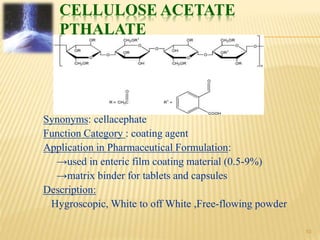
CELLULOSE ACETATE
PTHALATE
Synonyms: cellacephate
Function Category : coating agent
Application in Pharmaceutical Formulation:
→used in enteric film coating material (0.5-9%)
→matrix binder for tablets and capsules
Description:
Hygroscopic, White to off White ,Free-flowing powder
10
Typical properties
Density(bulk): 0.260 g/cm3
Density(tapped): 0.266 g/cm3
Melting point: 1920C
Moisture content: 2.2%
Solubility: <10%w/w
Incompatibilities : With ferrous sulfate , Fecl2 ,Cacl2,
Hgcl2, lead acetate , strong oxidizing agent.
Precaution:
Irritant to eye should be handled in a well ventilated
environment.
11
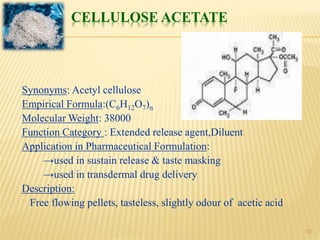
CELLULOSE ACETATE
Synonyms: Acetyl cellulose
Empirical Formula:(C6H12O7)n
Molecular Weight: 38000
Function Category : Extended release agent,Diluent
Application in Pharmaceutical Formulation:
→used in sustain release & taste masking
→used in transdermal drug delivery
Description:
Free flowing pellets, tasteless, slightly odour of acetic acid
12
Typical properties
Density:1.3 g/cm3
Melting point: 230-3000
c
Glass transition temperature: 170-1900c
Solubility: soluble in acetone-water
dichloromethane-ethanol
Viscosity: 10-230 mPa s
Incompatibilities : With strongly acidic or alkaline
substance
Precaution:
Cellulose acetate irritant to eye so eye protection should be
worm
13
HYDROXY ETHYL
CELLULOSE
Synonyms: cellulose hydroxy ethyl ether
Molecular Weight: 38000
Function Category : Suspending agent, Binder
Coating agent, Thickening agent
Application in Pharmaceutical Formulation:
→Opthalmic & Topical formulation
→ Cosmetic preparation
Description:
Hygroscopy powder, odourless, tasteless, cream to white
colour
14
Typical properties
Density(bulk):0.35-0.61g/cm3
Melting point: 135-1400
c(softens)
2050C(Decompose)
Moisture content: < then 5 % w/w
Solubility: soluble in Hot & Cold water
Insoluble in ethanol, ether, toluene
Viscosity: 2-20000 mPa s
cello size (2-3000)
Natrosol (>3000)
Incompatibilities : With fluorescent dyes , quaternary
disinfectant.
Precaution:
Irritant to eye so recommended eye protection.
15
HYDROXY PROPYL
CELLULOSE
Synonyms: Hyprolose
Molecular Weight: 50000-125000
Function Category : Suspending agent, Binder
Coating agent, Emulsifying agent
Application in Pharmaceutical Formulation:
→ Oral & Topical formulation
→ binder in tableting process (2-6% w/w )
→ extended drug release(15-35% w/w)
Description:
odourless, tasteless, white to slightly yellow colour.
16
Typical properties
Density(bulk): 0.5 g/cm3
Melting point: 1300
c(softens)
260-2750cDecompose)
Moisture content: 4 % w/w(at 50%relativehumidity)
12%w/w(at 84% relative humidity)
Solubility: soluble 1 in 10 part dichloromethane
1 in 2.5 part ethanol
1in 2 part methanol
Viscosity: 75-3000 mPa s
Incompatibilities : With phenol derivatives such as
methylparaben , propylparaben.
Precaution: Irritant to eye so recommended eye
protection.
17
HYDROXY PROPYL METHYL
CELLULOSE
Synonyms: Hypromellose
Empirical Formula : C56H108O30
Molecular Weight : 10000-1500000
Function Category : Coating agent, Suspending
agent, tablet binder
Application in Pharmaceutical Formulation:
→Binder (2-5%w/w)
→Thickening agent (0.45-1%w/w)
→Emulsifier, Suspending agent
→Plastic bandage
Description: White, Odorless, Tasteless
18
Typical properties
Density(bulk):0.341 g/cm3
Density(tapped):0.557g/cm3
Density(true):1.326g/cm3
Melting point: 190-2000
c
Moisture content: depend on initial moistur content,
temperature, relative humidity
Solubility: soluble in cold water
insolubal in chloroform, ethenol, ethers
Incompatibilities : With oxidizing agents , metallic
salts or ionic organics.
Precaution: Irritent to eye so recommended eye protection
19
POWDER CELLULOSE
Synonyms: Arbocel
Empirical Formula: (C6H10O5)n n=500
Molecular Weight : 243000
Function Category : Suspending agent, tablet diluent
disintigrant
Application in Pharmaceutical Formulation:
→Binder (5-25%w/w)
→Disintigrant (5-15-1%w/w)
→Glident(1-2%)
→Plastic bandag
Description: White, Odorless, Tasteless
20
Typical properties
Density(bulk):0.139-0.391 g/cm3
Density(tapped):0.210-0-481 g/cm3
Density(true):1.5 g/cm3
Moisture content: < then 5 % w/w
Solubility: Slightly soluble 5% in NAOH
Incompatibilities : With strong oxidizing agent.
Precaution: Irritent to eye so recommended eye
protection.
21
CARBOXYL METHYL
CELLULOSE
Synonyms: carmellose
Chemical formula: C8H16NaO8
Molecular formula: 90000-700000
Properties:
→ Water soluble
→Stable at pH 5-10, best at 7-9 pH
→At pH 3 CMC is insoluble
→ Fine Film Forming Properties
→ Resistance to oil Greases & Solvents
22
METHYL CELLULOSE
 Synonyms:- Methocel, methyl ether
 Contain 27.5 to 31.5%of methoxy groups.
 Description :- White,powder or granules.
 Solubility:- insoluble in ether,alcohol and chloroform but
soluble in glacial acetic acid and in mix. of equal parts of
alcohol and chloroform.
 Uses:- dispersing
thickening
emilsifying and coating agent.
23
ETHYL CELLULOSE
 Synonyms:- Aquacoat,ethocel,surelease.
 Description :- tasteless, free flowing.
 Solubility:- insoluble in glycerin, propylene glycol, and water.
soluble in chloroform, ethanol.
 Uses:- Micro encapsulation (10-20%)
Sustained release tablet coating (3-20%)
Tablet coating (1-3%)
24
ADVANTAGES
 Improve stability of drug.
 Good Lubrication
 Good binding properties
 Rapid disintigration
 Good flowing properties
 Reduced friability & weight loss
 Excellent compression & hardness
25
Pharmaceutical Application of
cellulose
26
27
Uses of Cellulose
• Cellulose has many uses such as the following.
 Anticake agents
 Emulsifier
 Stabiliser
 Dispersing agent
 Thickener
 Gelling agent
 Most important use is of holding on to water
CONCLUSION
Cellulose and Cellulose derivatives are carbohydrate
polymeric system is applicable for pharmaceutical as
well as industrial purpose.
28
REFERENCES
1) Raymand C. Rowe , Handbook of pharmaceutical
excipients , published by Royal pharmaceutical society of
great Britain ,London ,4th edition page no. 108-122,283-293
2) Goran Alderbond, Pharmaceutical powder compaction
technology , material for direct compression, page no. 428-
440
3) Excipient toxicity and safety , Myra L. Weiner(volume 103)
4) William J Reilly ,Remington’s pharmaceutical science,
Pharmaceutical Necessities 8th edition page no, 1084
5) Y. Nishiyama, P. Langan, H. Chanzy (2002). "Crystal
Structure and Hydrogen-Bonding System in Cellulose Iβ
from Synchrotron X-ray and Neutron Fiber Diffraction".
124 (31): 9074–9082.
29
30

Cellulose Derivatives

  • 1.
    1 Presented By, Mr. PatilParesh Ashok . M.Pharm 1st year ( sem-I ) Department Of Quality Assurance R. C. Patel Institute of Pharmaceutical Education & Research , Shirpur. CELLULOSE DERIVATIVES
  • 2.
    CONTENT Cellulose What are Cellulosederivatives History Classification Advantages Application of cellulose derivatives Uses of cellulose Conclusion References 2
  • 3.
  • 4.
    WHAT ARE CELLULOSE DERIVATIVES Pharmaceutically used cellulose derivatives obtained by either mechanical or chemical processing or both.  The hydroxyl groups of cellulose can be partially or fully reacted with various reagent to afford derivatives with useful properties.  Pure cellulose additional treatment by HCL produced various cellulose derivatives. 4
  • 5.
    HISTORY • 1912 Firstpatents on alkyl-, carboxymethyl, benzyl- and hydroxyethyl cellulose • 1920 First industrial production in in Germany: Carboxymethylcellulose (CMC) • 1927 First technical production of methylcellulose with methylchloride based on a patent of Sponsel (1925).
  • 6.
    CLASSIFICATION  Based onsolubility:- Water soluble:- hydroxypropylmethylcellulose hydroxyethylcellulose hydroxypropylcellulose Water insoluble:- ethyl cellulose cellulose acetate phthalate HPMC phthalate 6
  • 7.
    CLASSIFICATION  Based onchemical nature:- cellulose ester:- cellulose acetate cellulose triacetate cellulose propionate cellulose nitrate (nitrocellulose) cellulose ether:- methyl cellulose ethyl cellulose HPC,HPMC carboxy methyl cellulose 7
  • 8.
    MICROCRYSTALLINE CELLULOSE Synonyms: Celex, cellulose gel , fibrocel. Empirical Formula : (C6H10O5)n n=220 Molecular Weight : 36000 Function Category : Adsorbent, Suspending agent, table diluent Application in Pharmaceutical Formulation: →Binder (20-90%) → Disintigrant (5-15%) → Antiadherent (5-20%) → Lubricant →Diluent (20-90%) Description:White,Odorless, Tasteless,Crystalline power 8
  • 9.
    Typical properties Density(bulk):0.337g/cm3 Density(tapped):0.478g/cm3 Density(true):1.512-1.668g/cm3 Flow ability:1.41 g/s Melting point: 260-2700 c Moisture content: < then 5 % w/w Solubility: Slightly soluble in NAOH Precaution: Irritant to eye so recommended eye protection. Incompatibilities : With strong oxidizing agents. 9
  • 10.
    CELLULOSE ACETATE PTHALATE Synonyms: cellacephate FunctionCategory : coating agent Application in Pharmaceutical Formulation: →used in enteric film coating material (0.5-9%) →matrix binder for tablets and capsules Description: Hygroscopic, White to off White ,Free-flowing powder 10
  • 11.
    Typical properties Density(bulk): 0.260g/cm3 Density(tapped): 0.266 g/cm3 Melting point: 1920C Moisture content: 2.2% Solubility: <10%w/w Incompatibilities : With ferrous sulfate , Fecl2 ,Cacl2, Hgcl2, lead acetate , strong oxidizing agent. Precaution: Irritant to eye should be handled in a well ventilated environment. 11
  • 12.
    CELLULOSE ACETATE Synonyms: Acetylcellulose Empirical Formula:(C6H12O7)n Molecular Weight: 38000 Function Category : Extended release agent,Diluent Application in Pharmaceutical Formulation: →used in sustain release & taste masking →used in transdermal drug delivery Description: Free flowing pellets, tasteless, slightly odour of acetic acid 12
  • 13.
    Typical properties Density:1.3 g/cm3 Meltingpoint: 230-3000 c Glass transition temperature: 170-1900c Solubility: soluble in acetone-water dichloromethane-ethanol Viscosity: 10-230 mPa s Incompatibilities : With strongly acidic or alkaline substance Precaution: Cellulose acetate irritant to eye so eye protection should be worm 13
  • 14.
    HYDROXY ETHYL CELLULOSE Synonyms: cellulosehydroxy ethyl ether Molecular Weight: 38000 Function Category : Suspending agent, Binder Coating agent, Thickening agent Application in Pharmaceutical Formulation: →Opthalmic & Topical formulation → Cosmetic preparation Description: Hygroscopy powder, odourless, tasteless, cream to white colour 14
  • 15.
    Typical properties Density(bulk):0.35-0.61g/cm3 Melting point:135-1400 c(softens) 2050C(Decompose) Moisture content: < then 5 % w/w Solubility: soluble in Hot & Cold water Insoluble in ethanol, ether, toluene Viscosity: 2-20000 mPa s cello size (2-3000) Natrosol (>3000) Incompatibilities : With fluorescent dyes , quaternary disinfectant. Precaution: Irritant to eye so recommended eye protection. 15
  • 16.
    HYDROXY PROPYL CELLULOSE Synonyms: Hyprolose MolecularWeight: 50000-125000 Function Category : Suspending agent, Binder Coating agent, Emulsifying agent Application in Pharmaceutical Formulation: → Oral & Topical formulation → binder in tableting process (2-6% w/w ) → extended drug release(15-35% w/w) Description: odourless, tasteless, white to slightly yellow colour. 16
  • 17.
    Typical properties Density(bulk): 0.5g/cm3 Melting point: 1300 c(softens) 260-2750cDecompose) Moisture content: 4 % w/w(at 50%relativehumidity) 12%w/w(at 84% relative humidity) Solubility: soluble 1 in 10 part dichloromethane 1 in 2.5 part ethanol 1in 2 part methanol Viscosity: 75-3000 mPa s Incompatibilities : With phenol derivatives such as methylparaben , propylparaben. Precaution: Irritant to eye so recommended eye protection. 17
  • 18.
    HYDROXY PROPYL METHYL CELLULOSE Synonyms:Hypromellose Empirical Formula : C56H108O30 Molecular Weight : 10000-1500000 Function Category : Coating agent, Suspending agent, tablet binder Application in Pharmaceutical Formulation: →Binder (2-5%w/w) →Thickening agent (0.45-1%w/w) →Emulsifier, Suspending agent →Plastic bandage Description: White, Odorless, Tasteless 18
  • 19.
    Typical properties Density(bulk):0.341 g/cm3 Density(tapped):0.557g/cm3 Density(true):1.326g/cm3 Meltingpoint: 190-2000 c Moisture content: depend on initial moistur content, temperature, relative humidity Solubility: soluble in cold water insolubal in chloroform, ethenol, ethers Incompatibilities : With oxidizing agents , metallic salts or ionic organics. Precaution: Irritent to eye so recommended eye protection 19
  • 20.
    POWDER CELLULOSE Synonyms: Arbocel EmpiricalFormula: (C6H10O5)n n=500 Molecular Weight : 243000 Function Category : Suspending agent, tablet diluent disintigrant Application in Pharmaceutical Formulation: →Binder (5-25%w/w) →Disintigrant (5-15-1%w/w) →Glident(1-2%) →Plastic bandag Description: White, Odorless, Tasteless 20
  • 21.
    Typical properties Density(bulk):0.139-0.391 g/cm3 Density(tapped):0.210-0-481g/cm3 Density(true):1.5 g/cm3 Moisture content: < then 5 % w/w Solubility: Slightly soluble 5% in NAOH Incompatibilities : With strong oxidizing agent. Precaution: Irritent to eye so recommended eye protection. 21
  • 22.
    CARBOXYL METHYL CELLULOSE Synonyms: carmellose Chemicalformula: C8H16NaO8 Molecular formula: 90000-700000 Properties: → Water soluble →Stable at pH 5-10, best at 7-9 pH →At pH 3 CMC is insoluble → Fine Film Forming Properties → Resistance to oil Greases & Solvents 22
  • 23.
    METHYL CELLULOSE  Synonyms:-Methocel, methyl ether  Contain 27.5 to 31.5%of methoxy groups.  Description :- White,powder or granules.  Solubility:- insoluble in ether,alcohol and chloroform but soluble in glacial acetic acid and in mix. of equal parts of alcohol and chloroform.  Uses:- dispersing thickening emilsifying and coating agent. 23
  • 24.
    ETHYL CELLULOSE  Synonyms:-Aquacoat,ethocel,surelease.  Description :- tasteless, free flowing.  Solubility:- insoluble in glycerin, propylene glycol, and water. soluble in chloroform, ethanol.  Uses:- Micro encapsulation (10-20%) Sustained release tablet coating (3-20%) Tablet coating (1-3%) 24
  • 25.
    ADVANTAGES  Improve stabilityof drug.  Good Lubrication  Good binding properties  Rapid disintigration  Good flowing properties  Reduced friability & weight loss  Excellent compression & hardness 25
  • 26.
  • 27.
    27 Uses of Cellulose •Cellulose has many uses such as the following.  Anticake agents  Emulsifier  Stabiliser  Dispersing agent  Thickener  Gelling agent  Most important use is of holding on to water
  • 28.
    CONCLUSION Cellulose and Cellulosederivatives are carbohydrate polymeric system is applicable for pharmaceutical as well as industrial purpose. 28
  • 29.
    REFERENCES 1) Raymand C.Rowe , Handbook of pharmaceutical excipients , published by Royal pharmaceutical society of great Britain ,London ,4th edition page no. 108-122,283-293 2) Goran Alderbond, Pharmaceutical powder compaction technology , material for direct compression, page no. 428- 440 3) Excipient toxicity and safety , Myra L. Weiner(volume 103) 4) William J Reilly ,Remington’s pharmaceutical science, Pharmaceutical Necessities 8th edition page no, 1084 5) Y. Nishiyama, P. Langan, H. Chanzy (2002). "Crystal Structure and Hydrogen-Bonding System in Cellulose Iβ from Synchrotron X-ray and Neutron Fiber Diffraction". 124 (31): 9074–9082. 29
  • 30.

Editor's Notes