A REVIEW ON HYDROXYETHYL
CELLULOSES


Prepared by:                   Guided by:
Mr. Jiten B. Patel             Mr. Nishant Upadhyay
M.Pharm(2nd Sem)               Assit. Pro. M.pharm


                     BMCP(215),Surat
General description

1.   Nonproprietary Names
    BP: Hydroxyethylcellulose
    PhEur: Hydroxyethylcellulose
    USP-NF: Hydroxyethyl Cellulose
2.   Synonyms
    Cellosize HEC; Cellulose hydroxyethyl ether; Cellulose 2-
     hydroxyethyl, Cellulose hydroxyethylate
3. Chemical Name
    2-hydroxyethyl ether
5. Structural Formula


             R is H or [—CH2CH2O—]mH where m is a common integral
             number of cellulose derivatives.


6. Functional Category
  Coating agent;                                     Thickening agent;
  Suspending agent;                                  Tablet binder;
  Viscosity-increasing agent.
8. Description
    Hydroxyethyl cellulose occurs as a white, yellowish-white or
    grayish-white, odorless and tasteless, hygroscopic powder.


7. Applications in Pharmaceutical Formulation
   Thickening agent in ophthalmic and topical formulations,
   Used as a binder and film-coating agent for tablets,
   It is present in lubricant preparations for dry eye, contact lens care,
    and dry mouth,
   Hydroxyethyl cellulose is also widely used in cosmetics.
10. Typical Properties
   Density (bulk)
    0.35–0.61 g/cm3 for Cellosize;
    0.60 g/cm3 for Natrosol.
   Melting point
    Softens at 135–140ºC; decomposes at about 280ºC.
   Solubility
    Hydroxyethyl cellulose is soluble in hot or cold water.
    Practically insoluble in acetone, ethanol (95%), ether, toluene.
    In some polar organic solvents, such as the glycols, hydroxyethyl
        cellulose either swells or is partially soluble.
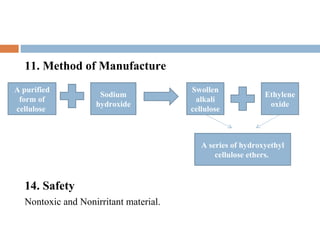
11. Method of Manufacture
A purified                             Swollen
                    Sodium                                  Ethylene
 form of                                alkali
                   hydroxide                                 oxide
cellulose                              cellulose


                                          A series of hydroxyethyl
                                              cellulose ethers.


  14. Safety
  Nontoxic and Nonirritant material.
Comparison of HEC with other
polymer
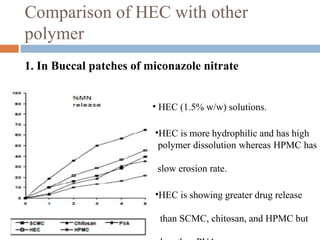
1. In Buccal patches of miconazole nitrate


                         • HEC (1.5% w/w) solutions.

                         •HEC is more hydrophilic and has high
                          polymer dissolution whereas HPMC has

                          slow erosion rate.

                         •HEC is showing greater drug release

                          than SCMC, chitosan, and HPMC but
 
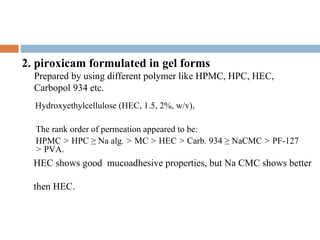
2. piroxicam formulated in gel forms
    Prepared by using different polymer like HPMC, HPC, HEC,
    Carbopol 934 etc.
    Hydroxyethylcellulose (HEC, 1.5, 2%, w/v),

    The rank order of permeation appeared to be:
    HPMC > HPC ≥ Na alg. > MC > HEC > Carb. 934 ≥ NaCMC > PF-127
    > PVA.
    HEC shows good mucoadhesive properties, but Na CMC shows better

    then HEC.
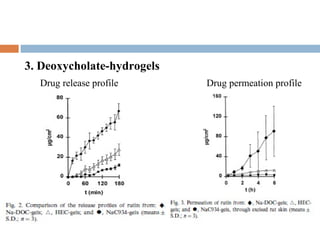
3. Deoxycholate-hydrogels
  Drug release profile      Drug permeation profile
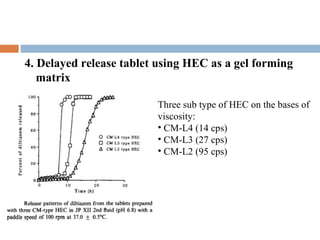
4. Delayed release tablet using HEC as a gel forming
   matrix

                         Three sub type of HEC on the bases of
                         viscosity:
                         • CM-L4 (14 cps)
                         • CM-L3 (27 cps)
                         • CM-L2 (95 cps)
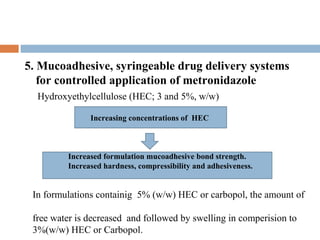
5. Mucoadhesive, syringeable drug delivery systems
   for controlled application of metronidazole
  Hydroxyethylcellulose (HEC; 3 and 5%, w/w)

               Increasing concentrations of HEC


         Increased formulation mucoadhesive bond strength.
         Increased hardness, compressibility and adhesiveness.


 In formulations containig 5% (w/w) HEC or carbopol, the amount of

 free water is decreased and followed by swelling in comperision to
 3%(w/w) HEC or Carbopol.
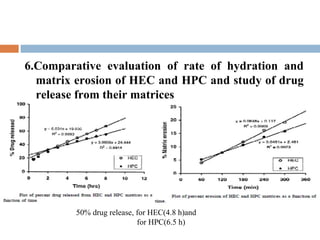
6.Comparative evaluation of rate of hydration and
  matrix erosion of HEC and HPC and study of drug
  release from their matrices


         50% drug release, for HEC(4.8 h)and
                           for HPC(6.5 h)
Conclusion
       In the present study we evaluated HEC widely used as Coating
 agent; Thickening agent Suspending agent; Tablet binder; Viscosity-
 increasing agent, Easily available, Nontoxic and Nonirritant
 material. HEC has high polymer dissolution and greater drug release
 capability. HEC shows good mucoadhesive properties as compare to
 other polymer. HEC shows better result within 1.5-3%w/w after that
 decreased formulation mucoadhesive bond strength, Increased
 hardness, compressibility and adhesiveness.
Reference:
   Hand book of pharmaceutical excipients, volume 6, pages
    311-313,Raymond C Rowe,Paul J shesky,Marian E Quinn
   International Journal of Pharmaceutics, Volume 264, Issues 1–2, 2
    October 2003, Pages 1-14
    Noha A Nafee, Fatma A Ismail, Nabila A Boraie, Lobna M Mortada
   International Journal of Pharmaceutics, Volume 276, Issues 1–2, 19
    May 2004, Pages 11-28
    M.A Attia, I El-Gibaly, S.E Shaltout, G.N Fetih
   International Journal of Pharmaceutics, Volume 151, Issue 2, 26
    May 1997, Pages 223-233
    David S Jones, A.David Woolfson, Andrew F Brown
   Journal of Controlled Release, Volume 49, Issue 1, 10 November
    1997, Pages 71-79
    David S Jones, A.David Woolfson, Andrew F Brown, Michael J
    O'Neill
THANK YOU

A review on_hydroxyethyl_cellulose

  • 1.
    A REVIEW ONHYDROXYETHYL CELLULOSES Prepared by: Guided by: Mr. Jiten B. Patel Mr. Nishant Upadhyay M.Pharm(2nd Sem) Assit. Pro. M.pharm BMCP(215),Surat
  • 2.
    General description 1. Nonproprietary Names  BP: Hydroxyethylcellulose  PhEur: Hydroxyethylcellulose  USP-NF: Hydroxyethyl Cellulose 2. Synonyms  Cellosize HEC; Cellulose hydroxyethyl ether; Cellulose 2- hydroxyethyl, Cellulose hydroxyethylate 3. Chemical Name  2-hydroxyethyl ether
  • 3.
    5. Structural Formula R is H or [—CH2CH2O—]mH where m is a common integral number of cellulose derivatives. 6. Functional Category Coating agent; Thickening agent; Suspending agent; Tablet binder; Viscosity-increasing agent.
  • 4.
    8. Description Hydroxyethyl cellulose occurs as a white, yellowish-white or grayish-white, odorless and tasteless, hygroscopic powder. 7. Applications in Pharmaceutical Formulation  Thickening agent in ophthalmic and topical formulations,  Used as a binder and film-coating agent for tablets,  It is present in lubricant preparations for dry eye, contact lens care, and dry mouth,  Hydroxyethyl cellulose is also widely used in cosmetics.
  • 5.
    10. Typical Properties  Density (bulk) 0.35–0.61 g/cm3 for Cellosize; 0.60 g/cm3 for Natrosol.  Melting point Softens at 135–140ºC; decomposes at about 280ºC.  Solubility Hydroxyethyl cellulose is soluble in hot or cold water. Practically insoluble in acetone, ethanol (95%), ether, toluene. In some polar organic solvents, such as the glycols, hydroxyethyl cellulose either swells or is partially soluble.
  • 6.
    11. Method ofManufacture A purified Swollen Sodium Ethylene form of alkali hydroxide oxide cellulose cellulose A series of hydroxyethyl cellulose ethers. 14. Safety Nontoxic and Nonirritant material.
  • 7.
    Comparison of HECwith other polymer 1. In Buccal patches of miconazole nitrate • HEC (1.5% w/w) solutions. •HEC is more hydrophilic and has high polymer dissolution whereas HPMC has slow erosion rate. •HEC is showing greater drug release than SCMC, chitosan, and HPMC but
  • 8.
      2. piroxicam formulatedin gel forms Prepared by using different polymer like HPMC, HPC, HEC, Carbopol 934 etc. Hydroxyethylcellulose (HEC, 1.5, 2%, w/v), The rank order of permeation appeared to be: HPMC > HPC ≥ Na alg. > MC > HEC > Carb. 934 ≥ NaCMC > PF-127 > PVA. HEC shows good mucoadhesive properties, but Na CMC shows better then HEC.
  • 9.
    3. Deoxycholate-hydrogels Drug release profile Drug permeation profile
  • 10.
    4. Delayed releasetablet using HEC as a gel forming matrix Three sub type of HEC on the bases of viscosity: • CM-L4 (14 cps) • CM-L3 (27 cps) • CM-L2 (95 cps)
  • 11.
    5. Mucoadhesive, syringeabledrug delivery systems for controlled application of metronidazole Hydroxyethylcellulose (HEC; 3 and 5%, w/w) Increasing concentrations of HEC Increased formulation mucoadhesive bond strength. Increased hardness, compressibility and adhesiveness. In formulations containig 5% (w/w) HEC or carbopol, the amount of free water is decreased and followed by swelling in comperision to 3%(w/w) HEC or Carbopol.
  • 12.
    6.Comparative evaluation ofrate of hydration and matrix erosion of HEC and HPC and study of drug release from their matrices 50% drug release, for HEC(4.8 h)and for HPC(6.5 h)
  • 13.
    Conclusion In the present study we evaluated HEC widely used as Coating agent; Thickening agent Suspending agent; Tablet binder; Viscosity- increasing agent, Easily available, Nontoxic and Nonirritant material. HEC has high polymer dissolution and greater drug release capability. HEC shows good mucoadhesive properties as compare to other polymer. HEC shows better result within 1.5-3%w/w after that decreased formulation mucoadhesive bond strength, Increased hardness, compressibility and adhesiveness.
  • 14.
    Reference:  Hand book of pharmaceutical excipients, volume 6, pages 311-313,Raymond C Rowe,Paul J shesky,Marian E Quinn  International Journal of Pharmaceutics, Volume 264, Issues 1–2, 2 October 2003, Pages 1-14 Noha A Nafee, Fatma A Ismail, Nabila A Boraie, Lobna M Mortada  International Journal of Pharmaceutics, Volume 276, Issues 1–2, 19 May 2004, Pages 11-28 M.A Attia, I El-Gibaly, S.E Shaltout, G.N Fetih  International Journal of Pharmaceutics, Volume 151, Issue 2, 26 May 1997, Pages 223-233 David S Jones, A.David Woolfson, Andrew F Brown  Journal of Controlled Release, Volume 49, Issue 1, 10 November 1997, Pages 71-79 David S Jones, A.David Woolfson, Andrew F Brown, Michael J O'Neill
  • 15.