B Y S A R O J M A K W A N A
PRE-FORMULATION
STUDY
DEFINITION
 Preformulation testing is the first step in the rational
development of dosage forms.
 It can be defined as an investigation of physical and
chemical property of a drug substance alone and
when combined with excipients.
10/13/2017
2
NEED….???
 Preliminary evaluation
 Molecular optimisation
 Suitability of Excipients
 Suitability of dosage foam
10/13/2017
3
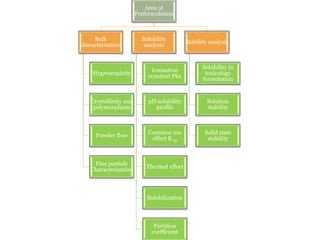
Area of
Preformulation
Bulk
characterisation
Hygroscopicity
Crystallinity and
polymorphism
Powder flow
Fine particle
Characterisation
Solubility
analysis
Ionisation
constant Pka
pH solubility
profile
Common ion
effect K sp
Thermal effect
Solubilization
Partition
coefficient
Stability analysis
Solubility in
toxicology
formulation
Solution
stability
Solid state
stability
10/13/2017
10/13/20175
BULK CHARACTERIZATION
CRYSTALLINITY AND POLYMORPHISM
10/13/2017
6
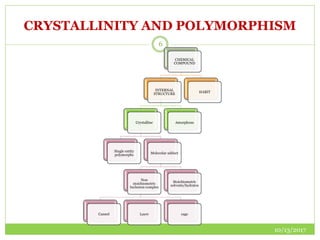
CHEMICAL
COMPOUND
INTERNAL
STRUCTURE
Crystalline
Single entity
polymorphs
Molecular adduct
Non
stoichiometric
Inclusion complex
Cannel Layer cage
Stoichiometric
solvents/hydrates
Amorphous
HABIT
Crystalline state
10/13/2017
7
 Crystal habit & internal structure of drug can affect bulk &
physicochemical property of molecule.
 Crystal habit is description of outer appearance of crystal.
 Internal structure is molecular arrangement within the solid.
 Change with internal structure usually alters crystal habit.
Eg. Conversion of sodium salt to its free acid form produce both
change in internal structure & crystal habit.
HABITS
10/13/2017
8
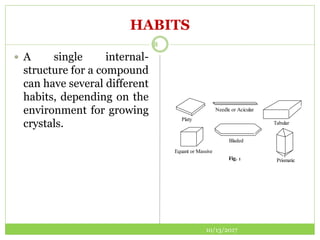
 A single internal-
structure for a compound
can have several different
habits, depending on the
environment for growing
crystals.
Platy
Needle or Acicular
Tabular
Equant or Massive
Bladed
PrismaticFig. 1
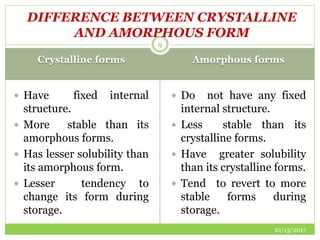
Crystalline forms Amorphous forms
10/13/2017
 Have fixed internal
structure.
 More stable than its
amorphous forms.
 Has lesser solubility than
its amorphous form.
 Lesser tendency to
change its form during
storage.
 Do not have any fixed
internal structure.
 Less stable than its
crystalline forms.
 Have greater solubility
than its crystalline forms.
 Tend to revert to more
stable forms during
storage.
9
DIFFERENCE BETWEEN CRYSTALLINE
AND AMORPHOUS FORM
POLYMORPHS
10/13/2017
10
 It is the ability of the compound to crystallize as more than one
distinct crystalline species with different internal lattice.
 Different crystalline forms are called polymorphs.
 Polymorphs are of 2 types
1. Enatiotropic
2. Monotropic
TYPES OF POLYMORPHS
10/13/2017
11
 The polymorph which can be changed from one form into
another by varying temp. or pressure is called as Enantiotropic
polymorph.
Eg. Sulfur.
 One polymorph which is unstable at all temp. & pressure is called
as Monotropic polymorph.
Eg. Glyceryl stearate.
10/13/2017
12
 Polymorph differ from each other with respect to their physical
property such as
Solubility
Melting point
Density
Hardness
Compression characteristic
Molecular adducts
10/13/2017
13
 During the process of crystallization, some
compounds have a tendency to trap the solvent
molecules.
Non-Stoichiometric inclusion compounds (or
adducts):- In these crystals solvent molecules are
entrapped within the crystal lattice and the number
of solvent molecules are not included in
stoichiometric number.
10/13/2017
14
 Depending on the shape they are of three types :-
1. Channel:- When the crystal contains continuous
channels in which the solvent molecule can be
included. e.g . Urea forms channel.
2. Layers:- Here solvent molecules are entrapped in
between layers of crystals.
3. Clathrates (Cage):- Solvent molecules are
entrapped within the cavity of the crystal from all
sides.
Stoichiometric inclusion compounds (or
stoichiometric adducts)
10/13/2017
15
 Molecular complex has incorporated the crystallizing
solvent molecules into specific sites within the
crystal lattice and has stoichiometric number of
solvent molecules complexed.
 Incorporated solvent is water - Hydrates
 Solvent is other than water - Solvates .
Anhydrous : 1 mole compound + 0 mole water
Hemihydrate: 1 mole compound + ½ mole water
Monohydrate: 1 mole compound + 1 mole water
Dihydrate : 1 mole compound + 2 moles water
ANALYTICAL METHODS FOR CHARACTERIZATION
OF SOLID FORMS
10/13/2017
16
 Microscopy
 Hot stage microscopy
 Thermal analysis
 X-ray diffraction
Microscopy
10/13/2017
17
 Isotropic material have single refractive index and this substance
do not transmit light with crossed polarizing filter and appears
black.
 Material with more than one refractive index are anisotropic &
appear bright with brilliant colors against black polarized
background.
 The color intensity depends upon crystal thickness.
10/13/2017
18
 Advantage :
By this method, we can study crystal morphology & difference
between polymorphic form.
 Disadvantage :
This require a well trained optical crystallographer, as there are
many possible crystal habit & their appearance at different
orientation.
Hot stage microscopy
10/13/2017
19
 The polarizing microscope fitted with hot stage is useful for
investigating polymorphism, melting point & transition temp.
 Disadvantage :
 In this technique, the molecules can degrade during the
melting process.
 Recrystalization of substance after melting.
Hot stage microscopy
10/13/2017
20
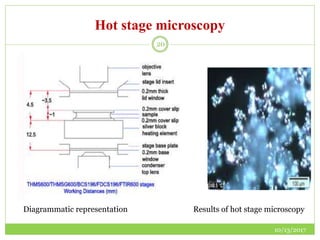
Diagrammatic representation Results of hot stage microscopy
THERMALANALYSIS
10/13/2017
21
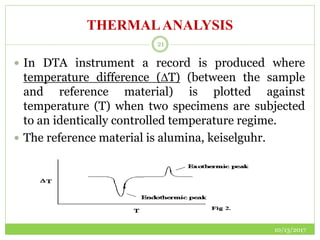
 In DTA instrument a record is produced where
temperature difference (T) (between the sample
and reference material) is plotted against
temperature (T) when two specimens are subjected
to an identically controlled temperature regime.
 The reference material is alumina, keiselguhr.
DIFFERENTIAL SCANNING CALORIMETRY
10/13/2017
22
 In DSC method the difference in energy inputs (H)
into a sample and reference material is measured as
a function of temperature as the specimens are
subjected to a identically controlled temperature
programme.
Samples that may be studied by DSC or
DTA
10/13/2017
23
 Powders
 Fibers
 Single crystals
 Polymer films
 Semi-solids
 Liquids
Applications of DTA / DSC in
Preformulation studies
10/13/2017
24
 To determine the purity of a sample
 To determine the number of polymorphs and to
determine the ratio of each polymorph.
 To determine the heat of solvation
 To determine the thermal degradation of a drug or
excipients.
 To determine the glass-transition temperature (tg) of
a polymer.
X-RAY DIFFRACTION
10/13/2017
25
 Working :
When beam of non-homogenous X-ray is allow to pass through the
crystal, X-ray beam is diffracted & it is recorded by means of
photographic plate.
 Diffraction is due to crystal which acts as 3 dimensional diffraction
grating toward X-ray.
 Random orientation of crystal lattice in the powder causes the X-ray to
scatter in a reproducible pattern of peak intensities.
 The diffraction pattern is characteristic of a specific crystalline lattice
for a given compound.
HYGROSCOPICITY
10/13/2017
26
 Many pharmaceutical materials have a tendency to
adsorb atmospheric moisture (especially water-
soluble salt forms). They are called hygroscopic
materials and this phenomenon is known as
hygroscopicity.
 Deliquescent materials: They absorb sufficient
amount of moisture and dissolve completely in it.
(e.g. anhydrous calcium chloride).
HYGROSCOPICITY
10/13/2017
27
 Equilibrium moisture content depends upon:
 the atmospheric humidity
 temperature
 surface area
 exposure time
 mechanism of moisture uptake.
TESTS OF HYGROSCOPICITY
10/13/2017
28
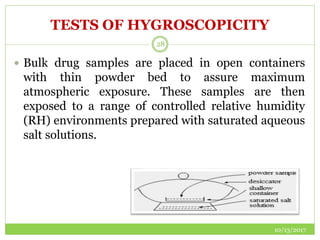
 Bulk drug samples are placed in open containers
with thin powder bed to assure maximum
atmospheric exposure. These samples are then
exposed to a range of controlled relative humidity
(RH) environments prepared with saturated aqueous
salt solutions.
10/13/2017
29
 The amount of moisture adsorbed can be determined
by the following methods:
 Gravimetry
 Thermogravimetric analysis (TGA)
 Karl-Fischer titration (KF-titration)
 Gas chromatography (GC)
10/13/2017
30
 Time of monitoring depends on the purpose:
o For the purpose of ‘handling’ data points from 0 to 24 hours
are taken
o For the purpose of ‘storage’ data points from 0 to 12 weeks are
taken.
 Moisture level in a powder sample may affect the flowability
and compactibility which, are important factors during
tableting and capsule filling.
 After adsorption of moisture, if hydrates are formed then
solubility of that powder may change affecting the dissolution
characteristics of the material.
 Moisture may degrade some materials. So humidity of a
material must be controlled.
FINE PARTICLE CHARACTERIZATION
10/13/2017
31
 Parameters those are measured:
o Particle size and size-distribution
o Shape of the particle
o Surface morphology of the particles
PARTICLE SIZE
10/13/2017
32
 Particle size is characterized using these terms :
 Very coarse (#8)
 Coarse (#20)
 Moderately coarse (#40)
 Fine (#60)
 Very fine (#80)
10/13/2017
33
 Particle size can influence variety of important
factors :
- Dissolution rate
- Suspendability
- Uniform distribution
- Penetrability
METHODS TO DETERMINE PARTICLE SIZE
10/13/2017
34
 Sieving
 Microscopy
 Sedimentation rate method
 Light energy diffraction
 Laser holography
 Cascade impaction
METHODS TO DETERMINE PARTICLE SIZE
10/13/2017
35
 Sieving method : Range : 50 – 150 µm
 Simple, inexpensive
 If powder is not dry, the apertures get clogged.
 Microscopy : Range : 0.2 – 100 µm
 Particle size can be determined by the use of calibrated grid
background.
 Most direct method.
 Slow & tedious method.
10/13/2017
36
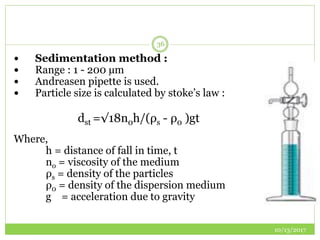
 Sedimentation method :
 Range : 1 - 200 µm
 Andreasen pipette is used.
 Particle size is calculated by stoke’s law :
dst =√18n0h/(ρs - ρ0 )gt
Where,
h = distance of fall in time, t
no = viscosity of the medium
ρs = density of the particles
ρ0 = density of the dispersion medium
g = acceleration due to gravity
10/13/2017
37
 Light energy diffraction : Range : 0.5 – 500 µm
 Particle size is determined by the reduction in light
reaching the sensor as the particle, dispersed in a liquid
or gas, passes through the sensing zone.
 Quick & fast.
 Laser holography : Range : 1.4 – 100 µm
 A pulsed laser is fired through an aerosolized particle
spray & photographed in three dimensional with
holographic camera, allowing the particles to be
individually imaged & sized.
10/13/2017
38
 Cascade impaction :
 The principle that a particle driven by an airstream will
hit a surface in its path, provide that its inertia is
sufficient to overcome the drug force that tends to keep
in it in airstream.
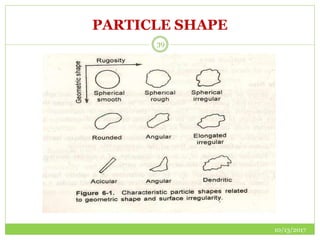
PARTICLE SHAPE
10/13/2017
39
MEASUREMENT OF FLOW PROPERTY
10/13/2017
40
 Apparent Bulk Density (g/cm3)
 Bulk drug powder is sieved through 40 mesh screen.
Weight is taken and poured into a graduated cylinder via
a large funnel. The volume is called bulk volume.
 Significance
• Bulk density is required during the selection of capsule
size for a high dose drug.
• In case of low dose drug mixing with excipients is a
problem if the bulk densities of the drug and excipients
have large difference.
10/13/2017
41
 Source of variation of bulk density
• Method of crystallization, milling, formulation.
 Methods of correction
• By milling, slugging or formulation.
Tapped density (g/cm3)
10/13/2017
42
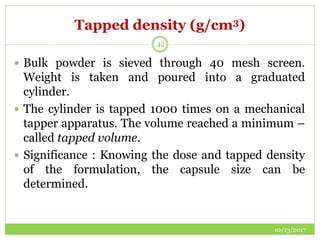
 Bulk powder is sieved through 40 mesh screen.
Weight is taken and poured into a graduated
cylinder.
 The cylinder is tapped 1000 times on a mechanical
tapper apparatus. The volume reached a minimum –
called tapped volume.
 Significance : Knowing the dose and tapped density
of the formulation, the capsule size can be
determined.
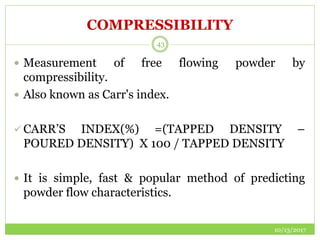
COMPRESSIBILITY
 Measurement of free flowing powder by
compressibility.
 Also known as Carr's index.
 CARR’S INDEX(%) =(TAPPED DENSITY –
POURED DENSITY) X 100 / TAPPED DENSITY
 It is simple, fast & popular method of predicting
powder flow characteristics.
10/13/2017
43
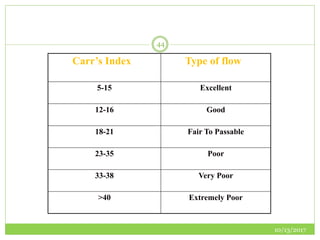
Carr’s Index Type of flow
5-15 Excellent
12-16 Good
18-21 Fair To Passable
23-35 Poor
33-38 Very Poor
>40 Extremely Poor
10/13/2017
44
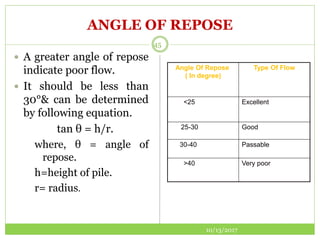
ANGLE OF REPOSE
 A greater angle of repose
indicate poor flow.
 It should be less than
30°& can be determined
by following equation.
tan θ = h/r.
where, θ = angle of
repose.
h=height of pile.
r= radius.
Angle Of Repose
( In degree)
Type Of Flow
<25 Excellent
25-30 Good
30-40 Passable
>40 Very poor
10/13/2017
45
SOLUBILITY ANALYSIS
10/13/2017
46
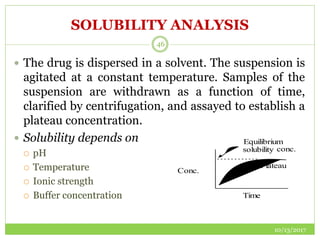
 The drug is dispersed in a solvent. The suspension is
agitated at a constant temperature. Samples of the
suspension are withdrawn as a function of time,
clarified by centrifugation, and assayed to establish a
plateau concentration.
 Solubility depends on
 pH
 Temperature
 Ionic strength
 Buffer concentration
Conc.
Time
Plateau
Equilibrium
solubility conc.
Fig. 1
SOLUBILITY ANALYSIS
10/13/2017
47
 Solvents taken
 0.9% NaCl at room temperature
 0.01 M HCl at RT
 0.1 M HCl at RT
 0.1 M NaOH at RT
 At pH 7.4 buffer at 370C
SOLUBILITY ANALYSIS
10/13/2017
48
 Drug concentration is determined by the following
analytical methods
 HPLC
 UV –Spectroscopy
 Fluorescence Spectroscopy
 Gas Chromatography
SIGNIFICANCE
10/13/2017
49
 A drug for oral administrative should be examined for
solubility in an isotonic saline solution and acidic pH.
This solubility data may provide the dissolution profile
invivo.
 Solubility in various mediums is useful in developing
suspension or solution toxicologic and pharmacologic
studies.
 Solubility studies identify those drugs with a potential for
bioavailability problems.
 E.g. Drug having limited solubility (7 %) in the fluids of
GIT often exhibit poor or erratic absorption unless
dosage forms are tailored for the drug.
IONIZATION CONSTANT (pKa)
10/13/2017
50
 When a weakly acidic or basic drug partially ionizes in GI
fluid, generally, the unionized molecules are absorbed
quickly.
 Can be calculated by Henderson Hasselbach equation-
For acidic drugs….pH= pKa+ log [ionized drug]
[unionized drug]
For basic drugs….pH= pKa+ log[unionized drug]
[ionized drug]
METHOD OF DETERMINATION OF pKa OF
A DRUG
10/13/2017
51
(1) Detection of spectral shifts by UV or visible
spectroscopy at various pH.
 Advantage: Dilute aqueous solutions can be analyzed by
this method.
(2) Potentiometric titration
 Advantage: Maximum sensitivity for compounds
with pKa in the range of 3 to 10.
 Disadvantage: This method is unsuccessful for
candidates where precipitation of the unionized forms
occurs during titration. To prevent precipitation a co-
solvent e.g. methanol or dimethylsulfoxide (DMSO) can
be incorporated.
(3) Variation of solubility at various pH.
EFFECT OF TEMPERATURE ON STABILITY
10/13/2017
52
 Heat of solution, HS represents the heat released or
absorbed when a mole of solute is dissolved in a
large quantity of solvent.
 Significance
 Most commonly, the solubility process is endothermic,
 e.g. non-electrolytes, unionized forms of weak acids and bases
 H is positive  Solubility increases if temperature
increases.
 Solutes that are ionized when dissolved releases heat  the
process is exothermic  HS is negative  Solubility
increases at lower temperature.
10/13/2017
53
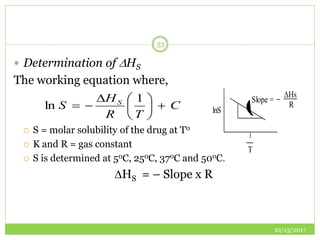
 Determination of HS
The working equation where,
 S = molar solubility of the drug at T0
 K and R = gas constant
 S is determined at 50C, 250C, 370C and 500C.
HS = – Slope x R
C
TR
H
S S







1
ln lnS
Slope =
1
T
Hs
R
SOLUBILIZATION
10/13/2017
54
 For drug candidates with poor water solubility, preformulation
studies should include limited experiments to identify the
possible mechanisms for solubilization.
 Means of increasing the solubility are:
(i) Addition of a cosolvent to the aqueous system e.g. ethanol,
propylene glycol and glycerin.
 MOA: These co-solvents disrupt the hydrophobic interactions
of water at the non-polar solute / water interfaces.
(ii) Solubilization in micellar solutions such as 0.01 M Tween 20
solution.
(iii) Solubilization by forming molecular complexes e.g. benzoic
acid forms complex with caffeine.

Pre-Formulation

  • 1.
    B Y SA R O J M A K W A N A PRE-FORMULATION STUDY
  • 2.
    DEFINITION  Preformulation testingis the first step in the rational development of dosage forms.  It can be defined as an investigation of physical and chemical property of a drug substance alone and when combined with excipients. 10/13/2017 2
  • 3.
    NEED….???  Preliminary evaluation Molecular optimisation  Suitability of Excipients  Suitability of dosage foam 10/13/2017 3
  • 4.
    Area of Preformulation Bulk characterisation Hygroscopicity Crystallinity and polymorphism Powderflow Fine particle Characterisation Solubility analysis Ionisation constant Pka pH solubility profile Common ion effect K sp Thermal effect Solubilization Partition coefficient Stability analysis Solubility in toxicology formulation Solution stability Solid state stability 10/13/2017
  • 5.
  • 6.
    CRYSTALLINITY AND POLYMORPHISM 10/13/2017 6 CHEMICAL COMPOUND INTERNAL STRUCTURE Crystalline Singleentity polymorphs Molecular adduct Non stoichiometric Inclusion complex Cannel Layer cage Stoichiometric solvents/hydrates Amorphous HABIT
  • 7.
    Crystalline state 10/13/2017 7  Crystalhabit & internal structure of drug can affect bulk & physicochemical property of molecule.  Crystal habit is description of outer appearance of crystal.  Internal structure is molecular arrangement within the solid.  Change with internal structure usually alters crystal habit. Eg. Conversion of sodium salt to its free acid form produce both change in internal structure & crystal habit.
  • 8.
    HABITS 10/13/2017 8  A singleinternal- structure for a compound can have several different habits, depending on the environment for growing crystals. Platy Needle or Acicular Tabular Equant or Massive Bladed PrismaticFig. 1
  • 9.
    Crystalline forms Amorphousforms 10/13/2017  Have fixed internal structure.  More stable than its amorphous forms.  Has lesser solubility than its amorphous form.  Lesser tendency to change its form during storage.  Do not have any fixed internal structure.  Less stable than its crystalline forms.  Have greater solubility than its crystalline forms.  Tend to revert to more stable forms during storage. 9 DIFFERENCE BETWEEN CRYSTALLINE AND AMORPHOUS FORM
  • 10.
    POLYMORPHS 10/13/2017 10  It isthe ability of the compound to crystallize as more than one distinct crystalline species with different internal lattice.  Different crystalline forms are called polymorphs.  Polymorphs are of 2 types 1. Enatiotropic 2. Monotropic
  • 11.
    TYPES OF POLYMORPHS 10/13/2017 11 The polymorph which can be changed from one form into another by varying temp. or pressure is called as Enantiotropic polymorph. Eg. Sulfur.  One polymorph which is unstable at all temp. & pressure is called as Monotropic polymorph. Eg. Glyceryl stearate.
  • 12.
    10/13/2017 12  Polymorph differfrom each other with respect to their physical property such as Solubility Melting point Density Hardness Compression characteristic
  • 13.
    Molecular adducts 10/13/2017 13  Duringthe process of crystallization, some compounds have a tendency to trap the solvent molecules. Non-Stoichiometric inclusion compounds (or adducts):- In these crystals solvent molecules are entrapped within the crystal lattice and the number of solvent molecules are not included in stoichiometric number.
  • 14.
    10/13/2017 14  Depending onthe shape they are of three types :- 1. Channel:- When the crystal contains continuous channels in which the solvent molecule can be included. e.g . Urea forms channel. 2. Layers:- Here solvent molecules are entrapped in between layers of crystals. 3. Clathrates (Cage):- Solvent molecules are entrapped within the cavity of the crystal from all sides.
  • 15.
    Stoichiometric inclusion compounds(or stoichiometric adducts) 10/13/2017 15  Molecular complex has incorporated the crystallizing solvent molecules into specific sites within the crystal lattice and has stoichiometric number of solvent molecules complexed.  Incorporated solvent is water - Hydrates  Solvent is other than water - Solvates . Anhydrous : 1 mole compound + 0 mole water Hemihydrate: 1 mole compound + ½ mole water Monohydrate: 1 mole compound + 1 mole water Dihydrate : 1 mole compound + 2 moles water
  • 16.
    ANALYTICAL METHODS FORCHARACTERIZATION OF SOLID FORMS 10/13/2017 16  Microscopy  Hot stage microscopy  Thermal analysis  X-ray diffraction
  • 17.
    Microscopy 10/13/2017 17  Isotropic materialhave single refractive index and this substance do not transmit light with crossed polarizing filter and appears black.  Material with more than one refractive index are anisotropic & appear bright with brilliant colors against black polarized background.  The color intensity depends upon crystal thickness.
  • 18.
    10/13/2017 18  Advantage : Bythis method, we can study crystal morphology & difference between polymorphic form.  Disadvantage : This require a well trained optical crystallographer, as there are many possible crystal habit & their appearance at different orientation.
  • 19.
    Hot stage microscopy 10/13/2017 19 The polarizing microscope fitted with hot stage is useful for investigating polymorphism, melting point & transition temp.  Disadvantage :  In this technique, the molecules can degrade during the melting process.  Recrystalization of substance after melting.
  • 20.
    Hot stage microscopy 10/13/2017 20 Diagrammaticrepresentation Results of hot stage microscopy
  • 21.
    THERMALANALYSIS 10/13/2017 21  In DTAinstrument a record is produced where temperature difference (T) (between the sample and reference material) is plotted against temperature (T) when two specimens are subjected to an identically controlled temperature regime.  The reference material is alumina, keiselguhr.
  • 22.
    DIFFERENTIAL SCANNING CALORIMETRY 10/13/2017 22 In DSC method the difference in energy inputs (H) into a sample and reference material is measured as a function of temperature as the specimens are subjected to a identically controlled temperature programme.
  • 23.
    Samples that maybe studied by DSC or DTA 10/13/2017 23  Powders  Fibers  Single crystals  Polymer films  Semi-solids  Liquids
  • 24.
    Applications of DTA/ DSC in Preformulation studies 10/13/2017 24  To determine the purity of a sample  To determine the number of polymorphs and to determine the ratio of each polymorph.  To determine the heat of solvation  To determine the thermal degradation of a drug or excipients.  To determine the glass-transition temperature (tg) of a polymer.
  • 25.
    X-RAY DIFFRACTION 10/13/2017 25  Working: When beam of non-homogenous X-ray is allow to pass through the crystal, X-ray beam is diffracted & it is recorded by means of photographic plate.  Diffraction is due to crystal which acts as 3 dimensional diffraction grating toward X-ray.  Random orientation of crystal lattice in the powder causes the X-ray to scatter in a reproducible pattern of peak intensities.  The diffraction pattern is characteristic of a specific crystalline lattice for a given compound.
  • 26.
    HYGROSCOPICITY 10/13/2017 26  Many pharmaceuticalmaterials have a tendency to adsorb atmospheric moisture (especially water- soluble salt forms). They are called hygroscopic materials and this phenomenon is known as hygroscopicity.  Deliquescent materials: They absorb sufficient amount of moisture and dissolve completely in it. (e.g. anhydrous calcium chloride).
  • 27.
    HYGROSCOPICITY 10/13/2017 27  Equilibrium moisturecontent depends upon:  the atmospheric humidity  temperature  surface area  exposure time  mechanism of moisture uptake.
  • 28.
    TESTS OF HYGROSCOPICITY 10/13/2017 28 Bulk drug samples are placed in open containers with thin powder bed to assure maximum atmospheric exposure. These samples are then exposed to a range of controlled relative humidity (RH) environments prepared with saturated aqueous salt solutions.
  • 29.
    10/13/2017 29  The amountof moisture adsorbed can be determined by the following methods:  Gravimetry  Thermogravimetric analysis (TGA)  Karl-Fischer titration (KF-titration)  Gas chromatography (GC)
  • 30.
    10/13/2017 30  Time ofmonitoring depends on the purpose: o For the purpose of ‘handling’ data points from 0 to 24 hours are taken o For the purpose of ‘storage’ data points from 0 to 12 weeks are taken.  Moisture level in a powder sample may affect the flowability and compactibility which, are important factors during tableting and capsule filling.  After adsorption of moisture, if hydrates are formed then solubility of that powder may change affecting the dissolution characteristics of the material.  Moisture may degrade some materials. So humidity of a material must be controlled.
  • 31.
    FINE PARTICLE CHARACTERIZATION 10/13/2017 31 Parameters those are measured: o Particle size and size-distribution o Shape of the particle o Surface morphology of the particles
  • 32.
    PARTICLE SIZE 10/13/2017 32  Particlesize is characterized using these terms :  Very coarse (#8)  Coarse (#20)  Moderately coarse (#40)  Fine (#60)  Very fine (#80)
  • 33.
    10/13/2017 33  Particle sizecan influence variety of important factors : - Dissolution rate - Suspendability - Uniform distribution - Penetrability
  • 34.
    METHODS TO DETERMINEPARTICLE SIZE 10/13/2017 34  Sieving  Microscopy  Sedimentation rate method  Light energy diffraction  Laser holography  Cascade impaction
  • 35.
    METHODS TO DETERMINEPARTICLE SIZE 10/13/2017 35  Sieving method : Range : 50 – 150 µm  Simple, inexpensive  If powder is not dry, the apertures get clogged.  Microscopy : Range : 0.2 – 100 µm  Particle size can be determined by the use of calibrated grid background.  Most direct method.  Slow & tedious method.
  • 36.
    10/13/2017 36  Sedimentation method:  Range : 1 - 200 µm  Andreasen pipette is used.  Particle size is calculated by stoke’s law : dst =√18n0h/(ρs - ρ0 )gt Where, h = distance of fall in time, t no = viscosity of the medium ρs = density of the particles ρ0 = density of the dispersion medium g = acceleration due to gravity
  • 37.
    10/13/2017 37  Light energydiffraction : Range : 0.5 – 500 µm  Particle size is determined by the reduction in light reaching the sensor as the particle, dispersed in a liquid or gas, passes through the sensing zone.  Quick & fast.  Laser holography : Range : 1.4 – 100 µm  A pulsed laser is fired through an aerosolized particle spray & photographed in three dimensional with holographic camera, allowing the particles to be individually imaged & sized.
  • 38.
    10/13/2017 38  Cascade impaction:  The principle that a particle driven by an airstream will hit a surface in its path, provide that its inertia is sufficient to overcome the drug force that tends to keep in it in airstream.
  • 39.
  • 40.
    MEASUREMENT OF FLOWPROPERTY 10/13/2017 40  Apparent Bulk Density (g/cm3)  Bulk drug powder is sieved through 40 mesh screen. Weight is taken and poured into a graduated cylinder via a large funnel. The volume is called bulk volume.  Significance • Bulk density is required during the selection of capsule size for a high dose drug. • In case of low dose drug mixing with excipients is a problem if the bulk densities of the drug and excipients have large difference.
  • 41.
    10/13/2017 41  Source ofvariation of bulk density • Method of crystallization, milling, formulation.  Methods of correction • By milling, slugging or formulation.
  • 42.
    Tapped density (g/cm3) 10/13/2017 42 Bulk powder is sieved through 40 mesh screen. Weight is taken and poured into a graduated cylinder.  The cylinder is tapped 1000 times on a mechanical tapper apparatus. The volume reached a minimum – called tapped volume.  Significance : Knowing the dose and tapped density of the formulation, the capsule size can be determined.
  • 43.
    COMPRESSIBILITY  Measurement offree flowing powder by compressibility.  Also known as Carr's index.  CARR’S INDEX(%) =(TAPPED DENSITY – POURED DENSITY) X 100 / TAPPED DENSITY  It is simple, fast & popular method of predicting powder flow characteristics. 10/13/2017 43
  • 44.
    Carr’s Index Typeof flow 5-15 Excellent 12-16 Good 18-21 Fair To Passable 23-35 Poor 33-38 Very Poor >40 Extremely Poor 10/13/2017 44
  • 45.
    ANGLE OF REPOSE A greater angle of repose indicate poor flow.  It should be less than 30°& can be determined by following equation. tan θ = h/r. where, θ = angle of repose. h=height of pile. r= radius. Angle Of Repose ( In degree) Type Of Flow <25 Excellent 25-30 Good 30-40 Passable >40 Very poor 10/13/2017 45
  • 46.
    SOLUBILITY ANALYSIS 10/13/2017 46  Thedrug is dispersed in a solvent. The suspension is agitated at a constant temperature. Samples of the suspension are withdrawn as a function of time, clarified by centrifugation, and assayed to establish a plateau concentration.  Solubility depends on  pH  Temperature  Ionic strength  Buffer concentration Conc. Time Plateau Equilibrium solubility conc. Fig. 1
  • 47.
    SOLUBILITY ANALYSIS 10/13/2017 47  Solventstaken  0.9% NaCl at room temperature  0.01 M HCl at RT  0.1 M HCl at RT  0.1 M NaOH at RT  At pH 7.4 buffer at 370C
  • 48.
    SOLUBILITY ANALYSIS 10/13/2017 48  Drugconcentration is determined by the following analytical methods  HPLC  UV –Spectroscopy  Fluorescence Spectroscopy  Gas Chromatography
  • 49.
    SIGNIFICANCE 10/13/2017 49  A drugfor oral administrative should be examined for solubility in an isotonic saline solution and acidic pH. This solubility data may provide the dissolution profile invivo.  Solubility in various mediums is useful in developing suspension or solution toxicologic and pharmacologic studies.  Solubility studies identify those drugs with a potential for bioavailability problems.  E.g. Drug having limited solubility (7 %) in the fluids of GIT often exhibit poor or erratic absorption unless dosage forms are tailored for the drug.
  • 50.
    IONIZATION CONSTANT (pKa) 10/13/2017 50 When a weakly acidic or basic drug partially ionizes in GI fluid, generally, the unionized molecules are absorbed quickly.  Can be calculated by Henderson Hasselbach equation- For acidic drugs….pH= pKa+ log [ionized drug] [unionized drug] For basic drugs….pH= pKa+ log[unionized drug] [ionized drug]
  • 51.
    METHOD OF DETERMINATIONOF pKa OF A DRUG 10/13/2017 51 (1) Detection of spectral shifts by UV or visible spectroscopy at various pH.  Advantage: Dilute aqueous solutions can be analyzed by this method. (2) Potentiometric titration  Advantage: Maximum sensitivity for compounds with pKa in the range of 3 to 10.  Disadvantage: This method is unsuccessful for candidates where precipitation of the unionized forms occurs during titration. To prevent precipitation a co- solvent e.g. methanol or dimethylsulfoxide (DMSO) can be incorporated. (3) Variation of solubility at various pH.
  • 52.
    EFFECT OF TEMPERATUREON STABILITY 10/13/2017 52  Heat of solution, HS represents the heat released or absorbed when a mole of solute is dissolved in a large quantity of solvent.  Significance  Most commonly, the solubility process is endothermic,  e.g. non-electrolytes, unionized forms of weak acids and bases  H is positive  Solubility increases if temperature increases.  Solutes that are ionized when dissolved releases heat  the process is exothermic  HS is negative  Solubility increases at lower temperature.
  • 53.
    10/13/2017 53  Determination ofHS The working equation where,  S = molar solubility of the drug at T0  K and R = gas constant  S is determined at 50C, 250C, 370C and 500C. HS = – Slope x R C TR H S S        1 ln lnS Slope = 1 T Hs R
  • 54.
    SOLUBILIZATION 10/13/2017 54  For drugcandidates with poor water solubility, preformulation studies should include limited experiments to identify the possible mechanisms for solubilization.  Means of increasing the solubility are: (i) Addition of a cosolvent to the aqueous system e.g. ethanol, propylene glycol and glycerin.  MOA: These co-solvents disrupt the hydrophobic interactions of water at the non-polar solute / water interfaces. (ii) Solubilization in micellar solutions such as 0.01 M Tween 20 solution. (iii) Solubilization by forming molecular complexes e.g. benzoic acid forms complex with caffeine.